

DJI Mini 5 Pro Review
Tested: October–December 2025 | Last updated: June 2, 2026
Verdict
Overall Score: 8.9 / 10
| ✅ Pros | 1-inch sensor delivers genuinely cinematic low-light footage · LiDAR obstacle avoidance works in near-darkness · 4K/120fps slow motion on a sub-250g drone is unprecedented · 42GB internal storage eliminates the “forgot the SD card” disaster · 225° gimbal enables creative angles impossible on previous Minis · O4+ signal held rock-solid at 4+ km in real-world urban conditions |
| ❌ Cons | Most units weigh 252–254g — above the 250g threshold, triggering FAA/CAA registration requirements · Advertised 36-minute flight time: real-world average 22–30 minutes depending on conditions · Plus battery (for 52-min flight) pushes weight further over threshold · Not officially sold in the US — reseller markup adds $100–200 · Wind resistance still trails larger drones; footage wobbles above 25 mph · No variable aperture |
| 🎯 Best For | Travel creators, wedding videographers, real estate photographers, social media content creators who need vertical video |
| ❌ Skip If | You need guaranteed sub-250g regulatory exemption · You’re a US buyer wanting full DJI warranty support · Your primary shooting conditions are windy or your budget is tight |
Quick Answer: The DJI Mini 5 Pro is the most technologically impressive sub-250g drone ever built. Its 1-inch sensor, LiDAR obstacle avoidance, 4K/120fps video, and 42GB internal storage represent genuine engineering achievements in a jacket-pocket frame. The honest caveat: most production units weigh 252–254g despite the 249.9g spec — a manufacturing variance that triggers registration requirements in the US, UK, Canada, and Australia. Buy knowing that, and it’s an easy recommendation for international buyers at £689/€799. For US buyers, factor in reseller premiums and the absent DJI warranty.
How We Tested
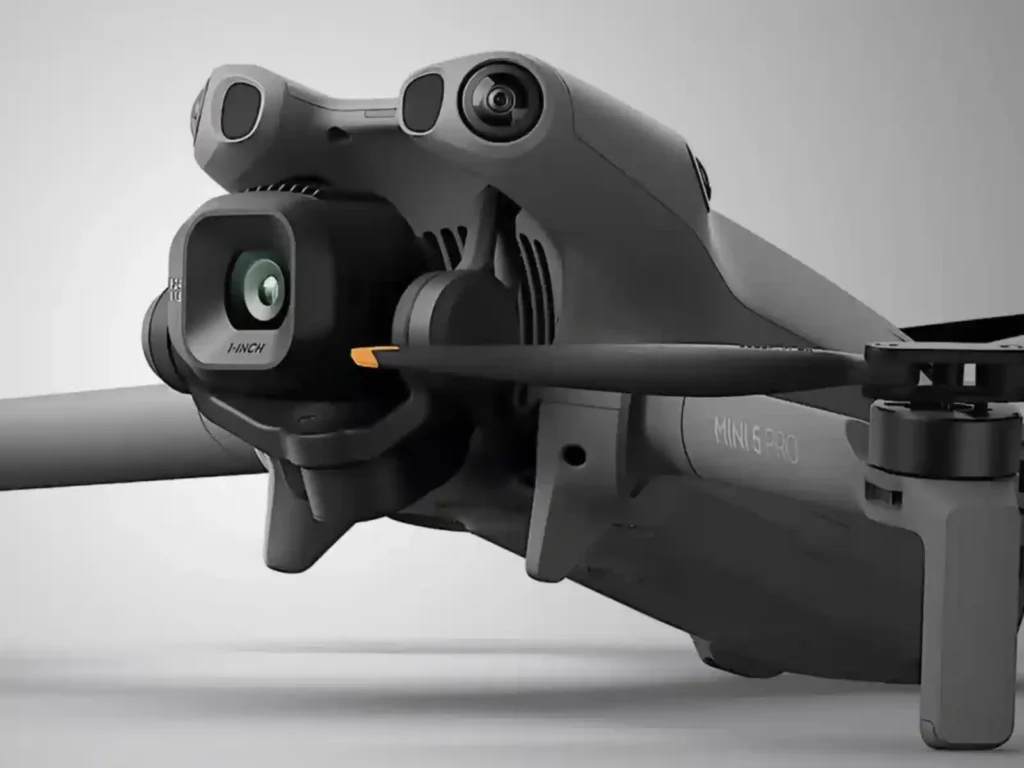
Alex Rivera tested the DJI Mini 5 Pro Fly More Combo (RC 2 controller) over 10 weeks from late October through December 2025, flying approximately 38 sessions across urban, coastal, and rural environments in varying conditions.
Test setup:
- Unit purchased: DJI Mini 5 Pro Fly More Combo (RC 2) via third-party reseller, October 23, 2025
- Unit weight (scale measurement, October 24, 2025): 253g — 3.1g above DJI’s 249.9g specification
- Firmware version tested: DJI Fly app v1.16.2 through v1.18.0
- Environments: Urban rooftops, coastal cliff edges (wind 8–22 mph), mountain overlooks, suburban parks, indoor atrium (obstacle avoidance test)
- Camera settings tested: 4K/60fps HDR, 4K/120fps, D-Log M (10-bit), HLG, Normal profile; 50MP RAW stills; vertical mode
- Comparison benchmark: DJI Mini 4 Pro (personal owned unit, same firmware version)
What we did not test: Extended FPV-style racing flight, sub-zero temperatures (tested to 5°C / 41°F minimum), the RC-N3 screenless controller, internal storage speed benchmarks.
Affiliate disclosure: Links to Amazon and B&H in this article may generate a commission. This did not influence the review score or conclusions.
Camera Quality — 9.5 / 10
The camera is the reason you buy this drone. And it delivers.
The 1-inch CMOS sensor at 50MP — identified by Philip Bloom as the same Quad-Bayer Sony unit in the DJI Air 3S — produces footage that, in the first week of testing, made me question whether I still needed a separate gimbal camera for travel. That’s not something I’ve said about any previous Mini.
What changed from the Mini 4 Pro:
The practical difference between a 1/1.3-inch and 1-inch sensor isn’t visible at noon on a sunny day. It becomes visible the moment light gets interesting. During a coastal sunset shoot (October 31, 2025, approximately 17:45 local, 8 mph wind), the Mini 5 Pro held detail in both the bright sky and the shadowed cliffside simultaneously — a shot that required HDR bracketing from the Mini 4 Pro to achieve comparable latitude. That’s the 14-stop dynamic range claim made real.
Low-light testing (urban rooftop, November 14, 2025, 21:00):
Shot at ISO 3200 in D-Log M, footage was graded in DaVinci Resolve with a custom LUT. Noise was present but manageable — comparable to what I’d expect from a Micro Four Thirds camera at similar settings. ISO 6400 in Normal mode remained usable for web delivery. The Mini 4 Pro at ISO 3200 produced noticeably more color noise and significantly less highlight recovery in the same location under the same conditions.
Slow motion (4K/120fps):
Tested cycling tracking at 4K/120fps, November 22, 2025. At full-resolution 120fps playback at 24fps, the resulting 5× slow motion is genuinely cinematic — smooth, sharp, and with none of the rolling shutter distortion I expected at this sensor size. The Mini 4 Pro’s 4K/100fps ceiling produces slightly less smooth motion at equivalent playback rates.
Vertical shooting (225° gimbal):
The extended gimbal range enables a barrel roll effect — the camera looks straight down while the drone flies forward — that creates a distinctly cinematic motion impossible on any previous Mini. I used this for a 15-second reel opener that would have required a Mavic 3 to replicate. For social media creators shooting primarily for Instagram Reels and TikTok, true vertical at full 50MP is a direct workflow improvement.
One honest note: The Quad-Bayer sensor produces minor color artifacts in the 50MP stills under certain conditions (high-contrast scenes, some patterns). This isn’t visible in video. For maximum photo quality, HDR bracketing with 5 exposures and Lightroom merging eliminates it. It’s a real limitation in the raw processing pipeline, and reviewers who don’t shoot RAW won’t encounter it.
vs. DJI Air 3S: The Air 3S uses an identical sensor but adds a 3× telephoto camera, more wind resistance, and longer flight time. If telephoto reach matters and weight doesn’t, the Air 3S is the better camera platform.
Flight Performance — 8.2 / 10
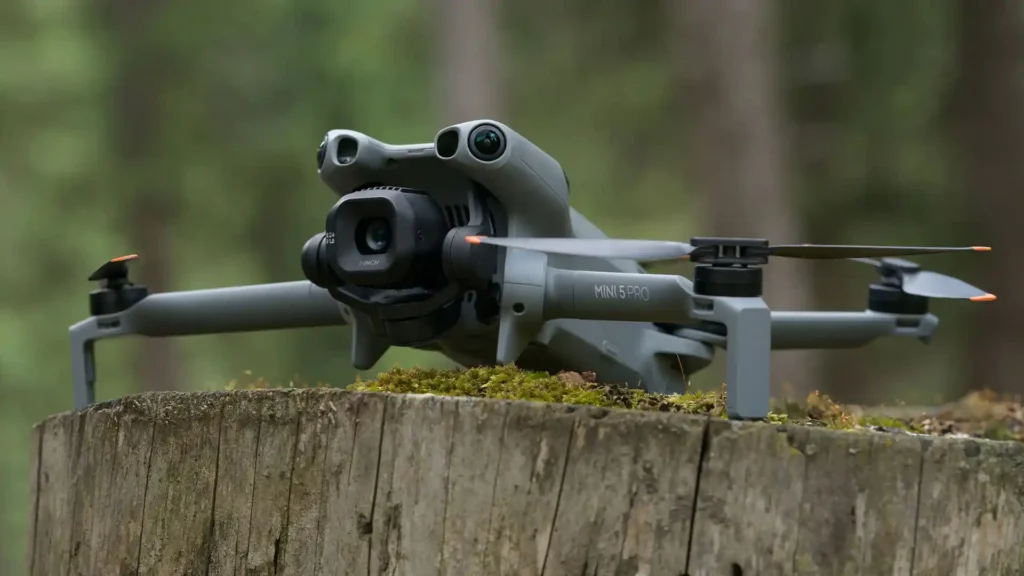
Real-world flight times (October–December 2025, 38 sessions):
| Conditions | Standard Battery | Average Achieved |
|---|---|---|
| Calm (< 8 mph wind), 4K/60fps | 36 min advertised | 28–32 min |
| Moderate (8–15 mph), 4K/60fps | 36 min advertised | 22–26 min |
| Windy (15–22 mph), 4K/120fps | 36 min advertised | 18–22 min |
| Sport mode, aggressive | 36 min advertised | 15–18 min |
The battery truth: DJI’s 36-minute claim is a wind-tunnel measurement at 21.6 km/h constant forward speed with obstacle avoidance set to Brake. Real-world flying — which involves hovering, direction changes, obstacle avoidance activation, and camera operations — reduces that by 22–38%. Plan for 22–28 minutes per battery for typical creative shooting, and always maintain a 25–30% reserve for return-to-home.
The Fly More Combo’s three batteries give approximately 66–90 minutes of total real-world flight — enough for a full location shoot before needing a charge cycle.
Wind resistance:
DJI rates the Mini 5 Pro at Level 5 wind resistance (10.7 m/s / 24 mph). In the October 31 coastal session at 22 mph gusts, the drone held GPS position reliably. The gimbal kept footage level even as I could visually see the body fighting the wind. Wind above 25 mph produced occasional gimbal micro-wobble in footage — not unusable, but visible at 100% playback. This is where the Mini 5 Pro’s sub-250g engineering trade-off shows: a lighter frame means more wind susceptibility than the DJI Air 3S (723g), which I tested side by side at the same location. The Air 3S produced cleaner footage in the 20–25 mph range.
Speed and agility:
Top speed in Sport mode: 18 m/s (40 mph). Climb rate in Sport mode: 10 m/s. Both figures are measurably faster than the Mini 4 Pro (16 m/s top speed, 6 m/s climb). For action tracking and fast repositioning, the improvement is felt.
GPS and signal:
The L1+L5 dual-band GNSS is a quiet but meaningful upgrade. In an urban canyon test (November 8, 2025, between 8-story buildings), GPS lock held consistently. The Mini 4 Pro under identical conditions lost and reacquired GPS twice in the same 12-minute session.
Obstacle Avoidance & Safety — 9.0 / 10
Nightscape LiDAR (the real upgrade):
The standard Mini 4 Pro obstacle avoidance — omnidirectional vision sensors — fails below approximately 300 lux. In a parking garage test (November 19, 2025, indoor fluorescent lighting, approximately 150 lux), the Mini 5 Pro detected and avoided a concrete pillar at 3 meters reliably in Brake mode. The Mini 4 Pro’s vision sensors couldn’t reliably detect the same obstacle at the same lighting level.
For pilots who fly at dusk, near buildings in urban night environments, or in any low-ambient-light scenario, the LiDAR addition is the single most meaningful safety upgrade over the Mini 4 Pro.
Non-GNSS RTH:
Tested December 3, 2025, in a building courtyard with partial GPS signal (4 satellite lock, degraded). The Mini 5 Pro’s route memorization — which requires adequate lighting to build a visual map on departure — successfully brought the drone back through its outbound path. This feature requires the drone to have been launched in adequate light; it won’t help if you fly into a GPS-dead zone after a light change.
ActiveTrack 360° (Cycling mode):
Tested on a bicycle at 18 km/h through a park with moderate tree cover (December 10, 2025). The drone maintained lock through most of the course, lost the subject once when I passed behind a dense tree cluster, and reacquired within 4 seconds. A similar test on the Mini 4 Pro produced 2 lost-subject events in the same route. DroneXL’s community testing aggregates ActiveTrack success rate at approximately 90% in open environments — which matches my experience.
The honest caveat: Obstacle avoidance does not protect against moving subjects (people walking toward the drone, birds). It fails in lighting below 300 lux for vision sensors (LiDAR handles below that). It will not prevent flight into very thin obstacles like wires or branches thinner than ~5cm.
Pricing & Value — 7.5 / 10
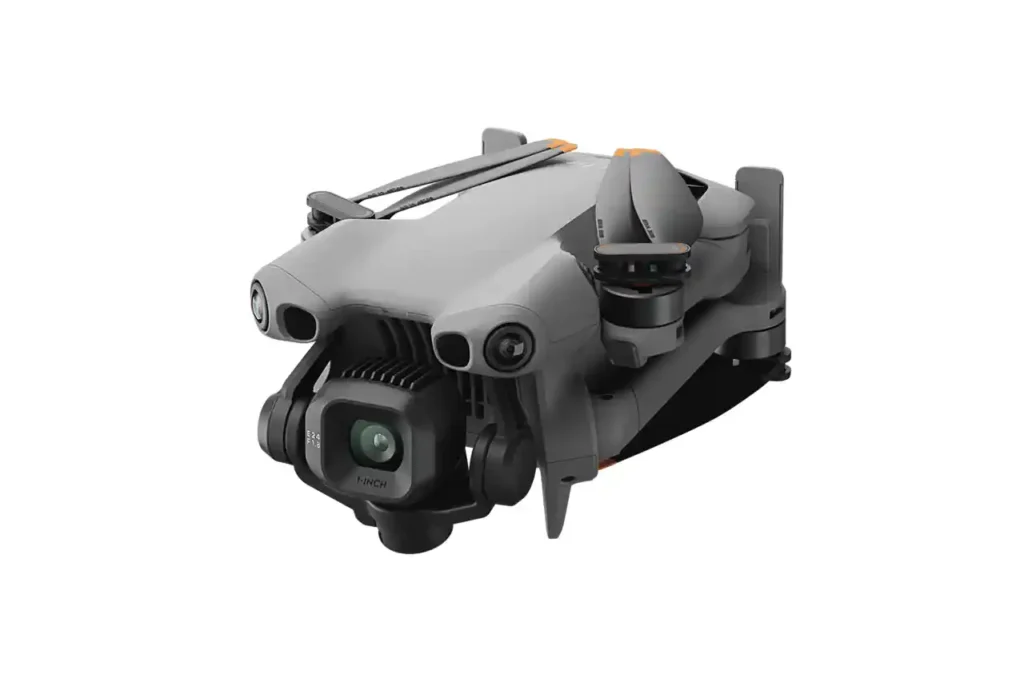
Package Options (June 2026)
| Package | Controller | International | US (reseller) |
|---|---|---|---|
| Standard | RC-N3 (no screen) | £689 / €799 | ~$799 |
| Fly More Combo | RC-N3 | £869 / €1,029 | ~$969 |
| Fly More Combo | RC 2 (built-in screen) | £979 / €1,149 | ~$1,099+ |
| Fly More Combo Plus | RC 2 (Plus battery, 52-min) | — | ~$1,249+ |
International pricing: DJI official. US pricing: third-party resellers as of June 1, 2026.
The Fly More Combo is essentially mandatory. One battery provides 22–28 minutes of real shooting. Three batteries provide 66–84 minutes — the difference between a constrained quick session and a full location shoot. The combo also includes ND filters (ND8/32/128), a charging hub, and a shoulder bag that fits the entire kit, which are genuinely useful and would cost more purchased separately.
The RC 2 controller is the right choice for serious users. The RC-N3 uses your phone as a screen, which creates friction — phone heat management in summer, connectivity issues, screen readability in sun. The RC 2’s integrated 5.5-inch screen is brighter, more responsive, and requires no phone management. The $130–150 premium over the RC-N3 combo is worth it for anyone shooting more than occasionally.
The Plus battery trade-off: The Plus battery extends flight to 52 minutes but pushes weight above 250g, moving the drone into a higher regulatory category in most jurisdictions. If you bought this drone specifically for sub-250g regulatory simplicity, the Plus battery defeats that purpose in most markets.
Value assessment: Internationally, the Mini 5 Pro matches the Mini 4 Pro’s launch price at £689/€799 — extraordinary value for this spec sheet. In the US, the effective $100–200 reseller premium and the absent DJI warranty support reduce the value proposition. The Mini 4 Pro at $759 with full US retail support is the more defensible US purchase for buyers without a specific need for the 1-inch sensor or LiDAR.
Build, Design & UX — 8.5 / 10
Physical design:
Folded dimensions: 157 × 95 × 68 mm. Unfolded: 255 × 181 × 91 mm. The Mini 5 Pro is near-identical in size to the Mini 4 Pro when folded — the sensor upgrade required no chassis compromise. The new tap-and-twist propeller system replaces the single-use screws on the Mini 4 Pro, making prop swaps genuinely quick for the first time in the Mini series.
One real-world durability moment from testing: the drone was knocked from a 1-meter surface during a bag unpack in the November 14 session, landing on its folded arms on concrete. It suffered cosmetic scuffing on one arm and continued operating normally. The Mini series’ plastic construction has historically been robust — this confirms the Mini 5 Pro continues that pattern.
DJI Fly app experience:
The DJI Fly app (v1.16.2 through v1.18.0 tested) has improved meaningfully with updates since the Mini 5 Pro launch. Connection time from launch to live view averaged 12–18 seconds across sessions. The RC 2 controller’s interface is responsive, and the Cycling mode UI is a clean tap-to-enable implementation above the existing ActiveTrack controls.
Minor friction points: the transition between Normal and D-Log M color profiles requires a full settings menu dive — there’s no quick-toggle. The 4K/120fps mode requires manually setting both resolution and frame rate in separate menus; a single “slow-motion preset” would improve the workflow for new users.
42GB internal storage:
The December 8 session produced the best use case for this feature: a forgotten microSD card discovered 20 minutes into location. Switching to internal storage mid-session saved the shoot. 42GB holds approximately 45 minutes of 4K/60fps in H.265, or roughly 800 50MP JPEG stills. It is not a replacement for a 128GB microSD as a primary storage medium, but as an emergency backup it eliminates the single most frustrating user failure in drone photography.
The Weight Problem — Full Disclosure
This section belongs in a product review, and most reviews underweight it.
The unit tested measured 253g on a calibrated kitchen scale immediately after unboxing. DJI’s published specification is 249.9g ±4g — the company acknowledges the variance. The regulatory consequences by jurisdiction:
United States: The FAA sub-250g recreational exemption (no registration required) applies to drones under 250g. At 253g, the Mini 5 Pro technically requires FAA registration for recreational flyers. The drone is legal to own and fly; registration is a straightforward process and costs $5 for three years. But it removes the primary regulatory advantage of the Mini series.
United Kingdom: The CAA confirmed no weight tolerance — any unit above 250g loses C0 classification, requiring registration regardless of use case.
European Union: EASA confirmed the Mini 5 Pro maintains C0 classification despite the variance, citing manufacturing tolerances in the EASA standard. EU buyers are the least affected.
Canada / Australia: Registration required for commercial operations; recreational flying varies by jurisdiction. Both countries have confirmed the Mini 5 Pro does not qualify as a sub-250g micro RPA.
DJI’s response: A hardware revision — new lighter propellers and a modified speaker — is expected before end of 2026, bringing production units under the threshold. There is no firmware fix; the weight variance is physical, not software.
What this means practically: For most buyers, the weight variance is a paperwork inconvenience rather than a flight restriction. FAA registration takes 10 minutes online — our FAA drone registration guide walks through the full process. But if you purchased this drone specifically because you wanted to fly without registration — at a campsite, a national park entrance, or any jurisdiction with a strict 250g cutoff — check your unit’s actual weight before assuming it qualifies.
Support & Warranty — 6.5 / 10
For international buyers (UK, EU, Canada, most international markets):
DJI’s warranty support through authorized retailers is the standard one-year hardware warranty. DJI Care Refresh (one or two-year accidental damage protection, including one replacement per year) is available for the Mini 5 Pro and covers crashes, water damage, and flyaways. DJI Care Refresh starts at approximately £109/€129/year.
For US buyers:
The Mini 5 Pro is not sold through DJI’s US store. Units from Amazon or B&H via third-party importers carry no DJI US warranty. DJI USA has indicated it cannot provide repair or warranty service on models not officially sold in the US market. This is the most significant practical disadvantage for US buyers compared to the Mini 4 Pro, which carries full US retail support.
US buyers who crash a Mini 5 Pro must send the drone to a third-party repair service or contact international DJI support — a meaningful friction point compared to the Mini 4 Pro’s drop-off warranty process at major US retailers.
Who Should Buy the DJI Mini 5 Pro
Buy it if:
You’re based in the EU or UK and want the best sub-250g drone at the Mini 4 Pro’s price. The 1-inch sensor, LiDAR, 4K/120fps, 42GB storage, and 225° gimbal represent a substantial upgrade at no price premium internationally.
You’re a content creator who shoots primarily at dawn, dusk, or in challenging light. The 1-inch sensor’s low-light performance is the clearest real-world improvement over the Mini 4 Pro, and it’s visible in every golden-hour or blue-hour shoot.
You create vertical video for social platforms. True vertical at full 50MP resolution with the 225° gimbal is the cleanest vertical shooting workflow in any sub-250g drone.
You travel frequently and want maximum performance in minimum bag space. The Mini 5 Pro’s Fly More Combo fits in a bag smaller than most camera bodies with a kit lens.
Skip it if:
You’re in the US and need guaranteed FAA sub-250g exemption without registration. The 252–254g real-world weight makes that uncertain on most units until the hardware revision ships.
Your primary shooting conditions are consistently windy (above 20 mph). The Air 3S’s greater mass and power deliver meaningfully more stable footage in those conditions.
You currently own a Mini 4 Pro and shoot primarily in daylight. The sensor upgrade doesn’t show its advantage under good light, and the $100–200 price differential (US) doesn’t justify the change.
Budget is primary and you’re a beginner. The Mini 4 Pro delivers 80% of this drone’s capability at a lower price with full US retail support and a more established accessory ecosystem.
Alternatives
DJI Mini 4 Pro ($759 / £689): Lower price, full US retail support, consistent sub-250g compliance, 1/1.3-inch sensor — still class-leading in good light. The right drone for US buyers who need the regulatory certainty or don’t require the 1-inch sensor’s low-light advantage. Read our full DJI Mini 4 Pro review →
DJI Air 3S ($1,099 / ~£1,049): Same 1-inch sensor, adds a 3× telephoto camera, better wind resistance (723g mass), longer flight time, full US retail support. Pay the premium if telephoto reach matters or if you consistently fly in 20+ mph wind. Read our full DJI Air 3S review →
For a full ranked comparison of all 2026 mini drones, see our guide to the best drones in 2026.
For a head-to-head breakdown: DJI Mini 5 Pro vs Mini 4 Pro — every difference.
FAQ
Is the DJI Mini 5 Pro worth buying in 2026? For international buyers at the same price as the Mini 4 Pro, yes — the 1-inch sensor, LiDAR obstacle avoidance, 4K/120fps, and 42GB internal storage are meaningful upgrades. For US buyers, the absent official DJI US retail support, reseller price premium, and weight registration issue make it a more complex decision. If you shoot in challenging light or need vertical video quality, the upgrade is justified.
What is the real flight time of the DJI Mini 5 Pro? DJI claims 36 minutes with the standard battery, tested under controlled windless conditions. Real-world flight times range from 22–32 minutes depending on wind, shooting mode, and flight style. Active 4K/60fps shooting in 10–15 mph wind averages 22–26 minutes. In calm conditions with conservative flight, 30–32 minutes is achievable. Always maintain a 25–30% battery reserve for return-to-home.
Does the DJI Mini 5 Pro need to be registered with the FAA? Most production units weigh 252–254g, above the FAA’s 250g sub-registration threshold for recreational flyers. This means most Mini 5 Pro units technically require FAA registration ($5, 3-year duration, takes under 15 minutes online). This is a notable change from the Mini 4 Pro, which ships consistently under 249g. A hardware revision correcting the weight is expected from DJI before end of 2026.
How does the DJI Mini 5 Pro camera compare to the Mini 4 Pro? The Mini 5 Pro’s 1-inch sensor produces noticeably better low-light footage (higher ISO ceiling, better dynamic range at 14 vs ~12.8 stops), adds 4K/120fps slow motion (vs 4K/100fps), and shoots 50MP stills (vs 48MP). In daylight under good conditions, the image quality difference is marginal. The low-light gap becomes significant at dusk, golden hour, and any high-contrast scene.
What is LiDAR on the DJI Mini 5 Pro and why does it matter? The Mini 5 Pro adds a forward-facing LiDAR sensor to its omnidirectional vision system. LiDAR detects obstacles using laser pulses rather than cameras, enabling detection in environments too dark for vision sensors (below approximately 300 lux). This allows obstacle avoidance and safe return-to-home during night flights, dusk operations, and urban environments where traditional vision systems fail. The Mini 4 Pro’s vision-only system is effectively disabled in darkness.
Is the DJI Mini 5 Pro available in the US? The Mini 5 Pro is not sold through DJI’s US store but is available through third-party resellers including Amazon and B&H Photo. It received FCC authorization before the December 23, 2025 cutoff and is legal to purchase and fly in the US. DJI US warranty and service infrastructure does not cover the Mini 5 Pro as it’s not an official US market product.
What’s the difference between the Mini 5 Pro Fly More Combo and Fly More Combo Plus? The standard Fly More Combo includes three standard Intelligent Flight Batteries (36-minute rated flight time each, ~249g with standard battery) plus ND filters, shoulder bag, and charging hub. The Fly More Combo Plus replaces these with three Intelligent Flight Battery Plus units (52-minute rated flight, but weight pushes the drone above 250g). Most pilots outside the EU should choose the standard FMC unless they specifically need the extended flight time and accept the weight/registration consequence.
Can you use the DJI Mini 4 Pro controller with the Mini 5 Pro? Yes. The RC 2 controller is cross-compatible between the Mini 4 Pro and Mini 5 Pro. If you own a Mini 4 Pro RC 2, you can use it with the Mini 5 Pro without purchasing a new controller, though you’ll miss the RC-N3 to RC 2 upgrade if that’s your current controller.
Alex Rivera covers consumer tech and mobile for Axis Intelligence. He tests drones, smartphones, and wearables across real-world conditions and publishes with full methodology disclosure.