

Tim Cook Steps Down as Apple CEO
Last updated: April 2026
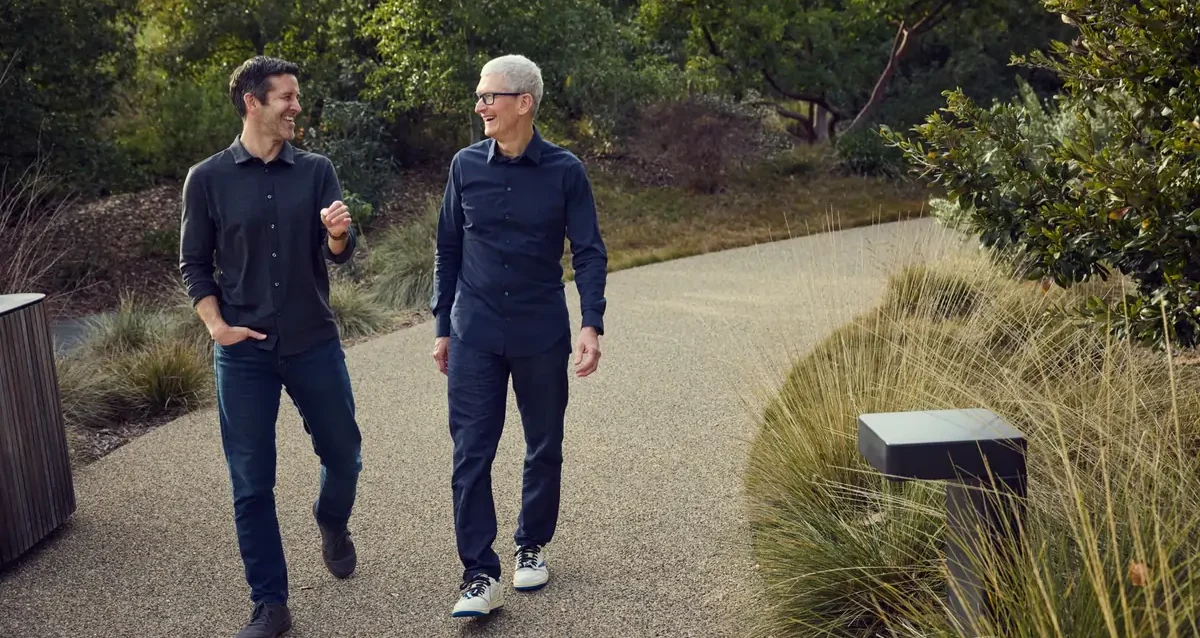
Tim Cook is stepping down as CEO of Apple. John Ternus, Apple’s senior vice president of hardware engineering, will become the company’s next chief executive officer on September 1, 2026. Cook will remain as CEO through the summer to ensure a smooth transition, then move into a new role as executive chairman of Apple’s board of directors.
The announcement came Monday afternoon in a press release published directly on Apple’s newsroom. The board’s approval was unanimous. It is the first CEO transition at Apple since Cook succeeded Steve Jobs in August 2011 — nearly 15 years ago.
Table of Contents
What’s Changing and What Isn’t
Cook, 65, is not leaving Apple. He becomes executive chairman of the board, a role in which he will “assist with certain aspects of the company, including engaging with policymakers around the world,” according to the press release. Arthur Levinson, who has served as Apple’s non-executive chairman for the past 15 years, steps down to become lead independent director on September 1.
Ternus, 51, joins Apple’s board of directors on the same date he becomes CEO. He’s been with the company for 25 years, joining in 2001 as a junior member of the product design team, and has overseen hardware engineering as SVP since 2021 — covering iPhone, iPad, Mac, Apple Watch, AirPods, and Apple Vision Pro.
The transition structure closely mirrors what Amazon and Netflix did when Jeff Bezos and Reed Hastings ended their CEO tenures: the outgoing leader stays involved in a chairman role while the company installs a long-tenured internal successor with deep institutional knowledge.
Cook’s 15-Year Tenure: The Numbers
When Tim Cook took the helm in August 2011, Apple’s market capitalization was roughly $350 billion. As of today, it closed at $4 trillion — a gain of more than $3.6 trillion under his leadership. That makes Cook’s tenure one of the most value-creating in corporate history by any measure.
The defining moves under Cook weren’t the products Jobs invented. They were the ecosystem Jobs didn’t live to build: the App Store’s evolution into a platform business, the services division that now stands as Apple’s second-largest revenue segment, the Apple Watch category that didn’t exist before 2015, AirPods, Apple TV+, Apple Silicon’s transition away from Intel, and the geographic expansion into markets like India that required Cook’s particular skillset as a supply chain and diplomatic operator.
Cook guided Apple through the COVID-19 pandemic, through Donald Trump’s tariff policies and trade war with China, and through the AI transition — a period in which Apple, despite its resources, visibly struggled to keep pace with competitors.
That last point — AI — is the shadow over an otherwise extraordinary record. Apple promised a next-generation Siri at WWDC 2024. Two years later, it still hasn’t shipped. The company turned to Google’s Gemini team for help building the AI features it couldn’t deliver on its own. It’s a notable asterisk on the Cook legacy, and it arrives precisely as he hands off the company.
Cook was also the first Fortune 500 CEO to publicly come out as gay, doing so in a personal essay in 2014 — a moment widely recognized as culturally significant beyond the business world.
Who Is John Ternus?
John Ternus is 51 years old and has spent virtually his entire career at Apple. He joined in 2001 after a stint as a mechanical engineer at Virtual Research Systems, where he designed virtual reality headsets — an early career move that looks prescient given where Apple has gone with Vision Pro.
At Penn, where he earned a mechanical engineering degree in 1997, he was a competitive swimmer. His senior engineering project was a mechanical feeding arm operable by individuals with quadriplegia using head movements — a detail that says something about how he thinks about what technology can do for people.
At Apple, he started on the product design team working on the Apple Cinema Display. By 2013 he was VP of hardware engineering. By 2021 he was SVP, running the teams responsible for every major Apple hardware product. His fingerprints are on the Apple Silicon transition, on the iPhone Air, on the Apple Watch’s evolution into a health platform, on Vision Pro.
Ternus has increasingly been Apple’s public face at product events and international meetings. Bloomberg’s Mark Gurman first identified him as the leading internal candidate to succeed Cook in 2024, and that consensus among Apple insiders and industry observers has only hardened since. His appointment today surprised no one who had been following the succession story — the question was always when, not who.
Cook’s statement about his successor is worth noting for the specificity of its praise: “John Ternus has the mind of an engineer, the soul of an innovator, and the heart to lead with integrity and with honor.”
Why Now?
Apple has not given an explicit reason for the timing. Cook is 65. The transition follows what Apple describes as “a thoughtful, long-term succession planning process” approved unanimously by the board.
The external context is unavoidable. Apple is at an inflection point. The AI revolution has reshuffled the competitive landscape in ways that have exposed Apple’s weaknesses — its Siri delays, its dependence on a Google partnership for capabilities that competitors have shipped natively, its uncertain positioning in the AI agent era that’s reshaping how people interact with software.
The timing also aligns with several milestones: WWDC on June 8 will be Cook’s final major Apple event as CEO, where he’ll introduce iOS 27, the revamped Siri, and the software foundation for the first foldable iPhone. September 1 — the date Ternus becomes CEO — is likely just ahead of the iPhone 18 launch event and the iOS 27 public release. Ternus will take charge at the exact moment Apple ships its most consequential hardware and software cycle in years: the iPhone Fold, Siri 2.0, and iOS 27.
If Apple’s board wanted Ternus to own the AI chapter of Apple’s story, September 1 is the precise moment to hand it to him.
Apple’s Stock Reaction
Apple’s stock moved on the news this afternoon. Markets are processing a transition that was widely anticipated but whose timing was not. The long-term institutional read — an orderly succession, an internal candidate with 25 years of institutional knowledge, Cook staying involved as chairman — is structurally similar to other big-tech leadership transitions that markets ultimately received well.
What Happens at WWDC on June 8?
Cook will be on stage. He remains CEO through the summer. WWDC will almost certainly carry a different emotional weight now — Cook’s final major keynote as chief executive, with iOS 27, Siri 2.0, and the foldable iPhone as his farewell slate. Expect the event to have a valedictory quality.
Ternus’s own public profile will likely intensify between now and September 1. Apple’s board, and Cook himself, have every incentive to give the incoming CEO visibility and credibility before the handoff.
Frequently Asked Questions
Why is Tim Cook leaving Apple?
Cook, 65, is transitioning to executive chairman — not leaving Apple entirely. In Apple’s press release, Cook described the move as a planned succession following a long-term process approved unanimously by the board. He gave no specific personal reason for the timing. He will remain involved as chairman, particularly on policy and government relations.
Who is replacing Tim Cook as Apple CEO?
John Ternus, Apple’s senior vice president of hardware engineering, becomes CEO on September 1, 2026. Ternus is 51, has spent 25 years at Apple, and has overseen hardware engineering across iPhone, iPad, Mac, Apple Watch, AirPods, and Vision Pro.
When does John Ternus officially become CEO?
September 1, 2026. Cook remains CEO through the summer and will work closely with Ternus on the transition.
What will Tim Cook do as executive chairman?
Cook will remain on Apple’s board and focus on government relations and policy engagement worldwide. He will not be involved in day-to-day operations.
Is this the first Apple CEO change since Steve Jobs?
Yes. Tim Cook became CEO in August 2011 after Steve Jobs stepped down due to declining health. Jobs died on October 5, 2011. This is the first CEO transition at Apple since then — nearly 15 years.
How did Apple’s stock react?
Markets moved on the news this afternoon. The transition was long anticipated, and Ternus is viewed as a stable, known quantity — an internal successor with deep product credibility. Final trading data will reflect in after-hours and tomorrow’s open.
What does this mean for Apple’s AI strategy?
Ternus takes charge at the exact moment Apple is launching Siri 2.0 and iOS 27 — the culmination (or reckoning) of Apple’s two-year AI overhaul. As the engineer who ran hardware for Vision Pro and the Apple Silicon transition, Ternus is arguably better positioned than Cook to lead Apple through a hardware-centric AI future involving smart glasses, AI pendants, and camera-equipped AirPods. His engineering background aligns with where Apple’s AI roadmap is heading.
What happens to WWDC 2026 on June 8?
Cook remains CEO through the summer, so he will lead WWDC 2026 on June 8 — his final major keynote as chief executive. The event will introduce iOS 27, the new Siri, and likely the software foundation for the iPhone Fold. Our full iOS 27 feature guide covers everything expected from that keynote.
Alex Rivera covers tech, gadgets, and consumer technology for Axis Intelligence. Published April 20, 2026. This article will be updated as more details emerge. Last updated: 5:30 PM ET.
[simple-author-box]