

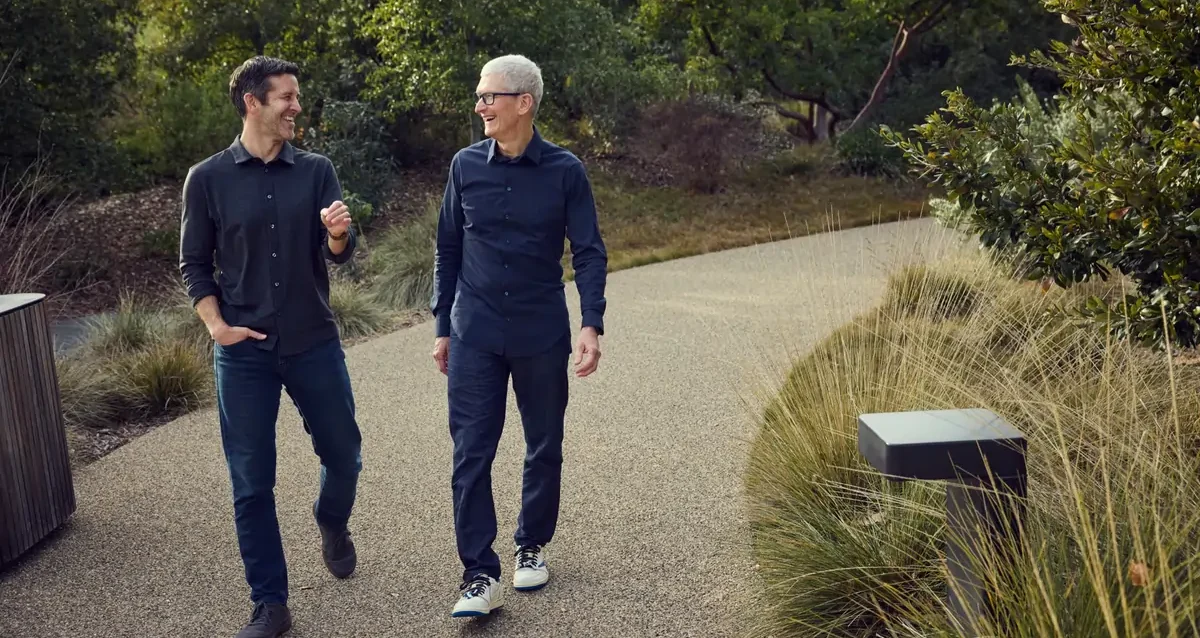
John Ternus New Apple CEO
Last updated: April 2026
Late one night in 2001, a brand-new Apple employee found himself alone in a supplier facility, far from home, well past midnight, pressing a magnifying glass against a tiny metal screw.
He was counting grooves. The screw had 35 of them. It was supposed to have 25.
“I distinctly remember stepping back for a minute and thinking, ‘What the hell am I doing? Is this normal?'” John Ternus recounted in his 2024 commencement address at the University of Pennsylvania. He decided it was. He kept counting.
That engineer — the one who flew to a supplier at midnight to argue about a screw on a monitor nobody would ever look closely at — is now CEO of the most valuable company in the world.
Table of Contents
Who Is John Ternus?
John Ternus is Apple’s incoming CEO, succeeding Tim Cook on September 1, 2026. He has spent the past 25 years at Apple, rising from a junior member of the product design team in 2001 to senior vice president of hardware engineering in 2021. Under his watch, Apple built the iPhone 17 lineup, launched the iPhone Air, completed the transition from Intel to Apple Silicon, shipped AirPods as a hearing health platform, and delivered the Vision Pro. He is 51 years old and, by all accounts, was Apple’s only realistic internal candidate to lead the company through its next chapter.
He will become Apple’s eighth CEO — the third in the company’s fifty-year history to matter to the general public.
Early Life and Education
John Ternus was born in May 1975 in the United States. He attended the University of Pennsylvania’s School of Engineering and Applied Science, graduating in 1997 with a Bachelor of Science in mechanical engineering.
At Penn, Ternus was a competitive swimmer, part of the men’s team. His senior engineering project was a mechanical feeding arm controllable by individuals with quadriplegia using head movements alone — a detail that, in retrospect, reveals something consistent about how he thinks about technology: not as an end in itself but as a thing that changes what people can do.
He has returned to Penn since. In 2024, he delivered the commencement address to the engineering school’s graduating class — and the speech, now widely circulated in tech circles, contains the two stories that best explain who he is.
The first is the screw story. His earliest Apple assignment was analyzing parts for the Apple Cinema Display. He flew to a supplier facility, stayed until after midnight, and got into an argument about the number of grooves on a screw head. The screw was wrong. He fought to get it right. Nobody would have known.
The second is a memory of Steve Jobs. Ternus described watching Jobs inspect a chest of drawers — pulling it away from the wall and looking at the back, studying the craftsmanship on a surface no one would ever see.
“The carpenter who made it had made it beautiful,” Ternus said. “It finished the back as beautifully as the rest of it, even though nobody was going to see it. And I think about that all the time because I think that perfectly exemplifies what we do here.”
Those two stories — the screw, the dresser back — are the lens through which Ternus sees product engineering. They will shape how he runs Apple.
Career Before Apple
After graduating from Penn in 1997, Ternus joined Virtual Research Systems, a small company building VR hardware. This was 1997 — consumer VR was not a product category; it was a research curiosity. He spent four years there as a mechanical engineer, working on headsets that most people never saw and that the market wasn’t ready for.
The experience was not wasted. When Apple began building Vision Pro decades later, Ternus led that project. The man who learned hardware by building VR devices that arrived before their time was the one who built the VR device that arrived at the right time. Whether Vision Pro ultimately becomes a platform or a footnote is the question he’ll now answer as CEO.
Career at Apple: A 25-Year Timeline
2001–2012: The Product Design Years
Ternus joined Apple in 2001 as a product design engineer, working first on the Apple Cinema Display. The screw story is from this period. His job was what the title said: design the products, obsess over the parts, make sure what ships is right.
He spent over a decade doing this kind of work across the company’s hardware portfolio, building the institutional knowledge of what it takes to ship something with the word “Apple” on it.
2013: Vice President of Hardware Engineering
In 2013, Ternus was promoted to VP of Hardware Engineering under Dan Riccio, his mentor at Apple. His portfolio in this role covered AirPods — a product that didn’t exist when he started — the iPad line expansion, Mac hardware, and Apple’s first 5G iPhones. These were the years when Apple was simultaneously defending its existing product categories and launching new ones, and Ternus was the person responsible for making the hardware work.
He also became a public face during this period, presenting at WWDC events — the iMac and MacBook Pro refreshes, the 2018 iPad Pros, the iMac Pro, the completely redesigned 2019 Mac Pro. He was not a headline speaker at the iPhone launches, but he was the engineer who understood what made those machines what they were.
2021: Senior Vice President of Hardware Engineering
In 2021, Ternus was promoted to SVP of Hardware Engineering, replacing Dan Riccio — the mentor who had hired him as a VP eight years earlier. This put him on Apple’s executive team and in direct reporting to Tim Cook.
The timing was significant. The Mac’s transition from Intel to Apple Silicon was underway and needed to be completed. Ternus led the teams that made it happen — the M1, M2, M3 chip families, the redesigned MacBook Pro, the MacBook Air, the iMac. His work on Mac helped the category become more powerful and more popular globally than at any time in its 40-year history.
He also oversaw the iPhone 17 lineup — including the iPhone Air, Apple’s radically thin new form factor — and the AirPods evolution into a hearing health system with active noise cancellation that Apple has positioned as a medical-grade device.
2025–2026: The Succession
Bloomberg’s Mark Gurman first identified Ternus as Apple’s leading internal CEO candidate in 2024. By 2025, the succession story had become an open secret in the industry, accelerated by the departure of Jeff Williams — once considered Cook’s natural successor as COO — in mid-2025. Apple’s PR team began “putting the spotlight on Ternus,” according to Gurman, signaling the company was preparing for a transition.
In September 2025, when the iPhone 17 launched, it was Ternus who ushered in customers at Apple’s Regent Street store in London — a role Cook had played at Apple’s Fifth Avenue store in New York for years. The gesture was read by those paying attention as deliberate: this is your next CEO, get used to his face.
On April 20, 2026, Apple made it official.
What He’s Actually Built
The abstract “hardware engineering” title understates what Ternus has actually done. Here is a more specific accounting of the products he has been responsible for in a leadership capacity:
iPhone: iPhone Air (radically thin new form factor, 2025), iPhone 17 series, multiple prior generations including the first 5G iPhones
Mac: The entire Apple Silicon transition — M1, M2, M3 families; redesigned MacBook Pro; MacBook Air (multiple generations); iMac; Mac Pro (2019 redesign); MacBook Neo (affordable Mac using iPhone chip architecture, 2026)
iPad: Multiple iPad Pro generations, including the 2018 redesign that introduced Face ID and the new form factor; iPad Air and standard iPad updates
AirPods: The evolution from wireless earbuds to active noise cancellation to hearing health platform — a product category Apple created from nothing under his watch
Apple Watch: Multiple hardware generations across the standard, SE, and Ultra lines, including the health sensor roadmap
Vision Pro: The mixed-reality headset that Apple spent seven years building, representing the largest new product category Apple has entered since the Apple Watch. Whatever Vision Pro becomes, Ternus built it.
Leadership Style: What People Who Work With Him Say
Apple is famously secretive. Profiles of its executives are rare, and candid assessments from insiders rarer still. The Bloomberg profile by Mark Gurman, published in advance of today’s announcement, contains the most detailed picture of how Ternus operates.
He is highly technical in a way Tim Cook was not. According to Bloomberg’s sources, Ternus is known for drilling into tiny engineering details in meetings. A longtime Apple executive who worked with Jobs, Cook, and Ternus described the distinction clearly: “Tim doesn’t participate in the product development.” Ternus, by contrast, “is a real engineer.” He likes to say Apple’s culture is based on hiring engineers who will push past the boundaries they are given.
He reversed a quality decline. Multiple Bloomberg sources said Ternus made a mark by “reversing a trend of declining product quality as the company prioritized thinness and sleekness over performance.” This is a pointed observation: under the years before his SVP role, Apple faced repeated criticism — butterfly keyboard reliability, iPhone antenna issues, the 2019 Mac Pro cheese grater form factor that prioritized aesthetics over thermal management. Ternus, sources say, pushed back toward quality.
He is calm and well-liked. Tony Blevins, Apple’s former procurement chief, describes Ternus as a “very meticulous engineer and a judicious executive” and an “outstanding and obvious choice” to succeed Cook. Multiple sources describe his leadership style as “calm, focused, and collaborative.” He has won support across Cook’s senior staff in ways that not every Apple executive has managed.
He is capable of accountability — but approaches it systemically. One Bloomberg source described a quality incident involving AirPods in which Ternus initially focused on finding out who was to blame, leading to a senior executive being reassigned. The source noted this was an outlier behavior — “a throwback to the department’s cutthroat culture before he took over.” Normally, Ternus “looks at mistakes as systematic problems that could be solved with better leadership instead of by putting the onus on engineers.”
He is, by consensus among those who know him, a “nice guy.” That phrase appears in multiple independent accounts. In a culture where genius-asshole was once treated as a leadership archetype, it’s worth noting as a deliberate departure.
How Ternus Differs From Jobs and Cook
Apple has had effectively two eras in its modern history: the Jobs era and the Cook era. Ternus begins a third. Understanding the distinction matters for anyone trying to anticipate what Apple looks like under his leadership.
Jobs was a product visionary and a cultural force — someone who could see a product that didn’t exist and will it into being through sheer conviction and intolerance for anything that wasn’t right. He was not an engineer; he was an editor. He couldn’t write code or design circuits, but he knew when they weren’t good enough.
Cook was an operational and strategic genius — a supply chain architect who turned Apple’s manufacturing into a competitive weapon, who built the services business that now rivals the iPhone in importance, who made Apple the first $4 trillion company. He was, by all accounts, not deeply involved in product development decisions.
Ternus is an engineer who became an executive. He can read the schematics. He argues about screws at midnight. He has spent 25 years learning every component of Apple’s hardware portfolio at a level of technical detail that neither of his predecessors possessed. Fortune notes that his appointment “signals a shift toward prioritizing technical innovation over purely operational excellence” — a meaningful statement at a moment when Apple’s AI capabilities have fallen behind competitors.
The risk in this archetype: technical leaders can optimize for engineering quality at the expense of the broader strategic bets that define new product categories. Bloomberg sources note Ternus has historically been in “the conservative camp” on big new product swings. The Vision Pro, which he built, has not become the platform Apple hoped it would be. The question his tenure will answer is whether the engineering instinct that built the best version of every existing Apple product will also produce the next thing that doesn’t exist yet.
The Challenges Ternus Inherits
Ternus takes charge at an extraordinarily consequential moment. Here are the specific challenges sitting on his desk on September 1:
Siri and the AI credibility gap. Apple promised a next-generation Siri at WWDC 2024. Two years and two iOS cycles later, it still hasn’t shipped at full capability. Apple had to turn to Google — partnering with the Gemini team — for help building features that OpenAI and Google have offered natively for years. Siri 2.0, codenamed Campo, is the centerpiece of iOS 27, set to launch in September 2026 — the same week Ternus becomes CEO. He will own the delivery of a product that his predecessor couldn’t get out the door.
The iPhone Fold. Apple’s first foldable device arrives in September 2026. It is the most significant new form factor since the iPhone itself. The hardware is Ternus’s work. The success of the platform — whether developers build for it, whether consumers adopt it, whether it becomes a category or a curiosity — is now his responsibility to steward as CEO.
Vision Pro’s future. The headset Ternus built has not captured the mass market Apple projected. At nearly $4,000, it remains a professional and enthusiast device. As CEO, he’ll have to decide whether to continue investing in a product category whose consumer case is unproven, or redirect resources toward the AI hardware bets — smart glasses, AI pendants, camera-equipped AirPods — that analysts believe represent Apple’s next platform.
Post-Cook geopolitics. Cook was Apple’s diplomat-in-chief — the executive who managed the company’s relationship with China’s manufacturing ecosystem, with the White House, and with regulators worldwide. His executive chairman role explicitly covers policy engagement, which means he stays in this lane. But Ternus will need to develop his own political credibility as the face of the company, particularly given ongoing trade tensions and the AI regulatory environment.
John Ternus: Key Facts
| Detail | Information |
|---|---|
| Born | May 1975 |
| Age | 51 |
| Education | BS Mechanical Engineering, University of Pennsylvania (1997) |
| Pre-Apple | Mechanical engineer, Virtual Research Systems (VR headsets) |
| Joined Apple | 2001 |
| First project | Apple Cinema Display parts analysis |
| Mentor at Apple | Dan Riccio (VP/SVP Hardware Engineering before Ternus) |
| VP Hardware Engineering | 2013 |
| SVP Hardware Engineering | 2021 |
| CEO effective | September 1, 2026 |
| CEO number | 8th in Apple’s history |
| Key products built | Apple Silicon Mac line, Vision Pro, iPhone Air, iPhone 17, AirPods hearing health, iPad Pro |
| Described as | “Meticulous engineer,” “judicious executive,” “real engineer” |
| Tim Cook on Ternus | “The mind of an engineer, the soul of an innovator, the heart to lead with integrity and honor” |
Frequently Asked Questions
Who is John Ternus?
John Ternus is Apple’s incoming CEO, succeeding Tim Cook on September 1, 2026. He is 51 years old and has spent 25 years at Apple, most recently serving as SVP of Hardware Engineering — responsible for all Apple hardware including iPhone, iPad, Mac, Apple Watch, AirPods, and Vision Pro.
How old is John Ternus?
John Ternus was born in May 1975 and is 51 years old — the same age Tim Cook was when he became CEO in 2011.
Where did John Ternus go to school?
Ternus graduated from the University of Pennsylvania’s School of Engineering and Applied Science in 1997 with a Bachelor of Science in mechanical engineering. He was a competitive swimmer on Penn’s men’s team.
What products did John Ternus build at Apple?
Ternus led the hardware engineering teams responsible for the Apple Silicon Mac transition (M1/M2/M3 chips), Vision Pro, the iPhone Air, iPhone 17, AirPods hearing health platform, multiple iPad Pro generations, and the MacBook Neo. His fingerprints are on virtually every major Apple hardware product shipped since 2013.
What did John Ternus do before Apple?
Before joining Apple in 2001, Ternus worked at Virtual Research Systems, a small VR hardware company, as a mechanical engineer designing headsets. He was there for four years after graduating from Penn in 1997.
Is John Ternus an engineer?
Yes — and his technical background is the defining distinction between him and Tim Cook. Multiple Apple insiders describe Ternus as someone who drills into engineering details in meetings, in contrast to Cook, who is described as not participating directly in product development. Ternus is, as one longtime Apple executive put it, “a real engineer.”
What is John Ternus’s leadership style?
Sources who have worked with Ternus describe him as calm, focused, collaborative, and highly technical. He is well-liked across Apple’s senior leadership. He approaches mistakes as systemic problems rather than individual failures — a deliberate departure from the more aggressive management culture that preceded him in hardware engineering.
When does John Ternus become Apple CEO?
Ternus officially becomes Apple’s CEO on September 1, 2026. Tim Cook remains CEO through the summer to facilitate the transition, then moves to executive chairman of Apple’s board.
What are the biggest challenges John Ternus faces as CEO?
The three most significant challenges: delivering Siri 2.0 and Apple’s overdue AI overhaul (including the partnership with Google’s Gemini team), successfully launching the first iPhone Fold and establishing it as a platform, and determining the future of Vision Pro. He also inherits the post-Cook geopolitical relationship management with China, Washington, and global regulators.
What is John Ternus’s net worth?
Ternus’s exact net worth is not publicly disclosed. As SVP at Apple, he receives a compensation package that includes base salary, stock awards, and bonuses. Apple executives at his level typically receive total annual compensation in the range of $20–$30 million, primarily in stock-based vesting, which would place his accumulated Apple equity in the hundreds of millions based on tenure. No precise public figure is available.
For more on what Ternus inherits when he takes the CEO role in September, see the iOS 27 complete guide and the Tim Cook stepping down full story.
Alex Rivera covers tech, gadgets, and mobile for Axis Intelligence. Published April 20, 2026. Last updated: April 20, 2026.