


Best AI Customer Service Tools 2026
Last Updated: September 2026
Our Verdict:
- 🏆 Best Overall: Intercom Fin
- 🛒 Best for Ecommerce: Gorgias Automate — native Shopify/WooCommerce read-write actions, resolves WISMO tickets without human handoff
- 💡 Best for SaaS/Technical Support: Twig — RAG quality that handles complex documentation queries with audit trails
- 💰 Best Budget Pick: Tidio Lyro — $29/month entry, 70%+ resolution on in-scope queries, live in days.
Table of Contents
The AI customer service market hit $15.12 billion in 2026. Meanwhile, 46% of consumers say they rarely get satisfactory results from AI support. Both statistics are true — and the gap between them is where vendor marketing lives and where real buying decisions get made.
This guide does something none of the standard “best AI customer service tools” lists do: it scores every platform on the metrics that determine your actual business outcome — autonomous resolution rate, realistic total cost of ownership, time to first production ticket, integration depth, and hallucination risk. We call this the Axis Intelligence AI CS Resolution Index (AIRI). The scores are our own synthesis. Use them as a structured starting point, not a substitute for a free trial.
The 2026 Market: What the Numbers Actually Mean
The headline metrics are compelling. The nuance matters more.
Companies see an average return of $3.50 for every $1 invested in AI customer service, with leading organizations reporting up to 8x returns, according to MIT Sloan Management Review research on AI deployment economics. Year-2 ROI reaches 4.1x median, and three-year cumulative net benefit ranges from $2.4M–$11.8M for mid-market deployments, $14M–$58M for enterprise, according to Forrester Total Economic Impact composite research across live deployments.
The catch: 64% of enterprise CX teams ran an agentic AI pilot in 2026, but only 27% had at least one channel in full production. The technology works. Implementation is what breaks most deployments.
Median tier-1 deflection is 41.2% across enterprise CX programs (Zendesk CX Trends 2026), with the top quartile reaching 58.7% and the bottom quartile stuck at 22.4%. Gartner research estimates conversational AI will reduce global contact center labor costs by $80 billion in 2026 and predicts that 20-30% of service agents will be replaced or reassigned by AI — while also warning that 50% of organizations that cut headcount early are expected to rehire. The 80% deflection rate vendors advertise is a ceiling achievable only with mature, well-curated knowledge bases — not the Day 1 reality for any deployment.
According to Axis Intelligence’s synthesis of Forrester, McKinsey, and Gartner data for 2026, the metric that separates real ROI from illusory deflection is ROAR — Resolved on Automation Rate. ROAR counts only tickets that are fully resolved without human handoff and without the customer re-contacting within 72 hours. Deflection counts any interaction where the customer stopped — including giving up. Every platform that claims 60-80% deflection should be asked: “What’s your ROAR?” Most will not have the answer.
The Axis Intelligence AI CS Resolution Index (AIRI) 2026
Our scoring methodology evaluates each platform across five dimensions totaling 100 points. These dimensions reflect what determines actual ROI — not the feature checklist that most comparison sites use.
| Dimension | Weight | What We Measure |
|---|---|---|
| Autonomous Resolution Rate (ARR) | 30 pts | Realistic production ROAR, not vendor claims; benchmarked against vertical averages |
| Total Cost of Ownership (TCO) Transparency | 20 pts | How honestly the platform presents its true first-year cost including implementation, KB curation, and QA overhead |
| Time to Value (TTV) | 15 pts | Realistic weeks from contract signing to first production-quality resolved tickets |
| Integration Depth | 20 pts | Read-write (can take actions: refunds, order updates, cancellations) vs. read-only (can answer but not act) |
| Hallucination Risk | 15 pts | Architecture-based assessment of AI response accuracy outside the trained knowledge domain |
AIRI Scores at a Glance:
| Tool | ARR | TCO | TTV | Depth | Halluc. | AIRI/100 | Best For |
|---|---|---|---|---|---|---|---|
| Intercom Fin | 28 | 17 | 13 | 18 | 12 | 88 | SaaS, high-volume support |
| Gorgias Automate | 26 | 17 | 14 | 18 | 11 | 86 | Ecommerce (Shopify/WooCommerce) |
| Twig | 26 | 15 | 12 | 18 | 12 | 83 | Technical SaaS, fintech |
| Zendesk AI | 22 | 13 | 12 | 17 | 11 | 75 | Existing Zendesk customers |
| Tidio Lyro | 19 | 19 | 15 | 10 | 12 | 75 | SMBs <1,000 tickets/month |
| Freshdesk Freddy AI | 21 | 12 | 12 | 16 | 11 | 72 | Freshdesk-native teams |
| Ada CX | 22 | 10 | 10 | 17 | 11 | 70 | Enterprise self-service |
| Help Scout AI | 14 | 17 | 14 | 10 | 13 | 68 | Small teams, email-first support |
| Salesforce Agentforce | 20 | 7 | 6 | 20 | 13 | 66 | Enterprise CRM-integrated CX |
| Sierra AI | 22 | 5 | 6 | 19 | 13 | 65 | Enterprise voice + complex CX |
Source: Axis Intelligence AI CS Resolution Index (AIRI) 2026. Scores reflect editorial assessment based on published performance data, pricing structure analysis, and industry benchmark cross-referencing as of May 2026. Individual outcomes vary by deployment quality and knowledge base maturity.
The 5 Architectural Categories: Know What You’re Actually Buying
Before evaluating individual tools, understand which category of product you’re looking at. Every vendor calls their product “AI-powered” — the architecture determines what it can actually do.
Category 1 — Copilot-First: AI assists agents in real time (suggests replies, summarizes threads, classifies tickets) but humans close every ticket. Best for: complex B2B support, regulated industries, high-empathy use cases. Resolution model: human-led, AI-accelerated. Tools: Zendesk AI Agent Assist, Freshdesk Freddy Copilot.
Category 2 — Autonomous Agent-First: AI resolves the ticket end-to-end, escalates to humans when it can’t. This is where ROAR metrics are highest. Best for: high-volume SaaS, subscription businesses, ecommerce. Tools: Intercom Fin, Ada CX, Twig, Gorgias Automate.
Category 3 — E-commerce Native: Autonomous agents with native Shopify/WooCommerce/BigCommerce API access — can take actions (issue refunds, update orders, check inventory) without human involvement. Best for: DTC brands handling 5,000+ tickets/month. Tools: Gorgias Automate, Yuma AI.
Category 4 — Enterprise Full-Stack: Voice + digital chat + QA analytics + agent coaching in a single platform. Requires 3-6 months implementation. Best for: large contact centers (500+ agents), regulated sectors. Tools: Salesforce Agentforce (full), Sierra AI, Kore.ai.
Category 5 — SMB Entry-Level: Affordable, fast-setup, limited integration depth. Resolves high-frequency simple queries well, struggles with complex multi-step issues. Best for: teams under 1,000 tickets/month with tight budgets. Tools: Tidio Lyro, Help Scout AI, Chatbase.
According to Axis Intelligence, the single most common buying mistake is purchasing a Category 4 platform for a Category 5 problem. A $150,000/year Sierra AI deployment solving 800 tickets/month will never achieve positive ROI. Match the architecture to your actual ticket volume and complexity — not your aspirational volume. For additional comparisons of specific AI tools and platforms and SaaS business software, see our full tool coverage.
Tool Profiles: The Honest Breakdown
1. Intercom Fin — AIRI Score: 88/100
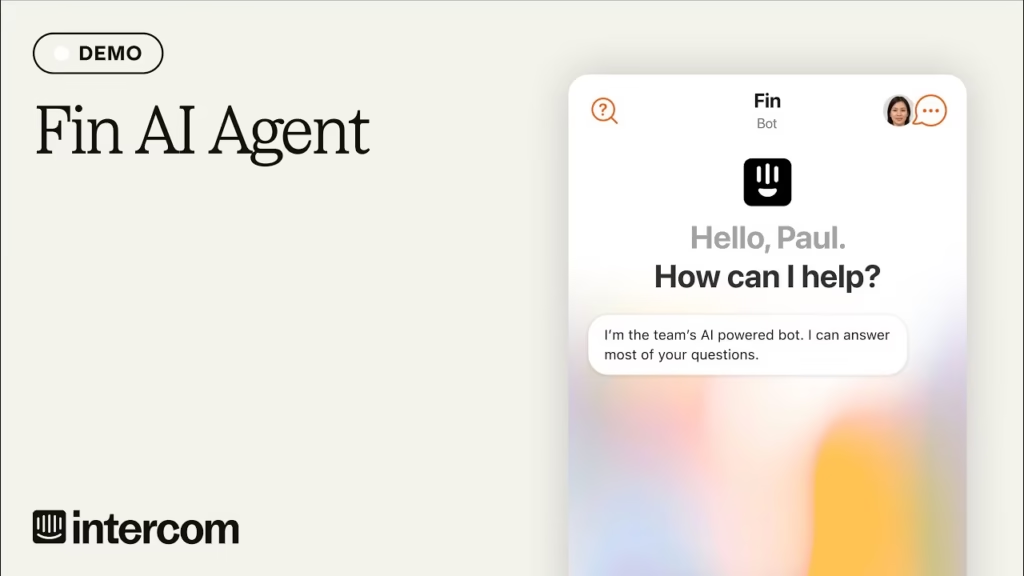
Best for: B2B SaaS, subscription products, teams already on Intercom Pricing: $0.99 per resolved conversation (Fin AI only) + Intercom base plan ROAR at maturity: 65–81% (Intercom’s own production data; independent benchmarks land at 60–70%)
Intercom Fin is the clearest example of outcome-based pricing done right. At $0.99 per resolution, you pay for results — not seats, not sessions, not “interactions” that may or may not solve the customer’s problem. This pricing transparency alone earns it a 17/20 on TCO visibility, the highest among non-SMB tools in our index.
The practical implication: a team handling 10,000 tickets/month with 65% resolution gets 6,500 AI-resolved tickets at $0.99 each — $6,435/month versus $52,000 at a $8/ticket human cost baseline. That’s a monthly saving of $45,565. Year-one ROI turns positive before the fourth month for most deployments at this volume.
Fin’s RAG (Retrieval-Augmented Generation) architecture means it answers from your knowledge base rather than hallucinating — but the quality of your knowledge base determines everything. Teams that deploy Fin against thin documentation see 20-30% ROAR. Teams that invest in KB curation first see 60%+. This is not an Intercom limitation. It’s true of every RAG-based system.
Limitations you need to know: Fin is native to Intercom. If your current helpdesk is Zendesk, Freshdesk, or Salesforce, you face platform migration — which historically tanks implementation timelines. Fin for non-Intercom systems exists but is less capable. If you’re not on Intercom, calculate migration cost before treating Fin’s pricing as your real number.
Who should look elsewhere: Teams with complex regulatory requirements (healthcare, financial services) where every AI response must be auditable and documented. Fin’s governance features are solid but not purpose-built for compliance-heavy environments. Consider Salesforce Agentforce or Kore.ai instead.
3. Gorgias Automate — AIRI Score: 86/100
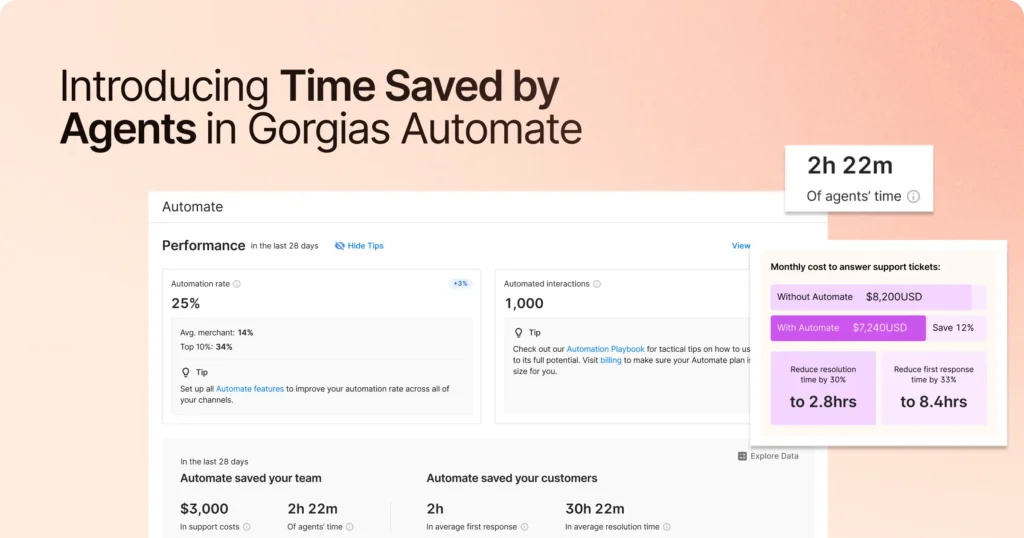
Best for: Ecommerce brands on Shopify, WooCommerce, or BigCommerce Pricing: Outcome-based; starts at ~$10/month for basic Gorgias + Automate add-on pricing by ticket volume ROAR at maturity: 70–85% for standard ecommerce intents
Gorgias Automate is the most purpose-built tool in this comparison. It doesn’t try to handle technical SaaS support, complex B2B inquiries, or regulated-industry workflows. It handles ecommerce support — and it handles it better than any generalist platform.
The key capability is read-write integration. Gorgias doesn’t just answer “where is my order” — it looks up the order, reads the tracking status, and if the package is delayed, it can issue a store credit, initiate a return, or apply a discount code without a human in the loop. This is the difference between a chatbot that deflects (the customer gives up without a real answer) and an AI agent that resolves (the customer got their refund).
High-structure intents with a clear backend system of record — auth, order, refund — deflect in the 65-80% range, which tracks with Gorgias Automate’s real-world performance for WISMO (Where Is My Order), returns, and product availability queries.
The ecommerce-specific benchmark according to Axis Intelligence: An ecommerce brand handling 8,000 tickets/month with 70% of queries falling into standard categories (WISMO, returns, product questions) should expect Gorgias Automate to resolve 5,600 tickets autonomously per month at maturity. At $8 fully loaded human cost per ticket, that’s $44,800/month in labor cost avoided. Gorgias pricing at that volume: approximately $2,000-$3,000/month all-in. Net monthly saving: $41,800–$42,800.
Limitations you need to know: Outside of Shopify/WooCommerce/BigCommerce, Gorgias integration depth drops significantly. It is not the right tool for SaaS, B2B services, or any support category that falls outside standard ecommerce workflows. If your tickets include “how do I configure your API” or “my enterprise contract renewal,” Gorgias Automate will escalate every single one of them.
Who should look elsewhere: Any non-ecommerce business. Any ecommerce brand with unusual product complexity, international regulatory requirements, or high-stakes transactions where AI resolution errors have material consequences.
4. Twig — AIRI Score: 83/100
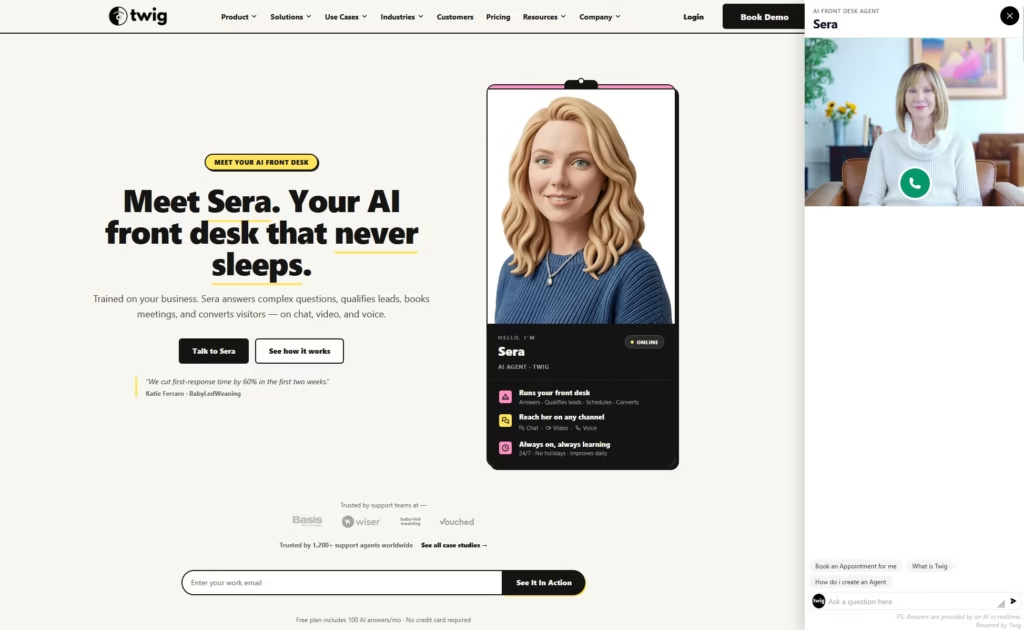
Best for: Technical SaaS companies with large documentation libraries; fintech with compliance requirements Pricing: $3–$5 per resolved ticket at scale; contact for enterprise ROAR at maturity: 60–70% for technical documentation queries; 55–65% for complex SaaS support
Twig‘s technical differentiation is RAG quality combined with a Human Review module that creates an audit trail for every AI response. For any company where a wrong AI answer has legal, financial, or safety consequences, this audit trail is not a nice-to-have — it’s a compliance requirement.
The platform excels at knowledge-base-intensive use cases: technical documentation, API queries, configuration questions, multi-step troubleshooting. Where Intercom Fin is built for conversational resolution, Twig is built for technical depth. It indexes your entire documentation library, past tickets, Confluence pages, and Notion docs and serves precise answers with source citations — the kind of specificity that reduces hallucination risk and maintains enterprise customer trust.
Limitations you need to know: Twig is overkill for simple, high-volume routine queries. If 60% of your tickets are “where is my invoice” and “how do I reset my password,” Tidio or Help Scout will handle them at 80% lower cost. Twig’s value is in the 40% of tickets that require real technical depth — and in organizations where that 40% is the most damaging to resolve badly.
5. Zendesk AI — AIRI Score: 75/100
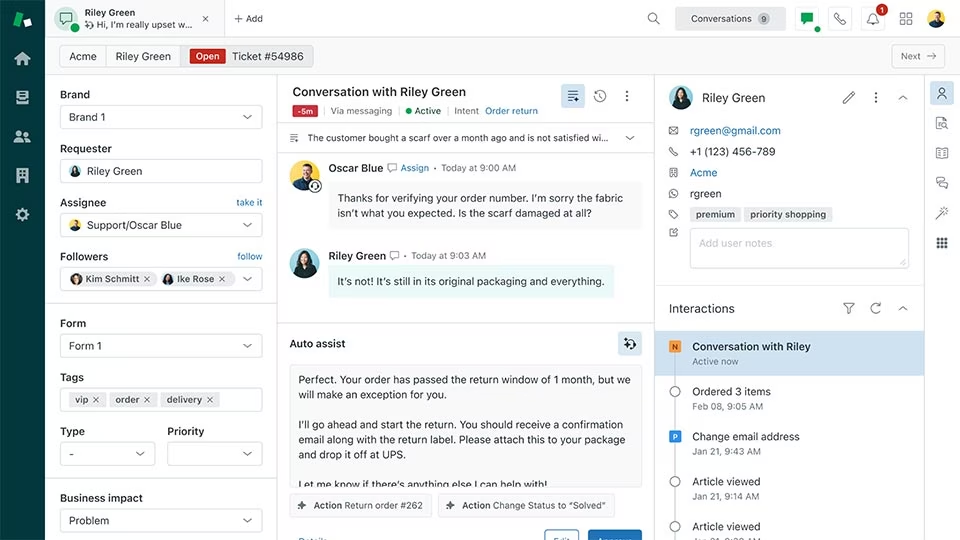
Best for: Companies already on Zendesk with no plans to migrate Pricing: $50/agent/month for Advanced AI (add-on to existing Zendesk plan) ROAR at maturity: 40–55% (constrained by Zendesk Guide knowledge base quality)
Zendesk AI is the correct choice for exactly one scenario: you are already on Zendesk, your team is trained on it, and you want AI without migration risk. In that scenario, the $50/agent/month Advanced AI add-on delivers solid value — agent copilot features (reply suggestions, ticket summarization, intelligent routing) plus the Zendesk AI Agent (the autonomous resolution piece) in a single familiar environment.
The problem is that Zendesk AI is not the strongest standalone AI platform. Its autonomous resolution capability is competitive but not leading — median ROAR around 40-55% versus Intercom Fin’s 60-70%+ at comparable knowledge base maturity. The underlying architecture relies heavily on Zendesk Guide content quality, which varies widely by organization.
Zendesk AI is the default for Zendesk customers, even if it’s not the best choice for organizations evaluating from scratch. That framing is accurate. If you’re starting fresh, compare against Intercom Fin and Twig before defaulting to Zendesk AI.
Limitations you need to know: The $50/agent/month pricing is for the add-on only — your base Zendesk suite cost is separate. A 20-agent team pays $1,000/month for the AI add-on plus $1,800-$3,200/month for the base Suite Professional plan. Total: $2,800-$4,200/month before implementation costs. Model this against actual ticket volume and expected ROAR before signing.
6. Freshdesk Freddy AI — AIRI Score: 72/100
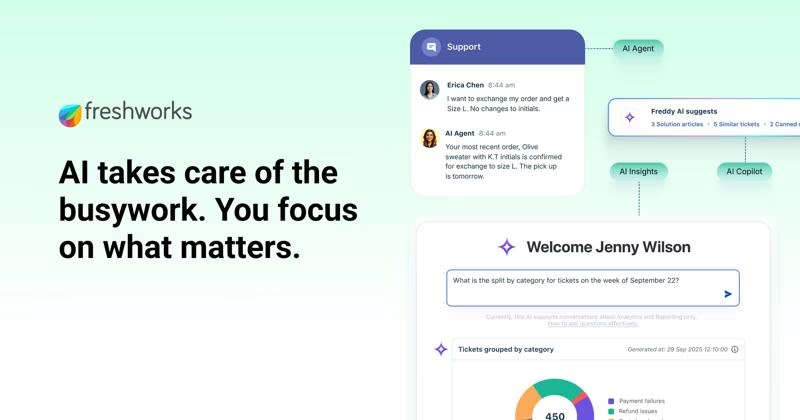
Best for: Teams already on Freshdesk; mid-market SaaS and retail Pricing: Session-based billing for Freddy AI (not included in base plan — this is a paid add-on) ROAR at maturity: 45–55%
Freddy AI is frequently presented as Freshdesk’s native AI — it is not. It is a paid add-on with session-based billing that sits on top of Freshdesk’s base plans. This distinction earns Freshdesk its relatively low TCO Transparency score (12/20) in our AIRI methodology — the add-on pricing structure obscures the true cost of AI deployment until you’re already committed to the platform.
That said, Freddy AI delivers real performance. Freddy AI Agents deflected 53% of retail queries, slashing first response time from 12 minutes to 12 seconds and resolution time from over an hour to just 2 minutes, according to Freshworks data. Those are vendor-supplied numbers from optimized deployments — expect 35-45% ROAR in typical mid-market implementations during the first 6 months.
Limitations you need to know: The session-based Freddy AI pricing can become expensive at high ticket volumes compared to resolution-based alternatives like Intercom Fin. At 10,000+ tickets/month, run the math on both pricing models before committing. Session billing rewards resolution; session billing can penalize browsing and early abandonment in ways that outcome-based pricing does not.
7. Ada CX — AIRI Score: 70/100
Best for: Enterprise companies with high automation ambitions and dedicated implementation resources Pricing: Custom enterprise contracts, typically $100K–$300K/year ROAR at maturity: 65–75% for well-structured enterprise self-service
Ada CX positions itself as an enterprise autonomous agent platform with RAG-like functionality and strong governance controls. It handles high-volume self-service well for organizations with the budget and implementation bandwidth to do the deployment properly.
The challenge is the gap between Ada’s ceiling and its floor. A well-implemented Ada deployment with curated KB, proper intent mapping, and tuned escalation logic reaches impressive resolution rates. An under-resourced Ada implementation reaches 25-35% ROAR and costs $100K-$200K/year for the privilege. Ada requires enterprise-grade implementation resources — budget $60K-$120K for Year 1 professional services in addition to licensing.
Who should look elsewhere: Any company under 5,000 tickets/month or without dedicated CX operations staff to manage the platform. Ada is enterprise infrastructure, not plug-and-play software.
8. Tidio Lyro — AIRI Score: 75/100
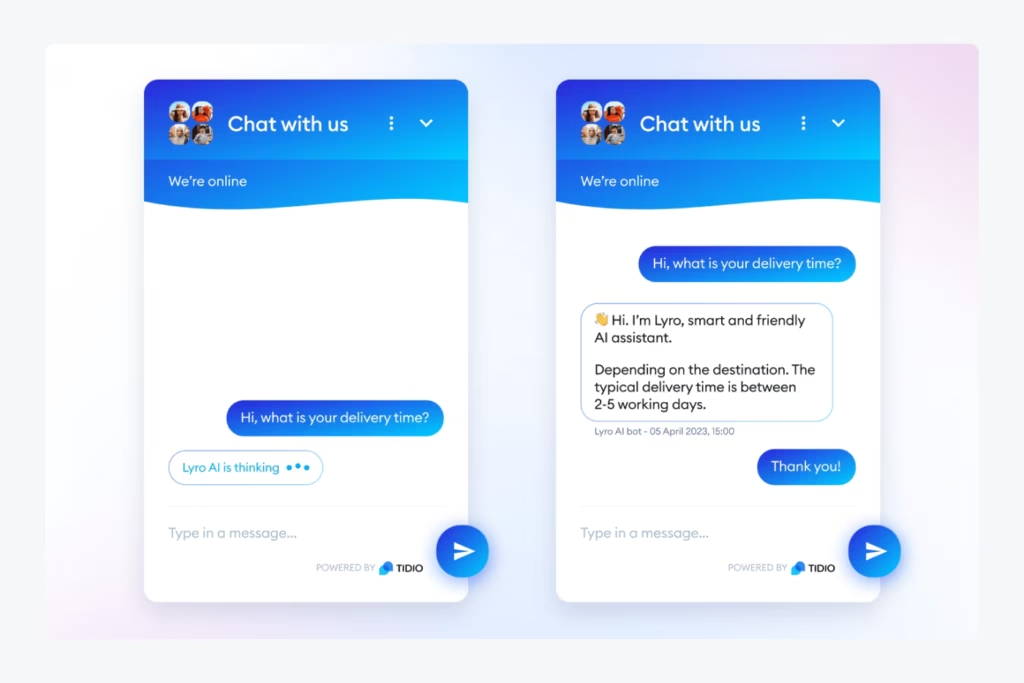
Best for: SMBs under 1,000 tickets/month; ecommerce and service businesses starting with AI Pricing: From $29/month (Lyro AI conversations included); scales with usage ROAR at maturity: 60–70% for in-scope, simple queries
Tidio Lyro earns its high AIRI score in the TCO (19/20) and TTV (15/15) categories because it does something almost no other tool in this list does: it works in days, at a price any business can afford, without professional services.
The trade-off is ceiling. Lyro handles standard support queries well — FAQs, product questions, hours and availability, simple troubleshooting. It is not built for multi-step backend actions, complex technical queries, or high-stakes transactions. At 500 tickets/month with 60% resolution rate, the savings are real: 300 tickets resolved by AI saves $1,800-$2,400/month in agent time at $6-$8/ticket. Against a $29-$99/month platform cost, the ROI is immediate.
Limitations you need to know: Lyro’s resolution depth is fundamentally limited by its architecture. It retrieves from your FAQ and knowledge base content — it does not take actions on backend systems (no refunds, no order lookups, no account modifications). For businesses whose #1 ticket type requires backend access, Lyro is not the right tool regardless of price.
9. Help Scout AI — AIRI Score: 68/100
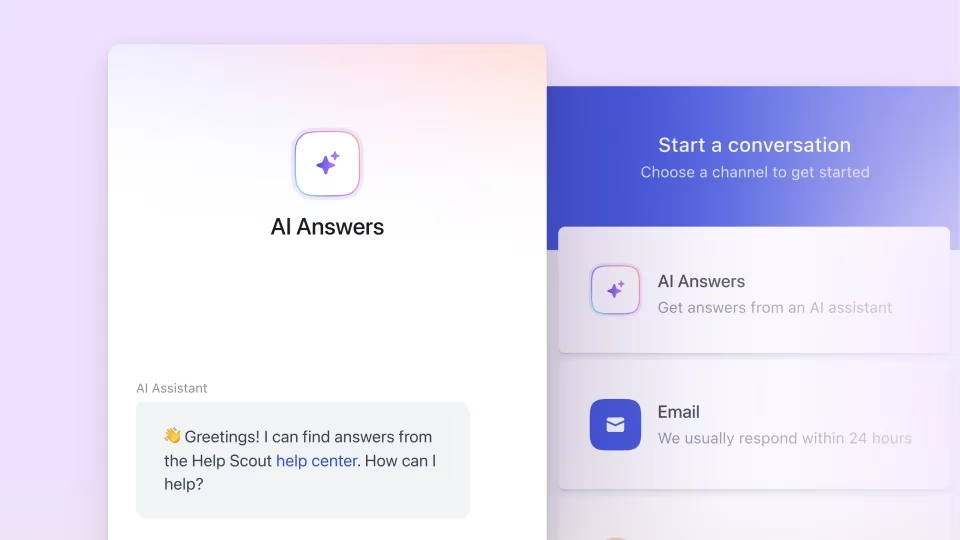
Best for: Growing SMBs and small teams that prioritize agent experience over autonomous resolution Pricing: Starting ~$50/user/month; AI features included in paid plans ROAR at maturity: 20–35% (not optimized for autonomous resolution — copilot-first architecture)
Help Scout is a beloved small-team helpdesk that added AI features — AI Drafts (reply suggestions), AI Summarize (thread summaries), AI Assist (tone and grammar improvement), and AI Answers (self-service knowledge base chat). It is unambiguously Category 1 (Copilot-First) in our architectural taxonomy.
If your goal is autonomous ticket resolution at scale, Help Scout AI is the wrong tool. If your goal is making a small support team faster and more consistent, Help Scout AI delivers straightforward, accessible value without the complexity of autonomous agent deployment.
Who should look elsewhere: Any team prioritizing autonomous ticket resolution over agent augmentation. Help Scout is an agent productivity tool with AI features, not an autonomous AI resolution platform.
10. Salesforce Agentforce — AIRI Score: 66/100

Best for: Large enterprises already in the Salesforce ecosystem where full CRM integration is non-negotiable Pricing: Add-on to Salesforce Service Cloud; all-in Year 1 cost typically $300K–$1.2M ROAR at maturity: 50–65% for well-implemented enterprise deployments
Agentforce scores a 20/20 on Integration Depth — it has the deepest CRM-integrated resolution capability in this comparison. When Agentforce resolves a ticket, it can simultaneously update the CRM record, trigger a workflow in Salesforce Flow, log the interaction for compliance, and update account health scores. No other platform in this list matches that level of CRM integration.
The cost of that integration depth: a 20-year sales cycle and an implementation timeline that makes “time to value” essentially irrelevant on a quarter-by-quarter basis. Agentforce deployments require 3-6 months of professional services, a Salesforce-certified implementation partner, and organizational commitment to a platform rebuild. The payback period for a typical Agentforce deployment is 12-18 months — which is perfectly reasonable for a Fortune 1000 company and completely inappropriate for a mid-market SaaS company with 3,000 tickets/month.
Salesforce’s 2026 State of Service report notes that the top quartile of Salesforce Agentforce deployments reaches 58.7% autonomous resolution. That figure, which requires mature implementation, represents best-in-class for complex enterprise CX — and it is achievable without the cost and complexity of Agentforce at lower volumes using Intercom Fin or Twig.
Who should look elsewhere: Any organization not already running Salesforce CRM at enterprise scale. The integration depth advantage disappears entirely outside the Salesforce ecosystem.
11. Sierra AI — AIRI Score: 65/100

Best for: Large enterprises with voice-first contact centers and complex multi-turn customer conversations Pricing: $150K–$200K+/year; custom contracts; professional services $50K–$200K additional ROAR at maturity: 60–75% for voice + digital at enterprise maturity
Sierra AI is the most enterprise-exclusive platform in this comparison — and the lowest on overall AIRI score precisely because of its TCO opacity (5/20). Sierra does not publish pricing. Contract minimums typically start at $150K/year. Implementation typically requires 3-6 months of professional services. The total first-year investment for a mid-size enterprise is $200K–$500K.
What Sierra offers for that investment: an enterprise-grade AI agent platform with voice capability that can handle complex, multi-turn conversations across voice and digital channels with strong governance controls. For organizations running large voice contact centers where human agent cost per call is $8–$15 and volume is 50,000+ contacts/month, Sierra’s ROAR at scale generates net savings that justify the cost structure.
Who should look elsewhere: Any organization under 20,000 monthly contacts. Any organization that cannot commit to a 6-month implementation timeline. Any organization without dedicated CX operations to manage and optimize the platform post-deployment. At Sierra’s price point, the opportunity cost of a failed deployment is catastrophic — it demands enterprise-grade organizational readiness.
Winner by Use Case: The Axis Intelligence Recommendation Matrix 2026
| Use Case | Recommended Tool | AIRI Score | Why |
|---|---|---|---|
| B2B SaaS, high-volume | Intercom Fin | 88 | Highest production ROAR; outcome-based pricing; fastest ROI path |
| Ecommerce (Shopify native) | Gorgias Automate | 86 | Read-write order actions; 70-85% ROAR for standard intents |
| Technical SaaS / fintech with compliance needs | Twig | 83 | RAG depth + Human Review audit trail; handles complex documentation |
| Already on Zendesk | Zendesk AI | 75 | Migration risk outweighs performance gap; native integration advantage |
| SMB < 1,000 tickets/month | Tidio Lyro | 75 | Fastest setup; lowest cost; immediate positive ROI at SMB scale |
| Complex enterprise + CRM integration | Salesforce Agentforce | 66 | Only platform with full CRM read-write at Salesforce ecosystem depth |
| Enterprise voice contact center | Sierra AI | 65 | Voice-first AI at scale; governance for regulated industries |
| Small team agent productivity | Help Scout AI | 68 | Not for autonomous resolution; best copilot for small team helpdesk |
Source: Axis Intelligence AI CS Resolution Index 2026. Scores and recommendations reflect analysis of published performance data, pricing structures, and industry deployment benchmarks.
The Hidden Cost Matrix: What Vendors Don’t Show You
This is the section that every AI customer service vendor hopes you skip. According to Axis Intelligence’s analysis of Forrester Total Economic Impact data and mid-market implementation records, the advertised platform cost represents 35–55% of true Year 1 total cost of ownership. The rest is implementation, knowledge base investment, and ongoing quality supervision.
| Cost Category | Mid-Market (Annual) | Enterprise (Annual) | Typically Disclosed? |
|---|---|---|---|
| Platform licensing | $60K–$240K | $300K–$1.4M | Yes |
| Implementation & integration | $40K–$180K (one-time) | $150K–$500K (one-time) | Rarely |
| Knowledge base curation & content engineering | $30K–$110K | $80K–$250K | Almost never |
| Human QA oversight & supervision | $50K–$220K | $120K–$400K | Never |
| Token/infrastructure cost (where billed separately) | $6K–$22K | $25K–$90K | Sometimes |
| True Year 1 TCO | $186K–$772K | $675K–$2.64M | — |
Source: Axis Intelligence synthesis from Forrester Total Economic Impact composite data, Gartner CX research, and industry implementation benchmarks. May 2026.
The knowledge base investment is the most underestimated. Every RAG-based AI customer service tool is only as good as the content it retrieves from. A poorly structured, incomplete, or outdated knowledge base produces 20-30% ROAR. A clean, well-curated KB produces 60%+. The difference is 30-40 percentage points of resolution rate — and it has nothing to do with which AI vendor you chose.
According to Axis Intelligence, organizations that invest $50,000-$80,000 in knowledge base curation before deploying AI customer service tools consistently reach 55-65% ROAR within 6 months. Organizations that deploy AI against existing documentation without curation investment average 28% ROAR at the 6-month mark — and frequently conclude that “AI doesn’t work” while their knowledge base is the actual problem. A separate but related cost that most vendors omit: the security and compliance overhead of handling customer data through AI systems. With data breaches reaching record levels in 2025, organizations processing customer data through AI must audit data retention policies, encryption practices, and customer data privacy frameworks before deployment — a gap that can add $15K-$50K in compliance remediation.
The ROI formula that actually works:
Net Monthly Savings = (Monthly Ticket Volume × ROAR%) × (Human Cost/Ticket - AI Cost/Ticket)
                    - (Annual Platform Cost + Annual KB + Annual QA) ÷ 12

Where:
  Human cost/ticket: $6–$12 (fully loaded)
  AI cost/ticket: $0.62–$1.99 (McKinsey 2026 benchmark range)
  ROAR: 25-40% in months 1-6; 50-65% at 12+ months
For a mid-market SaaS company with 8,000 tickets/month, human cost $9/ticket, targeting 50% ROAR at month 6:
- AI-resolved tickets: 4,000/month
- Human cost avoided: 4,000 × $9 = $36,000/month
- AI resolution cost: 4,000 × $1.20 = $4,800/month
- Monthly net saving: $31,200
- Platform + overhead (annualized, divided by 12): $22,500/month
- Net monthly surplus: $8,700 — break-even at month 6-7 of full deployment
Why Most AI Customer Service Deployments Fail
64% of enterprise CX teams ran an agentic AI pilot in 2026, but only 27% had at least one channel in full production. According to Axis Intelligence’s analysis of the deployment gap, three failure modes account for over 80% of failed or stalled implementations:
Failure Mode 1: Confusing deflection with resolution. Deflection counts any interaction that didn’t reach a human agent — including customers who gave up out of frustration. Resolution counts interactions where the customer’s problem was actually solved. ROAR (Resolved on Automation Rate) is the only metric that matters for ROI. Teams that optimize for deflection numbers produce CSAT disaster. Teams that optimize for ROAR produce both cost savings and customer satisfaction.
Failure Mode 2: Deploying AI against an unready knowledge base. The AI does not fail. The content fails. An AI system built on a KB with 200 outdated FAQ articles, inconsistent product documentation, and no troubleshooting structure will produce 20-25% ROAR and generate hallucination-adjacent responses for queries outside its training content. The $30K-$110K/year knowledge base curation investment exists because the KB is the asset, not the AI model. The model is the retrieval and reasoning layer. What it retrieves determines what it says.
Failure Mode 3: Poor escalation design. 90% of leaders struggle with AI-to-human escalation. When an AI agent reaches its confidence boundary, it must escalate seamlessly — with context, with conversation history, with a handoff that feels continuous rather than punishing. Systems that loop customers through re-authentication, re-statement of their problem, and transfer menus generate CSAT scores below baseline human agent performance. The escalation design deserves as much engineering investment as the AI resolution design.
How to Choose: 7 Questions That Determine the Right Tool
According to Axis Intelligence, these seven questions determine your tool choice before you look at a single feature comparison table:
1. What is your actual ROAR target — and is it achievable at your ticket complexity? High-structure intents (order tracking, password reset, return policy) deflect at 70%+. Complex complaints, billing disputes, and technical troubleshooting rarely break 25%. Know your ticket mix before setting ROAR expectations.
2. Does your primary use case require read-write backend integration or read-only answers? If the answer to 70% of your most frequent tickets requires taking an action (issuing a refund, updating an order, resetting a password in your system), you need a read-write capable platform. If the answer is information only, you can use a read-only tool at significantly lower cost and implementation overhead.
3. Are you willing to invest in knowledge base curation before deployment? The KB investment is not optional for ROAR above 50%. If the answer is no, set your ROAR expectations to 25-35% and price accordingly.
4. What is your realistic implementation timeline? If you need AI answering tickets within 30 days: Tidio, Help Scout, or Intercom Fin on Intercom native. If you can invest 3-6 months: Salesforce Agentforce, Sierra AI, Ada CX. Mismatch between timeline expectations and platform reality is a leading cause of deployment failure.
5. What is your true total budget including implementation and KB curation? Use the Hidden Cost Matrix from this guide. If your total Year 1 budget is $80K, enterprise platforms are off the table regardless of their feature set. Tidio, Intercom Fin at moderate volume, or Twig at the SMB tier are your options.
6. Are you starting fresh or constrained by an existing helpdesk? If you’re on Zendesk: Zendesk AI. If you’re on Freshdesk: Freddy AI. If you’re on Intercom: Fin. Platform migration risk is real and frequently underestimated. The performance gains from switching platforms rarely offset the cost and disruption of migration unless the performance gap is extreme.
7. What are your governance requirements? For regulated industries — financial services, healthcare, insurance — every AI response must be traceable and auditable. Twig’s Human Review module, Salesforce Agentforce’s Einstein governance layer, and Kore.ai’s auditability framework address this. Standard platforms like Tidio and Intercom Fin do not have purpose-built compliance governance.
Frequently Asked Questions
What is ROAR and why is it better than deflection rate?
ROAR — Resolved on Automation Rate — measures the percentage of tickets fully resolved by AI without human handoff, with no customer re-contact within 72 hours. Deflection rate measures any interaction that didn’t reach a human agent, including customers who abandoned in frustration without a resolution. Vendors optimize for deflection because it’s easier to inflate. Your ROI depends on ROAR. Median ROAR across enterprise CX programs in 2026 is 41.2% (Zendesk CX Trends 2026); the top quartile reaches 58.7% (Salesforce State of Service 2026).
How much does AI customer service cost in 2026?
Platform licensing ranges from $29/month (Tidio Lyro) to $200K+/year (Sierra AI enterprise). However, total first-year cost of ownership for mid-market deployments ranges from $186K to $772K when implementation ($40K–$180K), knowledge base curation ($30K–$110K), and QA oversight ($50K–$220K) are included. According to Axis Intelligence’s synthesis of Forrester Total Economic Impact data, the advertised platform cost represents 35–55% of true Year 1 TCO. Never evaluate AI customer service tools on licensing cost alone.
Can AI replace human customer service agents?
Not fully, and organizations that try face well-documented problems. Gartner predicts 20-30% of service agents will be replaced by AI in 2026, but 50% of companies that cut staff are expected to rehire as AI handles routine volume while humans manage complexity and relationship-critical escalations. The optimal model in 2026 is hybrid: AI handles 40-65% of ticket volume autonomously, with seamless escalation to human agents for complex, emotional, and high-stakes interactions. AI-only implementations consistently underperform hybrid models on CSAT — customers accept AI for simple issues and resent it for complex ones.
What resolution rate should I expect in the first 90 days?
Day 1 through month 3: 20-40% ROAR is realistic across most platforms with existing documentation. Month 6: 40-55% with active KB curation. Month 12+: 55-70% for well-managed deployments. The vendor that promises 80% resolution on Day 1 is either measuring deflection instead of resolution, or working from a prior deployment that already has a mature KB. Do not sign contracts with ROI projections based on Day 1 vendor claims.
What is outcome-based pricing for AI customer service?
Outcome-based pricing charges per resolved ticket rather than per seat, per session, or per interaction. Intercom Fin charges $0.99 per resolved conversation. This model aligns vendor incentives with your business outcome — the vendor profits when your tickets are actually resolved, not when customers abandon. Outcome-based pricing is now standard for autonomous agent platforms in 2026 and is strongly preferable to session-based pricing for high-volume deployments. At Gorgias Automate and Intercom Fin, it enables straightforward ROI calculation: (tickets resolved × $saved per human ticket) – (tickets resolved × $AI resolution cost) = net saving.
Is Salesforce Agentforce worth the cost?
For large enterprises already in the Salesforce ecosystem handling 20,000+ contacts/month across voice and digital: yes. Agentforce’s CRM integration depth (20/20 in our AIRI scoring) is unmatched — it can update CRM records, trigger workflows, and log compliance data automatically. For mid-market companies not already on Salesforce: almost certainly not. The $300K–$1.2M first-year TCO and 3-6 month implementation timeline require enterprise-scale ticket volume and organizational readiness to generate positive ROI.
What is the Klarna AI customer service case?
Klarna’s AI assistant handled two-thirds of all customer service chats, reducing resolution time from 11 minutes to under 2 minutes and driving a projected $40 million profit improvement in its first year. This is the most-cited case study in AI customer service — and it is a legitimate example of what mature, well-resourced enterprise AI deployment achieves. It is not a template for the average mid-market company. Klarna invested heavily in knowledge engineering and integration depth before launch. The “11 minutes to 2 minutes” headline obscures the 12+ months of preparation behind it.
How do I calculate ROI for AI customer service?
Use this formula: Net Monthly Savings = (Monthly Ticket Volume × ROAR%) × (Human Cost Per Ticket − AI Cost Per Ticket) − (Annual Platform + KB + QA ÷ 12). Human cost per ticket: $6–$12 fully loaded. AI cost per resolution: $0.62–$1.99, per McKinsey’s 2026 AI in Customer Service benchmark. ROAR: 25-40% in months 1-6; 50-65% at maturity. For a realistic scenario: 8,000 tickets/month, 50% ROAR at month 6, $9 human cost, $1.20 AI cost — monthly net saving of $31,200. Annual platform + overhead (mid-market): $270,000/year or $22,500/month. Net monthly surplus after overhead: $8,700. Break-even: month 7-8 of production deployment. To protect the customer account credentials flowing through these systems, pair your AI platform with a robust password management policy for customer-facing accounts.
What makes AI customer service hallucinate — and how do I prevent it?
AI hallucination in customer service occurs when the system generates plausible-sounding responses not grounded in actual knowledge base content. The primary prevention mechanism is Retrieval-Augmented Generation (RAG) — the AI retrieves from your knowledge base before generating a response, grounding the output in verified content. RAG-based platforms (Intercom Fin, Twig, Ada CX) have lower hallucination risk than pure generative systems. Secondary prevention: answer scope controls that restrict the AI to topics with documented answers and escalate anything outside scope. Hallucination-related complaints account for 0.34% of AI-handled tickets industry-wide — but 71% of CX leaders rank them as a top-three governance risk because each incident is publicly visible and reputationally costly. Organizations in regulated industries should also review their cybersecurity practices and consider how AI systems handle sensitive customer data in transit — a VPN policy for remote agents accessing AI customer service dashboards is part of a complete security posture.
Elena Rodriguez covers SaaS tools, business software, and productivity platforms at Axis Intelligence. Her work focuses on cost-benefit analysis, ROI frameworks, and honest evaluation of enterprise software.
[simple-author-box]