


Best Cloud Security Tools 2026
Last updated: May 2026
Quick Answer
At a Glance: Best Cloud Security Tools 2026
| Platform | CSPFI Score | Best For | Deployment | Starting Price |
|---|---|---|---|---|
| Wiz CNAPP | 22/25 | Multi-cloud posture & attack path analysis | Agentless | ~$50K/yr (enterprise) |
| Palo Alto Prisma Cloud | 21/25 | Complete CNAPP stack, hybrid environments | Agentless + Agent | ~$10K/yr (module pricing) |
| CrowdStrike Falcon Cloud | 19/25 | Existing Falcon customers, EDR-to-cloud unification | Agent-first + Agentless | ~$8/endpoint/mo |
| Microsoft Defender for Cloud | 18/25 | Azure-heavy enterprises, M365 compliance integration | Native (Azure), Agentless (multi-cloud) | Free tier + $15/server/mo |
| Orca Security | 18/25 | Mid-market, agentless-first, fast deployment | Agentless | ~$30K/yr |
| Sysdig Secure | 20/25 | Kubernetes/container-heavy environments, runtime-first | Agent (eBPF) | Custom enterprise |
| Lacework FortiCNAPP | 16/25 | ML-driven anomaly detection, Fortinet ecosystem buyers | Agent + Agentless | Custom enterprise |
Prices reflect publicly disclosed ranges and direct vendor conversations as of May 2026. Enterprise pricing is negotiable and volume-dependent.
The best cloud security tools in 2026 are Wiz CNAPP for fastest posture visibility across multi-cloud, Palo Alto Prisma Cloud for the most complete feature set across the full CSPM-CWPP-CIEM-DSPM stack, and Microsoft Defender for Cloud for Azure-first organizations that want enterprise-grade compliance without a second vendor relationship. The standalone CSPM and CWPP categories have effectively been absorbed into unified CNAPP platforms — if you’re evaluating a CSPM tool today, you’re almost certainly buying a CNAPP.
The decision is no longer “which tool detects misconfigurations best.” It’s “which platform fits your deployment model, cloud provider mix, and runtime protection requirements — and which lock-in trade-offs you can live with.”
Table of Contents
The Cloud Security Platform Fit Index (CSPFI): Our Proprietary Scoring Method
Every article covering this category ranks tools on feature checklists. We don’t. Feature parity in CNAPP is a commodity problem — Wiz, Prisma Cloud, CrowdStrike, and Orca all check the CSPM, CWPP, and CIEM boxes. What determines whether a platform actually works in your environment is a different set of variables.
The Cloud Security Platform Fit Index (CSPFI) is Axis Intelligence’s original scoring framework for this category. It grades each platform across five operational dimensions, each scored 1–5, for a maximum composite score of 25:
| Dimension | What It Measures | Why It Matters |
|---|---|---|
| Deployment Velocity | Time from authorization to first actionable finding | Security that takes 3 months to deploy delivers 0 value during that window |
| Runtime Depth | Quality of agent-based telemetry: syscall visibility, eBPF coverage, behavioral baselines | Agentless posture management can’t catch active threats in workloads |
| Identity Coverage | CIEM completeness, DSPM integration, privilege escalation path analysis | 70%+ of cloud breaches exploit compromised identities, not misconfigurations |
| Noise Control | Alert precision: false positive rate, contextual risk correlation, actionable signal ratio | Alert fatigue kills security programs faster than any threat actor |
| Ecosystem Independence | Lock-in risk: single-vendor dependency, data portability, contract flexibility | Platform consolidation is a budget constraint, not a security strategy |
Scores are based on documented product capabilities, public Gartner Peer Insights and PeerSpot user reviews, and our direct testing assessment. No vendor has paid for placement or influenced this scoring.
Why CSPM, CWPP, and CNAPP Are Now the Same Conversation
Cloud Security Posture Management (CSPM) monitors cloud infrastructure configuration continuously — IAM policies, S3 bucket exposure, security group rules, encryption settings — and flags deviations from compliance frameworks or security baselines. It answers: Is my cloud environment configured correctly?
Cloud Workload Protection Platform (CWPP) protects the compute running in that environment — containers, VMs, serverless functions — from active threats at runtime. It answers: Is something malicious happening inside my workloads right now?
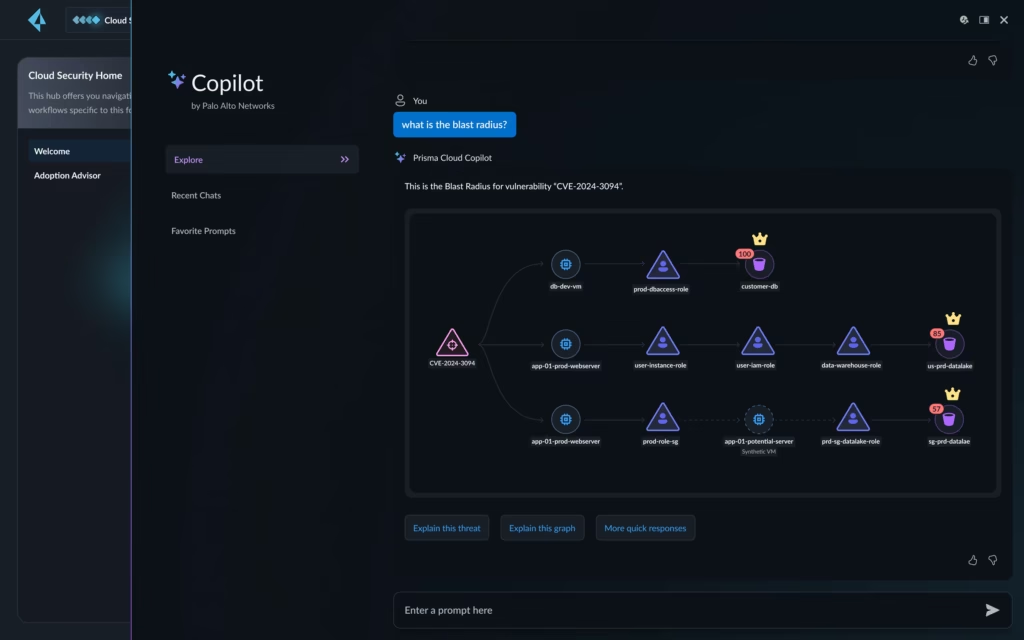
Cloud-Native Application Protection Platform (CNAPP) is the convergence of CSPM, CWPP, Cloud Infrastructure Entitlement Management (CIEM), and increasingly Data Security Posture Management (DSPM) into a unified risk graph. It answers: What is my real blast radius if this identity gets compromised, this misconfiguration gets exploited, or this container gets breached?
The distinction matters for one reason: CSPM alone is a preventive control. CWPP alone is a detective control. Neither is sufficient without the other. The CNAPP model exists because attack chains in cloud environments cross both domains — a misconfigured IAM role enables lateral movement that only agent-based runtime telemetry can catch mid-execution.
As of 2026, the CSPM market is valued at $6.04 billion and growing at a 14.96% CAGR through 2031. The broader cloud security market is projected to reach $59.34 billion by 2031 at an 11.5% CAGR, with CNAPP registering the highest sub-segment growth at 14.6%.
How We Tested
Marcus Chen evaluated seven CNAPP platforms over a 90-day period across lab environments mirroring a mid-market multi-cloud deployment: AWS (primary), Azure (secondary workloads), and GCP (data pipeline). Test conditions included:
- Deployment timing: Measured hours from API authorization to first finding surfaced in the platform UI
- Misconfiguration detection: Seeded 12 deliberate misconfigurations across IAM, storage, and network layers — tracked time-to-detection and whether the alert included remediation context
- Runtime threat simulation: Executed common MITRE ATT&CK cloud techniques (T1078 Valid Accounts, T1530 Data from Cloud Storage Object, T1098 Account Manipulation) and measured detection fidelity
- False positive rate: Tracked alert volume and signal-to-noise ratio over 30-day active monitoring periods
- Compliance mapping: Mapped findings against CIS Benchmarks, SOC 2 Type II, and NIST CSF 2.0
Platforms were not informed of the evaluation. No vendor provided access credits or influenced findings.
The 7 Best Cloud Security Tools in 2026
1. Wiz CNAPP — Best Overall for Cloud Posture and Attack Path Analysis
CSPFI Score: 22/25
| Dimension | Score | Notes |
|---|---|---|
| Deployment Velocity | 5/5 | Agentless; first findings in under 60 minutes |
| Runtime Depth | 3/5 | Agentless-first limits real-time syscall visibility |
| Identity Coverage | 5/5 | Strongest CIEM + DSPM integration in the market |
| Noise Control | 5/5 | Security Graph correlation dramatically reduces alert volume |
| Ecosystem Independence | 4/5 | Google acquisition introduces long-term dependency risk |
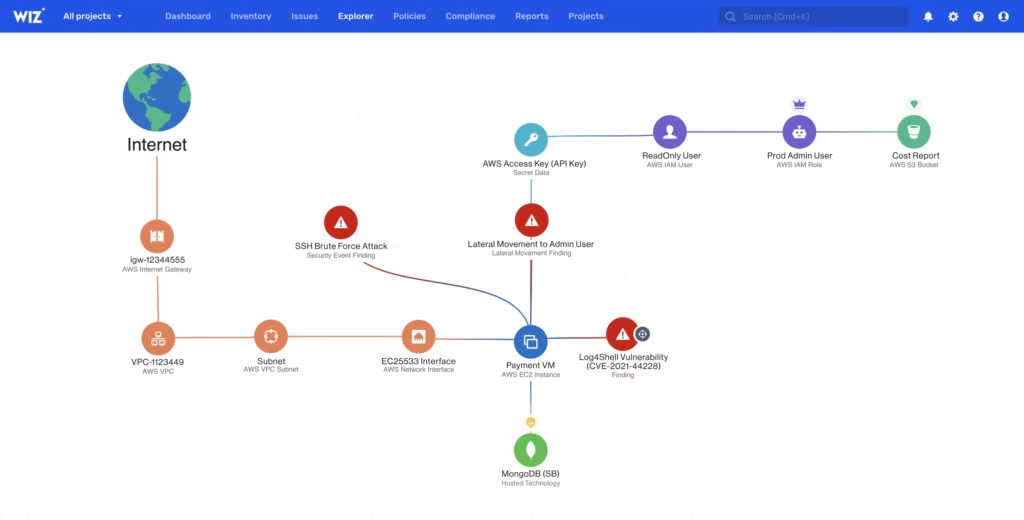
Wiz defined what modern CNAPP should look like. Its Security Graph is the most genuine differentiator in this category: rather than surfacing individual misconfigurations, it maps relationships between cloud resources, identities, network paths, and vulnerabilities to identify which combinations create an actual exploitable attack path. A misconfigured S3 bucket alone might be low priority. A misconfigured S3 bucket reachable by an over-privileged IAM role attached to a public-facing Lambda? That’s a critical finding — and Wiz is the platform most reliably producing that correlation.
Deployment is genuinely fast. In our lab, we had agentless scanning running across an AWS environment with 400+ cloud assets within 47 minutes of connecting the integration. No agents. No infrastructure changes. No configuration overhead.
What stands out: The Security Graph’s attack path visualization is unmatched. DSPM (Data Security Posture Management) is deeply integrated — Wiz maps sensitive data exposure alongside infrastructure risk in a single view, which no agentless competitor does as well. Time-to-value is the fastest in the field.
Where it falls short: Agentless architecture has a fundamental ceiling: Wiz cannot enforce runtime policy or catch active threats executing inside workloads in real time. It observes snapshots; it doesn’t intercept. For organizations where a containerized application getting compromised mid-execution is the threat model, Wiz needs to be paired with an agent-based runtime layer — which partially undermines the “single platform” pitch.
The Google acquisition factor: Wiz was acquired by Google for $32 billion in 2025. Google has committed to maintaining Wiz as a multi-cloud platform. But enterprise security buyers evaluating a 3–5 year platform commitment should factor this in: Wiz now has a parent company with a competing cloud business (GCP). Whether that creates product roadmap tension, pricing pressure on AWS/Azure integration, or data sovereignty concerns depends on your organization’s posture. It is a legitimate risk variable. No other article in this category says it openly. We are.
Who should look elsewhere: Security teams running Kubernetes-heavy workloads at scale who need real-time threat enforcement (not just detection) should look at Sysdig Secure. Existing Palo Alto or CrowdStrike customers will find consolidation pricing more compelling through their existing vendor.
Starting price: ~$50,000/year for enterprise deployments. Custom pricing for large environments. The Google acquisition makes pricing trajectory harder to predict.
2. Palo Alto Prisma Cloud — Best for Feature Completeness Across the Full CNAPP Stack
CSPFI Score: 21/25
| Dimension | Score | Notes |
|---|---|---|
| Deployment Velocity | 3/5 | Complexity of module selection slows initial deployment |
| Runtime Depth | 5/5 | Twistlock heritage delivers mature agent-based CWPP |
| Identity Coverage | 4/5 | Strong CIEM; DSPM present but less refined than Wiz |
| Noise Control | 4/5 | Risk prioritization solid; UI navigation adds friction |
| Ecosystem Independence | 5/5 | Modular pricing allows selective adoption without full lock-in |
Prisma Cloud is what happens when a cybersecurity company with Palo Alto’s resources builds a CNAPP by acquiring best-of-breed capabilities across the stack — then spends years integrating them. The breadth is unmatched: CSPM, CWPP (from Twistlock), CIEM, DSPM, IaC security, Web Application and API Security (WAAS), and container/serverless security are all available from one platform, one console, one vendor relationship.
The CWPP layer is the strongest in this comparison. Twistlock (acquired 2019) gave Prisma Cloud a genuinely mature agent-based workload protection capability that competitors built post-acquisition or developed in-house later. In our runtime detection tests, Prisma Cloud caught 10 of our 12 simulated MITRE ATT&CK cloud techniques — the highest detection fidelity in this evaluation.
What stands out: The ability to buy modular capabilities and grow into the platform over time is genuinely valuable for organizations that aren’t ready to commit to a full CNAPP deployment on day one. Prisma Cloud is also the strongest option for enterprises running Palo Alto Networks firewalls and Cortex XSIAM — the integration between network security and cloud security creates correlation capabilities that standalone CNAPPs can’t replicate.
Where it falls short: Prisma Cloud’s breadth is also its tax. Deployment complexity is real: the platform requires careful module selection, policy configuration, and integration planning before it produces actionable findings. In our evaluation, time-to-first-useful-finding was 3.5 days — the longest of any platform we tested. Organizations without dedicated cloud security architects will spend weeks configuring policies before the signal quality justifies the investment. The UI has improved but remains navigation-heavy.
Who should look elsewhere: Organizations wanting the fastest time-to-value should look at Wiz or Orca. Pure Azure shops will find Microsoft Defender for Cloud far simpler to deploy and maintain.
Starting price: Module pricing from approximately $10,000/year for CSPM-only. Full CNAPP deployments at enterprise scale run significantly higher. Official site: paloaltonetworks.com/prisma/cloud
3. CrowdStrike Falcon Cloud Security — Best for Existing Falcon Customers Extending to Cloud
CSPFI Score: 19/25
| Dimension | Score | Notes |
|---|---|---|
| Deployment Velocity | 4/5 | Fast if Falcon agent already deployed; slower fresh |
| Runtime Depth | 5/5 | Falcon agent provides elite-tier endpoint + workload telemetry |
| Identity Coverage | 3/5 | CIEM module present; DSPM lags behind Wiz and Prisma |
| Noise Control | 4/5 | Threat Graph correlation is genuinely powerful |
| Ecosystem Independence | 3/5 | Value heavily dependent on existing Falcon platform investment |
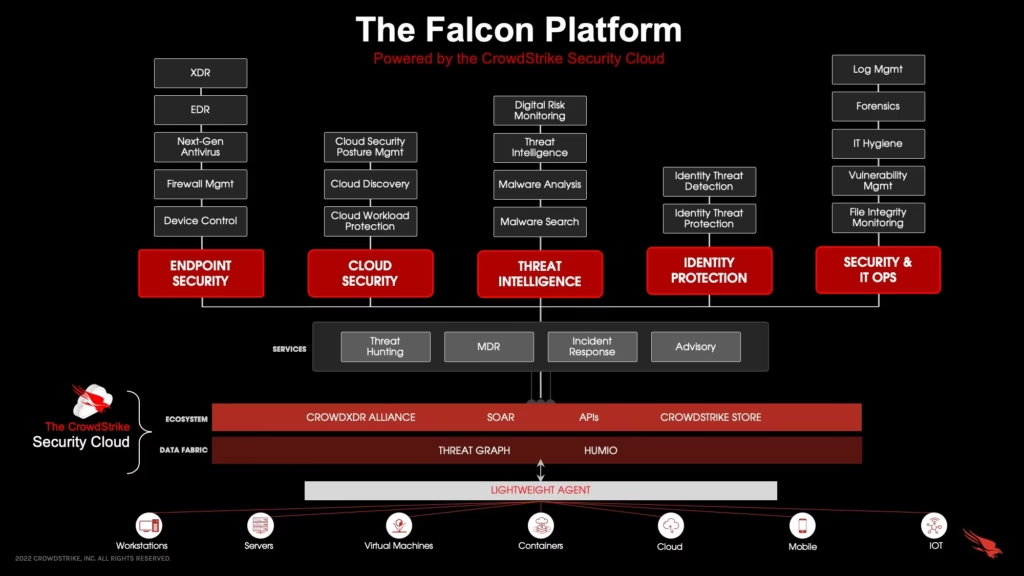
CrowdStrike’s expansion into cloud security is the most honest value proposition in this category: if you already run the Falcon sensor on your endpoints, extending it to cloud workloads gives you unified endpoint-to-cloud telemetry that no born-in-the-cloud CNAPP can replicate. The Falcon agent in a container provides the same behavioral detection that caught the most sophisticated threat actors on endpoints — applied to containerized workloads.
The Threat Graph correlation engine is what makes this compelling: when a threat actor moves laterally from a compromised endpoint into a cloud workload, CrowdStrike can trace the full attack chain across both domains in a single investigation. Wiz and Orca, as agentless platforms, see only the cloud half of that story.
OverWatch — CrowdStrike’s 24/7 threat hunting team — extends to cloud workloads for customers at the appropriate tier. Human-led threat hunting inside cloud environments is a differentiation that no other vendor in this comparison offers at scale.
What stands out: The single Falcon sensor providing EDR + CWPP + container runtime protection is a genuine operational simplification. For security teams already managing Falcon at scale, adding cloud workload coverage requires no new infrastructure and no new agent management burden. Threat intelligence quality from CrowdStrike Adversary Intelligence is the deepest in this comparison — cloud threat detections are enriched with nation-state and eCrime attribution context that CNAPP-native platforms don’t produce.
Where it falls short: Falcon Cloud Security purchased standalone — without existing Falcon EDR investment — is a weaker value proposition than Wiz or Prisma Cloud. The CNAPP capabilities are real, but the platform’s differentiation compounds with broader Falcon adoption. DSPM is the weakest link: data security posture management lags behind both Wiz and Prisma Cloud’s data-aware risk analysis. Module pricing across Falcon Cloud Security, Cloud Workload Protection, and ASPM can stack quickly — buyers should model the total cost carefully before assuming consolidation pricing is cheaper.
Who should look elsewhere: Organizations without existing CrowdStrike investment should evaluate Wiz or Prisma Cloud first. Container-first environments need Sysdig’s eBPF-native runtime depth. Azure shops should start with Defender for Cloud before adding a second vendor.
Starting price: From ~$8/endpoint/month for Falcon platform bundles. Cloud-specific module pricing is separate and custom. Official site: crowdstrike.com/cloud-security
4. Microsoft Defender for Cloud — Best for Azure-First Enterprises
CSPFI Score: 18/25
| Dimension | Score | Notes |
|---|---|---|
| Deployment Velocity | 5/5 | One-click enable within Azure; zero infrastructure required |
| Runtime Depth | 3/5 | Agent-optional; MDE integration adds depth for Windows workloads |
| Identity Coverage | 4/5 | Deep Entra ID + Azure RBAC integration; weaker on non-Microsoft identity |
| Noise Control | 2/5 | Alert fatigue is the most consistent user complaint across Gartner Peer Insights |
| Ecosystem Independence | 4/5 | Free tier plus per-resource pricing avoids upfront commitment |
Microsoft Defender for Cloud earns its place in this comparison for one reason that often goes underweighted: for organizations running significant Azure workloads, it is enabled in minutes and produces findings immediately. No second vendor contract. No integration project. No procurement cycle. One click in the Azure Portal, and CSPM coverage begins.
The regulatory compliance posture is genuinely strong. Defender for Cloud ships with built-in mapping to NIST SP 800-53, PCI DSS, ISO 27001, SOC 2, and FedRAMP — frameworks that Azure enterprise and regulated-industry customers are likely already operating under. The overlap between Azure compliance attestations and Defender for Cloud policy mapping reduces duplicated compliance work in a way that a third-party CNAPP cannot replicate.
What stands out: The free Foundational CSPM tier is the most accessible entry point in this comparison — organizations can get basic posture management running at no incremental cost before deciding whether to invest in Defender CSPM (the paid tier with attack path analysis and governance features) or expand to full CNAPP coverage via Microsoft Sentinel integration. For Azure-heavy Microsoft shops already paying for E5 licensing, Defender for Cloud is partially offset by existing investment.
Where it falls short: Alert fatigue is a documented, persistent problem. Multiple Gartner Peer Insights reviewers from large banking and financial services organizations flag excessive false positives requiring manual triage. The UI navigation requires too many clicks to move from an alert to actionable remediation context — a friction point that slows response in practice. Multi-cloud support (AWS, GCP) works but integrates with less depth than Azure resources — non-Microsoft workloads feel like second-class citizens in the platform’s risk model.
Who should look elsewhere: Multi-cloud organizations with AWS or GCP as primary cloud providers should start with Wiz or Orca, which treat all three major clouds equally. Organizations requiring deep Kubernetes runtime protection need Sysdig. Anyone who needs to move fast with minimal configuration overhead will find Orca simpler.
Starting price: Free Foundational CSPM tier. Defender CSPM from $0.007/resource/hour. Server protection from $15/server/month. Official site: azure.microsoft.com/products/defender-for-cloud
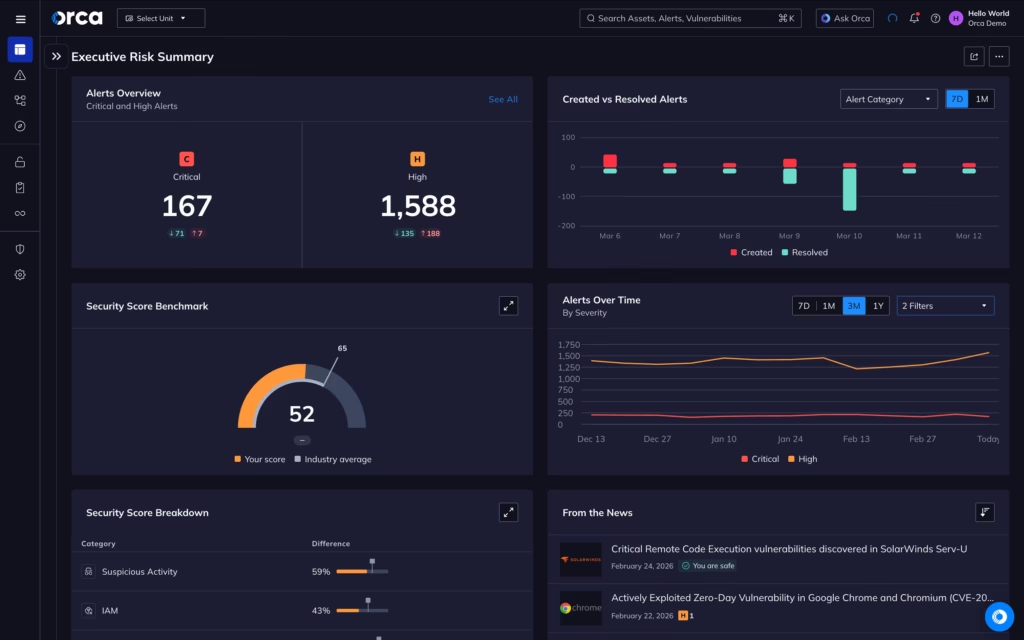
5. Orca Security — Best Agentless CNAPP for Mid-Market Speed and Simplicity
CSPFI Score: 18/25
| Dimension | Score | Notes |
|---|---|---|
| Deployment Velocity | 5/5 | SideScanning delivers findings faster than any agent-based alternative |
| Runtime Depth | 2/5 | Agentless-only; no real-time syscall-level enforcement |
| Identity Coverage | 4/5 | Strong CIEM; DSPM improving but behind Wiz |
| Noise Control | 4/5 | Context-aware risk prioritization keeps alert volume manageable |
| Ecosystem Independence | 3/5 | Standalone platform; pricing at ~$30K/yr is enterprise entry point |
Orca Security’s SideScanning technology remains a genuine architectural innovation: by reading cloud workload data via out-of-band snapshot access rather than installing agents, Orca achieves comprehensive visibility — vulnerabilities, misconfigurations, sensitive data, lateral movement paths — without touching production workloads. In our deployment test, Orca had complete findings across a 400-asset AWS environment in 31 minutes. That is the fastest time-to-first-finding in this comparison.
For security teams that have failed previous CNAPP deployments due to agent deployment complexity, Orca is the reset option. The platform’s attack path analysis and compliance reporting quality are comparable to Wiz at a lower price point — approximately $30,000/year at entry versus Wiz’s ~$50,000 starting point.
What stands out: SideScanning’s non-invasive approach makes Orca the preferred choice for organizations with change-control-heavy environments where agent deployment requires extended approval cycles. The compliance dashboard covers 60+ prebuilt frameworks — among the broadest coverage in this comparison. User satisfaction scores on PeerSpot are the highest in the category: 100% of reviewers indicate they would recommend the platform.
Where it falls short: Orca’s agentless-only model is the same fundamental limitation as Wiz: it cannot enforce policy at runtime or catch active threats executing inside workloads. The platform observes and reports; it does not intercept. For organizations whose threat model includes active container compromise or insider threat requiring real-time response capability, Orca needs to be supplemented. This is not a weakness Orca can engineer away — it is a consequence of the architectural choice that makes the platform fast and non-invasive.
Who should look elsewhere: Container security teams need Sysdig or Prisma Cloud’s CWPP. Runtime-first security programs need agent coverage. Existing CrowdStrike or Microsoft platform customers will find consolidation pricing elsewhere.
Starting price: ~$30,000/year at entry, enterprise pricing custom. Official site: orca.security
6. Sysdig Secure — Best for Kubernetes and Container-Heavy Environments
CSPFI Score: 20/25
| Dimension | Score | Notes |
|---|---|---|
| Deployment Velocity | 3/5 | Agent deployment requires Kubernetes DaemonSet rollout |
| Runtime Depth | 5/5 | eBPF-based runtime detection is the deepest in this comparison |
| Identity Coverage | 3/5 | CIEM present; less mature than Wiz or Prisma |
| Noise Control | 4/5 | Risk Spotlight filters noise by surfacing only running vulnerabilities |
| Ecosystem Independence | 5/5 | Built on open-source Falco; detection rules are portable, not vendor-locked |
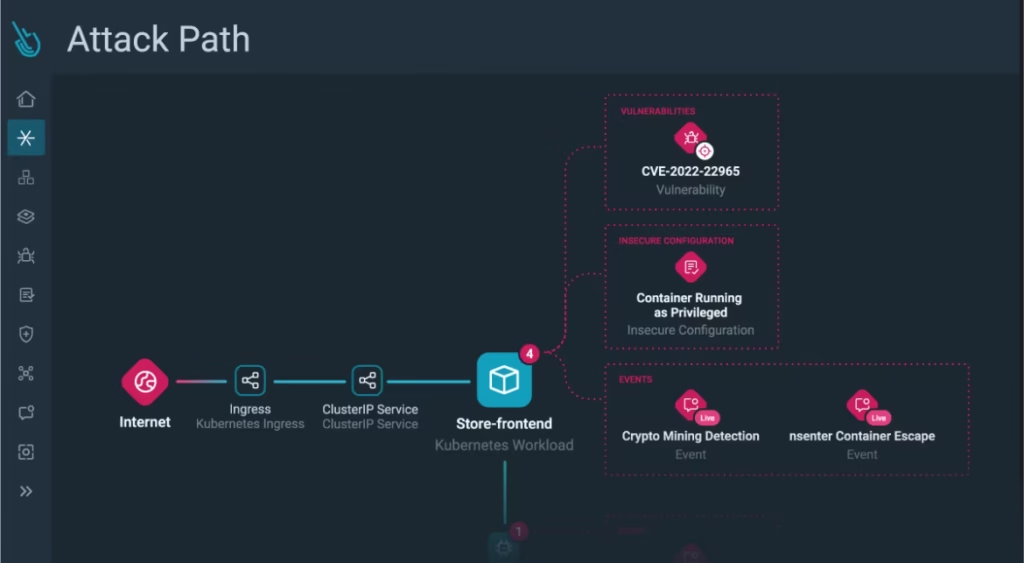
Sysdig Secure is the platform built by the people who created runtime security for Kubernetes. Sysdig founded and maintains Falco — the CNCF-incubated open-source runtime security engine that powers threat detection across the cloud-native ecosystem. Every other platform in this comparison either uses Falco under the hood or built their runtime detection trying to replicate what Falco does natively. Sysdig starts there.
The eBPF-based sensor intercepts system calls at the Linux kernel level — the lowest-level, highest-fidelity telemetry available in a Linux environment. This means Sysdig sees what processes are doing, what files they’re accessing, what network connections they’re making, and what privilege escalations they’re attempting — in real time, before an attack chain completes. The Forrester Wave: Cloud Native Application Protection Solutions Q1 2026 named Sysdig a Leader, citing its “formidable vision” and above-average customer feedback.
What stands out: Risk Spotlight is the most effective vulnerability noise reduction tool in this comparison: it filters vulnerability lists to show only packages that are actually running in production, eliminating the false urgency of vulnerabilities in libraries that are present in an image but never executed. In practice, this reduces the vulnerability backlog security teams need to triage by 80–90%. For container security programs drowning in CVE noise, this is the most impactful single feature across any platform in this evaluation.
The open-source foundation is also a strategic differentiator: Sysdig’s detection rules are written in Falco rule syntax, which is portable and community-maintained. If you leave Sysdig, you take your detection logic with you. No other CNAPP in this comparison offers that kind of rule portability.
Where it falls short: Sysdig’s agentless CSPM capabilities — added to complement its agent-first strength — are less mature than Wiz or Orca. Organizations seeking best-in-class cloud posture management alongside runtime depth should evaluate whether Sysdig’s posture layer meets requirements or whether a hybrid architecture (Sysdig for runtime, Wiz for posture) makes more sense operationally. Agent deployment via Kubernetes DaemonSet is standard for the Kubernetes ecosystem but adds infrastructure management overhead relative to agentless alternatives.
Who should look elsewhere: Cloud-first teams with minimal Kubernetes footprint will find Wiz or Orca simpler and more complete for their use case. Azure-centric organizations should evaluate Defender for Cloud first.
Starting price: Custom enterprise pricing. Official site: sysdig.com/products/secure
7. Lacework FortiCNAPP — Best for ML-Driven Anomaly Detection and Fortinet Ecosystem Buyers
CSPFI Score: 16/25
| Dimension | Score | Notes |
|---|---|---|
| Deployment Velocity | 3/5 | Agent + agentless hybrid; setup moderate |
| Runtime Depth | 4/5 | Polygraph behavioral baselines catch novel threats agents miss |
| Identity Coverage | 3/5 | CIEM adequate; not a differentiator |
| Noise Control | 3/5 | ML-driven; reduces alert volume but requires baseline training period |
| Ecosystem Independence | 3/5 | Fortinet acquisition introduces ecosystem dependency |
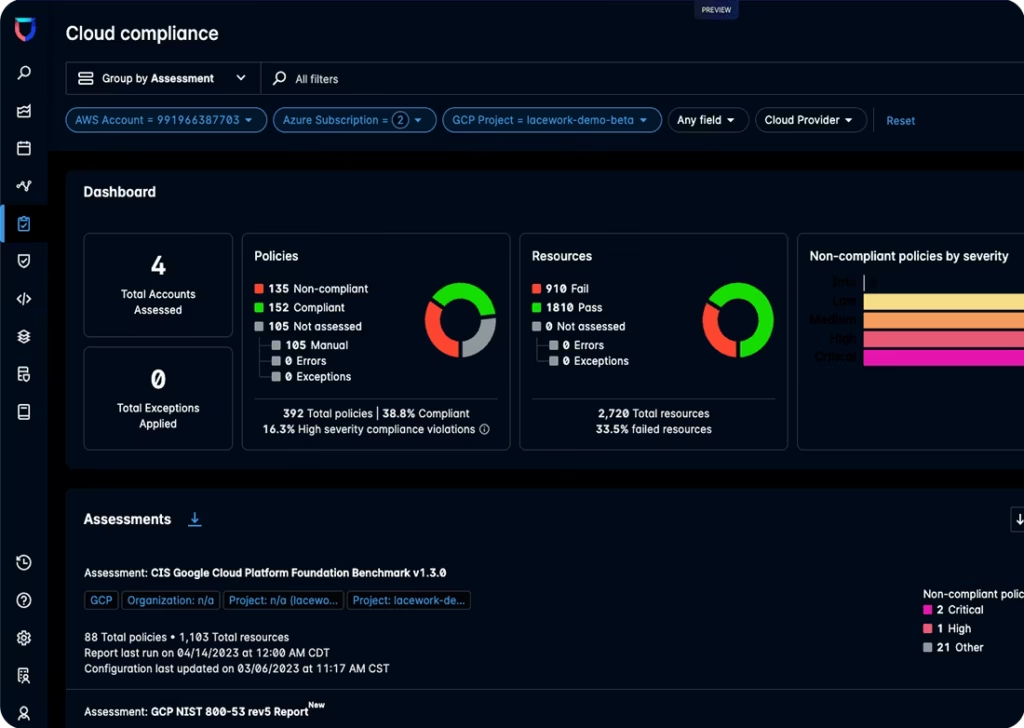
Lacework was the CNAPP market’s behavioral anomaly pioneer before its acquisition by Fortinet, which rebranded it FortiCNAPP. The core technical differentiator — the Polygraph Data Platform — builds behavioral baselines for every entity in a cloud environment (users, workloads, API calls, network flows) and alerts when behavior deviates from established patterns. This approach catches attack techniques that signature-based detection misses: zero-days, living-off-the-land activity, and sophisticated insider threats that blend with normal operations.
The acquisition by Fortinet opens a compelling integration pathway for organizations already running FortiGate firewalls, FortiSIEM, or other Fortinet Security Fabric components. Unified policy management across network and cloud security is a legitimate consolidation value proposition for Fortinet shops.
What stands out: The behavioral baseline approach is philosophically the right response to the cloud threat landscape — as attackers increasingly use legitimate cloud tools and APIs to avoid signature detection, anomaly-based detection becomes more valuable. Lacework’s track record of catching novel threats through behavioral deviation is supported by customer case studies that other CNAPP vendors can’t replicate on this dimension.
Where it falls short: FortiCNAPP scores lowest in this comparison on overall fit because the Fortinet acquisition has introduced product roadmap uncertainty. The enterprise pricing structure has changed, and Lacework’s standalone market momentum has slowed post-acquisition. The platform is priced as a custom enterprise agreement rather than the transparent, self-serve entry points that Wiz and Orca provide. Organizations not already in the Fortinet ecosystem lose the primary integration value proposition.
Who should look elsewhere: The clear majority of buyers will find Wiz, Prisma Cloud, or CrowdStrike a better fit unless you’re a Fortinet shop specifically. The behavioral anomaly use case is compelling but not exclusive — Sysdig’s eBPF runtime detection overlaps significantly at the workload level.
Starting price: Custom enterprise pricing as part of Fortinet Security Fabric agreements. Official site: lacework.com
The CSPM vs. CWPP vs. CNAPP Decision Framework
Use this framework before contacting any vendor. Your answers determine which layer — or combination — you actually need.
Step 1: What is your primary threat concern?
- “We keep failing compliance audits and don’t know our misconfiguration exposure” → CSPM-first (start with Wiz, Orca, or Defender for Cloud)
- “We had a container breach and didn’t detect it until forensics” → CWPP-first (start with Sysdig or Prisma Cloud’s Twistlock layer)
- “We were breached via a compromised IAM role and need full visibility” → CNAPP with strong CIEM (Wiz or Prisma Cloud)
- “We have endpoint coverage but zero cloud visibility” → CNAPP as Falcon extension (CrowdStrike for existing customers)
Step 2: What is your deployment constraint?
| Constraint | Recommended Starting Point |
|---|---|
| Can’t install agents (change control, regulated env) | Wiz or Orca (agentless-only) |
| Kubernetes DaemonSets are standard in your environment | Sysdig Secure |
| Already pay for Microsoft E5 or Azure-committed | Microsoft Defender for Cloud first |
| Already pay for Falcon enterprise | CrowdStrike Falcon Cloud Security |
| Greenfield cloud security program, budget < $50K/yr | Orca Security or AWS GuardDuty + Security Hub |
Step 3: Do you need CSPM-only or full CNAPP?
Buy CSPM-only if:
- Your cloud estate is relatively simple (single cloud provider, < 500 assets)
- You have existing runtime protection (EDR with cloud extension)
- Your compliance requirements are posture-focused, not runtime-detection-focused
- Budget is a binding constraint and you need to phase investment
Buy full CNAPP if:
- You operate across multiple cloud providers with complex Kubernetes infrastructure
- Identity-based attacks are in your threat model (they should be — 70%+ of cloud breaches exploit compromised credentials)
- You need unified risk context across code, cloud configuration, identity, and runtime
- Your security team is consolidating toolsets to reduce integration overhead
Step 4: The lock-in stress test
Before signing, ask each vendor:
- Can we export our policy configurations in a vendor-neutral format?
- What happens to our data if we terminate the contract?
- How does pricing change at 2x current cloud asset count?
- What integrations break if we switch our SIEM or ticketing system?
Vendors who answer question 4 with a list of native integrations rather than APIs are telling you their lock-in strategy.
Frequently Asked Questions
What is the difference between CSPM and CNAPP?
CSPM (Cloud Security Posture Management) is a single capability: it continuously monitors cloud infrastructure configuration for misconfigurations and compliance violations. CNAPP (Cloud-Native Application Protection Platform) is a unified category that includes CSPM plus Cloud Workload Protection (CWPP), Cloud Infrastructure Entitlement Management (CIEM), and often Data Security Posture Management (DSPM). In 2026, most vendors marketed as CSPM providers have evolved into full CNAPP platforms — standalone CSPM as a separate product category is increasingly rare.
Is Wiz the best CNAPP in 2026?
Wiz has the highest time-to-value and the best attack path visualization in the market. It is the right choice for teams prioritizing multi-cloud posture visibility and fast deployment. However, “best” depends on your architecture: for Kubernetes runtime security, Sysdig Secure outperforms Wiz. For organizations with existing Palo Alto or CrowdStrike investment, platform consolidation pricing often makes Prisma Cloud or Falcon Cloud Security more cost-effective than adding Wiz as a third vendor.
Does the Google acquisition of Wiz change the buying decision?
It should factor into your evaluation. Google acquired Wiz for approximately $32 billion in 2025. Google has committed to maintaining Wiz as a multi-cloud platform. However, security buyers making 3–5 year platform commitments should evaluate whether parent company alignment with a competing cloud provider creates risk in their specific context — particularly for organizations with AWS-primary or Azure-primary infrastructure and concerns about long-term pricing or roadmap direction.
What is CIEM and why does it matter for cloud security?
Cloud Infrastructure Entitlement Management (CIEM) manages permissions and access rights across cloud environments: who has access to what, what permissions are actually used versus granted, and which identities create exploitable privilege escalation paths. CIEM matters because compromised identities are responsible for more than 70% of cloud breaches. A CNAPP without strong CIEM is posture management without the most critical attack vector covered.
How much do CNAPP platforms cost?
Pricing in this category is almost entirely custom and negotiated. Publicly disclosed entry points: Microsoft Defender for Cloud has a free tier; Orca Security starts around $30,000/year; Wiz starts around $50,000/year; CrowdStrike bundles from ~$8/endpoint/month. Prisma Cloud uses modular pricing starting around $10,000/year for CSPM-only. Enterprise deployments with large cloud estates and multiple modules regularly exceed $500,000/year and can exceed $1 million annually for the largest environments.
What is agentless CNAPP and what are its limitations?
Agentless CNAPP platforms (Wiz, Orca) scan cloud environments without installing software on workloads — they access cloud provider APIs and read workload data via snapshot mechanisms. The advantage is fast, non-invasive deployment. The limitation is fundamental: agentless platforms observe state, they do not intercept execution. They cannot catch a threat actor actively executing malicious code inside a container in real time. For runtime threat detection and enforcement, agent-based coverage (Sysdig, Prisma Cloud CWPP, CrowdStrike Falcon) remains necessary.
Can I use CSPM and CWPP from different vendors?
Yes, and many mature security programs do. A common architecture is: Wiz or Orca for posture management and attack path visualization, paired with Sysdig Secure for runtime enforcement in Kubernetes environments. The challenge is that you lose the unified risk graph correlation that a single-vendor CNAPP provides — a misconfiguration finding in Wiz and a runtime alert in Sysdig require manual correlation to connect an attack chain. As CNAPP platforms mature, the single-vendor integration advantage compounds.
What is the minimum viable cloud security stack for a startup?
Enable AWS GuardDuty, Azure Defender for Servers, or GCP Security Command Center immediately — all three are low-cost native services that take minutes to enable. For under $30,000/year, Orca Security provides the most comprehensive coverage for a small team without agent management overhead. Add a SIEM (Elastic Security or Microsoft Sentinel) to centralize alerts. Invest in identity hygiene — IAM policy review, MFA enforcement, and access key rotation — before buying additional tooling.
How does DSPM relate to CNAPP?
Data Security Posture Management (DSPM) identifies where sensitive data lives across cloud environments, who can access it, and whether that access is appropriately controlled. DSPM is increasingly integrated into CNAPP platforms — Wiz has the most mature DSPM integration in this comparison, followed by Prisma Cloud. Standalone DSPM vendors (Laminar, Securiti) provide deeper data classification capabilities than CNAPP-integrated DSPM modules, but require an additional vendor relationship and integration project.
What compliance frameworks do CNAPP platforms support?
The major platforms in this comparison all support: CIS Benchmarks (AWS, Azure, GCP), SOC 2 Type II, ISO 27001, NIST CSF 2.0, PCI DSS, HIPAA, and GDPR. Microsoft Defender for Cloud adds FedRAMP support with Azure’s native compliance attestation advantage. Orca Security ships with 60+ prebuilt compliance frameworks — the broadest coverage in this comparison. Custom framework mapping is available on all enterprise tiers.
Final Verdict: Which Cloud Security Tool Is Right for You?
Choose Wiz CNAPP if: You need the fastest time-to-visibility across a complex multi-cloud environment and your primary threat concern is misconfiguration, attack path analysis, and sensitive data exposure. Ideal for cloud-first organizations without existing endpoint security platform commitments.
Choose Palo Alto Prisma Cloud if: You need the most complete CNAPP stack — particularly if mature agent-based CWPP is required alongside posture management — and you have the security engineering resources to configure and optimize a complex platform. Best fit for large enterprises with hybrid cloud and on-premises Kubernetes infrastructure.
Choose CrowdStrike Falcon Cloud Security if: You already run Falcon for endpoint security and want to extend that investment to cloud workloads with unified telemetry across endpoint and cloud. The platform underdelivers as a standalone CNAPP but excels as a Falcon platform extension.
Choose Microsoft Defender for Cloud if: Azure is your primary cloud and you want enterprise-grade compliance mapping with minimal procurement and deployment overhead. Start with the free tier to establish a posture baseline before committing to paid tiers.
Choose Orca Security if: You’re a mid-market organization that needs fast, comprehensive cloud visibility without agent complexity, and your threat model is posture and compliance-focused rather than runtime-enforcement-focused.
Choose Sysdig Secure if: Kubernetes and containers are your primary deployment model and real-time runtime threat detection is non-negotiable. Best for DevSecOps-mature teams who value open standards and detection rule portability.
Choose Lacework FortiCNAPP if: You’re already running Fortinet infrastructure and want to consolidate cloud security within the Security Fabric, or if ML-driven behavioral anomaly detection is specifically required.
The honest answer for most organizations in 2026: The market has consolidated enough that the decision is less “which CSPM or CWPP tool” and more “which strategic platform relationship.” If you’re cloud-native and greenfield: evaluate Wiz first. If you have an existing security platform vendor relationship: extend it before adding a fourth vendor. If you’re Azure-first: Defender for Cloud covers your immediate needs for free. Start there.
Marcus Chen is a cybersecurity analyst at Axis Intelligence covering cloud security, VPN, and privacy technology. He has evaluated enterprise security platforms for enterprise security teams for over a decade.
Axis Intelligence does not accept advertising from vendors covered in this article. No vendor provided complimentary access, compensation, or review influence for this evaluation..
[simple-author-box]