

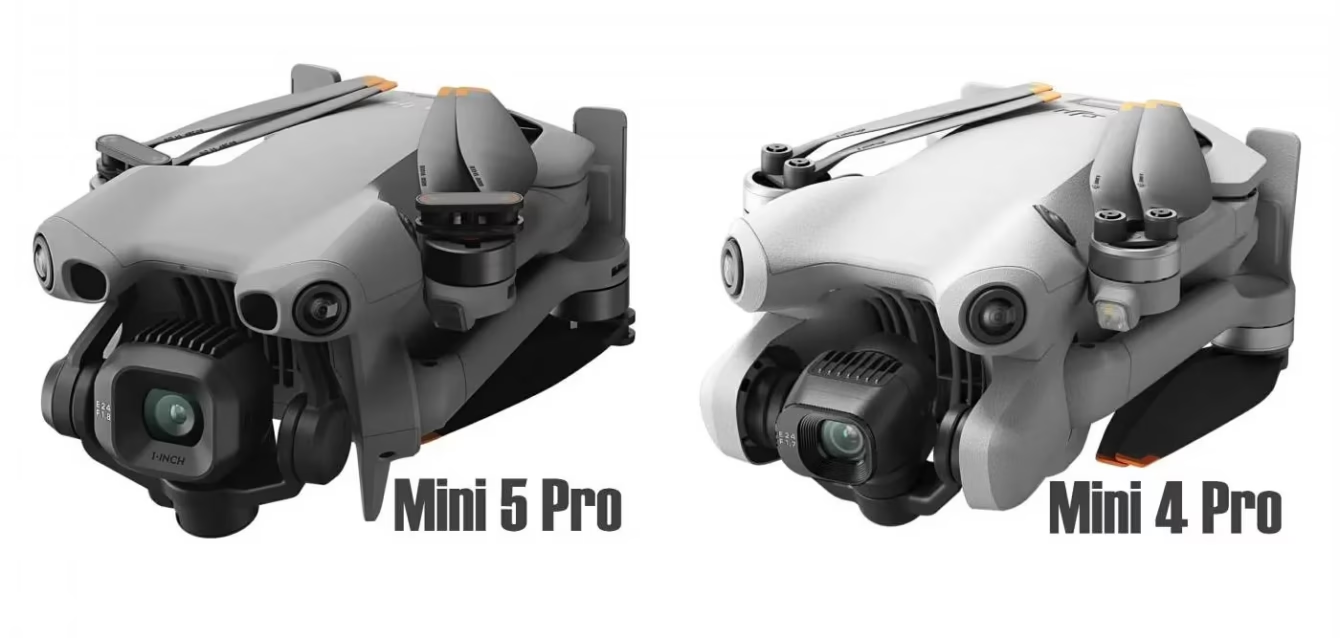
DJI Mini 5 Pro vs Mini 4 Pro
June 2, 2026 | Last updated: June 2, 2026
Comparison Table: DJI Mini 5 Pro vs Mini 4 Pro
| Specification | DJI Mini 5 Pro | DJI Mini 4 Pro |
|---|---|---|
| Launch date | September 17, 2025 | September 25, 2023 |
| Advertised weight | 249.9g | 249g |
| Real-world weight (measured) | ⚠️ 252–254g (most units) | ~249g (consistent) |
| Camera sensor | 1-inch CMOS, 50MP | 1/1.3-inch CMOS, 48MP |
| Aperture | f/1.8 (fixed) | f/1.7 (fixed) |
| Video (max) | 4K/120fps (slow motion) | 4K/100fps |
| 4K/60fps HDR | ✅ Yes | ✅ Yes |
| Color profiles | D-Log M, HLG, 10-bit | D-Log M, HLG, 10-bit |
| Dynamic range | 14 stops (D-Log M) | ~12.8 stops (D-Log M) |
| ISO range (video normal) | 100–12,800 | 100–6,400 |
| Gimbal rotation | 225° (true vertical) | 90° (true vertical) |
| Obstacle sensing | Omnidirectional + front LiDAR (Nightscape) | Omnidirectional vision only |
| Flight time (standard) | 36 min | 34 min |
| Flight time (Plus battery) | 52 min | 45 min |
| Transmission system | O4+ (20km FCC) | O4 (20km FCC) |
| Internal storage | 42GB | None |
| ActiveTrack | 360° (Standard + Cycling) | 360° (Standard) |
| US availability | Third-party resellers only | ✅ Full retail (Amazon, B&H, Best Buy) |
| Base price | ~$759 (reseller) / £689 / €799 | $759 / £689 |
| Fly More Combo (RC 2) | ~$1,099+ (reseller) / €1,149 | $979 |
Pricing verified June 1, 2026. US Mini 5 Pro prices reflect third-party reseller rates; official retail not available through DJI USA.
Quick Answer: The DJI Mini 5 Pro wins on camera (1-inch sensor, 4K/120fps, LiDAR, 52-min flight time) — but ships at 252–253g on most units despite DJI’s 249.9g spec, which has triggered registration requirements in the UK, Canada, and Australia. The Mini 4 Pro remains the better choice for US buyers who want guaranteed sub-250g status, full retail warranty, and a $150–200 lower price. Neither is the obvious answer without knowing where you live and how you fly.
Table of Contents
Camera Quality
Winner: DJI Mini 5 Pro
The single largest upgrade between these two drones is the sensor, and it’s not close. For the full hands-on breakdown, see our DJI Mini 5 Pro review. The Mini 5 Pro carries a full 1-inch CMOS sensor at 50MP — the same Quad-Bayer Sony unit identified by Philip Bloom as also used in the DJI Air 3S, a drone that costs significantly more. The Mini 4 Pro uses a 1/1.3-inch CMOS sensor at 48MP, which was already the best in its class at launch.
The practical difference shows up in two situations: low light and dynamic range. In golden hour, dusk, or interior shots near windows, the 1-inch sensor gathers roughly 2.5× more light than the Mini 4 Pro’s smaller chip. Multiple independent reviewers — including Tom’s Guide (rated the Mini 5 Pro 5/5) and Amateur Photographer — confirm that sunsets, backlit subjects, and blue-hour footage that previously required heavy post-processing on the Mini 4 Pro now render cleanly straight from the card. Dynamic range improves from approximately 12.8 stops to 14 stops in D-Log M, which translates directly to more recoverable highlights and shadow detail in challenging light.
Video capabilities also step up meaningfully. The Mini 5 Pro adds 4K/120fps slow motion — the Mini 4 Pro tops out at 4K/100fps. For sports, weddings, wildlife, or any footage where slow-motion is part of the creative toolkit, that 20fps gap matters. 1080p slow motion reaches 240fps on the Mini 5 Pro. Both drones shoot 4K/60fps HDR and offer 10-bit D-Log M for color grading.
One honest caveat flagged by long-term testers: the Mini 5 Pro’s Quad-Bayer sensor produces some color artifacts in 50MP stills that require HDR bracketing or careful post-processing to fully resolve. For daylight photography where conditions are controlled, the image quality difference between the two drones narrows considerably.
The Mini 4 Pro’s position: Its 1/1.3-inch sensor still delivers class-leading image quality for a sub-250g drone in good light. Our DJI Mini 4 Pro review covers it in full. Buyers who primarily shoot midday exteriors, real estate in daylight, or landscapes without strong contrast will see minimal practical benefit from upgrading to the 1-inch sensor.
Flight Performance & Battery
Winner: DJI Mini 5 Pro (on raw numbers); draw on real-world usability
The Mini 5 Pro extends standard battery flight time from 34 to 36 minutes — a 6% improvement that most pilots won’t notice in field conditions. The meaningful number is the Plus battery: 52 minutes versus the Mini 4 Pro’s 45 minutes, a 15.5% gain that adds one to two usable shots per outing.
Both figures are DJI lab measurements under controlled windless conditions. Real-world flight times run 15–20% lower depending on wind, temperature, flight style, and whether obstacle avoidance is active. Practical benchmarks: expect 26–30 minutes from the Mini 5 Pro’s standard battery and 40–44 minutes from the Plus battery in typical outdoor conditions.
Speed metrics are marginally better on the Mini 5 Pro: 19 m/s top speed (Plus battery configuration) versus 18 m/s for the Mini 4 Pro. Neither is relevant for normal content creation.
The critical flight performance variable is the weight issue covered in the next section. If the Mini 5 Pro’s real-world weight of 252–254g affects your regulatory category, it also affects every downstream benefit — you may be paying a premium for a drone that requires registration in jurisdictions where the Mini 4 Pro does not.
Weight, Regulation & The Mini 5 Pro’s Most Important Flaw
Winner: DJI Mini 4 Pro
This is the section most competitor comparisons soft-pedal. Axis Intelligence is not doing that.
DJI advertises the Mini 5 Pro at 249.9g — just under the critical 250g threshold that determines registration requirements in most countries. In practice, measurements from hundreds of owners across the drone community consistently show production units weighing 252–254g. According to DroneXL’s investigation, two last-minute design changes before launch — new propellers and an upgraded audio speaker for the DJI startup jingle — added approximately 4g that engineering couldn’t offset elsewhere.
The regulatory fallout has been real:
- UK Civil Aviation Authority: Confirmed no weight tolerances in UK regulations. Any unit above 250g loses C0 classification, requiring operator registration and additional compliance.
- Canada (Transport Canada): Units above 250g move into a higher regulatory category.
- Australia (CASA): Confirmed the Mini 5 Pro is classified as a “small restricted RPA,” not a sub-250g micro RPA. Registration required for commercial use regardless.
- EU/EASA: Formally confirmed the Mini 5 Pro maintains C0 classification despite the weight variance, citing manufacturing tolerances in the EASA standard. The EU situation is the most permissive.
- United States: The sub-250g FAA registration exemption for recreational flyers requires the drone to weigh under 250g. At 252–254g, the Mini 5 Pro requires FAA registration for recreational use, something the Mini 4 Pro does not.
DJI has acknowledged the issue and is reportedly preparing a hardware revision — new propellers and a lighter speaker — to bring production units back under the threshold before the end of 2026. Units currently in market will not be retrofitted.
The practical consequence: If you bought the Mini series specifically for the registration-free flying convenience, verify the weight of any Mini 5 Pro unit before assuming it qualifies. The Mini 4 Pro ships consistently at or under 249g.
Obstacle Avoidance & Safety
Winner: DJI Mini 5 Pro
Both drones have omnidirectional obstacle avoidance. The Mini 5 Pro goes further with a forward-facing LiDAR sensor that enables what DJI calls “Nightscape” detection — the ability to sense and avoid obstacles in low-light environments where the vision sensors used in both drones cannot reliably detect objects.
For the Mini 4 Pro, obstacle avoidance is effectively disabled in darkness because its system relies entirely on vision sensors that require ambient light to function. The Mini 5 Pro can maintain obstacle detection into urban nightscapes, during dusk, and in environments where the Mini 4 Pro would require disabling its avoidance system entirely to fly safely.
The practical benefit extends to return-to-home: the Mini 5 Pro can memorize its outbound flight route and return along it even without GPS signal, using LiDAR and stored visual data. This is a meaningful safety upgrade for urban canyon flying, indoor environments near windows, and any scenario where GPS reliability is reduced.
ActiveTrack also improves: the Mini 5 Pro’s 360° ActiveTrack adds a Cycling mode specifically calibrated for tracking moving subjects at speed, up to 15 m/s in open environments. The Mini 4 Pro’s ActiveTrack 360° lacks this mode. For sports and active tracking scenarios, this is a genuine workflow improvement.
Gimbal & Vertical Shooting
Winner: DJI Mini 5 Pro
Both drones support true vertical shooting, which means the camera physically rotates to portrait orientation rather than cropping a landscape frame — preserving full resolution for Instagram Reels, TikTok, and YouTube Shorts.
The Mini 5 Pro’s gimbal rotates 225° versus the Mini 4 Pro’s 90°. The additional rotation isn’t just for vertical mode — it enables a barrel roll shot inherited from the Mavic 3 series, producing creative angles (looking straight down, dramatic banking perspectives) that the Mini 4 Pro cannot physically achieve. For social media creators who mix landscape and portrait content, the 225° gimbal is a workflow improvement. For photographers who only need vertical as a static orientation option, the functional difference is negligible.
Transmission & Range
Winner: DJI Mini 5 Pro (marginal)
The Mini 5 Pro uses DJI’s O4+ transmission system; the Mini 4 Pro uses O4. Both offer a theoretical maximum of 20km in FCC mode. In practice, both drones return stable 1080p/60fps live feeds well beyond the practical range of their batteries — the 20km figure is a technical ceiling neither drone’s battery can approach.
The real-world difference is signal stability in congested RF environments — urban areas with dense Wi-Fi, Bluetooth, and cellular interference. O4+ uses a more aggressive frequency-hopping algorithm that multiple reviewers note maintains a more consistent feed in city environments. For rural landscape shooting where RF congestion is minimal, the two systems are practically equivalent.
Internal Storage
Winner: DJI Mini 5 Pro
The Mini 5 Pro ships with 42GB of internal storage. The Mini 4 Pro has none — you need a microSD card in every flight. Both drones support microSD expansion, but the internal buffer means Mini 5 Pro users have a safety net if they forget a card, and a faster write destination for burst shooting.
Pricing & Value
Winner: DJI Mini 4 Pro (for US buyers); Draw (internationally)
At launch, DJI priced the Mini 5 Pro identically to the Mini 4 Pro in the UK (£689) and Europe (€799) — a smart move that eliminates the typical generational upgrade premium. Internationally, the choice between them is purely about features, not price.
In the United States, the situation is different. DJI does not officially sell the Mini 5 Pro through its US store. Units available through Amazon and B&H Photo come through third-party importers and carry a $100–200 markup over the international base price. The Mini 4 Pro is fully available at $759 through all major US retailers, frequently discounted, and backed by full US warranty and service infrastructure. As of June 2026, DJI USA is unable to service Mavic 4 Pro units — a cautionary data point for buyers relying on Mini 5 Pro US service availability.
For US buyers, the Mini 5 Pro’s effective price premium of $150–200 over the Mini 4 Pro, combined with third-party warranty risk and the weight registration issue, changes the value calculation significantly compared to the international market.
Overall Verdict
For most international buyers (UK, EU, Canada, Australia, international markets): The DJI Mini 5 Pro is the better purchase at the same price. The 1-inch sensor, LiDAR safety, 4K/120fps, 42GB internal storage, 225° gimbal, and longer flight time are meaningful upgrades at no price premium. Understand and accept the weight registration situation in your jurisdiction before buying.
For US buyers: The DJI Mini 4 Pro remains the smarter purchase in most cases. Full retail availability, stable warranty infrastructure, consistent sub-250g compliance, and a lower effective price make it the lower-risk choice. The Mini 5 Pro is available through Amazon with Prime delivery and is legal to own and fly — but buy knowing you’re operating outside DJI’s official US support framework.
Choose the DJI Mini 5 Pro If…
- You shoot at dusk, golden hour, or in low-light environments where the 1-inch sensor’s light gathering makes a visible difference
- You need 4K/120fps slow motion for sports, wildlife, or events
- You want LiDAR obstacle avoidance for night flying or GPS-limited environments
- You primarily fly in the EU where EASA’s C0 classification holds for the weight variance
- You create vertical content for social media and want the full 225° gimbal rotation for creative angles
- You want 42GB internal storage as a backup when you forget a microSD card
Choose the DJI Mini 4 Pro If…
- You’re based in the US and want official retail pricing, US warranty support, and guaranteed FAA sub-250g exemption for recreational flying
- Your primary shooting conditions are daylight — the 1/1.3-inch sensor performs near-equivalently to the 1-inch in good light
- Budget is a factor — you can frequently find the Mini 4 Pro discounted to $599–699 at major US retailers
- You fly in the UK, Canada, or Australia where the Mini 5 Pro’s weight triggers a higher regulatory classification
- You’re a beginner buying your first serious drone — check our best beginner drones guide before committing to either model
Consider the DJI Air 3S Instead If…
The DJI Air 3S is the drone for buyers who need the Mini 5 Pro’s camera performance without the weight and regulatory complications. Read our DJI Air 3S review for the full breakdown. It uses the same 1-inch sensor, adds a second telephoto camera, delivers 45-minute flight time, and carries DJI’s full US retail and service support — at a higher weight (723g) and price ($1,099). If the sub-250g regulatory advantage isn’t central to your use case, the Air 3S is the more complete package.
FAQ: DJI Mini 5 Pro vs Mini 4 Pro
What is the main difference between the DJI Mini 5 Pro and Mini 4 Pro?
The primary differences are the camera sensor (1-inch vs 1/1.3-inch), obstacle avoidance system (LiDAR + vision vs vision-only), maximum video frame rate (4K/120fps vs 4K/100fps), flight time (52 vs 45 min with Plus battery), internal storage (42GB vs none), and gimbal rotation (225° vs 90°). The Mini 5 Pro is the more capable drone; the Mini 4 Pro has better US availability and guaranteed sub-250g compliance.
Is the DJI Mini 5 Pro available in the United States?
The Mini 5 Pro is not officially sold through DJI’s US store, but it is available through authorized resellers including Amazon and B&H Photo. It received FCC authorization and is legal to own and fly in the US. However, most production units weigh 252–254g rather than the advertised 249.9g, which may require FAA registration for recreational flyers under the sub-250g exemption threshold.
Does the DJI Mini 5 Pro actually weigh under 250g?
No — most production units weigh 252–254g, approximately 3–4g above the advertised 249.9g. DJI added new propellers and a speaker before launch that pushed the weight over the threshold. EASA has confirmed the drone maintains C0 classification in the EU despite the variance. The UK CAA, Canada’s Transport Canada, and Australia’s CASA have confirmed the Mini 5 Pro requires registration in their jurisdictions. A hardware revision is expected before end of 2026.
Is the Mini 5 Pro worth upgrading from the Mini 4 Pro?
For international buyers at the same price point, yes — the 1-inch sensor, LiDAR, 4K/120fps, internal storage, and extended flight time are meaningful improvements. For US buyers, the upgrade decision is more complex: you pay a reseller premium, lose US warranty coverage, and may need to register the drone where the Mini 4 Pro didn’t require it. If you primarily shoot in daylight and don’t need slow motion, the Mini 4 Pro remains an excellent camera drone.
What is LiDAR obstacle avoidance on the Mini 5 Pro?
The Mini 5 Pro adds a forward-facing LiDAR sensor (in addition to the omnidirectional vision sensors shared with the Mini 4 Pro) that detects obstacles in low-light environments where cameras cannot see. DJI calls this “Nightscape” sensing. It enables obstacle avoidance during dusk, night urban flying, and return-to-home in low visibility conditions — situations where the Mini 4 Pro’s vision-only system effectively disables obstacle detection.
Which drone has better image quality for video?
The Mini 5 Pro’s 1-inch sensor produces noticeably better video in challenging light — lower noise at high ISO, more shadow and highlight detail in HDR footage, and cleaner slow-motion thanks to the higher frame rate ceiling. In daylight with good conditions, the image quality gap narrows considerably. Philip Bloom identified the Mini 5 Pro’s sensor as the same Quad-Bayer Sony chip used in the DJI Air 3S, which costs significantly more.
What is 4K/120fps on the Mini 5 Pro used for?
4K/120fps is slow-motion video — recording at 120 frames per second and playing back at 24 or 30fps produces footage that plays at 4× to 5× slower than real time, creating the cinematic slow-motion effect. The Mini 4 Pro’s maximum of 4K/100fps produces comparable but marginally less smooth slow motion. For sports, wildlife, waves, or any dynamic subject where slow motion enhances storytelling, the Mini 5 Pro’s higher ceiling is a practical advantage.
Will DJI release a Mini 5 Pro firmware or hardware fix for the weight issue?
DJI is expected to release a hardware revision — new propellers and a lighter speaker — that brings production units back under the 250g threshold before the end of 2026. Existing units in market will not receive the weight correction via firmware. Buyers who need guaranteed sub-250g compliance should either wait for the revised SKU or purchase the Mini 4 Pro, which ships consistently under the threshold.
What controller options does the Mini 5 Pro come with?
The Mini 5 Pro is available with three controller options: the RC-N3 (screenless, uses your phone, entry-level), the RC 2 (built-in 5.5-inch screen, no phone needed, most popular), and the RC Pro (high-brightness screen for bright conditions, highest tier). The same RC 2 controller is compatible with both drones, so existing Mini 4 Pro RC 2 users can use their controller with the Mini 5 Pro.
Alex Rivera covers consumer tech and mobile for Axis Intelligence.