

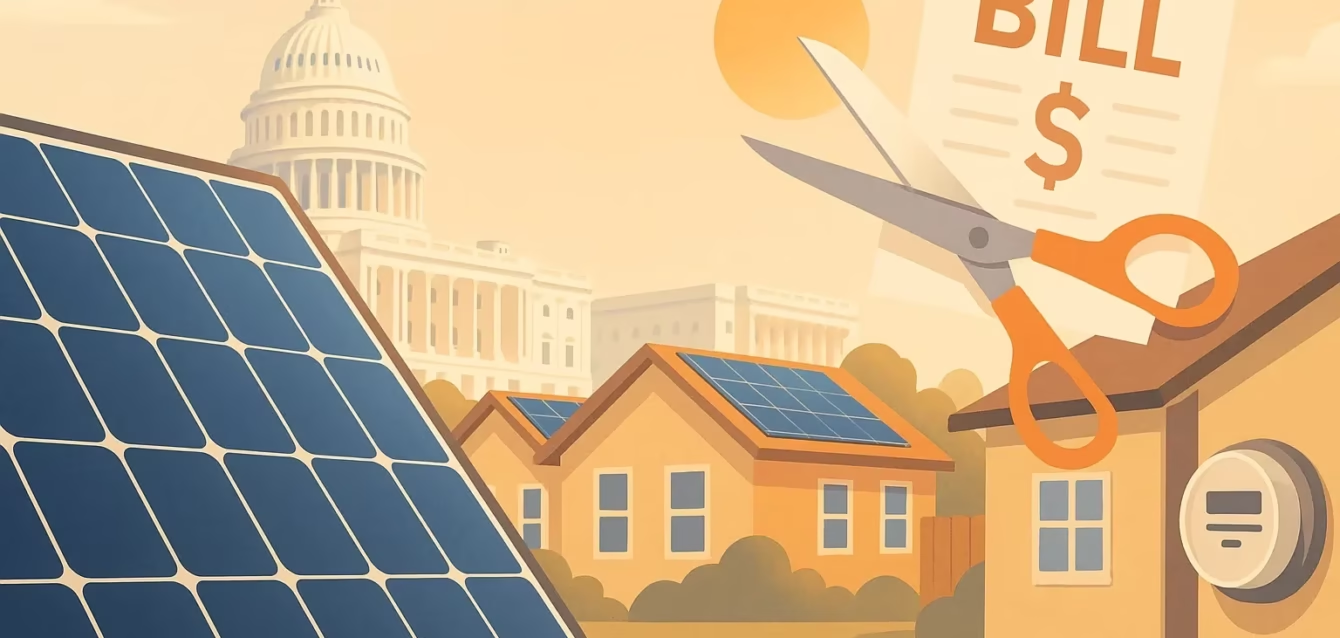
Solar Tax Credit Deadline July 2026
Published: June 7, 2026, 10:00 AM ET | Updated: June 7, 2026
The July 4, 2026 federal solar safe-harbor deadline is 27 days away, and the commercial solar industry is racing to lock in tax credits before they disappear — but a little-covered IRS rule change issued in late 2025 has quietly made the path to qualification significantly harder for large-scale projects than most coverage suggests.
What Happened
The One Big Beautiful Bill Act, signed July 4, 2025, ended the 30% residential solar tax credit on December 31, 2025, and imposed a construction-start deadline of July 4, 2026 for commercial solar projects to qualify for the Section 48E Investment Tax Credit — as detailed in SEIA’s official summary of the OBBBA’s clean energy provisions. Projects beginning construction before that date get a four-year completion window; projects starting after must be fully operational by December 31, 2027 — a timeline widely viewed as unworkable for most utility-scale and large commercial installations.
Why It Matters
The headline tells one story: commercial solar developers have until July 4 to begin construction or face compressed timelines that kill project economics. Most industry coverage stops there.
The story competitors missed is in IRS Notice 2025-42, issued September 2, 2025 and expanded in Notice 2026-15, which fundamentally changed what “beginning construction” means for most commercial projects.
Under the Inflation Reduction Act’s rules, developers had two routes to prove construction had started: the Physical Work Test (actual site or off-site work begins) or the 5% Safe Harbor (incur 5% of total project cost, typically by purchasing equipment). The 5% route was preferred precisely because it let developers lock in safe-harbor status without boots on the ground — purchase enough inverters or modules, take delivery, and you’re qualified.
Notice 2025-42 eliminated the 5% safe harbor for all solar projects with a net output above 1.5 MW that began construction on or after September 2, 2025. That threshold covers virtually every utility-scale project and most large commercial rooftop installations. For those developers, the only qualifying path now is the Physical Work Test — actual, significant construction activity, on-site or demonstrably underway under a binding contract.
The practical impact: signing a purchase order and paying a deposit is no longer enough for most projects. Equipment must be actively being manufactured or installed. Ground must be prepared, racking installed, or concrete poured. The documentation burden is substantially higher than what the industry had been using for years.
This matters for a second reason that has received almost no coverage: the FEOC (Foreign Entity of Concern) rules. Under the OBBBA, projects claiming Section 48E credits must document that at least 40% of the value of manufactured components does not originate from China, Russia, Iran, or North Korea. No full enforcement guidance has been published as of June 7, 2026. Developers safe-harboring now under the Physical Work Test are locking in projects without knowing exactly how FEOC compliance will be verified — a compliance risk that will price itself into tax equity financing terms.
The battery storage carve-out is the buried good news. Standalone battery systems are not subject to the same July 4 solar-specific deadline and remain eligible under Section 48E through 2032. That asymmetry is reshaping project structures right now: developers who miss the solar construction deadline are increasingly designing storage-first projects to preserve federal credit access.
SEIA’s 2025 Year in Review (March 2026) identified 40 GW of utility-scale projects that were positioned to begin construction in H1 2026. SolarStock USA’s Q2 2026 market brief estimated 6–8 GW of commercial mid-market capacity attempting to safe-harbor before the deadline, with a projected 50% completion rate given labor and EPC bottlenecks. That means 3–4 GW of planned commercial capacity may fail to qualify — representing roughly $3–5 billion in foregone tax credit value at 30% on an average $0.25/W system cost.
What Comes Next
The 27-day clock is not actually 27 days for most developers. Major installers, including Paradise Energy and Straight Up Solar, have set internal deadlines of June 30 to ensure that final equipment procurement and physical work documentation is in order before the federal holiday. Construction crews are already at capacity across key markets; new projects entering the pipeline now are unlikely to find qualified EPC contractors available before July 4.
The two scenarios from here:
Scenario A — The deadline holds and the cliff materializes. Post-July 4, the commercial solar market bifurcates sharply. Safe-harbored projects proceed under a 4-year completion window. Everything else faces the December 2027 placed-in-service deadline, which Wood Mackenzie and SEIA both characterize as workable only for projects already in late-stage interconnection queues. New commercial solar project starts collapse through at least H1 2027.
Scenario B — Treasury publishes extended or clarifying guidance. The administration has not signaled any extension. However, Notice 2026-15 (February 2026) already expanded FEOC compliance documentation pathways, suggesting Treasury is responsive to industry pressure on implementation details. A further notice clarifying Physical Work Test standards or extending FEOC compliance timelines would provide meaningful relief without requiring Congressional action — and would be consistent with how the IRS managed prior ITC construction-start deadlines under the Obama and first Trump administrations.
For homeowners who missed the December 2025 residential credit window: the PPA and lease pathway through third-party system owners (TPO) remains alive, but only for projects under providers who complete safe-harbor construction before July 4. If your solar company has not confirmed their Section 48E safe-harbor status, the economics of their lease proposals after July 4 will look materially different.
The battery storage story runs in the opposite direction. With standalone storage eligible through 2032 and no equivalent construction-start cliff, the next 12 months are likely to be the strongest commercial battery storage deployment period in US history — at the same time that solar project starts crater. That asymmetry is already visible in Q1 2026 SEIA data, where average battery duration per installation declined as Texas drove a surge in short-duration storage for arbitrage applications entirely independent of solar.
Axis Intelligence will update this article if Treasury publishes any guidance before July 4.