

AI in Agriculture
The agricultural sector is entering one of the most profound technological shifts in its history. From genomic editing to satellite-driven crop monitoring, artificial intelligence is transforming not only how food is produced, but also how farming ecosystems adapt to climate volatility, ecological stress, and market instability. AI in agriculture is no longer a theoretical concept—it is the backbone of modern farming operations across continents, enabling data-driven decision-making, predictive analytics, and precision biotechnology on a scale previously impossible.
This article explores how AI is redesigning the food system end-to-end, integrating biotechnology, climate science, automation, robotics, and environmental modeling to create a new generation of resilient, efficient, and sustainable agricultural landscapes.
Understanding the Rise of AI in Agriculture: Why Now?
The convergence of multiple innovation waves has accelerated AI adoption across global agriculture:
- Exponential increases in data availability (soil sensors, satellites, drones, genomic data, historical climate models).
- Accessibility of low-cost edge devices enabling computation directly in the field.
- Digitization of traditional farming driven by supply chain reforms.
- Climate instability forcing farmers to move from reactive to predictive decision-making.
- Affordable cloud AI services from major providers enabling scalable deployment.
But the most important catalyst is the shift toward precision biotechnology—a new frontier merging genomics, phenotyping, and machine learning to engineer crops capable of thriving in disrupted climates.
Precision Agriculture: How AI Turns Raw Data Into Real-Time Decisions
AI-powered precision agriculture relies on dozens of data layers combined to generate actionable insights. These include:
Soil Intelligence and Mineral Mapping
Machine-learning soil models help farmers understand nutrient deficiencies, carbon content, microbial presence, and toxicity levels.
Advanced systems can:
- Predict soil degradation
- Recommend fertilizer dosage
- Identify pathogen hotspots
- Optimize irrigation cycles
- Monitor nitrogen leaching
This is particularly important in regions facing desertification or chemical-heavy farming cycles.
AI-Driven Irrigation Optimization
Smart irrigation systems use sensors and AI forecasts to deliver water only when and where needed.
The results are significant:
- Up to 40% water savings
- Improved crop uniformity
- Reduced fungal outbreaks
- Greater drought resistance
AI models integrate evapotranspiration data, root-zone moisture, and local weather predictions.
Drone and Satellite Crop Analytics
AI analyzes multispectral and hyperspectral imagery to detect:
- Plant stress
- Nutrient deficiencies
- Water shortages
- Early-stage disease
- Pest clusters
- Yield potential
This replaces manual field inspection with automated, high-resolution monitoring.
Predictive Yield Modeling
Using historical data, climate models, and current plant health metrics, AI predicts yields with remarkable accuracy.
This enables:
- Smarter crop insurance
- Optimized market planning
- Improved logistics
- Accurate harvest scheduling
Yield prediction combined with supply chain AI reduces post-harvest loss significantly.
AI Meets Biotechnology: Engineering Climate-Resilient Crops
Biotechnology advancements have accelerated due to AI’s capability to analyze complex genetic data.
AI is now used extensively to:
- Identify stress-resilient gene clusters
- Model protein expression under environmental stress
- Accelerate CRISPR editing simulations
- Predict off-target effects
- Optimize phenotyping at scale
This allows scientists to design crops that can withstand:
- Extreme heatwaves
- Extended drought
- Soil salinity
- Fungal attacks
- Invasive pests
- Changing growing seasons
High-Throughput Phenotyping Powered by AI
Phenotyping bottlenecks previously slowed biotechnological development.
AI-driven phenotyping now enables:
- Automated trait recognition
- Disease classification
- Growth pattern analysis
- Biomass estimation in real time
Platforms integrate robotics, 3D imaging, and neural networks to evaluate thousands of plants daily.
Genomic Selection and CRISPR Optimization
Machine learning identifies genetic markers associated with high yield or stress tolerance.
AI models simulate gene edits before wet-lab execution, reducing years from research cycles.
Climate-Smart Agriculture: AI as a Weapon Against Climate Volatility
Climate adaptation is the core priority for modern farming.
AI is reshaping climate-smart solutions in three major ways:
Hyperlocal Climate Forecasting
Traditional forecasts fail at microclimate level.
AI models produce:
- Field-level predictions
- Disease outbreak risk alerts
- Frost and heatwave warnings
- Storm and flooding risk analytics
Large farms use these predictions to adjust planting dates and irrigation.
Carbon Accounting and Regenerative Agriculture
AI quantifies carbon sequestration, helping farmers:
- Participate in carbon markets
- Validate regenerative practices
- Optimize crop rotation for soil health
Biological models estimate microbial activity, root biomass, and carbon flux.
Ecological Impact Modeling
AI simulates:
- Biodiversity changes
- Pollinator behavior
- Water table levels
- Soil nutrient flows
This helps governments and large agricultural corporations evaluate environmental risks more accurately.
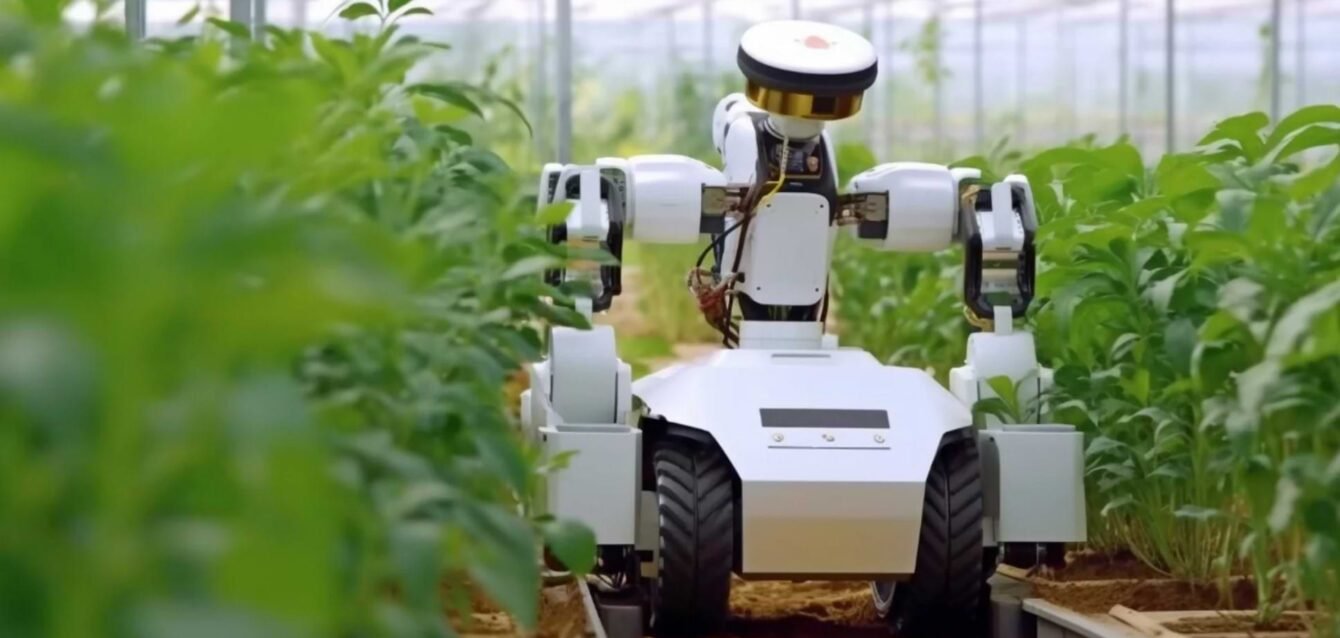
Robotics and Automation: The New Labor Force in Smart Farming
AI does not act alone—robotics now handles physical farm tasks such as:
- Autonomous tractors
- Robotic harvesters
- Precision seeders
- Weed-detection lasers
- AI-powered sprayers
- Robot pollinators in greenhouses
These systems reduce labor dependency and significantly increase efficiency.
5.1 Automated Weed Management
Machine vision robots can distinguish weeds from crops with >95% accuracy.
This reduces:
- Herbicide use
- Soil contamination
- Operational costs
Laser-based robots eliminate weeds without chemicals.
5.2 Autonomous Harvesting Systems
AI harvesters determine fruit ripeness, optimal picking time, and yield mapping, improving post-harvest quality.
AI and Pest/Disease Management: Preventing Outbreaks Before They Occur
Disease detection is one of the earliest and most critical uses of AI in agriculture.
Neural networks analyze imagery, temperature, humidity, and pathogen datasets to detect early signals of:
- Fungal infections
- Viral contamination
- Pest migration patterns
- Bacterial outbreaks
AI systems can:
- Trigger targeted spraying
- Predict infestation spread
- Recommend resistant crop varieties
- Reduce chemical input by up to 70%
Supply Chain Optimization: AI From Farm to Fork
Modern farms operate like data-driven corporations.
AI optimizes the entire chain:
- Cold chain management
- Smart logistics
- Waste reduction
- Market forecasting
- Automated grading and sorting
Computer vision evaluates product quality in real time, reducing food waste.
Socioeconomic Implications: AI’s Role in Global Food Security
AI in agriculture has global impact:
- Strengthens food security in developing nations
- Reduces input costs
- Promotes sustainable practices
- Reduces manual labor
- Increases profit per hectare
Countries adopting climate-smart AI systems are better positioned to handle climate shocks.
Ethical Considerations and Risks
AI-driven farming also presents risks:
- Data monopolies
- Farmer surveillance
- Loss of traditional knowledge
- Potential biases in AI crop recommendations
- Environmental dependency on tech companies
Regulations must ensure AI supports—not replaces—farmer autonomy.
The Future: Autonomous Climate-Smart Food Systems
In the next decade, AI will enable:
- Fully autonomous farms
- Genomic crops designed by AI
- Blockchain-enabled traceability
- Real-time carbon accounting
- Closed-loop regenerative systems
- Vertical farms powered by predictive climate AI
The fusion of biotechnology, robotics, and environmental intelligence will transform agriculture into a hyper-efficient, climate-smart industry capable of feeding 10 billion people sustainably.
FAQ
How does AI help farmers increase crop yields?
AI analyzes soil data, weather forecasts, plant health imagery, and historical patterns to recommend optimal planting, irrigation, and nutrient strategies.
Can AI reduce pesticide use?
Yes. AI-based pest detection identifies outbreaks early, enabling targeted spraying and reducing chemical use by up to 70%.
Is AI affordable for small-scale farmers?
Cloud AI, mobile apps, and low-cost sensors are making high-level analytics accessible even to small farms in developing regions.
How does AI integrate with biotechnology?
AI accelerates genomic editing, trait selection, protein modeling, and phenotyping, enabling faster development of climate-resilient crops.
Will AI replace farm jobs?
AI changes the nature of farm labor—reducing repetitive tasks while creating high-value digital and mechanical roles.