

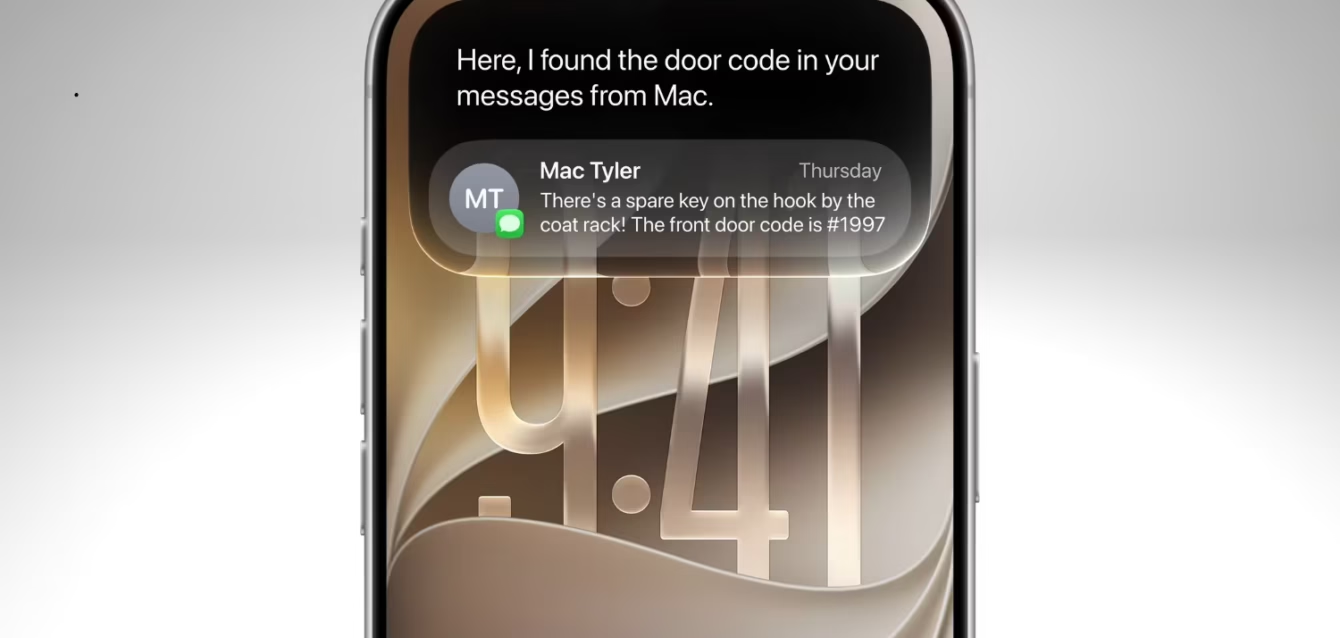
Apple Siri AI
Apple officially unveiled Siri AI on June 8, 2026 at WWDC. Powered by a custom 1.2-trillion-parameter Gemini model running on Nvidia Blackwell GPUs, rebuilt from scratch, Siri AI can hold multi-turn conversations, read your screen, search your personal data across apps, and execute multi-step tasks. It ships free with iOS 27 this fall — but not in the EU or China, and not on any device older than iPhone 15 Pro.
Two years, one class-action lawsuit, and a $250 million settlement later, Apple’s reimagined AI assistant is real. Siri AI — the official new name — debuted at WWDC 2026 on June 8, the final keynote presided over by Tim Cook before he hands the CEO title to John Ternus on September 1.
The demo looked genuinely capable. The honest question is whether the fall 2026 public release will match it, and what the architectural choices Apple made to get here mean for everyday users.
Here is what actually happened, what it means technically, and where the real gaps remain.
What Happened — June 8, 2026
Apple described Siri AI as “an entirely new version of Siri” built on Apple Intelligence. Craig Federighi, Apple’s SVP of Software Engineering, framed it around three new capabilities that the old Siri never had: personal context understanding, broad world knowledge, and onscreen awareness.
In concrete terms, that means:
Personal context understanding. Siri can now search across your messages, emails, photos, and third-party apps that integrate with Spotlight. You can ask it to surface a hotel confirmation from an old email, find a restaurant recommendation a friend sent weeks ago, or pull up photos from a specific trip — all in natural language, without knowing which app holds the answer.
Broad world knowledge. Siri now connects to the web for up-to-date information on virtually any topic, generating synthesized answers rather than routing you to a browser. Concert dates, solar eclipse schedules, breaking news — the kinds of queries that previously produced either a web redirect or an embarrassing non-answer.
Onscreen awareness. If you are reading a message about a potluck dinner, Siri can see what is on your screen and engage with it directly — suggesting what to bring, adding items to Notes, and chaining multiple steps without you switching apps manually.
The interface has changed too. On iPhone, Siri now lives in the Dynamic Island — swipe down from it to open a full conversation. On iPad and Mac, Siri AI integrates directly into Spotlight. On Apple Vision Pro, it appears as a 3D object you can place anywhere in your field of view and activate by looking at it. On Apple Watch, a Smart Stack card can surface ongoing Siri AI conversations at your wrist.
A dedicated Siri AI app lets users revisit past conversations across devices. Siri also gains new expressive voices, adjustable during setup.
“With access to broad world knowledge for up-to-date answers on virtually any topic, along with onscreen awareness and personal context understanding, Siri AI can help users take action across apps more naturally than ever,” Federighi said in Apple’s official announcement.
Developer betas opened June 9. Public betas are expected in July. Full public availability arrives this fall alongside new iPhone hardware.
The Architecture Apple Does Not Lead With
The most significant technical news from WWDC 2026 was not a feature. It was an infrastructure decision.
Siri AI runs on a custom 1.2-trillion-parameter model built on Google’s Gemini technology, hosted on Google Cloud servers powered by Nvidia Blackwell B200 GPUs. Apple announced this partnership with Google on January 12, 2026. The deal is reportedly worth approximately $1 billion per year.
For Apple — which has built its premium positioning on privacy as a differentiator — outsourcing the core AI inference layer to its largest search competitor required architectural engineering to preserve those commitments.
The solution Apple built is a three-tier processing stack:
| Tier | Where It Runs | What Goes There |
|---|---|---|
| On-device | Apple Neural Engine, inside your iPhone | Simple, fast tasks — timers, basic queries, local app actions |
| Private Cloud Compute (PCC) | Apple’s own servers | Moderately complex requests requiring more compute than the device can handle |
| Google Cloud (Nvidia Blackwell B200 GPUs) | Google’s infrastructure | Heaviest reasoning tasks using the custom Gemini-based Apple Foundation Model Cloud Pro |
At each routing step, Apple anonymizes and tokenizes queries so that — in Apple’s stated architecture — neither Apple staff nor Google can link requests to individual users. Federighi said at a media event following the keynote: “We use none of the models that Google deploys to its customers. Your requests are completely private to you. They’re never stored.”
Apple and Google issued a joint statement in January confirming that “Apple Intelligence will continue to run on Apple devices and Private Cloud Compute, while maintaining Apple’s industry-leading privacy standards.”
What this means in practice. For most everyday queries — setting reminders, controlling music, answering factual questions — the on-device and PCC tiers handle it. The Gemini-powered cloud tier activates for complex, multi-step reasoning tasks. Whether a specific query routes to Google Cloud is not user-visible or user-controllable.
Not everyone is satisfied with these assurances. Ciphero CEO Nakash argued that Private Cloud Compute is “only as private as the weakest link,” and questioned whether Google retains any pathway to usage data for model improvement. Apple has not published a comprehensive third-party audit of the three-tier routing system as of this writing.
The Delay, the Lawsuit, and Why This Launch Carries Extra Weight
Apple first promised a context-aware, personally intelligent Siri at WWDC 2024. The features did not ship. Some arrived piecemeal across 2025. The core Siri overhaul — the contextual, conversational assistant Apple advertised — did not.
A class-action lawsuit followed, alleging that Apple had “promoted AI capabilities that did not exist at the time, do not exist now, and will not exist for two or more years” and “saturated the internet, television, and other airwaves to cultivate a clear and reasonable consumer expectation that these transformative features would be available upon the iPhone’s release.”
Apple settled in December 2025 for $250 million. Eligible U.S. customers who purchased an iPhone 15 Pro, iPhone 16, or other Apple Intelligence-capable device between June 10, 2024 and March 29, 2025 can claim $25 per device, rising to up to $95 per device depending on claim volume. Apple did not admit wrongdoing.
The Gemini-powered Siri keynote demo on June 8 represents the first functional delivery of what Apple sold in 2024. Tim Cook reinforced Apple’s commitment on the company’s fiscal Q1 2026 earnings call: “We’re not changing our privacy rules.”
What Devices Get Siri AI
Not every iPhone that runs iOS 27 will get Siri AI. The feature requires Apple Intelligence, which is restricted to specific hardware.
Full Siri AI: supported devices
| Device | Minimum for Siri AI |
|---|---|
| iPhone | iPhone 15 Pro, iPhone 15 Pro Max, iPhone 16 series, iPhone 17 series |
| iPad | iPad Pro with M-series chip, iPad Air with M-series chip (12GB RAM required for advanced features) |
| Mac | MacBook Pro, MacBook Air, iMac, Mac mini with Apple Silicon (12GB RAM minimum for advanced features) |
| Apple Watch | Supported when paired with a compatible iPhone |
Older iPhones — including the iPhone 15 standard and iPhone 14 series — will run iOS 27 but will not have access to Siri AI or Apple Intelligence features. Expressive voices and the most advanced dictation, which run on Apple’s most powerful on-device model, are further restricted to the highest-spec devices with at least 12GB of unified memory.
Where Siri AI will not launch at all
Apple confirmed at WWDC that Siri AI will not be available in the European Union or China when iOS 27 ships this fall.
In the EU, the reason is the Digital Markets Act (DMA). Apple proposed a framework called the “Trusted System Agent” — an intermediary that would allow competing virtual assistants to access the same device capabilities as Siri AI, while preserving user privacy controls. The European Commission rejected all of Apple’s proposals. Craig Federighi stated: “Unfortunately, due to the Digital Markets Act, Apple will not be able to ship Siri AI in the European Union with the release of iOS 27 and iPadOS 27. Over the past several months, EU regulators did not accept any of our proposed solutions.”
“Our hope is to eventually bring Siri AI to the EU, and we will continue to engage with EU regulators on a path forward.” No timeline was provided.
In China, Apple is working through separate regulatory requirements that govern the use of foreign AI models. An accidental release of Apple Intelligence features in China in March 2026 — pulled hours later — added complexity to the regulatory picture there.
The scope of the exclusion: Apple blocks Siri AI from an estimated 450 million EU iPhone and iPad users, and an even larger user base in mainland China. This is the largest geographic AI rollout gap Apple has created since the original launch of Apple Intelligence in 2024.
How Siri AI Compares to ChatGPT, Gemini, and Alexa in 2026
According to Axis Intelligence’s cross-analysis of announced capabilities and the competitive landscape as of June 9, 2026, here is where Siri AI fits against the major alternatives.
| Capability | Siri AI (iOS 27) | ChatGPT (GPT-5 base) | Google Gemini | Amazon Alexa+ |
|---|---|---|---|---|
| Multi-turn conversation | ✅ Yes | ✅ Yes | ✅ Yes | ✅ Yes |
| Device-integrated personal context | ✅ Deep (native iOS/Mac) | ⚠️ Limited (via plugins) | ⚠️ Limited (Google Workspace) | ⚠️ Limited |
| Real-time web knowledge | ✅ Yes | ✅ Yes | ✅ Yes (Search-native) | ✅ Yes |
| On-screen awareness | ✅ Yes | ❌ No | ⚠️ Android only | ❌ No |
| Cross-app action execution | ✅ Yes | ⚠️ Via operator APIs | ⚠️ Limited | ✅ Smart home focused |
| Standalone conversation app | ✅ Yes (new) | ✅ Yes | ✅ Yes | ❌ No |
| Privacy architecture | ✅ On-device + PCC + Gemini cloud | ⚠️ OpenAI servers | ⚠️ Google servers | ⚠️ Amazon servers |
| Cost to user | ✅ Free (bundled) | ⚠️ Free tier / $20/mo Plus | ⚠️ Free tier / $20/mo Advanced | ⚠️ Alexa+ subscription |
| EU availability | ❌ Not at launch | ✅ Yes | ✅ Yes | ✅ Yes |
| Available today (June 2026) | ⚠️ Developer beta only | ✅ Yes | ✅ Yes | ✅ Yes |
The honest read: Siri AI’s structural advantage is device integration and bundled cost. No competing assistant has the same depth of access to iOS/macOS data — messages, photos, emails — without additional setup, and none is free without a subscription. Its disadvantage is shipping later than competitors and being unavailable to roughly a billion users in Europe and China at launch.
The Gemini engine underlying Siri AI is the same foundation that powers Google’s own flagship assistant — Ars Technica’s January 2026 comparative testing found that Gemini 3.2 and GPT-5 performed comparably on most everyday tasks, with Gemini holding an edge in real-time search-dependent queries.
The Axis Intelligence Reading: Four Things to Watch Before You Judge This
According to Axis Intelligence’s analysis of Apple’s WWDC 2026 announcements, the keynote demo is not the right moment to assess Siri AI. The developer beta that opened June 9 is where the real signal begins. Here are the four variables that will determine whether this is a genuine step forward or another round of overpromise.
1. Routing transparency. Users have no visibility into which of the three tiers handles any given query. Apple has not committed to publishing a third-party security audit of the Gemini cloud routing layer. Watch for independent researchers — not Apple’s own disclosures — to probe this architecture in July and August.
2. Cross-app action reliability. The demos showed Siri booking restaurant reservations, setting calendar reminders, and editing photos through a single natural-language prompt chain. Multi-step, cross-app execution is the hardest thing to do reliably at scale. The demo conditions are controlled. Real-world reliability across the full App Store surface area is unknown.
3. EU regulatory path. The Digital Markets Act impasse is not just an Apple problem — it is the most important live test of how AI assistants integrated into operating systems coexist with interoperability mandates. If Apple and the European Commission find no path forward, EU iPhone users will face a permanent capability gap relative to the rest of the world.
4. OpenAI. While Apple has replaced ChatGPT as Siri’s primary AI backbone with Gemini, OpenAI is reportedly preparing legal action over what it describes as a “strained” relationship with Apple. The original 2024 ChatGPT-Siri integration may remain in some form. How these two relationships — Gemini as the foundation, OpenAI as a question mark — coexist in iOS 27 is not yet fully clear.
What Comes Next
June 9–30, 2026: Developer beta period. Third-party developers test Siri AI integration, Spotlight APIs, and the new systemwide context menus.
July 2026: Public beta expected. Users can opt in via Software Update.
September 2026: iOS 27 general release, expected alongside new iPhone hardware. This is when Siri AI reaches the general public — and when the $250 million settlement class becomes relevant, as affected users will now be able to evaluate the product that Apple originally promised two years earlier.
TBD — EU: No timeline. The European Commission must accept a new proposal from Apple, or Apple must modify its architecture to satisfy DMA interoperability requirements. Federighi’s language at WWDC — “Our hope is to eventually bring Siri AI to the EU” — signals no imminent resolution.
TBD — China: Pending regulatory approval of the Gemini-based architecture under China’s AI governance framework.
For more on how AI assistants compare for specific use cases, see our best AI chatbot apps guide and our best AI tools overview. For context on how Apple’s AI strategy fits the broader industry picture, our AI statistics hub tracks the numbers behind the AI assistant market.
FAQ
What is Siri AI?
Siri AI is Apple’s completely rebuilt digital assistant, announced at WWDC 2026 on June 8. It is powered by Apple Intelligence and a custom 1.2-trillion-parameter model based on Google’s Gemini technology. It can hold multi-turn conversations, access your personal data across apps, read what is on your screen, and execute multi-step tasks across the operating system.
When is Siri AI available?
Developer betas opened June 9, 2026. A public beta is expected in July 2026. The full public release arrives this fall with iOS 27, iPadOS 27, and macOS 27 (Golden Gate) — alongside new iPhone hardware.
Is Siri AI free?
Yes, for users with compatible devices. Siri AI is included at no extra cost with iOS 27, iPadOS 27, and macOS 27. There is no Siri subscription.
Which devices support Siri AI?
Siri AI requires Apple Intelligence-compatible hardware: iPhone 15 Pro, iPhone 15 Pro Max, the full iPhone 16 lineup, and iPhone 17 series. For iPad and Mac, M-series Apple Silicon is required. Devices with less than 12GB of unified memory will not support the most advanced Siri AI features.
Why isn’t Siri AI available in Europe?
The European Union’s Digital Markets Act requires Apple to give competing virtual assistants broad access to the same device capabilities as Siri AI. Apple could not reach an agreement with EU regulators on a compliant implementation. There is currently no timeline for Siri AI’s availability in the EU.
Why isn’t Siri AI available in China?
China’s AI governance regulations require separate approval for the deployment of foreign AI models. Apple is working through those regulatory requirements, but has not provided a timeline.
Is Siri AI powered by Google?
Yes, partially. Apple licensed a custom 1.2-trillion-parameter model built on Google’s Gemini technology. It runs on Google Cloud servers using Nvidia Blackwell B200 GPUs for the most complex queries. Simpler tasks run on Apple’s own models, on-device or through Apple’s Private Cloud Compute. Apple states that user data is anonymized, tokenized, and never stored by either Apple or Google.
How does Siri AI compare to ChatGPT?
Siri AI’s primary advantage is deep integration with iOS, iPadOS, and macOS — it can read your screen, access your personal messages and emails, and take actions across apps without setup. ChatGPT offers stronger standalone reasoning for complex writing and analysis tasks, is available on more platforms, and does not require compatible Apple hardware. ChatGPT requires a Plus subscription ($20/month) for advanced features; Siri AI is free with a compatible device.
What happened to the Apple-OpenAI ChatGPT partnership?
Apple and OpenAI previously partnered to integrate ChatGPT into Siri as a fallback for complex queries. As of WWDC 2026, Apple’s primary AI foundation has shifted to Google Gemini. OpenAI is reportedly exploring legal options related to its relationship with Apple. It is not yet clear whether any ChatGPT integration will persist within iOS 27.
Did Apple admit its original Siri AI promises were false?
No. Apple settled the related class-action lawsuit for $250 million in December 2025 without admitting wrongdoing. Eligible U.S. customers who purchased Apple Intelligence-capable devices between June 10, 2024 and March 29, 2025 can claim $25–$95 per device. The settlement website and claims process are being administered separately from Apple.
Sarah Mitchell covers AI, machine learning, and AI tools for Axis Intelligence.
Last updated: June 9, 2026 | This article will be updated as iOS 27 developer betas release new information.