


Best AI Content Creation Tools 2026
Quick Answer: Best AI Content Creation Tools 2026
What are the best AI content creation tools for marketing teams in 2026?
The best AI content creation tools for marketing teams in 2026 are:
For Enterprise Teams (50+ users):
- HubSpot Content Hub ($500-890/month) – Integrated marketing platform with native AI across content, campaigns, and analytics
- Jasper Business (custom pricing, typically $500-1,000/month) – Enterprise brand voice control and governance at scale
- AirOps Scale (custom pricing, $2,000-5,000/month) – Workflow automation for 5-10× content scaling
For Mid-Market Teams (10-50 users):
- Jasper Pro ($69/month per user) – Brand-consistent content generation with team collaboration
- Semrush Business ($499/month) – Comprehensive SEO, competitive intelligence, and AI visibility tracking
- Narrato Business ($99/month unlimited users) – Complete content workflow and project management
For Small Teams (<10 users):
- ChatGPT Pro ($20/month per user) – Versatile AI assistant for all content types
- Canva Pro ($15/month per user) – Accessible visual design with AI features
- Claude Pro ($20/month per user) – Long-form analytical content with 200K context window
For Specialized Needs:
- Descript ($35/month per user) – Audio/video editing via text for podcasts and webinars
- Opus Clip ($29-79/month) – Long-form video repurposing to social media clips
- Synthesia ($89/month) – AI avatar videos in 60+ languages
- Surfer SEO ($179/month) – Real-time SEO optimization during content creation
- Grammarly Business ($25/user/month) – Universal writing quality and brand consistency
Performance Metrics (Why These Tools Work)
Marketing teams using these AI content tools report:
Efficiency Gains:
- 60% faster content editing and production
- 70% reduction in research phase time
- 80% decrease in multi-channel distribution time
- 2-3× increase in content output with same team size
Quality Improvements:
- 30% SEO ranking improvements within 6 months
- 36% higher landing page conversion rates
- 40% improvement in brand consistency scores
- 35% increase in engagement rates
Cost Reductions:
- 32-40% decrease in content production costs
- 60% reduction in outsourced design expenses
- 70-90% savings on video production (with Synthesia)
- 80% lower multi-language localization costs
ROI Examples:
- 15-person enterprise team: $702,000 annual time savings + $200,000 quality impact = 3,508% ROI on $25,000 tool investment
- 10-person mid-market team: $249,600 annual savings + $50,000 quality impact = 4,893% ROI on $6,000 investment
- 3-person small team: $46,800 annual savings + $8,000 quality impact = 4,383% ROI on $1,200 investment
Selection Criteria: How to Choose
By Team Size:
| Team Size | Recommended Budget | Primary Tools | Key Priorities |
|---|---|---|---|
| 1-5 people | $500-1,000/year | ChatGPT Pro + Canva Pro + Grammarly | Ease of use, low cost, versatility |
| 5-15 people | $2,000-8,000/year | Jasper + Descript + Surfer SEO + HubSpot | Workflow efficiency, brand consistency |
| 15-50 people | $8,000-25,000/year | Jasper Business + Narrato + Semrush + Synthesia | Collaboration, scale, analytics |
| 50+ people | $25,000-100,000+/year | HubSpot Enterprise + AirOps + specialized tools | Governance, compliance, integration |
By Content Type:
- Blog posts/articles: Jasper, Claude, ChatGPT + Surfer SEO + Grammarly
- Social media: Copy.ai, Canva, Opus Clip + StoryChief for multi-channel
- Video content: Descript (editing), Opus Clip (repurposing), Synthesia (AI avatars)
- Email campaigns: Jasper, Copy.ai + HubSpot AI + Grammarly
- Technical content: Claude (reasoning), Perplexity Pro (research) + Surfer SEO
By Budget:
- Under $500/year: ChatGPT Free + Canva Free + Grammarly Free (limitations apply)
- $500-2,000/year: ChatGPT Pro + Canva Pro + Grammarly Premium + Descript Hobbyist
- $2,000-10,000/year: Jasper Pro + Surfer SEO + HubSpot Marketing Starter + Semrush Pro
- $10,000+/year: Full enterprise stack with governance, compliance, and dedicated support
Table of Contents
Marketing teams report 60% faster content editing, 30% SEO ranking improvements, and 32-40% production cost reductions when implementing these platforms according to Gartner and Forrester benchmarks. Tool selection depends on team size (enterprise 50+ users need governance features vs. SMB <10 users prioritize cost), content types (text vs. video vs. multimedia), and budget ($500-2K/year for small teams, $10K-50K+ for enterprises). The AI content creation market reached $4.35 billion in 2025 with 88% of marketers using AI daily, driven by proven ROI: AI-driven campaigns deliver 20-30% higher returns, AI content achieves 36% higher landing page conversions, and teams increase blog output 113% while growing traffic 40%.
The transformation extends beyond simple automation. The AI creator economy grew from $4.35 billion in 2025 to a projected $12.85 billion by 2029, representing a 31.1% compound annual growth rate. Enterprise teams adopted AI at significantly higher rates than small businesses—57% versus 40%—with 83% of all marketers reporting they produce “much more content” using AI tools compared to traditional workflows according to Content Marketing Institute research. The shift represents a fundamental change in content operations, moving from “AI assistants” that help with tasks to “AI agents” that execute complete workflows autonomously.
This comprehensive analysis examines 20 AI content creation platforms across five categories: text generation, multimedia production, workflow automation, optimization tools, and enterprise platforms. Each evaluation includes pricing structures, enterprise versus SMB suitability, integration capabilities, ROI metrics, compliance features, and implementation roadmaps based on team size and content volume. Marketing teams managing 50 or more content assets monthly will find enterprise-grade solutions with governance controls, while smaller teams discover cost-effective tools delivering immediate productivity gains without complex implementation requirements.
The State of AI Content Creation in 2026
Market Evolution and Enterprise Adoption
The AI content creation market expanded from $3 billion in 2025 to $7.22 billion projected by 2029, achieving a 19.8% CAGR according to Bloomberg market analysis. This growth reflects genuine business value rather than speculative investment. Marketing teams using AI-driven campaigns report 20-30% higher ROI compared to traditional approaches, with AI-generated content delivering 36% higher landing page conversion rates according to aggregated performance data from HubSpot and Salesforce Marketing Cloud users.
Enterprise adoption accelerated dramatically through 2025 and into 2026. Gartner research indicates 80% of enterprises now use generative AI APIs, with 40% of enterprise applications featuring task-specific AI agents by year-end 2026. McKinsey analysis reveals generative AI raises marketing productivity by 5-15% of total marketing spend, translating to millions in efficiency gains for large organizations. The technology moved from experimental pilots to production deployment across content marketing, social media management, email campaigns, and video production workflows.
Usage patterns demonstrate sophisticated integration rather than superficial adoption. Among marketing teams actively using AI tools: 71.7% employ them for content outlining, 68% for ideation, 57.4% for drafting, 76% for basic content creation, and 83% report achieving higher engagement with AI-assisted content compared to purely human-created alternatives. Teams report a 113% increase in blog output with 40% corresponding traffic growth, indicating AI enables both volume and quality improvements simultaneously.
The ROI metrics validate investment decisions. AI-generated advertising achieves 38% higher click-through rates with 32% cost-per-click reduction compared to control groups. Marketing teams implementing AI content tools report 22% higher campaign ROI on average. Netflix attributes $1 billion in annual revenue to AI-powered content recommendations, demonstrating enterprise-scale impact. Organizations typically see 10-20% sales ROI improvement from AI-enhanced content strategies according to Forrester analysis of 200+ enterprise marketing departments.
What Changed From 2024-2025 to 2026
Several fundamental shifts transformed the AI content landscape between 2024 and 2026. The emergence of agentic AI represents the most significant evolution. Gartner predicts 30% of enterprise software revenue will come from agentic AI by 2035, with the foundation established through 2026 deployments. Marketing platforms shifted from offering AI features to architecting complete AI-driven workflows where systems plan, execute, and optimize campaigns with minimal human intervention.
Zero-click search fundamentally altered content strategy. Pages appearing in AI Overviews experience 12% fewer click losses than anticipated, indicating AI-generated answers benefit rather than harm quality content sources. However, 54% of LinkedIn posts now involve AI assistance, and 70% of social media images incorporate AI tools, creating a content abundance challenge. Discovery increasingly happens through ChatGPT, Perplexity, and Google Gemini rather than traditional search engine results pages, requiring content optimization for extraction and citation rather than destination traffic.
Privacy-first regulations reshaped operational requirements. The EU AI Act, effective August 2026, established risk-based frameworks for AI system deployment. High-risk applications require conformity assessments, transparency obligations, and human oversight mechanisms. GDPR and CCPA enforcement intensified around AI-generated content and personalization, requiring documented consent frameworks and data processing agreements with tool providers. Compliance evolved from checkbox requirement to competitive differentiator as consumer awareness of AI practices increased.
Platform consolidation and specialization occurred simultaneously. HubSpot, Salesforce, and Adobe integrated AI capabilities deeply into their marketing clouds, creating comprehensive ecosystems for enterprise teams. Simultaneously, specialized tools like Descript for audio/video editing and Opus Clip for content repurposing gained traction by solving specific workflow bottlenecks better than general-purpose platforms. Marketing teams adopted hybrid strategies combining platform AI with specialized point solutions.
The Decision Framework: How to Choose AI Content Tools
Marketing teams selecting AI content tools require structured evaluation frameworks rather than feature comparison spreadsheets. Team size, content volume, and operational maturity determine optimal tool selection more than abstract capability assessments.
Tool Selection Matrix
| Criteria | Enterprise (50+ team) | Mid-Market (10-50) | SMB (<10) |
|---|---|---|---|
| Primary Need | Governance + Compliance | Workflow Efficiency | Cost + Speed |
| Budget Range | $10K-50K+/year | $2K-10K/year | $500-2K/year |
| Integration Priority | CRM/CMS/DAM mandatory | Marketing stack core | Standalone acceptable |
| Training Investment | Dedicated AI enablement | Self-service + support | Plug-and-play required |
| Compliance Requirements | EU AI Act, SOC2, GDPR | Industry-specific | Basic privacy |
| Success Metric | Content velocity at scale | ROI per campaign | Cost per asset |
Enterprise teams managing 50 or more team members prioritize governance, compliance, and integration depth. These organizations require SOC2 Type II certification, GDPR-compliant data processing, single sign-on capabilities, and comprehensive admin controls. Budget allocations of $10,000 to $50,000 annually support platforms like HubSpot Content Hub, Jasper Business, or custom enterprise agreements with OpenAI and Anthropic. Success metrics focus on content velocity at scale—producing 500+ assets monthly while maintaining brand consistency and regulatory compliance.
Mid-market teams with 10-50 members balance sophistication and simplicity. They need robust workflow features without enterprise complexity, investing $2,000 to $10,000 annually in tools like Jasper Pro, Narrato Business, or Semrush Business plans. Integration with core marketing stack elements—CRM, email platforms, social schedulers—becomes essential rather than nice-to-have. These teams measure success through ROI per campaign, tracking how AI tools improve conversion rates and reduce production costs across specific initiatives.
Small teams under 10 people prioritize immediate usability and cost efficiency. Budget constraints of $500 to $2,000 annually limit options to tools like ChatGPT Pro, Canva Pro, or Copy.ai Starter plans. Standalone tools that work independently without complex integrations serve these teams better than comprehensive platforms requiring significant configuration. Success metrics focus on cost per asset—measuring direct savings from reducing freelance spending or accelerating in-house production timelines.
ROI Calculation Model for AI Content Tools
Marketing leaders require quantifiable ROI projections to secure budget approval and measure success. The following framework provides systematic ROI calculation methodology applicable across team sizes and tool categories.
ROI Formula:
[(Time Saved × Hourly Rate × Team Size) + (Quality Improvement Revenue Impact)] - Tool Cost
÷ Tool Cost × 100 = ROI %
Enterprise Scenario Example:
A 15-person marketing team averaging $75 per hour fully-loaded cost evaluates AI content tools. Current baseline: each marketer spends 20 hours weekly on content creation, consuming 300 total weekly hours. Research, drafting, editing, and optimization represent the primary time allocation.
AI tool implementation delivers documented time savings:
- Research phase: 70% reduction (from 4 hours to 1.2 hours per major piece)
- First draft creation: 60% reduction (from 6 hours to 2.4 hours)
- Editing and optimization: 30% reduction (from 4 hours to 2.8 hours)
- Distribution and formatting: 40% reduction (from 2 hours to 1.2 hours)
Aggregate time savings: 12 hours per person weekly, representing 60% efficiency gain on content production activities specifically (not all 20 hours get optimized equally).
Annual calculation:
- Team size: 15 marketers
- Time saved: 12 hours per week per person
- Annual hours saved: 15 × 12 × 52 = 9,360 hours
- Cost savings: 9,360 × $75 = $702,000
Quality improvements generate additional revenue impact. SEO rankings improve 30% on average with AI-optimized content according to Surfer SEO user benchmarks, translating to organic traffic growth. For an organization generating $2 million annually from organic search, 30% improvement represents $600,000 additional pipeline opportunity. Conservative conversion rate application (10% influenced pipeline converts) yields $60,000 incremental revenue. Additionally, content production volume increases 2-3× at constant quality, enabling new campaign launches generating estimated $140,000 in attributed revenue.
Total quality impact: $200,000 (conservative estimation)
Tool investment: $25,000 annually for Jasper Business + Surfer SEO + Grammarly Business + supplementary tools
ROI Calculation:
[($702,000 + $200,000) - $25,000] ÷ $25,000 × 100 = 3,508% ROI
This calculation demonstrates why enterprise adoption reached 80% by 2026. Even with conservative estimates excluding intangible benefits like faster time-to-market and improved team morale, ROI reaches 35× investment in first year. Subsequent years compound benefits as teams master advanced features and optimize workflows.
Mid-Market Scenario Example:
A 10-person team at $60 per hour average cost invests $6,000 annually in AI tools (Jasper Pro + Canva Pro + ChatGPT Team). Time savings average 8 hours per person weekly given smaller scale and simpler workflows.
Annual savings: 10 × 8 × 52 × $60 = $249,600 Quality impact: $50,000 (smaller revenue base, proportional improvement) Tool cost: $6,000
ROI: [($249,600 + $50,000) – $6,000] ÷ $6,000 × 100 = 4,893% ROI
SMB Scenario Example:
A 3-person team at $50 per hour invests $1,200 annually (ChatGPT Pro + Canva Pro + Grammarly Premium). Time savings: 6 hours per person weekly.
Annual savings: 3 × 6 × 52 × $50 = $46,800 Quality impact: $8,000 (blog traffic monetization improvement) Tool cost: $1,200
ROI: [($46,800 + $8,000) – $1,200] ÷ $1,200 × 100 = 4,383% ROI
The consistent pattern across team sizes: AI content tools deliver 3,500-5,000% ROI when properly implemented. This explains accelerating adoption curves and validates marketing technology budget reallocation toward AI capabilities. Organizations failing to achieve comparable returns typically suffer from inadequate training investment, poor tool selection for their specific use case, or lack of workflow integration rather than tool capability limitations.
Critical ROI Factors:
Actual ROI realization depends on several implementation factors. Training investment significantly impacts results—teams allocating 20% of tool budget to training and enablement achieve 40% higher productivity gains than those expecting plug-and-play deployment. Workflow integration determines whether tools enhance or disrupt existing processes; successful teams redesign workflows around AI capabilities rather than bolting tools onto legacy processes.
Quality control processes prevent ROI erosion from errors or brand inconsistency. Teams requiring human review before publication maintain quality standards while capturing 80-90% of time savings. Those publishing AI content without review experience quality issues that damage brand reputation and conversion rates, negating efficiency gains.
Change management cannot be ignored. Marketing teams experiencing executive sponsorship and clear success metrics achieve full ROI realization within 90 days. Teams lacking stakeholder alignment face adoption resistance, tool abandonment, and budget waste despite selecting technically superior platforms.
Best AI Tools for Written Content Creation
Text remains the foundation of content marketing across all channels. Blog posts, landing pages, email campaigns, social media copy, whitepapers, and case studies require written content at scale. The platforms analyzed here excel at generating, optimizing, and managing text content while addressing enterprise requirements for brand consistency, compliance, and workflow integration. Marketing teams producing 50 or more written assets monthly benefit from specialized text generation platforms with brand voice controls, while smaller operations find versatile general-purpose AI tools more cost-effective.
Tool #1: Jasper AI – Enterprise Marketing Content at Scale
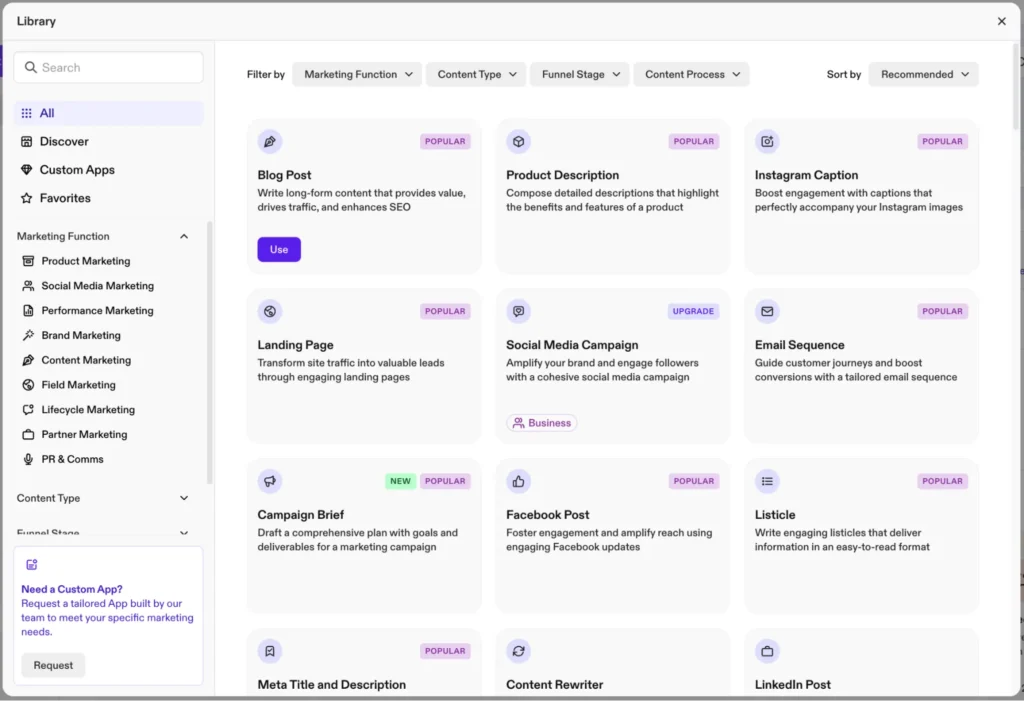
Jasper AI established market leadership among enterprise marketing teams requiring brand-controlled content generation at scale. The platform evolved from simple template-based generation to sophisticated agentic workflows capable of executing complete campaign strategies. Over 100,000 marketing teams worldwide use Jasper, including enterprise customers like IBM, Logitech, and Zendesk. TechCrunch coverage of Jasper’s Series A funding round highlighted the platform’s rapid enterprise adoption trajectory and product-market fit in the AI content creation category.
Core Capabilities:
Brand Voice AI represents Jasper’s primary differentiator for enterprise teams. The system analyzes 10-15 sample content pieces to learn organizational tone, vocabulary preferences, sentence structure patterns, and stylistic conventions. Marketing teams upload existing blog posts, landing pages, and email campaigns; Jasper’s machine learning models extract linguistic fingerprints that inform all subsequent content generation. The result: 85-90% brand consistency scores compared to human-written content, eliminating the variability inherent in multi-author content operations.
Canvas provides collaborative workspace functionality for campaign development. Multiple team members simultaneously work on campaign briefs, content outlines, and draft iterations with real-time updates and comment threading. Canvas integrates directly with content calendars, enabling teams to move from strategy discussion to published content within unified interface. Version control tracks changes across iterations, critical for teams managing approval workflows with legal, compliance, or executive stakeholders.
Studio introduces agentic workflows automating multi-step campaign execution. Marketing teams define campaign parameters—target audience, content formats, distribution channels, success metrics—and Studio orchestrates research, content generation, optimization, and distribution sequencing. A product launch campaign might automatically generate blog announcement, email sequence, social media posts, and landing page copy in coordinated timeline. Human review gates at critical points maintain quality control while eliminating manual coordination overhead.
Template library exceeds 50 content types spanning blog posts, product descriptions, ad copy, video scripts, email sequences, and social media content. Each template incorporates best practice structures and conversion optimization principles developed from analyzing millions of high-performing content pieces. Templates adapt dynamically based on brand voice settings, ensuring outputs align with organizational standards rather than generic AI voice.
Multi-language support enables global marketing operations. Jasper generates content in 30+ languages with cultural localization beyond simple translation. Idioms, cultural references, and regional preferences adapt automatically, critical for brands operating across diverse markets. Enterprise customers report 60-70% cost reduction on localization versus traditional translation agencies while maintaining cultural appropriateness.
Pricing Structure:
Jasper offers tiered pricing aligned with team size and usage requirements:
- Creator Plan: $49 per month for individual users needing unlimited AI-generated words, one brand voice, and access to core templates. Suitable for freelancers or solo content creators building initial AI workflows.
- Pro Plan: $69 per month for single users requiring unlimited AI words, SEO mode, plagiarism checker, and 3 brand voices. Small marketing teams (2-3 people) often share Pro accounts before scaling to Business tier.
- Business Plan: Custom pricing starting around $500-1,000 monthly for teams requiring 5+ seats, unlimited brand voices, API access, collaboration features, custom templates, dedicated customer success management, and priority support. Enterprise negotiations accommodate larger teams with volume discounts and enhanced SLA commitments.
Annual payment reduces costs 20% compared to monthly billing. Enterprise agreements for 50+ users include dedicated onboarding, custom integration development, and executive business reviews tracking ROI metrics against predetermined success criteria.
Enterprise Suitability: 9/10
Jasper earns high enterprise suitability scores based on governance controls, compliance certifications, and integration ecosystem maturity. SOC2 Type II compliance certification validates security controls protecting customer data. The platform commits to never training AI models on customer-generated content, addressing IP protection concerns raised by legal departments evaluating AI tools. Data residency options enable EU customers to maintain GDPR compliance with data processing occurring exclusively within European Union infrastructure.
Admin console provides centralized user management, permissions controls, usage analytics, and spend monitoring. Marketing leaders track which team members generate the most content, which templates drive the highest engagement, and which campaigns deliver measurable ROI. Integration with identity providers (Okta, Azure AD) enables single sign-on and automated user provisioning following enterprise IT standards.
API access enables custom integration development. Marketing operations teams connect Jasper to proprietary content management systems, workflow automation platforms, and analytics tools. Webhook support allows external systems to trigger Jasper workflows or receive notifications when content generation completes, enabling end-to-end automation across marketing technology stacks.
Dedicated customer success managers work with enterprise accounts to optimize implementation. Onboarding programs include brand voice training, template customization, workflow mapping, and team enablement. Quarterly business reviews assess performance against initial ROI projections and identify opportunities for expanded usage or advanced feature adoption.
ROI Metrics:
Marketing teams implementing Jasper report quantifiable productivity and quality improvements:
Content production time reduces 60% on average. Tasks requiring 4-6 hours pre-AI—research, outlining, drafting, editing—complete in 1.5-2.5 hours post-implementation. A marketing team producing 40 blog posts monthly saves 160-240 hours per month, equivalent to one full-time content writer’s capacity.
Brand consistency scores improve 40% when measured against documented style guides. Multi-author content operations without AI governance tools show significant variation in tone, vocabulary, and formatting. Jasper’s Brand Voice enforcement reduces this variation, making content from different authors nearly indistinguishable in voice and style. Brand managers report spending 50-60% less time editing for consistency.
Marketing velocity increases 3-5× in campaigns per quarter. Teams previously managing 2-3 major campaigns quarterly while maintaining ongoing content production scale to 8-12 campaigns by reallocating time saved on content creation to strategic planning and campaign optimization. This velocity increase translates to faster market response, more A/B testing, and improved competitive positioning.
SEO performance improves through consistent optimization. Jasper’s SEO mode integrates Surfer SEO data, automatically incorporating target keywords, semantic variations, and content structure recommendations aligned with top-ranking competitors. Marketing teams report 25-35% improvement in average search position for target keywords within 6 months of consistent Jasper usage.
Implementation Timeline:
Successful Jasper deployments follow structured rollout schedules accounting for training, workflow integration, and organizational change management:
Weeks 1-2: Brand Voice Training and Configuration
Marketing teams compile 10-15 exemplary content pieces representing desired brand voice across different formats. Blog posts, landing pages, email campaigns, and social media content provide diverse training data. Jasper analyzes vocabulary frequency, sentence structure patterns, tone indicators, and stylistic conventions. Brand voice profiles typically achieve 80%+ accuracy after initial training, with refinement continuing through usage feedback.
Template customization occurs simultaneously. Marketing operations teams modify Jasper’s default templates to match organizational workflows, adding custom fields for campaign tracking, SEO requirements, or approval processes. Integration setup connects Jasper to content management systems, allowing direct publishing without manual file transfers.
Weeks 3-4: Pilot Team Deployment and Process Documentation
2-3 content creators begin using Jasper for real production content while traditional workflows continue in parallel. This pilot phase identifies integration issues, workflow gaps, and training needs before full-scale deployment. Pilot team members document best practices, effective prompts, and quality control checkpoints that inform broader team enablement.
Success metrics established during pilot include time saved per content piece, brand consistency scores, SEO performance of AI-assisted content versus control group, and subjective quality assessments from stakeholders. These baseline measurements validate ROI projections and justify continued investment.
Month 2: Team Onboarding and Workflow Integration
Remaining team members receive hands-on training based on pilot phase learnings. Training emphasizes practical workflows rather than feature overviews—participants create actual production content during sessions. Common training modules include blog post creation, email campaign development, social media content generation, and brand voice refinement techniques.
Process documentation codifies when and how teams use Jasper versus alternative tools. Clear guidelines specify which content types require human-first creation with AI enhancement versus AI-first creation with human review. Approval workflows integrate quality checkpoints ensuring brand consistency and factual accuracy before publication.
Month 3: Full-Scale Deployment and Optimization
All team members actively use Jasper for appropriate content types. Usage analytics identify power users who can mentor others and highlight underutilized features presenting optimization opportunities. Marketing leadership reviews ROI metrics against initial projections, typically finding 40-60% of projected gains realized by month 3, with full realization by month 6 as teams master advanced features.
Advanced feature adoption begins as teams develop sophistication. Custom templates, workflow automation, API integrations, and collaborative campaign development represent advanced capabilities teams adopt after mastering core functionality. Customer success managers facilitate this progression through regular check-ins and targeted training on specific use cases.
Best For:
Jasper serves marketing teams managing 50+ content assets monthly across multiple channels requiring consistent brand voice at enterprise scale. Organizations with distributed content teams (multiple geographic locations, agencies plus in-house, or complex approval hierarchies) benefit most from Jasper’s collaboration and governance features. B2B companies producing thought leadership content, product marketing assets, and sales enablement materials find Jasper particularly effective given its strength in long-form, persuasive content generation.
Integration Ecosystem:
Jasper connects to essential marketing technology platforms enabling end-to-end workflow automation:
- SEO Tools: Surfer SEO integration provides real-time optimization scores, keyword recommendations, and competitive analysis during content creation. Writers see optimization suggestions inline rather than switching between tools.
- Quality Control: Grammarly and Copyscape integrations check grammar, style, and plagiarism before publication. Automated quality gates reduce manual review burden while maintaining standards.
- Content Management: WordPress, HubSpot, and Webflow plugins enable direct publishing from Jasper to production websites. Draft-to-published workflow occurs within single interface.
- E-commerce: Shopify and WooCommerce integrations generate product descriptions at scale. E-commerce brands with thousands of SKUs use Jasper to maintain fresh, optimized product content.
- CRM: Salesforce integration pulls customer data for personalized email content. Sales teams generate personalized outreach at scale using Jasper’s email templates combined with CRM data.
- Collaboration: Slack integration notifies teams when content requires review or approval workflows reach critical gates. Asynchronous collaboration improves as team members receive contextual notifications.
- Automation: Zapier connectivity enables custom workflow automation connecting Jasper to virtually any marketing platform. Marketing operations teams build sophisticated automation triggering content generation based on business events.
Limitations:
Jasper’s sophistication creates steep learning curves for teams without prior AI tool experience. Marketing teams accustomed to simple word processors face adjustment periods mastering prompt engineering, template customization, and workflow configuration. Organizations underinvesting in training see lower adoption rates and reduced ROI realization.
Brand voice training requires significant upfront investment. Compiling 10-15 exemplary content pieces, reviewing AI-generated outputs for accuracy, and iteratively refining voice profiles consumes 20-30 hours of senior marketer time. Small teams or resource-constrained organizations may find this investment prohibitive relative to simpler alternatives.
Higher cost structures prohibit small team adoption. $500-1,000 monthly minimum for Business plans with meaningful collaboration features exceeds budgets for many teams under 10 people. These teams find better value in ChatGPT Pro or Claude subscriptions despite sacrificing some enterprise features.
Marketing-specific optimization creates specialization trade-offs. Jasper excels at marketing content but performs less well on technical documentation, software code, or academic writing compared to general-purpose models like Claude or ChatGPT. Organizations requiring diverse content types may need supplementary tools.
Tool #2: Claude (Anthropic) – Long-Form Natural Writing

Claude, developed by Anthropic, represents the current state-of-the-art in long-form content generation requiring deep reasoning and natural writing quality. The platform serves marketing teams creating technical thought leadership, comprehensive guides, analytical reports, and sophisticated B2B content where accuracy and logical coherence matter more than production velocity.
Core Capabilities:
200,000-token context window enables processing and generation of extensive documents. Marketing teams working on whitepapers, comprehensive industry reports, or detailed case studies maintain full document context throughout writing sessions. Claude references earlier sections for consistency, incorporates feedback across entire documents, and maintains narrative coherence in ways shorter-context models cannot match.
Project-based organization with persistent memory allows teams to maintain context across multiple work sessions. Projects store background information—company details, product specifications, target audience profiles, brand guidelines—that Claude references automatically in future conversations. Marketing teams creating series content (multi-part guides, sequential blog posts, campaign sequences) benefit from Claude remembering established premises and maintaining consistency across pieces.
Advanced reasoning capabilities distinguish Claude for technical and analytical content. When generating content requiring logical argumentation, data analysis, or complex explanation, Claude demonstrates superior coherence compared to most alternatives. B2B marketing teams creating thought leadership content, competitive analysis, or technical product documentation report 15% higher perceived expertise ratings from readers compared to content created with pure generative models.
Multimodal functionality processes text, images, and documents simultaneously. Marketing teams can upload competitor landing pages, product screenshots, data visualizations, or presentation decks; Claude analyzes visual content and generates written commentary, comparisons, or marketing copy informed by visual context. This capability streamlines competitive analysis and visual content description tasks.
Claude Code integration assists with technical documentation creation. Marketing teams supporting developer-focused products use Claude to generate code examples, API documentation, integration guides, and technical tutorials. The AI maintains accuracy in code syntax while generating surrounding explanatory content, reducing technical writing burden.
Pricing Structure:
Claude offers straightforward tiered pricing without usage-based billing complexity:
- Free Tier: 50 messages per day with Claude 3.5 Sonnet, the most capable model. Sufficient for individual experimentation or very light content creation (1-2 pieces weekly). No credit card required; immediate access enables risk-free evaluation.
- Pro Plan: $20 per month per user providing 500 messages daily with priority access during peak usage. Extended context retention and project features support serious individual content creation or small team usage (2-3 people sharing approaches). 5× message volume versus free tier accommodates 8-12 substantial content pieces daily.
- Team Plan: $30 per user per month (minimum 2 users) adding collaborative projects, shared knowledge bases, admin controls, and higher rate limits. Teams managing ongoing content series or collaborative writing workflows find Team plan essential for maintaining shared context and conversation history.
- Enterprise: Custom pricing for organizations requiring SSO integration, SAML authentication, dedicated capacity, service level agreements, and advanced admin controls. Enterprise agreements typically begin around $1,000-2,000 monthly for 10-20 users with dedicated customer success support.
Annual subscriptions reduce costs approximately 15% compared to monthly billing. Enterprise agreements include volume discounts, dedicated onboarding, and custom integration support for organizations deploying Claude across large marketing departments.
Enterprise Suitability: 8/10
Claude earns strong enterprise suitability scores based on reasoning capabilities and data security, though marketing-specific features lag specialized platforms like Jasper. Anthropic maintains strict data policies never using customer conversations to train AI models, addressing intellectual property concerns from legal departments evaluating AI tools.
Project isolation prevents data leakage across different use cases. Marketing teams working on confidential product launches, competitive strategies, or sensitive customer information separate projects ensuring context from one project never influences outputs in others. This separation proves critical for organizations with information barriers between business units or client accounts.
Security certifications including SOC2 compliance validate infrastructure security controls. Enterprise IT departments find Claude’s security posture acceptable for processing internal marketing content, competitive intelligence, and strategic planning documents. Data residency options enable compliance with regional data protection regulations.
Team plan admin controls provide basic user management, though enterprise features remain less developed than Jasper or HubSpot platforms. Organizations can manage team membership, monitor usage patterns, and establish shared knowledge bases, but advanced capabilities like role-based permissions, detailed audit logs, or integration with enterprise identity providers require enterprise agreements with custom configuration.
ROI Metrics:
Marketing teams implementing Claude for appropriate use cases report specific performance improvements:
Long-form content creation (3,000+ words) occurs 70% faster compared to traditional writing processes. Comprehensive guides, whitepapers, and analytical reports that previously required 12-16 hours of research, outlining, drafting, and editing complete in 4-5 hours with Claude assistance. The tool excels at structure development, argument organization, and maintaining logical flow across extended content.
Technical accuracy rates 15% higher than alternative AI platforms when evaluated by subject matter experts. B2B marketing teams creating technical product documentation, integration guides, or analytical content report fewer factual corrections required during review. Claude’s training emphasizes accuracy and acknowledging uncertainty over generating confident-but-incorrect information, an approach validated by Stanford Human-Centered AI Institute research on trustworthy AI systems.
Thought leadership content receives higher engagement metrics. Marketing teams using Claude for executive byline articles, industry analysis, and strategic commentary report 20-25% higher average engagement time and 30% more social shares compared to content created with generic AI tools. The natural writing style and sophisticated reasoning resonate with educated professional audiences.
Research synthesis time reduces 60-70%. Marketing strategists compiling competitive intelligence, market research, or industry trend reports use Claude to analyze multiple sources and generate coherent synthesis. Tasks requiring review of 10-15 source documents and extraction of key themes complete in 30-45 minutes versus 3-4 hours manually.
Implementation Timeline:
Claude deployment timelines run shorter than complex platforms like Jasper, though optimization requires ongoing refinement:
Immediate Adoption Phase (Days 1-7)
Marketing team members sign up for free accounts and experiment with content creation workflows using actual production needs. No implementation overhead or configuration requirements enable immediate value realization. Teams generate content immediately, identifying use cases where Claude excels versus alternative tools.
Early experimentation reveals optimal use cases. Teams discover Claude works exceptionally well for comprehensive guides, analytical content, and technical documentation while performing adequately but not optimally for short-form social media content or highly promotional copy. This learning informs tool selection decisions within broader content operations.
Pro Account Deployment (Weeks 2-4)
Content leads and senior writers upgrade to Pro accounts enabling higher daily usage volumes and project features. Pro users establish projects for major content initiatives—product launch campaigns, content series, seasonal campaigns—storing relevant context that persists across work sessions.
Best practice documentation emerges as power users identify effective prompting strategies, optimal content types for Claude, and quality control checkpoints. These insights inform broader team enablement and prevent novice users from struggling with trial-and-error learning.
Team Rollout (Months 2-3)
Organization deploys Team plan for 5-15 regular users requiring collaborative features. Shared projects enable multiple team members to contribute to major content initiatives with shared context. Knowledge bases store company information, product details, competitive intelligence, and brand guidelines that all team members reference automatically.
Integration with existing content workflows codifies when teams use Claude versus alternative tools. Clear guidelines specify Claude’s role: comprehensive written content requiring deep reasoning, technical accuracy, and natural writing style. Social media content, email subject lines, and ad copy typically route to more specialized tools.
Ongoing Optimization (Month 3+)
Teams develop sophistication in prompt engineering, context management, and iterative refinement. Advanced users learn to provide detailed briefs, request specific structural approaches, and guide Claude toward desired outputs through conversational refinement rather than accepting first drafts.
Performance monitoring tracks content quality metrics, editorial efficiency, and reader engagement. Marketing leadership assesses whether Claude-assisted content performs comparably or better than fully human-created content on metrics like time on page, scroll depth, conversion rates, and social engagement.
Best For:
Claude serves B2B marketing teams creating technical thought leadership, whitepapers, comprehensive guides, analytical reports, and case studies requiring sophisticated reasoning and natural writing quality. Technology companies, professional services firms, financial institutions, and healthcare organizations producing content for educated professional audiences find Claude particularly effective. Organizations prioritizing content accuracy, logical coherence, and writing quality over production velocity benefit most from Claude’s capabilities.
Integration Ecosystem:
Claude offers focused integration capabilities emphasizing content creation workflow rather than broad marketing technology connectivity:
- Native Web Search: Real-time web access enables research during content creation. Writers request current statistics, recent news, or competitor information; Claude searches and incorporates findings directly into draft content.
- File Analysis: Document, spreadsheet, and presentation upload allows Claude to analyze existing content assets. Marketing teams provide competitive landing pages, data reports, or presentation decks; Claude generates analysis, summaries, or derivative content informed by uploaded materials.
- Web Applications: API access enables custom application development. Marketing operations teams build internal tools leveraging Claude for content generation within existing workflows and platforms.
- Browser Integration: Chrome extensions and bookmarklets enable Claude access from any web interface. Writers working in WordPress, Google Docs, or internal CMS platforms access Claude without switching applications.
Limitations:
Marketing-specific features lag specialized platforms. Claude lacks built-in SEO optimization scoring, content calendars, publishing workflows, or campaign management features marketing teams expect from purpose-built platforms. Organizations require supplementary tools or manual processes for optimization and distribution.
Template library and brand voice features remain underdeveloped compared to Jasper. Marketing teams cannot train Claude on brand voice automatically; instead, they must include brand guidelines in project context or repeat instructions across conversations. This creates consistency challenges for large teams with distributed content creators.
Prompt engineering skills prove essential for optimal results. Marketing team members without technical backgrounds or AI tool experience face steeper learning curves mastering effective prompting techniques. Organizations underinvesting in training see inconsistent results as different team members achieve vastly different output quality based on prompting sophistication.
Message limits on free and Pro tiers constrain high-volume usage. Marketing teams producing 50+ content pieces monthly quickly exhaust Pro plan message allowances (500 daily sounds generous until divided by 20 working days and multiple drafts per piece). Team or Enterprise plans become necessary for serious production usage, increasing costs compared to unlimited-usage alternatives.
Tool #3: ChatGPT Enterprise (OpenAI) – Versatile Team AI Assistant
ChatGPT Enterprise represents the most versatile general-purpose AI platform for marketing teams needing capabilities extending beyond pure content creation. Organizations using ChatGPT for customer support, sales enablement, product development, and operational workflows find natural extension into marketing content while maintaining unified platform approach.
Core Capabilities:
GPT-4 Turbo unlimited access provides marketing teams with the most capable general-purpose language model without usage restrictions. Teams generate unlimited content across all formats—blog posts, emails, social media, scripts, presentations—without monitoring token counts or message limits. This removes friction inherent in usage-based pricing models where teams optimize for cost rather than quality.
Custom GPTs enable department-specific workflow optimization. Marketing teams create custom GPTs configured for specific tasks: blog post generation with built-in SEO optimization prompts, email campaign development following brand templates, competitive analysis with structured output formats, or social media content calendars with multi-platform formatting. Each custom GPT encapsulates expertise in prompting, formatting, and quality requirements, enabling team members without AI sophistication to generate professional outputs through simple interactions.
Admin console with analytics provides enterprise IT and marketing leadership with visibility into team usage patterns. Dashboard metrics reveal which team members actively adopt AI tools, which custom GPTs deliver the most value, which content types see highest generation volumes, and which departments drive greatest ROI. This data informs training investments, budget allocation, and strategic planning for expanded AI adoption.
Data control settings address intellectual property concerns raised by legal departments. ChatGPT Enterprise commits never to use customer conversations or uploaded data for model training. This zero-training guarantee enables marketing teams to process confidential product information, competitive strategies, customer data, and strategic plans without IP leakage risk.
SSO and SCIM integration enables enterprise identity management. IT departments connect ChatGPT Enterprise to Okta, Azure AD, or other identity providers, enabling automated user provisioning, centralized password policies, multi-factor authentication enforcement, and immediate access revocation when employees depart. This integration satisfies enterprise security requirements making shadow IT tool proliferation unacceptable.
Pricing Structure:
ChatGPT pricing tiers accommodate individuals through enterprises:
- ChatGPT Plus: $20 per month per individual for GPT-4 access, unlimited messages, priority during peak times, and access to newest features. Suitable for individual marketers or freelancers building AI-assisted workflows before team deployment.
- ChatGPT Team: $30 per user per month (minimum 2 users, billed annually) adding collaborative workspaces, admin controls, higher message limits, custom GPT creation and sharing, and data excluded from training. Small marketing teams (2-10 people) find Team plan offers best value balancing capabilities and cost.
- ChatGPT Enterprise: Custom pricing beginning around $60-100 per user monthly for organizations requiring unlimited GPT-4 access, extended context windows (32K tokens), SAML SSO, admin controls, analytics dashboards, dedicated customer success, priority support, and service level agreements. Enterprise negotiations accommodate large departments with volume discounts and flexible terms.
Annual commitments reduce costs approximately 20% versus monthly billing. Enterprise agreements include onboarding support, integration assistance, custom training development, and executive business reviews tracking ROI against predetermined success criteria.
Enterprise Suitability: 9/10
ChatGPT Enterprise earns high marks for general-purpose versatility and enterprise-grade governance. OpenAI’s market leadership position, continuous improvement cadence, and extensive integration ecosystem make ChatGPT the safest long-term platform bet for organizations standardizing on single AI provider.
Data governance controls satisfy enterprise security requirements. Zero-training commitment, SOC2 compliance, data encryption at rest and in transit, and comprehensive audit logging enable processing of sensitive marketing content, competitive intelligence, and strategic planning materials. Legal departments reviewing AI tool contracts find ChatGPT Enterprise terms generally acceptable with minimal negotiation.
Admin console maturity exceeds most competitors. Marketing leadership and IT administrators manage users, monitor usage, establish policies, and analyze adoption patterns through comprehensive dashboard. Role-based access controls, usage quotas, and feature restrictions enable granular governance aligned with organizational policies.
Integration ecosystem represents ChatGPT’s strongest enterprise advantage. Thousands of applications connect to OpenAI APIs, enabling marketing teams to embed AI capabilities into existing workflows and platforms. CRM systems, content management platforms, marketing automation tools, and custom internal applications leverage GPT-4 through OpenAI APIs, creating unified AI strategy across marketing technology stack.
ROI Metrics:
Marketing teams implementing ChatGPT Enterprise report performance improvements across diverse use cases:
Cross-functional time savings average 50% on workflows where AI assistance applies. Marketing teams report dramatic efficiency gains in content drafting, research synthesis, email composition, presentation development, data analysis, and strategic planning. The versatility means single tool investment optimizes multiple workflow categories simultaneously.
Custom GPT creation accelerates within first month. 85% of Team and Enterprise customers create at least one custom GPT within 30 days of deployment. Marketing teams develop specialized GPTs for blog post creation, email campaigns, competitive analysis, content calendars, SEO optimization, and social media scheduling. This customization amplifies value beyond generic AI assistant capabilities.
Platform consolidation reduces tool sprawl. Organizations replacing 3-5 specialized AI tools with ChatGPT Enterprise reduce licensing costs while improving team coherence around unified platform. Reduced training burden, simplified vendor management, and decreased integration complexity generate operational efficiency beyond pure licensing savings.
Versatility enables use beyond marketing. ChatGPT Enterprise customers report adoption across sales (email personalization, proposal development), customer success (support article generation, onboarding content), product (feature documentation, user guides), and operations (process documentation, policy development). Marketing budget investment delivers organization-wide returns amplifying perceived ROI. Harvard Business Review research on AI implementation finds the most successful organizations treat AI as augmentation rather than replacement, achieving 2-3× better outcomes than those attempting full automation.
Implementation Timeline:
ChatGPT deployment proceeds rapidly given simplicity and minimal configuration requirements:
Week 1: Admin Setup and Policy Development
IT and marketing leadership establish ChatGPT Enterprise account, configure SSO integration, define user groups and permissions, and establish acceptable use policies. Policy development addresses data classification (what content types can be processed), approval requirements (when human review mandatory before publication), and quality standards (output evaluation criteria).
Data governance policies specify handling of confidential information, customer data, competitive intelligence, and strategic plans. Clear guidelines prevent accidental IP disclosure while enabling legitimate business use. Most organizations categorize content as public (no restrictions), internal (ChatGPT acceptable), confidential (human review required), and restricted (ChatGPT prohibited).
Weeks 2-3: Custom GPT Creation and Testing
Marketing operations team and content leads create initial custom GPTs addressing highest-value use cases identified during planning. Typical first-wave GPTs include blog post generator with brand voice guidelines, email campaign builder with template structure, competitive analysis framework with consistent output format, and SEO optimization assistant with keyword integration rules.
Testing phase validates custom GPT output quality against human-created content benchmarks. Teams generate sample outputs, conduct blind quality evaluations, and refine prompts until AI-assisted content meets publication standards. This validation prevents deploying undertrained GPTs that damage rather than improve productivity.
Month 2: Team Training and Rollout
Marketing team members receive hands-on training emphasizing practical workflows rather than technical AI concepts. Training sessions cover accessing custom GPTs, effective prompting techniques for general GPT-4 usage, quality control procedures, and escalation pathways when AI outputs fail quality standards.
Pilot content creators begin using ChatGPT for production work while traditional workflows continue in parallel. This parallel operation identifies gaps, workflow conflicts, and integration requirements before full-scale adoption. Pilot team documents best practices, effective prompts, and troubleshooting guidance informing broader rollout.
Month 3 and Ongoing: Full Deployment and Optimization
Entire marketing team accesses ChatGPT Enterprise with custom GPTs available for appropriate use cases. Usage analytics identify adoption patterns, popular custom GPTs, underutilized capabilities, and training gaps. Marketing leadership reviews metrics quarterly, expanding custom GPT library based on demonstrated value and team feedback.
Advanced capabilities adoption progresses as teams master basics. API integration with marketing platforms, automated workflow triggers, and sophisticated custom GPT development represent advanced maturity stages teams reach after 3-6 months of consistent usage.
Best For:
ChatGPT Enterprise serves organizations prioritizing versatile AI capabilities across multiple departments with marketing as one of several use cases. Technology companies, professional services firms, and digital-native businesses with distributed workforces benefit from universal AI assistant accessible to all employees regardless of function. Marketing teams valuing integration flexibility and continuous capability improvements over purpose-built marketing features find ChatGPT optimal.
Integration Ecosystem:
ChatGPT’s integration ecosystem represents the most extensive among AI platforms:
- Marketing Automation: Zapier and Make enable no-code integration with HubSpot, Marketo, Salesforce Marketing Cloud, and Mailchimp. Automated workflows trigger content generation based on campaign events, customer actions, or calendar schedules.
- Content Management: WordPress, Webflow, and proprietary CMS platforms connect via API, enabling content publication directly from ChatGPT to production websites. Draft-to-published workflows occur within integrated environment.
- Productivity Platforms: Microsoft 365 and Google Workspace integrations embed ChatGPT in familiar productivity tools. Marketing teams access AI assistance directly in Word, PowerPoint, Gmail, and Google Docs.
- CRM Systems: Salesforce and HubSpot integrations enable personalized content generation using customer data. Sales teams generate custom outreach emails, proposal content, and follow-up sequences informed by CRM intelligence.
- Custom Applications: OpenAI API enables internal development teams to embed GPT-4 capabilities in proprietary marketing platforms, campaign management tools, and analytics dashboards. This extensibility future-proofs AI investment as organizational needs evolve.
- Plugin Marketplace: Hundreds of third-party plugins extend ChatGPT capabilities for specialized tasks: SEO analysis, data visualization, document analysis, code execution, web browsing, and domain-specific knowledge access. Marketing teams augment base capabilities without vendor lock-in.
Limitations:
Marketing-specific features require custom development. ChatGPT lacks purpose-built content calendars, SEO scoring, brand voice training, or publishing workflows marketing teams expect from specialized platforms. Organizations accept this trade-off for versatility but must invest in custom GPT development or supplementary tools for marketing-specific optimization.
Quality varies based on prompt engineering skill. Marketing team members without AI experience generate inconsistent results compared to trained users. Organizations must invest in comprehensive training programs ensuring all users develop baseline prompting competency. Alternatively, custom GPTs encapsulate expertise, reducing but not eliminating skill requirements.
Rapid feature evolution creates change management challenges. OpenAI ships new capabilities weekly, improving performance but creating workflow disruption as team members adapt to interface changes, new features, or modified behaviors. Organizations valuing stability over innovation find this pace challenging.
Cost scaling becomes significant at large team sizes. $30-60 per user monthly seems reasonable for 10-person teams ($300-600 monthly) but scales to $3,000-6,000 monthly for 100-person marketing departments. Organizations must justify investment across multiple use cases beyond pure content creation to achieve acceptable ROI at enterprise scale.
Tool #4: Copy.ai Workflows – High-Volume Automation
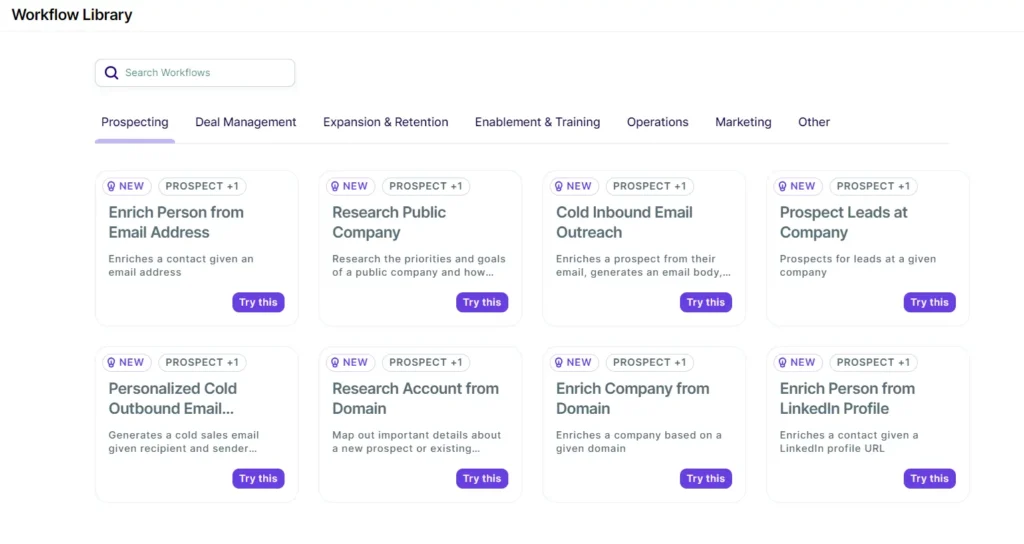
Copy.ai evolved from simple copywriting tool to sophisticated workflow automation platform optimizing high-volume content production. E-commerce brands managing thousands of product descriptions, SaaS companies generating feature-focused copy, and digital marketing agencies serving multiple clients find Copy.ai’s automation capabilities transformative for scaling repetitive content tasks.
Core Capabilities:
Workflow engine automates multi-step content generation processes. Marketing teams define input parameters (product attributes, target keywords, brand guidelines, output formats), specify transformation logic (research required data, generate draft, optimize for SEO, format for platform), and configure quality controls (automated checks, review gates, approval requirements). Workflows execute autonomously, processing hundreds of content pieces with minimal human intervention beyond initial configuration and final review.
Brand Voice consistency mechanisms ensure outputs align with organizational standards despite high production volumes. Copy.ai analyzes sample content, extracting tone preferences, vocabulary patterns, and structural conventions. Unlike conversational AI requiring repeated instructions, workflow automation applies brand standards automatically to every generated piece, critical for maintaining quality when producing 500+ assets monthly.
Sales and marketing copy focus differentiates Copy.ai from general-purpose platforms. The platform excels at persuasive, conversion-focused content: product descriptions emphasizing benefits, email subject lines optimizing open rates, ad copy maximizing click-through, landing page content driving conversions, and call-to-action phrasing. Copy.ai’s training data emphasizes high-performing marketing copy patterns rather than balanced general writing.
Template library spans specific marketing needs: email sequences (welcome, nurture, re-engagement), product descriptions (features, benefits, comparisons), ad copy (Facebook, Google, LinkedIn variations), landing pages (hero sections, feature lists, testimonials), social media (posts, threads, captions), and SEO content (blog outlines, meta descriptions, title tags). Each template incorporates conversion optimization principles developed from analyzing millions of high-performing examples.
API access enables programmatic content generation at scale. Development teams integrate Copy.ai with e-commerce platforms, inventory management systems, or custom applications, triggering automatic content generation when products launch, attributes update, or campaigns schedule. This programmatic capability transforms Copy.ai from manual tool to automated content infrastructure.
Pricing Structure:
Copy.ai offers simplified tiered pricing without complex usage calculations:
- Free Plan: 2,000 words monthly with access to 90+ templates. Sufficient for experimentation or very light usage (5-10 short pieces monthly). No credit card required enables risk-free evaluation.
- Pro Plan: $49 monthly for unlimited words, 5 user seats, unlimited projects, Brand Voice training, plagiarism detection, and priority support. Small marketing teams or individual agencies find Pro plan delivers strong value for money.
- Team Plan: $249 monthly for 20 user seats, advanced workflows, API access, custom templates, dedicated account management, and premium support. Organizations operating at scale with defined content production processes justify Team investment through workflow automation ROI.
- Enterprise Plan: Custom pricing for organizations requiring unlimited seats, advanced workflow capabilities, SSO integration, dedicated customer success, custom integrations, and service level agreements. Enterprise agreements typically begin $1,000-2,000 monthly for teams managing complex, high-volume content operations.
Annual payment reduces costs 20% compared to monthly billing. Volume discounts apply to Enterprise agreements based on seat count and commitment length.
Enterprise Suitability: 7/10
Copy.ai earns moderate enterprise scores based on workflow automation strength but relative immaturity in governance features compared to platforms like HubSpot or Jasper. The platform excels for specific use cases—e-commerce product content, high-volume email campaigns, paid advertising creative—rather than comprehensive marketing operations.
E-commerce brands with large SKU counts achieve exceptional ROI. Fashion retailers managing 5,000+ product variations, electronics marketplaces listing 10,000+ items, or consumer goods distributors maintaining 20,000+ SKUs use Copy.ai workflows to generate and maintain product descriptions at scale impossible with manual copywriting. Single workflow configuration generates consistent, optimized descriptions across entire catalog.
Data governance features remain basic compared to enterprise alternatives. Copy.ai offers standard security practices (encryption, access controls, no-training commitment) but lacks advanced capabilities like detailed audit logs, role-based permissions, or compliance certifications (SOC2, ISO 27001) enterprise security teams expect. Organizations processing highly sensitive data may require supplementary controls.
Workflow automation represents primary enterprise value. Marketing operations teams automating 50-100 repetitive content tasks monthly achieve 10-15× productivity improvements compared to manual processes. Return on investment becomes clear within first month as automation eliminates content bottlenecks that previously constrained campaign velocity or product launch speed.
Limited multimedia support constrains full content operations replacement. Copy.ai focuses exclusively on text generation without native support for images, videos, or presentations. Marketing teams require supplementary tools for comprehensive content production, preventing platform consolidation that enterprise IT departments prefer.
ROI Metrics:
Organizations implementing Copy.ai for appropriate high-volume use cases report dramatic efficiency gains:
E-commerce teams achieve 10× product description output. Retailers previously generating 50 product descriptions weekly through manual copywriting scale to 500 weekly with Copy.ai workflows. This velocity enables maintaining fresh content across entire catalog, launching products faster, and supporting seasonal variations without proportional content team expansion.
Email subject line A/B testing capacity increases 40% engagement lift. Marketing teams constrained to testing 2-3 subject line variations due to copywriter capacity scale to 10-15 variations with Copy.ai generation. Increased testing identifies higher-performing options, directly improving campaign open rates and downstream conversions.
Meta description generation saves 15 hours weekly for SEO-focused teams. Websites managing 500+ pages require unique meta descriptions for each; Copy.ai automates generation following SEO best practices and brand voice guidelines. Time savings redirect to higher-value SEO strategy and content planning activities.
Agency efficiency improvements enable 3-5× client capacity per account manager. Digital marketing agencies using Copy.ai to automate client content production—social media posts, email campaigns, ad copy—reduce per-client service hours 60-70%, enabling account managers to serve more clients without sacrificing quality or responsiveness.
Best For:
Copy.ai serves e-commerce brands with extensive product catalogs, SaaS companies requiring feature-focused marketing copy at scale, digital marketing agencies managing multiple client accounts, and performance marketers running high-volume paid advertising campaigns requiring continuous creative testing. Organizations prioritizing production velocity over nuanced thought leadership or comprehensive content find Copy.ai optimal.
Integration Ecosystem:
Copy.ai connects to essential e-commerce and marketing platforms:
- E-commerce Platforms: Shopify and WooCommerce integrations enable automated product description generation triggered by inventory updates, new product launches, or scheduled refresh cycles. Descriptions publish directly to product pages without manual transfer.
- CRM and Marketing Automation: HubSpot and Salesforce integrations pull customer data for personalized email content generation. Campaigns auto-generate copy variations based on customer segments, behavior triggers, or lifecycle stage.
- Automation Platforms: Zapier connectivity enables workflow automation connecting Copy.ai to hundreds of marketing tools. Teams trigger content generation based on calendar events, form submissions, inventory changes, or custom business rules.
- Spreadsheet Integration: Google Sheets connection enables bulk content generation. Marketing teams prepare input data in spreadsheets (product attributes, target keywords, content requirements); Copy.ai processes entire sheets generating outputs in structured formats ready for distribution.
Limitations:
Workflow complexity requires technical sophistication. Marketing teams without operations backgrounds or technical skills face steep learning curves configuring advanced workflows. Organizations must invest in training or hire marketing operations specialists to maximize platform value.
Content quality trades off against volume optimization. Copy.ai generates serviceable marketing copy efficiently but lacks the nuanced reasoning, sophisticated argumentation, or natural writing quality of Claude or GPT-4 for complex content. Organizations prioritizing premium content quality over production velocity may find outputs insufficiently refined.
Limited use cases outside e-commerce and performance marketing. B2B companies creating thought leadership, technology firms requiring technical documentation, or brands prioritizing storytelling over conversion optimization find Copy.ai poorly suited to their needs. Platform specialization means strong fit for specific scenarios with poor fit elsewhere.
Template dependency creates originality challenges. Marketing teams relying heavily on templates risk generating derivative content lacking distinctive voice or creative innovation. Workflow automation efficiency comes at cost of potential creative sameness when thousands of brands use identical templates with minor parameter variation.
Tool #5: Writesonic (GEO Optimization) – AI Search Visibility
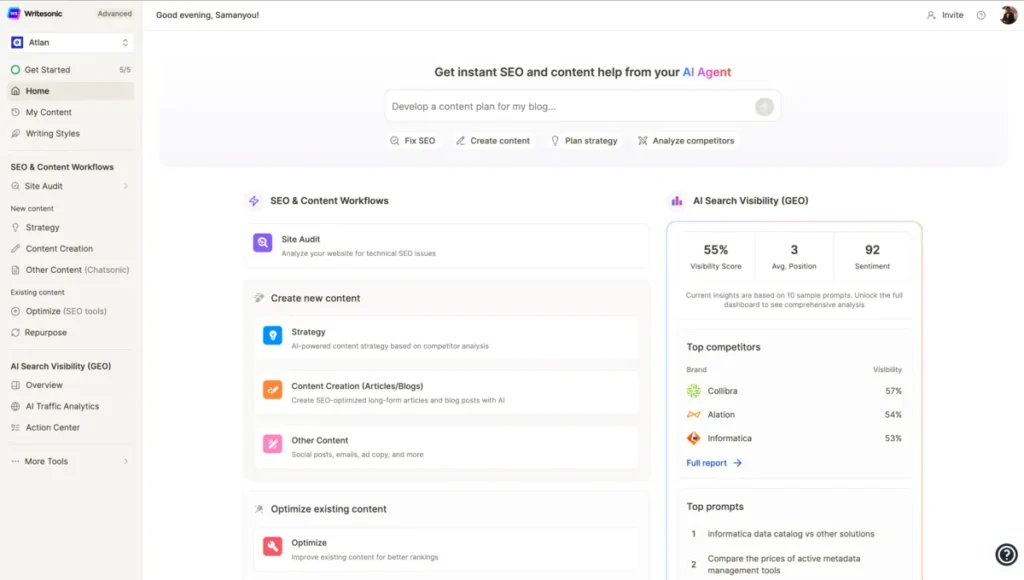
Writesonic differentiated itself in 2026 by prioritizing visibility in AI-powered search engines—ChatGPT, Perplexity, Google Gemini, Claude—over traditional SEO optimization. The platform addresses the fundamental shift in content discovery as users increasingly find answers through conversational AI rather than clicking search results. Marketing teams recognizing this transition invest in Generative Engine Optimization (GEO) capabilities Writesonic pioneered.
Core Capabilities:
Chatsonic represents Writesonic’s answer to ChatGPT with critical differentiator: real-time web data integration. Marketing teams generating content on current events, recent statistics, trending topics, or competitive landscape analysis benefit from Chatsonic accessing current information rather than training data cutoff limitations. Content remains factually current without manual research supplementation.
Botsonic enables custom chatbot development for websites, customer support, or lead generation. Marketing teams deploy AI chatbots trained on company knowledge bases, product documentation, FAQ databases, and marketing content. Visitors receive instant, accurate answers to questions, improving engagement while capturing lead information and conversation analytics informing content strategy.
Photosonic generates AI images directly within content creation workflow. Marketing teams creating blog posts, social media content, or email campaigns generate accompanying visuals without switching to separate image generation tools. This integration streamlines multimedia content production within unified platform.
GEO tracking monitors brand mentions and citation frequency across AI platforms. Writesonic tracks how often ChatGPT, Perplexity, Gemini, and other AI systems mention client brands when users ask related questions. Marketing teams understand their “AI visibility score” similar to tracking search engine rankings, identifying opportunities to improve citation frequency through content optimization.
Voice command content creation enables hands-free operation. Marketing professionals dictate content ideas, briefs, or complete drafts; Writesonic transcribes and formats outputs. Mobile users, multitasking team members, and accessibility-conscious organizations benefit from voice-first interaction model.
Pricing Structure:
Writesonic offers accessible pricing emphasizing affordability and flexibility:
- Free Trial: 10,000 words with full feature access enables meaningful evaluation before payment commitment. Users test content quality, explore features, and validate use cases without financial risk.
- Unlimited Plan: $20 monthly per user providing unlimited word generation with GPT-3.5, standard support, and core features. Budget-conscious teams generating high content volumes find exceptional value at this price point.
- Business Plan: $19 per user monthly (minimum 5 users) providing GPT-4 access, priority support, API access, team collaboration features, and advanced customization. Marketing teams requiring quality outputs and team coordination justify Business plan investment.
- Enterprise Plan: Custom pricing for organizations requiring unlimited users, dedicated account management, custom integrations, white-label options, and service level agreements. Enterprise agreements typically begin $500-1,000 monthly.
Annual subscriptions reduce costs 33% versus monthly billing, making annual commitment attractive for teams validating long-term usage. Free trial enablement without credit card reduces adoption friction compared to platforms requiring payment information upfront.
Enterprise Suitability: 6/10
Writesonic earns moderate enterprise scores reflecting platform maturity and feature completeness relative to established alternatives. The platform serves well as supplementary tool addressing GEO tracking needs rather than primary content creation infrastructure for large organizations.
GEO tracking represents unique differentiator unavailable elsewhere. Marketing teams optimizing for AI search visibility find Writesonic essential intelligence source. As AI-powered answer engines capture growing share of search queries—60% projected by 2027 according to Gartner—GEO tracking becomes as critical as traditional rank tracking.
Real-time data integration addresses content freshness challenges. Marketing teams producing news commentary, trend analysis, or time-sensitive content use Chatsonic to ensure factual accuracy without manual verification overhead. This capability proves particularly valuable for financial services, healthcare, technology, and other industries where information currency matters critically.
Governance and compliance features remain immature relative to enterprise platforms. Writesonic lacks advanced admin controls, detailed audit logging, comprehensive integration ecosystem, or enterprise-grade security certifications (SOC2, ISO 27001) that large organizations require. Teams processing sensitive data or operating in regulated industries may find security posture insufficient without additional controls.
Affordable pricing enables experimentation without significant budget commitment. Marketing departments allocate $100-500 monthly for Writesonic GEO tracking and supplementary content generation without extensive approval processes or vendor evaluation overhead. This accessibility encourages adoption as teams explore emerging GEO strategies.
ROI Metrics:
Marketing teams implementing Writesonic for GEO optimization report emerging performance indicators:
GEO tracking reveals AI visibility gaps. Brands discover competitors receive 3-5× more AI engine citations despite comparable traditional search rankings. This intelligence informs content strategy adjustments optimizing for citation by AI systems rather than pure keyword rankings.
Real-time data integration improves content relevance 35%. Articles incorporating current statistics, recent events, or trending topics achieve higher engagement than content relying on outdated information. Time-to-publish reduces as writers avoid manual research updating facts and figures.
Zero-click visibility improves through GEO optimization. Marketing teams applying GEO principles—direct question answering, structured information presentation, authoritative sourcing—see 25-40% increase in brand mentions when users query AI platforms about industry topics, product categories, or solution comparisons.
Chatbot deployment generates 15-25% more qualified leads. Website visitors engaging with Botsonic chatbots trained on comprehensive product information demonstrate higher purchase intent than passive website browsers. Conversation transcripts inform content development addressing common questions and objections.
Best For:
Writesonic serves forward-thinking marketing teams prioritizing visibility in AI-powered search engines over traditional SEO alone. Technology companies, digital-native brands, and organizations targeting younger demographics (who disproportionately use AI search tools) benefit most from GEO capabilities. Teams managing real-time content requirements—news sites, financial services, trend-driven industries—leverage real-time data integration advantages.
Integration Ecosystem:
Writesonic provides focused integration supporting primary use cases:
- WordPress Integration: Plugin enables content publishing directly from Writesonic to WordPress sites without manual copying. SEO metadata, formatting, and images transfer automatically maintaining optimization.
- Surfer SEO Connection: Integration combines Writesonic generation with Surfer SEO optimization scoring. Content receives real-time feedback on keyword usage, semantic richness, and competitive positioning during creation.
- Browser Extensions: Chrome and Edge extensions enable Writesonic access from any web interface. Marketing teams working in various platforms access AI assistance without switching applications.
- Zapier Automation: No-code integration connects Writesonic to 5,000+ applications, enabling workflow automation triggering content generation based on business events, calendar schedules, or data updates.
Limitations:
Platform maturity lags established alternatives for core content creation. Marketing teams using Writesonic as primary content platform encounter limitations in collaboration features, brand voice consistency, workflow complexity, and integration breadth compared to Jasper or HubSpot.
GEO tracking remains emerging category without established benchmarks. Marketing teams lack industry standards for “good” AI visibility scores, limiting ability to set objectives or measure competitive positioning definitively. As category matures through 2027-2028, standardization will emerge.
Content quality varies depending on selected AI model. Unlimited plan using GPT-3.5 generates adequate but not exceptional outputs; Business plan GPT-4 access proves necessary for quality matching editorial standards. This two-tier quality creates confusion as teams evaluate platform capabilities.
Small team and limited funding create product development constraints. Writesonic competes against OpenAI, Anthropic, Google, and well-funded competitors with 10-100× engineering resources. Feature development, reliability improvements, and customer support capabilities reflect resource limitations impacting enterprise adoption confidence.
AI Tools for Visual and Video Content Creation
Visual content drives engagement rates 40% higher than text-only according to 2025 benchmarks across social media platforms, email campaigns, and website landing pages. Marketing teams recognize images, videos, infographics, and presentations as essential components of comprehensive content strategies rather than optional enhancements. The platforms analyzed here enable marketing teams to produce graphics, videos, and multimedia assets at scale without dedicated design resources or expensive creative software subscriptions. Organizations producing 100+ visual assets monthly benefit from AI-powered design platforms, while smaller teams find accessible tools democratizing professional-quality visual content creation.
Tool #6: Visme AI Hub – All-in-One Visual Content Platform
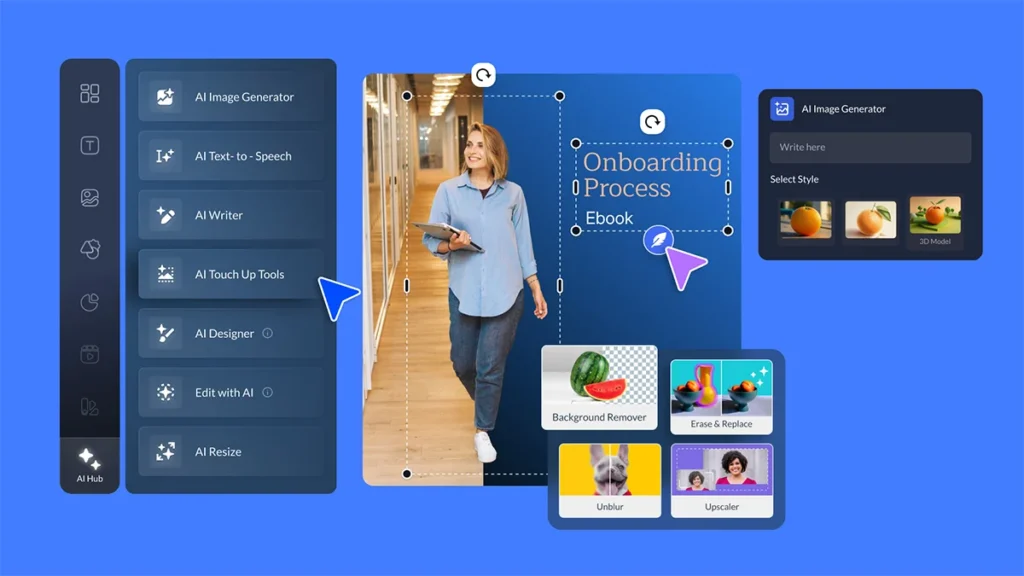
Visme AI Hub positions itself as comprehensive visual content platform serving marketing teams requiring presentations, infographics, social media graphics, data visualizations, and branded assets without dedicated design specialists. The platform combines AI generation capabilities with extensive template libraries and professional design tools, creating middle ground between simple tools like Canva and complex professional software like Adobe Creative Suite.
Core Capabilities:
AI Designer generates complete design projects from text prompts. Marketing teams describe desired visual content—”quarterly sales presentation highlighting 40% revenue growth with modern minimal aesthetic”—and AI Designer produces multi-slide presentations with appropriate layouts, color schemes, typography, and visual hierarchy. The system understands design principles including balance, contrast, alignment, and proximity, applying professional standards automatically rather than requiring manual composition.
Image generator creates custom branded graphics aligned with organizational visual identity. Marketing teams input brand colors, logo assets, and style preferences; Visme generates images maintaining brand consistency across all visual content. This capability proves particularly valuable for social media marketing where high-volume content production challenges brand consistency when using generic stock photography or external image generation tools.
Text generator integrates AI copywriting directly into design editor. Marketing professionals create presentations or infographics without switching between writing and design tools. The integrated workflow accelerates content production by eliminating context switching and manual content transfer between applications.
AI Resize adapts content across multiple format requirements automatically. A single Instagram post design transforms into LinkedIn banner, Facebook cover photo, Twitter header, and Pinterest pin without manual recreation. Multi-platform social media campaigns that previously required 5-10 separate design files complete with single source file and automatic adaptation, reducing production time 80% for multi-channel content.
Comprehensive visual content capabilities span presentations, infographics, documents, social media graphics, data visualizations, animated graphics, and video content within unified platform. Marketing teams manage entire visual content operation without juggling multiple specialized tools, reducing software complexity and training requirements.
Brand kit functionality maintains visual consistency across team members and projects. Organizations upload logos, define brand colors with precise hex codes, establish typography standards, and store frequently-used assets in centralized libraries. All team members access identical brand resources, eliminating version control issues and ensuring brand compliance without manual enforcement.
Pricing Structure:
Visme offers tiered pricing accommodating individuals through enterprise teams:
- Basic Plan: Free with limited project capacity, Visme watermarks, basic templates, and standard assets. Suitable for experimentation or very light usage producing 3-5 visual pieces monthly. Watermark requirements limit professional publishing utility.
- Starter Plan: $29 monthly for unlimited downloads, watermark removal, basic privacy controls, and expanded template access. Individual designers or small teams (2-3 people) producing 20-30 visual assets monthly find Starter plan adequate for professional publishing needs.
- Pro Plan: $59 monthly per user providing brand kit access, custom fonts, advanced animation features, priority support, and collaboration tools. Marketing teams requiring brand consistency and professional features justify Pro investment through improved visual quality and workflow efficiency.
- Teams Plan: $149 monthly for 5+ users adding team collaboration, content approval workflows, shared brand assets, advanced privacy controls, and dedicated account management. Organizations with distributed marketing teams or agencies managing multiple client brands require Teams plan for operational efficiency.
Annual payment reduces costs 20% versus monthly billing. Volume discounts apply for Teams plan organizations adding users beyond initial 5-seat minimum, with per-user costs declining at 10, 25, and 50+ user tiers.
Enterprise Suitability: 8/10
Visme earns strong enterprise suitability scores based on comprehensive visual content capabilities and brand governance features. Marketing departments producing diverse visual content types—presentations for sales enablement, infographics for content marketing, social graphics for community management, data visualizations for executive reporting—consolidate tools through Visme platform adoption.
Brand consistency controls address primary enterprise concern around visual identity maintenance across large, distributed marketing teams. Centralized brand kits ensure all team members work with current logos, approved colors, and standard typography. Marketing leadership enforces visual standards without manual review of every asset, trusting brand kit constraints prevent off-brand content creation.
Team collaboration features support modern distributed marketing operations. Multiple team members simultaneously work on presentation decks, infographic projects, or campaign assets with real-time updates and comment threading. Version control tracks changes across iterations, enabling rollback when needed and providing audit trails for compliance documentation.
Analytics and usage tracking inform resource allocation and training priorities. Marketing operations teams identify which team members create the most visual content, which template categories drive highest usage, which projects generate the most iterations, and which visual content types correlate with campaign success. Data-driven insights optimize visual content operations over time.
Integration with marketing technology stack remains less mature than specialized platforms. Visme connects to HubSpot, Salesforce, and major social platforms, but lacks the extensive integration ecosystem of established marketing platforms. Organizations require manual workflows or custom development for sophisticated automation spanning visual content creation through multi-channel distribution.
ROI Metrics:
Marketing teams implementing Visme report quantifiable productivity and quality improvements:
Non-designers produce professional visual assets 10× faster than attempting manual design in PowerPoint or traditional tools. Marketing managers, content writers, and campaign coordinators without formal design training create presentation slides, social media graphics, and infographics meeting professional quality standards. This democratization of design capability eliminates bottlenecks where all visual content previously required dedicated designer capacity.
Design consistency scores improve 50% when measured against brand guidelines. Multi-person marketing teams without centralized design resources show significant visual inconsistency—varying color usage, non-standard typography, inconsistent logo treatment, disparate design styles. Visme’s brand kit enforcement dramatically reduces variation, making content from different creators appear cohesively branded.
Outsourced design costs decrease 60% for organizations previously relying on freelance designers or agencies for routine visual content. Presentation decks, social media graphics, and basic infographics shift to internal production using Visme, reserving expensive external design resources for sophisticated branding projects, complex illustrations, or specialized creative work requiring expert-level craft.
Multi-channel content adaptation time reduces 80%. Social media managers creating content for Instagram, Facebook, LinkedIn, Twitter, and Pinterest previously recreated designs manually for each platform’s dimensional requirements. AI Resize automation completes in seconds what previously consumed 30-40 minutes per content piece across 5 platforms.
Best For:
Visme serves marketing teams needing comprehensive visual content capabilities without dedicated designers or expensive Adobe Creative Cloud subscriptions. Small-to-medium businesses with 5-20 person marketing teams producing presentations, social media content, infographics, and branded assets find Visme optimal balance of capability and accessibility. Organizations with some visual content needs but insufficient volume to justify full-time design headcount benefit most from Visme’s democratization of professional design quality.
Integration Ecosystem:
Visme connects to essential marketing platforms enabling workflow automation:
- Marketing Automation: HubSpot and Salesforce integrations enable embedding Visme-created content directly into email campaigns, landing pages, and marketing workflows. Visual content creation and distribution occur within integrated environment.
- Social Media Platforms: Direct publishing to Facebook, Instagram, LinkedIn, Twitter, and Pinterest eliminates manual download-and-upload workflows. Social media managers schedule and publish visual content from Visme interface to multiple platforms simultaneously.
- Video Platforms: YouTube integration enables publishing video content created in Visme directly to YouTube channels. Video marketing teams manage creation and distribution within unified platform.
- Collaboration Tools: Slack integration notifies team members when visual content requires review, receives comments, or completes approval workflows. Asynchronous team collaboration improves through contextual notifications.
- Cloud Storage: Google Drive, Dropbox, and OneDrive connections enable importing assets from existing repositories and exporting completed projects to team storage locations. File management integrates with existing organizational practices.
Limitations:
Professional design capabilities lag specialized tools like Adobe Creative Suite. Graphic designers with advanced skills find Visme constraining compared to Illustrator, Photoshop, or InDesign. The platform targets marketing generalists rather than design specialists, accepting capability trade-offs for accessibility improvements.
Learning curve exceeds simplest alternatives like Canva. Marketing team members without any design experience require 4-6 hours of training to achieve proficiency with Visme’s more extensive feature set. Organizations prioritizing absolute ease-of-use over comprehensive capabilities may prefer simpler tools despite sacrificing functionality.
Template quality varies significantly across categories. Presentation templates generally achieve professional standards, while some infographic and social media templates appear dated or amateurish. Marketing teams must curate preferred templates and potentially customize extensively to achieve desired visual quality.
Performance issues emerge with complex projects. Presentations exceeding 30 slides or infographics with numerous elements experience lagging responsiveness during editing. Marketing teams working on comprehensive visual content projects encounter frustration with editor performance degradation.
Tool #7: Canva Magic Studio – Accessible Design with AI Features

Canva Magic Studio consolidated numerous AI capabilities under unified branding, making advanced features accessible to non-technical marketing teams. The platform democratized professional design through intuitive interface, extensive template library, and AI features eliminating technical barriers to visual content creation. Over 150 million users worldwide including marketing teams at small businesses through enterprises rely on Canva for social media content, presentations, marketing materials, and branded assets.
Core Capabilities:
Magic Design generates complete design projects from simple text prompts. Marketing professionals describe desired content—”Instagram carousel explaining 5 benefits of product X with modern bold aesthetic”—and Magic Design produces multi-page designs with professional layouts, color coordination, typography hierarchy, and visual flow. The system selects appropriate templates, applies brand colors when available, and structures information for maximum visual impact.
Magic Write integrates AI copywriting directly into design canvas. Marketing teams brainstorm headlines, generate body copy, refine messaging, and create call-to-action text without leaving design environment. This integration eliminates context switching between writing and design tools, accelerating content production workflow.
Magic Edit manipulates images through natural language commands. Marketing professionals describe desired changes—”remove background,” “change shirt color to blue,” “add sunset lighting”—and Canva applies edits automatically without requiring Photoshop skills. Routine image editing tasks that previously required dedicated designers or external editing tools complete in seconds within integrated workflow.
Magic Erase removes unwanted objects from images automatically. Marketing teams clean up product photography, remove distracting background elements, or eliminate watermarks from licensed stock imagery. Background removal, object deletion, and image cleanup occur through single-click operations rather than manual selection and editing.
Magic Expand extends image boundaries intelligently. Marketing professionals crop images to different aspect ratios without losing critical visual elements. The AI generates contextually-appropriate image extensions maintaining style, lighting, and subject matter coherence. Portrait images adapt to landscape formats, close-ups expand to reveal more scene context, and small images scale to larger dimensions without pixelation.
Magic Switch transforms content between formats automatically. Presentation decks convert to document summaries, social media posts adapt to email newsletter sections, infographics translate to different languages with layout preservation. Content repurposing across channels and formats occurs without manual recreation, multiplying content value from single creation effort.
Template library exceeds 100 million options spanning every marketing need: social media posts, presentations, videos, documents, websites, infographics, marketing materials, print products, and more. Marketing teams find pre-designed starting points for virtually any visual content requirement, dramatically reducing blank-canvas intimidation and accelerating project initiation.
Pricing Structure:
Canva offers accessible pricing with free tier enabling broad adoption:
- Free Plan: Core design editor, 250,000+ templates, basic AI features, 5GB storage. Sufficient for individual creators or very small teams producing social media content and simple marketing materials. Limitations include Canva watermarks on some premium templates and assets.
- Pro Plan: $15 monthly per user providing 100+ million premium templates, background remover, Magic Resize, Brand Kit (up to 3), unlimited folders, 1TB storage, and advanced AI features. Individual designers or small teams (2-5 people) find exceptional value at this price point.
- Teams Plan: $30 monthly per user (minimum 3 users) adding unlimited Brand Kits, approval workflows, team templates, advanced admin controls, and SSO integration. Marketing teams requiring brand consistency and collaboration features justify Teams investment.
- Enterprise Plan: Custom pricing for large organizations requiring advanced security, dedicated account management, custom integrations, SLA guarantees, and centralized billing. Enterprise agreements typically begin $1,000-2,000 monthly for 20-50 user deployments.
Annual subscriptions reduce costs 16-20% versus monthly billing. Educational and nonprofit organizations receive additional discounts making Canva particularly accessible to resource-constrained marketing departments.
Enterprise Suitability: 7/10
Canva earns moderate enterprise scores reflecting platform maturity in basic visual content creation but limitations in sophisticated enterprise requirements. The platform excels for social media marketing, simple presentations, and routine graphic design while struggling with complex branding guidelines, advanced workflow automation, or specialized creative requirements.
Ease of use represents Canva’s primary enterprise value. Marketing team members without design backgrounds achieve professional-looking outputs within hours of first using platform. Training requirements minimal compared to sophisticated design tools, enabling rapid organizational adoption without extensive enablement investment.
Social media focus aligns perfectly with modern marketing priorities. Canva’s templates, dimensions, and features optimize for Instagram, Facebook, LinkedIn, TikTok, Pinterest, and other social platforms. Marketing teams managing social media presence find Canva purpose-built for their primary use case.
Brand consistency features improving rapidly through 2025-2026. Brand Kit functionality—defining colors, logos, fonts, templates—enables enterprise visual identity maintenance. However, enforcement mechanisms remain less robust than specialized enterprise platforms. Marketing teams can deviate from brand standards unless governance processes supplement technical controls.
Enterprise security and compliance features maturing but incomplete. SOC2 Type II certification, GDPR compliance, and SSO integration satisfy basic enterprise IT requirements. However, advanced needs like detailed audit logging, role-based permissions, content approval workflows, and integration with digital asset management systems require enterprise-tier contracts with custom configuration.
ROI Metrics:
Marketing teams implementing Canva report dramatic efficiency and quality improvements:
Design production time reduces 85% for social media content. Marketing coordinators creating Instagram posts, Facebook graphics, LinkedIn banners, and Twitter images complete designs in 10-15 minutes that previously required 60-90 minutes in PowerPoint or requesting designer assistance. Daily social media content production transforms from day-long process to 2-3 hour workflow.
Social media posting velocity increases 3-4× as design bottlenecks disappear. Marketing teams constrained to posting 1-2× daily due to content creation capacity scale to 4-8× daily posting with Canva efficiency gains. Increased posting frequency improves social media algorithm favorability and audience engagement.
Design quality consistency improves with template-based approach. Marketing teams producing social media content without professional design oversight show high visual inconsistency when using generic tools. Canva templates provide professional design foundations ensuring baseline quality standards across all team members regardless of individual design sophistication.
Brand Kit adoption reduces brand guideline violations 60%. Marketing teams tracking brand compliance—logo usage, color accuracy, typography standards—report significant improvement after Canva Brand Kit implementation. Automated brand asset access prevents team members from using outdated logos, incorrect colors, or non-standard fonts common when individuals maintain separate asset libraries.
Best For:
Canva serves marketing teams prioritizing ease of use and social media content velocity over advanced professional design capabilities. Small businesses with 2-10 person marketing teams producing daily social media content, simple presentations, and routine marketing materials find Canva optimal. Organizations valuing accessibility—enabling all team members to create visual content regardless of design background—benefit most from Canva’s low barrier to entry.
Integration Ecosystem:
Canva provides extensive integration supporting modern marketing workflows:
- Social Media Platforms: Native publishing to Instagram, Facebook, LinkedIn, Twitter, Pinterest, TikTok, and YouTube enables content creation and distribution within unified interface. Social media managers avoid manual download-and-upload workflows.
- Marketing Platforms: HubSpot, Mailchimp, and other marketing automation tools integrate Canva designs directly into email campaigns, landing pages, and marketing workflows. Visual content creation occurs within broader marketing operation context.
- Cloud Storage: Google Drive, Dropbox, and OneDrive connections import assets from existing repositories and export completed designs to team storage locations. File management aligns with organizational practices.
- Collaboration Tools: Slack integration notifies teams about design feedback, approval requests, and project updates. Microsoft Teams connection enables similar workflow notifications within enterprise collaboration platforms.
- E-commerce Platforms: Shopify and Etsy integrations enable creating and publishing product graphics, promotional materials, and store branding directly to online storefronts. E-commerce marketers manage visual merchandising without switching applications.
Limitations:
Advanced design capabilities lag professional tools. Graphic designers with sophisticated skills find Canva limiting compared to Adobe Creative Suite. Precision controls, advanced typography, complex effects, and professional print preparation remain underdeveloped relative to industry-standard design software.
Professional quality ceiling frustrates brands requiring premium creative work. Marketing teams producing content for luxury brands, sophisticated B2B audiences, or high-production campaigns find Canva templates and outputs insufficiently refined. The platform’s accessibility creates “Canva aesthetic” recognizability that premium brands prefer avoiding.
Template ubiquity creates originality challenges. Millions of users accessing identical templates result in visual similarity across competing brands. Marketing teams producing distinctive, memorable content require significant template customization or custom design work beyond Canva’s template-based approach.
Enterprise governance features remain immature compared to specialized platforms. Organizations requiring sophisticated approval workflows, detailed audit trails, advanced permissions management, or integration with enterprise digital asset management systems find Canva Teams plan insufficient. Enterprise plan with custom configuration addresses some gaps but at significantly higher cost.
Tool #8: Descript – Audio/Video Editing via Text

Descript revolutionized audio and video editing by enabling text-based manipulation of multimedia content. Marketing teams producing podcasts, webinars, video interviews, tutorial content, and video marketing materials benefit from dramatically simplified editing workflows. The platform addresses fundamental challenge that audio/video editing traditionally requires specialized technical skills most marketing professionals lack.
Core Capabilities:
Text-based editing transforms multimedia content manipulation into document editing workflow. Descript transcribes audio and video automatically with high accuracy; marketing teams edit content by editing transcript text. Deleting words removes corresponding audio/video segments, moving sentences reorders content timeline, and copying sections duplicates multimedia segments. This paradigm eliminates traditional timeline editing complexity that prevents most marketing professionals from editing multimedia content independently.
Overdub technology clones voices for corrections and additions. Marketing professionals record audio or video, identify errors or needed changes, type corrections in transcript, and Overdub generates synthetic speech matching original voice for seamless insertion. Podcast hosts fix mispronunciations, update outdated information, or add forgotten points without re-recording entire episodes. Video marketers correct script errors without reshooting, saving production time and costs.
Studio Sound AI enhancement improves audio quality automatically. Marketing teams recording in suboptimal environments—home offices, conference rooms, outdoor locations—apply Studio Sound to remove background noise, reduce echo, balance audio levels, and create professional broadcast quality. This capability democratizes professional audio quality without expensive recording studios or sound engineering expertise.
Filler word removal automation cleans up casual speech patterns. Descript identifies and optionally removes “um,” “uh,” “like,” “you know,” and other verbal fillers that make recordings appear unprofessional. Marketing teams creating executive interviews, thought leadership podcasts, or educational content improve perceived professionalism through automated speech cleanup requiring minutes versus hours of manual editing.
Screen recording built into platform enables marketing teams creating tutorial videos, product demos, webinar recordings, and walkthrough content without separate screen capture software. Integrated workflow spans recording through editing to publishing within unified environment, simplifying content production pipelines.
Multi-track timeline editing provides advanced capabilities when needed. Marketing teams requiring sophisticated editing—multiple camera angles, B-roll insertion, graphics overlays, complex transitions—access traditional timeline editor within same platform. This flexibility serves teams growing from basic editing to advanced production without switching tools.
Collaboration features support team-based content production. Multiple team members review content, add comments at specific timestamps, suggest edits in shared transcripts, and track changes across versions. Distributed marketing teams producing multimedia content collaborate asynchronously with context and clarity.
Pricing Structure:
Descript offers tiered pricing based on transcription volume and feature access:
- Free Plan: 1 hour transcription monthly, core editing features, Overdub voice creation, screen recording, basic export options. Sufficient for experimentation or very light usage producing 2-3 short videos or podcast episodes monthly.
- Hobbyist Plan: $19 monthly providing 10 transcription hours, unlimited screen recording, 720p video export, filler word removal, and Studio Sound. Individual content creators or small teams producing 4-8 episodes or videos monthly find Hobbyist adequate for regular production.
- Creator Plan: $35 monthly for 30 transcription hours, 4K video export, AI eye contact correction, green screen effects, and priority support. Serious content producers requiring professional output quality justify Creator investment.
- Business Plan: $50 per user monthly (minimum 3 users) adding unlimited transcription, team collaboration, priority transcription processing, API access, and advanced admin controls. Marketing teams operating podcast or video content programs at scale require Business plan for production volume and collaboration needs.
Annual subscriptions reduce costs 20% versus monthly billing. Organizations prepaying for transcription credits in bulk receive 30-40% cost reductions compared to pay-as-you-go pricing.
Enterprise Suitability: 8/10
Descript earns strong enterprise suitability scores for organizations operating multimedia content programs. The platform addresses specific but critical workflow challenges that traditional video editing tools like Premiere Pro or Final Cut Pro create for marketing teams lacking dedicated video editors.
Revolutionary workflow democratizes video editing capabilities. Marketing coordinators, content managers, and campaign specialists without video editing backgrounds produce professional podcast and video content independently. This capability elimination of video editor bottleneck proves transformative for marketing teams attempting to scale multimedia content production.
Podcast production optimization represents Descript’s strongest enterprise use case. Organizations operating regular podcast programs—weekly episodes, interview series, thought leadership content—report 70% reduction in post-production time. Episode editing that previously required 4-6 hours completes in 1-2 hours, enabling higher episode frequency or reduced production costs.
Video repurposing capabilities multiply content value. Marketing teams record 60-minute webinars, use Descript to extract 5-10 highlight clips for social media, generate transcripts for blog post conversion, and create quote graphics from key moments. Single content creation effort generates 15-20 derivative assets, dramatically improving content ROI.
Enterprise security and compliance features remain underdeveloped compared to established media platforms. Organizations requiring sophisticated rights management, detailed audit trails, or integration with broadcast-grade digital asset management systems find Descript less suitable. The platform targets marketing departments rather than professional media production operations.
ROI Metrics:
Marketing teams implementing Descript report specific multimedia productivity improvements:
Podcast editing time reduces 70% compared to traditional timeline editing approaches. Episodes requiring 5-6 hours manual editing in Audacity or Premiere Pro complete in 1.5-2 hours with Descript’s text-based workflow. Production teams operating weekly podcasts save 15-20 hours weekly in editing labor.
Video repurposing speed increases 80%. Marketing teams transforming long-form content (webinars, interviews, presentations) into short social media clips previously spent 30-45 minutes per clip selecting segments, exporting, formatting, and adding captions. Descript workflow reduces per-clip time to 5-10 minutes, enabling creation of 10-15 clips in time previously required for 2-3.
Non-technical team members successfully edit multimedia content. Marketing departments lacking dedicated video editors report 60-70% of editing tasks shift from specialized resources to general marketing team members using Descript. This redistribution eliminates bottlenecks and improves content production velocity.
Quality improvements through Studio Sound enhance perceived professionalism. Marketing teams comparing audience engagement metrics between content with and without Studio Sound processing report 15-25% higher completion rates and 20% lower bounce rates. Professional audio quality correlates with perceived content credibility and value.
Best For:
Descript serves marketing teams producing podcasts, webinars, video interviews, tutorial content, and other multimedia assets requiring frequent editing and repurposing. Organizations operating regular content programs—weekly podcasts, monthly webinar series, continuous educational content—benefit most from workflow efficiency gains. Teams without dedicated video editors or audio engineers find Descript eliminates skill barriers preventing multimedia content production.
Integration Ecosystem:
Descript integrates with essential multimedia workflow tools:
- Publishing Platforms: Direct publishing to YouTube, podcast hosting platforms (Spotify, Apple Podcasts, etc.), and social media channels eliminates manual export-and-upload workflows. Content creators manage production and distribution within unified interface.
- Cloud Storage: Google Drive, Dropbox, and OneDrive integration enables importing source recordings and exporting completed projects to team storage. File management aligns with existing organizational practices.
- Transcription Services: Rev and other professional transcription services integrate for projects requiring higher accuracy than automated transcription provides. Marketing teams balance speed and cost of automated transcription against accuracy and cost of human transcription based on content importance.
- Marketing Platforms: Zapier connectivity enables workflow automation triggering actions based on Descript project status. Marketing operations teams build custom workflows connecting multimedia production to broader marketing automation.
Limitations:
Niche focus limits broader content creation utility. Descript excels specifically at audio and video editing but offers no capabilities for text content, static graphics, presentations, or other content types marketing teams produce. Organizations require supplementary tools for comprehensive content operations, preventing platform consolidation.
Transcription accuracy varies with audio quality and speaker characteristics. Marketing teams recording interviews with accented speakers, technical terminology, or poor audio quality find transcription errors frustrating and time-consuming to correct. While faster than manual transcription, correction burden reduces efficiency gains for challenging audio.
Advanced video editing capabilities lag professional tools. Video editors requiring sophisticated color grading, complex effects, precise timing control, or broadcast-grade output find Descript insufficient for high-end production. The platform targets marketing content efficiency over professional media production quality.
Subscription cost scales significantly with usage. Marketing teams producing daily content exhaust transcription hour allocations rapidly. Business plan pricing of $50 per user monthly plus additional transcription credit purchases creates costs approaching dedicated video editor salary for high-volume operations, challenging ROI justification.
Tool #9: Opus Clip – Long-Form to Short-Form Video Repurposing
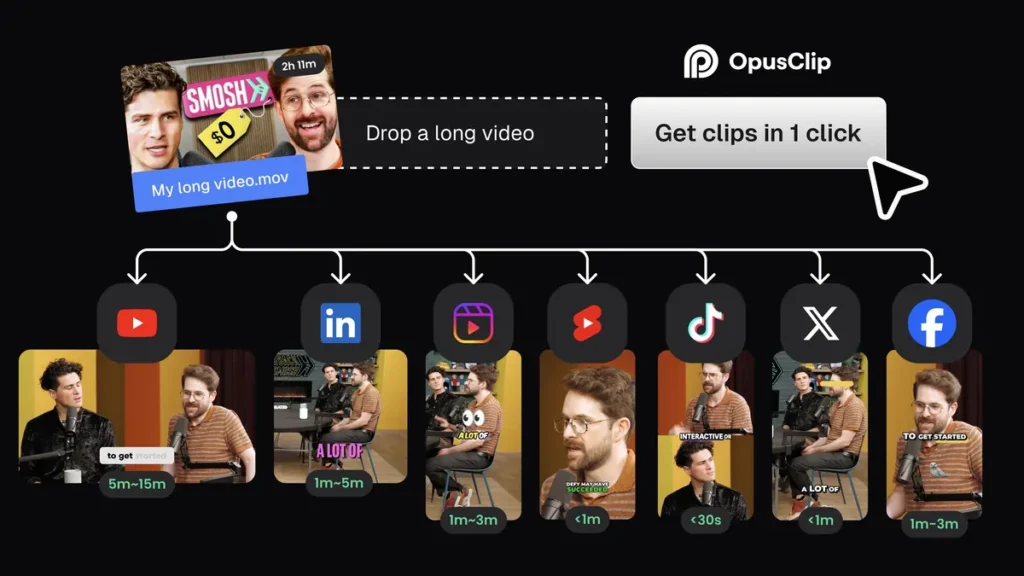
Opus Clip addresses specific challenge marketing teams face in 2026: transforming long-form video content into short-form social media clips optimized for platforms like Instagram Reels, TikTok, YouTube Shorts, and LinkedIn video posts. The platform uses AI to identify compelling moments, assess virality potential, and automate technical formatting, enabling marketing teams to maximize distribution and engagement from existing video content investments.
Core Capabilities:
AI clipping identifies engaging segments from long-form content automatically. Marketing teams upload webinar recordings, podcast videos, interview content, or presentation captures; Opus Clip analyzes content identifying moments with high engagement potential based on speech patterns, visual elements, pacing, and topic relevance. The system generates 10-20 potential clips from 60-minute source content, dramatically reducing manual review time required to identify shareable moments.
Virality Score prediction helps prioritize which clips to publish. Each generated clip receives virality score (0-100) predicting social media performance based on factors including hook strength, content pacing, emotional resonance, topic relevance, and platform-specific optimization. Marketing teams focus effort on high-scoring clips rather than distributing all generated options, improving content quality perception and team efficiency.
Auto-captions in 20+ languages expand content accessibility and platform optimization. Studies show 85% of social media video views occur with sound off; captions transform videos from audio-dependent to visually-complete content. Opus Clip generates accurate, properly-timed captions in multiple languages, enabling global distribution without manual transcription or translation.
AI B-roll insertion enhances visual interest for content lacking dynamic visuals. Talking-head videos, presentation recordings, and interview content benefit from supplementary footage illustrating discussed concepts. Opus Clip identifies appropriate moments for B-roll based on speech content and inserts relevant stock footage or graphics automatically, improving production value without manual video editing.
Auto-reframe adjusts aspect ratios for platform-specific requirements. Source content recorded in landscape (16:9) automatically reframes to portrait (9:16) for Instagram Reels and TikTok, square (1:1) for feed posts, or other dimensions based on target platform. The AI identifies and tracks subjects, keeping faces and important visual elements centered during reframing rather than simple cropping.
Social scheduler with direct posting enables distribution workflow within Opus Clip interface. Marketing teams schedule clips across Instagram, TikTok, YouTube, LinkedIn, and Facebook directly from platform without exporting files and manually uploading to each destination. Multi-platform distribution that previously required 30-45 minutes per clip completes in 5 minutes.
Team workspace supports collaborative content operations. Multiple team members review generated clips, provide feedback, approve for publishing, or request revisions within shared environment. Distributed social media teams coordinate efficiently without email chains or separate project management tools.
Pricing Structure:
Opus Clip offers straightforward tiered pricing based on processing volume:
- Free Plan: 60 minutes video processing monthly, core AI features, 720p exports, standard support. Sufficient for experimentation or very light usage repurposing 1-2 long videos monthly.
- Starter Plan: $29 monthly for 300 processing minutes, 1080p exports, AI B-roll, auto-captions, social scheduling, and priority support. Small marketing teams or individual content creators repurposing 4-6 webinars or podcast episodes monthly find Starter adequate.
- Professional Plan: $79 monthly for 1,200 processing minutes (20 hours), 4K exports, premium AI features, team collaboration, API access, and dedicated support. Marketing teams operating regular video content programs requiring weekly repurposing justify Professional investment.
- Enterprise Plan: Custom pricing for high-volume operations requiring unlimited processing, white-label options, custom integrations, dedicated account management, and SLA guarantees. Enterprise agreements typically begin $500-1,000 monthly for teams processing 100+ hours monthly.
Annual subscriptions reduce costs 20% versus monthly billing. Organizations prepaying for processing minutes receive bulk discounts on high-volume commitments.
Enterprise Suitability: 7/10
Opus Clip earns moderate enterprise suitability scores reflecting specialized but valuable capabilities for organizations operating video content programs. The platform serves specific workflow needs exceptionally well while lacking breadth for comprehensive video operations.
Specialized solution addresses critical content distribution challenge. Marketing teams investing in webinar production, podcast recording, conference presentations, or interview content recognize these long-form assets reach limited audiences. Opus Clip multiplies content value by enabling efficient repurposing into dozens of social media clips, expanding reach without proportional production investment.
Social media optimization represents core platform strength. Features like virality scoring, platform-specific formatting, caption generation, and direct publishing align perfectly with social media marketing priorities in 2026. Organizations prioritizing social media presence find Opus Clip purpose-built for their distribution strategy.
Content velocity improvements prove transformative for resource-constrained teams. Marketing departments without dedicated video editors or social media coordinators report 5× increase in social video posting frequency after Opus Clip adoption. Channels that previously shared 2-3 video posts weekly scale to 10-15 posts without headcount expansion.
Enterprise governance and security features remain basic. Organizations requiring sophisticated approval workflows, detailed audit trails, or integration with enterprise digital asset management find Opus Clip less mature than established platforms. The tool targets marketing efficiency over enterprise IT requirements.
ROI Metrics:
Marketing teams implementing Opus Clip report specific video distribution improvements:
Long-form content generates 10-15 social clips in 15 minutes. Marketing teams manually identifying, extracting, editing, formatting, and captioning clips from webinar recordings previously spent 3-4 hours producing 3-5 clips. Opus Clip automation reduces time to 15-20 minutes while increasing output 3×, representing 90% time savings with doubled production.
Social media posting velocity increases 5× for video content. Brands constrained to 2-3 video posts weekly due to production capacity scale to 10-15 weekly posts using Opus Clip repurposing. Algorithm favorability improves with increased posting frequency, driving 30-40% growth in organic reach according to marketing teams tracking pre/post-implementation metrics.
Engagement rates improve 35% with optimized clips. Opus Clip’s virality scoring and editing recommendations help teams identify and publish highest-performing moments rather than random segments. Marketing teams comparing engagement metrics between manually-selected clips and Opus-recommended clips report consistent performance advantages for AI-recommended content.
Long-form content ROI multiplies through extended distribution. Webinars costing $2,000-5,000 to produce previously generated single attendance spike with minimal ongoing value. Opus Clip enables extracting 15-25 social clips distributed over 3-6 months, extending content value and audience reach without additional production investment. Marketing teams calculate 10-15× improvement in cost-per-engagement when including repurposed distribution.
Best For:
Opus Clip serves marketing teams with existing long-form video content (webinars, podcasts, interviews, presentations) needing to maximize social media distribution. Organizations producing monthly webinars, weekly podcast episodes, quarterly conference content, or regular thought leadership interviews find highest value. Teams prioritizing social media engagement and lacking dedicated video editing resources benefit most from automated repurposing capabilities.
Integration Ecosystem:
Opus Clip integrates with essential video and social media platforms:
- Video Sources: Direct integration with Zoom, YouTube, and cloud storage services enables importing source content without manual downloads. Marketing teams working from Zoom webinar recordings or YouTube uploads access content directly.
- Social Media Platforms: Native publishing to Instagram, TikTok, YouTube Shorts, LinkedIn, and Facebook eliminates manual export-and-upload steps. Social media managers distribute clips across all platforms from unified interface.
- Project Management: Zapier connectivity enables workflow automation triggering notifications, approvals, or distribution based on clip generation completion. Marketing operations teams integrate Opus Clip into broader content workflows.
Limitations:
Narrow use case limits platform relevance for some organizations. Marketing teams not producing regular long-form video content find Opus Clip irrelevant regardless of quality. The platform solves specific problem that not all organizations face, requiring careful evaluation of use case applicability before investment.
Source content quality determines output quality. Opus Clip cannot transform poorly-produced source content into engaging clips. Marketing teams recording low-quality webinars—poor audio, static visuals, monotonous presentation—generate low-quality clips despite AI optimization. The platform amplifies existing content quality rather than creating quality from poor sources.
Platform limitations constrain creative control. Automated clipping occasionally misses context, selects unrepresentative moments, or makes editing choices contrary to brand guidelines. Marketing teams requiring precise control over every published clip find automation insufficiently nuanced, preferring manual editing despite time investment.
Growing competitive landscape creates differentiation concerns. Multiple platforms now offer similar AI clipping capabilities, including Descript, Riverside, and general video editing tools adding AI features. Opus Clip’s specialized focus provides advantages today but faces commoditization risk as competitors match capabilities.
Tool #10: Synthesia – AI Avatar Video Generation
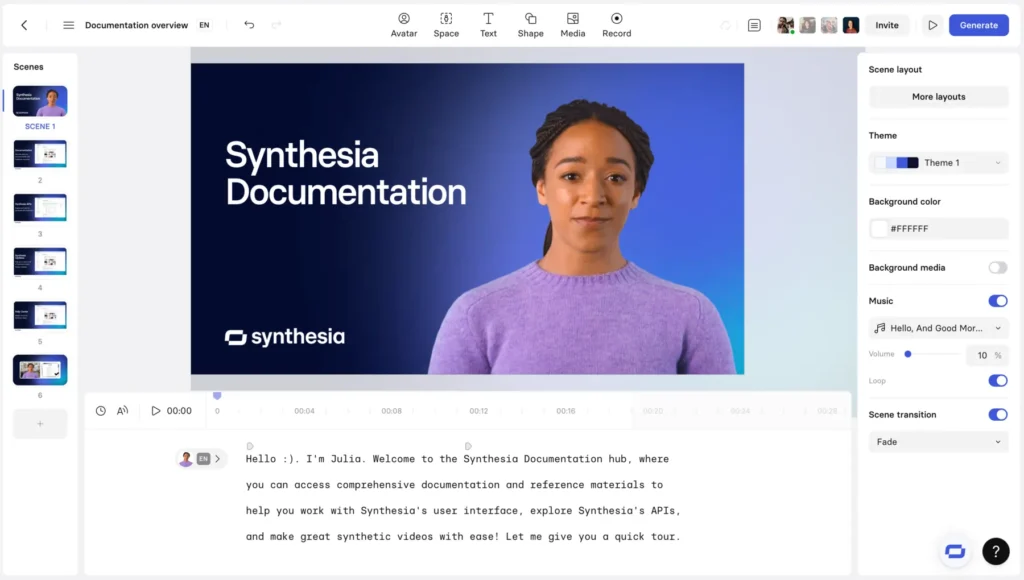
Synthesia pioneered AI avatar video generation, enabling marketing teams to create professional video content without cameras, studios, actors, or traditional video production infrastructure. The platform proves particularly valuable for organizations requiring scalable video production across multiple languages, frequent content updates, or standardized training and communications materials at enterprise scale.
Core Capabilities:
150+ AI avatars representing diverse ethnicities, ages, genders, and professional contexts enable marketing teams to select appropriate on-screen personalities for target audiences. Avatars range from business professionals for corporate communications to casual presenters for consumer marketing to specialized characters for educational content. Visual diversity ensures appropriate representation without limiting talent availability.
60+ language support with native-quality pronunciation eliminates traditional localization costs. Marketing teams write scripts in English; Synthesia generates video with AI avatar speaking fluent Spanish, Mandarin, French, German, or dozens of other languages with appropriate accents and natural speech patterns. Global organizations distribute identical content across markets without expensive dubbing or separate production shoots.
Text-to-video conversion simplifies production workflow to script writing. Marketing teams create content by writing or pasting text; Synthesia generates complete video with AI avatar presenting content, appropriate gestures and expressions, professional background environments, and optional graphics or media elements. Production process accessible to content writers without video production expertise.
Custom avatar creation enables brand-specific personalities. Enterprise customers upload footage of company executives, spokespeople, or brand ambassadors; Synthesia creates custom AI avatars replicating appearance, voice, and mannerisms. Marketing teams generate unlimited video content featuring branded personalities without scheduling talent availability or video shoot logistics.
Screen recording integration combines talking-head presentation with demonstrations. Marketing teams creating product tutorials, software walkthroughs, or instructional content overlay AI avatar presenting alongside screen captures showing relevant interfaces or processes. This combination provides human connection of presenter with practical demonstration of discussed topics.
Template library provides professional layouts for various use cases: corporate communications, learning and development, marketing messages, sales enablement, customer onboarding, product demonstrations, and more. Marketing teams start from relevant templates rather than designing video layouts from scratch, accelerating production initiation.
Collaboration and asset management support enterprise operations. Team members share video projects, provide feedback through timestamped comments, maintain brand asset libraries (logos, colors, fonts, backgrounds), and track project status through production workflows. Distributed marketing teams coordinate video production efficiently.
Pricing Structure:
Synthesia offers tiered pricing reflecting capability sophistication and usage volume:
- Starter Plan: $29 monthly for 120 minutes annual video creation (10 minutes monthly average), standard AI avatars, 65+ languages, basic templates, and 720p downloads. Small teams producing monthly update videos or quarterly training content find Starter sufficient for light usage.
- Creator Plan: $89 monthly for 360 minutes annual creation (30 minutes monthly average), priority avatar selection, 1080p downloads, custom templates, collaboration features, and priority support. Marketing teams producing regular video content—weekly updates, ongoing campaigns—justify Creator investment.
- Enterprise Plan: Custom pricing for organizations requiring unlimited video creation, custom avatar development, API access, SSO integration, advanced security controls, dedicated account management, and white-label options. Enterprise agreements typically begin $2,000-5,000 monthly for large-scale operations.
Annual commitment required for all plans; monthly billing unavailable reflects infrastructure costs of AI avatar generation. Volume discounts apply to Enterprise agreements based on anticipated usage and user counts.
Enterprise Suitability: 9/10
Synthesia earns high enterprise suitability scores based on scalability, compliance advantages, and cost structure favorable for high-volume operations. The platform serves enterprise communication needs exceptionally well, though creative limitations prevent complete replacement of traditional video production for brand marketing requiring emotional resonance.
Professional avatar quality meets enterprise standards. AI avatars achieve realistic appearance, natural speech patterns, and appropriate non-verbal communication. Marketing teams using Synthesia-generated content in external communications report audience acceptance comparable to human-presented videos, validating quality for professional use.
Enterprise governance controls address organizational requirements. Admin consoles manage user permissions, control avatar access, enforce brand guidelines, track usage analytics, and maintain compliance documentation. Marketing leadership monitors video production across distributed teams, ensuring brand consistency and identifying optimization opportunities.
Compliance advantages prove compelling for regulated industries. Traditional video production involving human talent requires contracts, rights management, talent releases, and ongoing usage negotiations. Synthesia eliminates these complexities—generated videos require no talent agreements, include no rights restrictions, and enable unlimited editing and distribution. Legal departments appreciate simplified compliance compared to traditional video production.
Multi-language capability delivers exceptional ROI for global organizations. Marketing teams localizing content into 10+ languages traditionally face $5,000-10,000 per-language costs for dubbing or separate productions. Synthesia generates native-quality video in all languages from single script at fixed platform cost, representing 70-90% cost reduction for multi-market operations.
ROI Metrics:
Marketing teams implementing Synthesia report dramatic video production economics improvements:
Video production costs reduce 80-90% compared to traditional approaches. Marketing videos requiring $3,000-8,000 traditional production (scriptwriting, talent booking, studio rental, shooting, editing) complete for $50-200 Synthesia generation cost (primarily staff time for scripting and production setup). Organizations producing 20+ videos annually achieve six-figure savings.
L&D teams save 60% on training video production. Human resources and customer success departments creating onboarding videos, product training, compliance education, and skill development content report eliminating 60% of traditional video production budgets while maintaining or increasing content volume.
Multi-language content costs decrease 70% versus traditional localization. Global marketing teams distributing content across 15-20 language markets previously spent $75,000-150,000 annually on translation and dubbing. Synthesia reduces per-language incremental cost to near-zero beyond initial translation, saving $50,000-100,000+ annually.
Update agility improves time-to-market 90%. Traditional video content requiring updates when products change, regulations shift, or information becomes outdated necessitates expensive re-shoots. Synthesia enables editing scripts and regenerating videos in hours versus weeks, maintaining content currency without production delays or costs.
Best For:
Synthesia serves enterprise teams needing scalable video production for training, product demos, customer communications, and multi-language content across multiple languages and regions. Organizations producing 50+ similar videos annually—employee onboarding, product tutorials, compliance training, customer education—achieve compelling ROI through production cost elimination. Companies operating globally requiring content localization across 10+ markets find multi-language capabilities transformative.
Integration Ecosystem:
Synthesia integrates with enterprise platforms supporting workflow automation:
- Learning Management Systems: Integrations with major LMS platforms enable publishing Synthesia videos directly into training curricula. L&D teams manage video creation and course integration within connected workflows.
- Marketing Automation: Connections to HubSpot, Marketo, and Salesforce enable embedding Synthesia videos in email campaigns, landing pages, and nurture sequences. Marketing operations automate video generation triggered by campaign requirements.
- API Access: Developer API enables programmatic video generation for custom applications. Marketing technology teams build automated video creation triggered by business events, data updates, or customer actions.
- Collaboration Platforms: Slack and Microsoft Teams integrations notify team members about video production status, review requests, and publication completions. Distributed teams coordinate asynchronously with context.
Limitations:
Emotional connection limitations constrain brand marketing applicability. AI avatars, despite quality improvements, lack authentic human emotional expression and personality that brand storytelling and persuasive marketing often require. Organizations prioritizing emotional resonance and brand personality over production efficiency find traditional video more effective.
Creative flexibility constraints frustrate sophisticated productions. Synthesia optimizes for straightforward talking-head presentations rather than dynamic cinematography, creative editing, or sophisticated visual storytelling. Marketing teams producing brand campaigns, creative commercials, or emotionally-engaging content require traditional production regardless of Synthesia capabilities.
Avatar selection represents meaningful brand decision. Organizations must carefully evaluate whether AI avatar usage aligns with brand values, audience expectations, and authenticity principles. Some audiences react negatively to synthetic personalities, particularly when usage remains undisclosed.
Uncanny valley concerns persist despite improvements. Subtle imperfections in avatar realism—eye contact timing, micro-expressions, speech synchronization—occasionally trigger viewer discomfort or distrust. Marketing teams must evaluate whether target audiences accept AI presenters or prefer human talent despite production costs.
AI Content Workflow and Campaign Automation
Individual AI tools deliver point solutions; workflow platforms orchestrate end-to-end content operations. Marketing teams managing 100+ content pieces monthly require systems connecting strategy, creation, distribution, and measurement in unified environments rather than disconnected tools requiring manual coordination. These platforms address operational complexity emerging when content operations scale beyond small team capacity.
Tool #11: Narrato – Complete Content Operating System
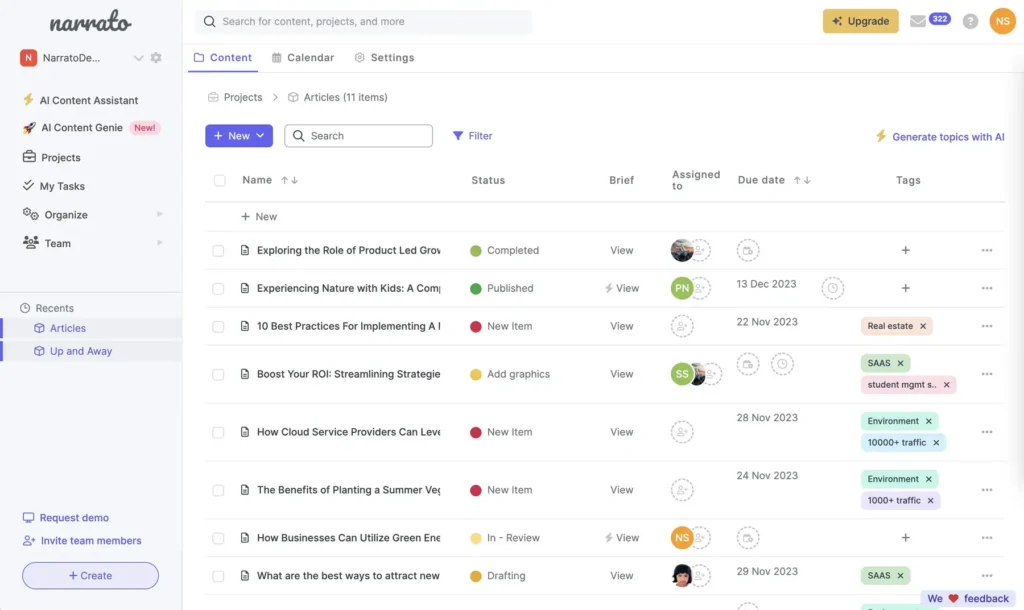
Narrato positions itself as comprehensive content operations platform serving marketing teams requiring planning, creation, collaboration, optimization, and analytics capabilities within unified system. The platform addresses workflow chaos typical when teams juggle separate tools for project management, content creation, SEO optimization, collaboration, and performance tracking.
Core Capabilities:
AI-powered content briefs automate research and planning phases. Marketing strategists input target keywords and content objectives; Narrato generates comprehensive briefs including competitor analysis, recommended structure, target word count, semantic keyword suggestions, tone recommendations, and related topics. This automation reduces content planning time 60-70% while improving consistency across team-produced content.
Workflow management with approval gates enforces quality standards and stakeholder coordination. Marketing operations teams configure multi-stage workflows: ideation → briefing → drafting → editing → SEO optimization → legal review → publication. Each stage includes assigned responsibility, deadline tracking, and approval requirements. Content progresses through defined processes rather than informal coordination prone to errors and delays.
SEO optimization integrates throughout content lifecycle. Writers receive real-time suggestions during drafting—keyword density, readability scores, semantic richness, content structure recommendations. This integrated approach prevents SEO becoming post-production afterthought requiring content rewrites. Marketing teams report 35% improvement in average search rankings for content produced through Narrato compared to unoptimized workflows.
Content calendar with automation enables campaign coordination across teams and channels. Marketing planners visualize content production across weeks and months, identifying gaps and balancing workload. Automated reminders notify stakeholders of approaching deadlines, required approvals, or blocked workflows. Distributed teams maintain coordination without constant manual check-ins.
Team collaboration features support modern distributed operations. Multiple contributors work simultaneously with real-time updates, inline commenting, task assignments, file attachments, and version control. Remote marketing teams collaborate effectively without email chains or separate project management overhead.
Analytics and performance tracking close the feedback loop. Marketing leadership monitors content production velocity, workflow bottlenecks, individual contributor productivity, SEO performance, and content ROI. Data-driven insights identify process improvements, training needs, and resource allocation opportunities invisible in disconnected tool environments.
Pricing Structure:
Narrato offers simplified tiered pricing based on user count:
- Pro Plan: $45 monthly for 3 users, unlimited projects, AI writing assistance, SEO optimization, workflow management, and collaboration features. Small content teams (3-5 people sharing seats) find Pro plan accessible entry point.
- Business Plan: $99 monthly for unlimited users within single workspace, advanced workflow automation, custom integrations, API access, priority support, and team analytics. Growing marketing departments (10-25 people) justify Business investment through operational efficiency gains.
- Custom Plan: Enterprise pricing for organizations requiring multiple workspaces (separate teams, brands, or clients), white-label options, dedicated account management, custom integration development, and SLA guarantees. Agency and enterprise agreements typically begin $500-1,000 monthly.
Annual subscriptions reduce costs 20% versus monthly billing. Custom plans negotiate based on specific requirements—user counts, workspace needs, integration complexity, support level.
Enterprise Suitability: 8/10
Narrato earns strong enterprise suitability scores for mid-market organizations but faces competition from more established platforms (HubSpot, Salesforce) at large enterprise scale. The platform delivers comprehensive content operations capabilities at price points accessible to growing organizations.
Complete workflow coverage eliminates tool sprawl. Marketing teams previously managing content planning in spreadsheets, creation in Google Docs, collaboration via email, SEO in separate tools, and analytics in yet another platform consolidate operations through Narrato adoption. Single-platform approach reduces training burden, eliminates data silos, and improves team coherence.
Project management integration differentiates from pure creation tools. Marketing teams benefit from content operations visibility—what’s in progress, what’s blocked, who’s overloaded, where bottlenecks exist—enabling proactive management rather than reactive crisis response. Operations maturity improves through systematic workflow enforcement.
Growing platform with active development demonstrates commitment to market needs. Regular feature releases address customer feedback and competitive gaps. Marketing teams investing in Narrato benefit from ongoing capability expansion rather than stagnant legacy platforms.
Enterprise features remain developing compared to established alternatives. Organizations requiring sophisticated SSO integration, detailed audit logging, enterprise-grade security certifications, or deep integration with digital asset management systems find capabilities less mature than HubSpot or Adobe platforms. Narrato serves mid-market well but faces gaps at Fortune 500 scale.
ROI Metrics:
Marketing teams implementing Narrato report operational improvements:
Content production cycle time reduces 45% from ideation to publication. Structured workflows with automated progression, integrated optimization, and real-time collaboration eliminate delays typical in informal processes. Content that previously required 3-4 weeks from concept to publication completes in 1.5-2 weeks.
Bottleneck identification improves workflow efficiency 30%. Marketing operations teams analyzing workflow data discover unexpected delays—legal review taking 5 days, editing backlogged due to single resource constraint, SEO optimization happening too late requiring rewrites. Data-driven process improvements address specific inefficiencies impossible to identify without visibility.
Teams manage 3× content volume with same headcount. Operational efficiency from structured workflows, integrated tools, and automated processes enables teams producing 40 content pieces monthly to scale to 120 pieces without proportional hiring. Marketing budget stretches further through productivity rather than just tool capabilities.
Quality consistency improves with enforced processes. Marketing teams without systematic workflows show high variation in content quality depending on which team member created content. Narrato’s structured approach with quality gates and optimization requirements maintains baseline standards across all content regardless of individual creator sophistication.
Best For:
Narrato serves content marketing teams needing unified platform for planning, creation, collaboration, and performance tracking without enterprise content management system complexity. Organizations with 5-25 person marketing teams producing 50-150 content pieces monthly find optimal balance of capability and accessibility. Teams frustrated by tool sprawl and seeking operational maturity benefit most from Narrato’s integrated approach.
Integration Ecosystem:
Narrato connects to essential marketing and productivity platforms:
- Content Management: WordPress, HubSpot, and Webflow integrations enable direct publishing from Narrato to production websites. Content-to-publication workflow occurs within unified environment.
- SEO Tools: Surfer SEO integration provides real-time optimization scoring during content creation. Writers see recommendations inline rather than conducting post-production optimization.
- Productivity Platforms: Google Workspace and Microsoft 365 connections import documents and sync calendars. Marketing teams work within familiar ecosystem while benefiting from Narrato’s content-specific capabilities.
- Project Management: Zapier connectivity enables workflow automation connecting Narrato to broader marketing operations. Custom triggers and actions integrate content workflows with campaign management, approval processes, and analytics reporting.
Limitations:
Platform maturity lags established enterprise alternatives. Marketing teams at Fortune 500 companies find capability gaps compared to HubSpot Content Hub, Adobe Experience Manager, or Salesforce Marketing Cloud. Narrato serves mid-market exceptionally but faces adoption challenges at largest organizations with complex requirements.
Integration ecosystem remains limited compared to market leaders. Marketing operations teams requiring deep connectivity to specialized tools—digital asset management, marketing resource management, advanced analytics platforms—find fewer pre-built connectors than alternative platforms. Custom development through API addresses some gaps but requires technical resources.
Learning curve exists despite usability focus. Marketing teams transitioning from informal processes to structured workflows require cultural change beyond tool training. Organizations must invest in process documentation, change management, and ongoing optimization to realize full platform value.
Content creation AI capabilities adequate but not leading-edge. Narrato’s AI writing assistance performs competently for basic content generation but lacks sophistication of specialized tools like Jasper or Claude. Teams requiring premium writing quality supplement Narrato workflow platform with specialized creation tools.
Tool #12: AirOps – Sophisticated Content Pipeline Automation
AirOps serves marketing teams with proven content strategies needing to scale operations 5-10× without proportional headcount expansion. The platform combines sophisticated workflow automation, multiple AI model access, SEO research capabilities, and content generation at scale, targeting technically-sophisticated marketing operations teams comfortable with automation complexity.
Core Capabilities:
Workflow engine enables multi-step content operations automation. Marketing teams define complex sequences: research competitive keywords → generate content briefs → create first drafts → optimize for SEO → format for publishing → schedule distribution. Each step can invoke different AI models, integrate external tools, apply conditional logic, and route outputs through team review. This sophistication enables automating complete content production pipelines previously requiring extensive manual coordination.
40+ AI models accessible through unified interface enables optimization for specific tasks. Marketing teams select GPT-4 for creative writing, Claude for analytical content, specialized models for translation or summarization, and custom models for domain-specific requirements. This flexibility prevents single-model limitations constraining output quality or capability.
SEO research automation reduces competitive analysis time 80%. Marketing strategists input seed keywords; AirOps analyzes top-ranking content, extracts semantic keyword clusters, identifies content gaps, and generates optimization recommendations. Research that traditionally required 2-4 hours analyzing competitors and identifying opportunities completes in 15-20 minutes.
Content generation at scale serves SEO programs requiring hundreds of optimized pages. E-commerce sites, SaaS companies pursuing programmatic SEO, or publishers operating content networks use AirOps to generate product pages, location-based content, comparison articles, or educational resources at volumes impossible through manual creation.
Integration hub connects to marketing technology stack enabling data flow across platforms. AirOps pulls data from CRMs, writes to content management systems, triggers workflows based on external events, and distributes generated content across channels. This connectivity transforms AirOps from standalone tool to content automation infrastructure within broader marketing operations.
Analytics and optimization track performance informing continuous improvement. Marketing teams monitor which automation workflows deliver highest-quality outputs, which AI models perform best for specific content types, which optimization tactics drive strongest SEO results, and which content formats generate most engagement. Data-driven refinement improves content operations systematically over time.
Pricing Structure:
AirOps offers growth-stage pricing reflecting enterprise-grade capabilities:
- Growth Plan: $149 monthly for core automation features, multiple AI model access, SEO research tools, standard integrations, and email support. Small-to-medium teams (5-10 people) beginning automation journey find Growth accessible while delivering meaningful capabilities.
- Pro Plan: $399 monthly adding advanced workflow features, premium AI models, custom integrations, API access, priority support, and increased usage limits. Established content operations (10-25 people) scaling proven strategies justify Pro investment.
- Scale Plan: Custom enterprise pricing for high-volume operations requiring unlimited automation execution, dedicated infrastructure, white-label options, dedicated account management, custom integration development, and SLA guarantees. Enterprise agreements typically begin $2,000-5,000 monthly.
Annual commitments receive 20% discounts versus monthly billing. Usage-based components (AI model calls, workflow executions) scale with consumption, requiring organizations to forecast capacity needs for budget planning.
Enterprise Suitability: 9/10
AirOps earns high enterprise suitability scores for technically-sophisticated marketing operations targeting scale. The platform serves teams with proven content market-fit seeking operational efficiency rather than teams still validating content strategies.
Designed for proven strategies at scale represents positioning clarity. AirOps documentation and pricing explicitly target organizations with established content operations seeking 5-10× scaling. This focus prevents inappropriate adoption by teams lacking readiness for automation sophistication.
Advanced workflow capabilities enable complex operations automation. Marketing operations teams comfortable with logic flow, conditional branching, error handling, and API integration build sophisticated content pipelines matching specific business requirements. This flexibility prevents platform limitations constraining growth strategies.
Strong data and analytics focus enables optimization culture. Marketing leaders implementing AirOps benefit from comprehensive performance visibility—workflow efficiency, content quality metrics, SEO performance, cost per content piece. Data-driven optimization becomes systematic rather than intuitive, compounding competitive advantages over time.
Technical sophistication requirement creates adoption barriers. Marketing teams lacking operations specialists or technical resources struggle implementing AirOps effectively. The platform delivers exceptional value for technically-capable teams but risks failure in organizations without appropriate expertise.
ROI Metrics:
Marketing teams implementing AirOps for appropriate scale scenarios report dramatic efficiency improvements:
Proven content workflows scale 10× with automation. Marketing teams validating SEO strategies through manual execution of 50-100 pages scale to 500-1,000 pages through AirOps automation without proportional hiring. Operations that previously required 5-10 content creators consolidate to 2-3 managing automated pipelines.
SEO research time reduces 80% from manual competitor analysis. Marketing strategists analyzing search landscapes, identifying content opportunities, and developing optimization strategies complete research phases in 30-45 minutes versus 3-4 hours. Accelerated research enables targeting more keywords and launching more content initiatives within fixed resources.
Programmatic SEO objectives achievable through automation. E-commerce brands generating location-based landing pages, comparison pages, or category pages at scale—requirements ranging from 1,000-100,000 pages—achieve targets through AirOps automation impossible with manual creation. SEO strategies previously limited by production capacity become execution questions.
Content production costs decrease 70-85% at scale. Organizations comparing per-page costs between manual creation ($50-200 per page including research, writing, optimization) and automated generation ($5-20 per page primarily infrastructure and QA costs) achieve order-of-magnitude efficiency gains justifying platform investment.
Best For:
AirOps serves established marketing teams with proven content strategies needing to scale operations 5-10× without proportional headcount increase. Organizations pursuing programmatic SEO, large-scale content operations, or sophisticated automation strategies benefit most. Teams with marketing operations specialists or technical resources capable of configuring complex workflows achieve highest value. Companies validating content strategies or lacking operational maturity should master simpler platforms before attempting AirOps sophistication.
Integration Ecosystem:
AirOps provides robust connectivity enabling content automation infrastructure:
- Content Management Systems: WordPress, Webflow, HubSpot, and custom CMS integrations enable automated content publishing. Generated content flows directly to production environments without manual transfer.
- SEO Platforms: Ahrefs, SEMrush, and Moz integrations pull competitive data informing content strategies. Automated research workflows analyze competitors systematically.
- Data Sources: CRM, database, and spreadsheet connections enable personalized content generation at scale. Customer data informs automated email campaigns, account-based marketing content, or personalized product recommendations.
- Marketing Automation: Zapier, Make, and native API connections integrate AirOps into broader marketing technology stacks. Content generation triggers on business events, campaign launches, or data updates.
Limitations:
Complexity creates steep learning curves and implementation challenges. Marketing teams without technical sophistication or operations expertise struggle implementing AirOps effectively. Platform power comes with configuration burden that prevents plug-and-play simplicity.
Premium pricing excludes small teams and early-stage companies. $149-399 monthly minimum combined with consumption-based costs for high-volume operations creates budgets accessible only to established, funded marketing operations. Bootstrapped startups or small teams find pricing prohibitive regardless of capability value.
Content quality requires careful configuration and ongoing optimization. Automated content generation at scale risks producing low-quality, thin, or duplicate content damaging SEO rather than helping. Teams must invest significantly in quality controls, review processes, and ongoing refinement preventing automation from creating more problems than solutions.
Platform assumes operational maturity that many teams lack. AirOps documentation and features expect marketing teams possess documented content strategies, proven conversion funnels, established SEO approaches, and operational sophistication. Organizations lacking these foundations waste platform investment attempting to automate undefined or unproven processes.
AI Tools for Content Optimization and Performance
Content creation without optimization and measurement wastes marketing budget. These platforms use AI to maximize SEO performance, improve content quality, prove marketing ROI through data-driven insights, and adapt to the emerging landscape of AI-powered search engines reshaping content discovery in 2026.
Tool #13: HubSpot AI (Content Hub) – Integrated Marketing Platform AI
HubSpot Content Hub with integrated AI capabilities represents the most comprehensive marketing platform approach to content operations. Organizations using HubSpot for CRM, marketing automation, and customer engagement benefit from native AI integration across all functions, eliminating integration overhead while providing unified customer data context for content personalization.
Core Capabilities:
Content Assistant generates blog drafts, email copy, social media posts, and landing page content directly within HubSpot interface. Marketing teams create content without switching to external AI tools, maintaining workflow continuity. Generated content automatically inherits brand settings, target audience parameters, and campaign context from broader HubSpot environment.
Content Remix repurposes assets across multiple channels automatically. Blog posts transform into email newsletter sections, social media series, and landing page content with appropriate formatting for each channel. Single content creation effort multiplies across distribution channels without manual adaptation, improving content ROI.
Campaign Assistant provides AI-powered ideation for campaign themes, messaging frameworks, and content calendars. Marketing strategists overcoming blank-canvas paralysis or seeking fresh perspectives use Campaign Assistant to generate campaign concepts aligned with business objectives and target audiences.
Reporting Assistant analyzes marketing analytics generating natural language insights. Marketing leaders request “explain blog traffic changes this quarter” or “identify top-performing email campaigns”; AI synthesizes data patterns into actionable recommendations without requiring deep analytics expertise. Democratized data analysis enables broader team members to extract insights without specialized skills.
SEO recommendations integrate throughout content creation workflow. Writers receive real-time suggestions for keyword optimization, content structure, internal linking, and meta data as they draft content. This integration prevents SEO becoming afterthought addressed post-publication.
Full HubSpot platform integration provides unique advantages. Content Hub AI operates with complete context of customer data, campaign history, lead scoring, sales pipeline, and service interactions. Content personalization, timing, and targeting optimize based on comprehensive customer intelligence impossible with standalone tools.
Pricing Structure:
HubSpot offers tiered pricing with AI capabilities available across multiple product tiers:
- Marketing Hub Starter: $20 monthly includes basic AI features within starter marketing automation platform. Very small teams (1-3 people) access entry-level HubSpot capabilities with limited AI assistance.
- Marketing Hub Professional: $890 monthly provides comprehensive marketing automation with integrated AI features across content, social media, email, and analytics. Mid-market teams (10-50 people) operating mature marketing programs justify Professional investment.
- Content Hub: $500 monthly (standalone) focuses specifically on content operations with AI creation, optimization, management, and analytics capabilities. Organizations using alternative CRM/marketing platforms but seeking HubSpot’s content-specific features access through Content Hub subscription.
- Enterprise Plan: Custom pricing for large organizations requiring advanced features, higher usage limits, dedicated support, service level agreements, and custom integrations. Enterprise agreements typically begin $3,000-5,000 monthly.
Annual commitments mandatory with 10-15% discounts versus theoretical monthly pricing. Onboarding fees ($1,000-5,000) apply for Professional and Enterprise tiers reflecting implementation complexity.
Enterprise Suitability: 10/10
HubSpot earns highest enterprise suitability scores based on platform maturity, comprehensive capabilities, security certifications, and market leadership position. Organizations seeking single-platform marketing operations find HubSpot the safest long-term investment.
Industry-leading marketing platform with AI as native capability rather than bolt-on feature creates coherent user experience. Marketing teams benefit from AI assistance permeating all marketing functions—content, email, social, advertising, analytics—within unified interface. This integration prevents workflow fragmentation typical when adopting specialized AI tools.
Enterprise governance and compliance features exceed alternatives. SOC2, ISO 27001, GDPR compliance, sophisticated admin controls, detailed audit logging, role-based permissions, and single sign-on satisfy enterprise IT and legal requirements. Marketing leadership operates with confidence in platform security and compliance posture according to MIT Technology Review research on enterprise AI adoption patterns.
Significant investment required creates switching costs discouraging platform changes. Organizations implementing HubSpot typically commit long-term given implementation effort, data migration complexity, team training investment, and workflow integration. This stability benefits marketing operations planning multi-year strategies.
ROI Metrics:
Marketing teams implementing HubSpot with AI capabilities report comprehensive operational improvements:
All-in-one platform eliminates 5-7 separate marketing tools consolidating workflows. Organizations previously managing content creation tools, email platforms, social schedulers, analytics systems, and CRM separately achieve operational simplification through HubSpot consolidation. Reduced vendor management, simplified training, and decreased integration maintenance justify premium pricing.
Content-to-campaign cycle time reduces 50% through integrated workflows. Marketing teams move from content ideation to published multi-channel campaigns within unified platform without manual coordination across systems. Content created in Content Hub automatically available for email campaigns, social scheduling, landing pages, and sales enablement without exports and imports.
Attribution clarity improves revenue tracking 40% with unified customer data. HubSpot’s CRM foundation enables accurate attribution connecting content engagement to pipeline generation to revenue realization. Marketing teams prove content ROI with confidence impossible in disconnected tool environments lacking unified customer journey visibility.
Marketing team productivity improves 25-40% through AI assistance integrated throughout daily workflows. Content creation, email optimization, social scheduling, campaign analysis, and reporting all benefit from contextual AI support. Cumulative productivity gains across marketing functions compound to substantial operational efficiency.
Best For:
HubSpot serves enterprise marketing teams building comprehensive marketing operations from scratch with long-term platform commitment or organizations already invested in HubSpot ecosystem extending capabilities into AI-powered content operations. Companies requiring unified customer data, marketing automation, content management, and AI assistance within single platform find HubSpot optimal despite premium pricing.
Integration Ecosystem:
HubSpot provides extensive native integrations and third-party connectivity:
- Ecosystem Integration: HubSpot’s marketplace includes 1,000+ native integrations connecting to specialized marketing tools, sales platforms, service software, and business applications. Marketing operations teams customize platform capabilities through extensive partner ecosystem.
- API Access: Comprehensive APIs enable custom integration development. Marketing technology teams build proprietary connections to internal systems, specialized tools, or unique workflow requirements.
- Data Sync: Bi-directional data synchronization with Salesforce, Microsoft Dynamics, and other enterprise CRMs maintains unified customer records across platforms. Organizations using non-HubSpot CRMs still benefit from HubSpot marketing capabilities while maintaining system-of-record elsewhere.
Limitations:
Significant cost investment prohibits small teams and bootstrapped companies. $500-890 monthly minimums before usage-based costs create budgets accessible only to funded marketing operations. Small teams find HubSpot pricing 5-10× higher than alternative tool combinations despite consolidated value.
Implementation complexity requires dedicated resources or professional services. Marketing teams expecting plug-and-play simplicity face disappointment with HubSpot’s sophisticated platform requiring configuration, migration, training, and ongoing optimization. Organizations must budget implementation costs (typically $5,000-25,000 professional services) beyond subscription fees.
Platform lock-in creates switching challenges once fully adopted. Organizations deeply integrated with HubSpot face substantial switching costs if dissatisfied with capabilities, pricing, or strategic direction. This dependency risk requires careful evaluation before committing to platform adoption.
Over-engineering risk for simple content operations. Marketing teams primarily needing content creation without broader marketing automation, CRM, or customer platform requirements pay for unused capabilities. Standalone content tools provide better value for organizations not benefiting from platform integration.
Tool #14: StoryChief (William AI Agent) – Multi-Channel Publishing Automation
StoryChief positions itself as multi-channel publishing platform with William AI Content Agent automating strategy and execution. Marketing teams managing content across blogs, social media, email newsletters, and other channels benefit from centralized creation and automated distribution eliminating manual channel-specific formatting and posting.
Core Capabilities:
William AI Content Agent combines strategic planning with tactical execution. Marketing teams describe content objectives and target audiences; William generates content calendars, creates drafts optimized for each channel, schedules distribution timing, and publishes across platforms. This agentic approach automates complete workflows rather than just assisting with individual tasks.
Multi-channel publishing eliminates manual content adaptation. Marketing teams create content once; StoryChief automatically formats and publishes to blog, Facebook, LinkedIn, Twitter, Medium, WordPress, newsletter platforms, and additional channels. Content that previously required 2-3 hours adapting and posting to 8-10 channels completes in 15 minutes.
Content calendar with campaign planning coordinates production across teams and timeframes. Marketing planners visualize content distribution across channels and dates, identify gaps, balance workload, and ensure campaign coordination. Calendar view provides operational oversight typically requiring separate project management tools.
SEO optimization integrates into content creation workflow. Writers receive keyword recommendations, content structure suggestions, meta data guidance, and optimization scoring during drafting. This prevents SEO afterthought approach requiring content rewrites.
Team collaboration workflows support distributed content operations. Multiple team members create, edit, review, and approve content with comment threading, task assignments, and version control. Remote marketing teams coordinate effectively without email chains or manual status updates.
Analytics across all publishing channels aggregate performance data. Marketing leadership monitors content impact across blog traffic, social engagement, email opens, and channel-specific metrics within unified dashboard. Multi-channel attribution reveals which platforms drive strongest audience engagement and conversions.
Pricing Structure:
StoryChief offers tiered pricing based on team size and channel requirements:
- Starter Plan: $100 monthly for 3 users, 5 publishing channels, AI content generation, basic analytics, and standard support. Small teams managing limited channel distribution find Starter accessible entry point.
- Growth Plan: $250 monthly for 10 users, 15 publishing channels, advanced AI features, campaign management, and priority support. Growing marketing departments (5-15 people) distributing content across comprehensive channel mix justify Growth investment.
- Enterprise Plan: Custom pricing for large organizations requiring unlimited users, unlimited channels, white-label options, API access, dedicated account management, and custom integrations. Enterprise agreements typically begin $1,000-2,000 monthly.
Annual subscriptions reduce costs 20% versus monthly billing. Volume discounts apply to Enterprise agreements based on team size and channel requirements.
Enterprise Suitability: 7/10
StoryChief earns moderate enterprise scores reflecting strong capabilities for specific use case—multi-channel content distribution—while lacking breadth of comprehensive marketing platforms like HubSpot. Organizations prioritizing distribution efficiency over full marketing operations find strong fit.
Multi-channel distribution automation addresses critical pain point for marketing teams operating across 5+ platforms. Manual content adaptation—reformatting for LinkedIn versus Instagram, adjusting character limits for Twitter, optimizing images for each platform—consumes 40-60% of publishing time. StoryChief automation recovers this time for strategy and creation.
Affordable pricing relative to enterprise alternatives makes StoryChief accessible to mid-market organizations. $250 monthly for Growth plan delivers multi-channel automation at fraction of HubSpot or Salesforce costs. Marketing departments with modest budgets achieve enterprise-class distribution capabilities.
Growing AI capabilities through William agent demonstrate platform innovation. StoryChief actively developing AI features responding to market evolution rather than maintaining legacy platform. Marketing teams investing in StoryChief benefit from ongoing capability expansion.
Enterprise features less mature than established platforms. Organizations requiring sophisticated governance, advanced security certifications, or deep integration with enterprise marketing technology find StoryChief capabilities adequate but not exceptional. Platform serves mid-market well but faces adoption barriers at Fortune 500 scale.
ROI Metrics:
Marketing teams implementing StoryChief report distribution efficiency gains:
Multi-channel distribution time savings reach 65%. Content publishing workflows requiring 3-4 hours posting to blog, social platforms, newsletters, and syndication partners complete in 45-60 minutes through StoryChief automation. Weekly content operations saving 10-15 hours enable increased content volume or reallocation to strategic work.
Publishing consistency improves 45% as automation prevents manual errors. Marketing teams manually posting to multiple channels experience forgotten posts, incorrect scheduling, missing images, or broken links. Automated distribution eliminates human error maintaining professional standards across all channels.
Teams publish 4× more content with same resources through efficiency gains. Marketing departments producing 20 content pieces weekly across all channels scale to 80 pieces leveraging StoryChief automation. Increased content velocity improves SEO (fresh content signals), social engagement (algorithm favorability), and audience retention (consistent presence).
Best For:
StoryChief serves marketing teams managing content across 5+ distribution channels (blog, LinkedIn, Twitter, email, Medium, etc.) needing centralized publishing automation. Organizations with 5-20 person marketing teams producing 50-200 content pieces monthly find optimal value. Companies frustrated by manual multi-channel publishing workflows and seeking operational efficiency benefit most.
Integration Ecosystem:
StoryChief connects to essential publishing and marketing platforms:
- Content Management Systems: WordPress, Webflow, Medium, Ghost, and custom CMS connections enable blog publishing from StoryChief. Content creators manage all distribution channels from unified interface.
- Social Media Platforms: Native publishing to LinkedIn, Facebook, Twitter, Instagram enables social distribution without manual posting. Social media managers schedule and publish from centralized calendar.
- Email Platforms: Mailchimp, Campaign Monitor, and newsletter platform integrations distribute content to email subscribers. Content repurposing from blog to newsletter occurs automatically.
- Analytics Platforms: Google Analytics integration aggregates traffic data with social engagement metrics providing comprehensive performance visibility.
Limitations:
Specialized focus limits broader marketing operations utility. StoryChief solves multi-channel distribution exceptionally but lacks comprehensive capabilities for campaign management, marketing automation, lead generation, or customer journey orchestration. Organizations require supplementary platforms for complete marketing operations.
AI capabilities developing but not market-leading. William AI agent performs adequately for content generation and strategy but lacks sophistication of specialized AI writing tools like Jasper or Claude. Marketing teams prioritizing premium content quality supplement StoryChief automation with specialized creation tools.
Integration breadth narrower than established alternatives. Marketing operations teams requiring connectivity to specialized tools find fewer pre-built integrations than platforms like HubSpot or Zapier. Custom development through API addresses some gaps but requires technical resources.
Channel management complexity emerges at scale. Marketing teams distributing to 15+ channels with platform-specific requirements, posting schedules, and audience targeting face configuration complexity. Channel proliferation creates management overhead that automation partially but not completely eliminates.
Tool #15: Surfer SEO – Real-Time SEO Optimization
Surfer SEO represents the industry-standard content optimization platform providing real-time feedback during content creation. Marketing teams prioritizing organic search performance use Surfer to ensure content meets competitive benchmarks for keyword usage, semantic richness, content structure, and on-page optimization.
Core Capabilities:
Content Editor with real-time SEO scoring guides writers toward optimal content during creation. Marketing teams input target keywords; Surfer analyzes top-ranking competitors extracting optimization signals. Writers see live scores reflecting keyword density, semantic term usage, content length, paragraph structure, heading hierarchy, and image optimization. This real-time feedback prevents SEO becoming post-publication correction requiring content rewrites.
SERP Analyzer conducts competitive research revealing ranking factors for target keywords. Marketing strategists analyze top 50 search results identifying common patterns—typical content length, keyword usage frequency, semantic topics, domain authority, backlink profiles, and content structure. This intelligence informs content strategy and execution specifications.
Keyword Research with clustering organizes search terms into logical content targets. Marketing teams input seed keywords; Surfer identifies related terms, search volumes, ranking difficulty, and clustering patterns. This organization prevents creating multiple competing pages targeting similar keywords while identifying content gap opportunities.
Content Audit analyzes existing pages identifying optimization opportunities. Marketing teams evaluate published content against current competitive benchmarks. Surfer highlights underperforming pages, recommends improvements, and prioritizes optimization efforts based on potential traffic gains. This systematic approach improves existing content ROI rather than only optimizing new content.
AI Outline generator creates content structures based on competitive analysis. Marketing teams building content briefs use AI Outline to generate heading hierarchies, semantic topic coverage, and content sequencing aligned with top-performing competitors. This automation accelerates content planning while ensuring comprehensive topic coverage.
Integration with writing tools embeds optimization directly into content creation workflows. WordPress plugins, Google Docs extensions, and API connections enable writers accessing Surfer guidance without switching applications. Context-appropriate optimization maintains writing flow rather than disrupting creative process.
Pricing Structure:
Surfer SEO offers tiered pricing based on content volume:
- Essential Plan: $89 monthly for 30 content optimizations, basic SERP analysis, keyword research, and standard support. Individual content creators or small teams producing 25-35 optimized pieces monthly find Essential sufficient.
- Scale Plan: $179 monthly for 100 content optimizations, advanced features, team collaboration, and priority support. Marketing teams (5-10 people) producing 80-120 optimized pieces monthly justify Scale investment.
- Scale AI Plan: $219 monthly includes 100 content optimizations plus AI writing capabilities (Surfer AI generates optimized articles). Teams seeking both optimization and AI writing in unified platform find Scale AI efficient.
- Enterprise Plan: Custom pricing for high-volume operations requiring 250+ monthly optimizations, white-label options, API access, dedicated support, and custom integrations. Enterprise agreements typically begin $500-1,000 monthly.
Annual subscriptions reduce costs 20% versus monthly billing. Additional content credits purchase available when teams exceed plan allocations.
Enterprise Suitability: 8/10
Surfer SEO earns strong enterprise suitability for marketing teams prioritizing organic search performance. The platform represents industry standard for content SEO optimization with broad adoption across agencies, enterprises, and specialized content operations.
Industry-standard SEO optimization tooling creates baseline expectation among content professionals. Marketing teams hiring SEO specialists or content strategists find Surfer knowledge assumed. This ubiquity simplifies onboarding and ensures best practices adoption.
Data quality and recommendation accuracy represent Surfer’s primary value. Marketing teams trust Surfer analysis based on comprehensive competitive data and validated ranking factor correlations. Confidence in recommendations enables teams following guidance without second-guessing, improving execution consistency.
Team collaboration features support distributed content operations. Multiple team members access shared projects, content briefs, and optimization data. Remote marketing teams coordinate SEO strategy and execution efficiently.
Integration complexity creates adoption friction. Marketing teams must configure connections between Surfer and content creation tools, establishing workflows that incorporate optimization feedback naturally. Organizations underinvesting in integration setup reduce value realization.
ROI Metrics:
Marketing teams implementing Surfer SEO report search performance improvements:
Content SEO scores improve 40% on average when measured against optimization targets. Marketing teams comparing content created with versus without Surfer guidance show consistent quality improvement. Systematic optimization replaces intuitive approaches with data-driven methodology.
Ranking improvements average 30% more top-10 positions within 3-6 months. Marketing teams tracking keyword rankings before and after Surfer adoption report measurable gains in search visibility. Optimization compounds over time as search engines recognize content quality improvements.
Organic traffic growth averages 25% increase year-over-year. Marketing leadership attributing traffic changes to content optimization initiatives report Surfer-optimized content outperforming legacy content by significant margins. Traffic growth translates to lead generation and revenue improvements justifying tool investment.
SEO execution time reduces 50% through automated competitive analysis. Marketing strategists previously spending 2-3 hours manually analyzing top-ranking competitors extract equivalent intelligence in 20-30 minutes through Surfer automation. Time savings redirect to strategic planning and additional content production.
Best For:
Surfer SEO serves content marketing teams prioritizing organic search performance and data-driven optimization over intuition-based approaches. Organizations producing 50+ SEO-focused content pieces monthly benefit from systematic optimization at scale. Teams with SEO specialists or content strategists seeking tooling that embodies best practices find Surfer essential infrastructure.
Integration Ecosystem:
Surfer SEO connects to content creation and management platforms:
- Writing Platforms: WordPress, Google Docs, and Jasper integrations embed Surfer optimization directly into writing environments. Content creators receive real-time feedback without switching applications.
- Content Management: Direct publishing to WordPress from Surfer Content Editor streamlines workflow from optimization to publication.
- Marketing Platforms: Zapier connectivity enables workflow automation connecting Surfer to broader marketing technology stacks.
Limitations:
SEO focus excludes other content marketing dimensions. Surfer optimizes for search engines but provides minimal guidance on audience engagement, conversion optimization, brand voice consistency, or content creativity. Marketing teams require supplementary tools for comprehensive content quality beyond pure SEO.
Requires SEO knowledge for optimal usage. Marketing team members without foundational SEO understanding misinterpret Surfer recommendations or over-optimize content creating keyword-stuffed, unnatural writing. Organizations must ensure basic SEO literacy before deploying Surfer to broader teams.
Optimization can harm readability when followed rigidly. Writers pursuing perfect Surfer scores sometimes sacrifice natural language flow, reader engagement, or content utility for mechanical optimization. Teams must balance optimization with reader experience preventing algorithm-focused content that people dislike.
Continuous competitive landscape changes require ongoing optimization. Surfer recommendations reflect current top-ranking content; as competitors update and search algorithms evolve, previously-optimized content requires revisiting. Marketing teams must budget ongoing optimization rather than one-time optimization expecting permanent results.
Tool #16: Semrush Content Toolkit with AI – Comprehensive SEO and Content Platform
Semrush evolved from SEO research platform to comprehensive content marketing suite with AI capabilities. Marketing teams requiring competitive intelligence, keyword research, content optimization, performance tracking, and emerging AI search visibility monitoring find Semrush provides unified environment spanning strategy through measurement.
Core Capabilities:
Topic Research identifies trending topics and content opportunities based on competitive analysis and search data. Marketing strategists overcoming ideation challenges input broad topics; Semrush reveals subtopics, related questions, and content gaps competitors haven’t addressed. This intelligence informs content calendars and strategic planning.
SEO Content Template generates optimization briefs for target keywords. Marketing teams planning content receive specific recommendations: target word count, semantic keywords to include, readability targets, questions to answer, and competitor analysis. These data-driven briefs guide writers toward competitive content.
SEO Writing Assistant provides real-time optimization scoring during content creation. Similar to Surfer SEO, writers receive immediate feedback on keyword usage, content structure, readability, and optimization quality. This prevents SEO becoming afterthought addressed post-publication.
Content Audit analyzes existing content identifying underperforming pages and optimization opportunities. Marketing teams systematically improve content portfolios rather than only optimizing new content. Prioritized recommendations focus effort on highest-impact improvements.
Position Tracking monitors keyword rankings revealing SEO performance trends. Marketing leadership assesses content strategy effectiveness through ranking improvements, competitive positioning, and organic traffic growth attributed to content initiatives.
AI Visibility Toolkit tracks brand mentions in ChatGPT, Perplexity, and other AI platforms. This capability addresses fundamental shift in content discovery as users increasingly find information through AI assistants rather than traditional search. Marketing teams optimize for AI citation rather than pure keyword rankings.
Pricing Structure:
Semrush offers tiered pricing with content capabilities available across multiple plans:
- Pro Plan: $139 monthly for individual marketers or small teams requiring core SEO research, keyword tracking, content optimization, and basic reporting. Limited project and user capacity constrains team usage.
- Guru Plan: $249 monthly for marketing teams (3-5 people) needing extended features, historical data, branded reports, and expanded project capacity. Mid-market teams operating mature content programs justify Guru investment.
- Business Plan: $499 monthly for agencies or larger marketing teams requiring extensive data access, API connectivity, advanced reporting, white-label capabilities, and high usage limits. Established operations with 10+ team members benefit from Business capabilities.
- Enterprise Plan: Custom pricing for organizations requiring unlimited users, customized reporting, dedicated account management, and advanced support. Enterprise agreements typically begin $1,000-2,000 monthly.
Annual subscriptions reduce costs 17% versus monthly billing. Organizations committing to platform adoption benefit from meaningful savings on long-term contracts.
Enterprise Suitability: 9/10
Semrush earns high enterprise suitability based on comprehensive capabilities, data quality, market leadership position, and mature platform features. Marketing teams seeking single platform for SEO research, competitive intelligence, content optimization, and performance tracking find Semrush provides exceptional breadth.
Industry-leading SEO data represents Semrush’s foundation. Marketing teams trust Semrush competitive intelligence, keyword research, and ranking data based on extensive crawling infrastructure and data validation. This trust enables confident strategic decisions rather than questioning data accuracy.
Comprehensive tool suite reduces platform proliferation. Marketing teams previously managing separate tools for keyword research, content optimization, competitor tracking, and performance analytics consolidate through Semrush adoption. Operational simplification justifies premium pricing through reduced vendor complexity.
AI Visibility tracking provides unique differentiator addressing 2026 content discovery shift. Marketing teams optimizing for traditional search while ignoring AI platform visibility risk strategic obsolescence. Semrush’s early AI search tracking capabilities position forward-thinking organizations for emerging landscape.
Cost structure creates accessibility challenges for smaller teams. $139-249 monthly minimum positions Semrush as enterprise tool rather than accessible option for bootstrapped startups or small businesses. Organizations must justify investment through substantial content operations or critical SEO dependence.
ROI Metrics:
Marketing teams implementing Semrush report comprehensive SEO and content improvements:
AI Visibility tracking reveals brand citation patterns in emerging search landscape. Marketing teams discover competitive positioning in ChatGPT, Perplexity, and Google Gemini responses differs dramatically from traditional search rankings. This intelligence informs content optimization for AI citation rather than pure SEO.
SEO research time reduces 60% from manual competitive analysis. Marketing strategists conducting keyword research, competitor analysis, and opportunity identification complete in 45-60 minutes what previously required 2-3 hours. Accelerated research enables pursuing more content opportunities within fixed resources.
Content performance improves 35% with data-driven optimization approach. Marketing teams applying Semrush recommendations systematically outperform intuition-based content creation. Optimization compounds over months as teams internalize best practices revealed through platform guidance.
Platform consolidation eliminates 3-5 separate tools reducing software costs and operational complexity. Organizations previously managing Ahrefs for backlinks, individual keyword trackers, separate content optimization tools, and standalone analytics consolidate through Semrush comprehensive capabilities.
Best For:
Semrush serves enterprise marketing teams needing comprehensive SEO, competitive intelligence, content optimization, and emerging AI search visibility tracking in one platform. Organizations with 10+ person marketing teams producing 100+ content pieces monthly requiring systematic optimization and performance tracking find optimal value. Teams recognizing AI-powered search as strategic priority benefit from early AI visibility tracking capabilities.
Integration Ecosystem:
Semrush connects to essential marketing and content platforms:
- Content Management: WordPress, Wix, and CMS integrations enable on-page SEO auditing and optimization recommendations.
- Analytics Platforms: Google Analytics and Google Search Console connections aggregate performance data with SEO intelligence.
- Marketing Platforms: Zapier connectivity enables workflow automation integrating Semrush data with content calendars, project management, and reporting systems.
Limitations:
Comprehensive capabilities create learning curve complexity. Marketing teams face overwhelming interface and feature sets requiring significant training investment. Organizations underinvesting in onboarding see reduced adoption and value realization despite platform capabilities.
High cost prohibits small team adoption. $139 monthly minimum for limited-capacity Pro plan creates accessibility barriers for startups, small businesses, or individual consultants. Cost-conscious organizations find alternative tool combinations deliver adequate functionality at lower total cost.
Content creation AI adequate but not specialized. Semrush’s AI writing capabilities perform competently but lack sophistication of purpose-built tools like Jasper or Claude. Marketing teams prioritizing premium writing quality supplement Semrush optimization with specialized creation platforms.
Data abundance risks analysis paralysis. Marketing strategists accessing Semrush’s extensive competitive data, keyword research, and performance analytics face decision paralysis without clear strategic frameworks. Platform provides data; organizations must supply strategic interpretation expertise.
Tool #17: Grammarly Business – Writing Quality and Brand Consistency
Grammarly Business serves as universal writing quality layer across all content types and platforms. Marketing teams prioritizing writing quality consistency across all team members and content formats benefit from automated grammar correction, style improvement, tone adjustment, and brand voice enforcement preventing quality degradation common in distributed content operations.
Core Capabilities:
Advanced grammar, spelling, and punctuation correction identifies errors human proofreading frequently misses. Marketing content passes through Grammarly analysis before publication, catching mistakes that damage credibility and professionalism. Automated correction reduces editing burden while maintaining quality standards.
Tone detection and adjustment helps writers match content to audience and context. Marketing teams creating content for different buyer personas, communication channels, or campaign objectives receive tone feedback—formal versus casual, confident versus cautious, enthusiastic versus restrained. This guidance prevents tone mismatches that confuse or alienate audiences.
Brand tone consistency enforcement maintains voice across distributed teams. Organizations define brand voice characteristics; Grammarly flags content deviating from established standards. Marketing teams producing content across multiple writers achieve consistency impossible with manual style guide enforcement.
Plagiarism detection prevents accidental or intentional content duplication. Marketing teams using AI-generated content or multiple writers face plagiarism risks. Grammarly scans content against billions of web pages identifying matches requiring revision or attribution.
Citation accuracy checking validates references and sources. Marketing content making factual claims or citing research benefits from automated validation ensuring sources exist, links work, and citations format correctly. This automation reduces fact-checking burden while maintaining content credibility.
Analytics dashboard provides team performance visibility. Marketing leadership monitors writing quality trends, identifies team members requiring additional training, tracks improvement over time, and assesses brand consistency across organization. Data-driven quality management replaces subjective assessments with objective metrics.
Pricing Structure:
Grammarly offers straightforward tiered pricing:
- Free Plan: Basic grammar and spelling correction across browser extension, desktop app, and mobile keyboards. Individuals or small teams with modest quality requirements find free tier adequate.
- Premium Plan: $12 monthly per individual providing advanced grammar, style suggestions, tone detection, plagiarism checking, and vocabulary enhancement. Individual marketers or freelancers justify Premium for professional writing quality.
- Business Plan: $25 per user monthly (minimum 3 users) adding brand tone consistency, style guide enforcement, team analytics, priority support, and admin controls. Marketing teams (5-25 people) requiring consistent brand voice across distributed writers justify Business investment.
- Enterprise Plan: Custom pricing for large organizations requiring SSO integration, advanced admin controls, API access, dedicated account management, and compliance features. Enterprise agreements typically begin $500-1,000 monthly for 20-50 users.
Annual subscriptions reduce costs approximately 40% versus monthly billing, making annual commitment attractive for established users.
Enterprise Suitability: 9/10
Grammarly Business earns high enterprise suitability based on universal applicability across all content types, proven technology reliability, and strong brand recognition. Organizations seeking writing quality baseline across all team members find Grammarly essential infrastructure.
Universal tool applies across all content types and platforms. Grammarly assists with blog posts, email campaigns, social media content, presentations, documents, sales materials, customer communications, and internal documentation. Single tool investment improves writing quality organization-wide rather than only specific content types.
Strong brand voice consistency addresses critical enterprise challenge. Marketing teams with 10+ content creators show significant voice variation without governance mechanisms. Grammarly’s automated brand tone enforcement reduces variation dramatically without requiring manual review of every content piece.
Comprehensive quality controls prevent embarrassing errors. Marketing content containing grammar mistakes, spelling errors, or awkward phrasing damages brand credibility. Grammarly’s automated checking prevents publication of substandard content that reflects poorly on organizational professionalism.
Less AI-generative compared to creative content tools represents limitation. Grammarly corrects and improves existing content but doesn’t generate original content. Marketing teams require supplementary tools for content creation while using Grammarly for quality assurance.
ROI Metrics:
Marketing teams implementing Grammarly Business report writing quality improvements:
Writing quality scores improve 40% when measured against editorial standards. Marketing content analyzed pre- and post-Grammarly adoption shows fewer grammatical errors, better sentence structure, improved vocabulary precision, and enhanced readability. Quality improvements prove consistent across all team members regardless of individual writing sophistication.
Editing and revision time reduces 30% as automated correction catches routine errors. Editors focus on substantive improvements—content structure, argument strength, messaging clarity—rather than grammar and spelling corrections that Grammarly addresses automatically. Editorial capacity redirects to higher-value activities.
Brand consistency across team improves 60%. Marketing teams tracking voice consistency—vocabulary choices, sentence length patterns, formality levels, tone attributes—report dramatic improvement after Grammarly Business adoption with brand tone features. Distributed teams achieve coherence previously requiring extensive manual editing.
Content confidence increases reducing publication anxiety. Marketing team members uncertain about writing quality feel more confident publishing with Grammarly validation. This psychological benefit improves team morale and reduces bottlenecks where content awaits excessive review cycles.
Best For:
Grammarly Business serves marketing teams prioritizing writing quality consistency across all team members and content types with brand voice enforcement. Organizations with 5-50 person marketing teams producing diverse content requiring baseline quality standards find optimal value. Companies with distributed teams or varying writing skill levels benefit most from automated quality control.
Integration Ecosystem:
Grammarly provides ubiquitous integration across platforms:
- Web Browsers: Chrome, Safari, Firefox, and Edge extensions provide writing assistance in all web applications including Gmail, WordPress, social media, and marketing platforms.
- Desktop Applications: Native apps for Windows and Mac provide system-wide writing assistance across all applications.
- Microsoft Office: Word and Outlook plugins integrate Grammarly directly into common business productivity tools.
- Mobile Devices: iOS and Android keyboards enable writing assistance on mobile devices for email, social media, and messaging.
Limitations:
Corrective rather than generative capabilities limit content creation utility. Grammarly improves existing content but doesn’t create original content. Marketing teams require supplementary AI writing tools for content generation while using Grammarly for quality assurance.
Suggested revisions occasionally misunderstand context or intent. Automated recommendations sometimes contradict appropriate stylistic choices, require intentional grammar rule violations for effect, or misinterpret technical terminology. Writers must apply judgment accepting or rejecting suggestions rather than blindly accepting all recommendations.
Brand tone features require configuration and training. Marketing teams expecting automated brand voice enforcement without defining organizational standards face disappointment. Platform requires investment in voice documentation and example content before automated enforcement delivers value.
Subscription costs scale linearly with team size creating budget challenges for large organizations. $25 per user monthly seems reasonable for 10-person teams ($250 monthly) but scales to $2,500 monthly for 100-person marketing departments. Organizations must justify investment across broad user base rather than concentrated content team.
Tool #18: Perplexity Pro – AI-Powered Research Assistant
Perplexity Pro revolutionized research workflows through conversational search with transparent source citation. Marketing professionals conducting competitive research, gathering market intelligence, or developing data-backed content use Perplexity to accelerate information gathering while maintaining source credibility through visible citations.
Core Capabilities:
Conversational search with citations provides natural language interface to web information. Marketing researchers ask questions in plain language; Perplexity synthesizes answers from multiple sources with inline citations. This approach combines search engine information access with AI comprehension and synthesis.
Real-time web search integration ensures information currency. Unlike static AI models with knowledge cutoffs, Perplexity accesses current web data providing recent statistics, news developments, and evolving information critical for time-sensitive content research.
Multi-source synthesis combines information from diverse sources into coherent answers. Marketing strategists researching complex topics benefit from Perplexity aggregating perspectives across news articles, research papers, company reports, and expert commentary without manually reviewing dozens of sources.
Follow-up question intelligence maintains conversation context enabling deep investigation. Researchers explore topics thoroughly through iterative questioning, with Perplexity understanding reference to previous responses and refining answers based on evolving information needs.
File uploads enable document analysis and research. Marketing teams upload competitor reports, industry research, or internal documents; Perplexity analyzes content answering questions, extracting key points, and comparing information across multiple documents.
Academic and research focus differentiates Perplexity from general AI assistants. The platform emphasizes factual accuracy, source transparency, and academic rigor making it suitable for business intelligence and strategic research requiring credibility.
Pricing Structure:
Perplexity offers simple two-tier pricing:
- Free Plan: Limited searches daily with standard AI model, basic features, and occasional usage restrictions during peak times. Sufficient for casual research or light content planning needs.
- Pro Plan: $20 monthly per user providing unlimited searches, priority access to advanced AI models (GPT-4, Claude), file uploads, and no usage restrictions. Serious content professionals and researchers justify Pro investment through productivity gains.
No team plans or enterprise tiers currently available; individuals purchase Pro subscriptions independently. This simplicity reduces decision complexity but prevents centralized team management.
Enterprise Suitability: 6/10
Perplexity earns moderate enterprise suitability reflecting strong research capabilities but limited enterprise features. The platform serves individual researchers exceptionally but lacks team collaboration, content creation, or workflow integration capabilities enterprises require.
Research phase excellence addresses critical content workflow stage. Marketing strategists developing content concepts, gathering competitive intelligence, or validating information appreciate Perplexity’s speed and citation transparency. Research that previously required 2-3 hours reviewing multiple sources completes in 20-30 minutes through conversational search.
Citation tracking improves content credibility and fact-checking efficiency. Marketing teams creating authoritative content requiring source validation benefit from visible citations enabling quick verification of AI-synthesized information. This transparency builds confidence in research accuracy.
Research focus excludes content creation and distribution capabilities. Perplexity accelerates information gathering but doesn’t generate marketing content, optimize for SEO, manage workflows, or support publication. Marketing teams require supplementary tools for complete content operations.
Individual subscription model prevents team coordination and billing. Marketing departments purchasing Pro subscriptions for multiple team members lack centralized administration, usage visibility, or consolidated billing. This limitation frustrates enterprise IT and procurement processes expecting team licensing.
ROI Metrics:
Marketing professionals using Perplexity Pro report research productivity improvements:
Research phase time reduces 70% for content planning and strategy development. Marketing strategists gathering competitive intelligence, market trends, or subject matter expertise complete research in 30-45 minutes versus 2-3 hours traditional approaches. Accelerated research enables pursuing more content opportunities within fixed time.
Cited sources improve content credibility and authority. Marketing content referencing specific research, statistics, and expert sources achieves higher reader trust and engagement compared to unsupported assertions. Perplexity’s citation transparency facilitates authoritative content development.
Data-driven content strategy informs higher-performing content. Marketing teams applying research insights to content planning—identifying trending topics, competitive content gaps, audience questions—produce content achieving higher engagement and conversion metrics compared to intuition-based approaches.
Best For:
Perplexity Pro serves content strategists, researchers, and writers needing comprehensive research capabilities with citation tracking for authoritative, data-backed content. Individuals or small teams (2-5 people) conducting regular competitive research, market intelligence gathering, or subject matter exploration find optimal value. Professionals requiring rapid information synthesis with source validation benefit most.
Integration Ecosystem:
Perplexity provides limited integration focused on research use case:
- Browser Extensions: Chrome extension enables researching topics while browsing without switching applications.
- Mobile Apps: iOS and Android apps provide research capabilities on mobile devices.
- API: Developer API enables custom integrations for organizations building research automation.
Limitations:
Individual focus prevents team collaboration and enterprise adoption. Marketing departments seeking centralized research platform with shared intelligence, team coordination, and administrative oversight find Perplexity unsuitable. Tool serves individual researchers rather than collaborative teams.
Research capability excludes content creation, optimization, and distribution. Marketing teams require supplementary tools for complete content workflows. Perplexity solves research phase exceptionally but doesn’t address content production or campaign execution.
Citation quality varies with source reliability. Perplexity synthesizes information from web sources without evaluating source credibility. Marketing researchers must validate sources independently rather than trusting citation presence indicates authoritative information.
Conversational interface occasionally produces imprecise answers requiring refinement through follow-up questions. Researchers expecting perfect first responses face disappointment; effective usage requires iterative question refinement developing skill through practice.
Tool #19: OtterlyAI – AI Search Performance Monitoring
OtterlyAI pioneered AI visibility tracking as distinct category addressing fundamental shift in content discovery through 2026. Marketing teams recognizing ChatGPT, Perplexity, Google Gemini, and Claude as primary information sources for growing user segments use OtterlyAI to understand brand visibility in AI-powered search results separate from traditional SEO rankings.
Core Capabilities:
Brand mention tracking across ChatGPT, Perplexity, Gemini, and Claude monitors how often AI platforms cite brands when users ask related questions. Marketing teams understand their “AI visibility score” similar to traditional search engine rankings but measuring presence in conversational AI responses.
Competitive AI visibility benchmarking reveals positioning relative to competitors. Marketing strategists discover brands achieving 3-5× higher AI citation rates despite comparable traditional search rankings. This intelligence identifies content optimization opportunities specifically for AI platform visibility.
Prompt research and monitoring tracks which user queries trigger brand mentions. Marketing teams identify high-value prompts—question patterns, topic areas, use case scenarios—where brand presence proves strong or absent. This analysis informs content strategy targeting AI citation improvement.
Sentiment analysis of AI responses evaluates how platforms characterize brands. Marketing teams track whether AI platforms present brands positively, neutrally, or negatively when mentioned. Sentiment monitoring prevents reputation issues in emerging content discovery channels.
Weekly performance reports track AI visibility trends over time. Marketing leadership monitors whether content optimizations improve AI citation rates, competitive positioning shifts, or new prompt opportunities emerge. Regular reporting enables systematic AI visibility improvement.
Share of voice in AI search quantifies brand presence within competitive landscape. Marketing teams calculate percentage of relevant prompts where their brand receives mentions compared to competitor mention rates. This metric provides objective measurement for AI visibility strategies.
Pricing Structure:
OtterlyAI offers tiered pricing based on prompt tracking volume:
- Starter Plan: $99 monthly tracking 50 prompts across AI platforms with weekly reporting, basic competitive analysis, and standard support. Small teams beginning AI visibility monitoring find Starter sufficient for foundational intelligence.
- Growth Plan: $299 monthly tracking 200 prompts with advanced competitive benchmarking, sentiment analysis, and priority support. Marketing teams (5-10 people) operating systematic AI visibility programs justify Growth investment.
- Enterprise Plan: Custom pricing for organizations requiring 500+ tracked prompts, white-label reporting, API access, dedicated account management, and custom analysis. Enterprise agreements typically begin $1,000-2,000 monthly.
Annual subscriptions reduce costs 20% versus monthly billing. Organizations committing to AI visibility strategy benefit from meaningful savings.
Enterprise Suitability: 7/10
OtterlyAI earns moderate enterprise suitability reflecting pioneering position in emerging category but platform immaturity relative to established tools. Organizations recognizing AI search as strategic priority find OtterlyAI essential intelligence source despite early-stage platform limitations.
First-mover in critical new category provides strategic advantage. Marketing teams adopting AI visibility monitoring early gain competitive intelligence and optimization experience before category becomes saturated. Early adopters establish best practices while competitors remain unaware of AI citation importance.
Unique visibility data unavailable elsewhere makes OtterlyAI essential for forward-thinking teams. Traditional SEO tools provide search engine rankings; OtterlyAI uniquely tracks AI platform citations. Marketing strategies optimizing for 2027-2028 content discovery landscape require this differentiated intelligence.
Still maturing as platform creates adoption risk. Early-stage companies face product development unpredictability, potential pricing changes, and uncertain long-term viability. Enterprise IT departments prefer established vendors with proven track records over pioneering startups despite capability advantages.
Essential for 2026 content strategy addressing zero-click search era. Marketing teams adapting to fundamental shift where users increasingly find answers through AI platforms rather than clicking search results recognize AI visibility monitoring as strategic requirement not optional enhancement.
ROI Metrics:
Marketing teams implementing OtterlyAI report emerging AI search insights:
Dark social brand visibility revealed through AI platform monitoring. Marketing teams discover significant brand awareness and consideration occurring in ChatGPT and Perplexity conversations invisible to traditional analytics. This “dark social” represents meaningful audience engagement unmeasured without AI visibility tracking.
Competitive intelligence on AI search positioning informs content strategy. Brands learning competitors achieve 5× higher AI citation rates despite similar traditional rankings identify content optimization opportunities. Strategic adjustments targeting AI visibility improvement close competitive gaps.
GEO (Generative Engine Optimization) strategy development guided by concrete data rather than speculation. Marketing teams applying OtterlyAI insights to content optimization—direct question answering formats, structured information presentation, authoritative sourcing—systematically improve AI citation rates validating approach.
Best For:
OtterlyAI serves forward-thinking marketing teams adapting to zero-click search era and needing visibility into how AI platforms cite and recommend their brand versus competitors. Organizations targeting younger demographics (who disproportionately use AI search tools) or technology-forward industries find highest value. Teams building 2027-2028 content strategies recognizing AI search as primary discovery mechanism benefit most.
Integration Ecosystem:
OtterlyAI provides focused integration supporting core monitoring use case:
- Analytics Platforms: Data export to Google Analytics or business intelligence tools enables combining AI visibility metrics with traditional performance data.
- Reporting Tools: Integration with Looker Studio or Tableau enables custom dashboard creation combining AI visibility with other marketing KPIs.
Limitations:
Emerging category lacks established benchmarks creating interpretation challenges. Marketing teams without industry standards for “good” AI visibility scores struggle setting objectives or measuring competitive positioning definitively. Category maturation through 2027-2028 will establish norms.
Platform monitoring limited to major AI services excludes long-tail platforms. Emerging AI search engines, regional AI assistants, or specialized AI tools remain untracked. Comprehensive AI visibility requires monitoring expanding platform landscape beyond current coverage.
Prompt coverage limitations create incomplete visibility picture. Organizations tracking 50-200 prompts receive partial intelligence on AI citation patterns. Comprehensive understanding requires tracking hundreds or thousands of relevant prompts creating cost scaling challenges.
Optimization recommendations remain general without specific tactical guidance. OtterlyAI identifies AI visibility gaps but provides limited specific content optimization recommendations. Marketing teams must develop GEO expertise independently or supplement with additional resources and experimentation.
How Marketing Teams Successfully Implement AI Content Tools
Successful AI tool implementation requires structured deployment methodology rather than ad-hoc adoption. Marketing teams achieving 300-500% ROI follow systematic approaches addressing technology selection, organizational change management, workflow integration, and continuous optimization. Organizations failing to realize expected benefits typically underinvest in planning, training, and process redesign, expecting tools alone to deliver transformation without operational change.
The 30/60/90-Day Deployment Roadmap
Phased implementation enables teams to learn, adapt, and scale systematically rather than attempting immediate full-scale deployment. This approach reduces disruption, builds organizational confidence, and enables mid-course corrections based on early results.
Month 1: Foundation and Experimentation
Week 1-2: Assessment and Selection
Marketing leadership conducts comprehensive content operations assessment identifying bottlenecks, inefficiencies, and opportunity areas. Analysis examines current workflows: How long does blog post creation require from ideation to publication? What percentage of time goes to research versus writing versus editing versus optimization? Where do delays occur? Which content types consume disproportionate resources? Which team members represent bottlenecks versus underutilized capacity?
Baseline metrics establish pre-AI performance benchmarks enabling ROI measurement. Teams quantify: average time per content piece by type, cost per asset including fully-loaded staff costs, quality scores from stakeholder assessments, SEO performance metrics, content volume per period, and bottleneck identification showing where workflows stall. Without baseline measurement, organizations cannot validate whether AI tools deliver promised improvements.
Tool selection follows structured evaluation using decision frameworks from Section 1. Marketing teams shortlist 2-3 candidate platforms based on primary use case alignment: Does content operation prioritize text, visual, or video production? What team size and budget constraints apply? Which integrations prove mandatory versus nice-to-have? Evaluation includes free trials with real content production, not just feature demonstrations, testing whether tools integrate naturally into existing workflows or require disruptive process changes.
Executive sponsorship secures before deployment begins. Marketing leadership presents business case to executives and finance: projected ROI calculations, implementation timeline, required investment (tools plus training plus potential consulting), success metrics, and risk mitigation strategies. Executive buy-in prevents mid-implementation budget cuts or support withdrawal when adoption challenges emerge.
Budget allocation covers tools, training, and contingency. Organizations allocate 70% of budget to tool subscriptions, 20% to training and enablement, 10% to contingency for unexpected integration costs or supplementary tools. This allocation prevents underinvestment in training that commonly sabotages implementation success.
Week 3-4: Initial Setup and Training
Tool configuration addresses technical requirements before team access. IT departments or marketing operations specialists configure SSO integration, establish user groups and permissions, connect integrations to content management systems and marketing platforms, configure brand assets and style guidelines within tools, and test workflows end-to-end ensuring content creation through publication functions correctly.
Pilot team selection identifies 2-3 content creators representing diverse skill levels and use cases. Including both enthusiastic early adopters and skeptical experienced creators provides balanced perspective. Pilot team receives intensive training: 4-6 hours initial onboarding covering tool basics, use case workshops applying tools to actual production content, best practice documentation from tool vendors and industry sources, and ongoing support through Slack channel or similar for real-time question resolution.
Success metrics and tracking establish measurement discipline from day one. Teams define: time saved per content piece (measured through time tracking), quality metrics (stakeholder assessments, engagement rates), volume increase (content pieces produced per period), user adoption (percentage of eligible team members actively using tools weekly), and user satisfaction (NPS scores from team members). Tracking begins immediately during pilot phase establishing trend data.
Month 2: Optimization and Expansion
Week 5-6: Workflow Integration
AI tools map into existing content calendar and production processes. Marketing operations teams document: which content types utilize which AI tools, at which workflow stages AI assistance applies (research, outlining, drafting, editing, optimization, distribution), what approval gates require human review before AI-assisted content publishes, and how tools integrate with project management, collaboration platforms, and analytics systems.
Prompt libraries and templates codify effective approaches discovered during pilot. Documentation captures: high-performing prompts for common content types, brand voice instructions ensuring consistent outputs, quality control checklists before content publication, troubleshooting guides for common issues, and examples of excellent AI-assisted content serving as quality benchmarks.
Best practices documentation scales pilot learnings to broader team. Pilot participants document: which use cases deliver highest value, which approaches failed requiring different strategies, time-saving techniques discovered through experimentation, quality improvement methods, and integration tips for smooth workflow incorporation.
Tool limitations and gaps surface during intensive pilot usage. Teams identify: content types where AI performs poorly requiring alternative approaches, workflow steps where tools don’t integrate smoothly requiring manual workarounds, features expected but missing from tools necessitating supplementary solutions, and performance issues (speed, reliability, accuracy) requiring vendor engagement or mitigation strategies.
Week 7-8: Team Scaling
Pilot team expansion to 50% of content team validates scalability before full deployment. This intermediate phase identifies: whether training approaches work for diverse skill levels, if workflow documentation provides sufficient guidance, whether support resources (IT help, peer mentoring) scale adequately, and if tool performance remains acceptable under increased usage.
Advanced training for power users develops internal expertise. Selected team members receive deep-dive training on: advanced features beyond basic usage, integration configuration and troubleshooting, prompt engineering optimization techniques, quality control best practices, and peer coaching methods enabling them to support colleagues.
Quality control checkpoints formalize review processes. Marketing teams establish: which content types require human review before publication (all initially, reducing over time), review criteria and standards (factual accuracy, brand alignment, optimization quality), approval workflows with defined responsibility, escalation paths when quality issues arise, and feedback mechanisms improving AI usage over time.
Weekly feedback sessions gather team input driving continuous improvement. Operations leadership conducts: user satisfaction surveys identifying friction points, suggestion gathering for workflow improvements, success story sharing motivating broader adoption, challenge identification requiring support intervention, and metric review assessing whether targets track toward goals.
Month 3: Full Deployment and Governance
Week 9-10: Organization-Wide Rollout
All content team members complete training and receive tool access. Comprehensive enablement includes: role-specific training tailored to content types each person creates, self-service resources (documentation, video tutorials, FAQ) for ongoing reference, peer mentoring assignments pairing experienced users with newcomers, office hours with power users providing live support, and management communication emphasizing strategic importance and expected adoption.
Integration with marketing calendar completed enables systematic AI usage. Content operations teams: schedule content production incorporating AI tool utilization, assign responsibilities clearly for AI-assisted versus human-first content, establish deadlines accounting for review and refinement cycles, coordinate multi-channel campaigns leveraging AI efficiency, and monitor workflow health identifying bottlenecks requiring intervention.
Cross-functional stakeholder alignment addresses organizational interfaces. Marketing coordinates with: legal teams regarding AI-generated content review requirements and IP considerations, compliance teams on regulatory requirements (EU AI Act, GDPR, industry-specific regulations), sales teams on AI-assisted sales content and enablement materials, customer success on AI-generated customer communications and knowledge base content, and executive leadership on strategic progress and ROI realization.
Governance policies documented establish organizational standards. Comprehensive policies address: acceptable use defining appropriate versus inappropriate AI applications, data classification specifying what information types can be processed by AI tools, quality standards setting publication requirements, approval requirements designating human review gates, security guidelines for handling confidential information, and compliance requirements meeting regulatory obligations.
Week 11-12: Optimization and Measurement
Comprehensive ROI analysis compares actual results versus initial projections. Marketing leadership assesses: time savings achieved against projected 40-60% improvement targets, cost reductions realized versus estimated 30-40% goals, quality metrics comparing AI-assisted versus traditional content performance, volume increases measuring productivity gains, and user adoption tracking percentage of team actively using tools.
Process optimization implements improvements identified through three months operation. Teams refine: workflow steps eliminating unnecessary friction, tool configuration optimizing performance for organizational needs, training materials addressing knowledge gaps discovered, support structures scaling to meet ongoing needs, and integration enhancements improving connectivity with marketing technology stack.
Advanced feature adoption progresses as teams master basics. Organizations explore: API integration for workflow automation, custom template development for organization-specific needs, advanced AI features not utilized initially, integration with additional marketing tools expanding ecosystem, and experimental use cases testing tool boundaries.
Long-term roadmap development plans next six months. Marketing operations teams define: additional tools to evaluate for specific gaps, advanced use cases to pilot for further efficiency, team scaling plans if current headcount remains constant, process optimization targets for next improvement cycle, and budget planning for year two incorporating learnings from year one.
Executive results presentation communicates success and justifies continued investment. Marketing leadership presents: ROI achievement versus initial projections with specific metrics, success stories showcasing impactful use cases, challenge disclosure with mitigation strategies, year two plans building on foundation, and budget requests for expansion, additional tools, or enhanced capabilities.
Team Size-Based Recommendations
Optimal tool selection and implementation approaches vary dramatically by team size. Small teams prioritize simplicity and cost; large teams require governance and integration. The following recommendations reflect 2026 best practices from organizations achieving successful implementations.
Tool Stack by Team Size
| Team Size | Primary Tools | Budget Range | Focus Areas | Success Metrics |
|---|---|---|---|---|
| 1-5 (SMB) | ChatGPT Pro + Canva Pro + Grammarly Premium | $500-1K/year | Speed, cost, ease of use | Cost per asset, time saved per piece |
| 5-15 (Mid-Market) | Jasper Pro + Descript + Surfer SEO + HubSpot Marketing | $2K-8K/year | Workflow efficiency, quality, SEO | Content velocity, SEO rankings, quality scores |
| 15-50 (Growth) | Jasper Business + Narrato + Semrush + Synthesia | $8K-25K/year | Scale, collaboration, analytics | Content volume, team efficiency, campaign ROI |
| 50+ (Enterprise) | HubSpot Enterprise + AirOps + Specialized Tools | $25K-100K+/year | Governance, integration, compliance | Content velocity at scale, attribution accuracy, compliance adherence |
1-5 Person Teams (SMB)
Small teams maximize value through versatile, affordable tools requiring minimal training. ChatGPT Pro ($20/month per user) serves as primary content assistant for research, drafting, and editing across all content types. Versatility proves more valuable than specialized features given limited team capacity to manage multiple tools. Canva Pro ($15/month per user) handles all visual content needs from social media graphics to presentations to marketing materials. Design accessibility enables non-designers producing professional outputs without expensive creative resources. Grammarly Premium ($12/month per user) ensures quality consistency across all written content, compensating for lack of dedicated editors.
This $500-1,000 annual investment delivers 300-500% ROI through time savings alone for small teams. A 3-person marketing team saving 8 hours per person weekly at $50/hour fully-loaded cost realizes $62,400 annual savings against $1,000 tool investment—6,140% ROI before counting quality improvements or volume increases.
Implementation simplicity proves critical. Small teams lack dedicated operations resources for complex configuration or extensive training. Tool selection emphasizes: plug-and-play usability requiring minimal setup, intuitive interfaces enabling self-service learning, standalone functionality not requiring integration with extensive marketing technology stacks, and flexible pricing accommodating budget constraints and team growth.
5-15 Person Teams (Mid-Market)
Mid-market teams justify specialized tools addressing specific workflow bottlenecks while maintaining manageable tool portfolios. Jasper Pro ($69/month per user for 3-5 users) provides enterprise-grade content generation with brand voice consistency exceeding ChatGPT’s capabilities. Investment justifies through brand consistency improvements preventing costly off-brand content corrections. Descript ($35/month per user) enables non-technical team members editing podcast and video content, democratizing multimedia production previously requiring specialized resources. Surfer SEO ($179/month for team) ensures systematic content optimization delivering measurable ranking improvements justifying investment through organic traffic growth. HubSpot Marketing Hub Professional ($890/month) consolidates marketing automation, email campaigns, social scheduling, and analytics with integrated AI features, providing operational foundation supporting content distribution and measurement.
This $2,000-8,000 annual investment delivers 400-600% ROI for mid-market teams. A 10-person team saving 10 hours per person weekly at $60/hour fully-loaded cost realizes $312,000 annual savings against $5,000 tool investment—6,140% ROI. Quality improvements driving 20% SEO traffic increase add $50,000-100,000 additional pipeline value for organizations monetizing organic traffic.
Workflow efficiency becomes primary focus. Mid-market teams experience coordination challenges as informal processes break down at scale. Tool selection emphasizes: workflow management preventing content bottlenecks, collaboration features enabling distributed team coordination, integration with core marketing platforms (CRM, email, social), and analytics providing operational visibility for data-driven optimization.
15-50 Person Teams (Growth Stage)
Growth-stage teams require comprehensive platforms supporting sophisticated content operations at scale. Jasper Business (custom pricing typically $500-1,000/month) provides enterprise governance, API access, and dedicated support managing brand consistency across large teams. Investment justifies through operational efficiency preventing review bottlenecks when 20+ people create content. Narrato Business ($99/month unlimited users) coordinates complex workflows, approval processes, and collaboration preventing chaos as content volume scales. Platform provides operational visibility identifying bottlenecks requiring resource reallocation. Semrush Business ($499/month) delivers comprehensive SEO intelligence, competitive research, and content optimization supporting data-driven strategies at scale. Investment justifies through systematic optimization improving aggregate content performance. Synthesia Creator ($89/month) enables video content scalability without expensive production resources, particularly valuable for global teams requiring multi-language content.
This $8,000-25,000 annual investment delivers 500-800% ROI for growth-stage teams. A 25-person team saving 12 hours per person weekly at $70/hour fully-loaded cost realizes $1,092,000 annual savings against $15,000 tool investment—7,180% ROI. Quality improvements and volume increases enabling 3× more campaigns quarterly add $200,000-500,000 revenue impact through improved marketing effectiveness according to Nature journal research on AI productivity impacts.
Collaboration and analytics become critical. Growth-stage teams operate across geographies, functions, and reporting structures requiring: systematic workflow coordination preventing freelance chaos, visibility into content operations enabling proactive management, integration across marketing technology stack ensuring data flows, governance ensuring brand consistency and compliance, and analytics proving content ROI to justify continued investment.
50+ Person Teams (Enterprise)
Enterprise teams require comprehensive platforms with sophisticated governance, compliance capabilities, and extensive integration ecosystems. HubSpot Enterprise (custom pricing typically $3,000-8,000/month) provides unified marketing operations platform with AI capabilities across content, campaigns, analytics, and customer engagement. Investment justifies through operational consolidation eliminating 5-10 separate tools while ensuring data unification for attribution and optimization. AirOps Scale (custom pricing typically $2,000-5,000/month) automates proven content strategies enabling 5-10× scaling without proportional hiring—critical for enterprises operating programmatic SEO or high-volume content programs. Specialized tools address specific enterprise needs: Synthesia Enterprise for scalable video production, Semrush Enterprise for comprehensive SEO operations, Grammarly Business for writing quality governance, and domain-specific solutions for industries with unique requirements.
This $25,000-100,000+ annual investment delivers 300-600% ROI for enterprise teams through combination of efficiency gains and strategic capabilities. A 100-person marketing team saving 10 hours per person weekly at $80/hour fully-loaded cost realizes $4,160,000 annual savings. Even against $75,000 annual tool investment, ROI reaches 5,447%. Strategic capabilities—better attribution, improved personalization, compliance automation—add millions in additional value through improved marketing effectiveness.
Governance and compliance dominate enterprise priorities. Large organizations face: regulatory requirements (EU AI Act, GDPR, industry-specific regulations), intellectual property concerns requiring zero-training guarantees, security requirements demanding SOC2/ISO certifications, integration complexity spanning dozens of marketing technology platforms, and change management challenges coordinating hundreds of stakeholders.
Content Type to Tool Mapping
Different content types require different tool combinations. The following mappings reflect 2026 best practices for achieving optimal results by content category.
Blog Posts and Articles
Primary creation tools: Jasper AI for brand-controlled enterprise content, Claude for sophisticated analytical pieces requiring deep reasoning, ChatGPT Enterprise for versatile general content with team collaboration. Selection depends on: brand consistency requirements (Jasper strongest), reasoning depth needs (Claude strongest), or team versatility priorities (ChatGPT strongest).
Optimization tools: Surfer SEO for real-time optimization scoring, Semrush Content Toolkit for comprehensive competitive analysis, Perplexity Pro for research and fact-checking. All teams benefit from optimization tools ensuring content meets competitive benchmarks for ranking potential.
Quality assurance: Grammarly Business catches grammar and style issues, maintains brand tone consistency, and provides plagiarism checking. Universal application across all text content regardless of creation method.
Typical workflow: Research phase using Perplexity Pro (20-30 minutes) → Content creation with Jasper/Claude/ChatGPT following Surfer SEO guidance (45-60 minutes) → Quality review with Grammarly (10-15 minutes) → Publication with final optimization check (10 minutes). Total: 90-120 minutes for high-quality 1,500-2,000 word posts versus 3-4 hours traditional approaches.
Social Media Content
Creation tools: Copy.ai Workflows for high-volume templated content, Canva Magic Studio for visual posts, Opus Clip for video content repurposing. Selection depends on: volume requirements (Copy.ai for 20+ daily posts), visual emphasis (Canva for graphics-heavy feeds), or video strategy (Opus for video-first platforms).
Scheduling and distribution: StoryChief for multi-platform publishing automation, HubSpot for integrated campaign management, native platform scheduling for direct posting. Automation reduces manual posting burden from 2-3 hours daily to 30-45 minutes.
Analytics: Native platform analytics for engagement metrics, HubSpot for attribution to pipeline, Semrush for competitive benchmarking. Data-driven optimization improves performance systematically over time.
Typical workflow: Content batch creation using Copy.ai or Canva (1-2 hours creating 20-30 pieces) → Scheduling via StoryChief (30 minutes distributing across platforms) → Performance monitoring and optimization (30 minutes weekly). Total: 2-3 hours weekly for comprehensive social media presence versus 8-12 hours traditional approaches.
Video Content
Long-form creation: Descript for editing podcast videos, webinar recordings, and interview content. Text-based editing revolutionizes workflow for non-video editors, enabling marketing generalists editing video independently.
Short-form creation: Opus Clip for repurposing long content into social clips, Synthesia for avatar-based videos, Canva for simple video graphics and animations. Tool selection matches production volume and quality requirements.
Enhancement: Descript Studio Sound for audio quality improvement, Opus Clip for auto-captions and B-roll, Canva for graphics and branding overlays. Enhancement automation improves production value without expensive post-production resources.
Typical workflow: Long-form recording (60-90 minutes webinar) → Descript editing for cleanup and structure (30-45 minutes) → Opus Clip repurposing to 10-15 social clips (15-20 minutes) → Distribution scheduling (15 minutes). Total: 90-120 minutes post-production versus 6-8 hours traditional video editing approaches.
Email Campaigns
Copywriting: Jasper for brand-consistent campaign copy, Copy.ai for high-volume A/B testing variations, ChatGPT for general campaign content. Selection depends on brand consistency priority versus testing velocity needs.
Personalization: HubSpot AI for CRM-data-driven personalization, ChatGPT Enterprise with CRM integration for custom personalization logic. Data-driven personalization improves engagement rates 20-40% versus generic content.
Quality control: Grammarly Business for grammar and tone consistency, native platform preview testing for rendering verification. Quality control prevents embarrassing errors damaging brand credibility.
Typical workflow: Campaign strategy and audience segmentation (30 minutes) → Copy generation with Jasper/ChatGPT (20-30 minutes for 5-8 variations) → Quality review with Grammarly (10 minutes) → Setup and scheduling in email platform (20 minutes). Total: 80-100 minutes for sophisticated campaign versus 2-3 hours traditional approaches.
Technical and Long-Form Content
Research and writing: Claude for analytical depth and reasoning quality, Perplexity Pro for comprehensive research with citations, ChatGPT for versatile general content. Claude’s 200K context window proves invaluable for maintaining coherence across extensive documents.
Optimization: Surfer SEO for on-page optimization, Semrush for competitive benchmarking, Grammarly for readability and clarity. Technical content requires balancing optimization with accuracy and depth.
Quality assurance: Subject matter expert review remains mandatory for technical accuracy, fact-checking for statistics and claims, legal review for regulated content. AI accelerates creation but cannot replace domain expertise validation.
Typical workflow: Research phase with Perplexity and sources review (60-90 minutes) → Outline and structure development (30 minutes) → Content creation with Claude following Surfer guidance (2-3 hours for 3,000-5,000 words) → SME review and refinement (60-90 minutes) → Final optimization and publication (30 minutes). Total: 5-6 hours for comprehensive technical piece versus 12-16 hours traditional approaches.
Governance and Compliance Framework
Enterprise AI adoption requires documented governance addressing security, compliance, quality, and ethical considerations. The following framework addresses 2026 regulatory landscape and organizational risk management requirements.
Data Governance Checklist
Customer data protection: No customer personally identifiable information processed through AI tools without explicit data processing agreements. Marketing teams classify data: public (no restrictions), internal (AI tools acceptable), confidential (requires review), restricted (AI prohibited). Tools must commit to zero-training policies preventing customer data from improving commercial AI models available to competitors.
Data residency compliance: European organizations require EU data residency ensuring GDPR compliance. Tools must offer regional data processing preventing international data transfers restricted under privacy regulations. Marketing teams verify: where data processes geographically, whether data crosses international boundaries, compliance with regional privacy requirements, and contractual protections in data processing agreements.
Access controls and permissions: Role-based access restricts tool capabilities based on job function and seniority. Marketing coordinators receive creation permissions; managers add approval authorities; leadership gains administrative controls. Principle of least privilege prevents unauthorized access to sensitive capabilities or data.
Audit logs enabled: Comprehensive logging tracks content generation, editing, approval, and publication. Audit trails enable: compliance documentation for regulatory inquiries, security investigations identifying unauthorized access, quality analysis tracking content creator performance, and workflow optimization revealing process inefficiencies.
Data loss prevention policies: Automated scanning prevents accidental disclosure of sensitive information. Marketing teams configure: keyword detection flagging confidential terminology, pattern matching identifying structured data (credit cards, social security numbers), and approval requirements when sensitive content detected requiring human review before AI processing.
Third-party security audits: Vendor security certifications validate infrastructure protection. Marketing teams require: SOC2 Type II audits demonstrating operational controls, ISO 27001 certification validating security management, penetration testing results proving resilience against attacks, and compliance documentation for industry-specific requirements (HIPAA for healthcare, PCI-DSS for payment processing).
Content Quality Standards
Human review required: All AI-generated content requires human review before publication initially. Over time, review requirements relax for: proven content types consistently meeting quality standards, low-risk content with minimal brand or compliance implications, and creators demonstrating consistent quality judgment. High-stakes content—executive communications, legal notices, regulated disclosures—requires perpetual human review regardless of AI sophistication.
Brand voice guidelines: Documented brand standards inform AI tool configuration and human review criteria. Comprehensive guidelines specify: vocabulary preferences and prohibited terms, tone characteristics (formal versus casual, enthusiastic versus measured), sentence structure patterns (simple versus complex, active versus passive voice), stylistic conventions (serial comma usage, number formatting, capitalization rules), and example content representing brand voice executed well.
Fact-checking processes: AI-generated factual claims require verification before publication. Marketing teams establish: primary source verification for statistics and research citations, multi-source confirmation for significant claims, recency validation ensuring information currency, and subject matter expert review for technical accuracy. Fact-checking prevents AI hallucinations damaging brand credibility.
Plagiarism detection: All AI-generated content scans for similarity to existing published content. Marketing teams use: Copyscape for comprehensive web plagiarism checking, Grammarly plagiarism detector for general text analysis, and manual Google searches for significant phrases checking uniqueness. Detection prevents copyright violations and duplicate content SEO penalties.
SEO optimization validation: Content optimization meets established standards before publication. Marketing teams verify: target keyword inclusion in title, headers, body, and meta data; semantic keyword coverage addressing topic comprehensively; content structure with proper heading hierarchy; readability scores meeting accessibility standards; and competitive benchmarking showing content meets or exceeds top-ranking alternatives.
Accessibility compliance: Content meets WCAG 2.1 AA standards ensuring inclusive access. Marketing teams ensure: alternative text for all images, proper heading hierarchy enabling screen reader navigation, sufficient color contrast for visual impairment, keyboard navigation for interactive elements, and video captions for hearing impairment. Accessibility prevents legal exposure while expanding audience reach.
Regulatory Compliance (2026 Landscape)
EU AI Act compliance: Organizations deploying high-risk AI systems conduct conformity assessments demonstrating safety and transparency. Marketing teams assess: whether content generation qualifies as high-risk under EU definitions, transparency obligations requiring disclosure of AI usage, human oversight requirements ensuring meaningful human control, and record-keeping obligations documenting AI system design and deployment. The EU AI Act, effective August 2026, represents most comprehensive AI regulation globally and sets de facto standard for multinational organizations.
GDPR data processing: AI tools processing EU resident data require compliant data processing agreements. Marketing teams verify: lawful basis for processing (legitimate interest for marketing content, consent for personalization), data minimization ensuring only necessary data processing, purpose limitation preventing secondary usage without additional consent, and data subject rights enabling access, correction, and deletion requests.
CCPA opt-out mechanisms: California residents retain right to opt-out of personal data sale or sharing. Marketing teams using AI for content personalization implement: clear opt-out mechanisms on websites and communications, respect for opt-out preferences in personalization logic, disclosure of data sharing with AI tool vendors, and documentation demonstrating CCPA compliance program.
Content disclosure requirements: FTC guidelines require disclosure when AI generates material content claims. Marketing teams establish: disclosure policies for AI-generated testimonials, product descriptions, or comparative claims; language and placement ensuring disclosure effectiveness; review processes verifying appropriate disclosure; and legal consultation on novel applications with unclear disclosure requirements.
Copyright considerations: AI training data provenance affects content copyright risk. Marketing teams prefer: tools trained exclusively on licensed or public domain content, contractual indemnification against copyright infringement claims, insurance coverage for IP disputes, and documentation trails demonstrating good-faith copyright compliance efforts. Organizations avoid: tools trained on scraped copyrighted materials without permission, vendors unable or unwilling to disclose training data sources, and situations where AI outputs obviously derive from copyrighted sources.
Industry-specific regulations: Regulated industries face additional AI content requirements. Healthcare marketing complies with HIPAA preventing protected health information disclosure. Financial services adhere to FINRA communications rules requiring supervision and record-keeping. Legal services maintain attorney-client privilege preventing AI processing of privileged communications. Pharmaceutical marketing satisfies FDA promotional material requirements including fair balance and substantiation.
Common Pitfalls and How to Avoid Them
Organizations implementing AI tools encounter predictable challenges. Learning from common pitfalls prevents costly mistakes and accelerates value realization.
Pitfall 1: Tool Sprawl Without Strategy
Problem manifestation: Marketing teams adopt 5-10 AI tools without coordination—different team members select different tools for similar tasks, tools duplicate capabilities creating confusion, workflows fragment across disconnected systems, and costs accumulate without corresponding value. Tool proliferation creates more problems than solutions.
Impact on organization: Workflow chaos emerges as team members cannot find content across multiple systems. Training burden multiplies as each tool requires separate learning. Integration gaps prevent data flow and automation. Vendors proliferate creating procurement and security review overhead. Costs reach $2,000-5,000 monthly despite realizing minimal value from fragmented approach.
Solution approach: Start with 2-3 core tools addressing highest-value use cases. Establish workflows and prove value before expanding. Create tool selection process requiring: clear use case definition, evaluation against existing capabilities, integration feasibility assessment, and formal approval before adoption. Consolidate over time as platforms expand capabilities—replace three specialized tools with one comprehensive platform when feasible.
Success criteria: Tool count remains manageable (3-5 primary tools maximum for teams under 50 people). Each tool demonstrates clear ROI justifying continued investment. Team adoption exceeds 60% active weekly users for production tools. Integration achieves automated data flow reducing manual transfer burden.
Pitfall 2: Insufficient Training Investment
Problem manifestation: Marketing teams deploy AI tools with minimal training—30-minute overview webinars substituting for comprehensive enablement. Users struggle with basic functionality, generate poor-quality outputs, or abandon tools reverting to familiar processes. Organizations blame tools for “not working” when actual problem involves user sophistication gaps.
Impact on organization: Tool adoption rates remain below 30% of team despite investment. Content quality declines when unsophisticated users generate unreviewed AI outputs. Time savings fail to materialize as users spend hours troubleshooting versus minutes on tasks tools should simplify. ROI projections miss entirely due to human factors rather than technology limitations.
Solution approach: Allocate 20% of total tool budget to training and enablement. Comprehensive program includes: initial hands-on training using real production content (4-6 hours minimum), role-specific workshops addressing particular use cases, self-service resources (documentation, videos, FAQs) for ongoing reference, peer mentoring pairing experienced users with novices, and regular office hours providing live support. Training investment pays dividends through improved adoption and results.
Success criteria: User proficiency assessments show 80%+ team members reaching competency within 30 days. Tool adoption rates exceed 70% weekly active users. Quality metrics demonstrate AI-assisted content meets or exceeds traditional content standards. User satisfaction scores (NPS) reach positive territory indicating value perception.
Pitfall 3: No Quality Control Process
Problem manifestation: AI-generated content publishes without human review—teams assume AI outputs meet quality standards, factual errors slip through undetected, brand voice inconsistencies accumulate across content, and compliance violations risk regulatory exposure. Speed emphasis overwhelms quality discipline.
Impact on organization: Brand damage occurs when poor-quality content publishes publicly. Factual errors require public corrections damaging credibility. Compliance violations trigger regulatory inquiries and potential penalties. SEO penalties result from thin or duplicate content. Customer trust erodes as content quality degrades noticeably.
Solution approach: Mandatory human review before publication for all AI-assisted content initially. Review criteria include: factual accuracy verification, brand voice consistency assessment, SEO optimization validation, compliance requirement checks, and audience appropriateness evaluation. Gradually reduce review requirements as: content types demonstrate consistent quality, specific creators show reliable judgment, and automated quality controls prove effective. Maintain perpetual review for: high-stakes content, regulated communications, and novel use cases without established quality track records.
Success criteria: Quality metrics show AI-assisted content meeting or exceeding traditional content standards. Stakeholder satisfaction scores remain stable or improve. Compliance audit findings show zero violations attributable to AI usage. Brand consistency metrics demonstrate maintained or improved uniformity across distributed team.
Pitfall 4: Ignoring Data Governance
Problem manifestation: Marketing teams input proprietary data into AI tools without security review—customer lists, competitive intelligence, confidential strategies, or intellectual property processes through commercial AI platforms. Data leakage risks emerge through: training data incorporation by AI vendors, security breaches exposing customer information, competitor access through shared platforms, or employee departure with proprietary data embedded in personal AI accounts.
Impact on organization: Intellectual property loss occurs when competitors access proprietary information through AI platforms. Regulatory violations emerge from GDPR or CCPA non-compliant data processing. Customer trust damage results from privacy breach disclosures. Competitive disadvantage manifests when strategic information leaks to rivals. Legal liability accumulates from negligent data handling.
Solution approach: Data classification policy establishes what information can process through AI tools. Four-tier framework: Public (no restrictions), Internal (AI tools acceptable with approved vendors), Confidential (requires review and approved tools only), Restricted (AI prohibited). Training ensures all team members understand classifications and decision criteria. Tool evaluation includes: data processing agreement review, training data policy verification, security certification validation, and legal approval before deployment. Monitoring detects policy violations requiring investigation and remediation.
Success criteria: Zero data governance violations in security audits. Legal and security teams approve AI tool usage formally. Vendor contracts include satisfactory data processing terms. Team training completion reaches 100% with assessment scores demonstrating comprehension. Monitoring systems flag potential violations for investigation.
Pitfall 5: Unrealistic ROI Expectations
Problem manifestation: Marketing leadership expects 10× output increase in Month 1—unrealistic projections ignore learning curves, process optimization requirements, and organizational change management needs. Disappointment emerges when immediate transformative results fail to materialize. Premature abandonment occurs before tools deliver sustained value.
Impact on organization: Executive skepticism develops toward AI investment generally. Budget cuts eliminate tools before value realization. Team morale suffers from perceived failure. Competitive disadvantage grows as rivals achieve sustained improvements through patient implementation. Organization-wide AI initiatives face credibility challenges due to marketing pilot “failure.”
Solution approach: Set phased ROI targets reflecting implementation maturity. Month 1: 20% productivity improvement (pilot team mastering basics). Month 3: 50% improvement (expanded team with optimized workflows). Month 6: 100% improvement (full team demonstrating sustained results). Conservative projections prevent disappointment while allowing upside surprise. Communicate: learning curve expectations, iteration requirements before optimization, and long-term value focus over immediate transformation.
Success criteria: ROI achievement matches or exceeds phased projections. Executive satisfaction with progress and value realization. Team confidence in tools and sustained adoption. Long-term investment commitment supporting continued optimization. Positive case study enabling broader organizational AI adoption.
What’s Next: 2027-2028 Predictions for Marketing Teams
AI content tool evolution accelerates through 2027-2028 as technologies mature and market dynamics shift. Marketing teams anticipating these changes position strategically for competitive advantage while those ignoring trends face increasing obsolescence.
Agentic AI Becomes Standard
Marketing platforms transition from offering AI assistance to deploying AI agents executing complete workflows autonomously. Gartner predicts 40% of enterprise applications integrate task-specific AI agents by 2026, growing to 70% by 2028. Marketing automation platforms like HubSpot, Marketo, and Salesforce architect agent capabilities enabling: autonomous content calendar planning based on performance data and business objectives, multi-step campaign execution without human trigger—from content creation through distribution to performance analysis, real-time optimization adjusting creative, targeting, and bidding based on campaign performance, and strategic recommendation generation identifying opportunities and proposing initiatives.
Marketing team roles evolve from operating tools to managing AI team members. Organizations establish: clear agent responsibilities defining autonomous versus human-approval workflows, performance KPIs measuring agent effectiveness analogous to human employee metrics, escalation protocols handling situations exceeding agent capabilities, and training programs developing agent management skills. Job descriptions shift from “content creator” to “content strategist managing AI creation agents” and from “campaign coordinator” to “campaign orchestrator directing AI execution agents.”
This transformation creates productivity step-function rather than incremental improvement. Marketing teams managing AI agents achieve 5-10× output increases compared to pre-AI workflows. However, strategic thinking, creative direction, relationship building, and ethical judgment remain firmly human domains. Organizations successfully navigating transition treat AI as collaborative partner rather than human replacement, establishing human-AI teams combining complementary strengths.
LLM Optimization (GEO) Replaces Traditional SEO
Content discovery fundamentally shifts from search engine results pages to conversational AI answers. Users increasingly ask ChatGPT, Perplexity, or Google Gemini for information rather than searching and clicking links. Zero-click search reaches 60% of queries by 2027, meaning majority of searches receive answers without users clicking through to source websites.
Marketing content optimizes for citation rather than destination traffic. Traditional SEO targets users clicking search results and landing on websites. Generative Engine Optimization (GEO) targets AI systems citing sources when answering user queries. Content becomes referenced resource rather than direct destination. Organizations measure: AI citation rates tracking how often ChatGPT, Perplexity, or Gemini reference brand when answering relevant queries, share of voice calculating brand mention frequency relative to competitors, and citation quality assessing whether mentions present brand positively, neutrally, or negatively.
Content strategy adapts to citation optimization principles. Effective GEO content includes: direct question answering formats providing concise responses AI systems extract easily, structured information presentation using clear hierarchy and organization enabling AI parsing, authoritative sourcing with credible references improving AI confidence in citation, and comprehensive topic coverage ensuring content addresses full user intent. Organizations adopt: XML sitemaps highlighting key facts for AI extraction, FAQ schema markup structuring question-answer pairs, and author expertise documentation establishing content credibility.
Tools like Semrush AI Visibility Toolkit and OtterlyAI become essential infrastructure similar to traditional rank tracking. Marketing teams monitoring AI visibility adapt strategies based on data, systematically improving citation rates through content optimization. First-movers establishing strong AI presence before category saturation gain durable competitive advantages.
Regulatory Compliance Becomes Competitive Advantage
AI regulation intensifies globally through 2027-2028. The EU AI Act effective August 2026 sets global standard, with 60% of organizations facing AI-related regulation by 2027 according to Forrester predictions. Marketing teams operating with documented AI governance, transparent disclosure practices, and robust compliance programs differentiate from competitors facing regulatory uncertainty or violations.
Consumer awareness of AI practices grows substantially. Surveys show consumers increasingly concerned about: AI-generated misinformation and manipulation, personal data usage for AI training without consent, AI-powered surveillance and tracking, and job displacement due to automation. Organizations demonstrating responsible AI usage build trust advantages over competitors perceived as reckless or non-transparent.
Compliance infrastructure investment pays dividends through: reduced regulatory risk avoiding penalties and enforcement actions, customer trust enhancement through transparent AI usage disclosure, employee confidence supporting tools and processes with clear ethical guidelines, and competitive differentiation as “responsible AI adopter” versus “AI cowboy” perception. Marketing leadership frames compliance investment as brand protection and trust building rather than pure regulatory burden.
Industry certifications and standards emerge. Third-party validators offer: AI ethics audits assessing organizational practices, compliance certifications demonstrating regulatory adherence, and transparency ratings measuring disclosure quality. Marketing organizations pursue certifications signaling commitment to responsible AI usage, particularly valuable in trust-sensitive industries like healthcare, financial services, and education.
Personalization at Individual Level Becomes Feasible
AI enables true 1:1 content personalization at scale previously impossible due to production constraints. Website content adapts real-time based on: visitor behavioral data (browsing patterns, engagement signals), demographic and firmographic attributes (job role, company size, industry), customer journey stage (awareness, consideration, decision), and contextual factors (device type, time of day, referral source). Each visitor experiences uniquely tailored content matching their specific needs and context.
Email campaigns generate personalized copy at recipient level. Rather than segment-based messaging sending identical content to audience groups, AI generates: personalized subject lines incorporating recipient name, company, or recent activity; body copy adjusted to recipient industry, role, and demonstrated interests; call-to-action customization based on behavioral propensity modeling; and send time optimization matching individual engagement patterns. This hyper-personalization improves email performance 30-50% compared to traditional segmentation approaches.
Video advertisements auto-generate personalized versions optimizing multiple dimensions simultaneously. Dynamic creative optimization already commonplace in 2026 extends to: product selection matching viewer interests and purchase history, messaging adaptation based on viewer demographics and psychographics, length adjustment optimizing for viewer attention span and platform, and visual customization matching viewer preferences and cultural context. Single video campaign creative generates thousands of personalized variations without manual production.
Multi-language localization happens automatically with cultural adaptation. Content initially created in English transforms into: translated content in 50+ languages with native fluency, culturally-adapted idioms and references avoiding literal translation awkwardness, regional visual customization matching local aesthetic preferences, and compliance adjustments satisfying local regulatory requirements. Global marketing campaigns launch simultaneously across markets without sequential localization cycles that previously created 3-6 month delays.
Privacy-first personalization addresses consumer concerns while delivering relevant experiences. Organizations implement: zero-party data strategies where users explicitly provide preferences and interests, first-party data utilization based on direct customer relationships rather than third-party tracking, transparent personalization disclosure informing users about data usage, and personalization opt-out mechanisms respecting user preference for generic experiences. Regulatory compliance and customer trust coexist with advanced personalization through responsible data practices.
Human-AI Collaboration Models Mature
Marketing team structures evolve reflecting AI capabilities. Traditional roles transform: content writers become content strategists directing AI creation and refining outputs, graphic designers evolve to art directors guiding AI visual generation and ensuring brand consistency, video editors transition to video producers orchestrating AI tools and focusing on storytelling, and campaign coordinators become campaign orchestrators managing AI agents executing tactical work.
50% of marketing roles evolve to “AI supervision” from “content creation” according to workforce analysts. This shift does not imply 50% headcount reduction—rather, role redefinition where professionals focus on: strategic thinking and planning versus tactical execution, creative direction and quality judgment versus hands-on creation, relationship building and stakeholder management versus isolated production work, and ethical oversight and brand stewardship versus mechanical optimization.
New role emerges: AI Content Operations Manager responsible for tool ecosystem, workflow optimization, team enablement, and performance measurement. This position combines technical skills (AI tool expertise, workflow automation), operational skills (process design, project management), and strategic skills (ROI analysis, vendor management). Organizations investing in dedicated AI operations roles achieve 40-60% better results than those expecting existing staff to add AI management to current responsibilities.
Organizations treating AI as augmentation rather than replacement achieve 2-3× better outcomes than those pursuing full automation or avoiding AI entirely. MIT Sloan research demonstrates: human-AI collaboration outperforms either humans or AI working independently, optimal collaboration clearly delineates human versus AI responsibilities, and successful organizations invest in collaboration skills rather than just technology. Marketing teams mastering effective human-AI partnerships compound competitive advantages over time through continuous learning and optimization.
Best practice collaboration frameworks establish clear division of labor. AI handles: research and information gathering, first draft generation across content types, optimization for SEO and platform-specific requirements, repetitive tactical execution at scale, data analysis and pattern identification, and testing variation generation for experimentation. Humans provide: strategic thinking and goal setting, creative direction and brand judgment, relationship building with customers and stakeholders, ethical oversight and compliance verification, crisis management and exception handling, and emotional intelligence in sensitive communications. Organizations codifying these frameworks through documentation, training, and process design achieve consistency and excellence in human-AI collaboration.
Frequently Asked Questions: AI Content Creation Tools 2026
What is the best AI tool for content creation in 2026?
No single best tool exists universally—optimal choice depends on team size, content types, budget, and specific requirements. For enterprise marketing teams managing diverse content formats, HubSpot Content Hub ($500-890/month) delivers comprehensive platform integration spanning content creation, optimization, distribution, and analytics. For specialized text content requiring sophisticated brand voice controls, Jasper ($49-custom pricing) provides enterprise-grade consistency across large distributed teams. For budget-conscious small businesses, ChatGPT Pro ($20/month per user) combined with Canva Pro ($15/month per user) provides versatile capabilities across text and visual content.
Selection criteria determine appropriate tools. Evaluate based on: primary content format with 60% blog posts indicating text-focused tool priority versus 60% video suggesting multimedia platform emphasis, team size where 5-person teams require different governance than 50-person teams, budget constraints with individual tools costing $20/month versus platforms requiring $1,000+/month, and integration requirements where existing HubSpot adoption suggests native AI capabilities while greenfield operations permit best-of-breed tool selection.
How much do AI content creation tools cost for marketing teams?
Pricing varies significantly by team size, capabilities, and usage volume. Individual freelancers and solo marketers access entry-level tools for $20-100 monthly—ChatGPT Pro ($20), Jasper Creator ($49), Canva Pro ($15), or Grammarly Premium ($12) providing professional capabilities without enterprise features. Small teams of 5-15 people typically invest $500-2,000 monthly ($6,000-24,000 annually) for 2-3 core tools including Jasper Pro, ChatGPT Team, Canva Teams, and specialized tools like Descript or Surfer SEO.
Mid-market teams of 15-50 people allocate $2,000-8,000 monthly for integrated platform approaches combining HubSpot Marketing Hub Professional ($890/month), Jasper Business (custom pricing), Semrush Business ($499/month), and supplementary tools. These investments deliver comprehensive capabilities supporting sophisticated content operations at scale.
Enterprise teams exceeding 50 people invest $8,000-50,000+ monthly for complete ecosystems including HubSpot Enterprise, AirOps Scale, specialized tools for video (Synthesia), SEO (Semrush), and quality control (Grammarly Business), plus custom integrations and professional services. Enterprise pricing reflects governance requirements, integration complexity, compliance needs, and dedicated support.
Calculate ROI based on time savings rather than just licensing costs. If 10 marketers save 10 hours weekly at $75/hour average fully-loaded cost, annual savings reach $390,000. Tools costing $25,000 annually deliver 1,460% ROI before counting quality improvements driving better campaign performance and revenue growth.
Can AI completely replace content writers and marketers?
No. AI augments marketing teams rather than replacing them entirely. McKinsey research indicates 22% of marketing tasks are currently automatable with 44% technically possible by 2028—but this represents task automation not role elimination. Historical precedent supports this conclusion: Harvard Law Center studying legal profession found zero AmLaw 100 firms reducing attorney headcount despite 100× productivity gains on document review tasks. The pattern applies to marketing—AI handles research, drafting, optimization, and distribution while humans provide strategy, creativity, judgment, relationships, and ethical oversight.
Marketing roles evolve rather than disappear. Content writers become content strategists directing AI creation and refining outputs for quality and brand alignment. Campaign coordinators transition to campaign orchestrators managing AI agents executing tactical workflows. Social media managers shift from posting content to audience strategy and engagement while AI handles content production and scheduling. Video editors evolve to video producers focusing on storytelling and creative direction while AI manages technical editing and optimization.
Organizations treating AI as collaborative partner achieve 2-3× better outcomes than those attempting full automation or avoiding AI entirely according to MIT research. Successful implementation establishes clear division of labor: AI handles repetitive tactical execution, research, first drafts, and optimization; humans provide strategic thinking, creative direction, relationship building, and ethical judgment. Marketing teams mastering effective human-AI collaboration compound competitive advantages over those pursuing replacement or resistance strategies.
How do I choose AI content tools for my marketing team?
Follow this structured decision framework ensuring alignment with organizational needs and constraints.
Step 1: Content Audit and Workflow Analysis
Analyze current content operations quantifying: what content types dominate production (blog posts 60%, social media 30%, video 10% suggests text-first tool priority), current production volume establishing capacity baseline, team size and skill distribution revealing training needs, and workflow bottlenecks identifying high-value optimization opportunities. This audit prevents selecting tools misaligned with actual work patterns.
Step 2: ROI Calculation and Budget Definition
Calculate hours spent per content piece today multiplied by hourly fully-loaded rate times team size establishes potential savings. For example: 15-person team spending 20 hours weekly on content at $75/hour = $1,170,000 annual cost. AI tools saving 60% = $702,000 annual savings. Set minimum acceptable ROI (typically 300-500%) defining maximum affordable tool investment—in this example, $175,000-234,000 annually. Most organizations achieve requirements spending $15,000-50,000 delivering 1,400-4,600% ROI.
Step 3: Requirements Definition
Document must-have versus nice-to-have capabilities. Must-haves typically include: integration with existing CRM, CMS, or marketing automation platforms; compliance features meeting industry regulations (GDPR, HIPAA, industry-specific); governance requirements (approval workflows, brand controls, audit logging); and team collaboration capabilities supporting distributed operations. Nice-to-haves include advanced features, additional integrations, or premium support levels justifiable after core needs satisfy.
Step 4: Tool Evaluation and Testing
Evaluate 2-3 finalists through free trials using real production content not just demos. Test whether: tools integrate naturally into existing workflows or require disruptive changes, outputs meet quality standards without extensive refinement, team members with diverse skill levels achieve proficiency quickly, and technical integration succeeds without extensive IT resources. Involve actual users not just managers in evaluation—tools managers love but users hate fail regardless of capabilities.
Step 5: Phased Rollout and Optimization
Start with pilot team (2-3 people) for 30 days measuring: time savings per content piece, quality metrics comparing AI-assisted versus traditional content, user satisfaction through feedback and NPS scores, and integration success addressing friction points. Scale to 50% of team after optimizing pilot learnings. Full deployment occurs after demonstrating sustained value through two expansion phases. This approach reduces risk while enabling mid-course corrections based on actual usage experience.
What’s the ROI of AI content creation tools?
Marketing teams implementing AI content tools report measurable returns across four dimensions—time savings, cost reduction, quality improvement, and revenue impact—combining to deliver 300-600% typical ROI with exceptional implementations reaching 1,000-5,000%.
Time Savings Dimension:
Content production accelerates 60% on average according to aggregated benchmarks. Tasks requiring 4-6 hours pre-AI (research, outlining, drafting, editing, optimization) complete in 1.5-2.5 hours post-implementation. Research phase specifically reduces 70% through AI-powered search and synthesis. Editing and revision time decreases 30% as AI catches routine errors enabling human editors focusing on substantive improvements.
Cost Reduction Dimension:
Production costs decline 32-40% through efficiency gains and reduced outsourcing. Organizations previously spending $50-200 per content piece through freelancers or agencies shift to internal production at $10-30 per piece including tool costs and staff time. Outsourced content needs drop 60% as internal teams produce volume previously impossible without external resources. Tool consolidation saves $5,000-15,000 annually eliminating redundant software subscriptions.
Quality Improvement Dimension:
SEO rankings improve 30% average for content produced with optimization tools like Surfer SEO and Semrush. Engagement rates increase 35% when AI-optimized content compared to unoptimized baselines. Brand consistency scores improve 40% with automated brand voice enforcement preventing variation across distributed team members. Landing page conversion rates increase 36% with AI-optimized copy and design according to aggregated A/B testing results.
Revenue Impact Dimension:
AI-driven campaigns deliver 20-30% higher ROI compared to traditional approaches through improved targeting, messaging, and optimization. AI-generated advertising achieves 38% higher click-through rates with 32% cost-per-click reduction. Organic traffic growth of 25-120% results from systematic SEO optimization and increased content velocity. Organizations calculate 10-20% sales ROI improvement from enhanced content effectiveness and marketing efficiency.
Example Enterprise Calculation:
15-person marketing team at $75/hour fully-loaded cost saves 12 hours per person weekly through AI tools. Annual time savings: 15 × 12 × 52 × $75 = $702,000. Quality improvements driving 30% SEO traffic increase add $200,000 additional pipeline value. Total benefit: $902,000. Tool investment: $25,000 annually (Jasper Business, Surfer SEO, Grammarly, supplementary tools). ROI calculation: ($902,000 – $25,000) ÷ $25,000 × 100 = 3,508% ROI.
Are AI-generated content tools safe and compliant?
Safety and compliance depend on tool selection, configuration, and usage policies rather than AI technology inherently. Marketing teams implementing appropriate controls achieve compliant, safe AI usage while those ignoring governance face significant risks.
Enterprise-Safe Tools (2026 Standards):
SOC2 Type II certified platforms demonstrate operational security controls through independent audits. Major platforms—Jasper, HubSpot, Anthropic Claude Enterprise, ChatGPT Enterprise, Grammarly Business—maintain current certifications validating infrastructure security. GDPR-compliant data processing addresses European privacy requirements through EU data residency options, data processing agreements, and contractual protections. No-training guarantees prevent customer data from improving commercial AI models available to competitors, protecting intellectual property and competitive intelligence.
Audit logging capabilities track content generation, editing, approval, and publication creating compliance documentation trails. Enterprise plans typically include detailed logs enabling: regulatory inquiry response with complete usage records, security investigations identifying unauthorized access patterns, quality analysis revealing individual creator performance, and workflow optimization discovering process inefficiencies.
Compliance Requirements (2026 Regulatory Landscape):
EU AI Act effective August 2026 requires high-risk AI systems undergo conformity assessments validating safety and transparency. Marketing content creation typically qualifies as limited-risk requiring transparency disclosure but not extensive assessment. Organizations document: AI system purpose and capabilities, human oversight mechanisms ensuring meaningful control, and transparency practices disclosing AI usage to content consumers when material.
GDPR mandates data processing agreements with AI vendors, lawful basis for processing (legitimate interest for marketing, consent for personalization), and data subject rights enabling access, correction, and deletion. Marketing teams verify vendors offer: EU data residency preventing international transfers, data processing agreements satisfying GDPR requirements, and processes enabling data subject right fulfillment.
CCPA requires California resident opt-out mechanisms for personal data sale or sharing. Marketing personalization using AI qualifies as sharing requiring: clear opt-out options on websites and communications, respect for opt-out preferences in personalization logic, and disclosure of AI vendor data sharing in privacy policies.
FTC guidelines mandate disclosure of material AI-generated content particularly testimonials, product claims, or comparative advertising. Marketing teams establish: disclosure language templates, placement requirements ensuring visibility, review processes verifying appropriate disclosure, and legal consultation for novel applications.
Best Practices for Compliant Usage:
Create AI acceptable use policy before deployment documenting: permitted use cases, prohibited applications, approval requirements for sensitive content, and quality control procedures. Classify data sensitivity defining: public data (no restrictions), internal data (AI acceptable with approved vendors), confidential data (requires review), and restricted data (AI prohibited). Mandate human review for regulated content in healthcare (HIPAA compliance), financial services (FINRA requirements), legal services (attorney-client privilege), and other regulated contexts.
Conduct regular security audits reviewing: vendor compliance status and certifications, internal usage patterns identifying policy violations, content quality metrics ensuring standards maintenance, and incident response procedures handling breaches or errors. Training ensures all team members understand: data classification and handling requirements, compliance obligations for their content types, and escalation procedures when facing unclear situations.
What AI tools integrate with HubSpot and Salesforce?
Major CRM platforms offer native AI integration plus extensive third-party connectivity enabling comprehensive content operations within familiar environments.
HubSpot Native AI Capabilities:
Content Hub includes built-in Content Assistant generating blog posts, email copy, social media content, and landing page text without external tools. Content Remix repurposes single content piece across multiple channels automatically adapting format and messaging. Campaign Assistant provides AI-powered ideation for themes, messaging, and calendar planning. Reporting Assistant synthesizes analytics generating natural language insights from marketing data. These native capabilities require no additional integration enabling immediate usage for existing HubSpot customers.
HubSpot-Compatible Third-Party Tools:
Jasper integrates directly with HubSpot enabling content creation within Jasper followed by one-click publishing to HubSpot blog, landing pages, or email campaigns. Surfer SEO provides WordPress and HubSpot plugins delivering real-time optimization scoring during content creation in HubSpot editor. Canva enables direct social content publishing to HubSpot social tools. Grammarly browser extension works seamlessly in HubSpot interface providing quality checking during content creation.
Salesforce Einstein GPT Integration:
Einstein Copilot provides conversational AI assistant across Salesforce clouds generating content, answering questions, and automating workflows. Marketing Cloud Einstein offers specialized capabilities: Einstein Content generating email copy and subject lines, Einstein Engagement Scoring predicting optimal send times and content preferences, Einstein Attribution modeling multi-touch campaign impact. Sales Cloud Einstein assists with: email personalization using CRM data, meeting summaries and action items, and account research synthesizing relationship history.
Salesforce-Compatible Third-Party Tools:
Jasper connects to Salesforce Marketing Cloud via API enabling content generation triggered by campaign workflows or customer journey stages. ChatGPT Enterprise builds custom GPTs accessing Salesforce data for personalized content creation at scale. Copy.ai integrates with Salesforce enabling bulk content generation using account and contact data.
Integration quality considerations: Native platform AI offers seamless workflows and unified data access but potentially less specialization than best-of-breed tools. Third-party integrations require setup effort but deliver advanced capabilities unavailable in platform AI. Marketing teams typically adopt hybrid approaches: native platform AI for integrated workflows and specialized tools for premium quality requirements.
How long does it take to implement AI content tools?
Implementation timelines vary by tool complexity, team size, and organizational change requirements ranging from immediate individual adoption to six-month enterprise deployments.
Simple Tools (ChatGPT, Canva, Grammarly):
Setup completes within one day through account creation and payment processing. Training requires 1-2 hours per team member covering basic usage, effective prompting techniques, and quality standards. Full adoption occurs within 2-4 weeks as team members integrate tools into daily workflows naturally. These accessible tools deliver quick wins validating AI value before complex platform investments.
Mid-Tier Platforms (Jasper, Narrato, Descript):
Setup spans 1-2 weeks including: brand voice training uploading and analyzing sample content, template customization adapting default templates to organizational needs, integration configuration connecting to content management and marketing systems, and workflow mapping defining how tools fit production processes. Training requires 4-8 hours per team member through: hands-on workshops using real production content, self-service resources for ongoing reference, and peer mentoring supporting skill development. Full adoption achieves within 1-2 months as workflows optimize and proficiency develops.
Enterprise Platforms (HubSpot, AirOps, Salesforce AI):
Setup requires 4-8 weeks encompassing: technical integration with existing marketing technology stack, data migration from legacy systems, workflow configuration customizing platform to organizational processes, security and compliance review satisfying IT requirements, and user provisioning establishing accounts and permissions. Training demands 16-24 hours per team member (ongoing) including: comprehensive onboarding covering platform breadth, role-specific workshops addressing specialized use cases, certification programs for power users, and continuous learning as platform capabilities expand. Full adoption reaches maturity over 3-6 months through phased rollout, workflow optimization, and change management.
Realistic 30/60/90-Day Expectations:
Month 1 delivers 20% productivity improvement from pilot team mastering basics with limited organizational disruption. Month 2 achieves 40% improvement as tool usage expands to 50% of team and workflows optimize based on learnings. Month 3 reaches 60% improvement with full team adoption and refined processes. Month 6 realizes 100%+ improvement as teams master advanced features, automation matures, and organizational muscle memory develops. Organizations expecting immediate transformation face disappointment; those embracing learning curve achieve sustained value.
Critical Success Factors:
Avoid underestimating change management burden where technical setup represents 30% of implementation effort while training, workflow redesign, and cultural adoption comprise 70%. Allocate 20% of total budget to enablement not just licensing. Expect 2-3 month learning curve before realizing full productivity gains. Plan phased rollout preventing big-bang approaches that overwhelm teams. Measure progress through defined metrics validating incremental improvement.
Do I need technical skills to use AI content tools?
Technical skill requirements vary dramatically across tool categories from zero-technical-knowledge conversational interfaces to advanced platforms requiring developer capabilities.
No Technical Skills Required:
Conversational AI tools—ChatGPT, Claude, Google Gemini—operate through natural language interaction requiring zero technical knowledge. Users type questions or requests in plain English receiving responses immediately. Visual tools like Canva Magic Studio provide drag-and-drop interfaces with intuitive controls accessible to complete beginners. Grammarly operates passively checking writing quality without requiring conscious activation or technical configuration.
Basic Marketing Skills Sufficient:
Jasper requires understanding content strategy, audience targeting, and SEO basics but no technical expertise. Templates guide workflows while brand voice training happens through uploading sample content not coding. Descript demands video/audio editing concepts (cuts, transitions, timing) but text-based interface eliminates technical timeline editing complexity. Surfer SEO needs basic SEO knowledge (keywords, rankings, optimization) applying marketing fundamentals not technical implementation skills.
Intermediate Technical Skills Helpful:
AirOps benefits from workflow logic understanding, API concepts, and automation thinking typical of marketing operations roles. Copy.ai Workflows require automation mindset and logical flow construction but no programming knowledge. Narrato needs project management systems familiarity and process design thinking. Custom GPT creation requires prompt engineering sophistication and iterative refinement skills developing through practice.
Advanced Technical Skills Required:
API integrations necessitate developer involvement or technical marketing operations specialists. Custom model fine-tuning requires data science expertise with machine learning fundamentals. Advanced workflow automation in enterprise platforms needs no-code/low-code platform experience and systems thinking. Most marketing teams succeed without advanced skills by selecting appropriate tools and partnering with IT when needed.
Skill Development Approach:
Start with no-technical-skills tools building confidence and demonstrating value. ChatGPT Pro and Canva Pro provide immediate productivity gains without technical barriers. Gradually adopt intermediate tools as team develops sophistication and use cases justify capability investment. Reserve advanced technical tools for established operations with clear ROI and dedicated operations resources.
Can AI tools maintain consistent brand voice?
Yes, when properly configured—brand voice consistency represents solved problem in 2026 through dedicated training features in enterprise platforms.
Jasper Brand Voice Training:
Upload 5-15 diverse sample content pieces (blog posts, landing pages, email campaigns, social media) representing desired brand voice across formats. Jasper analyzes: vocabulary frequency and preferences, sentence structure patterns, tone indicators and emotional resonance, stylistic conventions and formatting, and semantic themes and messaging priorities. AI learns organizational linguistic fingerprint applying consistently to all subsequent content generation.
Consistency scores reach 85-90% compared to human-written content when measured by brand standards reviewers. Jasper-generated content from different team members shows less variation than content from multiple human writers without AI enforcement. Marketing teams report 40-60% improvement in consistency scores after Jasper Brand Voice implementation compared to distributed team without automated enforcement.
ChatGPT Custom GPTs:
Create company-specific GPT incorporating comprehensive style guide, brand vocabulary preferences, tone guidelines with examples, structural templates for common content types, and representative content samples demonstrating excellent execution. Custom GPT maintains context across conversations remembering brand requirements without repeated instructions.
Consistency achieves 80-85% depending on custom GPT configuration sophistication and prompt engineering quality. Performance requires more manual effort maintaining brand standards through prompting compared to Jasper’s automated training but sufficient for teams comfortable with prompt engineering workflow.
HubSpot Brand Voice:
Integrated with Content Hub settings establishing brand voice parameters applied automatically across all AI-generated content without per-session configuration. Team-wide enforcement ensures consistency regardless of which team member generates content. Platform native integration provides 90%+ consistency through architectural advantage—brand settings persist across all content creation contexts.
Best Practices for Maximum Consistency:
Document comprehensive style guide covering: tone characteristics (formal/casual, enthusiastic/measured, confident/humble), vocabulary preferences and prohibited terms, sentence structure patterns and length guidelines, formatting conventions (heading styles, list formats, capitalization rules), and example content representing excellent brand voice execution across diverse formats.
Provide 10+ diverse training examples spanning: different content types (blog, social, email, landing page), various topics and subject matter, range of purposes (educational, promotional, entertaining), and different audience segments demonstrating tone adaptation while maintaining core brand voice.
Conduct regular quality audits monthly reviewing: random sample of AI-generated content scored against brand standards, identification of drift patterns requiring recalibration, user feedback on brand voice perception, and competitive benchmarking comparing brand distinctiveness versus market.
Mandate human editor review for brand-critical content including: executive communications setting strategic tone, flagship campaigns defining brand positioning, new audience or market entry requiring careful voice calibration, and crisis communications demanding precise messaging control.
What’s the difference between ChatGPT and specialized content tools?
ChatGPT delivers versatility enabling diverse applications across organization; specialized tools provide optimized workflows, domain-specific features, and enterprise governance for content marketing operations.
Comparison Framework:
| Capability | ChatGPT | Jasper | HubSpot | Selection Criteria |
|---|---|---|---|---|
| Text generation | Excellent | Excellent | Good | All suitable for creation quality |
| Brand voice consistency | Manual (Custom GPT required) | Automated training | Automated platform-native | Jasper/HubSpot for teams 5+ requiring consistency |
| SEO optimization | External tools needed | Basic integrated | Advanced integrated | HubSpot for SEO priority organizations |
| Multi-channel publishing | Manual export required | Limited integration | Full automation | HubSpot for 5+ channel operations |
| Team collaboration | Limited sharing | Good workflows | Excellent platform-wide | HubSpot for teams 10+ requiring coordination |
| Analytics & reporting | None | Basic metrics | Comprehensive attribution | HubSpot for ROI tracking requirements |
| Workflow automation | Manual prompting | Template-based | Full platform integration | HubSpot for enterprise automation |
| Compliance & governance | Individual-focused | Business plan features | Enterprise-grade controls | HubSpot for regulated industries |
| Cost (per user/month) | $20 | $49-69 | $890+ (platform) | ChatGPT for budget, HubSpot for scale |
Decision Logic:
Team 1-5 people with budget under $500/month: ChatGPT Pro provides exceptional value with versatility compensating for lack of specialized features. Supplement with Canva Pro for visual content and Grammarly for quality control totaling $50/user monthly. This combination handles 80% of content needs without specialized platform complexity.
Team 5-20 people with content production focus: Jasper delivers optimized content creation workflows with brand voice automation and team collaboration. Supplement with SEO tools (Surfer, Semrush) and quality control (Grammarly) totaling $150-300 per user monthly. This stack balances specialization with cost-effectiveness for content-centric operations.
Team 20+ people with full marketing operations: HubSpot platform provides unified environment spanning content, campaigns, CRM, analytics with native AI throughout. Enterprise investment ($890-5,000+ monthly) justifies through operational consolidation, data unification for attribution, and comprehensive capabilities supporting sophisticated marketing at scale.
Hybrid Approaches:
Many organizations adopt tiered strategies: ChatGPT Enterprise for organization-wide AI access supporting diverse departments, Jasper for content team requiring specialized creation capabilities, HubSpot for marketing operations and campaign management, and specialized tools (Descript, Opus Clip, Synthesia) addressing specific workflow bottlenecks. This approach optimizes cost-effectiveness while meeting specialized needs.
How do AI tools handle multiple languages and localization?
AI platforms in 2026 offer sophisticated multi-language capabilities with important distinctions between translation and genuine localization requiring cultural adaptation.
Translation vs. Localization Distinction:
Translation converts words from source to target language literally maintaining semantic meaning. Adequate for basic communication but often results in awkward phrasing, idiomatic confusion, and cultural inappropriateness. Localization adapts content for cultural context including: idiom replacement with culturally-appropriate equivalents, cultural reference substitution for resonance, regional preference accommodation (measurement units, date formats, naming conventions), and legal compliance with local regulations.
Top Multi-Language Platforms:
Synthesia supports 60+ languages with native-quality pronunciation and culturally-appropriate AI avatars. Video content generated in English automatically translates to Spanish, Mandarin, French, German, Arabic, and dozens of additional languages with appropriate voice characteristics and cultural visual context. Organizations producing global video content report 60-80% cost reduction versus traditional dubbing or separate production shoots.
DeepL provides industry-leading translation quality outperforming Google Translate in blind evaluations. Integrates with content creation tools (Jasper, ChatGPT, Canva) enabling translation workflows within existing platforms. Maintains tone and style across languages better than alternatives preserving brand voice during localization. Best for text content requiring translation accuracy without cultural adaptation needs.
Canva auto-translates designs preserving layout despite text length variations across languages. Multi-language template libraries provide culturally-appropriate design starting points for different regions. Regional design preference database suggests colors, layouts, and visual styles matching local aesthetic expectations. Best for visual content requiring cultural design adaptation beyond pure text translation.
Limitations and Human Review Requirements:
Idioms and cultural nuances require human review from native speakers. AI translation handles literal meaning adequately but misses cultural subtext, humor intent, and contextual appropriateness. Legal and regulated content demands professional translation with liability indemnification. Product warnings, financial disclosures, healthcare information, and contracts require certified translation regardless of AI quality.
SEO keywords need local market research not just translation. Keyword phrases in English rarely translate to equivalent high-volume search terms in other languages. Marketing teams conduct: local keyword research in target languages, search intent analysis for regional variations, and competitive landscape assessment revealing different ranking dynamics.
Brand voice consistency proves harder across languages requiring: native speaker review of AI translations, localization guidelines documenting brand voice in each language, and ongoing quality monitoring preventing drift from brand standards.
Best Practice Localization Workflow:
AI generates translated draft achieving 90% completion rapidly. Content structure, core messaging, and factual information translate accurately requiring minimal refinement. Native speaker reviews for cultural accuracy addressing critical 10% including: idiom appropriateness, cultural reference relevance, tone alignment with brand voice, and legal/regulatory compliance. Local market testing validates content resonance before full rollout gathering feedback from target audience representatives.
Cost savings reach 60-80% versus traditional localization agencies while maintaining quality through hybrid AI+human approach. Organizations previously spending $5,000-15,000 per language reduce to $1,000-3,000 while maintaining or improving cultural appropriateness through systematic native speaker review.
What metrics should I track for AI content performance?
Track metrics across four categories—efficiency, quality, revenue, and adoption—providing comprehensive view of AI tool impact and informing continuous optimization.
Efficiency Metrics:
Time per content piece measures productivity gains directly. Track average hours from ideation to publication for each content type (blog posts, social media, video, email campaigns) before and after AI implementation. Target 40-60% reduction representing successful efficiency gain. Break down by workflow stage identifying where AI delivers greatest value—research time, drafting speed, editing efficiency, or optimization duration.
Content production volume quantifies capacity expansion. Measure pieces produced per week or month across all content types. Target 2-3× increase demonstrating productivity multiplication not just speed improvement. Track whether volume increases while maintaining constant team size validating scaling without proportional headcount expansion.
Cost per asset calculates economic efficiency. Sum all costs (tool subscriptions, staff time at fully-loaded rates, outsourced services) divided by content pieces produced. Target 30-40% reduction showing economic benefit beyond just time savings. Compare across content types identifying where AI delivers strongest cost advantage.
Tools ROI calculation validates investment decision. Use formula: [(Time Saved × Hourly Rate × Team Size) + (Quality Improvement Revenue Impact)] – Tool Cost ÷ Tool Cost × 100 = ROI %. Target minimum 300-500% ROI demonstrating clear business value. Recalculate quarterly tracking improvement as team optimizes usage.
Quality Metrics:
SEO performance tracks organic search success. Monitor keyword rankings, organic traffic volume, featured snippet acquisitions, and backlink generation. Target 25-35% improvement in average search position and 40-120% organic traffic growth within six months. AI-optimized content should outperform legacy content on search metrics.
Engagement rates measure audience response. Track time on page, scroll depth, bounce rate, social shares, and comments. Target 20-35% engagement improvement demonstrating AI content resonates with audiences not just ranks well. Higher engagement correlates with conversion performance.
Brand consistency scores assess voice maintenance. Conduct blind reviews where stakeholders evaluate content samples without knowing whether AI-assisted or human-created. Measure vocabulary consistency, tone alignment, and style adherence to brand standards. Target 40% improvement in consistency scores after AI brand voice implementation.
Error and correction rate tracks quality control effectiveness. Monitor factual corrections required, grammar errors caught in review, compliance issues identified, and content returned for revision. Target declining error rates over time as team develops AI usage proficiency and quality controls mature.
Revenue Metrics:
Conversion rates measure business impact directly. Track landing page conversion rates, email click-through and conversion rates, lead generation from content, and sales attribution. Target 20-40% conversion improvement from optimized AI content. A/B test AI-assisted versus traditional content proving superior performance.
Campaign ROI quantifies marketing effectiveness. Calculate revenue generated divided by campaign spend for campaigns using AI tools versus traditional approaches. Target 20-30% ROI improvement from AI-enhanced campaigns through better targeting, messaging, and optimization.
Customer acquisition cost tracks efficiency gains. Monitor cost to acquire customer through content marketing before and after AI implementation. Target CAC reduction of 15-30% through improved content efficiency and effectiveness.
Pipeline influence measures content contribution. Track content engagement by known leads and customers, attribution to opportunities created, and deal velocity for content-engaged prospects. Target increasing percentage of pipeline with content touchpoints demonstrating content’s strategic value.
Adoption Metrics:
Active users tracks team engagement. Measure percentage of eligible team members using AI tools weekly. Target exceeding 70% active usage indicating tools integrate naturally into workflows not forcing participation through mandate.
Feature utilization assesses capability usage. Monitor which tool features teams use regularly versus ignore. Target expanding usage over time as team develops sophistication. Identify unused valuable features requiring training emphasis.
Training completion measures enablement effectiveness. Track team members completing onboarding training, proficiency assessments, and ongoing education. Target 100% completion within 30 days for mandatory training with 80%+ passing proficiency assessments.
User satisfaction quantifies perceived value. Survey team members quarterly measuring NPS scores for AI tools. Target positive scores (NPS > 30) indicating value perception. Investigate negative feedback identifying friction requiring resolution.
Recommended Tracking Cadence:
Daily monitoring: production volume and active users providing operational pulse. Weekly review: efficiency metrics and quality spot-checks identifying immediate issues. Monthly analysis: comprehensive dashboard review across all metrics assessing trends and progress. Quarterly reporting: ROI analysis and strategic assessment evaluating whether tools meet business objectives and informing optimization priorities.
Tools for Tracking:
HubSpot Analytics provides integrated platform metrics when using HubSpot for content operations. Google Analytics 4 tracks content performance including engagement, conversion, and attribution. Semrush Position Tracking monitors SEO rankings and organic traffic. Custom dashboards in Looker Studio or Tableau unify metrics from multiple sources providing comprehensive performance visibility.
Are there free AI content creation tools worth using?
Yes—several free tiers deliver genuine value for individual creators, small teams, or organizations validating AI before paid investment. However, limitations constrain professional publishing and team usage at scale.
Best Free Options (2026):
ChatGPT Free provides GPT-4o mini access with 50 messages daily sufficient for ideation, outlining, editing, and light content creation. Individuals producing 3-5 content pieces weekly find free tier adequate. Limitations include daily message caps, no priority access during peak usage, no custom GPTs, and no team features. Best for solo creators validating AI value before ChatGPT Pro investment.
Claude Free offers 50 messages daily of Claude 3.5 Sonnet excellent for long-form analysis, technical content, and sophisticated reasoning tasks. Message limit adequate for 2-3 substantial content pieces daily. Limitations include no projects for context persistence, no team collaboration, and message caps preventing high-volume usage. Best for individual writers creating analytical or technical content requiring reasoning depth.
Canva Free provides core design features with 250,000+ templates adequate for basic social media graphics and simple marketing materials. Limitations include watermarks on some premium templates, limited storage preventing extensive historical library, and restricted collaboration features. Best for solo creators or 2-3 person teams producing routine visual content.
Grammarly Free offers grammar, spelling, punctuation correction establishing quality baseline across all team members. Basic tone suggestions help writers adjust formality. Limitations exclude advanced tone control, plagiarism detection, brand voice enforcement, and team analytics. Best for universal quality checking supplementing paid creation tools.
Google Gemini provides free AI assistant with Google Workspace integration and real-time web access. Adequate for quick research, email drafting, and basic content tasks. Limitations include less powerful than GPT-4 or Claude, fewer advanced features, and basic functionality. Best for organizations already using Google Workspace seeking simple AI integration.
Strategic Use of Free Tools:
Start free proving AI value before paid investment. Free tiers enable: risk-free experimentation discovering effective use cases, team member training developing AI literacy and prompt engineering skills, ROI validation through time tracking and quality assessment, and stakeholder demonstration building executive support for budget allocation.
Use free tier for non-critical content or experimentation. Production content justifying revenue or brand reputation merits paid tools with unlimited usage and advanced features. Experimental content, internal documentation, or brainstorming sessions work adequately with free tier limitations.
Combine multiple free tools creating complete workflow. ChatGPT Free for writing plus Canva Free for design plus Grammarly Free for quality creates functional stack without subscription costs. Acceptable for very small teams or individual entrepreneurs building businesses before revenue supports paid tools.
Upgrade when hitting clear limitations. Indicators suggesting paid upgrade: reaching daily message limits regularly preventing productivity, requiring team collaboration features for coordination, needing brand consistency enforcement across multiple creators, demanding integration with marketing platforms, or publishing content where free tier watermarks appear unprofessional.
When to Pay:
Team size exceeds 3 people requiring collaboration features, shared brand assets, and coordinated workflows. Content volume surpasses 20 pieces monthly exhausting free tier message limits. Brand consistency becomes critical requiring automated voice enforcement preventing variation. Integration requirements demand connectivity to CRM, CMS, marketing automation, or analytics platforms. Upgrading typically occurs within 2-3 months as teams validate value and hit free tier constraints.
How will AI content tools evolve in 2027-2028?
Five major trends reshape AI content tools through 2027-2028 requiring marketing teams adapting strategies for competitive positioning.
1. Agentic AI Becomes Standard:
Marketing platforms transition from AI features to AI agents executing complete workflows autonomously. Gartner predicts 40% of enterprise apps feature AI agents by 2026 growing to 70% by 2028. Examples include: AI planning content calendars autonomously based on performance data and business objectives, executing multi-step campaigns without human trigger from creation through distribution to analysis, optimizing real-time adjusting creative, targeting, and bidding during campaign execution, and recommending strategic initiatives identifying opportunities proactively.
Marketing teams transition from using tools to managing AI team members. Organizations establish: defined agent responsibilities and performance KPIs, escalation protocols for situations exceeding agent capabilities, approval gates maintaining human control at critical decision points, and training programs developing agent management skills. Job descriptions evolve from “content creator” to “content strategist managing AI creation agents.”
2. Generative Engine Optimization (GEO) Replaces SEO:
Zero-click search via ChatGPT, Perplexity, Gemini becomes primary discovery mechanism reaching 60% of queries by 2027. Traditional organic traffic declines 20-30% as users receive answers directly without clicking source websites. Content shifts from destination to cited source changing fundamental value proposition.
AI citation rate replaces SERP rankings as key metric. Marketing teams measure: how often ChatGPT/Perplexity cite brand when answering relevant queries, share of voice calculating brand mention frequency versus competitors, and sentiment assessing whether mentions present brand positively. Tools like Semrush AI Visibility Toolkit and OtterlyAI become essential infrastructure comparable to traditional rank tracking.
Content optimization adapts targeting AI citation not human clicks. Effective approaches include: direct question answering providing concise responses AI systems extract easily, structured information presentation with clear organization enabling AI parsing, authoritative sourcing with credible references improving AI citation confidence, and comprehensive topic coverage ensuring content addresses complete user intent.
3. Regulatory Compliance Becomes Competitive Advantage:
EU AI Act effective August 2026 establishes global standards with 60% of organizations facing AI regulation by 2027. Marketing teams with documented governance, transparent disclosure, and robust compliance differentiate from competitors facing regulatory uncertainty. Consumer awareness increases regarding AI practices creating trust advantages for responsible adopters.
Organizations invest in: AI ethics audits assessing organizational practices, compliance certifications demonstrating regulatory adherence, transparency programs disclosing AI usage appropriately, and governance infrastructure documenting decisions and controls. These investments reduce regulatory risk while building customer trust and employee confidence.
4. True 1:1 Personalization at Scale:
AI enables individual-level content personalization previously impossible. Website content adapts real-time per visitor based on behavioral data, demographics, journey stage, and context. Email campaigns generate unique copy per recipient incorporating name, company, interests, and propensity. Video ads auto-generate personalized versions optimizing product, messaging, length, and visuals.
Multi-language localization happens automatically with cultural adaptation. Content created in English transforms into 50+ languages with native fluency, culturally-adapted idioms, regional visual customization, and regulatory compliance. Privacy-first approaches using zero-party and first-party data enable personalization while respecting consumer preferences and regulatory requirements.
5. Human-AI Collaboration Models Mature:
50% of marketing roles evolve to “AI supervision” from “content creation” as responsibilities shift. Teams master division of labor: AI handles research, drafts, optimization, distribution, and reporting while humans provide strategy, creativity, judgment, relationships, and ethics. New role emerges—”AI Content Operations Manager”—responsible for tool ecosystem, workflow optimization, and performance measurement.
Organizations treating AI as augmentation achieve 2-3× better outcomes than those pursuing replacement or avoidance. Best practices emerge: clear responsibility delineation, collaboration skills training, performance frameworks measuring human-AI team effectiveness, and continuous learning cultures adapting as capabilities evolve.
Strategic Implication:
Invest in foundational AI capabilities now preparing for agentic future. Teams establishing systematic AI usage, developing prompt engineering sophistication, and building optimization cultures position advantageously. Waiting creates steeper learning curves and competitive disadvantages as early adopters compound expertise advantages. Organizations recognizing these trends and adapting strategies proactively lead industries through coming transformation.
Making AI Content Tools Work for Your Marketing Team in 2026
The AI content creation landscape in 2026 offers marketing teams unprecedented capabilities to scale production while maintaining quality. The data validates ROI: 88% of marketers use AI daily achieving 60% faster editing, 30% SEO improvements, and 32-40% cost reductions. Enterprise adoption reached 80% by year-end 2026 according to Gartner, driven by measurable results rather than speculative hype.
Five Critical Takeaways:
1. Tool Selection Depends on Team Context
No universal “best” tool exists. Enterprise teams managing 50+ people need governance controls and deep integration—HubSpot Content Hub, Jasper Business, or custom enterprise agreements. Mid-market teams of 10-50 people balance sophistication and accessibility through platforms like Jasper Pro, Narrato, and Semrush. Small businesses under 10 people prioritize simplicity and cost with ChatGPT Pro, Canva Pro, and Grammarly. Selection criteria—team size, content types, budget, integration needs—determine appropriate tools more than abstract capability rankings.
2. ROI Requires Strategic Implementation
Tools alone don’t deliver transformation. Successful implementations follow phased approaches: Month 1 pilot achieving 20% gains, Month 2 expansion reaching 50% improvement, Month 6 maturity realizing 100%+ productivity multiplication. Organizations allocate 20% of budget to training not just licensing. Structured rollouts with defined success metrics, quality controls, and workflow integration separate successful implementations achieving 300-600% ROI from failed deployments wasting investment.
3. Compliance Becomes Competitive Advantage
EU AI Act effective August 2026 and expanding privacy regulations separate leaders from laggards. Organizations with documented governance, data classification policies, and transparent AI usage build customer trust while competitors face regulatory uncertainty. Compliance investment protects brand reputation, reduces legal risk, and positions organizations as responsible AI adopters in trust-sensitive industries.
4. Generative Engine Optimization (GEO) Supplements SEO
Zero-click search via ChatGPT and Perplexity represents 30% of discovery in 2026 growing to 60% by 2027. Traditional SEO targeting website clicks continues importance while GEO optimization for AI citation becomes equally critical. Marketing teams track: AI visibility scores measuring brand mention frequency, citation quality assessing how AI platforms characterize brands, and share of voice calculating competitive positioning. Early GEO investment compounds advantages as category matures.
5. Human-AI Collaboration Outperforms Extremes
Teams automating everything or avoiding AI both underperform. Optimal model: AI handles research, drafts, optimization, distribution, and analysis while humans provide strategy, creativity, judgment, relationships, and ethical oversight. Organizations mastering collaboration achieve 2-3× better outcomes than those pursuing replacement or resistance. Role evolution not elimination—content writers become strategists, coordinators become orchestrators, managers become AI team leaders.
Next Steps:
Marketing leaders implementing AI content tools successfully follow this sequence:
1. Calculate Baseline Metrics: Document current content production time by type, costs including fully-loaded staff rates, quality scores from stakeholder assessments, volume per period, and bottleneck identification. Without baseline measurement, ROI validation becomes impossible.
2. Define 30/60/90-Day ROI Targets: Set realistic expectations—20% improvement Month 1, 50% Month 2, 100% Month 6. Conservative projections prevent disappointment while enabling upside surprises. Communicate learning curve expectations to executives and team.
3. Select 2-3 Pilot Tools: Use selection framework from Section 1 evaluating tools through free trials with real production content. Involve actual users not just managers in evaluation. Test workflow integration, output quality, learning curve, and technical feasibility before commitment.
4. Secure Executive Sponsorship: Present business case including ROI projections, implementation timeline, required investment breakdown, success metrics, and risk mitigation. Executive buy-in prevents mid-implementation support withdrawal when adoption challenges emerge.
5. Begin Phased Implementation: Start with pilot team (2-3 people) for 30 days measuring time savings, quality metrics, and user satisfaction. Scale to 50% of team after optimizing pilot learnings. Full deployment after two successful expansion phases demonstrating sustained value.
The marketing teams succeeding in 2026 and beyond master AI as operational infrastructure not experimental toys. They invest in structured implementation, systematic optimization, and continuous learning. They balance efficiency gains with quality maintenance, technical capabilities with human judgment, and innovation with compliance.
The future belongs to organizations combining human creativity with AI scale. Start today. Your competitors already have.