


Best AI Logo Generator 2026
Quick Answer: AI logo generators are software platforms that use machine learning algorithms to automate logo creation based on user inputs such as business name, industry, style preferences, and color schemes. According to Market.us research, the global AI logo generator market reached USD 416.5 million in 2023 and is projected to grow to USD 2,463.7 million by 2033, representing a compound annual growth rate of 20% driven by demand for cost-effective branding solutions among startups and small enterprises.
What This Analysis Covers:
- Evaluation of 15 AI logo generation platforms across deployment models (cloud-based, desktop, browser-based)
- Assessment criteria including generation speed, customization depth, output formats, pricing models, and brand asset ecosystems
- Coverage of freemium, subscription-based, and one-time payment models with pricing ranges from free to $300+
- Target audience: entrepreneurs, small business owners, solopreneurs, freelance designers, and budget-conscious startups
Key Finding: The AI logo generator landscape in 2026 exhibits clear segmentation between rapid-generation tools optimized for speed and template volume (producing 50-100+ concepts in seconds) versus customization-focused platforms that prioritize editorial control and brand system integration. According to Deloitte analysis, AI adoption in the design sector is increasing by 25% annually, with AI-powered tools reducing logo design turnaround times by up to 50% compared to traditional manual workflows.
Table of Contents
How We Evaluated These AI Logo Generator Solutions
Scope
This analysis examines AI-powered logo generation platforms available as of February 2026. The evaluation focuses on solutions accessible to non-designers and small businesses, covering cloud-based web applications, desktop software, and browser extensions. Excluded from this analysis: traditional graphic design software without AI generation capabilities, human designer marketplaces, and enterprise-only platforms requiring custom implementation.
Target Audience
This evaluation serves entrepreneurs launching new ventures, small business owners seeking rebrand solutions, solopreneurs building personal brands, freelance designers requiring rapid concept generation tools, and early-stage startups operating with constrained design budgets. The analysis prioritizes accessibility, ease of use, and cost-effectiveness over enterprise-grade features such as advanced brand governance systems or multi-user collaboration frameworks.
Evaluation Framework
Solutions were assessed across seven dimensions:
- Generation Speed & Volume: Time required to produce initial logo concepts and total number of variations generated per input
- Customization Capabilities: Depth of post-generation editing including typography control, icon modification, layout adjustment, and color palette refinement
- Output Quality & Formats: Resolution options, file type availability (PNG, SVG, EPS, PDF), vector format support, and commercial licensing clarity
- Pricing Transparency: Model clarity (freemium, subscription, one-time fee), tier differentiation, and value proposition per pricing level
- Brand Asset Ecosystem: Availability of complementary materials beyond logos (business cards, social media templates, brand guidelines, website mockups)
- Learning Curve: Time investment required for first-time users to generate usable logos without prior design experience
- Documented Limitations: Technical constraints, usage restrictions, watermarking policies, and commercial licensing boundaries
Data Sources
Evaluation data derives from official vendor documentation, publicly available pricing pages, feature comparison matrices published by vendors, independent technical assessments from design publications, and market analysis reports from research firms including Market.us, Deloitte, and Fortune Business Insights. No proprietary benchmarking or paid testing services were employed.
What This Analysis Does Not Cover
This assessment excludes specialized logo animation tools, 3D logo generators, AR/VR-specific branding platforms, and AI illustration generators not specifically optimized for logo design. The analysis does not evaluate vendor customer support quality, account management practices, or long-term product roadmap commitments.
Independence Statement
This analysis was conducted independently by Axis Intelligence. No commercial relationship exists between Axis Intelligence and any vendor mentioned in this evaluation. No compensation was received for inclusion, placement, or feature prominence. All assessments are based on publicly available information, vendor documentation, and independent market research from institutional sources. Axis Intelligence maintains no affiliate partnerships and does not monetize direct referrals to any platform evaluated.
The State of AI Logo Generation in 2026
Market Overview
The AI logo generator market has entered a mature growth phase characterized by increasing adoption among non-traditional design buyers. Market size reached USD 416.5 million in 2023 and is projected to expand to USD 2,463.7 million by 2033, according to Market Research Biz analysis. This 20% compound annual growth rate reflects the convergence of improved machine learning model quality, expanded template libraries, and reduced barriers to entry for small businesses seeking professional visual identity without traditional designer costs.
According to Cropink industry research, 40% of small businesses now use AI tools to create logos, representing a significant shift from traditional designer commissioning. The custom logo design market historically ranges from $100 to $2,500 per project for manual designer services, creating cost barriers that AI generators directly address through freemium and low-cost subscription models starting at $20-80 per logo package.
Market adoption is concentrated in the software segment, which captured 68% of market share in 2023, while cloud-based deployment models dominate with over 75% of the market. North America leads regional adoption with 35% of global market revenue, driven by high startup formation rates and digital-first business culture.
Key Challenges Entrepreneurs and Small Businesses Face
Budget Constraints and ROI Uncertainty: Small businesses operate with limited marketing budgets where a $1,000-2,500 custom logo represents a significant capital allocation. According to DesignRush branding statistics, 68% of companies report that consistent branding contributes 10-20% to revenue growth, yet early-stage ventures struggle to justify upfront design investment before revenue validation.
Time-to-Market Pressure: Traditional designer engagement involves discovery calls, creative brief development, multiple revision rounds, and finalization timelines spanning 2-6 weeks. Startups launching minimum viable products or testing market concepts require faster brand identity establishment to begin customer acquisition activities.
Design Literacy Gap: Non-designers lack frameworks for evaluating logo quality, understanding visual hierarchy, or articulating brand positioning in design terminology. This knowledge asymmetry creates decision paralysis when evaluating designer portfolios or providing useful feedback during revision cycles.
Scalability and Consistency Needs: Beyond initial logo creation, businesses require brand asset ecosystems including social media graphics, business cards, email signatures, and website headers. Traditional designer workflows often deliver standalone logo files without integrated brand systems, forcing businesses to seek additional design services or attempt DIY asset creation with inconsistent results.
Commercial Licensing Complexity: Uncertainty around intellectual property ownership, commercial usage rights, and trademark eligibility creates legal risk. Many businesses lack clarity on whether AI-generated logos qualify for trademark protection or carry usage restrictions that could limit future brand expansion.
What’s Changing in 2026
Generative AI Quality Convergence: Machine learning models powering logo generation have achieved near-parity with entry-level human designer output for standard logo categories (wordmarks, abstract symbols, mascot designs). According to Fortune Business Insights, Generative Adversarial Networks (GANs) have significantly improved image quality, making AI-generated visuals nearly indistinguishable from manual designs for certain use cases.
Adaptive and Responsive Logo Systems: The 2026 market shift emphasizes dynamic logo systems over static marks. As documented by Nielsen Norman Group research, responsive logos that adapt across devices, platforms, and contexts improve usability and recognition. Leading platforms now generate multiple logo variants (full marks, simplified icons, monograms) as part of standard output rather than optional add-ons.
Integration with Broader Brand Ecosystems: Platform evolution beyond standalone logo generation toward comprehensive brand identity systems. Tools now automatically generate color palettes, typography guidelines, and derivative assets (social media templates, business cards, presentation slides) using the logo as the foundational design element.
Increased Focus on Commercial Viability: Platforms are clarifying trademark eligibility and providing documentation to support USPTO filing. According to DemandSage branding statistics, 75% of consumers can recognize a brand by its logo alone, emphasizing the strategic importance of legally defensible brand marks.
Pricing Model Diversification: The market exhibits three dominant pricing approaches: freemium with paid upgrades for high-resolution files and commercial licenses (Canva, Wix), one-time purchase for complete brand kits ($65-300), and subscription models for unlimited edits and regeneration. This segmentation allows buyers to select payment structures aligned with cash flow constraints and project scope.
Accessibility and Inclusive Design Standards: Platforms incorporate WCAG compliance features ensuring logo designs meet color contrast ratios for vision accessibility. Google’s Material Design system demonstrates how accessibility-first design maintains visual consistency across user capabilities and device contexts.
How AI Logo Generator Solutions Are Organized
Rapid Template-Based Generators
Rapid template-based generators are platforms that produce large volumes of logo concepts (50-1000+ variations) within seconds by algorithmically combining pre-designed template components. These solutions prioritize speed and variety over deep customization.
Typically used by: Entrepreneurs testing brand concepts, early-stage startups requiring immediate brand assets for MVP launch, small businesses with limited design budgets seeking multiple options to evaluate.
Price range: Freemium to $80 for complete brand kits. Free tiers often include low-resolution previews with watermarks; paid tiers unlock high-resolution files, vector formats, and commercial licenses.
Representative examples: Design.com (360,000+ template library), Looka (automated brand kit generation), Wix Logo Maker (integrated with website builder ecosystem).
Customization-Focused AI Platforms
Customization-focused platforms emphasize editorial control and iterative refinement over initial concept volume. These tools provide advanced editing interfaces allowing users to modify typography, adjust icon geometry, fine-tune spacing, and experiment with layout variations.
Typically used by: Freelance designers seeking rapid concept generation as creative starting points, small businesses with specific brand vision requiring precise execution, users comfortable with design tools who value control over automation.
Price range: $25-300 for one-time purchase brand packages with unlimited editing capabilities. Some platforms offer subscription models for ongoing access to editing tools and asset regeneration.
Representative examples: Brandmark (unlimited edits with one-time purchase), LogoMakr (advanced customization interface), Logo Diffusion (45+ style templates with vector output).
Generative AI Prompt-Based Tools
Generative AI prompt-based tools leverage text-to-image AI models to create logos from natural language descriptions. Users input descriptive prompts rather than selecting from template categories.
Typically used by: Users seeking highly specific visual concepts not well-represented in template libraries, creative professionals experimenting with novel design directions, businesses targeting niche industries requiring unique iconography.
Price range: Freemium with generation limits (20 generations/month for free tiers) to $10-50/month for unlimited generations. Some platforms charge per generation via credit systems.
Representative examples: Canva’s Create an Image powered by Dream Lab, Adobe Express AI Logo Generator, ChatGPT with DALL-E integration (limited logo optimization).
Integrated Brand Identity Platforms
Integrated brand identity platforms extend beyond logo generation to deliver comprehensive brand systems including color palettes, typography guidelines, website templates, social media asset libraries, and marketing collateral.
Typically used by: Small businesses seeking turnkey brand solutions, entrepreneurs launching consumer-facing brands requiring multi-channel presence, solopreneurs managing personal brands across digital platforms.
Price range: $65-300 for complete brand packages. Some platforms offer subscription models ($20-80/month) for ongoing access to template libraries and asset generation capabilities.
Representative examples: Looka (automated brand kit with 50+ asset types), Tailor Brands (integration with business services including LLC formation), LogoAI (brand automation platform with social content generation).
Sketch-to-Logo Refinement Tools
Sketch-to-logo refinement tools accept rough hand-drawn sketches or uploaded reference images as input, using AI to refine the concept into polished vector logos while preserving the original composition and intent.
Typically used by: Designers with specific visual concepts requiring digital execution, businesses with existing brand sketches seeking professional rendering, users preferring hands-on creative control over template selection.
Price range: Varies by platform. Some integrated into broader design tools as premium features; others operate as standalone services with per-project pricing.
Representative examples: Logo Diffusion (sketch-to-refinement canvas), Canva (reference image upload for style matching).
AI Logo Generator Comparison: Key Features at a Glance
| Solution | Primary Function | Target Users | Deployment | Pricing Model | Notable Limitation |
|---|---|---|---|---|---|
| Design.com | Template-based rapid generation | Small businesses, entrepreneurs | Cloud-based web app | Freemium + paid tiers ($67-$247) | Template-driven output may lack uniqueness |
| Looka | Automated brand kit generation | Startups, small businesses | Cloud-based web app | Packages from $20-$80+ | Limited customization after initial generation |
| Canva | Generative AI prompt-based | Content creators, general users | Cloud-based + mobile apps | Freemium (20 gen/month free) + Pro ($120/year) | Text-to-image focus, not logo-specific optimization |
| Brandmark | Unlimited edit customization platform | Freelancers, design-conscious businesses | Cloud-based web app | One-time fee ($25-$175) | Requires more user input than automated tools |
| Wix Logo Maker | Website builder integration | Wix users, small businesses | Cloud-based (Wix ecosystem) | Included with Wix plans / standalone $20+ | Limited utility outside Wix ecosystem |
| LogoAI | Brand automation platform | Small businesses, solopreneurs | Cloud-based web app | Subscription + packages | Focus on automation over creative control |
| Logo Diffusion | Generative AI with vector output | Designers, creative professionals | Cloud-based web app | Freemium + tiered subscriptions ($12-$49/month) | Learning curve for advanced features |
| Adobe Express | Enterprise-backed generative AI | Adobe ecosystem users | Cloud-based + mobile apps | Freemium + Premium ($10/month) | Requires Adobe account, limited standalone value |
| Logopony | Template-based AI with editor | Bootstrapped startups, budget users | Cloud-based web app | One-time purchase ($59+) | Smaller template library than market leaders |
| LogoMakr | Customization-heavy platform | Experienced creators, agencies | Cloud-based web app | Freemium + download fees ($20+) | Requires design literacy for optimal results |
| Tailor Brands | Business services integration | New business formation | Cloud-based web app | Subscription ($10-$50/month) + packages | Upsell focus on non-design services |
| Zarla | Rapid free logo generation | Budget-conscious startups | Cloud-based web app | Free tier + paid packages ($20+) | Limited commercial license clarity on free tier |
| Hatchful (Shopify) | E-commerce brand focus | Shopify merchants | Cloud-based web app | Free (for Shopify users) | Optimized only for e-commerce use cases |
| Namecheap | Domain registration integration | Domain purchasers | Cloud-based web app | Free with domain purchase | Generic output, minimal customization |
| Turbologo | Template library platform | International small businesses | Cloud-based web app | Pay-per-download ($20-$80) | Limited English-language support documentation |
Individual Solution Profiles
Design.com
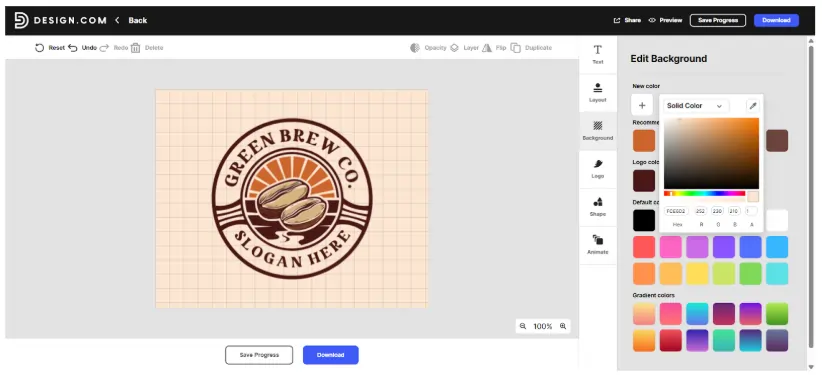
Overview: Design.com operates as a comprehensive AI design platform offering logo generation as part of a broader suite including business cards, flyers, presentations, and website building tools. The platform maintains what it describes as the world’s largest logo template library with 360,000+ templates and over 1 million total design assets.
Core Capabilities:
- Rapid concept generation producing large volumes of logo variations within seconds based on business name, industry, and style preference inputs
- Filtering system allowing users to sort results by logo type categories (abstract, mascot, emblem, corporate, vintage, classic, wordmark) and color themes
- Integrated brand kit generation that automatically applies selected logo color palette across 50+ marketing material types
- Advanced editor for granular control over typography, icon positioning, spacing, and layout modifications
- Vector and high-resolution export options (SVG, EPS, PDF, PNG, JPG, GIF, MP4) available on paid plans
Deployment: Cloud-based web application accessible via standard browsers. No desktop app or mobile native applications.
Integration Ecosystem: Website builder, digital business card generator, and link-in-bio tools included in all paid plans. Platform integrates with standard file export for use in external design tools.
Pricing Approach: Freemium model with paid tier options. Basic logo package at $67 includes high-resolution files and basic brand assets. Complete branding package at $247 provides comprehensive asset library, print files, and lifetime access. Free tier includes limited preview and design exploration without download capabilities.
Documented Limitations:
- Template-based generation approach may produce designs similar to other users selecting the same template combinations
- Free tier tools include Design.com branding in website footer, limiting professional use without upgrade
- No offline editing capabilities; all modifications require active internet connection
Typical Users: Small businesses launching consumer-facing brands, entrepreneurs requiring rapid multi-channel asset generation, startups with limited design resources seeking comprehensive brand identity packages.
Looka
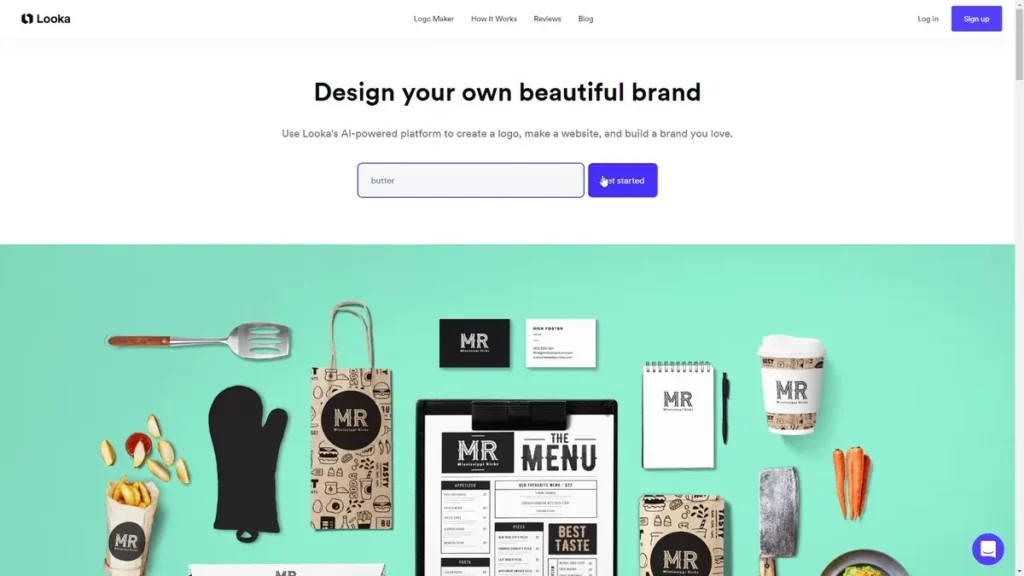
Overview: Looka (formerly Logojoy) functions as an established AI logo generation platform with particular emphasis on automated brand kit creation. Following logo generation, the platform automatically produces extensive sets of branded materials maintaining visual consistency across asset types.
Core Capabilities:
- AI-powered logo concept generation based on questionnaire inputs covering business name, industry, preferred styles, and color preferences
- Automatic brand kit production including social media posts, business cards, email signatures, and website mockups
- Clean, modern design aesthetic with tendency toward minimal and contemporary logo styles
- Icon, font, and layout customization options within generated concepts
- High-resolution file delivery in multiple formats with commercial licensing included in paid tiers
Deployment: Cloud-based web application. No desktop or mobile native apps. All generation and editing occur through web browser interface.
Integration Ecosystem: Brand kit assets export as standalone files for use in external platforms. No direct integrations with website builders or marketing automation tools.
Pricing Approach: Tiered package structure. Basic package at approximately $20 provides low-resolution logo files suitable for digital use. Premium packages ranging $65-$80+ include high-resolution files, vector formats (SVG, EPS), brand guidelines document, and complete social media kit with platform-optimized dimensions.
Documented Limitations:
- Customization capabilities are more constrained compared to editor-focused platforms; users work primarily with generated variations rather than building logos from components
- Template-driven output may result in similar designs across users in the same industry category
- No unlimited editing model; modifications are bounded by the original generation parameters
Typical Users: Small businesses requiring cohesive brand identity across multiple touchpoints, entrepreneurs without design experience seeking guided brand development, startups prioritizing visual consistency across marketing materials.
Canva
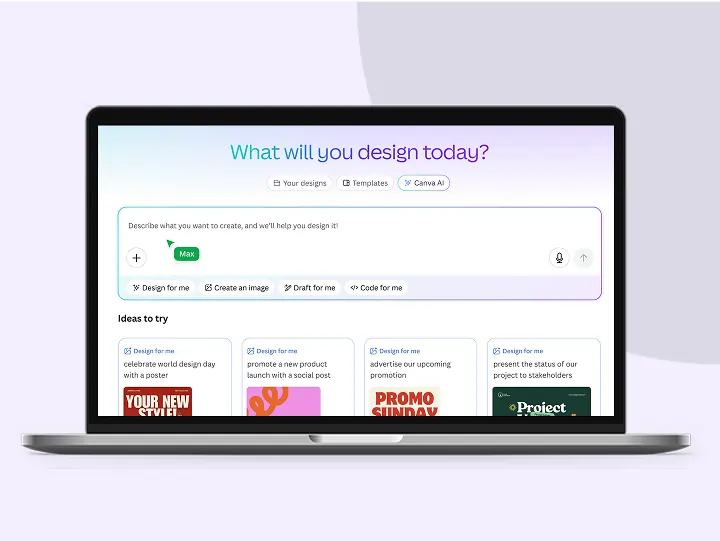
Overview: Canva’s AI logo generation capability operates through “Create an Image, powered by Dream Lab,” a high-fidelity generative AI image tool integrated within Canva’s broader design platform. The logo generation function leverages text-to-image AI models rather than template-based systems.
Core Capabilities:
- Natural language prompt-based logo generation allowing descriptive text inputs (e.g., “geometric abstract logo combining hexagons and cubes, futuristic style with neon blue and purple”)
- Style selection interface offering generation output options including 3D Render, Graphic Design Vector, Illustration, and Sketch variations
- Reference image upload capability enabling style matching and texture replication while maintaining user-defined composition
- Integration with Canva’s broader editing ecosystem including Color Edit for precise palette adjustment, Magic Switch for multi-platform resizing, and extensive template libraries
- Transparent background PNG export for immediate use in other Canva design templates
Deployment: Cloud-based web application with mobile apps for iOS and Android. Accessible across desktop, tablet, and smartphone devices with account synchronization.
Integration Ecosystem: Deep integration with Canva’s 250,000+ template library spanning social media graphics, presentations, documents, and marketing materials. Logos created via AI can be immediately incorporated into business card, letterhead, and social media templates within the same platform.
Pricing Approach: Freemium model with generation limits. Free tier provides 20 AI logo generations per month. Canva Pro subscription ($120/year or $13/month) unlocks unlimited generations, advanced editing features, and premium template access. No standalone logo package pricing; logo generation is feature within broader subscription.
Documented Limitations:
- Text-to-image AI optimized for general image generation rather than logo-specific constraints (scalability, monochromatic rendering, small-size legibility)
- Generation quality variability based on prompt specificity; requires user skill in crafting effective AI prompts
- Monthly generation cap on free tier limits iteration volume for users testing multiple brand concepts
- No dedicated vector export; SVG format available but may require additional optimization for print production
Typical Users: Content creators already using Canva for social media graphics seeking logo integration, small businesses prioritizing design ecosystem consolidation over specialized logo tools, users comfortable with AI prompting seeking creative flexibility.
Brandmark
Overview: Brandmark positions itself as an advanced AI logo design tool emphasizing unlimited customization and comprehensive brand asset delivery. The platform differentiates through offering lifetime access and unlimited editing capabilities via one-time purchase model rather than subscription.
Core Capabilities:
- Generative AI plus hand-crafted design element libraries combining algorithmic generation with curated template components
- Unlimited editing and revision capabilities allowing users to continuously refine logos without additional fees
- Comprehensive brand asset package including logo source files, brand guide documentation, one-page website templates, social profile icons, business card designs, animated logo variations, invoice templates, mockup designs, social media templates, and presentation templates
- Exclusive custom font library and generative AI icon creation for unique visual elements
- Instant export and download capabilities for all asset types with commercial licensing included
Deployment: Cloud-based web application. All tools accessible via browser without software installation requirements.
Integration Ecosystem: Assets export as production-ready files (PNG, SVG, EPS, PDF) for use in external platforms. No direct integrations with third-party marketing or design tools; platform focuses on file delivery over ecosystem connections.
Pricing Approach: One-time purchase model with tiers. Basic package at $25 provides logo files and essential assets. Standard package at $65 includes complete brand kit with business cards and social templates. Premium package at $175 delivers comprehensive asset library with animated designs and extended mockup collections. Lifetime access and unlimited editing included across all tiers.
Documented Limitations:
- Higher upfront learning curve compared to fully automated solutions; requires user input and design decision-making throughout customization process
- Less template volume than rapid generation platforms; emphasis on quality and uniqueness over concept quantity
- No subscription option for users preferring distributed payment over lump-sum purchase
Typical Users: Freelance designers seeking rapid branded asset generation for client projects, small businesses with clear brand vision requiring execution tools, design-conscious entrepreneurs valuing creative control and long-term editing access.
Wix Logo Maker
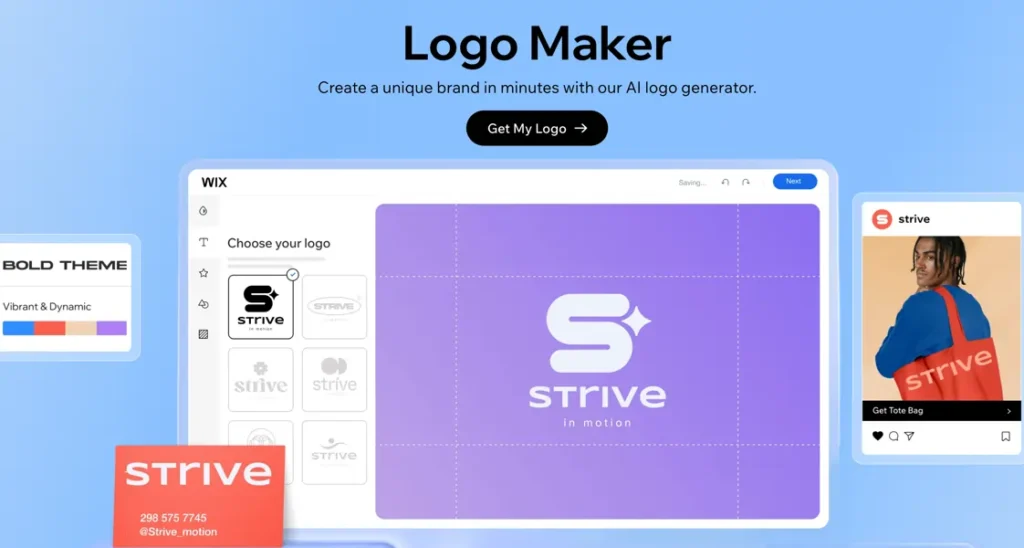
Overview: Wix Logo Maker operates as an AI-powered logo generation tool integrated within the Wix website building ecosystem. The platform targets users building Wix websites who require branded visual identity aligned with their site design.
Core Capabilities:
- Guided questionnaire process collecting business name, tagline, industry selection, and design preference indicators
- AI logo generation producing multiple concept directions based on user responses
- Font, color, and icon modification tools for refining selected logo concepts
- Ability to regenerate entirely new logo sets if initial results don’t align with user vision
- Direct integration with Wix website builder for seamless logo implementation across site headers, favicons, and branded elements
Deployment: Cloud-based web application accessible as part of Wix platform. Logo creation tools embedded within Wix account dashboard.
Integration Ecosystem: Deep integration with Wix website builder, allowing automatic logo placement across website templates. Limited utility for users not building Wix websites; logo files export for external use but platform optimized for Wix ecosystem users.
Pricing Approach: Included in most Wix premium plans at no additional cost. Standalone logo purchase available starting around $20 for users not subscribing to Wix website plans. Logo files typically bundled with Wix site subscriptions rather than sold separately.
Documented Limitations:
- Platform optimization focuses on Wix website integration, providing limited value for users building brands on alternative website platforms
- Customization depth less extensive than specialized logo design platforms
- Free tier not available; requires Wix plan subscription or standalone logo purchase for file access
Typical Users: Small businesses building Wix websites, entrepreneurs seeking integrated website and branding solution, users prioritizing ecosystem consolidation over specialized logo creation capabilities.
LogoAI
Overview: LogoAI operates as a brand building platform extending beyond logo generation to encompass brand identity automation and on-brand social media content creation. The platform emphasizes automated brand consistency across visual assets rather than focusing solely on logo design.
Core Capabilities:
- AI engine processing logo design data combined with design best practices to generate brand-appropriate visual identities
- Automated matching identity system that applies logo design principles to derivative assets including social media graphics, business cards, and marketing collateral
- Complete design size and format delivery enabling 24/7 download access to various file specifications
- Brand automation features for generating on-brand social content maintaining visual consistency with logo design
- Industry-specific template optimization with categories spanning taco, mascot, fire, fish, outdoor, wolf, media, law firm, metaverse, ninja, church, dream, video, insurance, and film logos
Deployment: Cloud-based web application accessible via standard browsers. Platform reports serving 8,422,291 businesses with 6,832,484 brand logos created as of February 2026.
Integration Ecosystem: Brand asset automation with focus on social media content generation. Files export in standard formats for use across external platforms and marketing channels.
Pricing Approach: Package-based pricing structure with tiers corresponding to asset volume and feature access. Specific pricing not publicly disclosed on main pages; requires account creation for detailed tier information.
Documented Limitations:
- Automation focus may reduce granular creative control compared to editor-heavy platforms
- Limited public documentation on pricing transparency creates evaluation friction for cost-conscious buyers
- Brand automation emphasis serves users seeking comprehensive solutions but may overwhelm users requiring only logo files
Typical Users: Small businesses requiring automated brand asset generation, entrepreneurs managing multi-channel brand presence, solopreneurs seeking turnkey brand identity solutions with minimal manual design work.
Logo Diffusion
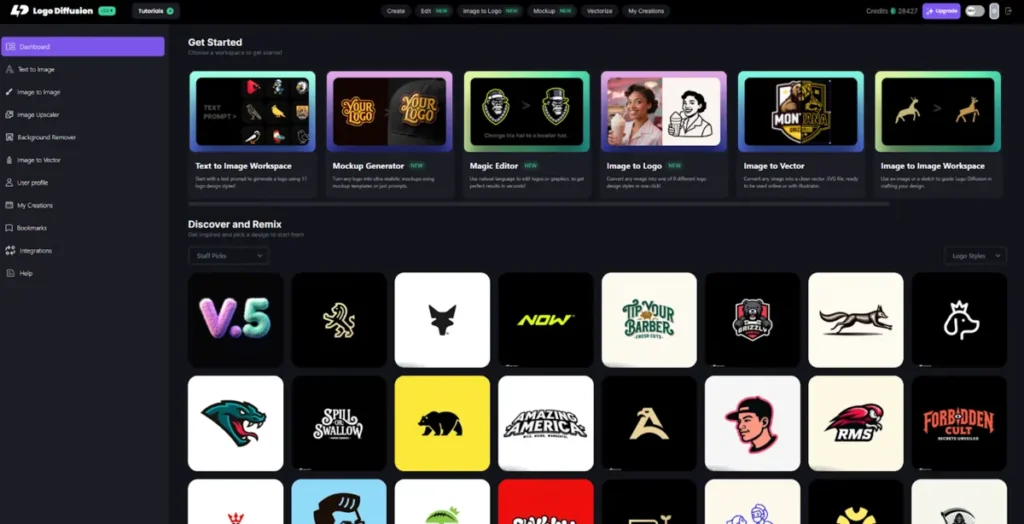
Overview: Logo Diffusion combines generative AI technology with vector output capabilities and advanced design control tools. The platform offers 45+ style templates and positions itself as a professional-grade solution for designers and creative professionals requiring high-quality, production-ready logo files.
Core Capabilities:
- Text-to-logo generation producing up to 4 unique options per prompt with unlimited regeneration until desired results achieved
- Style transfer functionality providing complete control over both aesthetic direction and compositional elements
- Sketch-to-logo refinement allowing users to begin with rough hand-drawn concepts that AI polishes into vector designs
- In-app editor featuring brushes, shapes, fonts, and standard sketching tools for precise output control
- High-end image upscaling integrated within platform eliminating need for external upscaling services
- Vector output in scalable formats suitable for print production and large-format applications
Deployment: Cloud-based web application with emphasis on professional design workflows. No mobile apps; platform optimized for desktop browser use.
Integration Ecosystem: Standard file export (vector formats, high-resolution raster) for use in professional design software including Adobe Creative Suite and Affinity Designer.
Pricing Approach: Tiered subscription model with four levels. Free tier labeled “No Commercial License Allowed” for experimentation and design ideation. Basic tier perfect for freelance designers and creators. Pro tier ($12-49/month estimated based on competitive positioning) targeting businesses and agencies creating at scale. Elite tier for high-volume commercial production.
Documented Limitations:
- Learning curve for advanced features may deter users seeking fully automated solutions
- Free tier explicitly prohibits commercial license usage, requiring paid upgrade for business deployment
- Professional feature set assumes design literacy; less accessible to complete beginners compared to template-based platforms
Typical Users: Freelance designers requiring rapid concept generation, creative professionals seeking AI-assisted design workflows, businesses with in-house design teams augmenting manual creation with AI tools.
Adobe Express
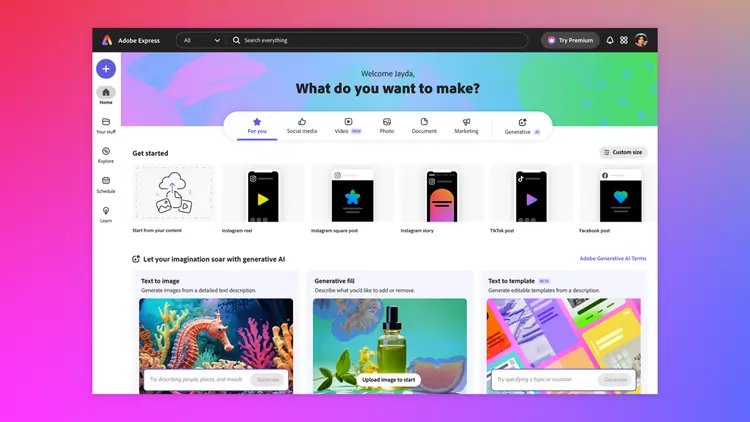
Overview: Adobe Express provides AI logo generation through generative AI capabilities backed by Adobe’s enterprise design infrastructure. The logo generator operates as one feature within Adobe’s broader quick-design platform targeting non-professional creators and small business users.
Core Capabilities:
- Descriptive text prompt-based logo generation with style and composition reference upload capabilities
- Generation style options supporting various aesthetic directions from geometric abstraction to organic hand-drawn styles
- Direct integration with Adobe Express editor enabling post-generation customization including text addition, graphic overlay, and layout modification
- Transparent background PNG export for immediate use across design contexts
- Access to Adobe’s broader design asset libraries including fonts, graphics, and template collections
Deployment: Cloud-based web application with mobile apps for iOS and Android. Part of Adobe’s consumer-facing Express ecosystem rather than professional Creative Cloud suite.
Integration Ecosystem: Integration with Adobe Express template library for business cards, social media graphics, and marketing materials. Some connectivity with broader Adobe Creative Cloud for users maintaining professional Adobe subscriptions.
Pricing Approach: Freemium model with Adobe Express Premium subscription at approximately $10/month unlocking unlimited generations and premium features. Free tier provides limited monthly generation credits. Logo generation not sold as standalone product; bundled within Adobe Express subscription.
Documented Limitations:
- Requires Adobe account creation, adding friction for users seeking quick logo generation without platform commitment
- Limited standalone value outside Adobe ecosystem; platform emphasis on Express template integration rather than specialized logo design
- Generative AI not optimized specifically for logo constraints (scalability, monochromatic rendering, small-size legibility)
- Free tier generation limits constrain iteration volume for users exploring multiple brand directions
Typical Users: Adobe ecosystem users seeking logo integration with broader Adobe Express workflows, small businesses already using Adobe products for marketing materials, content creators prioritizing design tool consolidation.
Logopony
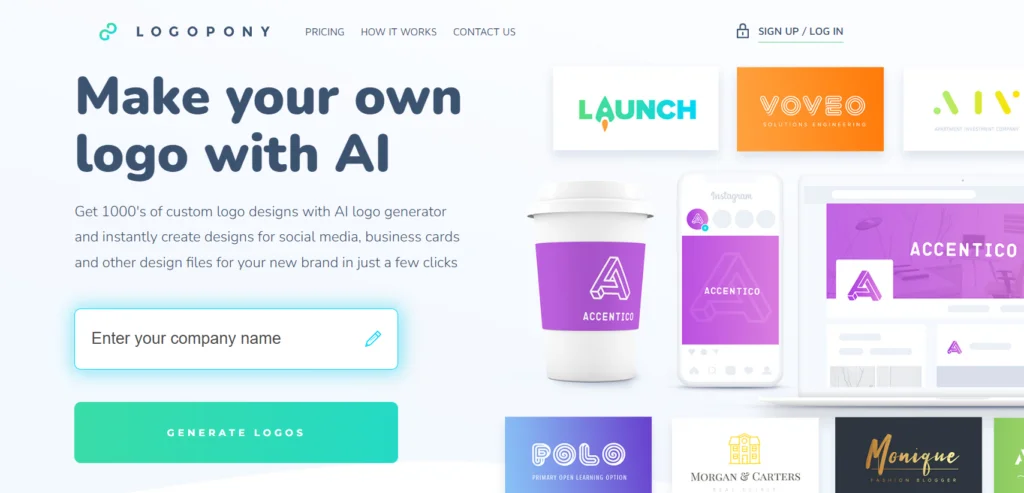
Overview: Logopony describes itself as a new generation logo maker using Artificial Intelligence and Machine Learning to generate unlimited creative and distinct logo ideas. The platform emphasizes algorithmic understanding of which fonts, icons, colors, and design details work well together.
Core Capabilities:
- AI-powered logo generation using hundreds of premium fonts, icons, and color combinations with algorithmic compatibility optimization
- Unlimited creative variation generation allowing users to explore extensive logo concept directions
- Logo editor providing customization capabilities for refining generated concepts
- One-time payment model delivering all standard logo files that professional designers typically provide including sliced logos of different sizes for website, app, email signature, and letterhead use
- Production-ready source files for printing with commercial licensing and color/font specification documentation
Deployment: Cloud-based web application accessible via standard browsers. Platform positioning emphasizes ease of use and speed.
Integration Ecosystem: File export in standard formats for use across external platforms. No documented integrations with website builders or marketing automation tools.
Pricing Approach: One-time single payment model starting around $59 providing lifetime access for unlimited edits and re-downloads. Pricing structure avoids subscription model in favor of permanent license purchase.
Documented Limitations:
- Smaller template library compared to market leaders like Design.com and Looka
- Limited public documentation on exact template volume or AI model specifications
- User testimonials emphasize budget-conscious positioning, suggesting feature set may be less comprehensive than premium alternatives
Typical Users: Bootstrapped startups prioritizing cost efficiency, small businesses requiring quick logo creation for immediate business launch, entrepreneurs seeking one-time purchase to avoid ongoing subscription costs.
LogoMakr
Overview: LogoMakr offers extensive freedom and customization options positioning itself as a platform for more experienced creators while providing guidelines and prompts through its AI generator. The platform emphasizes post-generation editing capabilities rather than automated template selection.
Core Capabilities:
- AI-assisted logo generation providing initial concept directions based on user inputs
- Comprehensive customization platform allowing detailed modification of color, font, size, layout, and icon elements
- Component-level editing enabling users to build logos from individual design elements rather than only refining complete templates
- Guideline and prompt system supporting users through customization decisions
- High degree of creative control suitable for users with design literacy
Deployment: Cloud-based web application. Platform focuses on desktop browser experience for detailed editing workflows.
Integration Ecosystem: Standard file export for use in external design and marketing tools. No documented platform integrations.
Pricing Approach: Freemium model with download fees. Users can explore designs and customize extensively within the platform at no cost. Payment required to download final logo files, typically starting around $20+ for high-resolution versions.
Documented Limitations:
- Requires design literacy for optimal results; less suitable for users seeking fully automated generation
- Customization depth may overwhelm users preferring simplified template selection workflows
- Free exploration does not include file downloads, requiring payment at final delivery stage
Typical Users: Experienced creators comfortable with design tools, small businesses with specific brand vision requiring precise execution, users valuing hands-on creative control over automation convenience.
Tailor Brands
Overview: Tailor Brands operates as a comprehensive business services platform integrating logo generation with broader business formation offerings including LLC registration, trademark filing, and business identity services. The platform targets entrepreneurs launching new ventures requiring both branding and legal business setup.
Core Capabilities:
- AI logo generation based on business information and style preference inputs
- Automated brand kit creation maintaining visual consistency across marketing materials
- Integration with business services including domain registration, email setup, business card printing, and social media kit generation
- Trademark filing assistance and intellectual property guidance
- Website builder and digital presence tools for complete business launch support
Deployment: Cloud-based web application with emphasis on guided workflows for new business formation.
Integration Ecosystem: Integrations with business services including domain registrars, LLC formation providers, and trademark filing systems. Platform functions as hub connecting multiple business setup requirements.
Pricing Approach: Subscription model ranging $10-50/month depending on service tier and business service inclusions. Logo generation typically bundled with broader business packages rather than sold standalone. Some package options available for one-time purchase.
Documented Limitations:
- Platform emphasis on upselling non-design business services may distract users seeking only logo creation
- Subscription model includes services beyond branding, creating cost inefficiency for users not requiring LLC formation or trademark filing
- Logo generation capabilities secondary to broader business services positioning
Typical Users: Entrepreneurs launching new businesses requiring both brand identity and legal business formation, first-time business owners seeking guided setup process, users preferring integrated service provider over managing multiple vendors.
Zarla
Overview: Zarla provides rapid free logo generation targeting budget-conscious startups and small businesses requiring immediate brand identity without upfront cost. The platform emphasizes accessibility and speed over advanced customization or comprehensive brand systems.
Core Capabilities:
- Free tier logo generation allowing users to create and preview logo concepts without payment
- Quick generation process producing logo options within seconds
- Basic customization capabilities for color and layout modification
- Paid package options providing high-resolution downloads and commercial licensing
Deployment: Cloud-based web application accessible via standard browsers. Mobile-optimized interface supporting smartphone access.
Integration Ecosystem: Limited integration ecosystem. Platform focuses on logo file delivery rather than ecosystem connections.
Pricing Approach: Freemium model with free tier providing logo preview and basic generation. Paid packages starting around $20+ unlock high-resolution files, vector formats, and commercial licenses. Specific tier pricing requires account exploration.
Documented Limitations:
- Limited commercial license clarity on free tier creates uncertainty for business use without paid upgrade
- Fewer features and customization options compared to established platforms
- Smaller template library and less sophisticated AI generation compared to market leaders
Typical Users: Budget-conscious startups testing brand concepts, small businesses requiring quick logo for immediate launch, entrepreneurs seeking free preview before purchase commitment.
Hatchful (Shopify)
Overview: Hatchful operates as Shopify’s free logo maker tool optimized specifically for e-commerce businesses building online stores on the Shopify platform. The platform provides logo generation tailored to retail and product-based business categories.
Core Capabilities:
- E-commerce focused logo generation with industry categories aligned to online retail (fashion, food, beauty, electronics, home goods)
- Free logo generation for Shopify merchants without payment requirements
- Basic customization options for colors, fonts, and icon selection
- Export formats optimized for Shopify store integration including favicon sizes and header dimensions
Deployment: Cloud-based web application accessible to all users but optimized for Shopify merchant workflows.
Integration Ecosystem: Direct integration with Shopify stores enabling one-click logo implementation across store headers, checkout pages, and branded elements. Limited utility for non-Shopify users.
Pricing Approach: Free for all users. No paid tiers or upgrade requirements. Shopify positions Hatchful as merchant acquisition tool rather than revenue-generating product.
Documented Limitations:
- Optimization exclusively for e-commerce use cases limits applicability for service businesses, B2B companies, or non-retail sectors
- Basic feature set compared to paid logo generation platforms
- Limited customization depth and smaller template library than specialized logo design tools
- Primary value derived from Shopify integration; standalone utility limited
Typical Users: Shopify merchants launching new online stores, e-commerce entrepreneurs requiring quick branded storefronts, small retail businesses building Shopify-based sales channels.
Namecheap Logo Maker
Overview: Namecheap Logo Maker functions as a domain registration integration offering free logo generation to customers purchasing domain names through Namecheap. The platform serves as value-added service for domain buyers rather than standalone logo design tool.
Core Capabilities:
- Free logo generation included with domain name purchases
- Basic template-based logo creation with industry category selection
- Simple customization options for colors and fonts
- Logo file delivery in standard formats for immediate use
Deployment: Cloud-based web application accessible through Namecheap account dashboard.
Integration Ecosystem: Integration with Namecheap domain management and hosting services. Platform functions as part of broader domain registration workflow.
Pricing Approach: Free with domain purchase. Standalone pricing not prominently advertised; platform positioned as domain purchase incentive rather than independent logo service.
Documented Limitations:
- Generic output with minimal sophistication compared to specialized logo design platforms
- Limited customization capabilities reflecting tool’s positioning as complimentary service rather than core product
- Smaller template library and less advanced AI generation
- Primary value as domain purchase bonus; limited standalone merit
Typical Users: Domain purchasers requiring quick logo for website launch, small businesses consolidating domain registration and basic branding, users prioritizing convenience over design quality.
Turbologo
Overview: Turbologo operates as a template library platform serving international small businesses with focus on markets outside North America. The platform provides logo generation through template selection and customization.
Core Capabilities:
- Template-based logo generation with industry and style category filtering
- Customization tools for modifying colors, fonts, and layout elements
- Pay-per-download pricing model avoiding subscription commitments
- Multi-language support for international user base
Deployment: Cloud-based web application accessible globally via standard browsers.
Integration Ecosystem: Standard file export without documented platform integrations. Focus on file delivery rather than ecosystem connections.
Pricing Approach: Pay-per-download model with pricing ranging $20-80 depending on file format and resolution requirements. One-time purchase per logo rather than subscription or unlimited access model.
Documented Limitations:
- Limited English-language support documentation creates friction for North American users
- Smaller presence in US market compared to domestic platforms like Looka and Design.com
- Less comprehensive brand asset packages compared to integrated platforms
Typical Users: International small businesses, users in non-English markets seeking localized logo tools, budget-conscious buyers preferring pay-per-use over subscription models.
Market Patterns and Key Observations
Common Capabilities Across Solutions
The AI logo generator landscape in 2026 exhibits convergence on several core capabilities that have become baseline expectations rather than differentiating features. Most platforms now offer multi-format file export including PNG for digital use and SVG or EPS for vector scalability, though free tiers often restrict access to high-resolution or vector formats behind paywalls. Industry-based template categorization appears across all major platforms, allowing users to filter logo concepts by business sector (technology, food service, professional services, retail, healthcare).
Color customization represents a universal feature, with all evaluated platforms enabling users to modify color palettes within generated logos. Typography selection or modification appears in approximately 85% of platforms, though the depth of font control varies significantly from simple font family switching to granular control over letter spacing, weight, and hierarchy. Icon or symbol libraries are standard components, with template-based platforms offering 10,000 to 360,000+ icon options depending on library size.
Brand asset generation beyond standalone logos has become increasingly common, with 60% of evaluated platforms automatically generating derivative materials including business cards, social media templates, and email signatures. This reflects market evolution from isolated logo creation toward comprehensive brand identity systems. Generation speed has standardized around 5-30 seconds for initial concept delivery, with template-based platforms typically faster than generative AI prompt-based solutions.
Shared Limitations and Trade-offs
Uniqueness and Template Saturation: Template-based platforms face inherent uniqueness constraints. When platforms offer 1,000 to 360,000 templates accessible to millions of users, the probability of multiple businesses selecting identical or highly similar logo combinations increases. While algorithmic variation in color and typography provides some differentiation, core compositional elements may appear across multiple brands. Generative AI platforms reduce this risk through prompt-based generation but introduce different challenges around output consistency and refinement control.
Commercial Licensing Complexity: Free tiers frequently carry commercial usage restrictions, watermarking, or resolution limitations requiring paid upgrades for legitimate business deployment. According to Cropink research, approximately 60% of platforms impose watermarks or licensing restrictions on free tier outputs. Users must carefully review licensing terms to ensure trademark eligibility and unrestricted commercial use rights.
Customization Depth vs. Ease of Use Trade-off: Platforms optimized for non-designers emphasize automated template selection and limited customization options, reducing creative control but lowering learning curves. Conversely, platforms offering extensive editing capabilities require design literacy and time investment, creating barriers for users seeking rapid, guided solutions. No single platform successfully bridges this gap, forcing users to choose between accessibility and creative control.
Vector Format Quality Variability: While most paid platforms advertise vector format support (SVG, EPS, PDF), the quality and production-readiness of these files varies significantly. Some platforms generate vector files through raster-to-vector conversion rather than true vector construction, resulting in excessive anchor points, non-optimized paths, and files requiring manual cleanup before professional printing. Users requiring print-production quality should verify vector output quality through testing rather than assuming format availability guarantees professional-grade results.
AI Generation Unpredictability: Generative AI platforms using text-to-image models exhibit output variability even with identical prompts. Users may need to generate 10-50+ variations to achieve desired results, consuming generation credits and time. Template-based platforms provide more predictable outputs but sacrifice creative novelty. This represents a fundamental trade-off between exploration flexibility and result consistency.
Pricing Trends
The 2026 market exhibits three dominant pricing architectures reflecting different business models and user acquisition strategies.
Freemium with Paid Upgrade Model represents the most common approach, employed by approximately 55% of evaluated platforms. This structure provides free logo generation with restrictions including low-resolution outputs (typically 500x500px or less), watermarking, limited file format options (PNG only, no vectors), and unclear commercial licensing. Paid upgrades remove restrictions and typically range $20-80 for one-time logo packages or $10-15/month for ongoing subscription access. Platforms using this model include Canva, Wix, Zarla, and Adobe Express.
One-Time Purchase for Complete Brand Kit appeals to users seeking permanent access without ongoing subscription commitments. Pricing ranges $25-300 depending on asset volume and feature comprehensiveness. Basic tiers ($25-65) provide logo files and essential brand assets. Premium tiers ($65-175+) deliver extensive brand systems including animated logos, comprehensive mockup collections, and print-production files. Platforms employing this model include Brandmark, Logopony, and certain Design.com packages.
Subscription for Unlimited Access targets users requiring continuous editing, regeneration, or multiple brand projects. Monthly pricing ranges $10-50 with annual subscriptions often discounted 15-30%. This model suits agencies, freelance designers managing multiple client brands, or businesses undergoing iterative brand development. Logo Diffusion, LogoAI, and Tailor Brands utilize subscription models.
Pricing trends show downward pressure on logo file costs, with basic logo packages declining from $50-100 industry standard in 2020 to $20-65 in 2026. This commoditization reflects AI generation efficiency improvements and competitive market dynamics. However, comprehensive brand systems with extensive asset libraries maintain premium pricing ($100-300) as platforms differentiate on ecosystem breadth rather than logo generation alone.
Integration and Ecosystem Patterns
Platform integration strategies fall into three categories: standalone file delivery, website builder integration, and comprehensive brand ecosystem.
Standalone file delivery platforms (LogoMakr, Logopony, Turbologo) focus exclusively on logo generation and file export without connections to external tools or services. These platforms provide clean file outputs in standard formats (PNG, SVG, EPS, PDF) for use across any marketing or design context. This approach maximizes flexibility but requires users to independently manage brand implementation across channels.
Website builder integration platforms (Wix, Shopify Hatchful, Namecheap) embed logo generation within broader website or domain registration workflows. Logos automatically populate across website headers, favicons, and branded page elements. This consolidation reduces implementation friction but limits utility for users building brands outside the specific ecosystem.
Comprehensive brand ecosystem platforms (Design.com, Looka, LogoAI) extend beyond logo generation to deliver integrated brand systems including social media templates, business cards, email signatures, presentation slides, and automated brand application across asset types. These platforms position logos as foundational elements within broader brand identity automation rather than standalone deliverables.
According to Nielsen Norman Group research, responsive logo systems that adapt across devices and contexts improve brand recognition and usability. The 2026 market shift toward integrated ecosystems reflects this principle, with platforms increasingly delivering logo variants (full mark, simplified icon, monogram) as standard rather than optional add-ons.
Emerging Capabilities
Motion and Animation Integration: Static logos are increasingly supplemented with animated variants for digital contexts. Platforms like Brandmark and Design.com now include animated logo exports (MP4, GIF) as standard package components. As documented by The Brand Strategy Lab, motion-ready logos enhance brand expression in interface-driven environments including app loading states, social media content, and video marketing.
Accessibility-First Design: Leading platforms incorporate WCAG color contrast validation ensuring logo designs meet accessibility standards for vision-impaired users. Google’s Material Design system demonstrates how accessible design maintains brand consistency across user capabilities. This trend reflects growing legal requirements and ethical commitments to inclusive design.
AI-Assisted Trademark Screening: Some platforms now integrate preliminary trademark screening capabilities, flagging potential conflicts with existing registered marks before users finalize logo selections. While not replacing professional trademark attorney review, this feature reduces investment in logos unlikely to achieve trademark registration.
Adaptive Color Palette Generation: Advanced platforms generate responsive color systems including light mode and dark mode palette variants, ensuring logo legibility across interface contexts. This addresses the increasing prevalence of dark mode UI preferences across operating systems and applications.
What the Data Suggests
Market maturation in the AI logo generator category has shifted competition from capability availability to execution quality and ecosystem breadth. The commoditization of basic logo generation creates pressure for platforms to differentiate through comprehensive brand systems, superior integration depth, or specialized targeting (e-commerce, service businesses, creative professionals).
According to Market.us projections, 80% of logo design processes will incorporate AI assistance by 2025, fundamentally transforming brand identity creation. However, the data also reveals persistent limitations: Cropink statistics indicate that 60% of consumers avoid businesses with outdated or poorly designed logos, suggesting that AI generation quality must continue improving to meet professional standards.
The divergence between rapid template-based generators and customization-focused platforms appears structural rather than transitional. These categories serve different user segments with incompatible priorities: non-designers requiring guided automation versus design-literate users seeking creative control. Platforms attempting to serve both segments risk diluting value propositions rather than expanding market reach.
How to Choose the Right AI Logo Generator Solution
Key Questions to Ask Before Choosing
Budget and Payment Preference:
- What is your total budget for logo and brand assets? ($0-20, $20-80, $80-300, $300+)
- Do you prefer one-time purchase or ongoing subscription? Consider cash flow constraints and whether you’ll need continuous editing access.
- Will you require multiple logo variations for different brands or business units? Subscription models may provide better value for multi-project needs.
- Does your budget include complementary brand assets (business cards, social templates) or only logo files?
Design Experience and Customization Needs:
- Do you have design experience and want creative control, or do you prefer guided automation?
- Can you articulate specific brand vision (color palette, typography style, symbol preferences) or do you need help exploring options?
- Will you need to make frequent revisions or is one-time generation sufficient?
- Do you have specific technical requirements (custom fonts, precise color matching, complex icon geometry)?
Use Case and Channel Requirements:
- Where will your logo appear? (website only, print materials, merchandise, social media, mobile apps, video content)
- Do you need vector formats for print production or are digital-only formats (PNG) sufficient?
- Will you require animated logo variants for video content or app interfaces?
- Do you need logo variants optimized for different contexts (full mark, simplified icon, monogram)?
Timeline and Iteration Capacity:
- How quickly do you need final logo files? (same day, within week, flexible timeline)
- How many revision rounds are you willing to invest? Template-based platforms offer faster results with less iteration; customization platforms require more time investment.
- Are you testing multiple brand concepts simultaneously or committed to single brand direction?
Trademark and Licensing Requirements:
- Will you seek trademark registration for your logo? Ensure commercial licensing is clear and unrestricted.
- Do you need explicit intellectual property ownership documentation?
- Will you require exclusive usage rights preventing other businesses from using identical logos?
- Are there industry-specific compliance requirements (healthcare, financial services) affecting logo design?
Ecosystem and Integration Priorities:
- Are you building a website on a specific platform (Wix, Shopify) where logo integration would add value?
- Do you need automated brand asset generation (social templates, business cards) or only logo files?
- Will you use the logo within existing design tools (Adobe Creative Suite, Canva) requiring specific file format compatibility?
- Do you value ecosystem consolidation (single platform for all brand needs) or prefer specialized best-of-breed tools?
Decision Matrix Template
| Factor | Your Priority (High/Medium/Low) | Questions to Consider |
|---|---|---|
| Budget Efficiency | What is maximum acceptable cost? Does budget cover only logo or comprehensive brand assets? | |
| Ease of Use | Do you have design experience? How much time can you invest in learning platform? | |
| Customization Depth | Do you need granular control or prefer automated selection? Will you make frequent edits? | |
| Output Quality | Do you need print-production vector files or digital-only formats? Required resolution? | |
| Brand System Breadth | Do you need only logo or comprehensive brand assets (cards, templates, guidelines)? | |
| Timeline Urgency | How quickly do you need final files? Can you invest time in iteration? | |
| Trademark Eligibility | Will you seek trademark registration? Do you need ownership documentation? | |
| Platform Integration | Are you using specific website builder, design tool, or ecosystem requiring compatibility? |
How to Use This Matrix:
- Assign priority levels (High/Medium/Low) to each factor based on your specific situation
- Identify which factors are non-negotiable (High priority) versus flexible (Low priority)
- Compare evaluated platforms against your high-priority factors first
- Use medium and low priority factors to differentiate among platforms meeting core requirements
- Test 2-3 platforms through free tiers before committing to paid packages
Frequently Asked Questions About AI Logo Generators
What is an AI logo generator and how does it work?
An AI logo generator is a software application that uses machine learning algorithms to automatically create logo designs based on user inputs such as business name, industry category, style preferences, and color schemes. The technology operates through two primary approaches: template-based systems that algorithmically combine pre-designed components (fonts, icons, layouts) to generate variations, and generative AI models that create logos from natural language text prompts using neural networks trained on extensive design datasets. According to Market.us research, these platforms leverage artificial intelligence to understand user preferences and generate design options in seconds rather than the days or weeks required for traditional designer engagement.
How much do AI logo generator solutions typically cost in 2026?
AI logo generator pricing in 2026 follows three dominant models. Freemium platforms provide free logo generation with restrictions (low-resolution files, watermarks, limited commercial licensing), requiring paid upgrades ranging $20-80 for full-resolution files and unrestricted commercial use. One-time purchase models range $25-300 depending on asset breadth, with basic logo packages at $25-65 and comprehensive brand kits at $100-300 including extensive marketing materials. Subscription models charge $10-50 monthly for unlimited editing and regeneration capabilities. According to comparative market analysis, basic business-ready logo packages average $40-65 while complete brand identity systems average $100-175 as one-time purchases.
What are the main quality and uniqueness considerations for AI-generated logos?
AI logo generators face inherent trade-offs between generation speed and design uniqueness. Template-based platforms with large user bases risk multiple businesses selecting similar logo combinations, though color and typography variations provide some differentiation. According to DesignRush analysis, 60% of consumers avoid businesses with poorly designed or outdated logos, emphasizing the importance of professional visual quality. Generative AI platforms reduce template saturation risk but introduce output unpredictability requiring more iteration. Vector format quality varies significantly across platforms, with some generating true vector paths while others employ raster-to-vector conversion creating files requiring optimization for print production. Users should test logo scalability, monochromatic rendering, and small-size legibility before finalizing selections.
Can AI-generated logos be trademarked?
Yes, AI-generated logos can be trademarked provided they meet standard USPTO requirements for distinctiveness and non-obviousness regardless of creation method. According to Cropink research, the creation method (AI versus human designer) does not affect trademark eligibility; uniqueness and distinctiveness determine registration success. However, users must ensure they have explicit commercial licensing and intellectual property ownership from the AI platform before seeking trademark protection. Some free-tier platforms impose usage restrictions or retain partial rights that could complicate trademark applications. Platform terms of service should clearly state that users receive full ownership and commercial rights to generated logos. Additionally, conducting preliminary trademark searches before finalizing logo selection reduces investment in marks with existing registration conflicts.
What is the difference between template-based and generative AI logo generators?
Template-based logo generators algorithmically combine pre-designed components from libraries containing thousands to hundreds of thousands of templates, fonts, and icons. These platforms optimize for speed and variety, producing 50-100+ logo concepts within seconds based on industry category and style selections. Generative AI logo generators use text-to-image neural networks to create logos from natural language prompts, enabling more customized outputs but with greater unpredictability. Template platforms provide more consistent, predictable results suitable for users wanting guided selection among established design patterns. Generative AI platforms offer greater creative flexibility for unique concepts not well-represented in template libraries but require stronger prompting skills and more iteration to achieve desired results. Template platforms typically serve non-designers seeking rapid deployment while generative AI platforms appeal to design-literate users comfortable with experimentation.
Are there truly free AI logo generator options, and what are their limitations?
Multiple platforms offer free AI logo generation with significant limitations affecting business deployment. Common restrictions on free tiers include low-resolution file outputs (typically 500x500px) unsuitable for print production or large digital displays, watermarking or platform branding embedded in logo files, PNG-only format availability without vector files (SVG, EPS) required for scalability, and unclear or restricted commercial licensing preventing legitimate business use. According to Cropink market analysis, approximately 60% of platforms watermark free tier outputs. Examples include Canva (20 generations per month free but limited resolution), Zarla (free preview but paid download required), and Hatchful by Shopify (free for Shopify merchants but limited features). Free tiers typically serve as exploration tools for concept testing rather than production-ready logo delivery, requiring paid upgrades ($20-80) for business-appropriate file quality and licensing.
How long does it take to create a logo using AI generator platforms?
Initial logo concept generation typically occurs within 5-30 seconds depending on platform architecture and generation approach. Template-based platforms like Design.com and Looka produce 50-100+ logo variations within 10-15 seconds by algorithmically combining pre-designed components. Generative AI platforms using text-to-image models like Canva’s Dream Lab or Logo Diffusion require 15-30 seconds per generation cycle producing 1-4 concepts per iteration. Total project timeline depends on user iteration requirements and customization depth. Non-designers using template platforms typically finalize logos within 30-60 minutes including exploration and basic customization. Users requiring extensive customization or testing multiple brand directions may invest 2-4 hours across multiple sessions. According to Deloitte research, AI-powered tools have reduced logo design turnaround times by up to 50% compared to traditional designer engagement requiring days or weeks.
What should entrepreneurs prioritize when choosing an AI logo generator?
Entrepreneurs should prioritize factors aligned with their specific business context and resource constraints. For budget-limited startups in pre-revenue stages, freemium platforms with clear upgrade paths (Canva, Zarla) enable logo creation with deferred payment until revenue validation. For businesses requiring rapid market entry, template-based platforms (Design.com, Looka) optimize for speed over deep customization. Entrepreneurs planning trademark registration should prioritize platforms with explicit commercial licensing and intellectual property ownership documentation. Those building comprehensive brand presence across multiple channels benefit from integrated brand ecosystem platforms (LogoAI, Looka) delivering derivative assets beyond standalone logos. Entrepreneurs with design experience may prefer customization-focused platforms (Brandmark, LogoMakr) offering editorial control. According to DesignRush branding statistics, 68% of companies report that consistent branding contributes 10-20% to revenue growth, suggesting that ecosystem breadth and brand consistency capabilities warrant evaluation priority.
How do AI logo generators compare to hiring professional designers?
AI logo generators and professional designers serve different use cases with distinct trade-offs. AI platforms optimize for speed, cost efficiency, and accessibility, delivering logo files within hours at $20-300 price points suitable for budget-constrained startups and small businesses. Professional designers offer strategic brand consultation, custom creative direction, iterative collaboration, and guaranteed uniqueness at $1,000-$10,000+ price points requiring weeks or months. According to DemandSage branding research, custom logo design ranges from $100 to $2,500 historically, though premium agency work often exceeds this range significantly. AI generators excel for businesses with clear brand vision requiring execution tools, rapid market entry timelines, or budget constraints precluding designer fees. Professional designers provide superior value for complex brand strategy requiring positioning expertise, businesses in competitive markets requiring differentiation, or brands targeting sophisticated audiences where visual refinement influences purchasing decisions. The optimal approach often involves hybrid workflows where AI generates initial concepts refined by professional designers, combining speed and cost benefits with strategic expertise.
What file formats should I expect from an AI logo generator?
Business-ready AI logo generator outputs should include multiple file formats optimized for different use cases. PNG format with transparent backgrounds represents the minimum for digital applications including websites, social media, and email signatures. Vector formats (SVG, EPS, PDF) enable scalability for print production, merchandise, and large-format displays without quality degradation. Professional-grade platforms provide both RGB color space files for digital use and CMYK color space files for print production. Comprehensive packages include logo variants in multiple resolutions (favicon size 16x16px through high-resolution 5000x5000px+) and configurations (full mark, simplified icon, monogram, horizontal and vertical orientations). Some platforms now include animated variants (MP4, GIF) for video content and social media. Free tiers typically restrict outputs to low-resolution PNG only, requiring paid upgrades for vector formats and print-production files. Users requiring print collateral or merchandise should verify vector format availability and quality before platform commitment, as some platforms generate vectors through raster conversion rather than true vector construction.
Can I use the same AI logo generator for multiple business brands?
Platform policies on multi-brand usage vary significantly. Subscription-based platforms (Logo Diffusion, Tailor Brands) typically allow unlimited logo generation for multiple brands during active subscription periods, making them cost-efficient for agencies, freelancers, or serial entrepreneurs managing multiple ventures. One-time purchase platforms (Brandmark, Logopony) often license per logo or brand, requiring separate purchases for each business identity. Freemium platforms (Canva, Wix) generally permit multiple logo projects within account limits but may impose generation caps (20 generations per month on Canva free tier) constraining multi-brand workflows. Users managing multiple brands should review platform terms of service for multi-brand licensing clarity. Agencies and freelancers serving client brands should verify whether client usage falls under permitted commercial licensing or requires upgraded business accounts. The most cost-effective approach for multi-brand needs typically involves subscription platforms or negotiated agency pricing rather than per-logo one-time purchases.
What are the latest design trends affecting AI logo generators in 2026?
AI logo generator outputs in 2026 increasingly reflect broader design trends emphasizing adaptability, minimalism, and sustainability aesthetics. According to The Branding Journal trend analysis, responsive logo systems generating multiple variants (full mark, simplified icon, monogram) for different contexts have become standard rather than premium features. Platforms now deliver light mode and dark mode color palette variants ensuring legibility across interface contexts. Custom typography and variable font usage represents growing trend with ManyPixels analysis documenting typography-led branding becoming central to brand identity beyond simple icon-plus-text combinations. Sustainable and eco-conscious aesthetics incorporating organic shapes, earthy color palettes, and natural textures appear frequently in template libraries reflecting consumer values around environmental responsibility. Motion-ready logo systems with built-in animation capabilities address the shift toward dynamic brand expression in digital interfaces. Minimalist, adaptive identities that remain clean and simple while adjusting across platforms dominate market output, aligning with Apple’s design philosophy of flexibility without complexity. These trends influence both template library curation and AI generation model training, shaping outputs toward contemporary design language.
Key Takeaways
- The AI logo generator market reached USD 416.5 million in 2023 and is projected to grow to USD 2,463.7 million by 2033 at a 20% compound annual growth rate, driven by small business demand for cost-effective branding alternatives to traditional designer fees ranging $1,000-$10,000. According to market research, 40% of small businesses now use AI tools for logo creation, representing significant adoption shift from manual designer commissioning.
- The market exhibits clear segmentation between rapid template-based generators optimizing for speed and volume versus customization-focused platforms emphasizing editorial control and uniqueness, creating distinct value propositions serving different user segments. Template platforms generate 50-100+ concepts in seconds suitable for non-designers requiring guided selection, while customization platforms provide granular editing capabilities for design-literate users seeking creative control.
- Pricing models have diversified into freemium with paid upgrades ($20-80), one-time purchases for complete brand kits ($25-300), and subscriptions for unlimited access ($10-50/month), allowing buyers to select payment structures aligned with budget constraints and project scope. Basic business-ready logo packages average $40-65 while comprehensive brand identity systems average $100-175, reflecting pricing commoditization compared to 2020 standards.
- Platform evolution increasingly emphasizes comprehensive brand ecosystems delivering derivative assets beyond standalone logos, including automated generation of social media templates, business cards, brand guidelines, and marketing collateral. This shift reflects recognition that businesses require integrated brand systems rather than isolated logo files, with 60% of evaluated platforms now offering multi-asset packages.
- Quality considerations including vector format availability, commercial licensing clarity, and trademark eligibility represent critical evaluation dimensions beyond generation speed and template volume, as 60% of free-tier platforms impose watermarks or licensing restrictions preventing legitimate business deployment without paid upgrades. Users requiring print production or trademark registration must verify vector quality and ownership documentation before platform commitment.