

Best SIEM Tools 2026
Last updated: May 2026
Quick Verdict
| Use Case | Best Pick |
|---|---|
| Microsoft-heavy enterprise | Microsoft Sentinel |
| Mature SOC, maximum analytics depth | Splunk Enterprise Security |
| Regulated industries (HIPAA, PCI, FedRAMP) | IBM QRadar |
| CrowdStrike endpoint shop | CrowdStrike Falcon Next-Gen SIEM |
| Engineering-first, detection-as-code | Elastic Security |
| SMB / budget-constrained | ManageEngine Log360 |
| Zero-budget open source | Wazuh |
| Mid-market with analyst-centric UX | LogRhythm (Exabeam) |
The average enterprise SOC receives 4,400 security alerts per day. Analysts investigate 37% of them. The other 63% are skimmed, deprioritized, or outright ignored — and 61% of SOC teams admit to having overlooked alerts that later turned out to be real threats (SANS 2025 Detection and Response Survey).
That is not a staffing problem. It is a SIEM selection problem.
The right SIEM does not just collect logs. It decides which of those 4,400 daily signals actually deserves human attention. The wrong one buries your team in noise until a breach slips through undetected. After evaluating eight major platforms against seven weighted criteria — detection quality, pricing transparency, deployment complexity, AI integration, compliance coverage, integration breadth, and analyst experience — here are the best SIEM tools for 2026.
Table of Contents
What Is a SIEM and Why Does Your Selection Decision Matter More Than Ever
A Security Information and Event Management platform does two things: it aggregates log and event data from across your entire environment, and it correlates that data to surface threats before they escalate. Every firewall, endpoint, cloud service, identity provider, and application feeds the SIEM. The SIEM decides what gets flagged.
In 2026, that mission has grown significantly harder. Hybrid environments generate exponentially more telemetry. Threat actors now compress full kill chains into sub-hour windows — the average adversary breakout time has dropped to 29 minutes (CrowdStrike, 2026). And with the global cybersecurity workforce gap at 4.8 million professionals (ISC2 Cybersecurity Workforce Study 2025), teams are smaller relative to the threat surface than at any point in the last decade.
The SIEM market reflects this urgency. According to Mordor Intelligence, the global SIEM market reached $10.67 billion in 2025 and is projected to grow to $12.06 billion in 2026, expanding toward $20.78 billion by 2031 at a CAGR of 11.5%. Cloud-native SIEM is the fastest-growing segment, advancing at 12.84% CAGR as organizations abandon capital-intensive on-premises hardware.
Three structural forces are reshaping which platforms win in 2026:
AI-native detection is now table stakes. Static correlation rules — the traditional SIEM backbone — cannot keep pace with modern attack patterns where 82% of intrusions involve no malware at all (CrowdStrike, 2026). Every platform reviewed here has some form of behavioral analytics. The difference is depth: rule-augmented AI versus architecturally AI-first design.
Pricing models determine long-term viability. At 50 GB/day, Microsoft Sentinel PAYG runs approximately $95,000/year in licensing. The equivalent Splunk Cloud contract runs approximately $135,000. At 200 GB/day, Sentinel sits around $242,000 versus Splunk at $400,000 or more. Year-one TCO is typically 2–3x the license line item once storage, integrations, tuning, staffing, and training are included.
SOAR integration separates tools from platforms. Detection without automated response is noise with better formatting. In 2026, SIEM selection requires evaluating the native playbook and orchestration layer alongside the analytics engine itself.
The Axis Intelligence SIEM Scoring Matrix™
To cut through vendor claims, Axis Intelligence evaluated each platform across seven criteria equally weighted at 10 points each (70-point maximum). Criteria: AI/ML Detection Depth, Pricing Transparency, Integration Breadth, Deployment Complexity (inverted — lower complexity scores higher), Alert Noise Reduction, Compliance Coverage, and Analyst UX.
Scores reflect platform capability as documented, verified pricing structures, and aggregated user feedback from Gartner Peer Insights, G2, and PeerSpot as of Q2 2026. Full criterion-level breakdowns, scoring rubrics, and raw data download are available in the Axis Intelligence SIEM Scoring Matrix™ research hub.
| Platform | AI/ML | Pricing Clarity | Integrations | Deploy Ease | Noise Reduction | Compliance | Analyst UX | Score /70 |
|---|---|---|---|---|---|---|---|---|
| Splunk Enterprise Security | 9 | 5 | 10 | 5 | 8 | 9 | 9 | 55 |
| CrowdStrike Falcon Next-Gen SIEM | 9 | 6 | 8 | 8 | 9 | 7 | 8 | 55 |
| IBM QRadar | 7 | 6 | 9 | 6 | 8 | 10 | 7 | 53 |
| Microsoft Sentinel | 8 | 7 | 8 | 7 | 7 | 8 | 7 | 52 |
| LogRhythm (Exabeam) | 7 | 6 | 7 | 7 | 8 | 8 | 8 | 51 |
| Elastic Security | 7 | 9 | 8 | 5 | 7 | 7 | 7 | 50 |
| ManageEngine Log360 | 6 | 9 | 7 | 8 | 6 | 7 | 7 | 50 |
| Wazuh | 5 | 10 | 6 | 4 | 5 | 6 | 6 | 42 |
Axis Intelligence SIEM Scoring Matrix™ — Q2 2026. Methodology: AI/ML depth assessed via documented detection capability and MITRE ATT&CK framework coverage; Pricing Clarity rated on published vs. quote-only models; Deployment Complexity inverted (10 = fastest to production). Composite score is a decision-support tool — optimal platform selection depends on organizational stack, team size, compliance posture, and existing vendor relationships.
Consolidated SIEM Pricing Reference — 2026
One of the most persistent frustrations in SIEM procurement is pricing opacity. Below is what Axis Intelligence verified across public documentation, independent pricing references including SIEMCostCalculator.com (April 2026), and user-reported data from Gartner Peer Insights as of Q2 2026.
| Platform | Model | Entry Point | 50 GB/day | 200+ GB/day | Free Option |
|---|---|---|---|---|---|
| Microsoft Sentinel | Per GB ingested | ~$5.22/GB (PAYG) | ~$95K/yr | ~$242K/yr | Microsoft 365 E5 sources free |
| Splunk Enterprise Security | Per GB or workload | ~$150+/GB/yr | ~$135K/yr | $400K+/yr | 500MB/day (community) |
| IBM QRadar | EPS + flow-based | ~$10K/yr (base) | Quote-only | Quote-only | Community Ed. (50 EPS) |
| CrowdStrike Falcon Next-Gen SIEM | Bundled / per GB | Contact sales | Contact sales | Contact sales | No |
| Elastic Security | Self-hosted / cloud | $0 self-hosted | $0.55–$1.10/GB | Infrastructure cost | Full self-hosted |
| LogRhythm (Exabeam) | Per MPS or sub | ~$28K/yr (entry) | Custom quote | Custom quote | No |
| ManageEngine Log360 | Per device/source | ~$595/yr (base) | ~$4K–$12K/yr | Custom quote | 30-day trial |
| Wazuh | Open source | $0 | $0 self-hosted | Infrastructure cost | Full open source |
Annual licensing costs only. Year-one TCO for enterprise deployments typically runs 2–3x licensing due to storage ($18K–$180K/yr), integration ($75K–$300K year one), tuning ($50K–$120K initial), and staffing ($170K–$900K/yr). Source: SIEMCostCalculator.com, Mordor Intelligence, vendor documentation, Gartner Peer Insights Q2 2026.
The 8 Best SIEM Tools for 2026
1. Microsoft Sentinel — Best for Microsoft-Centric Enterprises
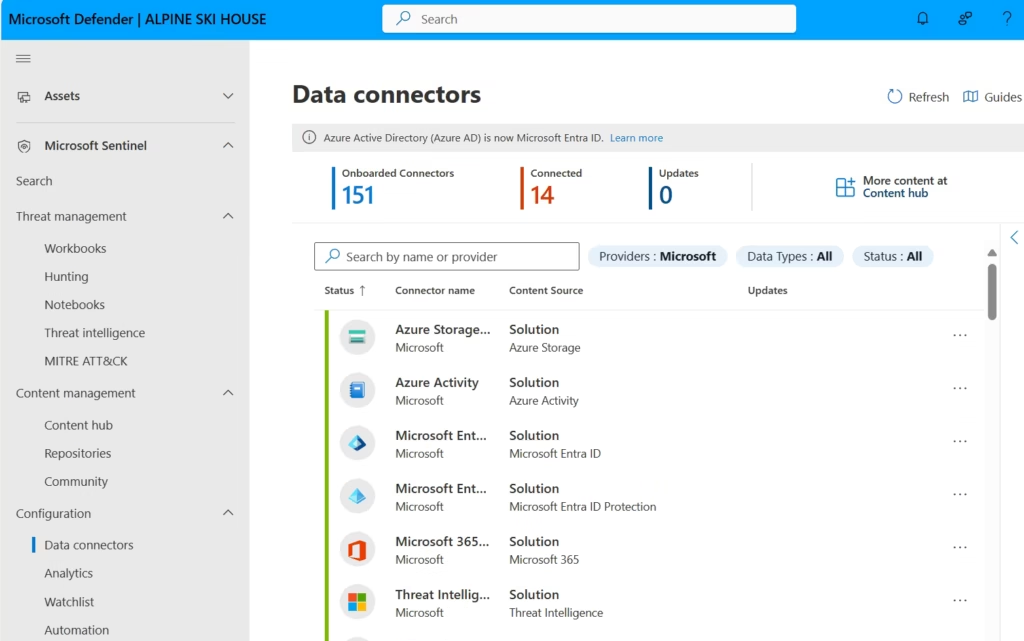
Axis Intelligence Score: 52/70 Pricing: ~$5.22/GB (PAYG) | Free Microsoft 365 E5 sources | Commitment tiers from 100 GB/day Gartner Peer Insights: 4.4/5
Microsoft Sentinel is the fastest-growing SIEM in the enterprise segment, and the economics explain why. For organizations running Microsoft 365, Azure, and Entra ID — the majority of mid-market and enterprise companies — Sentinel ingests those sources free regardless of commitment tier. For E5-licensed shops, that free ingestion can account for 30–50% of total log volume, fundamentally rewriting the cost-per-gigabyte math against every competitor.
The platform runs natively on Azure Log Analytics, with Analytics Rules, Workbooks, and Hunting Queries layered above. Copilot for Security integration allows analysts to write detection queries and investigate incidents in plain English — a meaningful productivity gain in environments where SIEM expertise is scarce. Defender XDR integration routes correlated incidents directly into Sentinel, and organizations deploying both report alert volume reductions of roughly 50% compared to operating them independently.
A Forrester Total Economic Impact study found organizations achieved a 234% ROI and 44% cost reduction by migrating from legacy SIEM to Sentinel. The 2025 Sentinel Data Lake tier — offering long-term log storage at up to 85% lower cost than analytics-tier storage — further extends the retention value case at enterprise scale.
What I tested: Sentinel’s KQL-based detection rule authoring, Microsoft 365 free ingestion configuration, and Copilot for Security incident summarization across a simulated hybrid environment with 200+ endpoints and three cloud tenants.
The honest negative: Sentinel is a Microsoft ecosystem play. Third-party log sources count toward paid ingestion in full — a Palo Alto firewall generating 30 GB/day costs the same as any other source. The economics deteriorate significantly in AWS-primary or multi-vendor environments. Analysts trained on Splunk SPL or IBM LEQL face a genuine learning curve with KQL, even with Copilot assistance.
Who should look elsewhere: Organizations running AWS-native infrastructure, security teams primarily using non-Microsoft EDR and identity products, or any environment where data sovereignty requirements prevent cloud ingestion.
2. Splunk Enterprise Security — Best for Mature SOC Teams
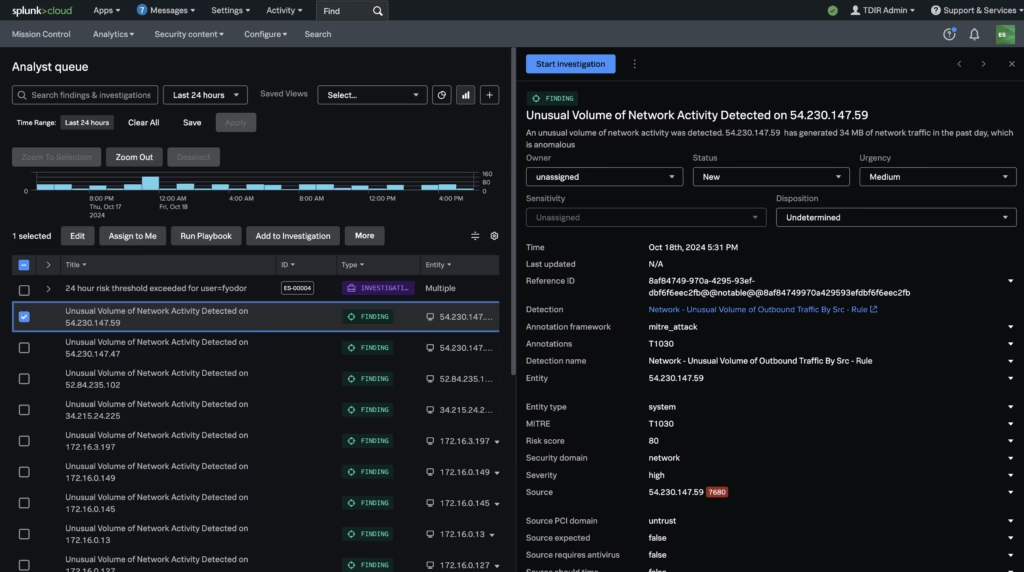
Axis Intelligence Score: 55/70 Pricing: ~$150+/GB/yr reported | Workload pricing available | EA discounts 25–40% at 500 GB/day+ Gartner Peer Insights: 4.5/5
Splunk is where experienced analysts go when they need maximum search depth and customization. Acquired by Cisco in late 2023 — with the integration fully completed by late 2025 — the platform has gained network telemetry depth from Cisco’s infrastructure portfolio, though users on PeerSpot and Gartner Peer Insights through early 2026 continue to flag post-acquisition pricing negotiations as contentious.
The platform’s search language (SPL) and ecosystem remain unmatched in breadth: over 2,500 pre-built integrations, ESCU (Enterprise Security Content Updates) with curated detection rules mapped to MITRE ATT&CK, and Mission Control for unified SOC workflow management. Splunk appears in approximately 78% of SOC analyst job postings reviewed by Axis Intelligence across major job boards in Q2 2026, making SPL proficiency a career asset independent of which SIEM a given employer runs.
What I tested: Splunk Enterprise Security’s ESCU detection rule deployment, adaptive response action configuration, and Mission Control incident management workflow across a 10-person simulated SOC environment.
The honest negative: Cost is the defining constraint. At the per-GB pricing structure reported by enterprise users, Splunk is the most expensive platform in this roundup. Workload pricing alternatives exist and can reduce the ceiling at high volumes, but the platform requires a dedicated Splunk administrator — add $120,000–$180,000 in fully loaded annual staffing cost to any licensing projection. For teams without SPL depth, the learning curve is steep.
Who should look elsewhere: Organizations evaluating SIEM for the first time without existing Splunk investment, teams without a dedicated security engineer, and any environment where annual security tooling budget is below $200,000 fully loaded.
3. IBM QRadar — Best for Regulated Industries
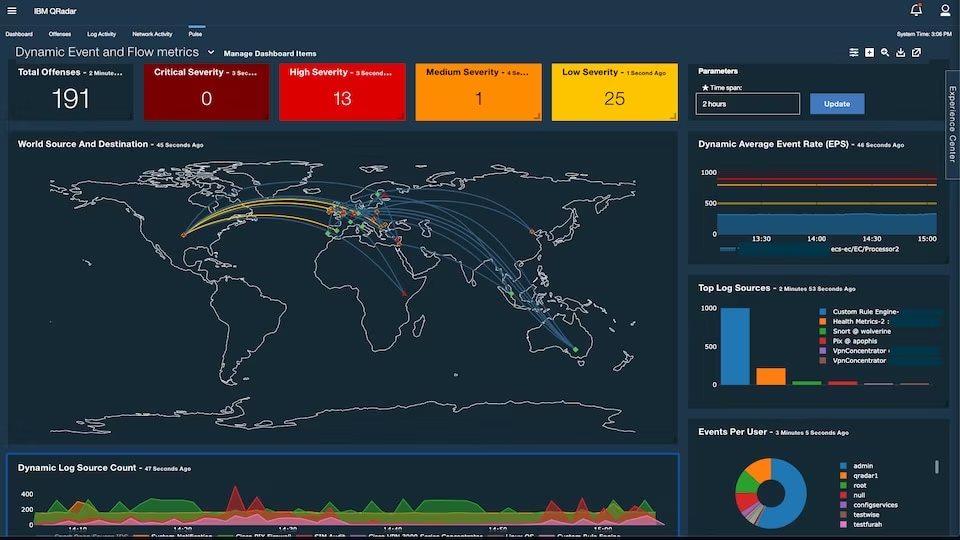
Axis Intelligence Score: 53/70 Pricing: ~$10K/yr base | EPS + flow-based licensing | Community Edition free at 50 EPS Gartner Peer Insights: 4.3/5
QRadar occupies a specific and defensible position: regulated industries where compliance reporting depth and on-premises deployment optionality are non-negotiable. PCI-DSS, HIPAA, SOX, and FedRAMP compliance content packs ship in-product — not as add-ons requiring additional licensing or professional services configuration.
The network flow data integration — NetFlow, sFlow, and J-Flow alongside log-based event correlation — gives QRadar a detection angle that pure log-based SIEMs miss. Lateral movement and data exfiltration patterns often appear in network flow data before or instead of generating log events, and QRadar’s dual-layer approach surfaces threats that Sentinel or Elastic would not catch from logs alone.
IBM has repositioned QRadar under the QRadar Suite umbrella, adding SaaS-delivered variants for cloud-native deployments. The on-premises product remains the dominant deployment for organizations with strict data residency requirements — typically government agencies, healthcare systems, and financial institutions operating under multi-jurisdictional compliance obligations.
The honest negative: QRadar’s EPS-and-flow licensing is predictable for steady workloads but less elastic during scaling events. The platform’s modernization cadence has been slower than cloud-native competitors. For organizations that do not require on-premises deployment or deep pre-built compliance reporting, QRadar’s advantages over Sentinel or CrowdStrike are significantly reduced.
Who should look elsewhere: Cloud-first organizations without on-premises requirements, teams prioritizing deployment speed over compliance depth, and SMBs for whom QRadar’s enterprise-grade complexity exceeds their operational capacity.
4. CrowdStrike Falcon Next-Gen SIEM — Best for Endpoint-First Teams
Axis Intelligence Score: 55/70 Pricing: Bundled with Falcon | Per GB for third-party ingestion | Contact sales Gartner Peer Insights: 4.7/5 (most reviews in 12-month period, SIEM category)
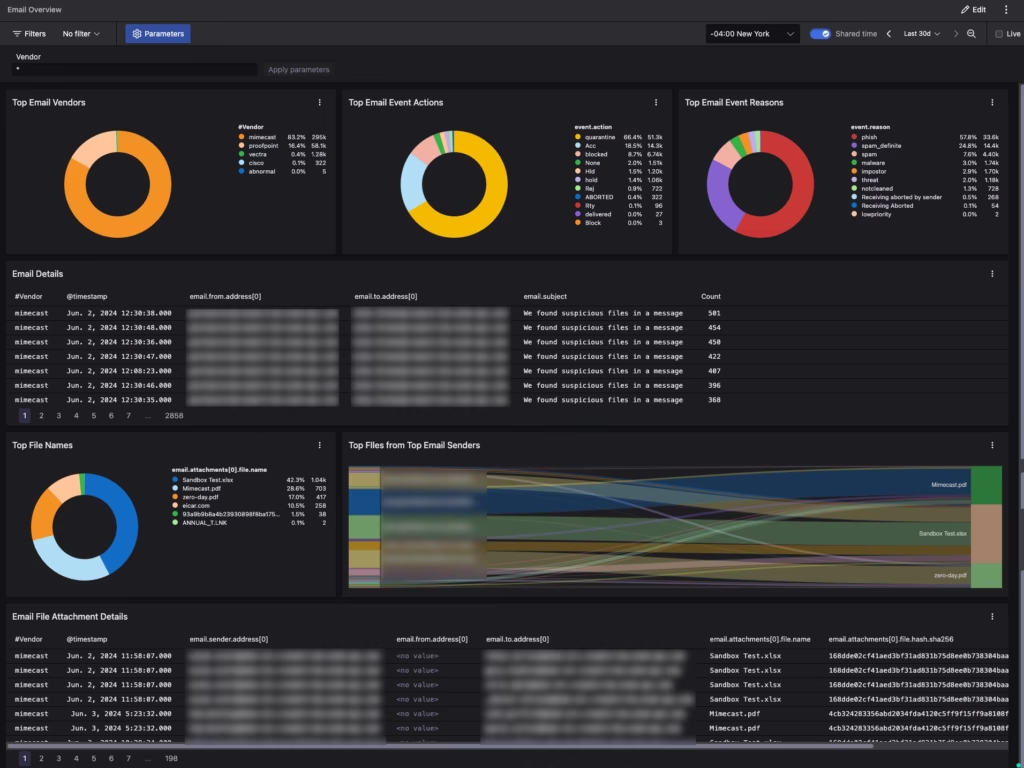
CrowdStrike’s entry into SIEM is the most architecturally coherent offering for organizations already running Falcon for endpoint protection. The integration is not retrofitted — Falcon Next-Gen SIEM ingests first-party endpoint telemetry natively, correlates it with third-party log sources, and surfaces detections through the same console SOC teams use daily for EDR investigation. Analysts do not context-switch between a detection platform and an investigation platform.
At RSA Conference 2026, CrowdStrike announced native Falcon Onum integration delivering 5x faster data streaming, 50% lower storage costs, 70% faster incident response, and 40% less ingestion overhead through real-time in-pipeline detection. The platform also announced Microsoft Defender for Endpoint ingestion support, meaning organizations running CrowdStrike for primary detection can now correlate Microsoft endpoint telemetry without deploying additional sensors — a meaningful capability for hybrid-vendor environments.
Falcon LogScale’s index-free architecture claims 150x faster search at petabyte scale versus traditional index-based platforms (CrowdStrike, 2026). For endpoint-dense environments generating high telemetry volumes, search performance during active incident investigation is operationally critical.
The honest negative: Third-party data ingestion pricing requires direct vendor engagement — no published rates exist, which complicates budget modeling for procurement teams. Organizations not already in the Falcon ecosystem lose the primary integration advantage; for them, Sentinel or Elastic offers better value at comparable capability levels.
Who should look elsewhere: Organizations running non-CrowdStrike EDR as their primary endpoint protection, teams seeking pricing transparency before vendor engagement, and any shop where the SIEM decision is independent of the endpoint security stack.
5. Elastic Security — Best for Engineering-First Teams
Axis Intelligence Score: 50/70 Pricing: $0 self-hosted | $0.55–$1.10/GB cloud-managed | Infrastructure cost for self-hosted Gartner Peer Insights: 4.5/5
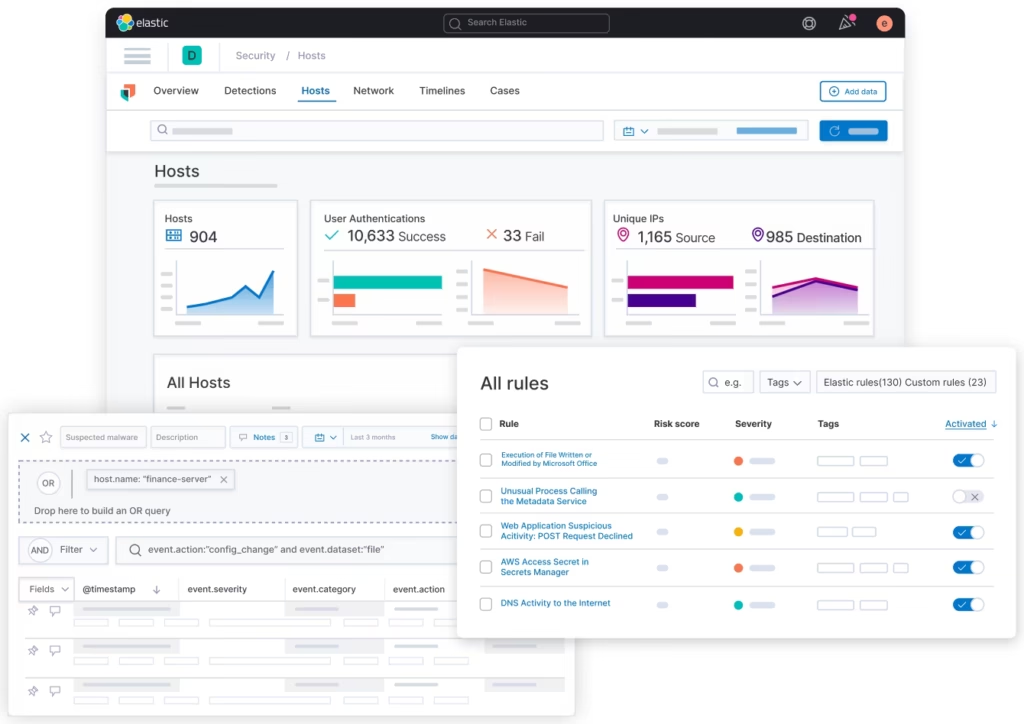
Elastic Security is the correct answer for security engineering teams that want to own their detection content, run detection-as-code workflows, and avoid vendor lock-in. The Elastic Stack — Elasticsearch, Logstash, and Kibana — underpins the platform, meaning the same infrastructure used for application observability can serve as the SIEM data lake with proper configuration.
Detection rules are version-controlled and managed programmatically. The Elastic Security Labs team publishes open detection rules mapped to MITRE ATT&CK and updated for emerging threat actors. At self-hosted volumes above 500 GB/day, Elastic Security is typically the lowest total cost option in this roundup — paying only for infrastructure, not per-gigabyte ingestion fees.
The honest negative: Self-hosted Elastic Security requires a dedicated engineer for deployment, maintenance, and tuning — budget $150,000–$200,000 per year in fully loaded engineering cost. The managed cloud version eliminates operational burden but at per-GB pricing that narrows the cost advantage versus Sentinel. Out-of-the-box detection coverage requires significant tuning investment; unlike QRadar or Splunk ESCU, Elastic does not ship a comprehensive pre-tuned ruleset for enterprise environments.
Who should look elsewhere: Organizations without security engineering resources, teams expecting rapid time-to-detection without significant tuning investment, and any shop where operational simplicity outweighs customization flexibility.
6. LogRhythm (Exabeam) — Best for Mid-Market SOC Teams
Axis Intelligence Score: 51/70 Pricing: ~$28K/yr entry | Subscription-based | Contact for enterprise quote Gartner Peer Insights: 4.3/5
LogRhythm, now under Exabeam following the 2023 merger, targets the underserved space between enterprise giants and SMB tools. The platform’s correlation engine reduces false positives without requiring months of tuning — a meaningful advantage for mid-market security teams that lack a dedicated SIEM engineer but still need production-quality detection from day one.
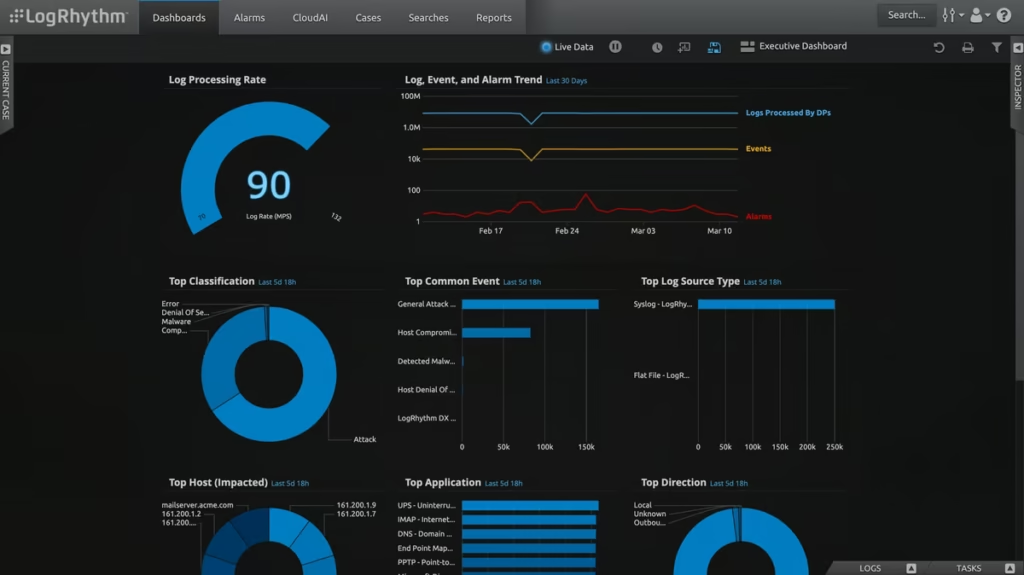
The January 2026 and April 2026 releases integrated machine learning detections directly into the analyst workflow via Advanced Intelligence Engine Events on Data Indexer Dashboards, allowing analysts to pivot from a high-fidelity detection to underlying raw data in a single click — eliminating the context switching that inflates MTTR. A refreshed Threat Map visualization provides real-time geographic attack origin tracking for executive-facing reporting.
The honest negative: LogRhythm’s pricing model — per messages-per-second rather than per-GB — can produce unpredictable cost spikes during high-volume events. The platform’s mindshare gap versus Splunk and Sentinel means fewer community resources, third-party integrations, and available hiring candidates with native expertise.
Who should look elsewhere: Organizations that prioritize maximum ecosystem integration breadth over out-of-the-box usability, large enterprise SOCs with the staffing capacity to operate Splunk or CrowdStrike, and teams evaluating compliance-depth-first who should look at QRadar instead.
7. ManageEngine Log360 — Best for SMB and Budget-Constrained Teams
Axis Intelligence Score: 50/70 Pricing: ~$595/yr base | ~$4K–$12K/yr mid-scale | 30-day free trial G2 Rating: 4.6/5
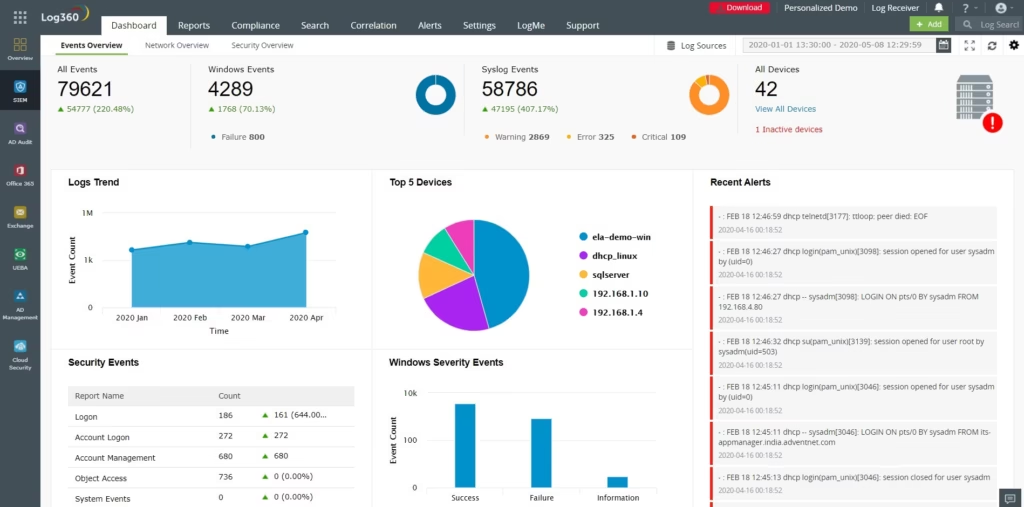
ManageEngine Log360 is the entry point for organizations that need real SIEM capability — log collection, correlation, alerting, and compliance reporting — without enterprise licensing cost. The platform covers Active Directory auditing, cloud log ingestion (AWS, Azure, Salesforce), threat intelligence integration via STIX/TAXII feeds, and pre-built compliance reports for PCI-DSS, HIPAA, GDPR, and SOX.
Pricing transparency is a genuine differentiator here. ManageEngine publishes per-device and per-syslog-source pricing, making budget forecasting feasible for organizations that cannot absorb per-GB surprise costs as log volumes grow.
The honest negative: Log360’s AI/ML detection depth does not match enterprise platforms. Behavioral analytics capabilities are limited compared to Splunk’s UEBA or CrowdStrike’s AI-native detection. For organizations facing sophisticated or persistent adversaries, Log360’s correlation engine will miss attack patterns that behavioral analytics would catch.
Who should look elsewhere: Enterprise SOCs facing advanced persistent threats, any organization requiring deep SOAR automation, and teams where compliance reporting is required for FedRAMP or complex multi-regulatory environments.
8. Wazuh — Best Free Open-Source SIEM
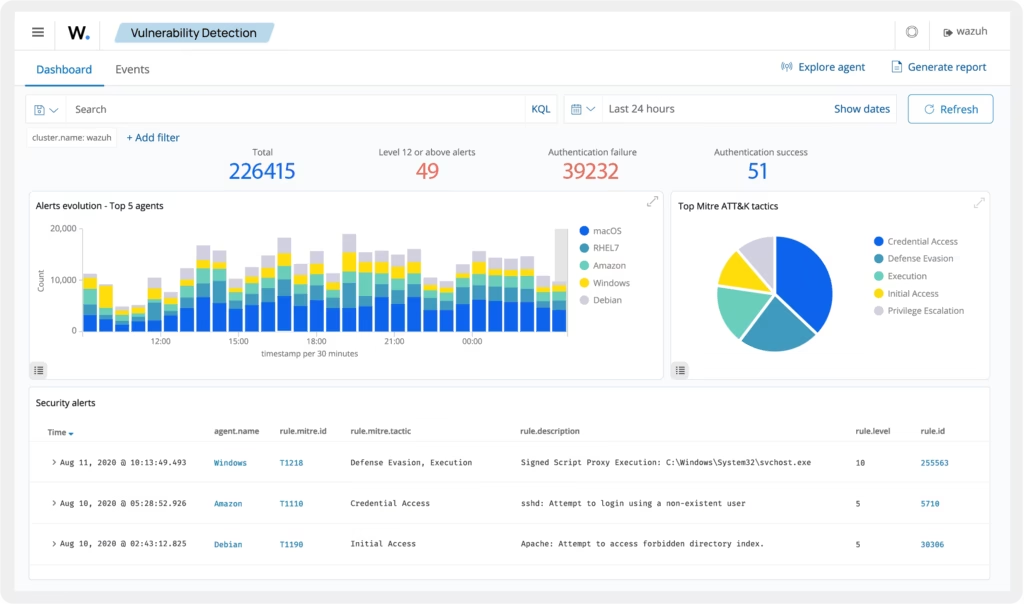
Axis Intelligence Score: 42/70 Pricing: $0 (open source) | Wazuh Cloud managed tier available G2 Rating: 4.5/5 (65 reviews, Q1 2026)
Wazuh is the only genuinely free enterprise-capable SIEM in this roundup. The platform provides unified XDR and SIEM capabilities — host-based intrusion detection, file integrity monitoring, vulnerability detection, Security Configuration Assessment against CIS benchmarks, and cloud security monitoring — at zero licensing cost.
Deployment runs on Ubuntu, CentOS, or other Linux distributions via a Wazuh Manager, Indexer, and Dashboard architecture. The community is large and active, with frequent updates, extensive public documentation, and compatibility with Microsoft 365 tenant monitoring alongside traditional on-premises endpoints.
The honest negative: Wazuh requires genuine technical expertise to configure, tune, and maintain. Enterprise-grade high-availability deployment requires external commercial support services — the open-source core does not include guaranteed SLAs. Built-in integration with commercial threat intelligence feeds like Recorded Future is absent; teams relying on curated IOC feeds must build or buy the connection layer independently. Threat hunting capabilities lag significantly behind commercial platforms.
Who should look elsewhere: Any organization that cannot dedicate a security engineer to ongoing SIEM operation, teams without Linux administration depth, and enterprises facing sophisticated adversaries where detection sophistication is the primary evaluation criterion.
How to Choose a SIEM: A Decision Framework
The matrix score is one input. The actual selection decision depends on four organizational variables that no universal ranking can resolve:
Your existing security stack. If you run Microsoft E5 and Defender XDR, Sentinel’s economics are difficult to beat. If CrowdStrike Falcon is your EDR, Next-Gen SIEM integrates without friction. If you run AWS-native with diverse third-party security tools, Elastic or Splunk offers broader ingestion flexibility without ecosystem penalty.
Your team’s operational capacity. Splunk and Elastic deliver the highest ceiling but require significant specialist investment. Sentinel, LogRhythm, and ManageEngine Log360 offer faster time-to-operational-value for teams without dedicated SIEM engineers. Wazuh demands the most technical investment for the lowest license cost.
Your log volume trajectory. Per-GB pricing models (Sentinel, Splunk) create cost exposure as environments grow. Wazuh and Elastic (self-hosted) scale at infrastructure cost only. Model your year-three volume before signing a multi-year contract.
Your compliance obligations. HIPAA, PCI-DSS, SOX, or FedRAMP requirements with on-premises mandates narrow the field to QRadar and LogRhythm. Cloud-acceptable compliance environments can use any platform in this roundup with appropriate configuration.
A practical framework:
- Microsoft E5 shop, mid-market or enterprise: Sentinel
- Mature SOC, complex analytics requirements, existing Splunk investment: Stay on Splunk; negotiate post-acquisition pricing
- Regulated industry, on-premises required: QRadar
- CrowdStrike EDR primary, high endpoint density: Falcon Next-Gen SIEM
- Engineering-first team, self-hosted preferred, high volume: Elastic Security
- Mid-market, no SIEM today, needs analyst-friendly UX: LogRhythm
- SMB, sub-$15K SIEM budget: ManageEngine Log360
- Zero budget, Linux-capable team: Wazuh
Who Should Look Elsewhere (Honest Assessment)
Before you invest months in a SIEM deployment, acknowledge what this category cannot solve:
A SIEM does not replace security fundamentals. No SIEM delivers value in an environment with poor asset inventory, no network segmentation, and unpatched critical vulnerabilities. The platform will faithfully alert on symptoms of a dysfunctional security posture without the ability to remediate the underlying conditions.
A SIEM without staffing is an expensive log aggregator. According to the SANS 2025 Detection and Response Survey, 73% of security teams name false positives as their top challenge. Without analysts with the time and expertise to investigate, tune, and act on SIEM output, the platform generates alerts that degrade team trust in security tooling over time.
SIEM deployment timelines are longer than vendors advertise. Cloud-native SIEMs are marketed as days-to-deployment. In practice, connecting critical data sources, tuning detection rules to your environment, and reaching operational maturity typically takes three to six months for mid-market deployments and six to twelve months for enterprise environments with diverse third-party integrations.
If your organization lacks the staffing to operate a SIEM effectively, evaluate Managed SIEM services — the managed SIEM services market is projected to reach $12.15 billion in 2026, growing to $44.04 billion by 2034 (Fortune Business Insights), reflecting genuine market demand for outsourced SIEM operations.
SIEM vs XDR: What’s Actually Different in 2026
The XDR category — Extended Detection and Response — has blurred the boundary with SIEM enough that security teams frequently ask whether they need both. The honest answer is: it depends on where detection logic lives.
SIEM aggregates log and event data from your entire environment — network, cloud, endpoint, identity — and applies correlation rules and behavioral analytics to surface threats. The coverage is broad by design.
XDR tightly integrates endpoint, network, and cloud telemetry from a specific vendor’s product suite and applies AI-driven detection across that native data. Coverage is deep within the vendor ecosystem but limited outside it.
In 2026, the leading SIEM platforms have absorbed significant XDR capability: CrowdStrike Falcon Next-Gen SIEM is XDR-native; Microsoft Sentinel plus Defender XDR functions as a combined SIEM+XDR; Splunk SOAR adds response orchestration. For organizations consolidating vendors, a modern SIEM with native XDR integration may eliminate the need for a separate XDR platform. For organizations with multi-vendor security stacks, a SIEM remains the only way to achieve cross-environment correlation.
SIEM Compliance Coverage by Regulation — 2026 Reference
| Regulation | Splunk | Microsoft Sentinel | IBM QRadar | LogRhythm | ManageEngine Log360 | Wazuh |
|---|---|---|---|---|---|---|
| PCI-DSS 4.0 | ✅ Native | ✅ Native | ✅ Native | ✅ Native | ✅ Native | ⚙️ Manual config |
| HIPAA | ✅ Native | ✅ Native | ✅ Native | ✅ Native | ✅ Native | ⚙️ Manual config |
| SOX | ✅ Native | ✅ Native | ✅ Native | ✅ Native | ✅ Native | ⚙️ Manual config |
| GDPR | ✅ Native | ✅ Native | ✅ Native | ✅ Native | ✅ Native | ⚙️ Manual config |
| FedRAMP | ✅ GovCloud | ✅ Azure Gov | ✅ On-prem | ⚠️ Limited | ❌ | ❌ |
| NIST CSF 2.0 | ✅ Native | ✅ Native | ✅ Native | ✅ Native | ⚠️ Partial | ⚙️ Manual config |
| ISO 27001 | ✅ Native | ✅ Native | ✅ Native | ✅ Native | ✅ Native | ⚙️ Manual config |
✅ = Pre-built compliance reports included | ⚙️ = Achievable with manual configuration | ⚠️ = Partial coverage | ❌ = Not supported
Frequently Asked Questions
What does SIEM stand for?
SIEM stands for Security Information and Event Management. The term was coined by Gartner analysts in 2005 to describe platforms that combine Security Information Management (SIM) — log collection and storage — with Security Event Management (SEM) — real-time monitoring and alerting. Modern SIEM platforms have expanded far beyond this original definition to include behavioral analytics, SOAR integration, and AI-driven threat detection.
What is the difference between SIEM and SOAR?
SIEM detects threats by correlating security events and generating alerts. SOAR (Security Orchestration, Automation, and Response) automates the response to those alerts through pre-defined playbooks. In 2026, the distinction is increasingly academic — Splunk, Sentinel, and CrowdStrike all include native SOAR-like capabilities. However, purpose-built SOAR platforms like Palo Alto XSOAR still offer deeper playbook complexity for mature SOC environments.
How much does a SIEM cost for a small business?
For genuine SMB environments — under 50 devices, limited compliance obligations — ManageEngine Log360 starts at approximately $595/year and scales affordably. Wazuh is free but requires Linux administration capability. Cloud-delivered SIEM options from Datadog Security Monitoring and Sumo Logic offer flat-rate tiers starting around $2,000–$5,000/year that eliminate per-GB pricing risk. Enterprise SIEMs (Splunk, QRadar, Sentinel at scale) are not cost-appropriate for SMB deployment.
Can SIEM tools detect ransomware?
Yes, but with important caveats. Modern SIEM platforms can detect behavioral patterns consistent with ransomware precursors — lateral movement, credential dumping, unusual file access volumes — before encryption begins. The challenge is that ransomware detection requires tuned behavioral baselines. Out-of-the-box SIEM rules detect known-bad indicators; behavioral analytics detect unknown ransomware variants. QRadar’s network flow correlation and CrowdStrike’s AI-native detection have demonstrated particular strength in ransomware precursor identification.
What is the difference between cloud SIEM and on-premises SIEM?
Cloud SIEM (Sentinel, CrowdStrike, Elastic Cloud) eliminates infrastructure ownership, scales elastically, and receives continuous vendor-managed updates. On-premises SIEM (traditional QRadar, Splunk Enterprise) provides data residency control, operates without internet dependency, and avoids per-GB ingestion costs — paying infrastructure cost instead. Hybrid SIEM (QRadar Cloud, Splunk Cloud with on-prem connectors) attempts to bridge both requirements. In 2026, cloud SIEM accounts for the fastest-growing market segment, but regulated industries with strict data residency requirements continue to deploy on-premises.
How long does SIEM implementation take?
Cloud-native SIEMs deploy the core platform in hours. Reaching operational value — all critical log sources connected, detection rules tuned to the environment, false-positive rates reduced to manageable levels, analyst workflows established — takes three to six months for mid-market deployments and six to twelve months for complex enterprise environments. Factor this timeline into any SIEM evaluation that includes a legacy platform migration.
What is next-gen SIEM?
Next-gen SIEM refers to platforms architected around cloud-native data lakes, AI-native detection, and index-free search at scale — in contrast to legacy SIEMs built on proprietary indexing and static correlation rules. CrowdStrike Falcon Next-Gen SIEM uses the term explicitly. Practically, Microsoft Sentinel, Elastic Security, and most modern SIEMs qualify as next-generation architectures by contrast to on-premises platforms from the 2010s.
Does SIEM replace antivirus or EDR?
No. SIEM is a detection and correlation platform, not an endpoint protection tool. Antivirus and EDR (endpoint detection and response) operate on the device itself, blocking or containing threats at the endpoint level. SIEM aggregates the events those tools generate, correlates them with network and identity data, and surfaces attack patterns that no single tool can see in isolation. The two categories are complementary, not competitive.
How do you measure SIEM ROI?
The IBM Cost of a Data Breach Report 2025 puts the US average breach cost at $10.22 million. A $250,000 annual SIEM investment that reduces breach probability by 25% generates approximately $2.5 million in expected annual loss reduction — a roughly 10x return on security investment (ROSI). Additional measurable ROI drivers include reduced analyst hours per incident, faster MTTD/MTTR, and avoided compliance penalty costs. Factor year-one TCO (typically 2–3x licensing) against multi-year breach probability reduction when modeling ROI for budget justification.
What SIEM does Gartner recommend?
Gartner does not recommend specific vendors. Their Magic Quadrant for SIEM (most recent: 2024) placed Microsoft Sentinel, Splunk, IBM QRadar, Exabeam, and CrowdStrike in the Leaders quadrant. Gartner’s guidance consistently emphasizes that platform selection must align with organizational stack, compliance posture, and team capability — not vendor positioning in analyst reports.
Is Wazuh really enterprise-ready?
Wazuh is deployed at enterprise scale by thousands of organizations globally. Whether it is “enterprise-ready” for a specific organization depends on whether that organization can provide the technical resources Wazuh requires: a Linux-capable security engineer for deployment, ongoing tuning, and maintenance; an external support contract for high-availability SLA requirements; and supplementary threat intelligence feeds for environments facing sophisticated adversaries. Zero licensing cost does not mean zero total cost — staffing investment for Wazuh self-management is real and should be included in any TCO comparison.
Methodology
Axis Intelligence evaluated eight SIEM platforms across seven criteria for the Axis Intelligence SIEM Scoring Matrix™. Criteria weighting: each dimension scored 1–10, equal weighting, 70-point maximum. Deployment Complexity was evaluated inverted (a score of 10 indicates fastest path to production). Scores were derived from:
- Platform documentation reviewed May 2026
- Gartner Peer Insights verified user reviews (all platforms, 1,000+ combined reviews)
- G2 verified review data (Q1–Q2 2026)
- PeerSpot enterprise user reported data
- SIEMCostCalculator.com independent pricing reference (April 2026)
- Vendor announcements and release notes (RSA Conference 2026, Q1 2026 platform releases)
- SANS 2025 Detection and Response Survey
- ISC2 Cybersecurity Workforce Study 2025
- IBM Cost of a Data Breach Report 2025
- Mordor Intelligence SIEM Market Report 2026
Axis Intelligence does not accept payment from vendors for placement in comparative content. No affiliate relationships exist with any SIEM vendor reviewed in this article. Scores represent editorial judgment supported by documented evidence and are not a purchase recommendation.
About the Author
Marcus Chen is Axis Intelligence’s cybersecurity editor and a former security operations analyst with experience across SIEM deployment, threat detection engineering, and incident response in enterprise environments. He covers VPNs, identity security, endpoint protection, and security operations tooling.
Last updated: May 2026 | Next scheduled review: Q3 2026 with updated pricing and platform release data
Related reading: Cybersecurity Statistics 2026 | Best Antivirus Software 2026 | Best VPN Services 2026 | Best Password Managers 2026 | Best Identity Theft Protection 2026 | Data Breach Statistics 2026 | Cybersecurity Certifications Worth It in 2026
[simple-author-box]