

CarPlay Ultra 2026
By Alex Rivera | Last updated: April 12, 2026
Apple CarPlay Ultra is trending again — and for good reason. Nearly a year after its launch, the next-generation in-car system is still confined to a handful of Aston Martin models that most people will never own. But the situation is about to change, and a fresh Apple confirmation published yesterday is making people ask the obvious question: will my car get it?
Here’s the full picture, including which brands are confirmed, which have quietly walked away, and what you actually need to run CarPlay Ultra right now.
Table of Contents
What Is CarPlay Ultra, Exactly?
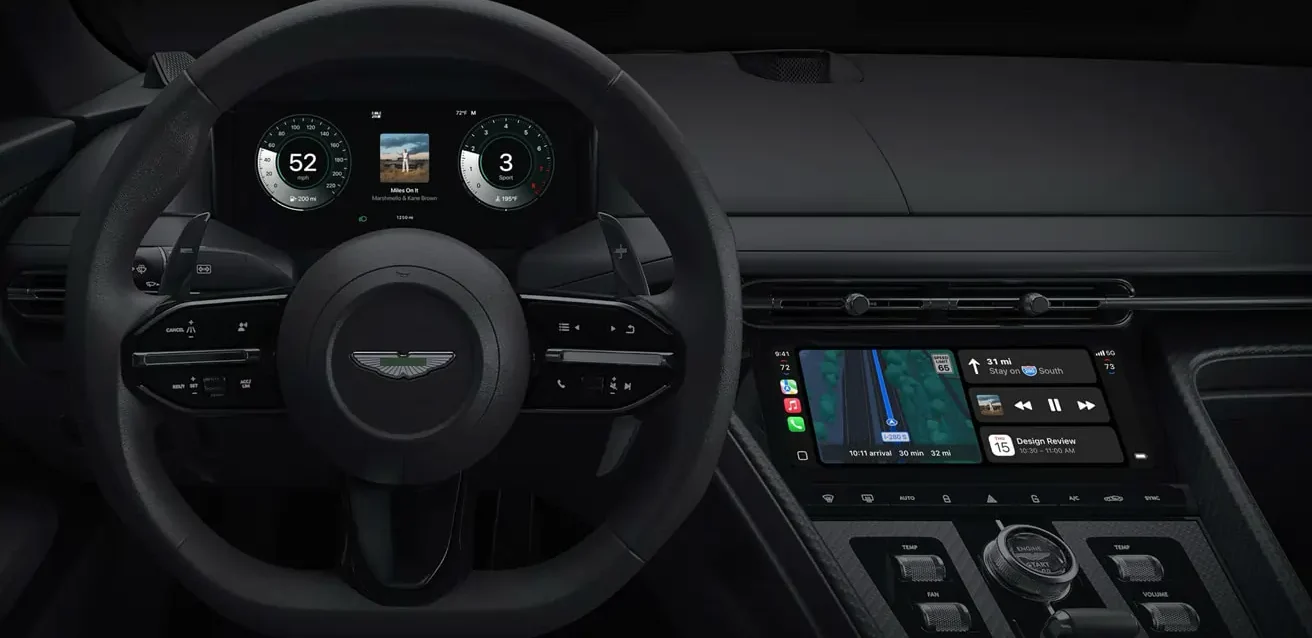
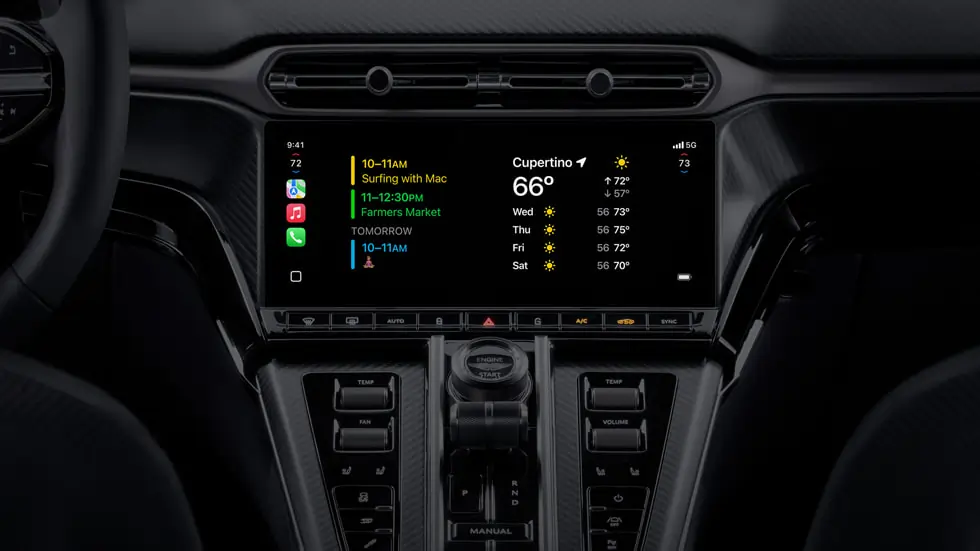
CarPlay Ultra is not just a fancy version of the CarPlay you already use. It’s a fundamentally different product. Standard CarPlay mirrors a handful of iPhone apps onto your center console screen. CarPlay Ultra takes over every screen in the vehicle — the instrument cluster behind the steering wheel, the center display, and any secondary screens — and deeply integrates with the car’s own systems.
That means your speedometer, tachometer, fuel gauge, and temperature readouts can all be rendered through Apple’s interface. You can control climate, drive modes, audio system configurations, and advanced vehicle-specific settings directly from CarPlay, without jumping back to the car’s native software. Widgets powered by your iPhone populate the gauge cluster at a glance.
CarPlay Ultra provides content for all the driver’s screens, including the instrument cluster, with dynamic options for the speedometer, tachometer, fuel gauge, temperature gauge, and more, bringing a consistent look and feel to the entire driving experience. Drivers can also use onscreen controls, physical buttons, or Siri to manage both standard vehicle functions like the car’s radio and climate, as well as advanced, vehicle-specific features like audio system configurations or performance settings, right from CarPlay.
The result, at least in theory, is that your iPhone essentially becomes the brain of the car’s entire digital experience. Apple calls it “the best of iPhone and the best of the car.” Critics call it Apple taking over your dashboard. Both descriptions are accurate.
Requirements: iPhone 12 or later, iOS 18.5 or later. You also need a compatible vehicle — and that’s where things get complicated.
The Current State: Still Just Aston Martin
As of now, only Aston Martin vehicles — DBX, DB12, Vantage, and Vanquish — support CarPlay Ultra. That’s it. For a system Apple first previewed at WWDC 2022 and officially launched in May 2025, the rollout has been glacially slow.
The price of entry is a problem. The Aston Martin DBX707 starts around $195,000–$250,000 depending on spec. The DB12 isn’t cheaper. So the “next generation of CarPlay” is currently available only to buyers who could have purchased four or five base-model Teslas instead.
Existing Aston Martin owners on the brand’s latest-generation infotainment system can get CarPlay Ultra via a software update at the dealership — which is at least something.
Which Brands Are Confirmed for CarPlay Ultra?
Apple said in May 2025 that CarPlay Ultra would expand to “more vehicles around the world in the next 12 months” — which puts the deadline at May 2026, roughly one month from now. Many other automakers are working to bring CarPlay Ultra to drivers, including newly committed brands Hyundai, Kia, and Genesis.
Here’s the status of each committed brand as of today:
Hyundai / Kia / Genesis — The most anticipated expansion. Bloomberg’s Mark Gurman said he was told that CarPlay Ultra will come to at least one major new Hyundai or Kia vehicle model “in the second half of this year.” Hyundai is currently teasing the Ioniq 3 launch — with the premiere expected in April 2026 — and that vehicle could be a likely candidate. The Ioniq 3 is expected to be priced around $33,000–$50,000, which would mark the first time CarPlay Ultra reaches a mainstream price point. Whether Genesis follows quickly with a premium model remains unconfirmed.
Porsche — Porsche appeared to remain committed to offering CarPlay Ultra eventually, but the brand hasn’t announced a specific model or timeline. Porsche is an interesting case because it needs to balance its own proprietary Porsche Communication Management system against full Apple integration.
Nissan, Honda, Land Rover, Jaguar, Infiniti, Acura — These brands announced plans for CarPlay Ultra support when it was previewed at Apple’s WWDC 2022 event, but it remains to be seen if they’ve maintained those commitments or quietly changed course like so many others. No official word from any of them since.
Who Has Walked Away?
This is where the story gets uncomfortable for Apple. A significant number of brands that were on the original 2022 commitment list have since publicly confirmed they are not implementing CarPlay Ultra.
According to a previous report from the Financial Times, at least five automakers confirmed they have no plans to offer CarPlay Ultra, including Audi, Mercedes-Benz, Polestar, Renault, and Volvo. BMW, Ford, and Rivian also publicly backed away from CarPlay Ultra.
The reasons vary, but they share a common thread: control. CarPlay Ultra requires automakers to hand Apple the keys to their entire dashboard experience. That creates real tension on multiple fronts:
- Brand identity — A Mercedes interior looks and feels like a Mercedes. CarPlay Ultra replaces that with an Apple interface.
- Data — Vehicle systems generate enormous amounts of driving data. Automakers are not eager to route that through Apple’s infrastructure.
- Revenue — Subscription-based connected services (navigation, music streaming integrations, remote start) represent growing revenue streams for automakers. CarPlay Ultra disrupts that model.
- Technical liability — If Apple pushes a software update that breaks the instrument cluster display, who’s responsible?
Ford CEO Jim Farley was asked whether the company is “considering” CarPlay Ultra support and said: “We are. We don’t like the execution in round 1 of Ultra, but we’re very committed to Apple.” That’s diplomatic language for “not yet, and maybe not ever in its current form.”
General Motors is the most extreme case — the company controversially dropped even standard CarPlay support from its new electric vehicles, making a full switch to its own Google-based system. CarPlay Ultra was never in the picture.
What Does This Mean for You?
If you’re shopping for a car right now and specifically want CarPlay Ultra, the options are genuinely limited. Unless you’re buying a new Aston Martin, you’re waiting.
The realistic mainstream timeline looks like this: late 2026 at the earliest, if Hyundai’s Ioniq 3 launches with CarPlay Ultra support in the second half of the year as Gurman reported. After that, it depends entirely on whether the Hyundai implementation is smooth enough to convince reluctant brands like Ford and BMW to reconsider.
There’s a good argument that Hyundai’s launch matters more than Apple’s launch ever did. Aston Martin is a niche luxury brand — its adoption proved the concept but told us nothing about mass-market viability. A Hyundai Ioniq 3 at $35,000–$40,000, on the other hand, is purchased by ordinary iPhone users. If CarPlay Ultra works well in that context and moves metal, the calculus changes for every automaker that’s currently on the fence.
If you want CarPlay Ultra before 2027, your options are:
- New Aston Martin (confirmed, available now)
- A Hyundai or Kia model in the second half of 2026 (reported but not officially confirmed)
- Porsche, at some unspecified future date
If your car doesn’t qualify, standard CarPlay is still excellent and available in most new vehicles across all price points. A wireless CarPlay adapter can also upgrade an older wired-CarPlay car without buying a new vehicle.
The Bigger Picture: Apple’s Long Game
CarPlay Ultra was announced four years ago. It launched at one luxury brand one year ago. It’s still at one luxury brand today. By any normal tech industry standard, that’s a troubled rollout.
But Apple plays long games. The original CarPlay took years to become genuinely useful. iMessage was clunky at launch. The App Store was a mess in 2008. Apple tends to announce ambitiously, iterate quietly, and eventually win through ecosystem gravity rather than initial execution.
The question isn’t whether CarPlay Ultra will eventually be widespread — it probably will, because iPhone users make up a huge portion of new car buyers and they prefer familiar interfaces. The question is whether Apple will make enough concessions to automakers on the control question to accelerate adoption before Android Automotive — which lets manufacturers customize more deeply — becomes the default alternative.
For now, if you’re an iPhone user buying a car in 2026, the smart move is to choose a vehicle with standard wireless CarPlay and check back on CarPlay Ultra in 2027. The experience will be more polished, the brand list will be longer, and the price of entry will finally be something other than a six-figure Aston Martin.
Frequently Asked Questions
What cars have CarPlay Ultra right now?
As of April 2026, only Aston Martin vehicles — the DBX, DB12, Vantage, and Vanquish — support CarPlay Ultra in the US and Canada.
Is CarPlay Ultra the same as CarPlay 2.0?
Yes. “CarPlay 2.0” was the informal name used after Apple previewed the system at WWDC 2022. Apple officially named it CarPlay Ultra at launch in May 2025.
What iPhone do I need for CarPlay Ultra?
You need an iPhone 12 or later, running iOS 18.5 or later.
Will Hyundai get CarPlay Ultra?
Hyundai is one of the committed brands. According to Bloomberg’s Mark Gurman, at least one Hyundai or Kia model will support CarPlay Ultra in the second half of 2026. The Hyundai Ioniq 3 is the most rumored candidate.
Why won’t BMW, Mercedes, or Ford offer CarPlay Ultra?
These brands cite concerns about losing control of their in-car experience, brand identity, and connected-services revenue. BMW and Rivian have publicly expressed skepticism, while Mercedes-Benz is investing in its own proprietary operating system instead.
Can I retrofit CarPlay Ultra into my existing car?
No. CarPlay Ultra requires deep hardware integration with the vehicle’s instrument cluster and systems — it cannot be added through an aftermarket adapter. Standard CarPlay retrofits remain possible for most vehicles.
Does Tesla support CarPlay Ultra?
No. Tesla uses its own operating system and has historically resisted CarPlay integration entirely. There are reports Tesla is exploring standard CarPlay support, but CarPlay Ultra is not in the picture.
Is CarPlay Ultra available in Europe?
CarPlay Ultra launched initially in the US and Canada through Aston Martin. Expansion to other regions is expected alongside the Hyundai/Kia rollout, but no confirmed timeline exists for Europe yet.

Consumer tech & culture writer. 200+ gadget reviews. Covers phones, laptops, gaming, streaming, puzzles, and digital culture. Writes for real people buying real products.