

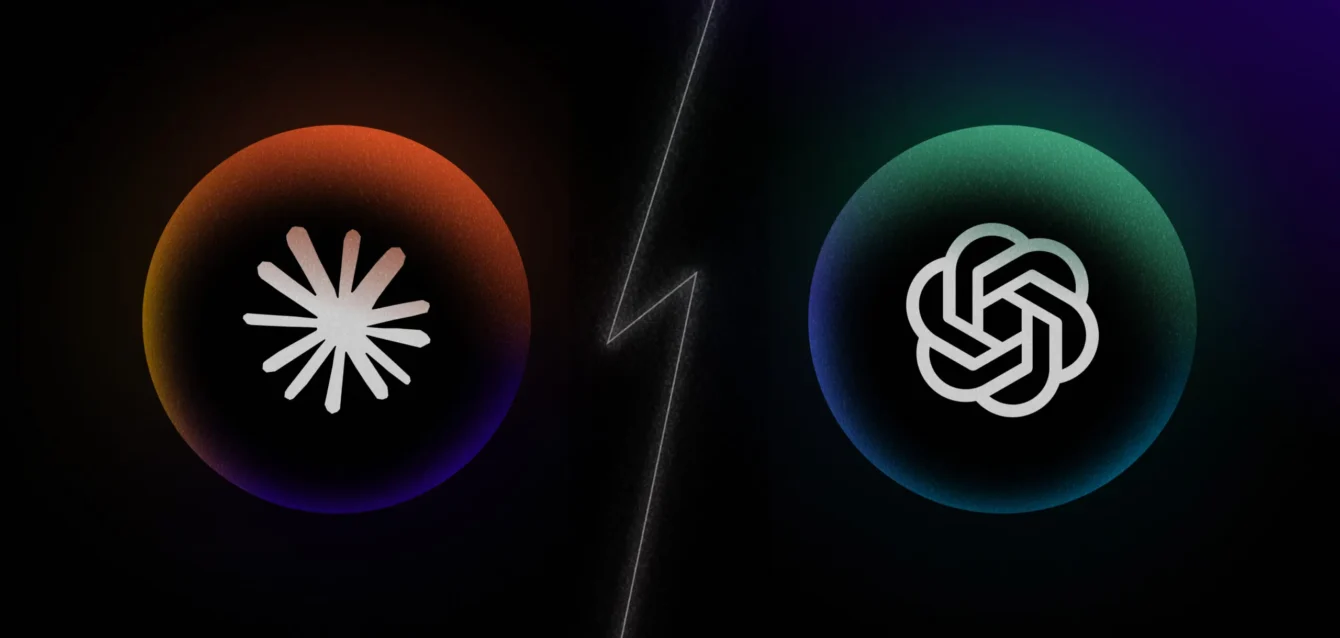
ChatGPT vs Claude 2026
The AI assistant market in 2026 comes down to two serious contenders. ChatGPT, powered by OpenAI’s GPT-5.2, remains the most recognized name in AI. Claude, built by Anthropic and now running on Claude Opus 4.6, has quietly become the tool that developers and writers reach for when the work actually matters.
Both cost $20 per month. Both can write, code, analyze, and reason. But they are fundamentally different tools built on different philosophies, and choosing the wrong one for your workflow costs you hours every week.
This is not a marketing comparison. We verified every pricing detail, checked current benchmarks from SWE-bench, Chatbot Arena, and METR evaluations, and cross-referenced real user feedback from Reddit communities (r/ClaudeAI, r/ChatGPT) to give you a clear, evidence-based verdict.
Quick Verdict: Claude wins for coding, long-document analysis, and writing quality. ChatGPT wins for multimodal creativity, ecosystem breadth, and speed. If your work is primarily text-based — writing, coding, research, document analysis — Claude delivers more consistent, higher-quality results. If you need image generation, video creation, voice interaction, and broad third-party integrations, ChatGPT is the more complete platform.
Choose ChatGPT if: You need an all-in-one creative toolkit with image generation (DALL-E), video creation (Sora), voice mode, and deep integration with tools like Slack, Google Drive, and GitHub through 60+ apps.
Choose Claude if: You write code professionally, work with long documents, or need an AI that produces natural-sounding prose without the typical AI “slop” that requires heavy editing.
The short version: ChatGPT does more things. Claude does the important things better.
Table of Contents
ChatGPT vs Claude at a Glance
| Feature | ChatGPT (GPT-5.2) | Claude (Opus 4.6 / Sonnet 4.6) |
|---|---|---|
| Price (standard paid) | $20/month (Plus) | $20/month (Pro) |
| Free plan | Yes — GPT-5.2 Instant, ~10 msgs/5 hrs | Yes — Sonnet 4.6, ~20 msgs/day |
| Premium tier | $200/month (Pro) | $100–$200/month (Max) |
| Budget tier | $8/month (Go) | None |
| Flagship model | GPT-5.2 (Dec 2025) | Claude Opus 4.6 (Feb 2026) |
| Context window | 400K tokens | 200K standard, 1M beta (Opus 4.6) |
| SWE-bench Verified | 80.0% | 80.8% (Opus 4.5) / 79.6% (Sonnet 4.6) |
| ARC-AGI-2 reasoning | 52.9% | 68.8% (Opus 4.6) |
| Image generation | Yes (DALL-E 4) | No |
| Video generation | Yes (Sora 2, 720p/5s on Plus) | No |
| Voice mode | Yes (Advanced Voice) | No |
| Web search | Yes (built-in) | Yes (added 2026) |
| Coding agent | Codex (Plus and above) | Claude Code (Pro and above) |
| Third-party apps | 60+ (Slack, Drive, SharePoint, GitHub, Atlassian) | Google Workspace, Slack, remote MCP connectors |
| Memory | Persistent across sessions | Memory from conversation history |
| Biggest strength | Multimodal versatility | Writing quality and coding depth |
| Biggest weakness | Writing quality regression (acknowledged by OpenAI) | No image/video generation |
Coding: ChatGPT vs Claude
Claude holds the edge for serious software engineering work, and the data supports this clearly.
On SWE-bench Verified — the industry-standard benchmark that uses 500 real GitHub issues from projects like Django and Scikit-learn — Claude Opus 4.5 became the first model to break 80% accuracy with a score of 80.9%. GPT-5.2 sits at 80.0%. The newer Claude Opus 4.6, released February 5, 2026, scores 80.8% and adds a 1 million token context window in beta, enabling analysis of entire large codebases in a single conversation.
But benchmarks only tell part of the story. In practical coding work, three differences matter most.
Context window for codebases. Claude’s 200K standard context (1M in beta for Opus 4.6) dwarfs ChatGPT’s 128K on standard paid plans (400K via API). When you need to analyze an entire repository, track dependencies across multiple files, or refactor a large project, Claude can hold significantly more code in memory at once. Reddit developers on r/programming consistently report that Claude handles multi-file refactoring tasks where ChatGPT loses track of dependencies.
Claude Code vs Codex. Both platforms now include dedicated coding agents in their $20/month plans. Claude Code operates directly in your terminal and can make changes to your codebase autonomously. OpenAI’s Codex is optimized for long-horizon coding with context compaction and handles Windows environments — an area where Claude Code is weaker. In Terminal-Bench 2.0, which evaluates complex command-line workflows, Claude Opus 4.6 leads at 65.4% versus GPT-5.2’s 64.7%, though the gap is narrow.
Code quality and debugging. Multiple independent tests and community evaluations consistently find that Claude produces cleaner, more idiomatic code with better variable naming, stronger type safety, and more thorough edge-case handling. In a side-by-side test documented by PlayCode, Claude’s TypeScript solution used proper generics where ChatGPT defaulted to any types. Claude also caught subtle bugs that ChatGPT missed, with users reporting roughly 20% faster bug-fixing rates.
Where ChatGPT pulls ahead is mathematical reasoning. On AIME 2025 (the American Invitational Mathematics Examination), GPT-5.2 achieves a perfect 100% accuracy without tools, versus Claude Opus 4.5’s approximately 92.8%. If your coding work involves heavy algorithmic computation or advanced mathematics, ChatGPT has a measurable advantage.
For coding, Claude has the edge because most professional software engineering involves debugging, refactoring, and working with large codebases — tasks where context window size and code quality matter more than raw mathematical ability. Developers who need heavy math or algorithm work will prefer ChatGPT’s reasoning engine.
Writing Quality: ChatGPT vs Claude
This is where the gap between the two platforms is widest — and where OpenAI has publicly acknowledged a problem.
In January 2026, OpenAI CEO Sam Altman admitted that the team “screwed up” GPT-5.2’s writing quality by prioritizing coding and mathematics improvements. Users across Reddit and X reported that GPT-5.2’s prose is stiffer, more formal, and harder to read than its predecessor GPT-4.5. As of February 2026, this writing regression has not been fully resolved.
Claude, by contrast, has built its reputation specifically on writing quality. Anthropic trains Claude using Constitutional AI, a methodology that embeds ethical principles and communication preferences directly into the model. The practical result is prose that reads more naturally, avoids the clichéd phrases that mark obvious AI output (“In today’s rapidly evolving landscape…”), and adapts its tone to the user’s expertise level.
In a blind test conducted in February 2026 with over 100 voters per round across eight prompts, Claude won four of eight rounds (often by margins of 35-54 points), while ChatGPT won only one round. Users consistently rated Claude’s outputs as more natural and publishable without heavy editing.
Several concrete differences stand out in daily writing work.
Long-form coherence. Claude maintains structure and consistency across long documents far better than ChatGPT. In essay-writing benchmarks, Claude scored 85% on structural coherence versus ChatGPT’s 78% for 2,000-word analyses. For anyone producing reports, articles, or documentation, this difference compounds with length.
Tone adaptability. Claude varies its tone and sentence structure more naturally. As Type.ai’s analysis documents, ChatGPT often falls into a distinctive “AI voice” with predictable patterns, while Claude’s outputs read more like they were written by a human with genuine opinions.
Critical pushback. Claude pushes back on flawed premises rather than simply executing instructions. Multiple users report that when given a poorly constructed argument, Claude will flag the issue rather than produce polished nonsense. ChatGPT tends to comply without questioning, which can be either a feature or a bug depending on your needs.
Where ChatGPT writing is better: Short-form creative brainstorming. When you need rapid-fire variations of social media captions, email subject lines, or ad copy, ChatGPT generates more options faster and with broader creative range. Several writing professionals report using ChatGPT for early ideation and Claude for polishing and final drafts — a split workflow that leverages each tool’s strength.
For writing, Claude wins decisively for anyone producing content that needs to read well without extensive manual editing. ChatGPT is better for brainstorming and ideation phases where quantity and creative breadth matter more than polish.
Multimodal Capabilities: ChatGPT vs Claude
ChatGPT dominates this dimension completely, and it is not close.
ChatGPT offers a genuinely multimodal experience. You can generate images with DALL-E 4, create short videos with Sora 2 (720p, 5-second clips on the Plus plan, higher resolution on Pro), hold real-time voice conversations through Advanced Voice mode, and upload images, documents, and spreadsheets for analysis. The voice mode in particular feels remarkably natural — users consistently describe it as having a conversation with a knowledgeable friend.
Claude’s multimodal capabilities are limited to text and static image analysis. You can upload images and Claude will analyze, describe, and interpret them with strong accuracy — its OCR capabilities for design work are notably praised by XDA Developers reviewers. But Claude cannot generate images, create videos, or engage in voice conversations. This is a fundamental architectural difference, not a feature gap that will close with an update.
For creative professionals, marketers, and anyone whose workflow involves visual content creation, this gap is decisive. A content marketer who needs to draft a blog post, generate a header image, create a social media video clip, and edit a promotional email can do all of that within ChatGPT’s interface. With Claude, the blog post and email will likely be higher quality, but the visual assets require entirely separate tools.
For multimodal work, ChatGPT is the clear winner. Claude doesn’t compete in this space and, based on Anthropic’s stated focus on text and reasoning, may not for a considerable time.
Pricing and Value: ChatGPT vs Claude
Both platforms charge $20 per month for their standard paid plans, but the value proposition differs significantly once you look beyond the headline price.
ChatGPT Pricing (February 2026)
| Plan | Monthly Price | Key Inclusions | Key Limitations |
|---|---|---|---|
| Free | $0 | GPT-5.2 Instant, basic DALL-E | ~10 messages/5 hours, ad-supported |
| Go | $8 | Faster GPT-5.2 Instant | No Sora, no Thinking mode, still ad-supported |
| Plus | $20 | GPT-5.2 Thinking, DALL-E 4, Sora 2 (720p), Codex, voice mode | ~160 msgs/3 hrs on flagship, Sora limited to 5s clips |
| Pro | $200 | GPT-5.2 Pro, unlimited Sora 2 Pro, max context | Overkill for most individuals |
| Business | ~$25-30/seat | Team workspace, admin controls, 60+ app integrations | Minimum seats required |
Source: OpenAI Pricing Page, OpenAI Go Announcement
Claude Pricing (February 2026)
| Plan | Monthly Price | Key Inclusions | Key Limitations |
|---|---|---|---|
| Free | $0 | Sonnet 4.6, web search, image analysis | ~20 searches/day, strict usage caps |
| Pro | $20 ($17/mo annual) | 5x free usage, Claude Code, Projects, Research, Google Workspace, extended thinking | ~45 msgs/5 hrs, no Opus on standard |
| Max 5x | $100 | All Pro features + Opus 4.6 access, 25x free capacity | High price jump from Pro |
| Max 20x | $200 | 100x free capacity, max priority | Comparable to ChatGPT Pro at same price |
| Team | $25-30/seat | Collaboration features, admin controls, SSO | Minimum 5 seats |
Source: Claude Pricing Page, Anthropic Documentation
Which Offers Better Value?
At the $20/month tier, ChatGPT Plus includes more features for the money — you get image generation, video creation, voice mode, and 60+ app integrations alongside the core AI assistant. Claude Pro gives you higher quality text outputs, Claude Code, and Google Workspace integration, but no visual content creation at all.
The free tier comparison favors ChatGPT for casual users. ChatGPT Free provides GPT-5.2 Instant with basic image generation, making it genuinely useful for light tasks. Claude’s free tier delivers excellent response quality through Sonnet 4.6 but imposes tight usage caps that users consistently describe as “just enough to show you how good it is” before hitting limits.
The premium tier gap is worth noting. ChatGPT jumps from $20 straight to $200, with nothing in between. Claude offers a $100 intermediate step (Max 5x) that unlocks Opus 4.6 access and 25x the free capacity. For power users who need more than Pro but not unlimited usage, Claude’s pricing structure provides better granularity.
One significant hidden cost: ChatGPT Go ($8/month) still shows ads. OpenAI confirmed that only Plus, Pro, Business, and Enterprise plans are ad-free. If paying to remove ads is a baseline expectation, your minimum effective ChatGPT price is $20.
For pricing, it’s a draw with caveats. ChatGPT offers more features per dollar at $20/month. Claude offers better quality per dollar at $20/month and better premium tier flexibility. Your priority — breadth of features versus depth of quality — determines which is the better value.
Ease of Use and Learning Curve: ChatGPT vs Claude

Both platforms have polished interfaces, but the experience diverges in meaningful ways as you move beyond basic chat.
Getting started. ChatGPT benefits from massive brand recognition and a frictionless onboarding experience. Most people try ChatGPT first simply because it is the name synonymous with AI assistants — a position analogous to how “Google” became synonymous with search. The interface is clean, the free tier is generous enough for casual exploration, and the learning curve for basic usage is essentially flat.
Claude’s onboarding is similarly straightforward, but the product assumes slightly more intentionality from the user. Features like Projects (for organizing documents and chats by topic), Artifacts (separate preview windows for code and content), and the ability to upload files for analysis are prominent from the start, subtly encouraging a workflow-oriented approach rather than casual Q&A.
Organization and workflows. Claude’s organizational tools are notably more developed. Projects let you group documents, chats, and context by work stream. Artifacts create separate content windows that keep code previews, documents, and generated content out of the main chat flow. Users transitioning from ChatGPT frequently cite this as a significant improvement — XDA Developers’ review specifically praises the ability to show or hide recent chats and multi-select conversations for project management.
ChatGPT counters with Custom GPTs — pre-configured AI assistants tailored for specific tasks. You can build a GPT for your brand voice, another for code review, and switch between them. This is powerful for users who want specialized tools rather than a general assistant, and the GPT Store provides thousands of community-built options. Claude has no equivalent marketplace.
Integrations and ecosystem. ChatGPT connects to 60+ third-party apps including Slack, Google Drive, SharePoint, GitHub, and Atlassian tools. These connections bring external data directly into your conversations. Claude’s integration ecosystem is smaller — Google Workspace (Docs, Gmail, Calendar), Slack, and remote MCP connectors — but the MCP (Model Context Protocol) standard is gaining developer traction as an open protocol for tool integration.
Long conversation quality. Here Claude has a structural advantage. Multiple users report that ChatGPT begins losing context and producing degraded responses in extended conversations. One XDA reviewer documented ChatGPT literally repeating a previous response word-for-word in a long session, while Claude maintained coherence and context throughout. This matters less for quick queries but becomes critical for research sessions, complex project discussions, or document drafting that spans multiple exchanges.
For ease of use, ChatGPT wins for beginners and casual users. Claude wins for power users who need organized workflows, long conversation coherence, and project-based document management.
Privacy and Security: ChatGPT vs Claude
Both companies invest heavily in security, but their philosophical approaches differ in ways that matter for privacy-conscious users and organizations.
Data training policies. ChatGPT’s free and Plus plans may use your conversations to improve models by default, though you can opt out in settings. OpenAI’s privacy policy details these practices, and the Business and Enterprise tiers guarantee no training on your data. Claude’s Pro and above plans do not use conversation data for training by default, and Anthropic’s privacy commitment positions data protection as a core design principle rather than an opt-in feature.
Safety approach. Anthropic built Claude around Constitutional AI, which makes the model more conservative in its responses. Claude is more likely to decline requests it considers potentially harmful, add safety caveats, or flag ethical concerns unprompted. Some users find this over-cautious and restricting. ChatGPT is more flexible on most requests but historically more prone to confidently stating incorrect information — though the hallucination gap between the two has narrowed significantly in their latest models.
Enterprise readiness. Both offer SOC 2 compliance, SSO, and encryption at rest and in transit for business plans. ChatGPT’s Enterprise tier adds SCIM provisioning, EKM (Enterprise Key Management), data residency options, and RBAC. Claude’s Enterprise tier includes similar governance features plus a larger 500K context window and GitHub integration for connecting company codebases. For organizations evaluating either platform, the enterprise security posture is comparable, with specific feature differences mattering based on your existing infrastructure (Microsoft ecosystem favors ChatGPT; developer-centric organizations may prefer Claude’s approach).
For privacy, Claude has a slight edge for individual users due to its default no-training stance on paid plans. Enterprise security is comparable, with ChatGPT offering deeper Microsoft ecosystem integration and Claude offering more developer-friendly governance.
Integrations and Ecosystem: ChatGPT vs Claude
The gap in third-party integrations is substantial and favors ChatGPT by a wide margin.
ChatGPT connects natively to over 60 apps — including Slack, Google Drive, SharePoint, GitHub, Atlassian (Jira, Confluence), Salesforce, and many more. This means you can ask ChatGPT to search your Google Drive for a document, pull data from a Slack channel, or reference your GitHub repositories without leaving the conversation. For teams already embedded in the Microsoft ecosystem, ChatGPT’s integration with Microsoft 365 Copilot creates a seamless workflow across Word, Excel, PowerPoint, Teams, and Outlook.
Claude’s integration ecosystem is smaller but strategically focused. As of February 2026, Claude connects to Google Workspace (Docs, Gmail, Calendar), Slack, and supports remote MCP (Model Context Protocol) connectors that allow developers to build custom integrations. The MCP standard is an open protocol that any developer can implement, which gives Claude’s ecosystem growth potential — but today, the practical selection is limited compared to ChatGPT’s established app marketplace.
Custom GPTs remain a significant ChatGPT differentiator. The ability to create task-specific AI assistants with custom instructions, knowledge bases, and behaviors — and share them through the GPT Store — has no direct equivalent in Claude’s ecosystem. While Claude’s Projects feature allows document and context organization, it doesn’t offer the same pre-built marketplace of specialized tools.
For integrations, ChatGPT wins clearly. If your workflow depends on connecting your AI assistant to a broad range of business tools, ChatGPT’s 60+ app ecosystem is significantly more mature. Claude’s MCP protocol shows promise for the future, but today ChatGPT is the better choice for integration-heavy workflows.
Speed and Performance: ChatGPT vs Claude
Response speed matters when you use an AI assistant dozens of times per day, and ChatGPT consistently delivers faster responses.
ChatGPT averages approximately 45 milliseconds per initial response token, compared to Claude’s roughly 50 milliseconds on standard queries. The difference widens with complex requests — Claude’s extended thinking mode deliberately takes longer to produce more thorough responses, which is a feature rather than a limitation, but the wait is noticeable. For quick queries, brainstorming sessions, or high-volume workflows where you fire off prompt after prompt, ChatGPT’s speed advantage compounds throughout the day.
Gemini 3 Pro outpaces both at roughly 134 tokens per second output, but between these two contestants, ChatGPT is the faster platform. Independent user tests confirm this — ChatGPT is approximately 4x faster in scenarios where rapid iteration matters, such as generating multiple variations of marketing copy or cycling through code solutions.
Claude’s slower speed comes with a tradeoff that many users consider worthwhile: fewer errors on the first attempt. Claude is more likely to think through edge cases, flag potential issues, and deliver a response that doesn’t require follow-up corrections. If your workflow involves sending a prompt and waiting for a polished result rather than rapid iteration, Claude’s approach saves total time even if each individual response takes longer.
For speed, ChatGPT wins. For accuracy-per-prompt (reducing total back-and-forth), Claude often wins despite being slower per response.
Reasoning and Analysis: ChatGPT vs Claude
Both models are highly capable reasoners in 2026, but their strengths distribute differently across reasoning types.
Abstract reasoning. Claude Opus 4.6 scores 68.8% on ARC-AGI-2, the benchmark that measures novel pattern recognition rather than memorized knowledge. GPT-5.2 scores 52.9% on the same test. This 16-point gap represents a meaningful difference in the ability to solve genuinely novel problems — the kind where memorized training data doesn’t help.
Mathematical reasoning. GPT-5.2 reclaims the lead with perfect 100% accuracy on AIME 2025 without tools, versus Claude’s 92.8%. For scientific knowledge, GPT-5.2 hits 94.3% on GPQA Diamond (graduate-level science questions). If your analysis work involves heavy quantitative reasoning, statistical modeling, or scientific research, ChatGPT’s mathematical engine is demonstrably stronger.
Enterprise knowledge work. Claude Opus 4.6 leads with a 1,606 Elo rating on GDPval-AA — 144 points ahead of GPT-5.2 — and outperforms GPT-5.2 approximately 70% of the time on economically valuable tasks across 44 professional occupations. This benchmark tests practical knowledge work performance: drafting business analyses, legal reasoning, financial modeling, and strategic planning. On BigLaw Bench (legal reasoning), Claude achieves 90.2% with 40% perfect scores. For professionals in law, finance, consulting, and business analysis, Claude’s reasoning advantage in applied professional contexts is substantial.
Hallucination and factual accuracy. Claude has historically produced fewer confident fabrications than ChatGPT, though the gap has narrowed in 2026. Claude’s Constitutional AI framework makes it more likely to say “I’m not sure” rather than confidently present incorrect information. ChatGPT’s GPT-5.2 has reduced errors by 30% compared to GPT-5.1, but user reports still find ChatGPT more prone to stating plausible-sounding falsehoods with high confidence.
For reasoning, it depends on the domain. Claude wins for abstract reasoning, professional knowledge work, legal analysis, and tasks where accuracy matters more than speed. ChatGPT wins for mathematics, scientific reasoning, and quantitative analysis.
The Verdict: Which Should You Choose?
After analyzing eight key dimensions — coding, writing, multimodal capabilities, pricing, ease of use, privacy, integrations, speed, and reasoning — a clear pattern emerges. Neither tool is universally superior. But for most professionals, one will be a better fit than the other.
Choose ChatGPT if you:
- Need image generation, video creation, or voice interaction as part of your workflow
- Work within the Microsoft ecosystem and need deep Office 365 integration
- Rely on a broad range of third-party app connections (Slack, Salesforce, Atlassian, SharePoint)
- Prioritize speed for high-volume, rapid-iteration tasks like brainstorming or generating variations
- Need advanced mathematical reasoning or scientific computation
- Want the most generous free tier for casual, occasional AI use
Choose Claude if you:
- Write code professionally and need reliable debugging, refactoring, and large-codebase analysis
- Produce long-form content that needs to sound natural without heavy editing
- Work with long documents, legal contracts, financial reports, or research papers
- Need organized project management with documents, chats, and context grouped by workflow
- Prioritize data privacy with default no-training policies on paid plans
- Want professional-grade knowledge work performance for business analysis, legal, or consulting tasks
Consider using both if: You need ChatGPT’s multimodal capabilities alongside Claude’s superior writing and coding quality. Many power users subscribe to both ($40/month total) and route different tasks to different tools — a strategy that Reddit communities consistently recommend as the optimal approach in 2026.
Consider neither if: Your needs are highly specialized. For real-time information retrieval and web research with citations, Perplexity AI may serve you better. For Google ecosystem integration and the largest context window with video processing, Gemini 3 Pro offers 1M tokens at a lower price point. For open-source flexibility and self-hosting requirements, DeepSeek V3 or Llama 4 provide alternatives that avoid vendor lock-in entirely.
Frequently Asked Questions
Is ChatGPT better than Claude in 2026?
Not universally. ChatGPT offers more features (image generation, video, voice, 60+ app integrations) and faster response times. Claude delivers higher quality on core tasks: coding, writing, long-document analysis, and professional reasoning. The right choice depends entirely on which capabilities your daily work requires most.
Is Claude worth the extra cost over ChatGPT?
Both cost the same at $20/month for their standard paid plans (ChatGPT Plus and Claude Pro). At this price point, you are not paying extra for one over the other — you are choosing a different set of strengths. If you subscribe to both at $40/month total, many professionals find the combined access more valuable than either premium tier alone.
Can I switch from ChatGPT to Claude easily?
Yes. Neither platform locks you into proprietary formats. Your conversations don’t transfer, but Claude’s Projects feature makes it straightforward to rebuild your organizational structure. The biggest adjustment is workflow adaptation: Claude handles tasks differently than ChatGPT (more pushback, fewer assumptions, different formatting preferences), so expect a brief learning period. The reverse switch from Claude to ChatGPT is equally straightforward.
Which is better for coding, ChatGPT or Claude?
Claude edges ahead for most professional coding work. It leads on SWE-bench Verified (80.8% vs 80.0%), produces cleaner code by default, and its larger context window handles bigger codebases. Claude Code, included in the $20/month Pro plan, operates directly in your terminal as an autonomous coding agent. ChatGPT’s Codex is better for mathematical algorithms, Windows-specific development, and environments where speed of code generation matters more than initial code quality.
What’s the main difference between ChatGPT and Claude?
The core difference is philosophical. ChatGPT is built to be a versatile, multimodal platform that does many things. Claude is built to be a precise, high-quality reasoning tool that does fewer things but does them better. ChatGPT adds features (image gen, video, voice, apps). Claude refines capabilities (better writing, better coding, better analysis). Choose breadth or choose depth.
Is the free plan good enough for either tool?
ChatGPT’s free tier is more practical for casual use — it includes basic image generation and wider access to GPT-5.2 Instant. Claude’s free tier offers arguably higher-quality responses through Sonnet 4.6 but imposes tight usage caps that most regular users will hit within a handful of substantive conversations per day. For serious professional use, both platforms essentially require the $20/month paid tier.
Which AI hallucinates less, ChatGPT or Claude?
Claude generally produces fewer confident fabrications, partly due to its Constitutional AI training which makes it more likely to express uncertainty rather than guess. GPT-5.2 has reduced errors by 30% versus its predecessor, narrowing the gap significantly. For high-stakes factual work, neither should be trusted without verification, but Claude’s tendency to flag its own uncertainty makes its errors easier to catch.
Which AI is better for business use?
It depends on the business function. Marketing teams that need creative assets (images, video) alongside copy benefit from ChatGPT’s multimodal toolkit. Legal, consulting, and financial analysis teams get better results from Claude’s professional reasoning capabilities — it outperforms ChatGPT on approximately 70% of economically valuable knowledge work tasks. For company-wide deployment, ChatGPT’s deeper enterprise integration (Microsoft 365, 60+ apps) may simplify IT administration, while Claude’s default privacy stance may appeal to compliance-conscious industries.
ChatGPT vs Claude for students?
ChatGPT’s free tier is better for casual study questions and general exploration. Claude is better for deep document analysis, research paper comprehension, and academic writing — its ability to maintain context across long documents and produce naturally structured prose gives it an edge for essay and thesis work. Students doing STEM coursework may prefer ChatGPT for mathematical problem-solving. Cost-conscious students should note that Claude Pro offers an annual plan at $17/month ($204/year), a modest saving over monthly billing.
Will ChatGPT or Claude be better by end of 2026?
Both companies ship updates at accelerating rates. OpenAI has GPT-5.3 development underway with early signs of improved writing quality. Anthropic’s roadmap suggests expanded multimodal capabilities and deeper agentic tools. The trend points toward continued specialization: ChatGPT as the broader platform, Claude as the deeper specialist. Power users will likely continue using both for different tasks rather than consolidating to one tool.