

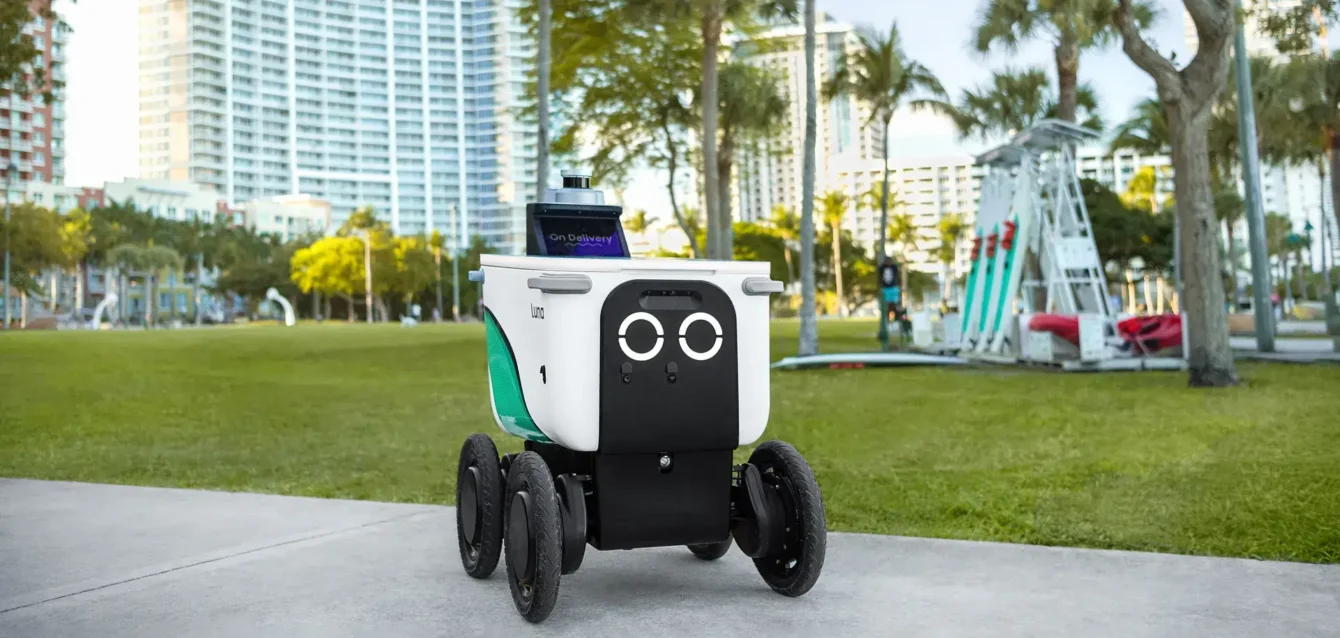
Delivery robots last-mile solutions
TL;DR: Autonomous delivery robots have transitioned from experimental pilots to commercial-scale operations, with market leaders like Starship Technologies completing over 9 million deliveries across 270+ locations globally. The sector projects explosive growth from $796 million in 2025 to $3.24 billion by 2030, driven by operational cost reductions up to 57%, labor shortage solutions, and sustainability mandates. This analysis examines how sidewalk robots, hybrid autonomy systems, and regulatory frameworks are transforming urban logistics infrastructure while creating new challenges around liability, data privacy, and workforce displacement.
The Last-Mile Delivery Crisis Nobody Saw Coming
Urban logistics networks are buckling under pressure that traditional infrastructure was never designed to handle. E-commerce sales acceleration has created delivery density that makes conventional last-mile operations economically untenable in many metropolitan cores. The numbers tell a stark story: last-mile delivery accounts for 53% of total shipping costs while representing only the final segment of the supply chain. For every $100 in logistics spending, retailers burn through $53 delivering packages from distribution hubs to consumer doorsteps.
This cost structure reflects fundamental inefficiencies that have persisted for decades. Human drivers require wages, benefits, vehicle maintenance, insurance, and regulatory compliance. They need breaks, can only work defined shifts, and operate most effectively on predictable routes with bulk deliveries. But modern e-commerce demands exactly the opposite: unpredictable, hyper-local, single-item deliveries with two-hour delivery windows that consumers now expect as standard service.
Labor markets have simultaneously tightened to crisis levels. The U.S. manufacturing sector projects a 2 million worker shortage by 2030, according to Deloitte’s industrial manufacturing research, while last-mile driver turnover reaches 50-70% annually in major urban markets. Delivery companies face a paradox: surging demand meets shrinking available workforce, all while consumer tolerance for delivery delays or premium fees continues to evaporate.
Enter autonomous delivery robots, which have quietly scaled from university campus novelties to commercially viable urban infrastructure. These systems represent more than incremental efficiency gains. They fundamentally rewire last-mile economics through operational models that traditional logistics cannot match.
Market Trajectory Through 2030
The autonomous delivery robots market demonstrates growth patterns that distinguish it from typical emerging technology curves. Rather than following hype cycles of overexpansion and correction, deployment has accelerated steadily as operators prove unit economics in controlled environments before geographic expansion. This disciplined scaling approach creates more sustainable growth projections than early autonomous vehicle predictions suggested.
Market valuation sits at $795.6 million in 2025, according to MarketsandMarkets analysis, with projected growth to $3.24 billion by 2030 at a compound annual growth rate of 32.4%. These figures reflect conservative estimates based on current deployment rates and regulatory approval timelines. Alternative projections from Research Nester place 2025 valuation at $738.3 million expanding to $7.58 billion by 2035, representing a 27.7% CAGR that accounts for accelerated regulatory adoption and technology maturation.
Geographic distribution reveals concentrated development in specific regulatory environments rather than uniform global adoption. North America commands 47.6% market share in 2024, driven by state-level legislation enabling sidewalk robot operations and venture capital availability for robotics startups. Europe follows with established pilots in urban cores where zero-emission vehicle mandates create structural advantages for electric robots over traditional delivery vans.
Asia Pacific emerges as the fastest-growing region through 2035, propelled by dense urban populations, e-commerce penetration rates, and government investment in autonomous systems infrastructure. China’s JD.com operates the largest integrated autonomous delivery network globally, handling millions of packages monthly through coordinated ground robots and drone systems. This regional leadership reflects strategic national priorities around logistics automation and smart city development rather than organic market forces alone.
Form factor segmentation shows outdoor robots capturing 58% of 2024 market share, while hybrid all-terrain systems project 27.8% CAGR through 2030. This shift toward hybrid designs reflects lessons learned from early deployments: sidewalk-only robots face insurmountable obstacles from infrastructure gaps, weather conditions, and pedestrian density. Hybrid robots capable of transitioning between sidewalks, bike lanes, and low-speed roadways demonstrate significantly higher delivery completion rates and geographic coverage.
Load capacity distribution concentrates in the 10kg-and-under category, accounting for 46.7% of deployed units in 2024. This weight class aligns with restaurant delivery, pharmacy orders, and convenience retail—the highest-frequency use cases driving commercial adoption. However, robots above 80kg show the steepest 23.1% CAGR outlook as grocery delivery and parcel services expand beyond prepared meal delivery.
Technology Leaders Reshaping Urban Delivery
Starship Technologies: The Deployment Benchmark
Starship Technologies has emerged as the undisputed volume leader in autonomous sidewalk delivery, completing over 9 million deliveries across 270+ locations in seven countries as of November 2025. Founded in 2014 by Skype co-founders Ahti Heinla and Janus Friis, Starship demonstrates how founder expertise in scalable software infrastructure translates to robotics operations. The company raised $50 million in Series C funding in October 2025, bringing total capital to $280 million for U.S. urban market expansion.
Starship’s operational metrics provide the clearest window into mature autonomous delivery economics. The fleet of 2,700+ robots operates at Level 4 autonomy, handling 100,000+ road crossings daily without human intervention for navigation. Average delivery time sits at 15 minutes globally, faster than traditional courier services while maintaining 99.7% delivery success rates. Energy consumption per delivery equals boiling a small kettle of water, demonstrating efficiency advantages that compound across millions of deliveries.
Partnership strategy focuses on embedding robots into existing delivery platform infrastructure rather than building consumer-facing applications. The November 2025 partnership with Uber Eats creates a global rollout framework starting in Leeds, UK, followed by European expansion in 2026 and U.S. cities in 2027. This multi-year, multi-continent deployment plan reflects Starship’s methodical scaling approach: prove unit economics in controlled environments, establish regulatory frameworks, then rapidly deploy once operational blueprints are validated.
University campus operations provide the proof-of-concept foundation. Starship operates on 60+ U.S. university campuses where contained geography, high delivery density, and tech-friendly demographics create ideal testing grounds. These deployments generate real-world data on pedestrian interactions, weather performance, and maintenance requirements that inform broader urban rollouts. Campus partnerships with Grubhub, Sodexo, and Aramark also demonstrate how robots integrate into existing food service contracts without disrupting established vendor relationships.
European grocery delivery represents Starship’s most mature commercial market. Operations across 30+ European cities include partnerships with S Group in Finland (completing over 1 million grocery deliveries), Bolt Food in Estonia, and Co-op in the United Kingdom. These grocery programs differ fundamentally from restaurant delivery: larger order sizes, scheduled delivery windows, and customer willingness to wait 30-60 minutes create operating parameters better suited to robot capabilities than on-demand food.
Manufacturing partnerships signal Starship’s evolution from prototype developer to industrial-scale producer. The collaboration with Magna, a major automotive supplier, enables production volumes that competitor startups cannot match. This manufacturing capacity becomes critical for the target of scaling from 2,700 robots in late 2025 to 12,000+ by 2027—growth that requires industrial assembly lines rather than artisanal robot production.
Real-world testing has generated approximately 200 million road crossing events that continuously train Starship’s AI models. This dataset represents competitive moat that newer entrants cannot quickly replicate. Each crossing provides training data on pedestrian behavior, traffic patterns, weather conditions, and edge cases that improve autonomy performance. The company leverages this data advantage by deploying improvements fleet-wide, creating operational improvements that compound as the fleet expands.
Serve Robotics: Vertical Integration Through Uber Partnership
Serve Robotics emerged from Postmates’ internal robotics division in 2017, then became independent when Uber acquired Postmates in 2020. This origin story creates unique advantages: Serve was designed specifically for Uber Eats’ delivery network requirements from inception, ensuring tight integration rather than retrofit partnerships. The company went public on Nasdaq in April 2024, becoming the first pure-play autonomous delivery robotics stock.
The $80 million funding raised in January 2025 finances rapid fleet expansion to meet Uber partnership commitments. Serve deployed over 1,000 third-generation autonomous sidewalk robots as of October 2025, with 380+ units deployed in a single month. The target of 2,000 units by year-end 2025 reflects manufacturing capacity scaled to match Uber Eats’ geographic expansion timeline across Los Angeles, Dallas, and additional metropolitan markets.
Technical specifications reveal Serve’s focus on urban density operations. Robots navigate sidewalks at walking pace while carrying 30-50 pounds of cargo, optimal for restaurant orders and retail packages. The proprietary autonomy stack processes sensor data for real-time navigation without requiring dedicated infrastructure or preset routes. Unlike some competitors using teleoperator oversight, Serve robots operate fully autonomously with remote operators only intervening for exceptional circumstances.
Operating economics demonstrate path to profitability that attracted public market investors. Uber CEO Dara Khosrowshahi publicly disclosed that Serve’s robots deliver at lower cost than human couriers for qualifying orders. While Serve currently deploys one order per robot per trip to maintain food quality and delivery speed, the platform supports multi-order deliveries that could further reduce per-delivery costs as operations mature.
Los Angeles serves as Serve’s primary deployment laboratory, with robots operating across multiple neighborhoods and servicing 900+ restaurants. This geographic concentration allows Serve to establish depot infrastructure, maintenance facilities, and operational expertise before expanding to new cities. The robots leave depot locations each morning, position themselves near high-density restaurant zones, complete deliveries throughout the day, then return to depots for overnight charging and maintenance.
Partnership with Wing Aviation (Alphabet’s drone delivery subsidiary) creates robot-to-drone handoff capabilities extending delivery range to 6 miles. In this hybrid model, Serve robots pick up orders at restaurants, transport them to automated loading stations, then Wing drones complete final delivery to suburban locations beyond economic sidewalk robot range. This multi-modal approach addresses a fundamental limitation of ground robots: they become uneconomical beyond 2-mile radius from pickup locations due to round-trip travel time.
Serve’s public company status provides transparency rare in robotics: quarterly reporting on deployment rates, delivery volumes, and unit economics. This financial visibility benefits the entire sector by establishing valuation frameworks and performance benchmarks that private competitors must match to attract capital. Public markets also impose discipline around profitability timelines that prevents overexpansion before proving sustainable unit economics.
Nuro: Purpose-Built Autonomous Vehicles for Goods
Nuro occupies a distinct niche: purpose-built autonomous vehicles designed exclusively for goods transport rather than adapted from sidewalk robots or passenger vehicles. Founded by former Google self-driving car engineers, Nuro raised over $2 billion in funding from SoftBank, Chipotle, Kroger, and other strategic investors betting on road-going autonomous delivery.
Vehicle design reflects Nuro’s unique approach. Rather than miniature robots sharing sidewalks with pedestrians, Nuro deploys compact vehicles operating on roads at speeds up to 25 mph. These vehicles measure roughly half the width of standard cars, enabling them to fit in bike lanes and narrow urban streets while carrying substantially more cargo than sidewalk robots. The custom vehicles incorporate safety features like external airbags protecting pedestrians in collisions, temperature-controlled compartments for grocery and food delivery, and modular cargo bays accommodating various package sizes.
Regulatory strategy differentiates Nuro from competitors. The company secured the first U.S. Department of Transportation exemption allowing deployment of vehicles without traditional safety equipment required for human passengers—no steering wheel, pedals, or mirrors. This exemption acknowledges that goods-only vehicles present different safety parameters than passenger vehicles, enabling optimized designs impossible under conventional automotive regulations.
Retail partnerships focus on grocery delivery where Nuro’s larger cargo capacity and temperature control create distinct advantages. Pilots with Kroger and Walmart test automated grocery delivery from store to home, addressing last-mile costs that make grocery delivery economically marginal under traditional courier models. These grocers view autonomous delivery as infrastructure investment enabling profitable online grocery operations rather than robotics experimentation.
Autonomous technology development leverages Nuro founders’ Google Waymo experience while adapting to goods delivery requirements. The perception systems must identify delivery addresses, navigate driveways and parking areas, and coordinate handoffs with customers—different challenges than passenger vehicle navigation. Nuro’s third-generation vehicle incorporates partnerships with ARM for chip design, enhancing onboard compute capacity for real-time AI processing without cloud connectivity dependencies.
Competitive positioning targets the gap between sidewalk robots (limited range and capacity) and traditional delivery vans (expensive for small orders). Nuro vehicles can economically serve 5-mile radius with 200+ pounds cargo capacity, handling deliveries that justify dedicated vehicle dispatch but don’t require full-size delivery trucks. This middle market represents significant opportunity: orders too large or distant for sidewalk robots, too small to justify human driver costs.
DoorDash Dot: First-Party Platform Integration
DoorDash’s September 2025 launch of Dot, an in-house developed autonomous delivery robot, signals major platform operators building proprietary delivery infrastructure rather than relying on third-party robotics providers. This vertical integration strategy mirrors Amazon’s approach with Scout (though Amazon paused Scout development in 2022) and reflects platforms’ belief that delivery robotics constitute core competitive infrastructure, not outsourced services.
Technical capabilities position Dot for multi-surface navigation uncommon in competing robots. The system operates on roads, sidewalks, bike lanes, and driveways, traveling up to 20 mph with 30-pound cargo capacity. This flexibility addresses a fundamental challenge facing sidewalk-only robots: infrastructure gaps force delivery routes through areas lacking continuous sidewalk coverage, creating dead zones where robots cannot complete deliveries. Dot’s road-capable design eliminates these coverage gaps.
Integration into DoorDash’s Autonomous Delivery Platform creates AI-driven dispatch logic matching orders to optimal delivery method: human Dasher, sidewalk robot, road-capable robot like Dot, or drone partner. This multi-modal orchestration system evaluates distance, package weight, traffic conditions, weather, and delivery urgency to dynamically allocate resources. The platform essentially functions as an autonomous logistics optimization engine determining which delivery method minimizes costs while meeting customer expectations.
In-house development provides DoorDash control over hardware design, software integration, and intellectual property that third-party partnerships cannot match. The company can optimize Dot specifically for DoorDash platform requirements: restaurant pickup workflows, customer notification systems, and branded customer experience. Proprietary development also allows DoorDash to capture full economic value from automation rather than sharing margin with robotics suppliers.
Strategic implications extend beyond delivery cost reduction. DoorDash views autonomous delivery infrastructure as defensive necessity: if competitors like Uber Eats gain cost advantages through robot deployments, DoorDash must match or lose market share. Autonomous delivery also potentially reshapes restaurant marketplace dynamics by enabling more efficient service of lower-value orders that currently lose money under human courier economics.
Additional Market Players Expanding the Ecosystem
Robot.com (formerly Kiwibot) operates 500+ robots across U.S., Canada, and Middle East markets, focusing heavily on university campus delivery through partnerships with Sodexo, Grubhub, and Aramark. The company completed over 1.7 million robot tasks and recently pivoted toward industrial use cases while maintaining delivery operations, signaling recognition that campus delivery alone may not support standalone business models.
Avride, originally part of Yandex’s autonomous driving division, provides both delivery robots and robotaxis through partnerships with Grubhub on college campuses and Uber Eats in Jersey City. This dual product strategy reflects betting on multiple autonomous vehicle categories rather than specializing in delivery robots alone.
Coco Robotics operates in Los Angeles with hybrid autonomy model: robots perform basic navigation autonomously while human teleoperators provide remote assistance for complex situations. This approach reduces autonomy complexity and associated costs while maintaining human oversight for safety and reliability. Coco raised substantial new funding in 2025 and expanded partnerships with restaurant and delivery platforms, demonstrating investor appetite for alternative autonomy architectures beyond full Level 4 systems.
Amazon’s role in the sector deserves particular attention despite pausing Scout development in 2022. The company continues developing warehouse robots and autonomous vehicles for internal logistics while evaluating consumer-facing delivery robot strategies. Amazon’s warehouse robotics operations inform broader autonomous delivery development: the company understands robot economics, fleet management, and integration challenges at scale that pure-play delivery robotics startups are only beginning to encounter.
Technology Architecture Enabling Autonomous Operations
Sensor Fusion and Environmental Perception
Modern delivery robots operate through integrated perception systems combining multiple sensor modalities to build comprehensive environmental models. This sensor fusion architecture differs fundamentally from single-sensor approaches that dominated early autonomous vehicle development.
LiDAR (Light Detection and Ranging) provides precise 3D mapping of surroundings, generating point clouds that identify obstacles, pedestrians, and navigation surfaces with centimeter-level accuracy. Delivery robots typically deploy solid-state LiDAR units rather than mechanical spinning sensors, reducing cost, size, and failure points while maintaining detection ranges of 50-100 meters. These systems emit laser pulses and measure return times to calculate distances, creating real-time spatial maps updated dozens of times per second.
Camera arrays complement LiDAR with visual data essential for semantic understanding. While LiDAR excels at distance measurement and object detection, cameras identify traffic signals, read street signs, detect pedestrian gestures, and recognize landmarks for localization. Multi-camera setups provide 360-degree visual coverage, with overlapping fields of view enabling stereoscopic depth perception. Computer vision algorithms process these visual streams in real-time, detecting objects, classifying their types, and predicting movement patterns.
Ultrasonic sensors fill gaps in close-range detection where LiDAR and cameras face limitations. These sensors operate effectively in dark or visually degraded conditions, detecting obstacles within 2-3 meters through acoustic reflection. Delivery robots position ultrasonic sensors low on vehicle bodies to detect curbs, small obstacles, and ground-level hazards that overhead sensors might miss.
GPS provides coarse positioning accurate to several meters, insufficient for precise navigation but valuable for route planning and general localization. Delivery robots augment GPS with SLAM (Simultaneous Localization and Mapping) algorithms that build detailed maps while tracking robot position within those maps. SLAM operates independently of GPS signals, critical for navigation in urban canyons, indoor deliveries, or areas with poor satellite visibility.
Inertial Measurement Units (IMUs) track acceleration, rotation, and orientation at high frequencies, providing data for sensor fusion algorithms that combine multiple input streams into unified environmental models. IMUs help robots maintain stability on inclines, detect collisions, and estimate position when other sensors face temporary occlusions.
The fusion of these sensor streams creates redundancy enabling robots to navigate safely even when individual sensors face degraded performance. Heavy rain might reduce camera effectiveness, but LiDAR and ultrasonic sensors continue operating. Bright sunlight that saturates cameras poses no issue for LiDAR or ultrasonic detection. This multi-modal approach ensures reliable operation across weather conditions, lighting variations, and environmental complexity.
Artificial Intelligence and Machine Learning Integration
Autonomous navigation relies on AI systems trained on millions of real-world scenarios to handle situations too complex for rule-based programming. Machine learning models process sensor data to identify objects, predict pedestrian behavior, plan routes, and make real-time decisions about navigation strategies.
Object detection neural networks classify entities in robot surroundings: pedestrians, vehicles, bicycles, dogs, strollers, construction equipment, and hundreds of other categories. These models must operate in real-time, processing camera and LiDAR data at 10-30 frames per second to maintain current environmental awareness. Training datasets for these networks include millions of labeled examples captured across diverse urban environments, weather conditions, and times of day.
Behavioral prediction models estimate how dynamic objects will move in the next several seconds, essential for collision avoidance and path planning. If a pedestrian stands at a crosswalk looking at their phone, will they step into the robot’s path? If a cyclist signals a turn, when will they execute the maneuver? These prediction systems don’t rely on simple physics models but learn complex human behavior patterns from observational data.
Path planning algorithms combine environmental understanding with mission objectives to determine optimal routes from current position to delivery destination. These systems must balance multiple constraints: reaching the destination quickly, avoiding obstacles, maintaining safe distances from pedestrians, obeying traffic rules, and minimizing energy consumption. Advanced path planners use reinforcement learning to discover strategies that optimize these sometimes-competing objectives.
According to McKinsey’s research on AI agents and robotics, the integration of spatial perception, reasoning, and action in modern robotic systems represents fundamental advances in AI-driven operations. These systems can now operate in unstructured environments and follow verbal instructions, marking significant evolution from traditional rule-based automation.
Continuous learning systems improve robot performance over time as fleets accumulate operational experience. When one robot encounters a new scenario—a construction barrier type, an unusual crosswalk configuration, a novel obstacle—the learned adaptation can be shared across the entire fleet after validation. This distributed learning creates network effects: each additional robot deployment generates training data benefiting all robots in the network.
Edge computing architecture processes most AI inference locally on robot hardware rather than relying on cloud connectivity. This approach reduces latency to milliseconds rather than hundreds of milliseconds required for cloud round-trips, critical when robots must react immediately to sudden obstacles or safety hazards. Local processing also maintains operation when cellular connectivity drops in urban dead zones or underground passages.
High-performance computing platforms like Intel Xeon processors paired with modular GPUs enable concurrent AI workloads: 3D localization, multi-object tracking, semantic segmentation, and obstacle classification all operating simultaneously within strict power and thermal budgets. These systems represent engineering challenges balancing computational power, energy efficiency, heat dissipation, and cost constraints.
Fleet Management and Remote Operations
Commercial-scale deployment requires fleet management systems coordinating hundreds or thousands of robots across cities and regions. These systems handle task allocation, route optimization, battery management, maintenance scheduling, and exception handling through centralized control platforms.
Task assignment algorithms match delivery requests to available robots based on current location, battery charge, cargo capacity, and route efficiency. The systems must solve complex optimization problems in real-time: given 500 robots and 2,000 pending deliveries, which robot should handle which delivery to minimize total delivery time and energy consumption? These vehicle routing problems grow exponentially complex with fleet size, requiring sophisticated algorithms and substantial computing power.
Battery management becomes critical as fleets scale. Robots must complete assigned deliveries, return to charging stations before batteries deplete, and spend minimal time charging to maximize delivery capacity. Predictive algorithms estimate remaining battery life based on planned route terrain, weather conditions, and historical consumption patterns. Fleet management systems schedule charging rotations ensuring sufficient robots remain operational during peak demand periods.
Remote operator oversight provides safety net when robots encounter situations beyond autonomous capability. While Level 4 autonomy means robots operate without human intervention for most scenarios, edge cases inevitably arise: road construction blocking all viable routes, aggressive dogs, flooding, or equipment malfunctions. Remote operators monitor robot fleets, ready to provide assistance when automated systems request help.
Research on hybrid autonomy models, as documented in academic studies, shows that one remote operator can oversee 100+ robots simultaneously when intervention requirements remain low. This ratio makes remote operations economically viable: human oversight costs spread across many simultaneous deliveries, maintaining human judgment availability without requiring one operator per robot. As autonomy improves, this ratio should expand further, with individual operators managing larger fleets as intervention frequency decreases.
Fleet maintenance scheduling uses predictive analytics to identify robots requiring service before failures occur. Sensor data streams from operational robots reveal developing issues: abnormal battery discharge patterns, camera lens contamination, wheel alignment drift, or motor performance degradation. Proactive maintenance reduces downtime and prevents delivery failures caused by in-field breakdowns.
Communication Infrastructure and Connectivity
Delivery robots require robust communication systems connecting them to fleet management platforms, remote operators, and customers receiving deliveries. This connectivity enables real-time tracking, remote assistance, delivery notifications, and data collection for continuous system improvement.
4G/5G cellular connectivity provides primary communication channel in most deployments, offering broad coverage and sufficient bandwidth for operational data, sensor telemetry, and occasional video streaming to remote operators. Robots don’t transmit continuous video feeds—that would consume excessive bandwidth and incur prohibitive cellular data costs—but can stream video when human operators need visual information for decision support.
WiFi connectivity supplements cellular in environments with dense access point coverage: university campuses, business parks, and retail districts. WiFi can provide higher bandwidth at lower cost for high-traffic operational zones, though robots must handle seamless handoffs between access points and fallback to cellular when moving beyond WiFi coverage.
Edge computing architecture minimizes connectivity requirements by processing most operations locally. Navigation, obstacle avoidance, and delivery execution don’t depend on cloud connectivity; robots operate autonomously using onboard computing. Connectivity becomes essential for fleet coordination, task assignment, and human operator communication rather than basic autonomous operation.
Customer-facing communication systems notify recipients when robots approach delivery locations and provide access codes or app-based unlocking mechanisms. These systems must work reliably across various smartphone platforms and handle edge cases like customers with limited technical literacy or temporary app issues. Fallback options include SMS notifications, customer service calls, and remote operator assistance.
Regulatory Frameworks Enabling Deployment
United States State-by-State Legislation
Autonomous delivery robot regulation in the United States emerged through state-level legislation rather than comprehensive federal frameworks, creating patchwork regulatory landscape that robot operators must navigate strategically.
Virginia pioneered personal delivery device (PDD) legislation in 2017, establishing legal framework defining delivery robots as distinct category separate from vehicles or pedestrians. The Virginia statute set critical precedents: robots under specific weight limits can operate on sidewalks, maximum speed restrictions apply, and operators face liability requirements similar to other commercial activities. Weight limits typically cap at 500 pounds, with speed restricted to 10 mph on sidewalks.
Over 23 states enacted delivery robot legislation by the end of 2022, according to data from the Pedestrian and Bicycle Information Center. However, substantial variation exists in specific provisions. Weight limits range from 80 pounds in New Hampshire to 500 pounds in Georgia. Speed limits vary from 4 mph to 12 mph on sidewalks. Some states allow road operation in certain contexts while others restrict robots to pedestrian pathways exclusively.
These regulatory variances often reflect which robot operators led legislative advocacy in specific states, as noted by Coco Robotics’ government relations leadership. Starship Technologies’ early legislative efforts in 2017-2018 produced weight and size limits matching Starship’s robot specifications. Subsequent legislation influenced by Amazon and FedEx incorporated provisions for larger robots with greater cargo capacity, reflecting different operational requirements.
State legislatures generally require:
- Operator insurance coverage for liability and property damage
- Remote operator availability to assist robots when needed
- Compliance with pedestrian right-of-way rules
- Visible identification marking robots as autonomous delivery devices
- Navigation systems preventing interference with pedestrian traffic
Some states impose additional requirements around data collection, privacy protections, or accessibility accommodations ensuring robots don’t block sidewalks for wheelchairs or strollers. Kansas Governor Laura Kelly’s 2022 veto of delivery robot legislation demonstrates that approval isn’t universal; some jurisdictions remain skeptical about allowing robots in pedestrian spaces.
European Union AI Act and Mobility Regulations
European regulatory approaches reflect different priorities than U.S. frameworks, emphasizing consumer protection, data privacy, algorithmic accountability, and environmental sustainability alongside operational safety.
The EU AI Act, which entered force in August 2024, establishes risk-based rules for AI developers and deployers. High-risk AI systems, including autonomous vehicles, face stringent requirements for transparency, human oversight, accuracy, and robustness. Full implementation occurs in August 2026 for high-risk AI systems, creating defined timeline for compliance.
The AI Act mandates disclosure when humans interact with AI systems, ensuring delivery recipients understand when robots rather than human couriers handle their orders. Generative AI systems must identify AI-generated content, though this provision primarily affects customer service chatbots rather than delivery robots themselves. The transparency obligations create documentation requirements for robot operators about AI system capabilities, limitations, and safety validation.
France’s “Loi d’orientation des mobilités” (Mobility Orientation Law) specifically addressed autonomous delivery robots with 2020 decree enabling experimental deployments. By 2022, the framework expanded to allow commercialization of autonomous delivery solutions operating on public roads under certain conditions. Level 3 autonomous vehicles can now operate in France for both passenger and goods transport, either with direct supervision or remote control. This progression from experimental authorization to commercial approval provides roadmap other EU members may follow.
Local and municipal authorities exercise significant control over robot deployments within broader national frameworks. Dense European urban cores create complications: narrow medieval streets, heavy pedestrian traffic, and historical preservation requirements that limit infrastructure modifications. Municipal governments often restrict or prohibit delivery robots in city centers despite national enabling legislation, forcing operators to focus on suburban and campus deployments where local support proves stronger.
Privacy regulations under GDPR impose strict requirements on data collection by delivery robots. Camera systems recording public spaces must comply with limitations on facial recognition, retention periods for recorded data, and individual rights to access or delete collected information. These requirements create technical challenges: robots need visual data for navigation but must implement privacy-preserving processing that extracts navigation information without persistent storage of identifiable individuals.
Liability and Insurance Frameworks
Legal liability for delivery robot operations remains evolving area with limited case law providing precedent for novel scenarios these systems create. Traditional tort law assumes human agency in harmful actions, but autonomous systems complicate liability attribution when no human directly controls moment-to-moment robot behavior.
Manufacturer liability represents clearest pathway for injured parties: if robot design defects cause harm, manufacturers face strict product liability similar to other defective products. A robot that tips over crushing a child’s foot due to inadequate stability systems would likely trigger manufacturer liability. This framework requires proving design or manufacturing defects caused specific harm.
Operator liability applies when companies deploying robots fail to maintain systems properly, provide adequate remote oversight, or operate in contexts where regulatory approval hasn’t been obtained. A delivery company that deploys robots with known sensor failures or operates without required insurance coverage faces liability when foreseeable harms occur.
The level of autonomy affects liability allocation. Highly autonomous robots operating without human oversight in specific scenarios create ambiguity: if the AI system makes navigation decision that causes collision, who bears responsibility? The software developer? The operator? The training data provider? Current frameworks don’t clearly resolve these questions, and case law will likely evolve as more incidents occur and reach courts.
Insurance products for delivery robot operations are emerging but remain specialized offerings from limited carriers. Coverage typically combines aspects of commercial vehicle insurance, product liability insurance, and general business liability in policies customized for autonomous delivery operations. Premiums reflect underwriters’ uncertainty about actual risk levels given limited historical data on robot-caused injuries or property damage.
Some policy frameworks propose no-fault insurance models where all robot-related harms receive compensation through operator insurance regardless of fault determination. This approach would reduce litigation costs and provide faster victim compensation while creating clear financial incentive for operators to minimize incidents. However, no-fault models face political resistance from parties concerned about removing accountability mechanisms.
Safety Standards and Testing Requirements
Safety validation for delivery robots lacks standardized protocols comparable to automotive crash testing or aviation certification processes. Operators generally develop internal safety validation approaches then work with regulators to demonstrate adequate safety measures.
Key safety considerations include:
- Pedestrian collision avoidance and safe proximity maintenance
- Failsafe behaviors when sensors or motors malfunction
- Emergency stop capabilities for remote operators or nearby individuals
- Visible and audible signaling of robot presence and intended movements
- Secure cargo compartments preventing theft or tampering
- Weatherproofing and operation in adverse conditions
- Cybersecurity protecting navigation systems from hacking or interference
Leading operators like Starship Technologies demonstrate safety through operational track records: millions of deliveries with minimal incidents provide empirical validation that current systems operate safely under real-world conditions. This evidence-based approach complements theoretical safety analyses, showing that robots encountering tens of millions of pedestrian interactions can coexist safely in urban environments.
Industry standardization efforts through organizations like the Association for Advancing Automation seek to establish common safety protocols reducing fragmentation across operators and jurisdictions. Standardized testing procedures would enable regulators to certify robot safety without requiring deep expertise in autonomous systems engineering for each regulatory body evaluating different robot designs.
Infrastructure Adaptation Requirements
Urban Design and Accessibility Considerations
Widespread delivery robot adoption requires examining whether existing urban infrastructure accommodates autonomous ground vehicles sharing pedestrian spaces. Many cities face fundamental challenges:
Sidewalk conditions vary dramatically even within individual cities. Premium commercial districts maintain smooth, wide sidewalks with curb ramps and clear pathways. Residential neighborhoods often feature cracked, narrow, or nonexistent sidewalks with obstacles like utility poles, street signs, trash bins, and overgrown vegetation. Delivery robots struggle or cannot operate in degraded infrastructure conditions.
The 2021 Kiwibot pilot in Pittsburgh’s Bloomfield neighborhood documented these challenges clearly. Despite Pennsylvania enacting enabling legislation in 2020, robots faced insurmountable obstacles from cracked sidewalks, missing curb cuts, and overgrown trees blocking pathways. The pilot demonstrated that regulatory approval alone doesn’t ensure operational viability; physical infrastructure must meet minimum standards for robot navigation.
Accessibility requirements create tension between delivery robot operations and protections for disabled pedestrians. Wheelchairs, mobility scooters, and visually impaired individuals with canes or guide dogs need clear sidewalk paths. Delivery robots occupying sidewalk space potentially create obstacles, particularly on narrow sidewalks in older neighborhoods. Some advocacy groups have opposed delivery robot approvals citing accessibility concerns that regulations don’t adequately address.
Cities face decisions about infrastructure investment prioritization: should municipalities upgrade sidewalks to accommodate delivery robots, or should robot operators bear adaptation costs? Some jurisdictions require operators to fund infrastructure improvements as condition of operating permits. Others view robot-accessible sidewalks as public good benefiting multiple constituencies beyond delivery companies.
Depot Networks and Charging Infrastructure
Large-scale robot deployments require physical infrastructure supporting fleet operations: staging locations, charging stations, maintenance facilities, and parts inventory. This infrastructure represents significant capital investment and real estate requirements that operators must secure before scaling beyond pilot deployments.
Depot locations must provide:
- Sufficient charging capacity for entire local fleet
- Weather-protected storage preventing exposure damage
- Maintenance workspace and spare parts inventory
- Loading docks or areas for restocking delivery cargo
- Network connectivity for fleet management systems
- Proximity to high-delivery-density zones minimizing robot travel distance
Real estate costs for depot facilities become significant operational expense in major metropolitan areas where suitable commercial space commands premium rates. Operators face build-or-lease decisions: purpose-built facilities optimized for robot operations versus adapting existing warehouse or commercial space. Purpose-built facilities minimize wasted space and operational inefficiencies but require larger upfront capital investment.
Charging infrastructure must balance charging speed against installation costs and power grid capacity. Standard electrical service may support small fleets, but large deployments require substantial electrical upgrades to charge hundreds of robots simultaneously. Fast charging reduces robot downtime but increases infrastructure costs and battery wear. Operators optimize charging schedules to avoid peak electricity pricing while ensuring adequate fleet availability.
Starship Technologies reports deploying wireless charging stations for robots in Finland, representing infrastructure innovation that could reduce maintenance requirements and improve charging efficiency. Robots autonomously align with charging pads without requiring physical plug connections, reducing wear on charging ports and enabling faster robot turnaround between deliveries.
Geographic depot distribution creates strategic decisions: centralized facilities serving broad regions versus distributed micro-depots positioned throughout service areas. Centralized depots minimize real estate costs but increase robot travel distances. Distributed micro-depots position robots closer to delivery zones but multiply facility costs and operational complexity.
Economic Analysis and Cost Structure
Last-Mile Delivery Cost Breakdown
Traditional last-mile delivery economics create structural challenges that make many e-commerce deliveries unprofitable at current pricing. Understanding these cost dynamics explains why autonomous robots generate such intense commercial interest despite technical complexity.
Human driver labor represents 75% of total traditional delivery costs, according to logistics industry analysis. This includes direct wages, payroll taxes, benefits, workers’ compensation insurance, and training expenses. A delivery driver earning $20/hour with full benefits costs employers approximately $30-35/hour when including all labor-associated expenses. Regional variations create even higher costs in major metropolitan areas where competitive labor markets and higher living costs drive wages upward.
Vehicle costs constitute roughly 15% of traditional delivery expenses: vehicle purchases or leases, fuel, maintenance, insurance, registration, and depreciation. Delivery vans operating in stop-and-go urban traffic require frequent maintenance and face accelerated depreciation compared to highway vehicles. Fuel costs fluctuate with petroleum markets but represent persistent operational expense.
Remaining 10% covers operational overhead: dispatch software, customer service, warehouse facilities, administrative staff, and other business expenses not directly tied to labor or vehicles.
This cost structure means a typical last-mile delivery costs approximately $1.60 under traditional human driver models, according to ARK Invest analysis. For low-value deliveries—a $12 restaurant meal, a $15 pharmacy prescription, a $20 retail purchase—this delivery cost consumes substantial portion of transaction value, making the economics marginal or negative after platform fees and payment processing.
Autonomous delivery robots fundamentally restructure these economics. Hardware costs, electricity, and remote operator oversight become the primary expenses, with labor requirements reduced dramatically when one remote operator oversees 100+ robots rather than 1:1 operator-to-vehicle ratio.
ARK Invest projects autonomous delivery robot costs could drop to $0.06 per delivery at scale, representing 96% cost reduction from traditional delivery methods. This projection assumes continued hardware cost declines, improved battery efficiency, and increased remote operator productivity as autonomy capabilities advance. Even conservative estimates show 50-70% cost reduction, transforming delivery economics for numerous business models.
Cost Reduction Mechanisms and Operational Efficiency
Recent academic research from September 2025, published in Transportation Research journals, demonstrates that integrating autonomous delivery robots can reduce operational costs by up to 57% and energy consumption by up to 42% depending on configuration. These figures come from simulation models using real-world data on parcel demand, building density, and road networks.
The 57% cost reduction reflects several mechanisms working in combination:
Labor arbitrage through autonomy: Replacing 1:1 human-to-vehicle ratio with 1:100+ operator-to-robot ratio reduces labor costs per delivery by 95%+. Even accounting for higher wages for specialized remote operators monitoring fleets, the dramatic ratio improvement creates overwhelming cost advantage.
Continuous operation capability: Robots operate 16-18 hours daily without meal breaks, shift changes, or productivity variations from fatigue. Traditional drivers work 8-10 hour shifts with legally mandated breaks, limiting daily delivery capacity per driver. Robots maximize asset utilization by operating most of daytime hours when deliveries occur.
Predictable maintenance costs: Robots follow defined maintenance schedules with predictable component replacement intervals. Human driver performance varies unpredictably, with individual driving styles affecting vehicle wear rates. Electric robot propulsion eliminates complex combustion engine maintenance required for traditional delivery vehicles.
Route optimization through AI: Fleet management systems optimize delivery routes continuously based on real-time traffic, weather, and delivery density. Human drivers rely on GPS navigation and experience but cannot match AI systems processing massive datasets to identify optimal routing strategies. Studies show AI route optimization reduces delivery distances 15-30% compared to human driver routes.
Reduced insurance costs: As safety track records accumulate, insurance underwriters should reduce premiums reflecting lower actual risk compared to human driver operations. Delivery robots operate at pedestrian speeds with extensive sensor coverage and conservative safety margins, creating fundamentally different risk profiles than vehicles traveling at road speeds.
Energy efficiency from electric propulsion: Battery-electric robots consume energy equivalent to boiling a small kettle for average delivery, as Starship Technologies reports. This energy consumption costs pennies per delivery compared to gasoline or diesel fuel for traditional delivery vehicles. At scale, this efficiency multiplies across millions of annual deliveries.
Fleet sharing across multiple operators: Single robot fleet can serve multiple delivery platforms simultaneously if regulatory frameworks allow shared infrastructure. A robot completing an Uber Eats delivery could immediately pick up a CVS pharmacy order if both platforms share fleet access. This asset utilization increase spreads fixed costs across more deliveries.
Energy consumption reduction of 42% comes primarily from electric propulsion efficiency and optimized routing. Traditional delivery vans idle frequently, operate inefficiently in stop-and-go urban traffic, and consume fuel warming or cooling cargo spaces. Robots operate only when moving between delivery locations, use minimal climate control for most cargo types, and optimize routes minimizing unnecessary travel.
These efficiency gains compound over time as technology improves. Early robot deployments operate conservatively to establish safety records and regulatory acceptance. As autonomy capabilities advance, robots can operate faster, handle more complex routing, and reduce remote operator intervention requirements. Each improvement incrementally reduces per-delivery costs while expanding addressable market.
Market Sizing and Revenue Projections
Autonomous delivery robots address massive addressable market: global last-mile delivery services represent hundreds of billions in annual expenditure. Even capturing small percentage of this market creates multi-billion dollar revenue opportunity for leading robot operators.
North American last-mile delivery market exceeds $100 billion annually and growing. E-commerce penetration continues expanding, currently representing approximately 15-16% of total retail sales with projections for continued growth. Each percentage point increase in e-commerce share generates billions in additional delivery demand.
Food delivery represents particularly high-frequency segment where robots demonstrate strong product-market fit. Restaurant delivery orders often travel less than 3 miles from restaurant to customer, ideal range for sidewalk robots. Order values typically range $20-40, making traditional $4-6 delivery fees economically painful for customers while providing marginal profitability for platforms. Robot delivery costing $0.50-1.50 dramatically improves unit economics.
According to Amazon data from February 2025, the company delivered over 9 billion items same-day or next-day globally in 2024, with Prime members saving nearly $95 billion on fast delivery services. This delivery volume and consumer expectation for rapid fulfillment create structural demand for cost-effective last-mile solutions that traditional logistics cannot profitably serve.
Grocery delivery emerges as high-potential vertical despite operational complexity. Average household sits 2.14 miles from nearest supermarket, per U.S. census data, creating addressable market for robot delivery that can serve this radius economically. Grocery orders average higher value than restaurant delivery ($75-150 typical basket) and occur regularly, creating recurring revenue opportunity.
Healthcare logistics represents premium-priced segment where delivery reliability and speed justify higher costs. Pharmacy deliveries, medical supply transport, and lab sample movement all require rapid, secure delivery within specific time windows. Hospitals and healthcare providers already pay premium rates for courier services, creating market where robots can capture margin while still providing cost savings to customers.
Parcel delivery from e-commerce represents largest total addressable market but faces steepest competition from established logistics providers. UPS, FedEx, and Amazon Logistics operate at massive scale with existing infrastructure and route density that robots must match to be cost-competitive. However, robots can target specific high-density urban corridors where traditional delivery vehicle parking and traffic create operational inefficiencies.
Industry-Specific Applications and Case Studies
University Campus Deployments: The Proving Ground
University campuses have emerged as ideal initial deployment environment for delivery robots, providing controlled geography, high delivery density, and tech-savvy user base forgiving of early-stage technology limitations.
Starship Technologies operates on 60+ U.S. university campuses, delivering to students, faculty, and staff from campus dining facilities, convenience stores, and nearby restaurants. These deployments demonstrate mature operational models transferable to broader urban deployment:
Density economics work: Universities concentrate thousands of potential customers within 1-2 square mile areas, creating delivery density that makes robot economics highly favorable. High order frequency means deployed robots stay busy throughout dining hours rather than sitting idle between sporadic deliveries.
Constrained geography simplifies operations: Campus boundaries clearly define service area, typically with limited entry/exit points creating naturally bounded operational zone. Robots don’t encounter ambiguous service area questions or requests for deliveries beyond viable range.
Pedestrian-priority infrastructure enables robot navigation: Many campuses restrict vehicle traffic in central areas, creating pedestrian zones where robots operate freely without competing with cars for roadway space. Wide pathways, regular maintenance, and accessibility accommodations create infrastructure well-suited to robot navigation.
Repeat customer base generates operational learning: Students and faculty order regularly throughout semester, creating repeat interactions that improve user experience quality. Operators learn high-traffic routes, common delivery locations, and peak demand patterns enabling optimization impossible in more transient customer environments.
Partnership models vary by campus. Some universities contract directly with Starship or other operators to provide delivery services. Others allow existing food service providers like Sodexo, Aramark, or Grubhub to deploy robots as part of broader dining contracts. These partnership structures demonstrate robots integrating into existing commercial relationships rather than requiring completely new contract frameworks.
Economic results show robots enabling service expansions that wouldn’t occur with human delivery. Late-night delivery to dormitories, quick trips for forgotten textbooks or supplies, and low-value convenience items all become economically viable when delivery costs drop to $0.50-1.00 per order. This expanded service access demonstrates how cost reduction creates new use cases beyond replacing existing deliveries.
Grocery Retail: The European Model
Grocery delivery via autonomous robots has reached commercial maturity in select European markets, with Starship Technologies completing over 1 million grocery deliveries in Finland through partnership with S Group retailers.
The grocery model differs fundamentally from restaurant delivery in ways favoring robot deployment:
Scheduled delivery windows accommodate robot constraints: Customers order groceries for delivery 30-90 minutes in future rather than expecting 10-minute arrival typical of restaurant delivery. This scheduling flexibility allows sophisticated route optimization grouping multiple orders along efficient paths.
Higher order values justify delivery allocations: Average grocery order of €50-100 (approximately $55-110 USD) provides margin supporting delivery services. Even if robot delivery costs €2-3 per order, that represents 2-4% of transaction value versus 15-30% for restaurant delivery on €15-20 orders.
Repeat customer behavior creates predictable demand: Grocery shopping occurs weekly or bi-weekly on relatively consistent schedules. This regularity enables demand forecasting and fleet sizing based on historical patterns rather than reactive deployment following unpredictable order spikes.
Temperature control requirements remain manageable: Most grocery orders include combination of ambient, refrigerated, and occasional frozen items. Robot cargo compartments can accommodate basic insulation and cooling elements maintaining product quality during 15-30 minute delivery windows. This is less complex than restaurant delivery requiring hot food arriving at serving temperature.
S Group partnership demonstrates how robots integrate into existing retail operations. Orders placed through S Group’s mobile apps or websites route to nearby stores where employees pick and pack items into robot cargo compartments. Robots queue at loading areas, receive orders, then autonomously deliver to customers’ addresses. This workflow adds minimal complexity to store operations beyond traditional in-store or curbside pickup.
Store-to-customer delivery radii typically range 1.5-3 kilometers (roughly 1-2 miles), optimal range for sidewalk robots operating at 5-8 kph (3-5 mph). This limited radius creates natural coverage areas around each participating store, with overlapping coverage in dense urban cores and gaps in suburban areas requiring longer delivery distances.
Economic analysis shows grocery robot delivery becoming profitable in mature markets. Fixed costs from depot infrastructure and robot hardware amortize across hundreds of daily deliveries in high-density areas. Variable costs per delivery—electricity, remote operator time fraction, minimal maintenance—total under €1 in efficient operations. Charging customers €2-3 for delivery creates positive margin while providing cost advantage versus traditional courier services charging €5-8.
Restaurant Delivery Partnerships: The Urban Application
Restaurant delivery represents highest-frequency use case but poses operational challenges from time sensitivity and order value economics. Partnerships between Serve Robotics and Uber Eats, and Starship Technologies with Grubhub and Uber Eats, demonstrate different approaches to integrating robots into existing food delivery platforms.
Serve Robotics’ model positions robots near high-density restaurant zones in Los Angeles. Rather than starting each delivery from central depot, robots autonomously position themselves in neighborhoods with many restaurants and high order volume. When orders arrive, nearby robots travel to pickup locations, typically within 2-3 blocks. This pre-positioning strategy minimizes pickup time and maximizes delivery radius from robots’ lunch and dinner operating positions.
Order matching algorithms face complex optimization: should platform dispatch available robot immediately to pickup location even if multiple pending orders could batch along similar routes? Or wait several minutes for additional orders enabling route optimization? These decisions balance customer expectation for fast delivery against operational efficiency from batching. Current implementations typically prioritize delivery speed, dispatching robots immediately rather than optimizing routes through batching.
Economic viability depends heavily on order density. In high-density Los Angeles neighborhoods, Serve robots remain busy throughout meal periods with minimal idle time. Lower-density areas see robots waiting extended periods between orders, destroying unit economics when fixed costs from hardware and operation amortize across few daily deliveries. This density dependence explains why robot deployments concentrate in specific urban cores rather than blanketing entire metropolitan regions.
Temperature maintenance becomes critical challenge for food delivery. Customers expect hot food arriving at serving temperature, typically within 30-45 minutes of ordering. Robot cargo compartments incorporate insulation but not active heating. Delivery times exceeding 30 minutes risk food quality complaints even if robot operates perfectly. This time constraint limits viable delivery radius more strictly than technical robot capabilities.
Hybrid robot-drone systems demonstrate one solution to distance limitations. Serve Robotics’ partnership with Wing creates handoff model where robots travel to automated drone loading stations. Wing drones then complete final delivery to suburban locations 4-6 miles from restaurants, beyond practical sidewalk robot range but within drone flight capabilities. This multi-modal approach combines robots’ efficient urban navigation with drones’ speed and range advantages.
Healthcare and Hospital Logistics
Hospital deployments represent distinct segment where delivery robots transport supplies, medications, laboratory samples, and meals within campus environments. These applications differ from consumer delivery in important dimensions:
Security and traceability requirements exceed consumer delivery: Medical supplies and patient medications require chain-of-custody tracking, temperature logging, and contamination prevention. Hospital delivery robots incorporate locked cargo compartments with access control, temperature monitoring systems, and tamper-evident packaging to meet regulatory requirements.
Indoor navigation adds technical complexity: Hospital robots must navigate elevators, operate in multi-floor buildings, and handle automatic door integration. These capabilities require cooperation from facility management implementing robot-friendly building automation systems. Environmental sensing must handle crowded hallways, equipment carts, and patient mobility devices creating dense obstacle fields.
Consistency and reliability outweigh cost in value proposition: Healthcare providers will pay premium for extremely reliable delivery systems reducing clinical errors from misplaced supplies or delayed medication delivery. A robot that costs 3× more than cheapest alternative but achieves 99.97% on-time delivery rate creates compelling value through error reduction and improved patient care.
Companies like Aethon (acquired by ST Engineering) specialize in hospital logistics robots, deploying hundreds of units across U.S. healthcare facilities. These systems demonstrate mature indoor robot operations with established integration patterns for hospital information systems, materials management, and clinical workflows.
Pharmacy-to-patient delivery represents emerging application where robots could deliver prescriptions from retail pharmacies directly to patients’ homes. This addresses medication adherence challenges: patients who don’t pick up prescriptions from pharmacies often skip doses or discontinue treatment. Convenient home delivery at minimal incremental cost could improve health outcomes while creating revenue opportunity for pharmacy chains.
Pandemic experiences accelerated hospital robot adoption as contactless delivery became priority during COVID-19 surges. Robots eliminated human courier exposure risks while maintaining critical supply flows. This experience established proof points for robot reliability during crisis conditions, addressing skepticism about whether robots could handle mission-critical healthcare logistics.
Future Trajectory and Market Evolution
Scaling Dynamics Through 2030
Delivery robot deployment follows predictable scaling pattern: prove technology and unit economics in controlled environments, expand to similar contexts, then gradually increase operating complexity as capabilities improve.
2026-2027 will likely see major platform operators (Uber Eats, DoorDash, Grubhub) significantly expand robot deployment in existing markets while entering new cities. Starship’s target of 12,000+ robots by 2027 represents nearly 5× growth from late 2025 levels. Serve Robotics’ public company status creates reporting transparency on deployment rates that should clarify whether scaling proceeds as projected or encounters unforeseen obstacles.
Regulatory evolution will enable or constrain scaling velocity. Cities observing successful robot operations in peer jurisdictions will face political pressure to allow similar deployment rather than forcing residents to forgo services available elsewhere. This creates regulatory cascade effect: early-adopter cities establish precedent, late-adopter cities follow proven frameworks reducing political resistance. However, high-profile incidents—robot-pedestrian collisions, traffic disruptions, privacy controversies—could trigger regulatory backlash slowing expansion.
Manufacturing capacity must scale ahead of deployment targets. Current robot production runs hundreds of units monthly; scaling to tens of thousands requires transitioning from custom fabrication to high-volume manufacturing with automotive-style assembly lines. Starship’s partnership with Magna provides this manufacturing capacity, but competitors must similarly industrialize production or face supply constraints limiting deployable fleet sizes.
Technology maturation will expand addressable markets by improving all-weather performance, extending operating hours into night deliveries, and enabling service in less-ideal infrastructure conditions. First-generation deployments concentrate in optimal environments: temperate climates, well-maintained sidewalks, high delivery density. Successive generations should operate in snow, rain, and heat; navigate degraded infrastructure; and maintain economics in moderate-density markets.
Business Model Evolution and Market Structure
Current dominant business model positions robots as infrastructure serving existing delivery platforms rather than consumer-facing brands. Starship, Serve, and others operate fleets that integrate with Uber Eats, Grubhub, or retail chains. This infrastructure model creates different competitive dynamics than consumer brand competition.
Infrastructure operators face increasing returns to scale within geographic markets: the more robots deployed in specific area, the better unit economics become through:
- Amortized depot costs across larger fleets
- Reduced robot travel distance from higher deployment density
- Improved maintenance efficiency from concentrated operations
- Enhanced market power negotiating platform partnerships
This dynamic suggests market consolidation toward one or two dominant operators per metropolitan area rather than fragmented competition with many small providers. Cities may ultimately resemble broadband or rideshare markets: a few major operators with citywide deployment rather than dozens of competitors with small fleets.
Platform operators face strategic decisions about vertical integration versus outsourced robots. DoorDash building proprietary Dot robots signals belief that delivery robotics constitute strategic competitive asset worth internalizing. Uber’s partnership approach suggests outsourcing to specialized robotics companies allows focus on platform operations. These competing strategies will play out over coming years with winners and losers emerging from strategic choices.
Robotics-as-a-Service (RaaS) models eliminate capital requirements for platform operators or retailers while providing robotics companies recurring revenue streams. Rather than purchasing robots outright, customers pay per delivery or monthly subscriptions for delivery capacity. This shifts capital intensity to robotics operators while providing customers operational flexibility to scale up or down based on demand fluctuations.
Adjacent Market Expansion
Proven delivery robot capabilities will expand to adjacent applications beyond traditional delivery:
Reverse logistics and returns: Retailers face mounting costs from e-commerce returns, with return shipping, processing, and restocking consuming margin. Robots could pick up returns from customers’ homes, transport them to processing facilities, and enable convenient return processes encouraging customers to purchase without return shipping concerns.
Local commerce try-before-buy: Clothing and accessory retailers could use robots to deliver multiple items to customers’ homes for try-on, with robots waiting to return unselected items. This model bridges online convenience with brick-and-mortar try-on experience while avoiding return shipping costs.
Hyperlocal inventory movement: Dense urban retail needs frequent small-batch inventory transfers between store locations. Robots could handle continuous inventory balancing, moving small quantities of fast-selling items from overstocked to understocked locations without requiring human courier dispatch.
Community-based delivery networks: Residential communities, business parks, and campus environments could operate shared robot fleets for general delivery needs: parcels, groceries, restaurant food, and resident-to-resident transfers. This community-owned infrastructure model differs from commercial operator model but addresses similar use cases.
Advertising and mobile branding: Delivery robots operating throughout cities offer mobile advertising platforms reaching pedestrians at street level. Robot exterior surfaces could display digital ads, product sampling could occur during deliveries, and sponsored positioning could place robots near events or high-traffic locations. This advertising revenue stream could subsidize delivery costs or provide additional margin for operators.
Technology Convergence with Autonomous Vehicles
Delivery robot development shares significant technology overlap with autonomous passenger vehicle development, creating opportunities for cross-pollination as both sectors mature:
Sensor technology advances: Innovations in LiDAR cost reduction, camera image processing, and radar miniaturization benefit both delivery robots and autonomous cars. Economies of scale from automotive production volumes drive sensor costs down, making advanced perception systems economically viable for smaller robots.
AI algorithm improvement: Machine learning advances in object detection, scene understanding, and motion prediction transfer between applications. Techniques developed for highway driving autonomy often apply to sidewalk navigation with appropriate adaptation. The reverse also holds: constrained-environment autonomy in structured settings provides insights for broader autonomous vehicle challenges.
Regulatory frameworks establish precedent: Successful delivery robot operations demonstrate that autonomous systems can operate safely in public spaces, potentially reducing regulatory resistance to broader autonomous vehicle deployment. Conversely, high-profile autonomous vehicle incidents could trigger increased scrutiny of delivery robots despite different technical profiles and risk levels.
Shared infrastructure investments: Cities developing smart infrastructure for autonomous vehicles—enhanced lane markings, vehicle-to-infrastructure communication, edge computing nodes—create assets delivery robots can also leverage. Coordinated infrastructure investment provides public good benefiting multiple autonomous system categories.
Environmental Impact and Sustainability Integration
Delivery robots align with urban sustainability mandates creating structural tailwinds for adoption beyond pure economics:
Electric propulsion eliminates local emissions, directly addressing air quality concerns in dense urban cores where vehicle emissions concentrate. European cities facing strict emission reduction targets view electric delivery robots as pathway to cleaner freight movement. Starship reports preventing over 650 tonnes of CO2 emissions in European operations, demonstrating quantifiable environmental benefit.
Reduced vehicle miles traveled (VMT) decreases congestion even if robots don’t directly reduce emissions. Replacing delivery van trips with sidewalk robot deliveries removes vehicles from roadways, freeing capacity for remaining traffic. Studies project 40%+ energy savings when sidewalk robots replace traditional courier deliveries, combining electric efficiency with reduced vehicle weight and improved route optimization.
Zero-emission zone regulations in European cities create competitive advantage for electric robots over combustion delivery vehicles. Amsterdam, London, Paris, and other major cities implement or plan emission-restricted zones where traditional delivery vehicles face access charges or outright prohibitions. Electric robots operate freely in these zones while competitors pay fees or must find alternative delivery methods.
Corporate sustainability commitments drive enterprise adoption. Major retailers and delivery platforms face investor and consumer pressure to reduce carbon footprints. Delivery robot deployment provides tangible emissions reduction that companies can quantify and publicize in sustainability reports. This creates demand independent of pure cost considerations, particularly among larger enterprises where sustainability performance affects market valuation.
Workforce Transition Considerations
Widespread robot delivery adoption creates workforce displacement concerns that communities and policymakers must address:
Delivery driver employment represents significant labor force segment, with hundreds of thousands of drivers working for delivery platforms, logistics companies, and restaurants. Progressive displacement as robots scale could leave many workers searching for alternative employment. The transition won’t occur overnight—human drivers will remain necessary for years—but directional trend points toward reduced driver employment in delivery sector.
Remote operator positions create new employment categories requiring different skills than driving. Operators need spatial reasoning, problem-solving capabilities, and comfort with technology interfaces but don’t require commercial driver’s licenses or vehicle operation skills. This creates possible transition pathway for some current drivers while excluding others unable to develop required technical capabilities.
Warehouse and logistics jobs could increase as robot delivery lowers costs enabling business expansion. If cheaper delivery economics allow restaurants to serve broader geographic areas or retailers to launch delivery services previously too expensive, overall delivery volume growth might create net job increases in pickup, packing, and dispatch roles even as driver jobs decline.
Training and transition programs will likely become necessary to support displaced workers. Some delivery platforms and robot operators may voluntarily fund training programs as public relations investments and community goodwill measures. Government workforce development programs might provide additional support for workers transitioning from driving to other occupations.
The workforce transition discussions parallel earlier automation concerns in manufacturing, clerical work, and retail. Historical pattern shows technology adoption proceeding despite workforce disruption, with displaced workers eventually finding employment in other sectors or retiring. However, individual worker transitions can be economically painful even if aggregate employment ultimately recovers.
Key Takeaways
- Commercial maturity has arrived: Delivery robots have transitioned from experimental pilots to scaled commercial operations, with market leaders completing millions of deliveries and attracting mainstream delivery platform partnerships.
- Economics drive adoption more than technology novelty: Cost reductions of 50-70% compared to traditional delivery create compelling business case independent of automation fascination. Unit economics improve as fleets scale and technology matures.
- Regulatory fragmentation creates strategic complexity: Patchwork state and municipal regulations force operators to navigate diverse requirements rather than unified frameworks. Successful scaling requires regulatory engagement alongside technology development.
- Geographic context determines viability: High-density urban cores with maintained sidewalk infrastructure and e-commerce penetration offer ideal deployment conditions. Suburban, rural, and infrastructure-challenged locations face economic and operational hurdles limiting near-term adoption.
- Hybrid human-robot systems dominate near-term reality: Rather than complete automation, successful deployments combine autonomous robots for optimal use cases with human couriers for complex scenarios. Multi-modal orchestration maximizes strengths of each approach.
- Technology limitations remain real: Weather constraints, stair navigation, limited cargo capacity, and restricted operating range create meaningful boundaries on addressable market. Continued R&D gradually expands capabilities but won’t eliminate all constraints.
- Market consolidation appears likely: Economics favoring large-scale fleet operations, infrastructure capital requirements, and platform partnership dynamics suggest concentration toward few dominant operators per metropolitan market.
- Workforce transition requires proactive management: Progressive displacement of delivery drivers necessitates training programs, transition support, and economic adaptation policies preventing individual hardship from technological progress.
- Environmental benefits align with urban sustainability mandates: Zero-emission operations and congestion reduction create structural policy support for robot adoption beyond pure economics, particularly in emissions-restricted European urban cores.
- Adjacent market expansion broadens addressable opportunity: Proven delivery capabilities enable expansion into reverse logistics, local commerce, healthcare distribution, and community-based delivery networks beyond initial restaurant and retail delivery focus.
Conclusion
Autonomous delivery robots represent fundamental restructuring of last-mile logistics economics rather than incremental efficiency improvement. By reducing delivery costs from approximately $1.60 to as little as $0.06-0.50 per delivery, these systems make previously uneconomical business models viable while transforming cost structures of existing delivery services.
Commercial deployments have achieved operational maturity in controlled environments: university campuses, European grocery markets, and high-density urban restaurant corridors. Starship Technologies’ 9+ million deliveries, Serve Robotics’ 1,000+ robot fleet, and partnerships with Uber Eats and Grubhub demonstrate technology viability and business model validation. Market projections showing growth from $796 million in 2025 to $3.24 billion by 2030 reflect credible expansion pathways rather than speculative forecasts.
However, widespread adoption faces real constraints beyond technology readiness. Regulatory frameworks remain fragmented and evolving, infrastructure limitations constrain operations in many areas, workforce displacement concerns create political resistance, and profitability at scale remains unproven for many operators. Success requires sustained execution across technology development, regulatory engagement, infrastructure investment, and operational excellence—not just technical capability demonstrations.
The sector appears positioned for steady expansion rather than explosive disruption. Cities will gradually permit operations, fleets will incrementally scale, and capabilities will progressively improve. This measured growth trajectory allows ecosystem adaptation—regulators developing appropriate frameworks, workers transitioning to new roles, infrastructure upgrading to accommodate robots—rather than forcing abrupt discontinuities.
For logistics professionals, retailers, and delivery platforms, delivery robots transition from experimental curiosity to strategic necessity. Competitors deploying robots gain cost advantages and service differentiation that laggards must match or accept competitive disadvantage. Early movers establish operational expertise, regulatory relationships, and market position that create compounding advantages as the sector matures.
The coming years will determine whether delivery robots achieve transformative impact predicted by optimistic forecasts or settle into niche applications with modest market penetration. Evidence suggests the former appears more likely than the latter, though actual trajectory will depend on execution quality, regulatory evolution, and operational economic realization.
Frequently Asked Questions
What are delivery robots and how do they work?
Delivery robots are autonomous mobile systems designed to transport goods from distribution points to consumers’ doorsteps. These robots operate using integrated sensor suites combining LiDAR, cameras, ultrasonic sensors, GPS, and IMUs to perceive their environment and navigate safely through pedestrian spaces. AI algorithms process sensor data in real-time to detect obstacles, predict pedestrian behavior, plan routes, and make navigation decisions without human control.
Most commercial delivery robots travel on sidewalks at pedestrian speeds (3-6 mph), carrying 20-50 pounds of cargo within 2-3 mile delivery radius. They operate at Level 4 autonomy, meaning they handle all driving tasks within defined operational contexts but may request remote operator assistance for unusual scenarios. Customers receive mobile notifications when robots approach delivery locations and use smartphone apps or access codes to unlock secure cargo compartments.
How much do delivery robots cost compared to traditional delivery?
Traditional last-mile delivery costs approximately $1.60 per delivery using human drivers, according to logistics industry analysis. Labor represents 75% of this cost, with vehicle expenses accounting for another 15%. Autonomous delivery robots could reduce costs to $0.06-0.50 per delivery at scale through several mechanisms: replacing 1:1 human-to-vehicle ratio with 1:100+ remote operator-to-robot oversight, continuous 16-18 hour daily operation without breaks, electric propulsion efficiency, and AI route optimization.
Recent academic research demonstrates integrating robots can reduce operational costs 57% and energy consumption 42% depending on deployment configuration. These savings don’t account for infrastructure investments (depot facilities, charging stations, maintenance capability) that operators must amortize across delivery volumes. Early deployments face higher per-delivery costs that should decline as fleets scale and technology matures.
Cost advantages vary by delivery context: high-density urban areas with many daily deliveries achieve better unit economics than suburban locations with sparse demand. Restaurant delivery shows stronger economics than parcel delivery due to predictable operating hours and concentrated pickup locations. Grocery delivery economics depend on order values and scheduling flexibility accommodating robot constraints.
Are delivery robots safe for pedestrians?
Leading delivery robot operators have completed millions of deliveries with minimal pedestrian incidents, demonstrating that current systems can coexist safely with human pedestrians when properly designed and operated. Starship Technologies reports over 9 million deliveries with 99.7%+ completion rates and accident rates far below human-driven vehicles. This safety record reflects multiple design elements:
Robots operate at walking pace (3-6 mph maximum), providing extended reaction time for both robot sensors and nearby pedestrians to avoid conflicts. Conservative safety margins programmed into navigation systems cause robots to yield to pedestrians rather than attempting to pass through narrow gaps. Sensor redundancy enables continued safe operation even when individual sensors face degraded performance from rain, bright sunlight, or temporary occlusions.
However, safety concerns persist around pedestrian accessibility, particularly for disabled individuals. Delivery robots occupying sidewalk space can create obstacles for wheelchairs, mobility scooters, and visually impaired pedestrians with canes or guide dogs. Some jurisdictions require robots to maintain clear pedestrian pathways and limit deployment in areas with narrow or congested sidewalks. Robot visibility and signaling also matter: robots must clearly communicate presence and intended movements to prevent startling pedestrians or creating confusion in crowded environments.
Regulatory oversight and operator accountability provide institutional safety mechanisms. States requiring operator insurance coverage create financial incentive for safety investments and compensation pathways for injured parties. Remote operator availability enables human intervention when robots encounter ambiguous situations requiring judgment beyond current AI capabilities.
What weather conditions can delivery robots handle?
Current-generation delivery robots operate in rain, light snow, and moderate temperatures but face limitations in extreme weather that would also challenge human couriers. Technical capabilities vary by robot design and operator deployment policies:
Rain generally doesn’t prevent operations as sensor systems, motors, and electronics feature weatherproofing suitable for outdoor use. However, heavy downpours can reduce camera effectiveness and create slippery surfaces affecting traction. LiDAR and ultrasonic sensors continue operating effectively when cameras face degraded visibility. Operators may restrict deployments during severe storms both for equipment protection and because customer demand typically drops during harsh weather.
Snow presents greater challenges, particularly accumulated snow blocking sidewalks or creating traction issues. Wheeled robots struggle in snow deeper than 3-4 inches, and ice creates slip hazards that conservative safety programming avoids by suspending operations. Some newer robot designs incorporate enhanced winter operation capabilities, but snow removal and ice management largely determine whether sidewalk robots can operate in winter climates.
Extreme heat or cold affects battery performance and electronic component operation. Very cold temperatures reduce battery capacity and charging efficiency, limiting robot range and extending charging duration. Extreme heat creates thermal management challenges for onboard computers and electronics. Most robots operate reliably in temperature ranges typical of human outdoor activity (roughly 20-95°F) but face performance degradation at temperature extremes.
Wind affects stability for taller or lighter robots, though most current designs feature low centers of gravity and sufficient weight providing reasonable wind resistance. Operators may restrict deployment during high wind warnings as safety precaution.
How do delivery robots navigate streets and avoid obstacles?
Navigation relies on multi-layered software architecture combining mapping, localization, perception, and path planning:
Pre-mapped routes provide baseline navigation data. Robots use SLAM (Simultaneous Localization and Mapping) algorithms to build detailed maps of service areas during initial deployments, identifying sidewalk networks, crosswalks, curb cuts, and landmarks. These maps serve as reference for future navigation but don’t constitute fixed tracks; robots adjust routes dynamically based on real-time conditions.
Real-time localization determines robot position within mapped environment by comparing current sensor data against stored maps and fusing GPS, IMU, and visual information. This localization accuracy reaches centimeter-level precision necessary for sidewalk navigation where small position errors could place robots on roads or in pedestrian pathways.
Obstacle detection processes continuous sensor streams identifying static and dynamic obstacles: pedestrians, vehicles, animals, construction barriers, parked bikes, trash bins, and countless other objects that might obstruct robot travel. Machine learning models classify detected objects and predict how dynamic objects will move in coming seconds.
Path planning algorithms synthesize environmental understanding with delivery destinations to calculate routes. These systems balance multiple objectives: reaching destinations quickly, avoiding obstacles, maintaining safe distances from pedestrians, obeying traffic rules, and minimizing energy consumption. Advanced planners use reinforcement learning to discover strategies optimizing these sometimes-competing goals.
Behavior selection determines moment-to-moment robot actions: maintain current speed, slow down, stop, alter course, wait for pedestrians to pass, or request remote operator assistance. These decisions must occur in real-time, typically within milliseconds, requiring onboard computing processing sensor data and running AI models locally rather than relying on cloud connectivity.
Can delivery robots climb stairs or enter buildings?
Most current delivery robots cannot climb stairs and operate exclusively outdoors, limiting their utility for deliveries requiring building entry or navigation to upper floors. This constraint affects:
Multi-story apartment and office buildings where deliveries must reach specific floors require alternative approaches. Robots typically deliver to building entrances or secured package rooms, with customers collecting deliveries rather than receiving curbside or doorstep service. Some newer robot designs incorporate stair-climbing capabilities using wheeled-leg hybrid locomotion, but these remain experimental rather than commercially deployed.
Ground-floor deliveries to single-family homes or accessible commercial entrances work well within current robot capabilities. Robots navigate driveways, pathways, and ramps to reach doorsteps or designated delivery zones. Accessible building design accommodating wheelchairs generally enables robot access as well.
Indoor delivery represents distinct category requiring different robot designs and capabilities. Indoor delivery robots operate in hospitals, hotels, office buildings, and airports, navigating elevators, automatic doors, and interior hallways. These systems typically require building infrastructure modifications: elevator integration for robot calls, automatic door interfaces, and facility-specific mapping. Indoor and outdoor delivery robots serve different use cases rather than representing single unified category.
Hybrid solutions are emerging where outdoor delivery robots hand off packages to building-based systems for vertical transport and final delivery. A sidewalk robot might deliver to apartment building lobby where separate indoor system transports items to residents’ doors. This multi-robot coordination adds operational complexity but extends delivery automation to environments single robot types cannot serve.
What happens if a delivery robot breaks down or gets stuck?
Fleet management systems continuously monitor robot health, location, and operational status, enabling rapid response when robots encounter problems:
Robots facing navigation difficulties attempt autonomous problem-solving before escalating to human operators. If a robot cannot find clear path due to temporary obstacles, it may wait several minutes for obstruction to clear or calculate alternate routes around blocked pathways. Only when autonomous solutions fail do robots request remote operator assistance.
Remote operators receive alerts when robots report problems, with access to robot cameras providing visual understanding of situations. Operators can provide navigation guidance, remotely control robots through difficult sections, or dispatch field technicians for physical intervention. One operator typically monitors 50-100+ robots simultaneously, responding to occasional requests for assistance while most robots operate autonomously.
Field service teams retrieve robots that cannot resolve issues remotely. If a robot suffers mechanical failure, becomes trapped in inaccessible location, or faces vandalism requiring physical intervention, nearby technicians travel to robot locations for recovery. Depot networks position service personnel to respond within 30-60 minutes of notification in most urban deployments.
Customer notifications inform delivery recipients when delays occur. If a robot cannot complete delivery due to technical issues, platforms automatically assign human couriers to fulfill orders or provide refunds and credits. This redundancy ensures customer experience degradation stays minimal even when individual robot deliveries fail.
Predictive maintenance reduces breakdown rates by identifying developing issues before failures occur. Sensor data streams from operational robots reveal abnormal patterns suggesting component wear or degradation. Proactive service and part replacement occur during routine maintenance windows rather than reactive repairs after in-field failures.
How secure are delivery robot cargo compartments?
Cargo security protections vary by operator and use case, balancing security against operational convenience:
Locked compartments with access control prevent unauthorized opening during transit. Most robots feature electronically controlled locks that customers unlock using smartphone apps, access codes, or QR codes. The compartment remains secured until authorized recipient provides credential, preventing theft by opportunistic passersby.
Tamper detection systems alert operators if someone attempts forced entry or interferes with robots during deliveries. Cameras recording surroundings provide evidence for investigating security incidents and deterrent against theft attempts. Some robots incorporate alarm systems activating if compartments are breached without authorization.
Location tracking enables rapid response if robots are stolen or moved inappropriately. GPS monitoring provides real-time position updates, with alert systems triggering when robots leave authorized service areas. Stolen robots can be tracked to recovery locations, and remote disabling prevents thieves from accessing cargo or operational systems.
However, physical security limitations exist. Determined thieves could potentially force compartment locks, tip over smaller robots to disable them, or transport robots to locations preventing tracking signal transmission. Operators mitigate these risks through visible deterrents (cameras, signage), high-value cargo restrictions, and insurance coverage for losses.
For medical deliveries and controlled substances requiring heightened security, operators implement enhanced measures: reinforced compartments, biometric access controls, chain-of-custody logging, and sometimes human courier escorts for highest-value or most sensitive items.
What regulations govern delivery robot operations?
Regulatory frameworks vary significantly by jurisdiction, creating complex compliance landscape for operators:
United States regulation occurs primarily at state level, with 23+ states enacting personal delivery device legislation as of late 2022. Common provisions include weight limits (typically 80-500 pounds), speed restrictions (4-12 mph on sidewalks), insurance requirements, and operator oversight mandates. However, specific parameters vary substantially between states based on which robot manufacturers influenced legislation in specific jurisdictions.
European Union regulation involves multiple layers: EU-wide AI Act establishing requirements for autonomous systems, national legislation enabling or restricting robot operations, and municipal permissions for specific deployment areas. The EU AI Act, becoming fully effective August 2026, imposes transparency obligations, safety validation requirements, and human oversight mandates for high-risk AI systems including autonomous delivery robots.
Data protection regulations under GDPR impose strict requirements on robots collecting visual data in public spaces. Camera systems must implement privacy-preserving processing that extracts navigation information without persistent storage of identifiable individuals. Compliance requires technical measures and documentation demonstrating regulatory adherence.
Local municipal approval often determines whether robots can actually operate despite state or national enabling legislation. Cities retain authority over sidewalk use, traffic management, and commercial activities in public spaces. Some municipalities enthusiastically permit robot operations while others impose restrictions or outright prohibitions despite higher-level authorization.
Liability frameworks remain evolving as courts haven’t established comprehensive precedent for autonomous system liability. Current approaches generally rely on traditional product liability (manufacturer responsibility for design defects) and operator liability (deployment in inappropriate contexts or inadequate maintenance). Insurance requirements create financial safety nets compensating injury victims even if liability attribution remains ambiguous.
Will delivery robots replace human delivery drivers?
Workforce displacement will likely occur gradually rather than sudden mass replacement, with outcomes varying by delivery segment and geography:
High-density urban delivery represents most vulnerable employment segment. Short-distance deliveries in areas with continuous sidewalk infrastructure and high order volumes match robot capabilities well. Human drivers in these contexts face greatest competitive pressure as robots scale. However, transition timeline spans years rather than months as robot fleets expand incrementally and regulatory approvals proceed jurisdiction by jurisdiction.
Complex delivery scenarios will require human couriers longer. Deliveries requiring navigation into large apartment complexes, interactions with building security, stair climbing, or customer service beyond package handoff exceed current robot capabilities. Rural and suburban deliveries traveling distances beyond robot operating radius similarly require human drivers with vehicles. Weather-constrained deliveries continue needing human flexibility when robots cannot operate safely.
New remote operator positions offset some driver job losses. While ratios favor robots (one operator per 100+ robots versus one driver per vehicle), specialized remote operation jobs provide employment for workers with spatial reasoning skills and technical aptitude. These positions require different capabilities than driving and may not accommodate all displaced drivers.
Total delivery volume growth might sustain employment even as automation increases. If robot economics enable business models previously unviable—hyperlocal delivery, try-before-buy services, low-value convenience items—expanded delivery market could create jobs in warehousing, order fulfillment, and customer service. Historical automation patterns show job displacement in specific categories accompanied by employment growth in related areas, though individual workers may struggle transitioning between roles.
Policy interventions will shape transition pace and worker support. Some jurisdictions might restrict robot deployment protecting existing jobs. Others might encourage automation while funding worker retraining programs. The political economy of automation continues debating appropriate balance between technological progress and workforce protection.
How much do delivery robots cost to purchase or lease?
Delivery robot procurement costs remain largely undisclosed as most commercial operators don’t publish detailed pricing. Available information suggests:
Hardware costs for commercial-grade sidewalk delivery robots range $5,000-25,000+ per unit depending on capabilities, sensors, and production volumes. Early low-volume production costs substantially more than mass-manufactured robots. Starship’s partnership with automotive supplier Magna enables production-line efficiency reducing per-unit costs compared to artisanal fabrication.
Robotics-as-a-Service (RaaS) models eliminate upfront capital requirements by allowing customers to pay per delivery or monthly capacity subscriptions. This shifts capital burden to robotics operators while providing customers flexibility scaling capacity to match demand fluctuations. Pricing structures vary but generally charge $0.50-2.00 per delivery depending on volume commitments and operating conditions.
Total cost of ownership extends beyond robot purchase prices to include depot infrastructure, charging systems, maintenance capabilities, insurance, remote operator staffing, software licenses, and regulatory compliance. These operational costs often exceed initial hardware acquisition, particularly in early deployments before economies of scale develop.
Economics favor large fleet operators over small deployments. Fixed costs from infrastructure and operational systems amortize more efficiently across thousands of robots than dozens. This scale dynamic explains consolidation trends toward few major operators per metropolitan area rather than fragmented cottage industry.
Depreciation schedules and equipment lifespan remain uncertain for what remains relatively new technology. Operators must estimate whether robots operate productively for 3 years, 5 years, or longer when calculating per-delivery costs. Rapid technology evolution might obsolete early robots before physical wear out occurs, creating technology refresh costs that conventional vehicles don’t face.
What environmental impact do delivery robots have?
Environmental effects span multiple dimensions with generally positive but nuanced overall assessment:
Emissions elimination from electric propulsion provides clearest environmental benefit. Battery-electric robots produce zero tailpipe emissions, improving air quality in urban areas where vehicle exhaust concentrates. Starship Technologies quantifies over 650 tonnes of avoided CO2 emissions in European operations, demonstrating measurable environmental improvement. However, upstream emissions from electricity generation must be considered; clean grid power maximizes environmental advantage while coal-heavy grids reduce benefits.
Energy efficiency per delivery substantially beats traditional vehicles. Sidewalk robots consume energy equivalent to boiling a small kettle per delivery, far less than gasoline or diesel fuel powering delivery vans. Aerodynamic efficiency improves dramatically at pedestrian speeds versus highway velocities. Light vehicle weight requires less energy for propulsion compared to multi-ton delivery trucks.
Congestion reduction occurs when robots replace delivery vehicles, freeing road capacity for remaining traffic and reducing traffic-induced emissions. Studies project 40%+ energy savings when sidewalk robots replace traditional courier deliveries through combined electric efficiency and vehicle miles traveled reduction.
Manufacturing environmental costs depend on production methods, materials sourcing, and supply chain practices. Aluminum chassis, lithium batteries, electronic components, and plastic housings all carry embodied environmental impacts from mining, processing, and manufacturing. Life cycle assessments comparing robots against traditional delivery require accounting these upstream impacts against operational savings.
E-waste and end-of-life disposal represent emerging concern. As first-generation robots reach end of useful life, operators must responsibly recycle or dispose materials, particularly batteries containing hazardous substances. Circular economy approaches would remanufacture robots, recovering valuable materials and extending useful life through component refurbishment.
Behavioral changes from cheaper delivery might increase overall consumption. If delivery costs drop from $5 to $0.50, consumers might order more frequently and purchase lower-value items previously not worth delivery fees. This induced demand could increase total environmental impact even if per-delivery impact decreases.