

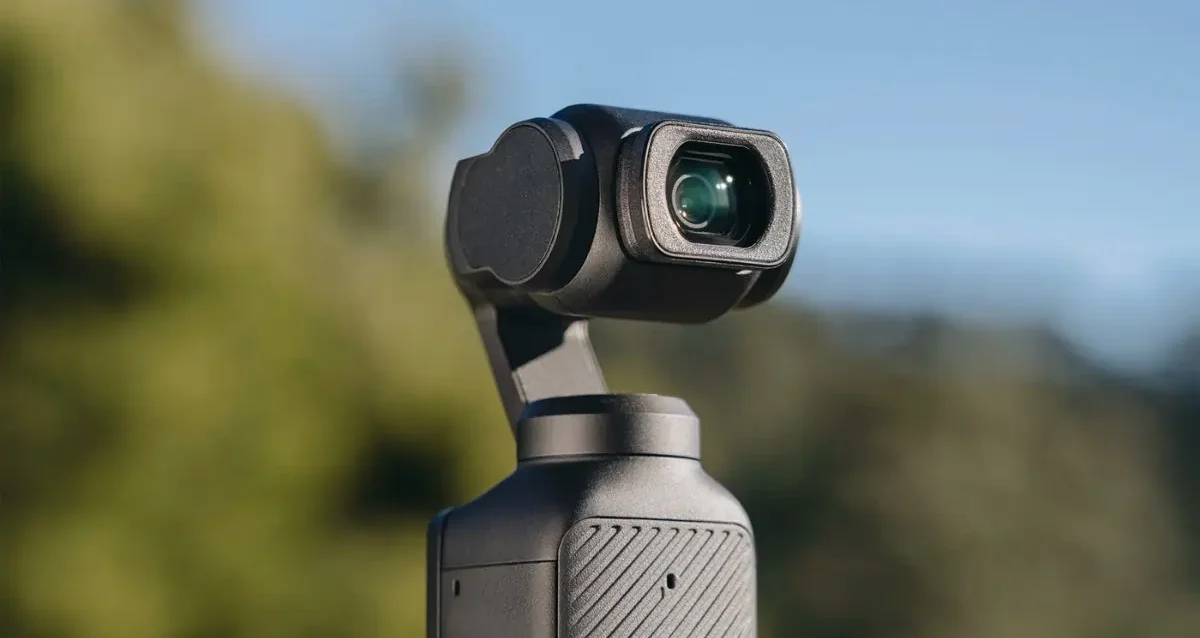
DJI Osmo Pocket 4 2026
Last Updated: April 2026
DJI officially announced the Osmo Pocket 4 today at 12:00 PM GMT. Global availability begins around April 20, timed to land during NAB Show week. The base model starts at $499. The Creator Combo, which includes a wireless microphone, magnetic fill light, wide-angle lens, and mini tripod, runs $649–$749.
Here is everything confirmed from the official announcement, retail packaging, FCC filings, and DJI’s own specs sheet — and an honest read on who this camera is for.
Table of Contents
The Confirmed Specs
| Spec | DJI Osmo Pocket 4 | DJI Osmo Pocket 3 |
|---|---|---|
| Sensor | 1-inch CMOS | 1-inch CMOS |
| Dynamic range | 14 stops | 13 stops |
| Max video resolution | 4K | 4K |
| Max slow-motion | 4K / 240fps | 4K / 120fps |
| Color profile | 10-bit D-Log M | 10-bit D-Log M |
| Internal storage | 107 GB @ 800 MB/s | No internal storage |
| MicroSD slot | None | Yes |
| Zoom | 2x lossless + 4x digital | 2x lossless |
| Audio | OsmoAudio 4-channel | 3-channel |
| Stabilization | ActiveTrack 7.0 | ActiveTrack 6.0 |
| Weight | ~116g | 179g |
| Battery | ~1,545 mAh | 1,300 mAh |
| Connectivity | Wi-Fi 6, USB 3.1 | Wi-Fi 5, USB 2.0 |
| Gimbal mount | Magnetic | Standard |
| Display | Rotating touchscreen (larger, brighter) | Rotating touchscreen |
| Physical controls | Zoom rocker + programmable “C” button | Single record button |
| US availability | Yes (FCC certified) | Yes |
| Price (base) | ~$499 | $499 |
What Actually Changed and Why It Matters
The weight drop is the headline nobody’s leading with. At 116 grams versus the Pocket 3’s 179 grams, that’s a 35% reduction in mass for a camera that already fit in a jacket pocket. Most Pocket 3 users carry it daily. Losing 63 grams on a device you already wear sounds trivial; over a day of shooting, it isn’t.
4K/240fps is the spec shooters actually care about. The Pocket 3 was already solid for slow-motion at 4K/120fps. Doubling that to 240 frames per second at full 4K — not cropped 1080p — is genuinely unusual for a camera this size. For travel vloggers, wedding videographers, and social content creators who build their edits around cinematic slow-mo, this is a meaningful upgrade. The competition — Insta360’s still-unshipped Luna, GoPro’s action cameras — doesn’t offer this combination of sensor size and frame rate in a pocketable gimbal.
107 GB of internal storage at 800 MB/s changes the workflow. No microSD slot is a controversial call. DJI’s bet: most creators will prefer fast internal storage they can offload via USB 3.1 over hunting for a compatible high-speed card. At 800 MB/s write speed, raw 4K/240fps footage can be offloaded to a laptop in minutes. For creators who’ve lost footage to failing cards or incompatible formats, the tradeoff may be worth it. For those who currently carry multiple cards for multi-day shoots, this is a constraint worth factoring.
The magnetic gimbal head is more than a design choice. The Creator Combo’s fill light clips directly to the gimbal head magnetically — no cold shoe adapter, no protruding arm. For night shoots, indoor interviews, or low-light vlogs, this means a single self-contained unit without a separate light rig. DJI is clearly positioning accessories as part of the product, not afterthoughts.
ActiveTrack 7.0 and OsmoAudio 4-channel are incremental but real improvements. The tracking refresh means fewer drops on fast-moving subjects. The 4-channel audio adds a second capture direction — useful for interview setups where you’re pointing the camera at a subject while ambient sound comes from another angle.
14 stops of dynamic range, up from 13. One stop matters in practice — it’s the difference between a sunset silhouetting your subject and a sunset with detail in both the sky and the face. Whether this is a measurable improvement in real-world footage or a spec-sheet delta will take hands-on testing to confirm.
The One Controversy: No MicroSD
DJI removing the microSD slot will generate more argument than any other single spec. The objections are real:
- Multi-day or remote shoots can’t expand capacity
- Firmware updates and file management require a cable or Wi-Fi
- If internal storage fails, you have no backup path
- Power users accustomed to a 256GB card feel constrained by 107GB
DJI’s counterargument is also real: at 800 MB/s write speed over USB 3.1, an hour of 4K footage offloads faster than it took to shoot it. The math on 107GB: at 4K/30fps in standard compression, that’s roughly 8–10 hours of footage. At 4K/120fps slow-motion, closer to 2–3 hours. For most day-trip or weekend shooting, that’s adequate. For a five-day backcountry expedition without a laptop, it isn’t.
This is a genuine tradeoff, not a mistake. Whether it works for your use case depends on your shooting cadence.
What About the Pocket 4 Pro?
A dual-camera Pocket 4 Pro is in development and leaked extensively in the days leading up to today’s announcement. Key confirmed-via-leaks details:
- Dual-lens setup with an estimated 3–4x optical zoom (telephoto camera paired with the standard lens)
- Larger battery than the standard Pocket 4
- Expected launch: June 2026
- Expected price: ~$700 (3,499 RMB for standard Pocket 4, 4,999 RMB for Pro — approximately $513 and $733 USD at current exchange)
- No FCC registration on record — meaning the Pro variant is unlikely to be officially available through US retail channels
The US availability issue with the Pro is significant. DJI was added to the FCC’s Covered List in December 2025, which affects its ability to sell new, unregistered devices through normal US retail. The standard Pocket 4 received FCC certification before that designation took effect, clearing it for US sale. The Pro variant has no FCC filing, making any US purchase dependent on grey market import, which voids warranty coverage and may create issues with service.
US buyers: if you want the dual-camera setup, wait for clarity on FCC status. If you’re in Europe, Asia, or Australia, the Pro may be worth watching in June.
DJI Osmo Pocket 4 vs. Insta360 Luna: The Real Competition
The competitive context DJI can’t ignore: Insta360 has officially announced the Luna, a dual-camera pocket gimbal camera described by early observers as a more aggressive feature spec than what DJI is shipping today. The Luna doesn’t yet have a confirmed price or ship date as of this writing.
DJI’s April 16 announcement timing — landing squarely at NAB, before the Luna ships — is not accidental. By getting the Pocket 4 into creators’ hands before Insta360 ships the Luna, DJI controls the review cycle, the YouTube comparison videos, and the purchase intent traffic through peak spring and summer content creation season.
The strategic play: Pocket 4 ships now at $499. Luna is compelling but unshipped. Most creators buying a pocket gimbal camera in April and May will buy the device they can actually put in their pocket today.
Whether the Luna, when it ships, genuinely outperforms the Pocket 4 on image quality, slow-motion, or workflow integration remains to be seen. If DJI’s track record holds, the Pocket 4 will be a well-tuned, reliable product at launch. Insta360 has closed the quality gap significantly over the past two product cycles — the competition in this category is now genuinely close for the first time since the original Pocket launched in 2018.
Should You Upgrade from the Osmo Pocket 3?
Upgrade if:
- Slow-motion is a significant part of your output and 4K/120fps is a bottleneck
- You’re carrying the Pocket 3 daily and 63 grams less weight is meaningful over a full day
- You’ve lost footage to card failures or formatting issues and want the workflow simplicity of internal storage
- The magnetic accessory ecosystem (especially the fill light) fits your regular shoot scenarios
Don’t upgrade if:
- You shoot primarily 4K/30fps or 4K/60fps and the Pocket 3 handles it cleanly
- Multi-day remote shoots without laptop access are a regular use case for you
- You’re waiting to evaluate the Pocket 4 Pro or the Insta360 Luna before committing
The Pocket 3 is still a capable camera. A direct upgrade to the Pocket 4 makes strongest sense for creators to whom slow-motion is a primary tool, not an occasional effect.
Should You Buy the Standard or the Creator Combo?
Standard Combo (~$499): Camera, gimbal clamp, wrist strap, threaded handle, mini tripod, USB-C cable, carrying case. Right for shooters who already have microphone solutions and don’t need the fill light.
Creator Combo (~$649–$749): Everything above plus: DJI Mic 3 wireless transmitter, magnetic clip and windscreens, magnetic fill light, wide-angle lens, additional carry bag. Right for anyone doing vlog, interview, or run-and-gun work where on-camera audio and fill lighting are part of the standard kit.
The math on the Creator Combo: the DJI Mic 3 transmitter retails separately for approximately $199. The wide-angle lens and fill light add meaningful individual value. If you need both the mic and the light, the Combo is the better value. If you only need one, the Standard plus a separate purchase of whatever you need is likely comparable in cost but more intentional about what you’re actually paying for.
The Verdict
The DJI Osmo Pocket 4 is a disciplined evolution of a product that already dominated its category. Nothing here is transformative — but everything here is better, and the 35% weight reduction plus 4K/240fps slow-motion together make a genuine case for the upgrade path, especially for working creators.
The no-microSD decision will frustrate some users with real, legitimate workflows. For most day-to-day creators, 107GB at 800 MB/s changes the friction profile of shooting in a genuinely useful direction.
At $499 against a still-unshipped Insta360 Luna, DJI is in a strong position through at least mid-summer. For US buyers specifically, the standard Pocket 4’s FCC clearance matters — this is a camera you can buy, import legally, and service through normal channels, which is not guaranteed for the Pro model or potentially for future DJI products.
Who should buy it today: Travel vloggers, content creators who shoot slow-motion regularly, anyone making their first purchase in the Pocket category, and professionals who want 4K/240fps in something that fits in a coat pocket.
Who should wait: Pocket 3 owners satisfied with 4K/60fps, multi-day expedition shooters who need card-based backup, and anyone whose use case might be better served by the Pocket 4 Pro or the Insta360 Luna — assuming both ship with the specs currently expected.

Alex Rivera covers consumer technology at Axis Intelligence. He’s been reviewing gadgets since 2017, testing over 400 products from smartphones to wearables. Alex doesn’t care about specs that don’t translate to real-world experience — he cares about whether a product actually makes your life easier. He covers smartphones, laptops, tablets, wearables, earbuds, and mobile apps.
Voice: Practical, user-first. Writes for normal people buying real products. Doesn’t use jargon unless he explains it immediately.