

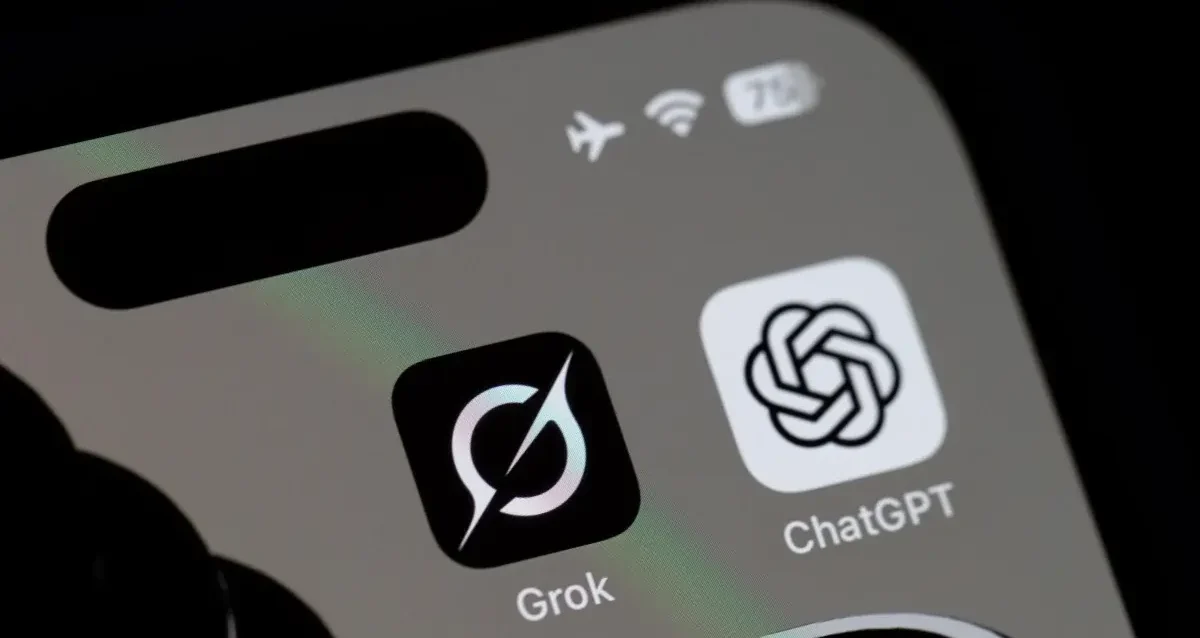
Grok vs ChatGPT 2026
Grok and ChatGPT represent fundamentally different philosophies in conversational AI: Grok delivers real-time X (Twitter) integration, unfiltered responses, and an edgy personality powered by xAI’s Grok 4.1 model, while ChatGPT offers polished reliability, a mature ecosystem with 500+ integrations, and enterprise-grade features through OpenAI’s GPT-5.2. Both models achieve frontier performance, with Grok 4.1 Thinking reaching 1,483 Elo on the LMSYS Arena leaderboard and GPT-5.2 scoring 94.2% on MMLU-Pro reasoning benchmarks. ChatGPT Plus costs $20/month versus SuperGrok’s $30/month, though ChatGPT includes more features like Canvas, Custom GPTs, and Projects.
Table of Contents
What Is ChatGPT and How Does It Work?
ChatGPT is OpenAI’s flagship conversational AI, launched in November 2022 and now powered by GPT-5.2, the company’s most advanced model released in December 2025. The system processes natural language using transformer-based neural networks trained on massive datasets of text, code, and multimodal content to generate human-like responses.
OpenAI’s approach centers on Reinforcement Learning from Human Feedback (RLHF), where human reviewers rank model outputs to improve accuracy, reduce harmful content, and align responses with user expectations. According to OpenAI’s GPT-5.2 announcement, the model achieves state-of-the-art performance across 44 professional occupations on the GDPval benchmark, matching or exceeding human experts in well-specified knowledge work tasks.
ChatGPT reached 100 million users within two months of launch, making it the fastest-growing consumer application in history. The platform now serves millions daily across web, mobile, and desktop interfaces, handling tasks from content creation to complex coding and data analysis. OpenAI reports that the average ChatGPT Enterprise user saves 40-60 minutes daily, with heavy users saving more than 10 hours weekly.
ChatGPT Model Architecture
GPT-5.2 operates as a unified system with three distinct modes optimized for different use cases:
| Mode | Purpose | Key Capability |
|---|---|---|
| GPT-5.2 Instant | Everyday tasks | Fast responses, conversational tone |
| GPT-5.2 Thinking | Complex analysis | Chain-of-thought reasoning |
| GPT-5.2 Pro | Maximum accuracy | Extended compute, lowest error rate |
The Thinking mode represents a significant advancement in reasoning capability. When faced with complex problems, GPT-5.2 can adaptively allocate more computational resources, displaying a visible “chain of thought” as it works through multi-step logic. This approach achieves a 70.9% score on GDPval benchmarks, effectively matching human professional performance across diverse knowledge domains.
What Is Grok and How Does It Differ from ChatGPT?
Grok is xAI’s conversational AI assistant, created by Elon Musk’s artificial intelligence company following his departure from OpenAI in 2018. The chatbot runs on Grok 4.1, a mixture-of-experts large language model trained with unprecedented scale reinforcement learning on the 200,000 GPU Colossus cluster, the world’s largest AI training infrastructure.
What fundamentally separates Grok from ChatGPT is its integration with X (formerly Twitter). Grok accesses live posts, trending topics, and breaking news directly from the X platform, giving it real-time awareness that most AI chatbots lack. When a news event happens, Grok knows about it within seconds because it can pull first-hand accounts and commentary directly from X’s data stream.
Grok’s personality deliberately contrasts with ChatGPT’s measured approach. According to xAI’s official documentation, Grok 4.1 is “exceptionally capable in creative, emotional, and collaborative interactions,” designed to be “more perceptive to nuanced intent, compelling to speak with, and coherent in personality.” The model offers both “Fun Mode” for witty, sometimes sarcastic responses and “Regular Mode” for straightforward answers.
Grok Technical Foundation
Grok 4 was trained using reinforcement learning at pretraining scale, a technical approach that xAI claims allows the model to use tools like code interpreters and web browsing more effectively than previous generations. The model architecture includes:
| Component | Specification | Impact |
|---|---|---|
| Context Window | 128K tokens (standard), 2M tokens (API) | Handles extremely long documents |
| Training Infrastructure | 200,000 H100 GPUs | Fastest iteration cycles |
| Tool Integration | Native search, code execution | Real-time data augmentation |
| Real-Time Access | X platform + web search | Breaking news awareness |
Grok 4.1 Thinking achieved the #1 position on the LMSYS Text Arena with 1,483 Elo, surpassing all non-xAI models by 31 points. The non-reasoning mode (tensor) ranks #2 at 1,465 Elo, exceeding every other model’s full-reasoning configuration on the public leaderboard.
Grok vs ChatGPT: Head-to-Head Feature Comparison
Understanding the practical differences between Grok and ChatGPT requires examining their core capabilities across multiple dimensions. Both platforms have matured significantly through 2025-2026, but they’ve evolved in distinctly different directions based on their creators’ philosophies.
Feature Comparison Table
| Feature | ChatGPT (GPT-5.2) | Grok (4.1) | Winner |
|---|---|---|---|
| Real-Time Data | Web browsing (limited) | Native X integration + DeepSearch | Grok |
| Reasoning Modes | Instant, Thinking, Pro | Standard, Think, Big Brain | Tie |
| Context Window | 256K (chat), 400K (API) | 128K (SuperGrok), 2M (API) | Grok (API) |
| Image Generation | DALL-E 3 / GPT-Image-1.5 | Aurora (FLUX-based) | ChatGPT |
| Video Generation | Sora 2 (limited access) | Grok Imagine (10-sec clips) | ChatGPT |
| Voice Mode | Web, mobile, desktop | Mobile app only | ChatGPT |
| Custom Assistants | Custom GPTs + GPT Store | Limited customization | ChatGPT |
| Enterprise Features | Team/Enterprise plans | SuperGrok Heavy | ChatGPT |
| Code Execution | Built-in interpreter | Code interpreter + tools | Tie |
| Integrations | 500+ apps via Zapier | X-centric ecosystem | ChatGPT |
| API Availability | Full developer platform | Growing API ecosystem | ChatGPT |
Real-Time Information Access
The most significant differentiator between Grok and ChatGPT is their approach to current information. Grok’s native X integration provides immediate access to social media discourse, trending topics, and breaking news as events unfold. According to independent testing by Android Police, Grok outperforms ChatGPT in response time for real-time queries, particularly those involving current events or social sentiment.
ChatGPT relies on web browsing capabilities that, while functional, don’t offer the same social media immediacy. The DataCamp comparison notes that “if you need to understand what’s happening on social media right now, Grok has an unmatched advantage.”
However, this X-centric approach has limitations. Grok’s real-time advantage is strongest within the X ecosystem; for general web research, ChatGPT’s broader browsing capabilities and established search partnerships often deliver more comprehensive results.
Reasoning and Analysis Capabilities
Both platforms now offer sophisticated reasoning modes, though their implementations differ. ChatGPT’s GPT-5.2 Thinking mode uses adaptive computation, automatically deciding when problems benefit from deeper analysis. Users see a streamlined view of the model’s chain-of-thought reasoning, with the option to interrupt for faster answers.
Grok offers multiple reasoning tiers: standard responses, Think mode for deeper analysis, and Big Brain mode (exclusive to SuperGrok Heavy at $300/month) for PhD-level reasoning tasks. According to xAI’s benchmarks, Grok 4 Heavy was the first model to score 50% on Humanity’s Last Exam, “a benchmark designed to be the final closed-ended academic benchmark of its kind.”
In practical testing reported by ClickRank, “in strict reasoning tasks, ChatGPT usually feels more stable” with better handling of math, logic puzzles, and structured planning. Grok can be “impressive in open-ended reasoning, especially when search is involved,” but “sometimes becomes verbose or tangential.”
Content Generation and Writing
Writing quality represents a core use case for both platforms. ChatGPT has historically excelled at polished, structured writing with consistent voice and format adherence. According to OpenAI, GPT-5 represents their “most capable writing collaborator yet,” able to handle structural ambiguity like “sustaining unrhymed iambic pentameter or free verse that flows naturally.”
Grok’s writing tends toward a more casual, sometimes irreverent style that reflects its “truth-seeking” philosophy. Some users prefer this directness; others find it less suitable for professional contexts. The Zapier comparison notes that “Grok will occasionally use slang or answer more casually, but unless you prompt it to be different,” the distinction from other chatbots is subtle.
For enterprise and professional writing, ChatGPT’s maturity advantage remains significant. Canvas, introduced in 2024, provides a Google Docs-style interface for collaborative writing and coding where users can work alongside the AI, making real-time edits while receiving suggestions—a feature Grok currently lacks.
Benchmark Performance: How Do Grok and ChatGPT Compare?
AI benchmarks provide standardized measurements of model capabilities across reasoning, coding, mathematics, and general knowledge. While no single benchmark captures real-world utility, aggregated performance data reveals meaningful differences between Grok and ChatGPT.
LMSYS Chatbot Arena Rankings
The LMSYS Chatbot Arena uses crowdsourced blind comparisons where users vote on preferred responses without knowing which model generated them. As of February 2026, the Text Arena leaderboard shows:
| Rank | Model | Elo Rating | Votes |
|---|---|---|---|
| 1 | Claude Opus 4.6 Thinking | 1,506 | 3,922 |
| 2 | Claude Opus 4.6 | 1,502 | 4,653 |
| 3 | Gemini 3 Pro | 1,486 | 35,697 |
| 4 | Grok 4.1 Thinking | 1,475 | 35,401 |
| 5 | Gemini 3 Flash | 1,473 | 26,326 |
ChatGPT’s GPT-5.2 models rank lower on the current LMSYS leaderboard, though it’s worth noting that Elo ratings reflect user preference in blind comparisons—not necessarily objective capability measures. Grok 4.1 Thinking’s strong showing (1,475 Elo) validates xAI’s claims about competitive performance, but the 31-point gap behind top models like Claude Opus suggests room for improvement.
Academic and Professional Benchmarks
Standardized evaluations reveal more granular capability differences:
| Benchmark | ChatGPT (GPT-5.2) | Grok 4 | What It Measures |
|---|---|---|---|
| MMLU-Pro | 94.2% | 91.3% | Advanced reasoning |
| MATH-500 | 94.6% | 84% | Mathematical problem-solving |
| SWE-Bench | 39% | 43.6% | Real-world coding tasks |
| GPQA | 88.4% | 85.2% | Graduate-level science |
| HLE (text-only) | N/A | 50.7% | Extreme difficulty questions |
| GDPval | 70.9% | N/A | Professional knowledge work |
According to data compiled by NerdBot, “ChatGPT leads in 70% of 2026 evals,” particularly in mathematical reasoning (94.6% MATH vs. Grok’s 84%). However, Grok shows strength in specific STEM subsets and achieved a milestone 50.7% on Humanity’s Last Exam—the first model to break the 50% barrier on this extreme difficulty benchmark.
Speed and Inference Performance
Response latency matters for interactive use cases. According to industry testing, Grok’s inference speed reaches 1,200 tokens per second on optimized hardware, approximately 20% faster than GPT-5.2’s 900 tokens per second. However, this speed advantage comes with trade-offs: ChatGPT’s error rate is reportedly 12% lower in long-chain reasoning tasks.
The practical impact depends on use case. For quick queries and real-time information, Grok’s speed provides tangible benefits. For complex analysis where accuracy matters more than immediacy, ChatGPT’s reliability may justify slightly longer response times.
Pricing: What Do ChatGPT and Grok Cost in 2026?
Pricing structure significantly impacts which platform delivers better value for different user profiles. Both OpenAI and xAI have developed tiered subscription models targeting everyone from casual users to enterprise deployments.
ChatGPT Pricing Tiers
| Plan | Monthly Cost | Key Features |
|---|---|---|
| Free | $0 | GPT-5.2 Instant (10 messages/5 hours), limited features |
| Go | $8 | Ad-supported, faster GPT-4o, no GPT-5.2 |
| Plus | $20 | GPT-5.2 (Instant + Thinking), DALL-E 3, Canvas, Custom GPTs |
| Pro | $200 | Unlimited GPT-5.2, Sora 2 Pro, o3-pro reasoning |
| Business | $25/user | Team workspace, admin controls, SSO |
| Enterprise | Custom | Full enterprise features, dedicated support |
According to OpenAI’s official pricing page, ChatGPT Plus at $20/month represents the value tier for regular users, offering “everything in Free” plus advanced reasoning, expanded messaging, custom GPT creation, and early access to new features like Sora video generation and Codex agent.
ChatGPT Pro at $200/month targets power users requiring unlimited access and maximum model capabilities. As IntuitionLabs analysis notes, “many power users—writers, programmers, analysts—subscribe to avoid downtime and to harness ChatGPT for daily productivity.”
Grok Pricing Tiers
| Plan | Monthly Cost | Key Features |
|---|---|---|
| Free (via X) | $0 | ~10 queries/2 hours, 3 images/day, basic Grok 3 |
| X Premium+ | $40 | Grok access + X platform perks (ad-free, monetization) |
| SuperGrok | $30 | Full Grok 4.1, 128K context, 50 queries/2 hours, DeepSearch |
| SuperGrok Heavy | $300 | Grok 4 Heavy, 428K context, multi-agent, Big Brain mode |
SuperGrok at $30/month provides dedicated Grok access without requiring X Premium+ benefits. According to the SuperGrok documentation, this tier includes “unlimited use, faster response, and extra tools like Big Brain mode, DeepSearch, and voice features.”
Value Comparison
For individual users, ChatGPT Plus ($20) delivers more features than SuperGrok ($30) at a lower price point:
| Feature | ChatGPT Plus ($20) | SuperGrok ($30) |
|---|---|---|
| Advanced Models | GPT-5.2 Instant + Thinking | Grok 4.1 |
| Custom Assistants | ✓ Custom GPTs | ✗ |
| Canvas Collaboration | ✓ | ✗ |
| Projects/Organization | ✓ | ✗ |
| Team Plans | Available ($25/user) | ✗ |
| Voice Mode | Web + Mobile | Mobile only |
| Image Generation | DALL-E 3 | Aurora |
As the Zapier comparison concludes, “when it comes to paid plans, ChatGPT offers a lot more value across the board.” ChatGPT Plus costs 33% less while including Canvas, Custom GPTs, and Projects that Grok doesn’t match.
However, if real-time X integration drives your use case, Grok’s $30 SuperGrok tier may justify the premium. For heavy research workloads requiring Big Brain mode’s multi-agent reasoning, the $300 SuperGrok Heavy tier competes with ChatGPT Pro’s $200—though targeting different strengths.
API Pricing Comparison
For developers, API costs differ significantly:
| Model | Input (per 1M tokens) | Output (per 1M tokens) |
|---|---|---|
| GPT-5.2 | $5.00 | $15.00 |
| GPT-4o | $5.00 | $15.00 |
| Grok 4 | $3.00 | $15.00 |
| Grok 4.1 Fast | $0.20 | $0.50 |
According to IntuitionLabs API pricing analysis, Grok offers competitive pricing, particularly with Grok 4.1 Fast at $0.20/$0.50 per million tokens—representing “a 98% reduction in price to achieve the same performance on frontier benchmarks as Grok 4.” For cost-sensitive applications, Grok’s API pricing provides a significant advantage.
Coding and Development: Which AI Is Better for Programmers?
Software development represents one of the most demanding use cases for AI assistants, requiring accurate code generation, effective debugging, and the ability to handle complex multi-file projects. Both ChatGPT and Grok have invested heavily in coding capabilities through 2025-2026.
ChatGPT Coding Capabilities
GPT-5 was positioned as OpenAI’s “strongest coding model to date,” with OpenAI highlighting “particular improvements in complex front-end generation and debugging larger repositories.” The model can “often create beautiful and responsive websites, apps, and games with an eye for aesthetic sensibility in just one prompt.”
Key coding features in ChatGPT include:
- Canvas for Code: Collaborative interface for iterative development
- GPT-5.2-Codex: Specialized variant achieving state-of-the-art on SWE-Bench Pro
- Code Interpreter: Built-in execution environment
- Deep Research: Multi-source code reference gathering
- Memory: Context retention across coding sessions
According to OpenAI’s GPT-5.2-Codex documentation, the model excels at “working in large repositories over extended sessions with full context intact” and can “more reliably complete complex tasks like large refactors, code migrations, and feature builds.”
Grok Coding Capabilities
Grok 4 was “trained with reinforcement learning to use tools,” according to xAI, enabling code interpreter integration and web browsing during development tasks. The model can search documentation, analyze codebases, and execute code while generating responses.
Grok’s coding features include:
- Native Tool Use: Code execution integrated into responses
- Real-Time Documentation: Live web search for library references
- X Code Search: Finding code examples shared on the platform
- Big Brain Mode: Multi-agent approach for complex architecture
Independent benchmarks show Grok 4 achieving 43.6% on SWE-Bench Verified versus ChatGPT’s 39%, suggesting competitive real-world coding performance. However, as ClickRank testing notes, Grok’s code “sometimes misses edge cases, lacks comments, or skips requirements,” making it useful as “a creative co-pilot” that “may need more oversight” compared to ChatGPT’s production-ready output.
Practical Coding Comparison
| Capability | ChatGPT | Grok | Verdict |
|---|---|---|---|
| Code Generation | Clean, well-documented | Fast, may skip details | ChatGPT |
| Debugging | Methodical, comprehensive | Quick, sometimes incomplete | ChatGPT |
| Full-Stack Development | Strong front-end design | Capable but less polished | ChatGPT |
| API Integration | Mature ecosystem | Growing tools | ChatGPT |
| Real-Time Docs | Web browse | Native web + X search | Grok |
| Enterprise Support | Codex, Team plans | Limited | ChatGPT |
For professional software development, ChatGPT maintains an edge in reliability and enterprise features. However, Grok’s real-time documentation access and competitive SWE-Bench performance make it viable for many development workflows, particularly in fast-moving domains where current information matters.
Research and Analysis: DeepSearch vs Deep Research
Both platforms have introduced advanced research features that combine reasoning capabilities with real-time information gathering. These features target users who need comprehensive analysis beyond simple question-answering.
Grok’s DeepSearch
DeepSearch, introduced with Grok 3, is described by xAI as “a powerful agent that can rapidly synthesize key information, reason about conflicting facts & opinions, and distill clarity from complexity.” The feature combines:
- Real-time web search across multiple sources
- X platform mining for first-hand accounts and sentiment
- Multi-step reasoning to resolve contradictions
- Source verification and conflict identification
According to SuperGrok documentation, DeepSearch “combines AI expertise with real-time web scanning to deliver complete research outputs,” positioning it as “ideal for students, journalists, and professionals who need in-depth, verifiable information.”
Grok’s research advantage centers on timeliness. Because it accesses live X data, DeepSearch can construct timelines of breaking news before traditional media, aggregate real-time sentiment, and surface first-person accounts that wouldn’t appear in conventional web search.
ChatGPT’s Deep Research
ChatGPT’s Deep Research takes a different approach, focusing on thoroughness over speed. According to DigitalOcean’s comparison, it “takes its time (several minutes) to crawl the web, investigate sources, and gather more in-depth information to provide detailed research responses.”
Key Deep Research capabilities include:
- Comprehensive web crawling across authoritative sources
- Multi-step verification of claims
- Structured report generation
- Citation linking for verification
- Industry analysis and trend identification
Deep Research targets use cases like “initial topic analysis, report generation, and precise knowledge collection.” The deliberate pace allows for more thorough source evaluation and cross-referencing than Grok’s faster but potentially less comprehensive approach.
Research Feature Comparison
| Aspect | Grok DeepSearch | ChatGPT Deep Research |
|---|---|---|
| Speed | Fast (seconds to minutes) | Slower (several minutes) |
| Real-Time Data | Native X integration | Web browsing |
| Social Sentiment | Excellent | Limited |
| Source Authority | Variable (includes X) | Higher (emphasizes quality) |
| Report Structure | Good | Excellent |
| Breaking News | Superior | Adequate |
| Academic Research | Adequate | Better |
For time-sensitive research involving current events or social dynamics, Grok’s DeepSearch offers genuine advantages. For academic, professional, or in-depth analysis where thoroughness matters more than immediacy, ChatGPT’s Deep Research delivers more comprehensive results.
Safety, Content Moderation, and Personality
The philosophical differences between xAI and OpenAI manifest clearly in how Grok and ChatGPT handle sensitive content, controversial topics, and user requests that other AI systems might decline.
ChatGPT’s Safety-First Approach
OpenAI has invested heavily in alignment research, using RLHF and other techniques to produce responses that are helpful while avoiding harmful outputs. ChatGPT employs multiple guardrails:
- Content policies prohibiting certain categories
- Refusal patterns for potentially dangerous requests
- Nuanced handling of sensitive topics
- Enterprise-grade compliance features
This approach makes ChatGPT suitable for professional environments where consistency and predictability matter. As DataCamp’s analysis notes, ChatGPT’s “safety-conscious approach with more guardrails around sensitive content” appeals to organizations prioritizing risk management.
However, some users find ChatGPT overly cautious. Certain legitimate requests trigger refusals, and the model sometimes provides hedged responses when directness would be more helpful.
Grok’s “Truth-Seeking” Philosophy
xAI positions Grok as “maximally truth-seeking,” designed to “engage with taboo or controversial prompts” that other AI systems might avoid. According to Musk, Grok should provide answers “even if that truth is sometimes at odds with what is politically correct.”
In practice, this means:
- Fewer automatic refusals on sensitive topics
- More willingness to engage controversial questions
- Direct, sometimes blunt responses
- Occasional humor and irreverence
The Zapier comparison notes that while Grok’s “safety guardrails are lower,” the actual difference is subtle—”it isn’t some hyper-intelligent or unhinged AI.” Users can “more easily get it to make copyright and trademark infringing images,” but Grok still maintains basic safety protocols.
Practical Implications
| Consideration | ChatGPT | Grok |
|---|---|---|
| Enterprise Compliance | Excellent | Developing |
| Brand Safety | High | Variable |
| Controversial Topics | Cautious | More Direct |
| Creative Freedom | Moderate | Higher |
| Professional Tone | Consistent | Varies by mode |
For organizations with compliance requirements or brand sensitivity, ChatGPT’s predictable moderation provides operational confidence. For individuals who want fewer restrictions and more direct engagement, Grok’s approach may feel more authentic—though it comes with increased risk of outputs that could be inappropriate in professional contexts.
Use Cases: When to Choose Grok vs ChatGPT
Selecting between Grok and ChatGPT depends on your specific workflow requirements, professional context, and priorities around features like real-time data, ecosystem integration, and enterprise support.
Best Use Cases for ChatGPT
Professional Writing and Content Creation: ChatGPT’s mature writing capabilities, Canvas collaboration, and consistent output quality make it the stronger choice for:
- Marketing copy and brand content
- Technical documentation
- Academic writing and research papers
- Email drafting and professional communication
- Long-form content requiring structural consistency
Software Development: ChatGPT’s coding ecosystem, including GPT-5.2-Codex, enterprise integrations, and reliability advantages, serves developers who need:
- Production-ready code with comprehensive documentation
- Large codebase navigation and refactoring
- Team collaboration through Business/Enterprise plans
- Integration with existing development tools via API
Enterprise Deployments: According to OpenAI’s Enterprise documentation, organizations like Sourcegraph use ChatGPT for “financial modeling, comms, and even board prep,” with the platform “accelerating everything we do.” ChatGPT Business and Enterprise tiers provide:
- Team workspaces with admin controls
- SOC 2 compliance and enterprise security
- SAML SSO and multi-factor authentication
- Data exclusion from training by default
Learning and Education: ChatGPT’s structured explanations and adaptive communication style suit educational contexts:
- Tutoring and concept explanation
- Language learning
- Skill development courses
- Research assistance
Best Use Cases for Grok
Real-Time Information and News: Grok’s X integration makes it the clear choice for:
- Breaking news analysis
- Social media sentiment tracking
- Trend identification and monitoring
- Current events commentary
- Real-time data gathering
Social Media and Marketing on X: For creators and marketers operating within the X ecosystem:
- Content ideation based on current trends
- Engagement analysis
- Competitor monitoring
- Viral content strategy
Research Requiring Current Data: When timeliness matters more than depth:
- Stock and market sentiment
- Political developments
- Technology announcements
- Sports and entertainment news
Casual and Direct Interaction: Users who prefer less filtered responses:
- Brainstorming without guardrails
- Direct opinions on controversial topics
- Irreverent or humorous interactions
- Creative exploration without restrictions
Decision Framework
| Your Priority | Choose | Reason |
|---|---|---|
| Current events/social data | Grok | Native X integration |
| Enterprise deployment | ChatGPT | Team plans, security, compliance |
| Production coding | ChatGPT | Codex, reliability, integrations |
| Cost efficiency | ChatGPT | $20 vs $30, more features |
| Creative freedom | Grok | Fewer content restrictions |
| Structured writing | ChatGPT | Canvas, consistent quality |
| API development | Either | Both competitive, Grok cheaper |
| Research depth | ChatGPT | More thorough Deep Research |
| Speed | Grok | 20% faster inference |
Ecosystem and Integration Capabilities
The surrounding ecosystem significantly impacts how effectively you can incorporate AI assistance into existing workflows.
ChatGPT Ecosystem
ChatGPT benefits from years of development producing a mature integration landscape:
Custom GPTs and GPT Store: Users can create specialized assistants with custom instructions, knowledge bases, and tool access. The GPT Store provides thousands of pre-built assistants for specific use cases, from writing helpers to specialized calculators.
Third-Party Integrations: ChatGPT connects to 500+ applications through Zapier, enabling automated workflows that trigger ChatGPT responses based on external events. According to Zapier documentation, users can “automatically reply to Google Business Profile reviews with ChatGPT” or integrate with Salesforce, Microsoft tools, and custom applications.
Enterprise Connectors: ChatGPT Business and Enterprise include direct integration with:
- Google Drive
- SharePoint
- GitHub
- Notion
- Slack (via API)
Developer Tools: OpenAI provides comprehensive API access with documentation, SDKs, and tools like Codex for IDE integration. The API supports fine-tuning, embeddings, and advanced features for custom implementations.
Grok Ecosystem
Grok’s ecosystem is younger but growing rapidly:
X Platform Integration: Native embedding in X provides seamless access for the platform’s hundreds of millions of users. Grok can analyze posts, profiles, and media directly within X conversations.
Developer API: The xAI API offers competitive pricing and growing capabilities, including the 2-million-token context window that exceeds ChatGPT’s offerings. According to xAI’s API documentation, developers can access both Grok 4 and Grok 4.1 Fast models with real-time tool integration.
SuperGrok Features: Premium tiers include advanced tools like:
- Aurora image generation
- Voice mode for natural conversations
- DeepSearch for comprehensive research
- Big Brain mode for complex reasoning
Limitations: Grok lacks ChatGPT’s breadth of third-party integrations. There’s no equivalent to the GPT Store, Custom GPTs are not available, and enterprise features like team management and SSO remain limited.
Ecosystem Comparison
| Capability | ChatGPT | Grok |
|---|---|---|
| Third-Party Apps | 500+ via Zapier | Limited |
| Custom Assistants | Custom GPTs + Store | None |
| Enterprise Tools | Admin console, SSO, compliance | Basic |
| Developer API | Mature, comprehensive | Growing |
| Context Window (API) | 400K tokens | 2M tokens |
| Platform Integration | Multi-platform | X-centric |
For users embedded in the X ecosystem or prioritizing API-first development with large context needs, Grok offers unique advantages. For those requiring broad integrations, team features, and custom assistant creation, ChatGPT’s ecosystem maturity remains unmatched.
Mobile and Desktop Experience
Access patterns vary significantly between users, making platform availability an important consideration.
ChatGPT Apps
ChatGPT provides native applications across all major platforms:
- Web: Full-featured interface at chatgpt.com
- iOS: Native app with voice mode support
- Android: Native app with full functionality
- Windows: Desktop application
- macOS: Desktop application
Voice mode works across web and mobile, enabling conversational interaction with the ability to interrupt mid-response. The desktop applications provide system-level integration for quick access during work.
Grok Apps
Grok’s availability is more constrained:
- Web: grok.com (availability varies by region)
- X Integration: Embedded in X desktop and mobile apps
- iOS: Native Grok app
- Android: Native Grok app
According to Zapier’s comparison, Grok’s voice mode “only works through its mobile app,” limiting conversational access compared to ChatGPT’s cross-platform voice support.
Future Development: What’s Coming for Each Platform?
Both companies have announced ambitious roadmaps that will shape how these platforms evolve through 2026 and beyond.
OpenAI’s Direction
OpenAI continues rapid iteration on the GPT-5 series:
- GPT-5.3: Expected Q1 2026, focusing on agentic tools and autonomous task completion
- Enhanced Multimodal: Improved vision, audio, and video understanding
- Operator Preview: Agent capabilities for complex multi-step workflows
- Codex Advancement: GPT-5.2-Codex optimizations for software engineering
According to OpenAI’s release notes, the company periodically adjusts thinking time for reasoning models based on “ongoing experiments to find the best balance between answer quality and response speed.”
xAI’s Direction
xAI has signaled aggressive development plans:
- Grok 5: Reportedly beginning training in late 2025, with CEO claiming “it has a shot at being true AGI”
- Colossus Expansion: Continued scaling of the 200,000 GPU training cluster
- Enhanced Multimodal: Improved video generation and image capabilities
- Enterprise Tools: Development of business-tier features
According to LifeArchitect’s Grok timeline, xAI has maintained rapid release cadence, with major updates every 2-3 months through 2025.
Grok vs ChatGPT FAQ
What is the main difference between Grok and ChatGPT?
The fundamental difference is their approach to information access and personality. Grok integrates natively with X (Twitter) for real-time social data and takes an unfiltered, sometimes irreverent approach to responses. ChatGPT relies on web browsing for current information and prioritizes polished, consistent, safety-conscious outputs. According to DataCamp, “Grok embraces what xAI calls an ‘anti-woke’ stance, meaning it’s more willing to engage with controversial topics,” while “ChatGPT takes a balanced, safety-conscious approach with more guardrails.”
Is Grok better than ChatGPT for coding?
Both platforms are capable code assistants, but they excel in different ways. ChatGPT’s GPT-5.2-Codex achieves state-of-the-art performance on SWE-Bench Pro, producing cleaner, better-documented code suitable for production use. Grok 4 scores higher on SWE-Bench Verified (43.6% vs 39%) but sometimes “misses edge cases, lacks comments, or skips requirements,” according to ClickRank testing. For professional development with team features, ChatGPT’s Codex integration and enterprise plans provide clear advantages.
Which is cheaper: Grok or ChatGPT?
ChatGPT offers better value at comparable tiers. ChatGPT Plus costs $20/month versus SuperGrok at $30/month, and ChatGPT Plus includes additional features like Canvas, Custom GPTs, and Projects that Grok lacks. However, Grok’s API pricing is more competitive, with Grok 4.1 Fast at $0.20/$0.50 per million tokens versus GPT-5.2 at $5.00/$15.00. For developers building cost-sensitive applications, Grok’s API pricing represents significant savings.
Can Grok access real-time information better than ChatGPT?
Yes, for social media and breaking news. Grok’s native X integration provides immediate access to posts, trends, and sentiment as events unfold. According to DataCamp, “if you need to understand what’s happening on social media right now, Grok has an unmatched advantage.” However, ChatGPT’s web browsing capabilities provide broader real-time access beyond X’s ecosystem, making it more versatile for general current events research.
Is Grok safer to use than ChatGPT?
ChatGPT has stronger safety guardrails and is better suited for professional environments requiring content predictability. OpenAI’s RLHF alignment process produces consistent, brand-safe outputs suitable for enterprise deployment. Grok intentionally provides fewer restrictions, which offers more creative freedom but may produce outputs inappropriate for some professional contexts. Organizations with compliance requirements typically prefer ChatGPT’s documented safety measures and SOC 2 compliance.
Which AI is better for research?
It depends on research type. For academic, in-depth research requiring comprehensive source verification, ChatGPT’s Deep Research delivers more thorough analysis over several minutes of web crawling. For time-sensitive research involving current events, social sentiment, or breaking news, Grok’s DeepSearch leverages X integration for faster results with real-time data. According to DigitalOcean, ChatGPT is better for “initial topic analysis, report generation, and precise knowledge collection.”
What are the benchmark differences between Grok and ChatGPT?
Grok 4.1 Thinking achieves 1,483 Elo on the LMSYS Text Arena, ranking #4 overall. ChatGPT’s GPT-5.2 scores higher on academic benchmarks: 94.2% on MMLU-Pro (vs ~91% for Grok) and 94.6% on MATH-500 (vs 84% for Grok). Grok 4 Heavy was the first model to exceed 50% on Humanity’s Last Exam. According to NerdBot, “ChatGPT leads in 70% of 2026 evals,” though Grok wins in speed and specific STEM subsets.
Can I use Grok without an X account?
Yes, through grok.com and the standalone Grok apps for iOS and Android. You no longer need X Premium+ to access Grok. SuperGrok at $30/month provides full access independent of X subscription. However, Grok’s deepest integration and some real-time features work best within the X platform ecosystem.
Does Grok have memory like ChatGPT?
Both platforms offer conversation memory, though implementations differ. ChatGPT’s memory feature retains information across sessions, learning user preferences and context over time. Grok’s Extended Memory in SuperGrok tiers provides 128K tokens of context for long sessions. Neither platform’s memory is permanent—both have limitations on retention period and scope.
Which is better for business use: Grok or ChatGPT?
ChatGPT is significantly better suited for business deployment. OpenAI offers dedicated Team ($25/user/month) and Enterprise plans with admin consoles, SSO, compliance features, and workspace management. According to Zapier, “if you’re looking for a chatbot for your business, Grok isn’t even in consideration” due to the lack of team plans. Grok’s SuperGrok Heavy ($300/month) targets individual power users rather than organizational deployment.
How do Grok and ChatGPT compare for image generation?
Both offer image generation but with different strengths. ChatGPT integrates DALL-E 3 and GPT-Image-1.5 with refined safety controls, producing polished images suitable for professional use. Grok uses Aurora (based on FLUX) with fewer restrictions—according to Zapier, it’s “very willing to use copyright infringing characters in its designs.” For brand-safe professional imagery, ChatGPT is preferable; for creative freedom with fewer guardrails, Grok offers more flexibility.
Is Grok faster than ChatGPT?
Yes, by approximately 20%. According to industry benchmarks, Grok’s inference speed reaches 1,200 tokens per second versus GPT-5.2’s 900 tokens per second on optimized hardware. However, ChatGPT’s error rate is 12% lower in long-chain reasoning, suggesting a trade-off between speed and accuracy for complex tasks.
What’s the context window difference between Grok and ChatGPT?
Grok offers larger context windows: 128K tokens in SuperGrok consumer plans and up to 2 million tokens via the xAI API. ChatGPT provides 256K tokens in the chat interface and 400K tokens via API. For applications requiring extremely long document processing, Grok’s 2M token window represents a significant advantage.
Which AI writes better content?
ChatGPT consistently produces more polished, structurally sound writing suitable for professional publication. According to OpenAI, GPT-5 is their “most capable writing collaborator yet,” handling complex structural elements like “sustaining unrhymed iambic pentameter.” Grok’s writing tends toward casual, direct expression that may suit certain creative applications but lacks ChatGPT’s refinement for formal business and academic content.
Should I use Grok or ChatGPT for learning?
ChatGPT is generally better for structured learning due to its consistent explanations, ability to adapt complexity levels, and educational content design. The platform excels at tutoring, concept explanation, and progressive skill building. Grok may be preferable for learning about current events, understanding social dynamics, or exploring controversial topics that ChatGPT might handle more cautiously.
Conclusion: Making the Right Choice
Grok and ChatGPT both represent frontier AI capabilities, but they serve different user needs based on distinct design philosophies.
Choose ChatGPT if you need:
- Enterprise deployment with team management and compliance
- Polished, consistent writing for professional contexts
- Mature ecosystem with 500+ app integrations
- Reliable coding assistance with production-ready output
- Better value at $20/month with more features
- Canvas collaboration and Custom GPT creation
Choose Grok if you need:
- Real-time X/Twitter data integration
- Breaking news and social sentiment analysis
- Fewer content restrictions and more direct responses
- Faster inference speed (20% advantage)
- Larger context windows (up to 2M tokens via API)
- Competitive API pricing for development
For most users, ChatGPT’s combination of capability, ecosystem maturity, and value makes it the safer default choice. The $20 Plus tier delivers more features than Grok’s $30 SuperGrok while providing access to GPT-5.2’s benchmark-leading performance.
However, Grok earns its place for specific use cases where real-time social data, speed, or reduced content restrictions matter. Power users may find value in maintaining subscriptions to both platforms, leveraging ChatGPT’s reliability for production work while using Grok’s X integration for research and real-time awareness.
The AI landscape continues evolving rapidly. With Grok 5 reportedly in development and OpenAI iterating toward GPT-5.3, the competitive dynamics may shift significantly through 2026. Regular evaluation against your specific needs remains essential as both platforms continue expanding their capabilities.
Scope, Methodology & Independence Statement
This comparison analyzes Grok (xAI) and ChatGPT (OpenAI) based on official documentation, independent benchmark data, and published user research as of February 2026. We examined LMSYS Arena rankings, SWE-Bench scores, pricing documentation, and feature comparisons from authoritative technology publications.
Axis Intelligence maintains complete editorial independence. This analysis includes no affiliate relationships, sponsored content, or commercial arrangements with xAI, OpenAI, or any related entities. All pricing, features, and capabilities are documented from official sources and subject to change as platforms evolve.
Model versions referenced: GPT-5.2 (December 2025), Grok 4.1 (November 2025). Benchmark data reflects publicly available results as of February 2026.