

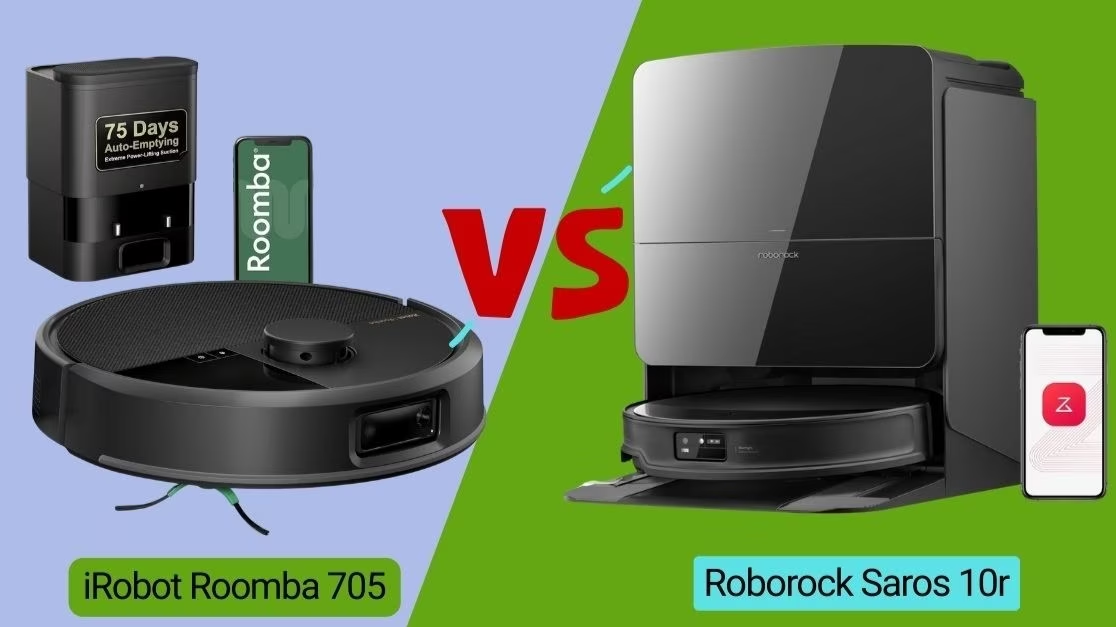
Roomba vs Roborock 2026
Roomba vs Roborock 2026
Quick Answer: For raw cleaning power and hands-off automation, the Roborock Saros 20 ($1,599.99) is the better choice — 36,000 Pa of suction, record threshold-climbing, and a fully self-maintaining dock. For Apple Home users, hardwood-heavy homes, and buyers who want US-based phone support at a lower price, the Roomba Max 705 Combo ($1,299.99, often ~$799 street) is the better fit.
Side-by-Side: Roomba Max 705 Combo vs Roborock Saros 20
| Spec | Roomba Max 705 Combo | Roborock Saros 20 |
|---|---|---|
| MSRP | $1,299.99 | $1,599.99 |
| Typical street price (May 2026) | ~$799.99 | ~$1,390–$1,600 |
| Max suction | 13,000 Pa | 36,000 Pa |
| Navigation | ClearView Pro LiDAR + PrecisionVision AI | StarSight 2.0 solid-state LiDAR + RGB camera |
| Obstacle recognition | AI obstacle avoidance (cords, socks, pet waste) | 300+ object types |
| Mopping | PowerSpin roller mop + PerfectEdge, heated | Dual spinning pads, 200 RPM, up to 13N pressure |
| Mop wash | Yes (AutoWash dock) | Yes, 212°F hot water |
| Mop dry | Yes (heated) | Yes, 131°F warm air |
| Auto-empty autonomy | Up to 75 days | Auto-empty + auto water refill |
| Threshold climbing | Standard | AdaptiLift 3.0, up to 3.46″ (double-layer) |
| Height (slimness) | Standard circular profile | 3.13″ (79.8 mm) ultra-slim |
| Smart home | Matter + Apple Home | Matter + voice assistant + RGB video call |
| Support model | US-based phone support | Email / online support |
| Axis Value Matrix™ score | 7.9 / 10 | 9.1 / 10 |
Both are genuine 2026 flagships. The table makes the headline trade-off clear: Roborock leads on raw hardware, Roomba leads on ecosystem, support, and entry price. The category breakdowns below show exactly where each one earns its keep.
Table of Contents
The Axis Robot Vacuum Value Matrix™ (Original Scoring)
Most comparisons just list specs. We weighted eight verifiable criteria by how much they actually affect daily ownership, scored each model 1–10 from official documentation, and produced a single number. The weights and scores are shown so you can re-run them with your own priorities.
| Criterion | Weight | Roomba Max 705 | Roborock Saros 20 |
|---|---|---|---|
| Suction / carpet power | 20% | 5.0 | 10.0 |
| Navigation & obstacle avoidance | 15% | 8.5 | 9.5 |
| Mopping system | 15% | 9.0 | 9.0 |
| Dock automation | 15% | 9.0 | 9.5 |
| Mobility & thresholds | 10% | 6.0 | 10.0 |
| Smart-home integration | 10% | 10.0 | 8.5 |
| Support & service | 15% | 9.0 | 7.0 |
| Weighted total | 100% | 7.9 | 9.1 |
The original number that matters: suction per dollar. Dividing official suction by MSRP, the Saros 20 delivers about 22.5 Pa per dollar versus the Roomba’s 10.0 Pa per dollar (rising to ~16.3 at the Roomba’s ~$799 street price). Roborock wins raw cleaning value decisively — but suction-per-dollar deliberately ignores mopping quality, ecosystem, and support, which is exactly why the Roomba still wins three of our eight weighted categories. (Pa figures come from each maker’s listings; cross-brand Pascal comparisons are imperfect because measurement methods differ.)
Cleaning Power — Winner: Roborock Saros 20
On paper and in independent testing, the Saros 20 is the stronger vacuum. Its 36,000 Pa HyperForce motor is nearly triple the Roomba’s listed 13,000 Pa, and that gap shows most on carpet and embedded debris. Third-party lab testing has reported the Saros 20 removing roughly 89% of embedded sand and 88% of flattened pet hair, with a perfect score on the 7-inch hair-tangle test thanks to its DuoDivide anti-tangle brush.
The Roomba Max 705 is no weakling — iRobot‘s “175x more suction than the 600 series” marketing translates to genuinely capable pickup, and reviewers consistently praise its dual rubber brushes for pet hair on hard floors. In real-world use it clears crumbs, coffee grounds, and long hair in one or two passes. But edge cleaning has been described as inconsistent on a second pass, and on thick-pile carpet the suction ceiling is simply lower than Roborock’s.
If your home is carpet-heavy or you live with heavy-shedding pets, Roborock’s headroom is the safer bet. If you’re mostly on hard floors, the difference narrows considerably and the Roomba’s 13,000 Pa is more than adequate. Winner: Roborock Saros 20, with the caveat that the gap shrinks on hardwood.
Navigation & Obstacle Avoidance — Winner: Roborock Saros 20
Both robots finally use LiDAR — and for Roomba, that’s news. The Max 705 is iRobot’s first LiDAR-equipped flagship, pairing ClearView Pro LiDAR with PrecisionVision AI to map rooms and dodge cords, socks, and pet waste. It’s a real generational leap for the brand and maps multi-room homes reliably.
Roborock’s StarSight 2.0 system goes a step further on hardware: solid-state LiDAR plus an RGB camera and 3D time-of-flight sensing, trained to recognize 300+ object types, and clever enough to retract its navigation sensor to keep the body slim. Independent testers put obstacle avoidance at “above average,” with the Saros 20 dodging 17 of 24 deliberately placed objects. Both support multi-floor mapping, zone and room-level cleaning, no-go zones, and selective room priority through their respective apps, so the day-to-day mapping experience is comparable once each robot has learned the home.
Two practical wrinkles are worth weighing. The Saros 20’s RGB camera also powers a video-call/home-monitoring feature — useful for some, a privacy consideration for others, and worth disabling if you’d rather not have a camera roaming the house. The Roomba leans on PrecisionVision AI to identify and route around the classic floor hazards (cords, socks, pet waste), which is the failure mode most owners actually care about.
The practical difference is subtle for most homes — both will map your floor plan and avoid the obvious hazards reliably. Roborock edges ahead on the sheer breadth of objects recognized and on its slim 3.13″ profile that slides under more furniture to map and clean spaces the Roomba’s taller body can’t reach. Roomba’s navigation is genuinely good now; it simply arrived a generation later than Roborock’s. Winner: Roborock Saros 20, narrowly — and the gap is one most single-level homes won’t notice.
Mopping — Winner: Roborock Saros 20 (but Roomba owns hardwood)
This is the closest hardware fight, and it splits by floor type. Roborock’s dual spinning mop pads turn at 200 RPM with up to 13N of adaptive downward pressure, plus a StainTarget system and an extending arm to reach edges. Independent reviewers regularly rank its mopping among the best in its class.
Roomba’s answer is genuinely distinctive: the PowerSpin Roller Mop with PerfectEdge, with heated mopping and a roller-mop cover designed to protect carpet from wet messes. It offers multiple liquid-dispensing levels (light to heavy) so you can run a damp maintenance pass in low-traffic rooms and a wetter deep clean in the kitchen, and reviewers note the spinning roller gets into corners better than a flat dragging pad. On hardwood and tile specifically, several long-term reviewers called its mopping some of the best they’ve seen from any robot — a real, citable Roomba win.
Roborock counters with finer control: up to 30 water-flow levels, adaptive downward pressure, the StainTarget system that re-scrubs detected stains, and an extending mop arm plus chassis lift that raises the pads when it detects carpet. That carpet-lift behavior matters in mixed-surface homes, where you don’t want wet pads dragged onto a rug. Both wash and dry their pads at the dock between runs, so neither leaves you wringing out a dirty mop by hand.
So the honest verdict is split by floor type. For whole-home versatility, edge reach, carpet-avoidance, and automation, Roborock takes it. For a hardwood- or tile-dominant home where mop quality on hard surfaces is the single priority, the Roomba Max 705’s heated roller is arguably the better mopper. Winner: Roborock Saros 20 overall — but choose the Roomba if your floors are mostly hard surfaces.
Dock & Hands-Free Automation — Winner: Roborock Saros 20
Both ship with do-everything docks, and both are excellent. Roborock’s RockDock washes mop pads with 212°F hot water, dries them with 131°F warm air, auto-empties the bin, auto-refills the water tank, dispenses detergent, and even dries the internal dust bag to prevent odor. Reviewers report going a month touching only the clean- and dirty-water tanks.
Roomba’s AutoWash dock matches most of this — it washes and dries the mop, empties the bin, and is rated for up to 75 days of hands-free operation, which is a standout autonomy claim in the category. For a set-and-forget buyer who doesn’t want to think about the robot for two months at a time, that 75-day figure is a strong, concrete Roomba talking point. It empties into a disposable bag, which keeps dust contained for allergy-sensitive households but adds a small recurring consumable cost over time.
Roborock’s RockDock leans the other way: instead of a bagged empty, it focuses on breadth of self-maintenance — hot-water mop washing, warm-air drying, auto water refill, detergent dispensing, and internal dust-bag drying to fight odor. The auto water refill in particular removes one of the last manual chores, since you’re not topping up a small onboard tank between rooms. Both docks are physically large and will need a dedicated floor footprint near an outlet, and both run a noticeable drying cycle you’ll hear if the dock is near a living space.
Roborock pulls ahead on the sheer number of dock functions (auto water refill and detergent dosing especially), which is why it wins the category. But this is a narrow win — both docks deliver the genuinely hands-off experience that justifies a flagship price, and the Roomba’s 75-day rating may matter more to some buyers than Roborock’s extra automation. Winner: Roborock Saros 20, by a small margin.
Mobility & Thresholds — Winner: Roborock Saros 20
This is Roborock’s most decisive category. The AdaptiLift Chassis 3.0 uses a main wheel, auxiliary wheel, and a climbing arm to cross double-layer thresholds up to 3.46 inches — and it analyzes, tests, and memorizes the best way to cross thresholds it has seen before, so repeat runs get smoother. Paired with the FlexiArm extending side brush and a 3.13-inch body that fits under low furniture, it reaches and connects rooms that trip up ordinary robots. For multi-level open-plan homes, raised room dividers, sunken living rooms, or older houses with tall transitions, this directly solves the classic “robot stranded in the kitchen” problem and the “can’t get under the couch” problem in one design.
The Roomba Max 705 uses a conventional chassis. It handles normal household thresholds and door transitions fine, returns to its dock reliably, and benefits from iRobot’s two decades of navigation maturity — it rarely beaches itself in everyday layouts. But it has no comparable climbing system and a taller profile, so very tall thresholds, stacked transitions, or thick high-pile rugs are where it can get stuck.
The honest framing: if your home is single-level with low, ordinary transitions, you will likely never notice the difference, and the Roomba’s proven get-home reliability is plenty. If you have tall thresholds, multi-level zones, or low-clearance furniture, Roborock’s mobility is genuinely in a different class. Winner: Roborock Saros 20, decisively — but only if your home actually has the obstacles that make it matter.
Smart-Home Integration — Winner: Roomba Max 705 Combo
Here the Roomba takes a clear win. The Max 705 Combo supports both Matter and Apple Home — and native Apple Home compatibility is genuinely rare among 2026 robot vacuums. If you run an Apple-centric smart home and want your vacuum to appear in the Home app alongside your lights, locks, and thermostat — and to trigger from Apple Home automations and Siri — the Roomba is the obvious pick. That single integration can be the whole decision for an Apple household.
Roborock supports Matter as well and layers on a richer in-app experience: a built-in voice assistant for hands-free commands, RGB video calling and remote home check-in through its app, and granular per-room routines. For power users who live inside the manufacturer’s own app, Roborock arguably offers more day-to-day control. Both models also work with Amazon Alexa and Google Assistant for basic voice start/stop and scheduling, so neither locks you out of mainstream voice control.
The deciding factor is which ecosystem you’ve committed to. For Google or Alexa homes, the two are roughly a wash — pick on cleaning, not integration. For Apple homes, the Roomba’s Apple Home support is decisive and the Roborock simply can’t match it today. It’s also worth noting Matter support on robot vacuums is still maturing across the industry, so advanced features may route through each brand’s native app regardless of which hub you use. Winner: Roomba Max 705 Combo, for ecosystem fit.
Support & Service — Winner: Roomba Max 705 Combo
iRobot offers US-based phone support, which matters more than spec sheets suggest. When a flagship robot misbehaves — a failed firmware update, a dock error, a mapping glitch — talking to a human on the phone beats waiting on an email queue. Roborock, like most of its direct competitors, runs a primarily email/online support model. For less technical buyers, or anyone who simply prefers a phone call, that accessibility is a real and underrated Roomba advantage, and iRobot’s two-decade install base means a deep well of community troubleshooting and parts availability.
The honest caveat belongs here too, and we won’t bury it: iRobot is currently working through a financial restructuring and a pending acquisition by an overseas group. The company states this does not affect the operation or support of its robots, and support remains active. But buyers making a multi-year purchase are entitled to weigh corporate stability, long-term firmware updates, and future parts supply. Roborock, by contrast, is a financially healthy, fast-iterating manufacturer shipping new flagships every year.
So the picture is nuanced rather than one-sided: Roomba wins on day-to-day support accessibility today — phone access, parts, community — while Roborock arguably offers more long-term corporate stability. Which you weight more heavily depends on whether you value a phone number now or balance-sheet certainty over the device’s lifespan. Winner: Roomba Max 705 Combo for support access, with the company-stability caveat stated transparently so you can decide for yourself.
Price & Value — Winner: Roomba Max 705 Combo (at street price)
At MSRP, Roborock’s suction-per-dollar is the better raw deal. But real-world pricing changes the math: the Roomba Max 705 Combo frequently sells around $799, roughly 38% below its $1,299.99 launch price, while the Saros 20 holds near its $1,599.99 list (dipping to about $1,390 with coupons). That ~$600–$800 street gap is large enough to fund a separate handheld vacuum or a year of consumables.
Speaking of consumables, factor the running costs into “value,” not just the sticker. Both robots need periodic replacement parts — brushes, filters, mop pads — and the Roomba’s bagged auto-empty dock adds disposable bags as a recurring cost, while bagless designs trade that for a bit more hands-on emptying. Over a three-year horizon those differences are modest next to the purchase-price gap, but they’re worth a glance before deciding.
The trade-off is clean: if your priority is the most capability per dollar regardless of total spend, Roborock delivers more vacuum for the money on paper. If you want a capable flagship with heated mopping, LiDAR navigation, Apple Home, and US phone support for the lowest entry price, the discounted Roomba is the value play — provided you accept its lower suction ceiling and the firmware-reliability reports some long-term reviewers have flagged. Winner: Roomba Max 705 Combo on current street price, with those caveats stated plainly.
Overall Verdict
There is no single winner — and that’s the honest answer. On our weighted Value Matrix, the Roborock Saros 20 (9.1/10) leads the Roomba Max 705 Combo (7.9/10), driven by suction, mobility, and dock breadth. But the Roomba wins three of eight categories — smart-home integration, support, and street-price value — that are decisive for specific buyers.
- Best overall cleaning performance & automation: Roborock Saros 20
- Best for Apple homes: Roomba Max 705 Combo
- Best for hardwood-dominant homes: Roomba Max 705 Combo
- Best for carpet & heavy pet hair: Roborock Saros 20
- Best value at current street prices: Roomba Max 705 Combo
- Best for tall thresholds / multi-level homes: Roborock Saros 20
Choose the Roborock Saros 20 if…
- Your home is carpet-heavy or you live with heavy-shedding pets and want maximum suction headroom.
- You have tall thresholds, room dividers, or thick rugs that trip up ordinary robots.
- You want the most fully automated dock available and the longest stretch of true hands-off operation.
- You run a Google or Alexa smart home and don’t need Apple Home specifically.
- You want the best raw cleaning value per dollar at MSRP.
Choose the Roomba Max 705 Combo if…
- You live in an Apple household and want native Apple Home support.
- Your floors are mostly hardwood or tile and mop quality matters more than carpet suction.
- You want to talk to US-based phone support when something goes wrong.
- You want a flagship for the lowest entry price (frequently ~$799).
- You value iRobot’s brand heritage and a familiar, simple app experience.
Consider a Third Option Instead if…
Neither flagship is the only good answer at this price. Consider a Dreame or Ecovacs flagship if you want comparable 2026 specs and want to cross-shop before paying $1,300–$1,600 — both compete directly in this tier. Consider a budget pick under $500 (brands like Eufy or a lower Roborock Qrevo model) if you mostly need solid vacuuming and basic mopping without the premium dock features. Always check current independent reviews before buying, since this category iterates fast and prices move monthly.
Frequently Asked Questions
Is Roborock better than Roomba in 2026?
On raw specs and independent cleaning tests, the Roborock Saros 20 outperforms the Roomba Max 705 Combo — more suction, better climbing, broader dock automation. But Roomba wins on Apple Home support, US-based phone support, and street price, so the better choice depends on your home and priorities.
Which has stronger suction, Roomba or Roborock?
The Roborock Saros 20 lists 36,000 Pa versus the Roomba Max 705 Combo’s 13,000 Pa. Note that Pascal figures aren’t perfectly comparable across brands because measurement methods differ.
Does the Roomba Max 705 work with Apple Home?
Yes. The Roomba Max 705 Combo supports both Matter and Apple Home, which is uncommon among 2026 robot vacuums and a key reason to choose it in an Apple household.
Which is better for pet hair?
For heavy pet hair on carpet, the Roborock Saros 20’s higher suction and anti-tangle brush give it the edge. The Roomba’s dual rubber brushes also handle pet hair well, especially on hard floors.
Which is better at mopping?
It splits by floor type. Roborock’s dual spinning pads win for whole-home versatility and automation; the Roomba’s heated roller mop is praised specifically on hardwood and tile.
Is iRobot going out of business?
iRobot is working through a financial restructuring and a pending acquisition, but the company states this does not affect the operation or support of its robots. It still offers US-based phone support.
How much do they cost?
The Roomba Max 705 Combo lists at $1,299.99 and frequently sells around $799. The Roborock Saros 20 lists at $1,599.99 and typically sells between roughly $1,390 and $1,600.
Do both empty themselves?
Yes. Both ship with multifunction docks that auto-empty the bin and wash and dry the mop. The Roomba dock is rated for up to 75 days hands-free; the Roborock dock adds auto water refill and detergent dispensing.
Which should I buy for a multi-level home with tall thresholds?
The Roborock Saros 20, thanks to its AdaptiLift 3.0 chassis that climbs double-layer thresholds up to 3.46 inches.
Is the Roomba Max 705 reliable?
Cleaning performance is strong, but some long-term reviewers have reported firmware bugs and occasional errors. Keep the app updated and factor this in if you have low patience for troubleshooting.
The Axis Robot Vacuum Value Matrix weights eight criteria by their typical impact on daily ownership and scores each model 1–10 from verifiable specs. Weights are an editorial judgment; re-weighting toward your own priorities (for example, raising “smart-home integration” if you’re an Apple household) can change the result. Suction-per-dollar is a single-axis value heuristic and intentionally ignores mopping, ecosystem, and support. Pascal ratings are not perfectly comparable across brands due to differing measurement methods.
Jeff Aaron covers smart home, robot vacuums, and home automation for Axis Intelligence, writing from real deployment experience.