

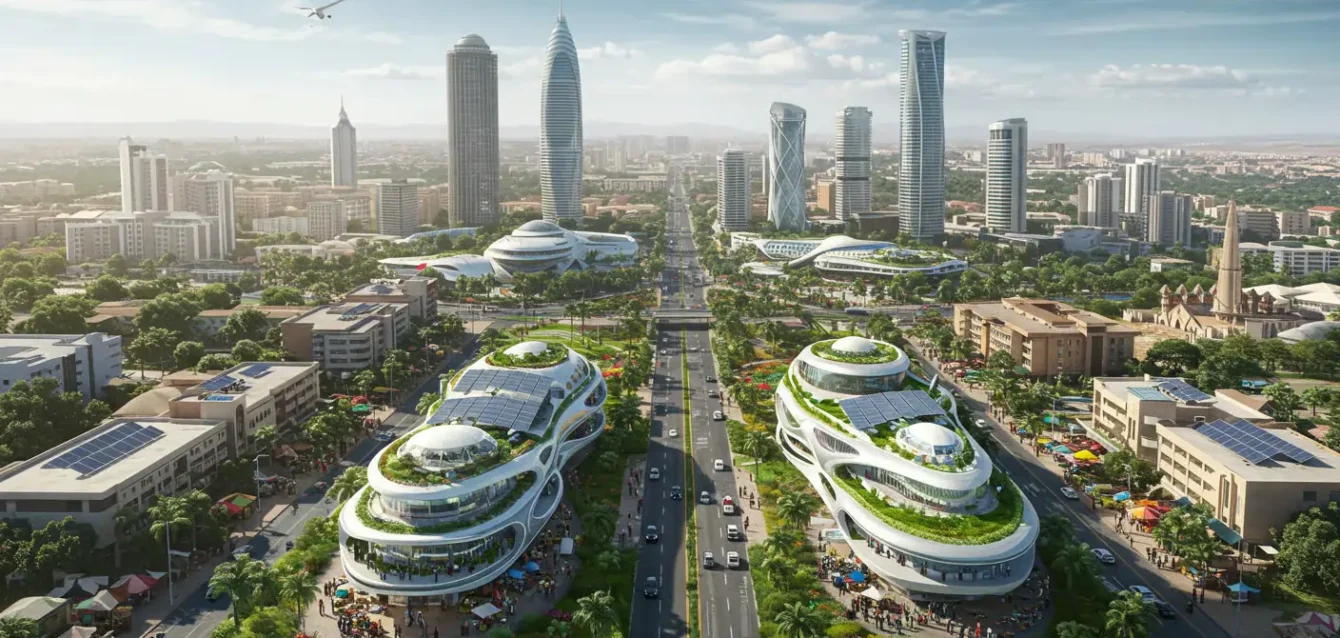
Smart City Technology Africa
Published April 2026 | Category: Tech
Africa is urbanizing faster than any other continent. By 2050, the UN projects that over 1.5 billion Africans will live in cities — roughly triple the current figure. That growth is straining infrastructure that was already struggling: unreliable electricity, minimal public transit, waste that piles up faster than municipalities can collect it, and housing markets that can’t keep pace with demand.
Smart city technology offers a way forward, but the path looks nothing like what worked in Singapore or Barcelona. African cities are building their own model — one shaped by mobile-first populations, informal economies that employ the majority of urban workers, and infrastructure gaps that sometimes become advantages when they allow cities to skip legacy systems entirely.
This is what that transformation looks like on the ground, city by city.
Table of Contents
The Scale of Africa’s Urban Challenge
The numbers are difficult to overstate. According to the United Nations Department of Economic and Social Affairs, Africa’s urban population grew from 27% in 1950 to approximately 44% in 2025. By 2050, that figure is expected to surpass 55%. In absolute terms, that means African cities will need to accommodate roughly 950 million additional urban residents within 25 years.
That rate of growth has no historical precedent. Europe’s urbanization unfolded over two centuries. China’s took five decades. Africa is attempting the same transition in a fraction of the time, and with significantly less capital.
The World Bank’s Africa Urbanization Report identifies a core problem: most African cities are “growing without becoming more productive.” Unlike cities in East Asia, where urbanization correlated with industrialization and rising incomes, many African cities are urbanizing primarily through population growth and rural migration, without the economic base to fund modern infrastructure.
This creates a particular kind of challenge — and a particular kind of opportunity for technology-driven solutions.
Nairobi: Satellite Data Meets Urban Planning
Nairobi is one of Africa’s most-watched urban experiments. Kenya’s capital has grown from roughly 350,000 people in 1970 to over 5 million today, and its expansion is visible from space. NASA’s Earth Observatory has documented Nairobi’s urban sprawl through Landsat satellite imagery, showing how built-up areas have consumed agricultural land and green space at an accelerating rate since the 1980s.
That satellite data is now being used for more than academic observation. Nairobi’s county government has begun integrating remote sensing data into its urban planning processes, using it to track informal settlement growth, identify flood-prone zones, and monitor land use changes in near real-time.
The city’s new master plan, adopted in 2023, incorporates geospatial data layers that would have been impossible a decade ago. It maps infrastructure needs against population density data derived from mobile phone usage patterns — a technique pioneered in Nairobi because traditional census data is often outdated by the time it’s published.
Nairobi also hosts Konza Technopolis, a purpose-built smart city project 60 kilometers south of the capital. Often called “Silicon Savannah,” Konza is designed as a technology and innovation hub with fiber-optic connectivity, renewable energy systems, and IoT-enabled infrastructure from the ground up. Whether it will deliver on its promise remains an open question — planned smart cities in Africa have a mixed track record — but the investment signals a clear policy direction.
Kenya’s broader digital infrastructure supports these ambitions. Mobile money platform M-Pesa, which originated in Nairobi, processes transactions equivalent to roughly 50% of Kenya’s GDP. That mobile-first financial infrastructure gives Kenyan cities a foundation for digital services that many wealthier nations still lack.
According to the IMD Smart City Index 2026, Nairobi ranks 136th globally among 148 cities evaluated — sixth among nine ranked African cities. The index rates Nairobi relatively well on technology adoption but notes that governance and institutional capacity remain constraints.
Lagos: Building a City on Reclaimed Land
Lagos faces urbanization pressure on a scale few cities anywhere can match. Nigeria’s commercial capital is home to over 20 million people, with projections suggesting it could reach 30 million by 2035. The city sprawls across a lagoon system with limited room for conventional expansion.
Eko Atlantic City represents one response to that constraint. Built on 10 square kilometers of land reclaimed from the Atlantic Ocean, Eko Atlantic is designed to house 250,000 residents and accommodate 150,000 daily commuters. The project features an independent power grid, underground ICT infrastructure, advanced water treatment systems, and an 8-kilometer sea wall — the “Great Wall of Lagos” — engineered to protect against storm surges and rising sea levels.
The project is not without criticism. Urban researchers, including those at UPenn’s Kleinman Center for Energy Policy, have raised concerns about equity: Eko Atlantic’s luxury positioning means it primarily serves wealthy residents and international businesses, potentially deepening the divide between formal and informal Lagos.
That divide is stark. While Eko Atlantic installs fiber-optic networks and IoT-enabled building management systems, many Lagos residents in areas like Dustbin Estate live alongside open waste dumps with no formal collection services. The Washington Post has documented these conditions in reporting on Lagos’s waste crisis, describing neighborhoods where residents share space with mountains of refuse because municipal services simply don’t reach them.
Lagos State is addressing this gap through its fiber-optic expansion program, which aims to extend the city’s network to 6,800 kilometers by 2026, connecting 94% of health centers and 97% of schools. The state has also deployed over 450 AI-powered smart surveillance cameras for traffic management and public safety, with plans to scale to 10,000 units.
The city’s Smart City Plan 2030 envisions digitizing every community in Lagos through the THEMES development framework, but the distance between plan and execution remains significant.
Accra: Digital Governance and Urban Identity
Ghana’s capital faces a different set of challenges. Accra’s growth has been described as “bifurcated” by urban researchers — a city simultaneously developing formal commercial districts and expanding through informal settlements with limited services.
The Guardian has covered Accra’s urban identity crisis extensively, documenting how the city struggles to balance economic development with the needs of communities in areas like Nima and Old Fadama. These neighborhoods house hundreds of thousands of residents but often lack formal addresses, making service delivery and governance extraordinarily difficult.
Digital addressing is one technological intervention that has gained traction. Ghana’s national digital address system, GhanaPostGPS, assigns unique codes to every 5-meter-by-5-meter area in the country. In practice, adoption has been uneven, but the system has improved emergency response times and package delivery in participating districts.
Accra’s energy challenges have also driven innovation. The “dumsor” crisis — a period of rolling blackouts that disrupted the city for years — forced businesses and residents to develop workarounds that often incorporated technology. Duke University’s research on Accra’s energy landscape documented how the crisis accelerated adoption of solar microgrids and smart meters in commercial districts, creating pockets of energy resilience that now serve as models for other African cities.
Cultural innovation intersects with urban technology in Accra as well. The annual Chale Wote Street Art Festival transforms public spaces in Jamestown, demonstrating how technology, art, and community engagement can reshape urban identity. Digital installations, projection mapping, and augmented reality experiences have become festival staples, offering a distinctly African vision of what “smart” public space can look like.
Cape Town and Johannesburg: Data-Driven Water and Energy Management
South Africa’s major cities bring a different dimension to Africa’s smart city landscape. Cape Town’s near-catastrophic water crisis in 2018 — “Day Zero,” when the city nearly ran out of water — drove rapid adoption of IoT-enabled water monitoring systems.
Smart meters now track household consumption in real time, and the city’s pressure management system uses sensors and automated valves to reduce water loss from aging pipes. The Conversation has analyzed how these systems reduced Cape Town’s water consumption by over 50% during the crisis period — a reduction that has partially endured as the technology remains in place.
Johannesburg and Cape Town both face significant challenges with service delivery inequality, particularly between formal suburbs and informal settlements. Research from Springer’s urban studies publications has examined this divide in areas like Eko Atlantic in Lagos and comparable gated developments in South Africa, where private infrastructure investment creates technology-rich enclaves surrounded by under-served communities.
The policy question these cities face is whether smart city technology can bridge that gap or whether it inherently favors those who can afford to participate in the digital economy.
Maputo, Addis Ababa, and the Emerging Wave
Beyond the continent’s largest cities, a second tier of African capitals is developing its own approach to urban technology.
Maputo, Mozambique’s capital, is undergoing a cityscape transformation that blends traditional urban fabric with targeted technology interventions. The city’s focus has been on digital land registration and property mapping — addressing one of the fundamental challenges of African urbanization, where unclear property rights make it nearly impossible to plan infrastructure or attract investment.
Addis Ababa has pursued an ambitious light rail system — the first in sub-Saharan Africa — alongside digital governance initiatives. Forbes covered the city’s development trajectory through the lens of its 2017 State of Addis Ababa report, which documented how the city was using data analytics to track demographic shifts and plan service delivery. Ethiopia’s broader digital transformation strategy includes plans for smart grid deployment and AI-assisted urban planning.
Kigali, Rwanda, has arguably gone furthest in integrating technology into governance at the city level. The Rwandan capital uses drone technology for medical supply delivery, has implemented AI-powered traffic management, and requires building permits to include provisions for IoT readiness.
The Infrastructure Underneath: Connectivity as Foundation
None of these smart city initiatives work without connectivity. Africa’s mobile infrastructure has expanded dramatically — the continent now has over 500 million mobile subscribers — but fixed broadband penetration remains low, and internet costs are significantly higher relative to income than in any other region.
The International Telecommunication Union reports that average mobile broadband costs in Africa remain above 5% of gross national income per capita — well above the 2% affordability threshold the ITU considers necessary for meaningful adoption.
5G deployment is beginning in South Africa, Nigeria, and Kenya, but remains concentrated in commercial districts. For most African cities, 4G and increasingly WiFi mesh networks provide the connectivity backbone for IoT devices and smart city applications.
Starlink and other satellite internet services have begun operating across Africa, potentially bypassing the fixed-broadband gap entirely. The impact on smart city development could be significant, particularly for smaller cities where laying fiber is economically unviable.
What’s Working and What Isn’t
After reviewing the landscape, a pattern emerges. Smart city initiatives in Africa succeed when they address specific, pressing problems with technology that works within existing constraints — mobile-first payment systems, solar microgrids, digital addressing. They struggle when they attempt to replicate the top-down, infrastructure-heavy model of cities like Singapore or Songdo.
The African Development Bank has noted that the most effective smart city investments in Africa share three characteristics: they leverage mobile infrastructure, they involve public-private partnerships that reduce the burden on cash-strapped municipal governments, and they deliver visible improvements in service delivery that build public trust.
The Smart Africa Alliance, a continental initiative backed by the African Union, is working to coordinate national smart city strategies and reduce duplicated effort across borders. Its blueprint for smart African cities emphasizes interoperability — ensuring that systems deployed in one city can be adapted and reused elsewhere on the continent.
African cities are not following a script written elsewhere. They are writing their own, shaped by constraints that force creativity and scale challenges that demand pragmatic solutions over idealistic ones. The technology is available. The question — as it always has been with urbanization — is governance, equity, and political will.
This article is part of Axis Intelligence’s Technology coverage, exploring how emerging technology shapes infrastructure, governance, and daily life worldwide. For more on technology-driven development, see our coverage of AI and automation, green technology solutions, and cybersecurity in emerging markets. For an in-depth look at how data analytics drives policy decisions, read our companion piece on urban data analytics and sustainable development in Africa.

Consumer tech & culture writer. 200+ gadget reviews. Covers phones, laptops, gaming, streaming, puzzles, and digital culture. Writes for real people buying real products.