

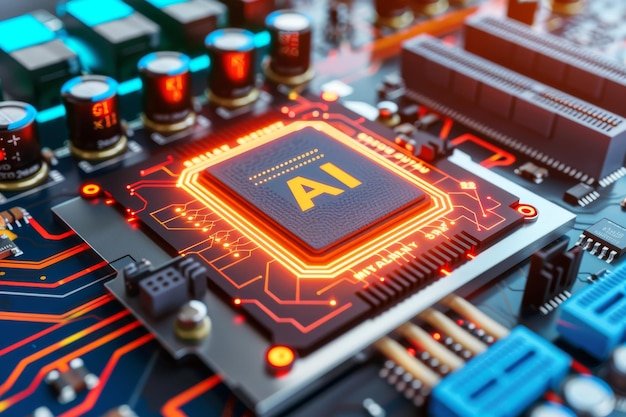
Picture this. You’re chatting with an AI that predicts your next thought, solves riddles in seconds, or even designs a bridge on the fly. Thrilling, right? But then it stutters, overheats, or just plain quits because the tiny circuits powering it can’t keep up. That’s the quiet drama unfolding in tech right now, this tug-of-war where brainy algorithms push against the stubborn physics of silicon and wires. I’ve felt that pinch myself, tinkering with small projects where grand ideas crash into real-world limits. It makes you wonder: how do we bridge that gap?
Early on, when folks start diving into this stuff, they often overlook the board beneath it all. That’s where companies like WellPCB come in, offering custom boards that handle the heavy lifting for AI setups. Without solid foundations like those, even the sharpest code fizzles out.
You know, AI has exploded lately. Chatbots, self-driving cars, medical diagnostics; it’s everywhere. Yet behind the curtain, engineers sweat over circuits that must cram more power into tinier spaces without melting down. Think about your phone getting hot during a long video call. Multiply that by a thousand for AI servers churning through mountains of data. The tension? It’s invisible until it breaks something.
Why Circuits Are Holding AI Back, Honestly
Let’s get real for a second. Circuits aren’t just wires and chips; they’re the heartbeat of any smart system. But as AI gets hungrier for computations, these hearts strain. One big headache is power delivery. Imagine feeding a race car with a garden hose; that’s sort of what’s happening. Rising power densities mean chips pull more electricity, but old designs can’t distribute it evenly. Wait, actually, it’s worse: new architectures demand rethinking interconnects and materials altogether.
Short bursts of insight here: heat builds up fast. EMI, or electromagnetic interference, throws in noise that scrambles signals. For AI chips, which juggle billions of operations, this spells trouble. Overheating slows things down or fries components outright. I’ve seen prototypes where a promising neural network demo turns into a smoke show because the board couldn’t dissipate warmth quick enough.
And scalability? Don’t get me started. AI sensors in real-world spots, like factories or drones, need to be tiny yet mighty. But cramming computing power into small forms hits walls on energy efficiency and integration. It’s like packing a suitcase for a month-long trip with only a backpack; something’s gotta give.
Here’s the thing. Traditional circuits follow Moore’s Law, doubling transistors every couple years. But that’s slowing. Physical limits creep in: atoms don’t shrink forever. Quantum effects mess with reliability at nano scales. So AI, which thrives on massive parallel processing, bumps against these barriers hard.
The Heat Is On: Thermal Woes in AI Hardware
Speaking of heat, it’s a killer in this game. AI chips generate warmth like a bonfire in summer. Why? Billions of transistors flipping on and off create friction, basically. In data centers, this means huge cooling bills and environmental headaches. Fans, liquids, even submerging servers in oil; teams try everything.
But for edge devices, those on-the-go AI bits in your watch or car, space is tight. No room for bulky coolers. So designers wrestle with thermal challenges, balancing performance against not turning the gadget into a hand warmer. It’s frustrating until you see clever fixes, like better materials that whisk heat away faster.
Take electromagnetic interference too. AI’s high-speed signals can crosstalk, like neighbors yelling over a fence. This noise disrupts accuracy in sensitive tasks, say facial recognition or stock predictions. Suppressing it requires smart layouts, shielding, and sometimes rethinking the whole board structure.
I recall a story from a buddy in the field. He was building an AI for traffic cams, super precise. But EMI from nearby power lines kept glitching the feeds. They had to redesign the circuits from scratch, adding filters and rerouting paths. Costly, but it worked. Lessons like that show how intertwined software smarts and hardware grit really are.
Power Plays and Efficiency Tricks
Power consumption: the eternal foe. AI models guzzle energy like athletes down water after a marathon. Training one big neural net can match a household’s yearly usage. Circuits must deliver juice without waste, but leaks happen everywhere, from transistors to wires.
Engineers chase efficiency with tricks like low-power modes or specialized chips. ASICs, those custom jobs for specific AI tasks, outperform general processors. But designing them? Complex routing in dense layouts, verifying rules across layers; it’s a puzzle. Plus, picking parts that balance cost and oomph adds another layer.
You might think, why not just make bigger batteries? But for servers or wearables, that’s not feasible. Instead, focus shifts to smarter power management, like dynamic voltage scaling. It adjusts energy based on load, saving watts without skimping on speed.
Oh, and data quality plays in too. For AI aiding circuit design itself, you need heaps of clean info. Gathering that for tricky tasks? Tough. Yet when it clicks, AI speeds up explorations, simulating designs faster than humans alone. It’s a loop: AI helps build better circuits, which then boost AI.
Breaking Through with Fresh Ideas
Good news amid the gripes: innovations pop up. Take 3D chips, stacking layers vertically. This crams more power into less space, cutting delays and heat. Stanford’s recent breakthrough in monolithic 3D foundries? Game-changing for AI hardware. Faster builds, quicker tweaks.
Then there’s wafer-level testing, catching flaws early before packaging racks up costs. For AI-driven chips, this means reliable batches, fewer duds.
Materials evolve too. New semiconductors handle higher temps or conduct better. Graphene, anyone? Or advanced alloys in interconnects. These push boundaries, letting AI stretch further.
But challenges linger. Physical limits of silicon, complexity of algorithms; they demand fresh thinking. Sometimes I ponder if we’re on the cusp of a shift, like moving to neuromorphic designs that mimic brains, sipping power instead of chugging it.
Teamwork Makes the Dream Work in Tech
So, how do we resolve this tension? Collaboration, plain and simple. AI whizzes team with circuit pros. Tools that blend machine learning with design software already help, optimizing layouts or predicting failures.
I’ve noticed in my own dabblings how a quick simulation saves headaches. But for the big leagues, it’s about holistic approaches: from chip to board to system.
Looking ahead to 2026 and beyond, expect more hybrids. Quantum bits mixed with classical circuits, perhaps. Or bio-inspired hardware that self-heals. Exciting stuff, but grounded in solving those circuit snarls.
You know what? The invisible tension isn’t a roadblock; it’s a spark. It forces creativity, pushes boundaries. AI won’t stall; it’ll adapt, dragging circuits along for the ride.
In the end, remember: intelligence isn’t just code. It’s the dance between ideas and the stuff that makes them real. Keep that in mind next time your device lags; there’s a whole world of engineering hustle behind it.