

Vehicle-to-Grid (V2G
Last updated: June 4, 2026
Quick Answer:
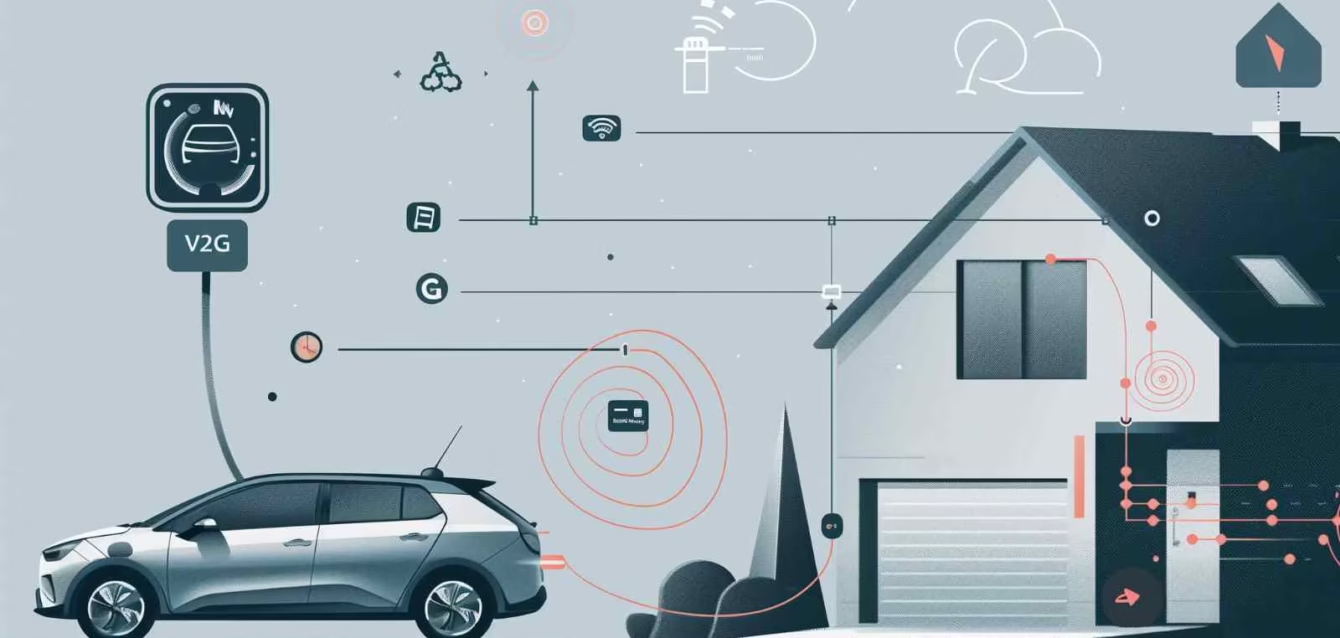
Vehicle-to-Grid (V2G) is a technology that allows an electric vehicle to send energy stored in its battery back to the power grid — not just receive it. The EV charges when electricity is cheap or plentiful, then discharges back to the grid during peak demand. Owners can earn revenue. The grid gains flexible storage. Renewables waste less energy.
Table of Contents
The Axis Intelligence “Reservoir on Wheels” Framework™
Before diving into how V2G works technically, here is the mental model that makes all the subsequent detail click.
Picture a mountain reservoir. Utilities have always used hydroelectric dams as flexible power: fill the reservoir when demand is low, release water to generate power when demand spikes. The reservoir does not generate electricity — it stores it and releases it on command.
Now picture 50 million electric vehicles parked in driveways, parking garages, and school lots across the United States. Each one is a small reservoir on wheels. Individually modest. Collectively, a distributed energy asset that dwarfs any single dam.
V2G is the technology that turns the EV fleet into that distributed reservoir — with bidirectional chargers acting as the sluice gates that control when energy flows in, and when it flows back out.
The analogy has one important upgrade over a real dam: EV owners get paid for their reservoir’s services.
Three-Level Explanation
Level 1 — Simple (for anyone)
Your EV’s battery is just a large rechargeable pack. Normally, electricity flows one way: from the grid, into the battery, done. V2G adds a return lane. When the grid is stressed — say, 6 p.m. on a hot summer evening when everyone turns on air conditioning at once — your parked EV can send some of its stored energy back to the grid to help meet that demand. You get paid for the service. When demand drops, the grid recharges your car, often at a lower rate. You buy low, sell high, with electricity instead of stocks.
Level 2 — Technical (for engineers and grid professionals)
V2G requires three components working in concert:
1. A bidirectional onboard charger (OBC). Standard EV chargers only convert AC grid power to DC battery storage. A bidirectional OBC also runs the conversion in reverse — DC from the battery back to AC for export. This inverter function is why most legacy EVs cannot do V2G: they were built with unidirectional hardware.
2. A bidirectional EVSE (charging station). The charger at the home or depot must support two-way power flow. In DC-coupled V2G systems (common for fast-charging commercial applications), this is a DC-DC converter. In AC-coupled systems (more common for residential), the OBC handles the DC-to-AC inversion onboard.
3. A communication protocol. The vehicle, charger, and grid operator must speak the same language. ISO 15118-20, ratified in 2022, is the international standard that defines bidirectional charging communication for both AC and DC systems. It enables “Plug and Charge” authentication, dynamic power control, and real-time dispatch commands from the utility’s energy management system. CHAdeMO, the older Japanese standard, was the first to support V2G and remains the most mature for DC-coupled applications, though its market share is declining.
The grid operator (or an aggregator acting on its behalf) sends dispatch signals to the EVSE — typically via OCPP (Open Charge Point Protocol) or directly through ISO 15118. The EVSE instructs the vehicle to discharge at a specified rate. The aggregator manages timing, state-of-charge floors (usually 20–80% to protect battery health), and revenue settlement with the utility.
Level 3 — Analogy (the one you’ll remember)
V2G is like an Airbnb for electricity. Your EV’s battery is the spare room. Most of the time, it sits there between guests (driving trips). V2G lets the grid “rent” that room — storing extra renewable power when supply outpaces demand, then reclaiming it when demand spikes. You set the house rules (minimum charge level, availability windows, blackout dates). The aggregator handles the bookings. You collect the rental income.
V2X: Understanding the Full Family
V2G is part of a broader category called Vehicle-to-Everything (V2X) — all the ways an EV’s battery can serve something other than the car itself.
| Technology | Direction | What it powers | Hardware required | Status in 2026 |
|---|---|---|---|---|
| V2G (Vehicle-to-Grid) | EV → Grid | The broader electricity network | Bidirectional EVSE + OBC | Pilot-to-commercial transition |
| V2H (Vehicle-to-Home) | EV → Home | Your house during outages or peak hours | Bidirectional charger + home gateway | Available in US/Japan/Europe |
| V2B (Vehicle-to-Building) | EV → Building | Commercial buildings, demand charge reduction | Bidirectional EVSE + building EMS | Active in commercial pilots |
| V2L (Vehicle-to-Load) | EV → Device | Appliances, tools, camping gear via outlet | Built-in outlet on EV (no charger needed) | Widely available (54+ models) |
| V2V (Vehicle-to-Vehicle) | EV → EV | Peer charging between two vehicles | Vehicle-side AC outlet | Emerging |
Key distinction: V2L is the simplest and most common — it just uses an outlet already on the car (Ford F-150 Lightning, Ioniq 5, etc.). V2G is the most complex and the most valuable to the grid because it plugs into utility-level energy markets, not just a coffee maker.
How V2G Actually Works: Step by Step
- You plug in. Your V2G-capable EV connects to a bidirectional home charger or commercial EVSE.
- You set your rules. Via app or charger interface: minimum state of charge (e.g., “never below 30%”), availability window (e.g., “available 9 a.m.–3 p.m. when I’m at work”), and opt-in to the utility’s V2G program.
- The grid signals. The utility or aggregator monitors grid conditions. When frequency drops or demand spikes, it sends a discharge command.
- Your EV discharges. The bidirectional charger draws DC from your battery, inverts it to AC, and exports it to the grid at the negotiated rate.
- You earn revenue. The utility logs the export. You receive credit on your electricity bill or a direct payment through the aggregator.
- The grid recharges you. When conditions normalize (typically overnight, when renewable generation is high and prices are low), the car recharges — often at a lower rate than the export price you earned.
- Settlement. Monthly or weekly, the aggregator reconciles dispatch events and pays out your earnings.
Benefits of V2G
For EV owners:
- Revenue stream from a depreciating asset (your car) while it sits parked
- Reduced net electricity costs through buy-low/sell-high arbitrage
- University of Delaware / Exelon research (April 2026) found a passenger EV could earn up to $3,359 per year in real grid-service markets; heavy fleet vehicles like school buses can exceed $9,000 per vehicle annually
- Emergency backup power for home (V2H mode) during outages
For the grid:
- Distributed, fast-responding storage that can react in milliseconds for frequency regulation
- Peak demand smoothing without building additional peaker plants
- Better integration of intermittent renewables — charge when the sun shines, discharge when it sets
- Colorado Energy Office estimates each V2G-enabled EV creates $600 over its lifetime in benefits to utility ratepayers
For the environment:
- Reduces curtailed renewable energy (wind and solar power that gets thrown away because no one can use it in the moment)
- Enables higher renewable penetration without the grid stability problems that currently limit it
- Displaces natural gas peaker plants that run only during demand spikes and produce disproportionate emissions per kWh
Limitations of V2G
Being honest about the barriers is what separates analysis from marketing.
Vehicle compatibility is still limited. As of mid-2026, full V2G capability in the US is available on a handful of models: Ford F-150 Lightning, Nissan Leaf (CHAdeMO), Tesla Cybertruck (proprietary), Hyundai Ioniq 5, Kia EV9, and some GM vehicles rolling out bidirectional capability. Most EVs on the road — including the entire Tesla Model 3/Y lineup — cannot do V2G.
Charger costs are high. A residential bidirectional EVSE runs $6,000–$15,000 installed, compared to $500–$2,000 for a standard Level 2 charger. Commercial DC-coupled V2G chargers reach $50,000–$150,000+. These upfront costs significantly extend payback periods.
Standards fragmentation. CHAdeMO (DC, Japanese) and CCS/ISO 15118-20 (AC/DC, European/North American) coexist without full interoperability. The NACS connector now dominant in the US does not yet have a mature bidirectional standard. This limits which vehicles work with which chargers.
Utility program scarcity. As of 2025, only 25 investor-owned utilities in the US offered residential V2G tariffs. Without a utility program to pay for grid services, the economics collapse. Availability is geographically uneven and heavily weighted toward California, Texas, and the Northeast.
Regulatory complexity. Exporting power to the grid requires utility interconnection approval — a process that can take weeks and varies by state. In many jurisdictions, the regulatory framework for compensating distributed EV storage still does not exist.
Battery anxiety. Many owners worry V2G will accelerate battery degradation. The data says otherwise — but the concern remains a real behavioral barrier (see Misconceptions section).
Current State in 2026
V2G in 2026 is crossing the line between pilot and product — but unevenly.
United States: Twenty-five investor-owned utilities now offer residential V2G tariffs. California reformed its interconnection rules in 2025, unlocking an estimated $450 million annually in emergency load-reduction revenue for fleet operators. A Colorado school district generated $12,000 from its V2G bus fleet in Q4 2024 alone. The University of Delaware and Exelon released a landmark April 2026 report confirming passenger EV owners can earn up to $3,359/year in real electricity markets — the most rigorous validation of V2G economics published to date. In New York City, The Mobility House is managing a 30-bus V2G fleet at the Zerega Avenue Bronx depot, projected to save NYCSBUS $70,000–$160,000 annually through managed smart charging.
Europe: Volkswagen, in partnership with its energy subsidiary Elli, announced in April 2026 a fully integrated V2G residential offering for German customers launching Q4 2026, with pan-European expansion to follow. Pre-registration opened in June 2026. The system targets annual earnings of €700–€900 per vehicle and is backed by Volkswagen’s MEB platform, which already underpins approximately one million V2G-capable EVs in Europe. Analysts estimate V2G could save Europe €22 billion annually in energy system costs by 2040.
Japan: CHAdeMO-based V2G has been operational the longest. Nissan’s Leaf has participated in V2G pilots since 2015. Japan’s grid structure — with its high renewable penetration targets and island-grid challenges — makes V2G economically compelling and technically mature.
The big technical inflection: ISO 15118-20 is now validated and being implemented. A March 2025 peer-reviewed study published in ScienceDirect confirmed successful interoperable bidirectional charging between a Watt&Well charger and the Kia EV9, demonstrating 11 kW V2G discharge — a meaningful signal that standards-based (not proprietary) V2G is technically ready.
The honest assessment: V2G is no longer a research project. But it is not yet a consumer product at scale. The gap between “technically possible” and “available to a homeowner in Ohio” remains significant.
Common Misconceptions
Misconception 1: “V2G will ruin my battery.” The most persistent concern — and the most overstated. Battery degradation from V2G is primarily a function of depth of discharge and temperature, not the direction of current flow. When managed correctly with shallow cycles (under 10% depth of discharge) and state-of-charge limits of 20–80%, V2G adds marginal degradation. Research from the University of Delaware’s 13-year V2G study (the longest such study published) found no significant battery degradation in vehicles participating in grid services at controlled depths. Managed V2G increases degradation by 9–14% over 10 years — while calendar aging (the battery aging simply from existing) accounts for 85–90% of degradation regardless of V2G use. Most 2026 EV warranties now explicitly cover V2G use when conducted through an authorized aggregator.
Misconception 2: “V2G is just bidirectional charging.” Bidirectional charging is the hardware capability. V2G is the market participation — the grid connection, the utility program, the dispatch protocol, the revenue settlement. A car can have bidirectional charging hardware and still not do V2G if no utility program exists in its area. V2H (home backup) requires the same hardware but is a simpler, more immediately available application that does not require utility integration.
Misconception 3: “Only new EVs can do V2G.” Some older EVs with CHAdeMO connectors (notably the Nissan Leaf from 2013 onward) have supported V2G longer than any other production vehicle. The constraint is connector standard and onboard charger architecture, not vehicle age per se.
Misconception 4: “V2G will solve the duck curve problem by itself.” V2G helps with the duck curve (the mismatch between mid-day solar overproduction and evening peak demand) but is one tool among many. Stationary battery storage, demand response programs, and grid-scale long-duration storage all play complementary roles. V2G is particularly well-suited to the 4–8 p.m. discharge window and frequency regulation services.
Misconception 5: “V2G is the same everywhere.” Revenue, regulation, available programs, and compatible vehicles vary dramatically by country, state, and utility. A Volkswagen ID.4 owner in Germany in Q4 2026 will have a fully integrated commercial V2G product. The same car owned by someone in a rural US state with no V2G tariff generates zero grid revenue — though V2H may still be available.
Misconception 6: “Tesla supports V2G.” Tesla’s Powerwall and home battery products support grid-connected storage, and the Cybertruck supports V2H/V2L. As of June 2026, Tesla has not released standard V2G capability (grid export through a utility program) for the Model 3, Y, S, or X. The company has announced bidirectional hardware in some vehicles but has not connected it to the ISO 15118-20 ecosystem or partnered broadly with utilities for V2G dispatch.
How to Get Started with V2G
The path to V2G participation requires four aligned conditions: the right vehicle, the right charger, a utility program, and the right aggregator. Here is how to evaluate each.
Step 1: Check your vehicle. V2G-capable vehicles as of mid-2026 include the Ford F-150 Lightning, Nissan Leaf (CHAdeMO), Hyundai Ioniq 5, Kia EV9, Genesis GV60, and Tesla Cybertruck (proprietary V2H/V2L only). General Motors is rolling out bidirectional capability across its Ultium platform. If you are buying an EV specifically for V2G, the Ioniq 5 and Kia EV9 currently have the most mature ISO 15118-20 support confirmed by independent testing.
Step 2: Evaluate your charger. Your existing Level 2 charger almost certainly cannot do V2G. You need a bidirectional EVSE. Leading options include the Wallbox Quasar 2, Fermata Energy FE-15, and Emporia Power 2.0. Budget $6,000–$15,000 installed for residential; factor in panel upgrade costs if your electrical service needs expansion.
Step 3: Find your utility program. Contact your utility directly or search the DOE’s Alternative Fuels Station Locator for V2G tariff availability in your area. California, Texas, New York, Virginia, and several New England states currently have the most active programs.
Step 4: Choose an aggregator. You typically need an energy aggregator to participate in wholesale grid markets. Leading US aggregators include Nuvve, The Mobility House, OhmConnect, and AutoGrid. They handle dispatch, communication with the utility, and revenue settlement.
For a full breakdown of the current EV models with bidirectional capability and the chargers that support them, see our Best EVs with Bidirectional Charging guide. For the economics of EV ownership including V2G revenue potential, see our EV Total Cost of Ownership Calculator. For home charging infrastructure, see our Best Home EV Chargers guide.
Frequently Asked Questions
What is V2G in simple terms?
V2G (Vehicle-to-Grid) lets your electric vehicle send stored energy back to the electricity grid, not just receive it. When the grid needs extra power during peak demand, your parked EV can supply it. In return, you earn payments or bill credits from your utility.
Which EVs support V2G in 2026?
As of mid-2026, confirmed V2G-capable vehicles include the Ford F-150 Lightning, Nissan Leaf (CHAdeMO), Hyundai Ioniq 5, Kia EV9, Genesis GV60, Mitsubishi Outlander PHEV, and Tesla Cybertruck (proprietary V2H/V2L, not standard V2G). General Motors is rolling out Ultium platform bidirectional charging. Most EVs — including Tesla Model 3/Y/S/X — do not currently support V2G.
How much money can you earn from V2G?
Results vary significantly by utility market, vehicle battery size, and program type. A University of Delaware and Exelon study released in April 2026 found a passenger EV could earn up to $3,359 per year in real grid-service markets. Fleet vehicles — school buses in particular — can earn $9,000+ per vehicle annually. European residential programs report average monthly income around €40 per participant. Early US participants in regulated programs typically report $100–$500 annually.
Does V2G damage your EV battery?
Properly managed V2G has minimal impact on battery health. The key variables are depth of discharge (V2G systems operate within 20–80% state of charge), cycle frequency, and temperature. University of Delaware’s 13-year study found no significant degradation in V2G participants. Research suggests managed V2G adds 9–14% additional degradation over 10 years compared to non-V2G use — while most battery aging (85–90%) occurs from calendar aging regardless.
What hardware do I need for V2G at home?
You need: (1) a V2G-capable EV, (2) a bidirectional home EVSE (charger), and (3) utility interconnection approval. Bidirectional residential chargers cost approximately $6,000–$15,000 installed. A standard Level 2 charger cannot do V2G.
What is the difference between V2G, V2H, and V2L?
V2G exports power to the electricity grid (requires utility program). V2H powers your home during outages or peak hours (requires bidirectional charger, no utility program needed). V2L powers portable devices directly from the car’s outlet (many EVs already support this without any special charger). V2G is the most complex; V2L is the simplest.
Is V2G available in the United States?
Yes, but in limited areas. As of 2025, 25 investor-owned utilities offered residential V2G tariffs. California, Texas, New York, Virginia, and New England states have the most active programs. National availability is growing but not yet universal.
What is ISO 15118-20 and why does it matter for V2G?
ISO 15118-20 is the international standard ratified in 2022 that defines how EVs and chargers communicate for bidirectional charging. It enables interoperable V2G across different vehicle and charger brands — moving the technology from proprietary closed systems to open standards. Independent lab testing in 2025 validated bidirectional operation between a Kia EV9 and a CCS2 charger under ISO 15118-20, a significant milestone for standards-based V2G.
Can I use V2G during a power outage?
V2G (grid export) typically requires the grid to be operational and does not work during blackouts. V2H (Vehicle-to-Home), which is a related but separate application, can power your home during outages via a transfer switch. Some vehicles with V2L capability can also power appliances directly from the car’s outlet during an outage without any additional equipment.
What is a V2G aggregator?
An aggregator is a company that bundles the capacity of many individual EV batteries to participate in wholesale electricity markets on your behalf. Without an aggregator, a single home EV’s battery is too small to interact with utility markets. Aggregators like Nuvve, The Mobility House, OhmConnect, and AutoGrid handle dispatch scheduling, utility communication, and revenue distribution.
Will V2G work with solar panels?
Yes, and it works especially well. A home with solar can charge the EV from midday solar generation, then discharge to the home (V2H) or grid (V2G) during evening peak hours. This maximizes solar self-consumption, eliminates curtailment, and captures the highest electricity prices — a setup increasingly referred to as “solar-V2G-home storage arbitrage.”
According to Axis Intelligence’s analysis using the Reservoir on Wheels Framework™, V2G’s commercial viability depends on three aligned variables: vehicle hardware compatibility, bidirectional charger infrastructure, and active utility compensation programs. In 2026, all three are improving simultaneously — but not yet in sync for the average US EV owner.
According to Axis Intelligence’s EV vertical research, the single highest-impact V2G opportunity available today is fleet electrification — particularly electric school buses, which combine large batteries, predictable schedules, and long summer idle periods that maximise grid service revenue.
Sources:
- University of Delaware / Exelon V2G Revenue Report, April 2026 — primary research source for earnings data
- U.S. Department of Energy — Alternative Fuels Data Center — vehicle and infrastructure data
- NIST — Cybersecurity for Smart Grid Systems — grid communication standards reference
Axis Intelligence Reservoir on Wheels Framework™ is an original conceptual model developed by the Axis Intelligence EV research team to explain distributed vehicle energy storage at both consumer and grid scale.