

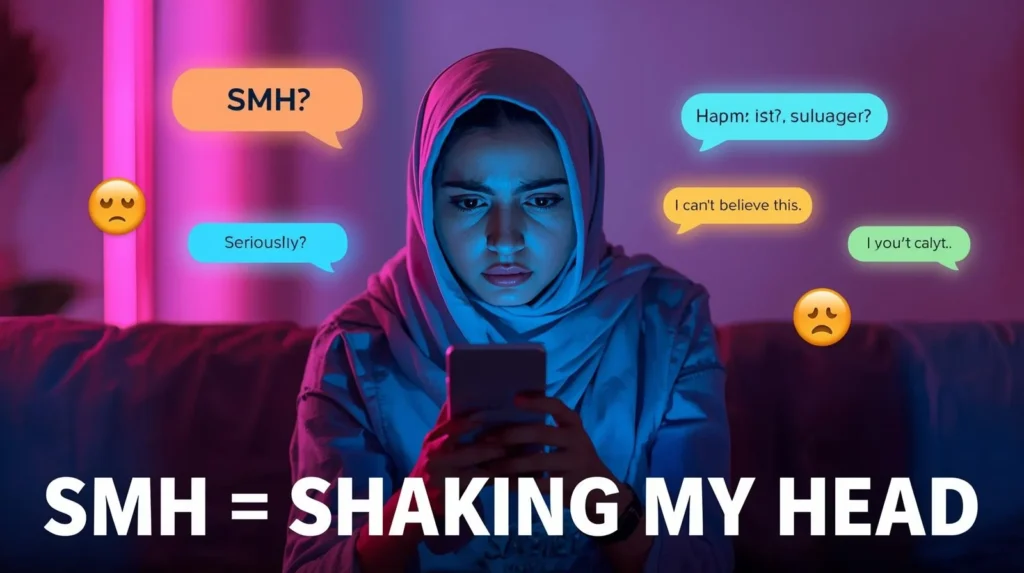
What Does SMH Mean in Texting?
Last updated: April 13, 2026
SMH stands for “Shaking My Head” — internet slang used to express disappointment, disbelief, or mild frustration at something you find stupid, cringeworthy, or just deeply unfortunate. When someone types SMH, they’re doing the textual equivalent of slowly shaking their head at whatever just happened.
That’s the core definition. Everything below explains the nuances that actually matter when you see it in the wild.
Table of Contents
What SMH Actually Communicates
SMH is a reaction, not a statement. You wouldn’t open a conversation with SMH — you’d use it in response to something. The emotion it conveys can range from light-hearted exasperation (“SMH, why do I always forget my charger”) to genuine disappointment (“They lost the lead in the final minute. SMH.”) to mock outrage at something absurd.
It operates on a spectrum:
- Mild SMH — affectionate exasperation, used on yourself or a friend doing something predictably silly
- Medium SMH — genuine disbelief at something that should have gone differently
- Heavy SMH — real disappointment or frustration, often at someone doing something obviously wrong
The context and what surrounds the SMH always determines which register it falls into. SMH alone at the end of a text reads very differently from a long rant followed by “SMH.”
SMH Examples in Context
Reacting to someone else’s decision:
- “He wore flip flops to a job interview. SMH.”
- “They cancelled the show after one season. SMH.”
Self-directed SMH:
- “I studied the wrong chapter for the exam. SMH at myself.”
- “SMH I left my umbrella at home and it’s been raining all day.”
Reacting to news or events:
- “Another three-hour flight delay. SMH.”
- “They raised the subscription price again. SMH.”
Affectionate / playful:
- “You forgot my birthday again… SMH you’re the worst” (clearly joking between friends)
- “My dog ate my homework. Literally. SMH.”
Notice that SMH is almost always placed at the beginning or end of a sentence — rarely in the middle. Both positions work. At the start, it primes the reader for frustration. At the end, it’s the punchline or the exhale after the complaint.
SMH vs SMDH: What’s the Difference?
You’ll also see SMDH — “Shaking My Damn Head.” It’s exactly the same meaning as SMH, just amplified. SMDH signals deeper disbelief or more serious frustration. If SMH is a head shake, SMDH is a slow, eyes-closed head shake.
Use SMDH when the situation is so egregious that a regular head shake doesn’t cover it. “They deleted three seasons of content from the streaming platform with no warning. SMDH.”
Other SMH Meanings (Rare, But Worth Knowing)
“Shaking My Head” accounts for probably 99% of SMH usage you’ll encounter. There are a couple of edge cases:
- “So Much Hate” — very occasionally used in gaming or social media drama contexts, but genuinely uncommon. If someone says “the comments section is SMH,” they almost certainly mean “Shaking My Head” in response to hate, not “So Much Hate” as a standalone term.
- “Scratching My Head” — used by a small number of people to indicate confusion rather than disappointment. Context usually makes it clear.
When in doubt, assume “Shaking My Head” — you’ll be right almost every time.
SMH vs Other Honesty and Reaction Slang
SMH belongs to a family of reaction acronyms that convey a specific emotional state rather than a statement:
| Acronym | Stands For | Vibe |
|---|---|---|
| SMH | Shaking My Head | Disappointment / disbelief |
| SMDH | Shaking My Damn Head | Intensified SMH |
| NGL | Not Gonna Lie | Personal honesty / candor |
| TBH | To Be Honest | Honest opinion, often diplomatic |
| FR | For Real | Emphasizing something is true |
| SMH FR | Shaking My Head, For Real | Combined: disappointed + genuinely serious |
SMH is purely reactive. It doesn’t introduce an opinion the way NGL does (“NGL, that was bad”) — it is the reaction, standing on its own or punctuating a description of events.
When NOT to Use SMH
Like all internet slang, SMH is casual by nature. It belongs in:
- Text messages and DMs
- Social media comments and captions
- Group chats and Discord servers
- Informal Slack conversations with close colleagues
Avoid it in:
- Professional emails and workplace communication (unless you genuinely know the culture allows it)
- Academic or formal writing
- Any context where tone could be misread — SMH can come across as dismissive or condescending if the other person isn’t sure you’re being playful
Quick Summary
| Stands for | Shaking My Head |
| Used for | Expressing disappointment, disbelief, or mild frustration |
| Tone | Exasperated, disappointed, sometimes playful |
| Placement | Beginning or end of a sentence |
| Intensified version | SMDH (Shaking My Damn Head) |
| Avoid in | Formal emails, professional writing, academic contexts |
| Related slang | SMDH, NGL, TBH, FR |
Frequently Asked Questions
What does SMH mean in texting?
SMH stands for “Shaking My Head.” It’s used in texts to express disappointment, disbelief, or mild frustration — the digital version of literally shaking your head at something.
What does SMH mean on TikTok and Instagram?
Same meaning everywhere: “Shaking My Head.” On social platforms it appears in captions, comments, and stitches to express a reaction to something the creator or commenter finds stupid, frustrating, or disbelieving.
Is SMH negative?
Usually, yes — but not always harshly so. SMH often conveys mild, sometimes affectionate exasperation rather than serious anger. “SMH I did it again” at yourself is very different from “SMH they actually did that” about someone’s bad decision.
What’s the difference between SMH and SMDH?
SMDH (Shaking My Damn Head) is just an intensified version of SMH. Use SMDH when regular disappointment doesn’t capture the scale of what you’re reacting to.
Can SMH mean anything else?
Occasionally “So Much Hate” or “Scratching My Head,” but these are rare. In any everyday texting or social media context, assume “Shaking My Head.”
What’s the difference between SMH and NGL?
SMH is a pure reaction — it expresses how you feel about something. NGL (Not Gonna Lie) introduces an honest statement or admission. You’d use SMH after watching someone make a bad decision; you’d use NGL to preface your honest take on it.
[simple-author-box]