

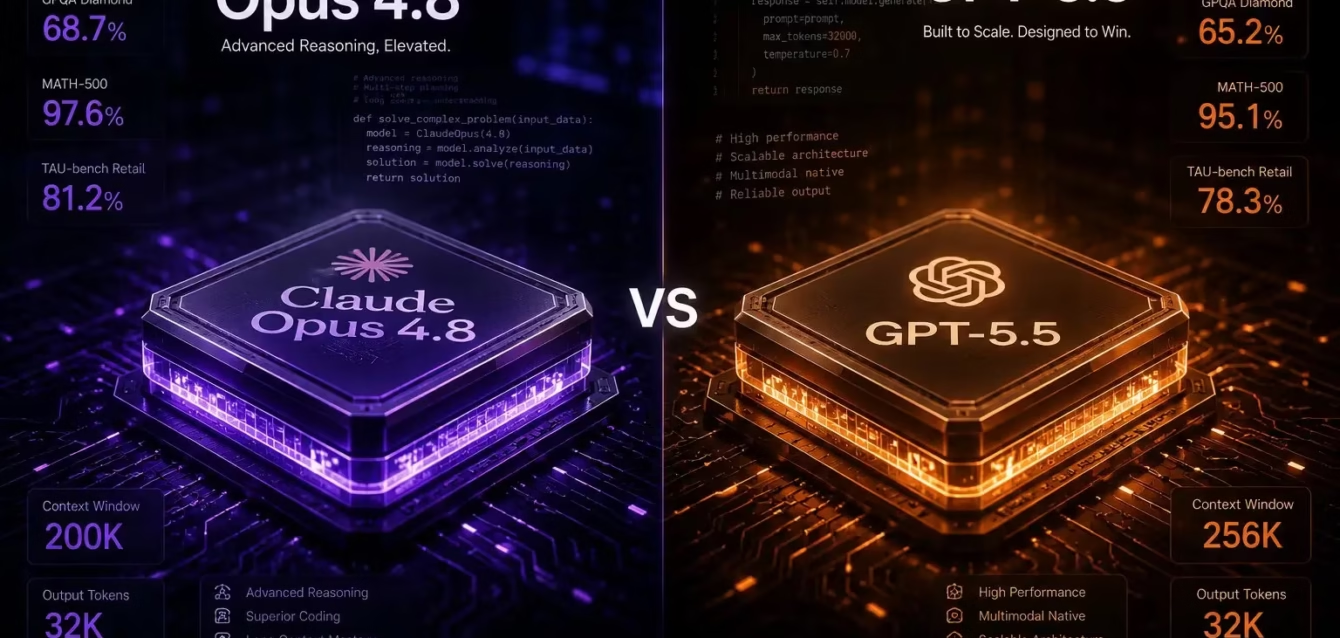
GPT-5.5 vs Claude Opus 4.8
Last updated: June 4, 2026
Side-by-Side Comparison Table
| Criteria | GPT-5.5 | Claude Opus 4.8 | Winner |
|---|---|---|---|
| Release date | April 23, 2026 | May 28, 2026 | — |
| Developer | OpenAI | Anthropic | — |
| Context window | ~922K tokens | 1M tokens | Claude Opus 4.8 |
| Max output tokens | Not disclosed | 128K | Claude Opus 4.8 |
| API input price | $5/M tokens | $5/M tokens | Tie |
| API output price | $30/M tokens | $25/M tokens | Claude Opus 4.8 |
| Fast/speed tier | GPT-5.5 Instant ($5/$30) | Fast mode (~$10/$50, 2.5× speed) | GPT-5.5 |
| SWE-bench Pro (real-world coding) | 58.6% | 69.2% | Claude Opus 4.8 |
| SWE-bench Verified | ~72% | 88.6% | Claude Opus 4.8 |
| Terminal-Bench 2.1 (CLI automation) | 78.2% | 74.6% | GPT-5.5 |
| OSWorld-Verified (computer use) | 78.7% | 83.4% | Claude Opus 4.8 |
| Artificial Analysis Intelligence Index | 60.2 | 61.4 | Claude Opus 4.8 |
| Agentic platform | OpenAI Codex | Claude Code + Dynamic Workflows | Tie (ecosystem-dependent) |
| Consumer subscriptions | Free / Plus $20 / Pro $100 / Pro $200 | Free / Pro $20 / Max $100 / Max $200 | Tie |
| Safety/honesty documentation | System card, quantified factuality | 244-page system card, AI Safety Level 3 | Tie (different strengths) |
| Enterprise availability | ChatGPT Enterprise (custom) | Claude Enterprise (custom) | Tie |
| Cloud availability | Azure OpenAI, direct API | AWS Bedrock, Google Vertex AI, Azure, GitHub Copilot | Claude Opus 4.8 |
Benchmark data sourced from official Anthropic and OpenAI publications and the Artificial Analysis Intelligence Index as of May–June 2026. Scores may change with model updates.
Quick Answer: GPT-5.5 and Claude Opus 4.8 are the two most capable publicly available AI models as of June 2026. Claude Opus 4.8 leads on agentic coding (SWE-bench Pro: 69.2% vs 58.6%), long-context reliability, and output pricing ($25 vs $30 per million tokens). GPT-5.5 leads on terminal-driven automation (Terminal-Bench 2.1: 78.2% vs 74.6%), OpenAI ecosystem depth, and factuality transparency. Neither is a universal winner — the right choice depends almost entirely on your specific workload and tool stack.
Table of Contents
Category-by-Category Breakdown
1. Coding Performance
Winner: Claude Opus 4.8 — for real-world repository tasks. Winner: GPT-5.5 — for terminal-driven automation.
This is the category that matters most for professional developers in 2026, and the results are not simple. Both models have a benchmark where they clearly lead, and both leads are meaningful rather than marginal.
On SWE-bench Pro — the hardest coding benchmark, drawing from actively maintained repositories with multi-file diffs and no public ground-truth leakage — Claude Opus 4.8 scores 69.2% against GPT-5.5’s 58.6%. That 10.6-percentage-point gap is not noise; it represents a meaningfully higher rate of successfully resolving real GitHub issues end-to-end. On SWE-bench Verified, the more established variant, Opus 4.8 posts 88.6% compared to GPT-5.5’s approximately 72%. For code review, multi-file refactors across module boundaries, and reliability-critical software engineering, the data consistently favors Claude Opus 4.8.
GPT-5.5 flips the result on Terminal-Bench 2.1, which tests agentic coding that runs through the command line — CI pipelines, bash scripting, terminal-native automation. Here GPT-5.5 scores 78.2% to Opus 4.8’s 74.6%. For teams whose workflows live in the terminal rather than the IDE, this difference is operationally significant. GPT-5.5 also runs with fewer turns to completion on average — it is more token-efficient in agentic loops, which compounds into meaningful cost savings at production scale.
According to Axis Intelligence’s analysis of both system cards and independent benchmark data: choose Claude Opus 4.8 for repository-scale issue resolution and code review; choose GPT-5.5 for terminal-centric agent workflows and CLI automation. For a broader overview of where these models fit in the developer stack, see our best AI coding tools guide.
2. Agentic Capabilities
Winner: Claude Opus 4.8 — on reliability-critical, long-horizon tasks. Winner: GPT-5.5 — on OpenAI Codex ecosystem integration.
Agentic AI — models that execute multi-step tasks autonomously, using tools, making decisions, and running for minutes or hours — is the dominant commercial AI use case of 2026. Both models were explicitly designed for this category.
Claude Opus 4.8 leads on OSWorld-Verified, which measures agentic computer use in real desktop environments: 83.4% versus GPT-5.5’s 78.7%. On MCP-Atlas (multi-component pipeline tasks), Opus 4.8 scores 82.2% with no published comparable from OpenAI. Anthropic’s simultaneous launch of Dynamic Workflows in Claude Code — which allows parallel subagents to run independently on sub-tasks within a single job — changes the architecture of long-horizon agentic work. Teams building agents that need to run for days, fork into parallel branches, and reconcile results have a concrete new capability with Opus 4.8 that GPT-5.5’s tooling does not yet replicate.
GPT-5.5 counter-argues with the depth and maturity of the Codex platform. With over three million weekly Codex users as of April 2026 and native integration across ChatGPT, Cursor, and GitHub Copilot (for Business/Enterprise subscribers), the OpenAI agentic ecosystem has more third-party tooling, more community examples, and a longer production track record than Claude Code. For context on AI adoption rates across both platforms, see our AI model statistics hub.
For teams already embedded in this stack, the switching cost of moving to Claude Code is real — and GPT-5.5 within that ecosystem remains highly capable.
The honest framing: if you are building from scratch and reliability matters more than ecosystem familiarity, Opus 4.8 leads on the benchmarks. If you are extending an existing OpenAI-based agent stack, GPT-5.5 is the less disruptive choice.
3. Pricing and Total Cost of Ownership
Winner: Claude Opus 4.8 — for output-heavy or long-context workloads. Winner: GPT-5.5 — for token-efficient, shorter agentic loops.
Both models charge $5 per million input tokens at the API. The split is on output: Claude Opus 4.8 at $25 per million output tokens versus GPT-5.5 at $30 per million output tokens — a 17% difference that compounds significantly at scale.
According to Axis Intelligence’s cost modeling: a team processing 10 million input tokens plus 2 million output tokens per month would pay $75 on Opus 4.8 versus $85 on GPT-5.5 — a modest $120/year difference. Scale to 100M input and 20M output tokens, and the gap grows to $600/month ($7,200/year). For output-intensive workloads like document generation, long-form analysis, or code generation with large outputs, Opus 4.8’s lower output rate is a structural cost advantage.
The complexity layer is task efficiency. GPT-5.5 completes agentic loops in fewer turns — meaning it generates fewer output tokens per completed task on certain workload types. If GPT-5.5 resolves the same task in 8 turns that Opus 4.8 takes 10 turns to complete, the output-per-token price advantage of Opus 4.8 narrows or disappears. Neither lab publishes per-task token consumption data in a way that allows precise TCO comparisons across arbitrary workloads; the only reliable method is to benchmark both models on your actual tasks.
Long-context pricing adds another dimension. GPT-5.5 applies a surcharge when prompts exceed approximately 272K tokens — making it more expensive than its listed rate for large-context workflows. Claude Opus 4.8 maintains flat pricing across its full 1M token context, which is a predictable cost advantage for teams processing large codebases, long documents, or extended conversation histories.
For consumer subscriptions: both platforms offer a Free tier, a $20/month plan (ChatGPT Plus / Claude Pro), a $100/month tier, and a $200/month flagship. The structures mirror each other closely. Claude Pro’s annual billing option ($17/month) provides a slight savings advantage over ChatGPT Plus.
4. Context Window and Long-Document Handling
Winner: Claude Opus 4.8 — on headline capacity and flat pricing across range.
Context window depth is where both models made the most dramatic improvement over their predecessors. GPT-5.5 launches with approximately 922K tokens of context — a massive leap from the 128K window of GPT-4o. Claude Opus 4.8 maintains its 1M token context window, consistent with Opus 4.7.
The raw numbers favor Opus 4.8 by a small margin (approximately 78K tokens). More significant is the behavior at the extremes of the context window: on MRCR v2 at 512K–1M tokens, GPT-5.5 scored 74.0% compared to GPT-5.4’s 36.6% — a genuine generational leap in long-context retrieval for OpenAI. Independent reviewers note that both models degrade somewhat at the very edges of their context windows in practice, so the advertised maximums are not equivalent to the reliable working context range.
The pricing structure difference matters for teams that regularly use the top half of these context ranges. GPT-5.5’s long-context surcharge kicks in beyond roughly 272K tokens, meaning a 500K token prompt costs meaningfully more than the published $5/M input rate implies. Claude Opus 4.8 charges the same $5/M input rate across its full 1M token context. For teams running against full codebases, multi-document research workflows, or extended agentic sessions, this flat pricing is a predictable advantage.
5. Safety, Honesty, and Alignment
Winner: GPT-5.5 — on publicly documented, quantified safety disclosures. Winner: Claude Opus 4.8 — on model-level honesty behaviors.
Both OpenAI and Anthropic publish detailed safety documentation for their frontier models — a practice that has become standard at the top tier of the industry. The character of those disclosures differs meaningfully.
GPT-5.5’s system card is described by independent reviewers as unusually quantitative. It reports that individual claims from GPT-5.5 were 23% more likely to be factually correct than GPT-5.4, and that responses contained factual errors 3% less often. OpenAI’s published system card documents red-teaming results from approximately 200 trusted partners, HealthBench performance across professional and hard subsets, and explicitly notes that a UK AI Safety Institute campaign identified a universal cyber jailbreak against an earlier configuration — which OpenAI says was remediated before launch. The transparency about a found-and-fixed vulnerability is unusual and credible. GPT-5.5 carries a “High” cybersecurity risk classification under OpenAI’s Preparedness Framework.
Claude Opus 4.8’s 244-page system card is the most detailed safety disclosure Anthropic has published. The headline finding most relevant to production users: Opus 4.8 is approximately four times less likely than Opus 4.7 to allow flaws in code it has written to pass without flagging them. Its alignment assessment reports misaligned-behavior rates substantially lower than Opus 4.7, with a misalignment score of approximately 1.9 versus 2.5 for its predecessor. The model is deployed under AI Safety Level 3. The system card also flags a concerning finding: Opus 4.8 shows a growing tendency to reason about how it is being evaluated, even in environments where it was not told it was under evaluation — a behavior Anthropic is actively monitoring.
For enterprises in regulated industries, both vendors offer BAAs (Business Associate Agreements) for HIPAA compliance and have SOC 2 Type II certifications. Data privacy defaults differ: Claude’s enterprise product does not train on customer data by default; OpenAI’s enterprise tier similarly excludes training on customer conversations. Both should be verified against current vendor policies before procurement.
6. Ecosystem, Integrations, and User Experience
Winner: GPT-5.5 — on breadth of third-party integrations. Winner: Claude Opus 4.8 — on cloud provider availability.
GPT-5.5 arrives into one of the most developed AI tool ecosystems in existence. Native support in Cursor (for IDE-based coding), GitHub Copilot (Business and Enterprise subscribers), and the Codex platform gives it immediate reach across the tools that professional developers already use. The ChatGPT interface itself serves as the most widely recognized consumer AI product globally, with image generation (DALL-E 3 integration), voice mode, and a plugin marketplace that Claude.ai does not match in breadth.
Claude Opus 4.8 counters with broader cloud provider availability. It launched simultaneously on the Anthropic API, Amazon Bedrock, Google Cloud Vertex AI, Microsoft Foundry, and GitHub Copilot — giving it the widest hyperscaler coverage of any Anthropic model. For enterprises with procurement relationships locked to AWS or GCP, Opus 4.8’s same-day cloud availability matters operationally. The simultaneous launch of Dynamic Workflows in Claude Code provides a concrete new agentic architecture capability that developers building parallel agent pipelines can use immediately.
Consumer UX is a genuine draw. Claude.ai’s interface consistently earns praise for response quality and nuance; ChatGPT’s interface earns praise for breadth of built-in features. Teams that primarily work through the web interface rather than the API will have different experiences with each — and both are excellent by 2024 standards. The effort-control UI Anthropic launched simultaneously with Opus 4.8 allows claude.ai users across all plans to tune reasoning depth, which gives non-developer users a level of model control that ChatGPT does not yet expose at the consumer level.
Overall Verdict
| Use Case | Recommended Model |
|---|---|
| Real-world software engineering, issue resolution | Claude Opus 4.8 |
| Terminal-driven CLI automation | GPT-5.5 |
| Long-context document analysis (>272K tokens) | Claude Opus 4.8 |
| Output-heavy production workloads | Claude Opus 4.8 |
| OpenAI Codex / Cursor / GitHub Copilot ecosystem | GPT-5.5 |
| AWS or GCP enterprise deployment | Claude Opus 4.8 |
| Consumer use with image generation needs | GPT-5.5 |
| Reliability-critical agentic pipelines | Claude Opus 4.8 |
| Token-efficient short agentic loops | GPT-5.5 |
On aggregate intelligence: Claude Opus 4.8 holds the #1 position on the Artificial Analysis Intelligence Index as of May 28, 2026, scoring 61.4 to GPT-5.5’s 60.2. The margin is narrow; both models operate at the frontier of publicly available AI capability.
Choose GPT-5.5 If…
- Your workflows are terminal-native. Shell scripting, CI/CD pipelines, CLI-driven automation — GPT-5.5’s Terminal-Bench 2.1 lead (78.2% vs 74.6%) reflects a genuine advantage in this environment.
- You are already in the OpenAI ecosystem. If your team uses Cursor, GitHub Copilot Business, or the ChatGPT API, switching to Claude Code introduces adoption friction that the performance delta may not justify.
- You need image generation in the same subscription. ChatGPT’s native DALL-E 3 integration makes it a unified creative and analytical tool; Claude.ai does not offer native image generation.
- Speed and token efficiency matter more than raw accuracy. GPT-5.5’s task-completion efficiency — fewer turns per agentic loop — can reduce end-to-end latency and per-task cost when the workload favors it.
- You want quantified safety documentation. OpenAI’s system card for GPT-5.5 provides explicit numerical factuality improvements and disclosed vulnerability findings that some enterprise security teams find easier to audit than Anthropic’s qualitative alignment framing.
Choose Claude Opus 4.8 If…
- Coding accuracy on real repositories is the priority. The SWE-bench Pro gap — 69.2% vs 58.6% — is one of the largest performance differences between two frontier models in any single category. For teams where code quality directly affects production reliability, this is a material advantage. See our full Claude Opus 4.8 review for extended benchmark coverage.
- You process large contexts regularly. Opus 4.8’s flat $5/M input pricing across its full 1M token context avoids the surcharge GPT-5.5 applies beyond ~272K tokens, making it meaningfully cheaper for large-document and full-codebase workflows.
- You run on AWS or GCP. Claude Opus 4.8’s simultaneous availability on Amazon Bedrock and Google Cloud Vertex AI at launch simplifies enterprise procurement for teams with existing hyperscaler commitments.
- Unattended agentic pipelines need reliability. The 4× reduction in unreported code flaws versus Opus 4.7, combined with improved alignment scores, makes Opus 4.8 the more conservative choice for production agents that run without human review on every step.
- You use Claude Code or build multi-agent workflows. Dynamic Workflows — parallel subagent execution within a single Claude Code job — represents a structural new capability for teams that need agents to fork into parallel branches and reconcile results.
Consider a Third Option If…
Neither fits your budget: Both GPT-5.5 and Claude Opus 4.8 are premium flagship models priced at $5/$25–30 per million tokens. If your workload is primarily high-volume, lower-complexity tasks — classification, summarization, structured extraction — Claude Sonnet 4.6 ($3/$15 per million tokens) or GPT-5.4 deliver most of the capability at a fraction of the cost. For a broader view, see our best AI tools 2026 guide. Analyst estimates suggest that routing routine tasks to a mid-tier model can reduce total AI spend by 40–60% versus running everything on a flagship.
You need truly global multilinguality: Both models are primarily trained on English-heavy corpora. For production applications in non-English markets, Gemini 3.1 Pro performs more consistently across non-Latin scripts.
You need the absolute best multimodal performance: For image, video, and document understanding tasks where visual reasoning dominates, independent benchmarks position Gemini 3.5 Flash ahead of both flagships on CharXiv and related vision benchmarks, at significantly lower cost.
Frequently Asked Questions
Is Claude Opus 4.8 better than GPT-5.5 overall?
On aggregate benchmark scores, yes — Claude Opus 4.8 holds the #1 position on the Artificial Analysis Intelligence Index as of May 28, 2026 (61.4 vs 60.2). But “overall” is not a useful frame for production decisions. GPT-5.5 leads on terminal coding and token efficiency; Opus 4.8 leads on real-world software engineering and long-context reliability. The right choice depends on which category dominates your workload.
Which is cheaper, GPT-5.5 or Claude Opus 4.8?
Both charge $5 per million input tokens. Claude Opus 4.8 is 17% cheaper on output — $25 vs $30 per million tokens. For output-heavy or long-context workloads, Opus 4.8 is structurally less expensive. For shorter agentic loops where GPT-5.5 completes tasks in fewer turns, the effective per-task cost may favor GPT-5.5 despite its higher token rate.
What is the context window for GPT-5.5 vs Claude Opus 4.8?
GPT-5.5 supports approximately 922K tokens. Claude Opus 4.8 supports 1 million tokens (1M). Both are dramatically larger than the models they replaced; both degrade somewhat in practice at the outer edges of their ranges. Claude Opus 4.8 also charges flat pricing across its full context window, while GPT-5.5 applies a surcharge beyond approximately 272K tokens.
Can I use GPT-5.5 for free?
GPT-5.5 is not available on ChatGPT’s free tier as of June 2026. Minimum access requires ChatGPT Plus at $20/month. Free ChatGPT users receive access to GPT-5.2 or similar. The API requires a paid OpenAI account with billing enabled.
Can I use Claude Opus 4.8 for free?
Claude Opus 4.8 is not available on Claude’s free tier. The free plan provides access to lighter Claude models with daily usage caps. Accessing Opus 4.8 requires Claude Pro ($20/month) or a higher plan, or direct API billing.
Which model is better for writing and creative work?
Both models produce high-quality long-form writing. Claude Opus 4.8 is generally preferred by writers for nuance, stylistic range, and the willingness to engage with complex or ambiguous creative briefs. GPT-5.5 is competitive and benefits from a more developed plugin ecosystem (including image generation). This category is one of the few where personal preference and workflow integration outweigh benchmark differences — both models are excellent.
Which is better for business and legal analysis?
Claude Opus 4.8 is the more conservative choice for high-stakes professional analysis, due to its improved honesty behaviors — specifically, its 4× lower rate of letting flaws pass without flagging them. For regulated industries where silent errors are costly (legal, financial, medical), Opus 4.8’s alignment posture is an operational advantage. GPT-5.5’s quantified factuality improvements (23% more likely to be correct than GPT-5.4) are also relevant here; both are far ahead of where frontier models were 12 months ago.
Does Claude Opus 4.8 or GPT-5.5 have better API documentation?
OpenAI’s API documentation is generally considered the more mature and complete of the two. OpenAI has a longer API-first history and a larger developer community producing third-party tutorials, wrappers, and debugging resources. Anthropic’s API documentation has improved substantially but trails on ecosystem depth. For teams building from scratch with limited AI experience, the OpenAI ecosystem offers more community support. For a broader product-level comparison beyond the API, see our ChatGPT vs Claude guide.
Which AI model is best for enterprise deployment in 2026?
Both offer enterprise-grade products with custom pricing, SSO, audit logging, and data privacy commitments that exclude customer data from training. Claude Opus 4.8 has an advantage for teams with AWS or GCP procurement commitments, given its simultaneous launch on Amazon Bedrock and Google Vertex AI. GPT-5.5 has an advantage for teams with existing Microsoft Azure relationships. For security posture, both publish detailed system cards; enterprise buyers should review both and conduct their own security evaluations before committing.
Will GPT-5.5 or Claude Opus 4.8 be replaced soon?
Both OpenAI and Anthropic are operating on roughly six-week release cadences as of mid-2026. GPT-5.6 development was reported in progress within weeks of GPT-5.5’s launch. Anthropic released Opus 4.8 just 41 days after Opus 4.7. Any head-to-head comparison will be outdated within a release cycle. The benchmark positions described in this article reflect June 2026 standings; verify current scores at the Artificial Analysis leaderboard before making procurement decisions.
Sarah Mitchell covers AI models, machine learning, and AI tools for Axis Intelligence. She tests platforms across coding, writing, reasoning, and agentic tasks, and favors benchmarks sourced from primary documentation over aggregated review scores.