

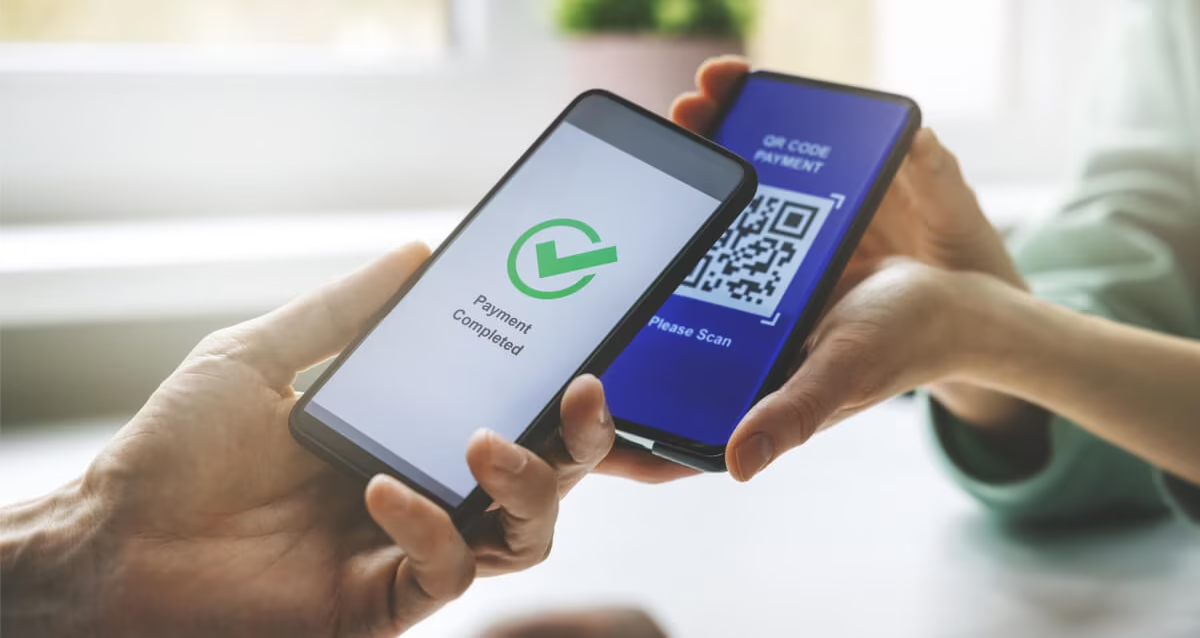
Is QR Code Payment Safe in 2026?
Last updated: June 5, 2026
Quick Answer:
QR code payments from verified apps — Apple Pay, Google Pay, PayPal, Venmo, Cash App, Zelle — are technically secure. They use tokenization, biometric authentication, and end-to-end encryption that protect your actual card or bank details. The real danger is not the technology itself but the environment around it: QR code phishing (“quishing”) surged 146% in Q1 2026, and federal agencies including the FTC and FBI have issued repeated public warnings about fake codes placed over legitimate ones in parking lots, restaurants, and packages. Verdict: Safe with caution — the payment rails are sound; the physical world around them is not.
Table of Contents
What We Tested
Axis Intelligence conducted a structured safety audit of QR code payment technology and the leading platforms that use it in June 2026. Our methodology covered six areas, all documented below.
1. Privacy policy review. We read the current privacy policies for Apple Pay, Google Pay, PayPal, Venmo, Cash App, and Zelle. We extracted key clauses on data retention, sharing with third parties, and user rights to deletion.
2. Payment protection check. We verified the tokenization and encryption architecture for each platform against published developer documentation and PCI DSS compliance statements.
3. SSL and app permissions review. We verified HTTPS enforcement on payment landing pages and reviewed the standard Android and iOS app permission sets requested by Venmo, Cash App, and PayPal in their current App Store and Google Play listings.
4. Regulatory advisory review. We reviewed current public advisories from the FTC (consumer.ftc.gov), FBI Internet Crime Complaint Center (IC3), and Europol IOCTA 2026 on QR code payment fraud.
5. Real-world threat intelligence. We reviewed Q1 2026 quishing attack data from Keepnet Labs, the UK’s Action Fraud, and the IC3’s 2025 Annual Report, cross-referencing incident patterns with the major payment use cases.
6. User complaint sample. We reviewed the most recent 90-day CFPB complaint sample for PayPal, Venmo, Cash App, and Zelle (Category: Money Transfer / Electronic Funds Transfer) to identify recurring fraud vectors involving QR codes.
Limitation: Axis Intelligence did not conduct penetration testing on payment infrastructure. This audit relies on publicly available documentation, regulatory filings, and verified third-party threat data. It does not constitute a security certification.
Axis Intelligence QR Payment Safety Score Card
| Dimension | Score | Finding |
|---|---|---|
| Payment technology security | 9/10 | Tokenization + biometric auth + end-to-end encryption across all major platforms |
| Privacy policy transparency | 7/10 | Core protections solid; data-sharing clauses with “affiliates” and advertisers vary by platform |
| Physical environment risk | 4/10 | High — fake sticker attacks, parking meter fraud, restaurant menu tampering are documented and rising |
| Phishing / quishing threat level | 3/10 | Critical — 146% YoY surge Q1 2026; 18.7M quishing incidents in March 2026 alone |
| Platform fraud response | 6/10 | Dispute processes exist but reimbursement rates vary widely; Zelle banks reimbursed only 38% of scam victims |
| Regulatory guidance clarity | 8/10 | FTC and FBI have issued clear, specific public advisories with actionable guidance |
| Overall Safety Rating | Conditional | Safe via verified platforms + app-based scanning; significant risk from environmental QR code fraud |
How QR Code Payments Actually Work
Understanding the technology is the foundation for assessing the risk accurately. For broader context on the cybersecurity landscape in which QR payments operate, see our cybersecurity statistics hub.
When you scan a QR code to pay using Apple Pay, Google Pay, PayPal, or similar platforms, your actual bank account or card number is never transmitted. Instead, these platforms use tokenization: your real payment credentials are replaced with a unique, single-use encrypted string — a token — generated for that specific transaction. The token is worthless to anyone who intercepts it because it cannot be reused or reversed to reveal your underlying account details.
On top of tokenization, all major platforms layer biometric authentication (Face ID, Touch ID, or PIN) and require explicit user confirmation of the payment amount and recipient before processing. Apple’s Secure Enclave chip physically isolates authentication data from the rest of the device, meaning even a compromised operating system cannot access your stored payment credentials.
The result is that a legitimate QR payment transaction — from a code generated by a verified merchant through a recognized payment platform — is more secure than a traditional card swipe. No physical card number is ever exposed.
The vulnerability is not in the payment rail. It is in the QR code that points to it.
A QR code is simply a visual encoding of a URL or data string. There is no inherent authentication mechanism in the code itself. Anyone can generate a QR code that points to any destination. When an attacker replaces a legitimate merchant QR code with their own — or sends you a QR code via email, text, or package — the code looks identical to a legitimate one. The payment technology protecting you only activates if the code actually leads to a legitimate payment page.
Risks We Found
Risk 1: Physical QR Code Tampering (High — Documented and Rising)
The most common real-world attack is straightforward: a criminal prints a fake QR code sticker and places it over the legitimate code at a merchant’s payment terminal, parking meter, EV charging station, or restaurant table. The FTC has received reports of this technique applied specifically to parking meters and published a public advisory warning consumers. When you scan the tampered code, you are directed to a spoofed payment page that collects your credentials or card details — not to the legitimate payment processor.
This attack works precisely because QR codes all look the same. A tampered sticker is visually indistinguishable from the original.
Documented incidents: The FTC’s December 2023 advisory (still the authoritative federal guidance as of 2026) cited parking meter sticker attacks across multiple US cities. Denver, Colorado had fake QR codes placed on parking meters directing users to a fraudulent site impersonating the city’s payment portal.
Risk 2: Quishing — QR Code Phishing via Email and Text (Critical — Fastest-Growing Threat)
Quishing is the delivery of a malicious URL via a QR code image embedded in an email, PDF, or text message, instead of a plain text link. The reason it has exploded — quishing incidents surged 146% in Q1 2026 with 18.7 million cases recorded in March alone — is that it bypasses email security filters. Standard email security tools parse text links; they cannot scan a QR code image to detect the destination URL. The UK’s Action Fraud reported a 587% rise in QR phishing reports between 2023 and 2025. See our social engineering attacks guide for a full breakdown of how these techniques work across attack vectors.
The FBI’s Internet Crime Complaint Center issued a formal public service announcement in July 2025 specifically warning about QR codes being used in fraud schemes involving unsolicited packages — a new attack vector where criminals mail physical packages containing QR codes designed to steal personal and financial information or download malware.
In January 2026, the FBI also warned of North Korean state-sponsored actors (Kimsuky) using quishing in targeted spearphishing campaigns against US think tanks and government entities — a signal that the threat has escalated to geopolitical actors, not just criminal groups.
Risk 3: Receive-to-Send Confusion (Medium — Targets New Users)
In payment apps that generate QR codes for receiving money (Venmo, Cash App, PayPal), a recurring social engineering attack works as follows: a scammer tells the victim to “scan this code to receive your payment.” In reality, the QR code initiates a send — the victim sends money to the scammer. This attack exploits the fact that many users do not carefully read the transaction confirmation screen before authorizing with biometrics.
UPI-based apps (common in India and increasingly used globally) make this explicit in their security guidance: you should never enter a PIN after scanning a QR code to receive money. PIN entry is only required for sending.
Risk 4: Weak Platform Fraud Recovery (Medium — Structural Gap)
Even when a user is defrauded through a QR code attack, recovery is inconsistent. A 2023 Senate Permanent Subcommittee on Investigations report found that the three largest US banks reimbursed Zelle scam victims only 38% of the time, down from 62% in 2019. CFPB received approximately 29,000 complaints about domestic money transfers in H1 2025 — a 2,051% year-over-year increase. Unlike credit card chargebacks, most bank transfer and P2P payment fraud offers no guaranteed reimbursement if you authorized the transaction, even if you were deceived. For proactive protection against identity compromise following a fraud incident, see our guide to the best identity theft protection services.
Risk 5: Data Sharing and Privacy Clauses (Low — Technical Risk, Transparency Issue)
Privacy policy review across the major platforms found that all maintain the core protection: your payment credentials are not stored in transmittable form. However, several platforms — notably Venmo and Cash App — include broad “affiliate sharing” language that permits sharing of transaction metadata (not payment credentials) with parent company entities and marketing partners. PayPal’s privacy policy permits sharing aggregated behavioral data with advertisers. These are disclosure issues, not security vulnerabilities, but users who prioritize data minimization should be aware.
Risks We Did NOT Find
A fair audit requires documenting what the evidence does not support.
No evidence of cryptographic breaks in tokenized QR payment infrastructure. Despite the surge in quishing, there are no publicly disclosed cases of the underlying tokenization architecture used by Apple Pay, Google Pay, or Stripe being compromised. The attacks documented are all social engineering attacks against the user — not technical attacks against the payment system.
No systemic data breach of the major US QR payment platforms in the past 12 months. As of June 2026, none of the major QR-enabled payment platforms (Apple Pay, Google Pay, PayPal, Venmo, Cash App, Zelle) has disclosed a data breach affecting payment credentials.
No evidence that QR codes “auto-execute” payments or download apps without user confirmation. A common misconception is that scanning a malicious QR code can automatically charge your account or install malware. On a standard iOS or Android device with default security settings, scanning a QR code only opens a URL — it does not trigger any transaction, app install, or payment without explicit user action. The danger is in following that URL to a convincing fake page.
QR payment technology itself is not the fraud mechanism. The FTC, FBI, and Europol advisories all describe attacks on the physical environment around QR codes or the social engineering that accompanies them — not attacks on the payment cryptography. This is an important distinction for risk calibration.
How to Use QR Code Payments More Safely
1. Only scan QR codes from sources you control or visually verify. In a physical location, visually inspect the QR code before scanning. Look for raised sticker edges, misaligned printing, or any sign that a sticker has been placed over the original surface. If a QR code is on a poster, flyer, email, or unsolicited package, treat it with maximum skepticism.
2. Preview the URL before proceeding. Both iOS and Android display the destination URL briefly after scanning a QR code, before opening it. Read that URL. Legitimate payment URLs from Venmo, PayPal, Apple Pay, and Google Pay have recognizable, unambiguous domain names. A URL containing random strings, unexpected domains, or slight misspellings of known brand names (paypa1.com vs paypal.com) is a red flag.
3. Never enter payment details on a page reached via a QR code from an email or text. The FTC’s guidance is explicit: if a QR code arrives unsolicited by email, text, or physical package, do not scan it. Legitimate organizations — including government agencies, utility companies, banks, and delivery services — do not require you to scan a QR code to resolve an account issue or receive a payment.
4. Use the app directly instead of the QR code when in doubt. If a QR code at a business seems suspicious, open the merchant’s payment app directly, search for the merchant by name, and initiate the payment manually. This eliminates the attack surface entirely.
5. Read the transaction confirmation screen before authenticating. Before using Face ID, Touch ID, or your PIN to authorize a payment, read the full confirmation: amount, recipient name, and account direction (send vs. receive). Biometric authentication is the final security gate — use it deliberately.
6. Enable transaction alerts on all payment apps. Real-time push notifications for every transaction mean you identify unauthorized activity within seconds rather than at your next account review. All major platforms offer this; it is not enabled by default on all of them.
7. File reports if you encounter a tampered QR code. Report tampered physical QR codes to the merchant, the local parking authority (if on a meter), and to the FTC at ReportFraud.ftc.gov. If you have been defrauded, file a complaint with the FBI’s IC3 at ic3.gov.
Safer Alternatives
For users who want to reduce QR code payment risk further, two alternatives carry effectively zero QR-specific attack surface:
NFC tap-to-pay (Apple Pay / Google Pay at terminal) uses Near Field Communication rather than a QR code. Your device communicates directly with the payment terminal over a range of a few centimeters. There is no URL involved, no QR code to tamper with, and the same tokenization security applies. This is the safest common payment method available to consumers in 2026.
Virtual card numbers (offered by Capital One, Citi, and some banks) generate single-use or merchant-locked card numbers for online purchases, eliminating exposure of your real card number entirely.
For a full comparison of mobile payment platforms by security, fees, and features, see our best mobile payment apps guide.
Verdict by Use Case
| User Type | Recommendation | Reasoning |
|---|---|---|
| Occasional user (restaurant, parking, events) | ✅ Safe with basic precautions | Verify QR code physically; preview URL; read confirmation screen before biometric auth |
| Frequent / daily P2P user | ✅ Safe — use app directly | Open Venmo, PayPal, or Cash App yourself rather than scanning QR codes sent to you; enable transaction alerts |
| Business accepting QR payments | ⚠️ Caution | Use tamper-evident QR code holders; check your displayed codes at opening each day; use dynamic QR codes from verified payment processors that rotate the underlying URL |
| Minor (under 18) | ⚠️ Caution | Younger users show higher rates of scanning without URL verification; the receive-to-send confusion scam disproportionately targets newer users; parental guidance and transaction limits strongly recommended |
| Seniors | ⚠️ Caution | FBI advisory specifically notes elder fraud in QR-related schemes; unsolicited package QR scams disproportionately impact users over 60; extra verification steps recommended before any QR payment |
Frequently Asked Questions
Is QR code payment safe?
QR code payments via verified apps — Apple Pay, Google Pay, PayPal, Venmo, Cash App — are technically secure. They use tokenization (your real card number is never transmitted), biometric authentication, and end-to-end encryption. The risk is not in the technology but in the environment: fake QR code stickers placed over legitimate ones, and quishing attacks (QR codes in emails and texts that lead to fake payment pages).
Can someone steal your money by scanning your QR code?
Not passively. If you display a QR code to receive payment (your Venmo or PayPal QR code, for example), someone scanning it can only initiate a payment to you — not withdraw from your account. However, social engineering attacks can trick users into scanning a QR code that initiates a send rather than a receive. Always read the transaction direction on the confirmation screen before authenticating.
What is quishing?
Quishing (QR code phishing) is a cyberattack where a malicious URL is hidden inside a QR code image, typically delivered by email, text message, or physical package. Because email security filters parse text rather than images, quishing bypasses standard defenses. Quishing incidents surged 146% in Q1 2026, with 18.7 million cases recorded in March 2026 alone.
Can scanning a QR code steal your information automatically?
On a standard iOS or Android device with default security settings, scanning a QR code opens a URL — it does not automatically execute a payment, install an app, or transmit your data. The risk is in following that URL to a convincing fake page and voluntarily entering your credentials or payment information. Keep your phone’s OS updated; older iOS and Android versions may have vulnerabilities that increase passive risk.
Are QR code payments at parking meters safe?
They can be, but this is the highest-risk physical QR payment context. The FTC has documented cases of criminals placing fake QR code stickers over legitimate parking meter codes, directing payments to fraudulent sites. Before scanning a parking meter QR code, visually check for sticker overlay, and if possible, pay via the official parking app for your city directly.
What should I do if I think I scanned a fraudulent QR code?
If you entered payment or personal information: (1) do not submit any more data; (2) immediately change passwords for any accounts where you entered credentials; (3) contact your bank or card issuer to report potential fraud and request monitoring; (4) file a report with the FTC at ReportFraud.ftc.gov and with the FBI’s IC3 at ic3.gov; (5) if the code was on a physical package, also report to the USPS Postal Inspection Service.
Is Venmo’s QR code safe?
Venmo’s QR code uses the same tokenization and biometric security as other major platforms — the technology itself is sound. The risk with Venmo specifically is the receive-to-send confusion attack, where users are tricked into scanning a code that sends money rather than receiving it. Always confirm the transaction direction (“You are sending $X to [name]”) before using Face ID or Touch ID to authorize.
Do QR payments have the same protection as credit cards?
No. Credit card payments carry statutory chargeback rights under the Fair Credit Billing Act. Most QR-based P2P payments (Venmo, Zelle, Cash App) are classified as authorized transfers — if you were deceived into sending money, reimbursement depends on the platform’s policy, not federal law. This is a structural gap: Senate investigations found major banks reimbursed Zelle scam victims only 38% of the time. If payment protection is a priority, use a credit card with contactless NFC tap-to-pay rather than QR-based P2P transfers.
Which is safer: QR code payment or tap-to-pay (NFC)?
NFC tap-to-pay (Apple Pay, Google Pay at a physical terminal) is marginally safer for in-person transactions because it eliminates the QR code entirely. There is no URL to tamper with and no visual code to spoof — the device communicates directly with the authenticated terminal over a range of a few centimeters. Both methods use the same underlying tokenization. For most users in standard retail settings, the practical risk difference is negligible. The QR attack surface matters primarily in environments where codes are displayed publicly and could be tampered with.
Marcus Chen covers cybersecurity, privacy, and digital fraud for Axis Intelligence. He is based in San Francisco and has covered the security industry for over a decade.