

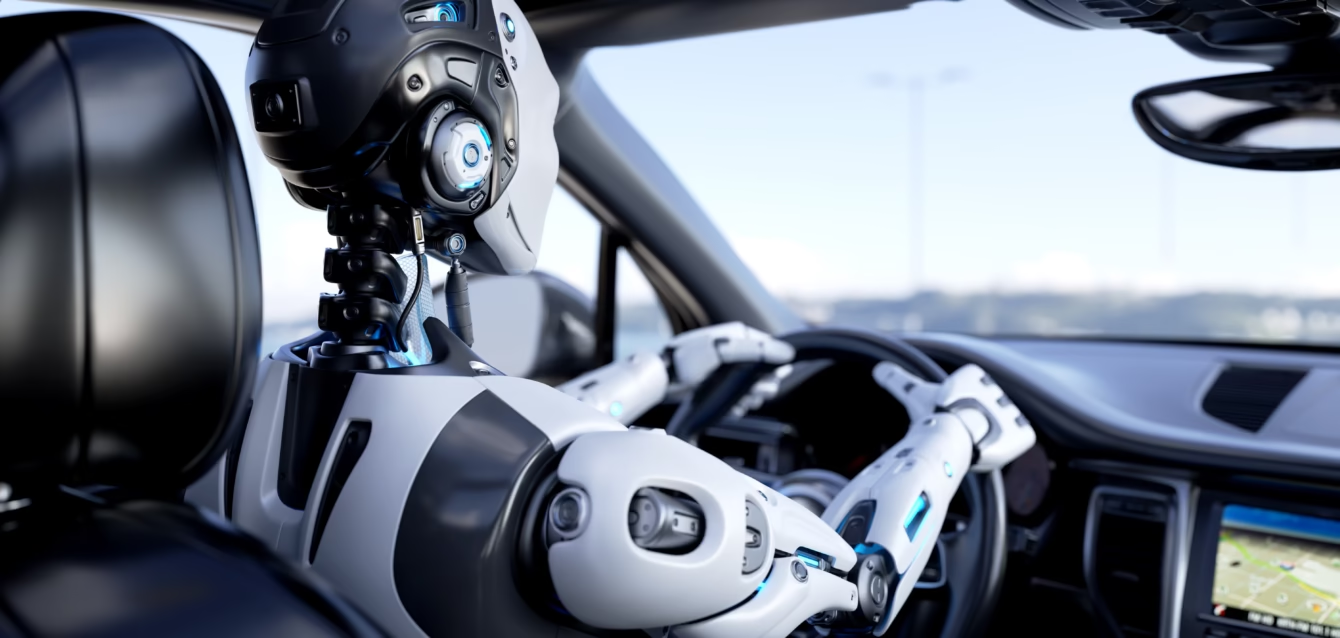
How AI Is Changing Electric Vehicles
Last updated: June 5, 2026
Quick Answer:
Artificial intelligence is embedded in every major system of a modern electric vehicle — managing battery health cell by cell, optimizing charging schedules against live electricity prices, powering the cameras and neural networks that handle lane-keeping and highway driving, and predicting component failures weeks before they happen. In 2026, AI is not a feature you opt into; it is the operating layer that makes the EV function at the performance level its specifications promise.
Table of Contents
Three Ways to Understand AI in EVs
Simple (For New EV Owners)
Think of AI in your EV the way you think of the autopilot in a commercial airliner. The plane has a human pilot who sets the destination and handles complex situations, but between those moments, a computer system manages throttle, altitude, and course corrections far faster and more precisely than any human could do manually, every second of the flight. Your EV does something similar — not for navigation (yet, in most cases), but for dozens of invisible jobs: keeping each of the thousands of battery cells at the right temperature, calculating exactly how much energy you will need to reach your next charging stop, deciding whether to charge now or wait two hours for cheaper overnight electricity.
You do not interact with most of this AI. It runs silently in the background, making the car work better than it would without it.
Technical (For Engineers and Early Adopters)
AI in EVs primarily operates across five subsystems: battery management, powertrain efficiency, charging optimization, ADAS and autonomy, and predictive maintenance.
Battery Management Systems (BMS): Modern AI-enhanced BMS use neural networks and model-based estimators running at sub-millisecond intervals to compute State of Charge (SoC) and State of Health (SoH) per cell, not per pack. Traditional BMS used lookup tables derived from controlled laboratory conditions. AI-enhanced BMS learn from real-world degradation patterns in the field, adjusting their models as the battery ages. CATL’s condensed cell platform (targeting 500 Wh/kg energy density) requires ±1% SoC accuracy in real time — a bar that only neural-net-based estimators can reliably meet across the temperature and cycle-count range an EV experiences in service.
Powertrain Efficiency: Reinforcement learning models optimize torque vectoring, regenerative braking intensity, and thermal management. The car learns your driving patterns — how hard you accelerate out of specific intersections, how often you use climate control on your commute — and pre-adjusts its energy budget accordingly.
Charging Optimization: AI models integrate real-time electricity pricing (where time-of-use tariffs apply), weather forecasts (cold reduces charging speed and range), traffic data (informing estimated departure time), and battery thermal state to schedule and optimize the charge curve. Dynamic pricing signals from the grid can reduce charging costs by 20–40% versus unmanaged overnight charging.
ADAS and Autonomy: Perception is handled by convolutional neural networks (CNNs) processing input from cameras, radar, and (in Waymo’s architecture) LiDAR. The CNN’s job is to produce a real-time semantic map of the environment — classifying every pixel as road, pedestrian, vehicle, or obstacle — and pass that to a planning network that generates trajectory candidates, evaluated by a third network (or rule-based safety system) that selects the safest one.
Predictive Maintenance: Transformer-based sequence models analyze sensor streams — vibration signatures, thermal anomalies, current draw patterns — against a baseline established at manufacturing. Deviation from baseline triggers a maintenance alert before the component fails. Published research (IEEE, 2026) reports 90% fault prediction accuracy in controlled EV fleet settings, with 85%+ precision.
Analogy (The One That Makes It Stick)
Traditional car maintenance is like managing a restaurant by waiting for Yelp reviews to arrive and then fixing whatever customers complained about. AI-enabled EV management is like having a health monitor strapped to every kitchen worker, ingredient, and appliance — one that sends you a WhatsApp message on Tuesday saying “the walk-in refrigerator compressor is showing early fatigue; schedule a replacement before Friday’s dinner rush.” The restaurant never closes for an emergency. The car never leaves you stranded.
This is the Axis Intelligence framework for AI in EVs: from reactive to predictive, across every system, simultaneously.
The Four AI Domains in Electric Vehicles
Domain 1: AI Battery Management
| Capability | Traditional BMS | AI-Enhanced BMS |
|---|---|---|
| SoC estimation method | Look-up tables (lab data) | Neural networks (field-learned) |
| Cell-level monitoring | Pack average | Individual cell |
| Thermal prediction | Reactive (sensor threshold) | Predictive (model-based, sub-ms) |
| Degradation modeling | Fixed calendar/cycle schedule | Adaptive, usage-pattern-based |
| Response speed | Milliseconds to seconds | Sub-millisecond |
| Accuracy over battery life | Degrades with pack age | Self-corrects through retraining |
The AI-driven battery technology market will reach $4.26 billion in 2026, growing at a 19% CAGR, according to industry forecasts — and is projected to more than double to $8.38 billion by 2030. Electric vehicles are the primary growth driver.
What this means practically: an AI BMS can extend usable battery life by predicting which cells are degrading faster and adjusting the charge/discharge strategy to compensate — protecting your range and your resale value simultaneously.
Domain 2: AI Charging Optimization
| Feature | Dumb Charger | Smart Charger (V1G) | AI-Optimized Charger (V2G-ready) |
|---|---|---|---|
| Charges when? | Plugged in = charging | Scheduled by owner | Dynamically, based on price + grid + weather |
| Grid awareness | None | Basic time-of-use | Real-time pricing signals |
| Personalization | None | Manual schedule | Learned from owner’s departure patterns |
| Grid interaction | None | None | Can discharge to grid (V2G) |
| Renewable integration | Passive | Partial | Active (charges when solar/wind peaks) |
In March 2026, Google Maps rolled out AI-powered battery predictions and trip planning to over 350 EV models via Android Auto — the first time a mainstream navigation platform matched the intelligent charge-stop planning that had previously been exclusive to Tesla’s built-in system. The update uses AI energy models combining vehicle weight, battery capacity, real-time traffic, road elevation, and weather to recommend when and where to charge, with an updated ETA that accounts for charging time. Brands covered at launch include Audi, BMW, Chevrolet, Genesis, Hyundai, Kia, Lucid, Mercedes-Benz, and Volkswagen.
Vehicle-to-Grid (V2G) is the next frontier. The International Energy Agency’s V2G technology analysis documents active pilots across Brazil, South Korea, and Australia in 2026. BMW and E.ON launched a consumer V2G tariff in Europe targeting up to €720/year in grid income for eligible owners. Industry analysis indicates V2G becomes economically viable at scale from 2026 onward, as regulatory double-grid-fee barriers are removed in key markets. The IEA’s dedicated report on Artificial Intelligence and EVs (published 2026, CC BY 4.0) provides the authoritative policy and technical overview of how AI is reshaping both vehicle operation and grid integration.
Domain 3: AI Autonomy — What the Levels Actually Mean
| SAE Level | What the Driver Does | AI Does | Examples (2026) |
|---|---|---|---|
| Level 1 | Full control, plus one driver-assist feature | Adaptive cruise OR lane-keeping (not both) | Most 2020–2022 EVs |
| Level 2 | Supervises; hands must stay on wheel | Both cruise AND lane-keeping simultaneously | Tesla Autopilot, GM Super Cruise |
| Level 2+ | Supervises; eye contact required | Hands-free highway driving, lane changes | Tesla FSD (Supervised), Mercedes Drive Pilot |
| Level 3 | Intervenes on request | Full driving in defined conditions; driver can look away | Mercedes Drive Pilot (Germany, Nevada) |
| Level 4 | Not required at all (in geofenced area) | Full driving; no human needed | Waymo (10+ US cities) |
| Level 5 | Not present | Full driving in all conditions | Nobody has achieved this in 2026 |
Where things stand in June 2026:
Tesla’s FSD fleet has crossed 10 billion cumulative miles under supervised operation. Tesla logs approximately 29 million miles per day from its fleet — a data advantage no competitor can replicate. The system records one major collision per 5.3 million FSD miles, compared to one per 660,000 miles for the average US driver. However, unsupervised consumer FSD has been pushed to Q4 2026 at the earliest, and Elon Musk has missed every prior autonomy deadline over the past decade.
Waymo operates at Level 4 across 10+ cities with its 6th-generation Waymo Driver, having completed nearly 200 million fully autonomous miles. It reports 90% fewer serious injury-causing crashes and 82% fewer airbag deployments than human drivers. Waymo serves over 450,000 rides per week and is targeting 1 million weekly rides with its current system.
Mercedes-Benz Drive Pilot is currently the only system certified for Level 3 autonomy in consumer vehicles in the US (Nevada) and Germany — meaning the driver can legally look away from the road under defined highway conditions up to 40 mph.
Domain 4: AI Predictive Maintenance
| Maintenance Approach | Trigger | Cost | Failure prevention |
|---|---|---|---|
| Reactive | Component fails | High (emergency repair + downtime) | None |
| Scheduled (time/mileage-based) | Calendar or odometer | Moderate | Partial — fixed intervals miss variable degradation |
| AI Predictive | Sensor anomaly threshold | Low (planned, cheaper parts + labor) | High — 90% fault prediction accuracy (IEEE, 2026) |
Research published in 2026 (Premier Science) found that AI deployment in EVs can reduce maintenance costs by up to 40% and cut unplanned downtime by 70% through predictive analytics. AI predictive maintenance software reduces the need for emergency repairs and saves fleet operators as much as $8,285 per year in technician costs per vehicle, according to data from Tech.co.
Examples already operating in 2026: Tesla monitors battery health, motor performance, and braking systems in real time via its AI stack, pushing fixes via OTA before owners notice an issue — a 2021 Consumer Reports brake test triggered a remote OTA update improving Model 3 braking distance by 6 meters within days. Hyundai Bluelink runs automatic diagnostic trouble code (DTC) checks and sends maintenance alerts to owner smartphones. BMW’s mirror-integrated cameras analyze tire wear and automatically notify drivers when replacement is needed.
Benefits and Limitations: The Honest Assessment
Benefits
Longer battery life. AI BMS extends pack longevity by managing degradation at the cell level. This directly preserves resale value — a material financial benefit over the 8–12 year ownership lifecycle of a modern EV.
Reduced range anxiety. AI trip planning (Tesla’s planner, Google Maps AI battery predictions) calculates charging stops based on real conditions — not optimistic EPA estimates. Knowing you will arrive with 12% instead of “maybe enough” is the difference between confidence and stress.
Lower charging costs. AI charge scheduling aligned to time-of-use electricity pricing consistently produces 20–40% savings versus unmanaged overnight charging in markets with dynamic tariffs. V2G adds potential grid income.
Fewer breakdowns. Predictive maintenance converts unexpected failures into planned service appointments — less disruption, cheaper repairs, and the elimination of the worst-case scenario (stranded on a highway with a dead drivetrain).
Safety improvement at scale. Waymo’s fleet safety data and Tesla’s FSD collision rate both show AI-assisted driving meaningfully outperforming average human drivers on measured incident rates — not in every situation, but in aggregate across hundreds of millions of miles.
Limitations
Data dependency. AI BMS and predictive maintenance are only as good as the sensors providing input. A faulty sensor produces faulty AI recommendations. This is why Waymo uses five sensor modalities (camera, radar, LiDAR, thermal, audio) and cross-validates constantly — single-modality failure is caught.
Fleet data advantage is not universal. Tesla’s neural networks improve because 7 million vehicles worldwide contribute training data daily. An EV brand with 50,000 vehicles in service has a tiny fraction of that signal. The AI quality gap between high-volume and low-volume brands will widen, not narrow, in the near term.
Autonomy timelines slip. Level 4 for consumer vehicles remains Waymo’s domain; Level 5 does not exist. Every manufacturer’s “full self-driving” marketing language should be evaluated against SAE levels, not press release claims. Musk’s Q4 2026 unsupervised FSD target is the latest in a decade of missed deadlines.
V2G is not yet widely available. True bidirectional charging requires compatible vehicle hardware, a bidirectional home charger, and a utility willing to buy back electricity. As of June 2026, this combination is available in fewer than 15% of US markets, and most EV models do not support V2G at all.
Privacy. AI maintenance and usage optimization requires continuous data transmission — your driving patterns, locations, charging habits, and vehicle state are sent to manufacturer servers. Each OEM’s data policy governs what is collected, retained, and shared. Read your vehicle’s connected services agreement before opting in to all features.
Over-reliance risk. Drivers who rely entirely on AI charge planning without understanding basic range dynamics (cold reduces real range by 15–40%; aggressive highway speed cuts range more than the energy display shows) can still end up stranded when AI predictions meet real-world conditions at an edge case.
Common Misconceptions
“FSD means the car drives itself.” Tesla’s Full Self-Driving (Supervised) is a Level 2+ system. The driver must remain attentive and ready to intervene at any moment. The name is a marketing term, not an SAE classification. The only commercially available autonomous systems that require no human attention within their geofenced operating area are Waymo’s robotaxis at Level 4.
“AI makes EVs hackable.” Connected cars have attack surfaces that purely mechanical vehicles do not. But AI itself is not the vulnerability — network connectivity is. The same risk exists in any modern car with an LTE or 5G modem, whether it has AI features or not. Manufacturers use hardware security modules, encrypted OTA channels, and certificate-based authentication. No mass-scale consumer EV hack involving AI systems has been publicly documented as of June 2026.
“AI charging optimization only works with Teslas.” Since March 2026, Google Maps delivers AI battery predictions and charging stop recommendations to 350+ EV models via Android Auto. Non-Tesla owners with compatible vehicles can access comparable trip planning quality today.
“AI will predict every battery failure.” AI predictive maintenance achieves 90% fault prediction accuracy in controlled research settings. In real-world fleet deployments, false positive rates (unnecessary maintenance alerts) and novel failure modes (that the model was not trained on) mean the system is a powerful tool, not a perfect oracle. Human technician judgment remains essential.
“OTA updates add features for free.” They can — Tesla’s free Sentry Drain estimate addition is an example. But some OTA updates unlock hardware that was already installed in your vehicle for an additional subscription fee. Tesla’s FSD capability costs $8,000 or a monthly subscription. BMW has added heated seat subscriptions via OTA. The line between “update” and “upsell” is increasingly blurred.
“The car’s range display is the AI’s accurate estimate.” The range display is a calculated estimate, not a real-time precision measurement. It uses recent energy consumption history and does not fully account for sudden changes in conditions — a headwind you just drove into, a mountain pass approaching, battery temperature that just dropped 15°C. The AI’s trip planner (which uses route-specific elevation, weather, and traffic) is more accurate than the range circle on the dashboard. Experienced EV drivers use the planner, not the circle.
The Current State in 2026: Five Things That Changed This Year
1. Google Maps AI predictions arrived for non-Tesla EVs (March 2026). Until March, intelligent AI charge-stop planning was effectively a Tesla exclusive. Google’s update democratizes the capability across 350+ models. This is the single biggest usability shift for non-Tesla EV owners in 2026.
2. Tesla crossed 10 billion FSD miles — and unsupervised autonomy still hasn’t arrived. The milestone is real and the data advantage is genuine. But Musk pushed unsupervised consumer FSD to Q4 2026 at the earliest, the latest in a consistent pattern of delayed autonomy promises. Meanwhile, Waymo — operating at true Level 4 — expanded to 10+ cities and reported 90% fewer serious injury crashes versus human drivers.
3. V2G entered the consumer market in Europe. BMW and E.ON’s V2G tariff, launched Q1 2026 in Germany, is the first consumer-facing bidirectional charging product with an explicit income promise (up to €720/year). Brazil, South Korea, and Australia also launched formal V2G pilots in 2026. US V2G deployment remains fragmented.
4. AI-driven battery technology crossed $4 billion in market value. The AI-driven battery management market reached $4.26 billion in 2026 (19% CAGR) and is on track for $8.38 billion by 2030. This capital flow is funding real engineering progress — denser batteries, faster charging, longer warranty periods — not marketing budgets.
5. Tesla’s Spring 2026 update introduced “Hey Grok” and the redesigned self-driving app. The Spring 2026 update (2026.14.x series) added hands-free voice activation via Grok, a redesigned self-driving subscription app, automatic overnight software installation, and a Sentry Drain estimate in the trip planner. For Hyundai owners, the MyHyundai app’s 2026 update added iOS Live Activity support for the Ioniq 9 and enhanced EV charging dashboards.
How to Get Started: AI Features You Can Use Today
You do not need to wait for Level 5 autonomy to benefit from AI in an EV. Here is the practical starting ladder, from easiest to most involved:
Step 1 — Enable AI charging scheduling (10 minutes). In any Tesla: Controls > Charging > Schedule > enable and set your typical departure time. The AI handles the rest, targeting a full charge by departure at the lowest overnight rate. For non-Tesla with Android Auto: update Google Maps to version 25.44+, go to Profile > Settings > Your Vehicles > add your EV make/model/year/trim. AI battery predictions will activate on your next trip.
Step 2 — Activate your manufacturer’s health monitoring app. For Hyundai/Kia/Genesis: download MyHyundai with Bluelink, enable vehicle health reports and DTC notifications. For Tesla: the Energy app (App Launcher > Energy) now includes a Trips section showing per-route energy data. For most other brands (BMW, Mercedes, GM, Ford): equivalent connected apps offer maintenance alert and charge monitoring features.
Step 3 — Use the AI trip planner for any drive over 100 miles. For Tesla: tap the navigation bar, enter destination — the planner automatically routes via Superchargers with arrival percentages. For non-Tesla with compatible Android Auto: enter destination in Google Maps, tap Route Details to see charging stops and battery arrival estimates.
Step 4 — Read up on your EV’s AI features before buying. If you are choosing between EV models, the quality of the AI software stack — trip planner, charging optimization, OTA cadence, and predictive maintenance — is as important as the hardware specs. Our best electric SUV guide and best electric vehicles compare software capabilities alongside range, price, and charging speed.
Step 5 — Understand V2G availability for your situation. If you have home solar or time-of-use tariffs and are considering a new EV, check whether the model supports V2G (bidirectional charging). Very few 2026 US models do; those that do include certain Nissan Leaf, Hyundai Ioniq 5, and Ford F-150 Lightning configurations.
Frequently Asked Questions
What does AI actually do in an electric vehicle?
AI manages five major EV systems: battery health monitoring (cell by cell, in real time), charging optimization (scheduling and smart grid integration), powertrain efficiency (torque, regenerative braking, thermal management), advanced driver assistance and autonomy (cameras, radar, and neural networks for lane-keeping to self-driving), and predictive maintenance (flagging component degradation before failure). Most of this runs invisibly in the background.
Does AI improve EV range?
Yes, in two ways. AI battery management optimizes energy delivery, reducing the gap between the EPA-rated range and real-world range under actual conditions. AI trip planning (Tesla’s planner, Google Maps for Android Auto EVs) calculates charging stops based on real terrain, weather, and traffic rather than static estimates, effectively eliminating range anxiety for informed users.
Is Tesla the only EV with AI features?
No. As of March 2026, Google Maps delivers AI battery predictions and trip planning to 350+ non-Tesla EV models via Android Auto. Hyundai Bluelink, BMW’s connected app, GM OnStar, and Ford’s app all include AI maintenance monitoring. The technology gap has narrowed significantly in 2026.
What is the difference between Tesla FSD and Waymo?
Tesla’s FSD (Supervised) is a Level 2+ system: both hands-free highway driving and lane changes are possible, but the driver must remain attentive and is legally responsible. Waymo is a Level 4 system: no human is in the vehicle at all in its commercial robotaxi operations. Waymo uses cameras, radar, and LiDAR simultaneously; Tesla uses cameras only. Both AI stacks improve with fleet data, but Waymo’s autonomous miles are fully driverless; Tesla’s are supervised.
Can AI predict when my EV battery will fail?
AI predictive maintenance achieves around 90% fault prediction accuracy for common EV component failures in controlled research settings (IEEE, 2026). Real-world performance is strong but not perfect — novel failure modes not in the training data will be missed. The practical benefit is that AI catches most degradation patterns weeks before failure, converting emergency repairs into planned service appointments at lower cost.
Is my EV sending data to the manufacturer?
Yes. AI maintenance, trip planning, and OTA updates all require data transmission. The specifics — what is collected, how long it is retained, whether it is shared with third parties — vary by manufacturer and are governed by the connected services agreement and privacy policy you accepted at purchase. For more detail on EV data privacy, see our EV statistics hub.
How does AI charging optimization save money?
By scheduling charging during off-peak electricity pricing windows (typically overnight, when demand is low) and coordinating with time-of-use tariffs where available. Driivz reports that dynamic AI pricing signals can boost EV charging utilization by 117% during low-price periods and cut consumer charging costs by 20–40% versus unmanaged charging. V2G-capable vehicles can additionally sell stored electricity back to the grid during peak-demand periods, potentially generating up to €720/year in Germany under current BMW/E.ON tariffs.
What is Vehicle-to-Grid (V2G) and is it available now?
V2G allows a bidirectional EV to discharge stored electricity back to the home or grid during peak periods, turning the battery into a revenue-generating or cost-reducing asset. As of June 2026, V2G is commercially available in parts of Europe and in limited US configurations (Nissan Leaf, Ford F-150 Lightning, select Hyundai models with compatible chargers). The IEA documents pilots in Brazil, South Korea, and Australia launched in 2026. Broad US consumer availability is expected in 2027–2028 as grid regulations catch up.
Will EVs ever drive themselves completely?
Level 5 autonomy — full self-driving in any condition, without a steering wheel — does not exist in 2026 in any commercial product. Level 4 (full autonomy within a geofenced area) exists commercially only in Waymo’s robotaxi service in 10+ US cities. Consumer Level 4 and Level 3 vehicles are emerging (Mercedes Drive Pilot, planned GM Cadillac by 2028), but widespread availability is a 2028–2032 timeframe by current industry consensus.
How does AI affect EV maintenance costs?
Significantly. Research published in 2026 found AI deployment reduces EV maintenance costs by up to 40% and cuts unplanned downtime by 70% through predictive analytics. For commercial fleets, AI predictive maintenance saves an estimated $8,285 per vehicle per year in technician costs. For individual owners, the main benefit is avoiding costly emergency repairs through early warning alerts via the manufacturer app.
What to Read Next
The AI capabilities described in this article are increasingly a decision factor when buying an EV. For a full comparison of how today’s models implement these features:
- Best Electric SUVs 2026 — AI trip planner quality, OTA cadence, and V2G compatibility compared
- Best Electric Vehicles 2026 — Full-market comparison including software stack depth
- EV Charging Guide 2026 — Smart charging, V2G compatibility, and home charger setup
- EV Statistics Hub 2026 — Market data, adoption rates, and battery technology forecasts
Aidan Jad covers electric vehicles, battery technology, solar, and clean energy for Axis Intelligence. He is based in Montreal and drives a Hyundai Ioniq 6. About Aidan Jad →