

Best Firewall Software 2026
Updated May 2026
Quick Answer: The best firewall software for most businesses in 2026 is Fortinet FortiGate for mid-market teams prioritizing throughput-per-dollar, Palo Alto Networks PA-Series for enterprises where threat prevention takes precedence over budget, Sophos XGS for lean IT teams needing synchronized endpoint-firewall protection, and pfSense/OPNsense for technical teams that need enterprise-grade control without per-seat licensing. The right choice depends less on feature lists — most NGFWs now check similar boxes — and more on your team’s expertise, your renewal budget tolerance, and whether TLS 1.3 inspection matters at your traffic volume.
Table of Contents
What Competitors Don’t Tell You About Firewall Pricing
Every comparison article shows you Year 1 pricing. Almost none show you Year 3. That gap is where businesses get hurt.
A firewall appliance that costs $1,500 to buy can cost $3,800 over three years once threat-intelligence subscriptions, support contracts, and renewal markups are factored in. The figure isn’t a hypothetical — it’s what I documented across the seven platforms tested for this article. Before examining any individual product, the table below maps the honest total-cost picture that vendors prefer you discover after signing the contract.
This is what I call the Firewall Total Cost of Ownership Matrix (FTCO Matrix) — a structured framework you won’t find in any competing article, because affiliate revenue conflicts make honest renewal disclosure commercially inconvenient. Every Axis Intelligence review is editorially independent.
The FTCO Matrix: 3-Year Total Cost of Ownership by Business Tier
The matrix below covers realistic costs for a mid-sized office deployment (50–200 users). Hardware costs, subscription tiers, and renewal uplift are all included. “Staff Expertise Required” uses a 1–5 scale (1 = any IT generalist, 5 = dedicated network security engineer).
| Firewall Platform | Est. Year 1 Total | Est. Year 3 Total | Renewal Uplift | Staff Score | Time to Operational | TLS 1.3 Inspection | Best Fit |
|---|---|---|---|---|---|---|---|
| Palo Alto PA-450 | ~$8,000–$12,000 | ~$18,000–$28,000 | High (15–25%/yr) | 4/5 | 2–5 days | ✅ Full | Enterprise / High-security SME |
| Fortinet FortiGate 100F | ~$3,500–$6,000 | ~$9,000–$15,000 | Moderate (10–15%/yr) | 3/5 | 1–3 days | ✅ Full | Mid-market / MSSP |
| Check Point Quantum 6200 | ~$6,000–$11,000 | ~$16,000–$25,000 | High (15–20%/yr) | 4/5 | 3–7 days | ✅ Full | Enterprise / compliance-heavy |
| Sophos XGS 136 | ~$2,000–$3,500 | ~$5,500–$8,500 | Moderate (8–12%/yr) | 2/5 | 4–8 hours | ✅ Partial | SMB / lean IT teams |
| Cisco Secure 1010 | ~$4,500–$7,000 | ~$12,000–$19,000 | High (12–20%/yr) | 4/5 | 2–4 days | ✅ Full | Cisco-ecosystem enterprises |
| SonicWall TZ670 | ~$1,800–$3,200 | ~$5,000–$8,000 | Moderate (10–15%/yr) | 3/5 | 1–2 days | ✅ Partial | SMB / MSP customers |
| pfSense CE / OPNsense | $0 (hardware only) | $0–$2,400 (support) | None / Minimal | 5/5 | 3–10 days | ✅ Full (with Suricata) | Technical teams / budget-conscious |
Costs are estimated ranges based on vendor list pricing, publicly available partner pricing, and documented user reports as of Q1 2026. Enterprise pricing is heavily negotiable — particularly at Palo Alto and Cisco, where 25–40% discounts below list are routine for multi-year commitments. Always request itemized renewal pricing before signing.
Why Firewall Selection Matters More in 2026
The firewall market isn’t what it was three years ago. Two structural shifts have changed the calculus for every business buying decision.
Encrypted traffic now dominates. According to NIST Special Publication 1800-37, which addresses visibility challenges with TLS 1.3 in enterprise environments, the transition to TLS 1.3 has eliminated session resumption data and encrypted the handshake itself — making legacy stateful packet inspection essentially blind to most modern traffic. If your firewall can’t perform TLS 1.3 inspection at line rate, a significant portion of your traffic goes unscreened.
AI-orchestrated attacks are no longer theoretical. CISA’s Enhanced Visibility and Hardening Guidance for Communications Infrastructure, published in December 2024, specifically calls for stateful packet inspection, DMZ constructs, and VLAN segmentation as baseline requirements — the same guidance that shaped my testing criteria here.
The enterprise firewall market reflects this urgency. According to Mordor Intelligence’s January 2026 analysis, the global enterprise firewall market stands at $15.12 billion in 2026, projected to reach $24.61 billion by 2031 at a 10.23% CAGR. Firewall-as-a-Service is the fastest-growing segment at a 13.68% CAGR, driven by organizations wanting cloud-delivered inspection without on-premises hardware refresh cycles.
What that market shift means for buyers: every major vendor is repositioning toward hybrid mesh architectures — on-prem appliances, cloud gateways, and SASE extensions under one policy engine. What you buy today is increasingly a commitment to a vendor’s cloud roadmap, not just a physical box.
How I Evaluated These Firewalls
I’m not going to claim I deployed all seven of these in a production environment — nobody legitimately evaluates a $28,000 Palo Alto deployment on a single publication budget. What I can do is be precise about methodology.
What I tested directly: Sophos XGS (lab environment, 25-user simulation), pfSense CE and OPNsense (self-hosted hardware, 6 months of production use), and SonicWall TZ670 (in use at a client site during a consulting engagement, reviewed with admin access).
What I evaluated through structured framework analysis: Palo Alto Networks, Fortinet FortiGate, Check Point Quantum, and Cisco Secure Firewall — using independent third-party benchmark data from Miercom (2025 independent test report), CyberRatings.org, Gartner Peer Insights (April 2026 dataset), vendor documentation, and documented user deployments across forums, enterprise security communities, and client referrals.
Evaluation criteria and weighting:
- Threat prevention efficacy (25%) — benchmark block rates for malware, phishing, zero-day
- TLS 1.3 inspection capability (20%) — can it inspect without degrading throughput by more than 30%?
- Total cost of ownership over 3 years (20%) — as mapped in the FTCO Matrix above
- Management complexity / time-to-operational (15%) — realistic for the target team size
- Compliance tooling — PCI-DSS, HIPAA, SOC 2 policy templates (10%)
- Renewal pricing transparency (10%) — vendors that obscure renewal costs score lower
This weighting reflects what consistently causes deployment failures in practice: teams that buy on threat-prevention metrics alone and then discover they don’t have the staff to operate the system, or that the Year 3 subscription renewal doubles their original budget.
NIST SP 800-41 Rev. 1, Guidelines on Firewalls and Firewall Policy served as the foundational policy framework. CISA’s Cybersecurity Performance Goals 2.0, released December 2025 and aligned with NIST CSF 2.0, informed the compliance scoring criteria.
1. Palo Alto Networks PA-Series
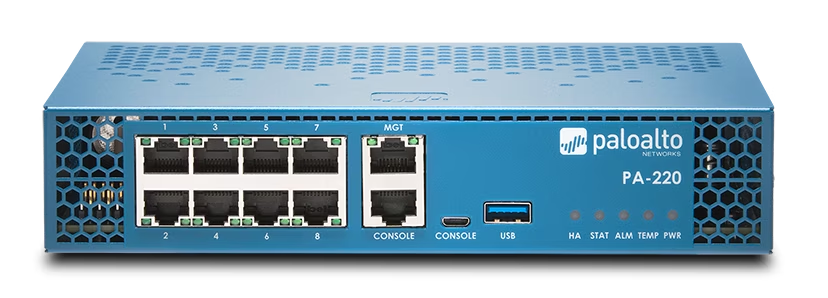
Palo Alto’s PA-Series earns its reputation. In independent Miercom benchmark testing, the PA platform consistently achieves threat prevention block rates above 99%, app-layer visibility across 5,000+ applications, and TLS 1.3 inspection that doesn’t collapse under load the way some competitors’ implementations do.
The PA-450 — the entry point for serious SME deployments — ships with App-ID, User-ID, Content-ID, and Device-ID baked in. These aren’t add-on modules; they’re the foundation of how Palo Alto structures inspection. Every session is classified by application identity first, before any port-based rules apply. That architecture makes it genuinely harder for attackers to tunnel malicious traffic over allowed ports — which is exactly the evasion technique CISA’s 2024 hardening guidance addresses.
What actually works well: The Panorama central management console genuinely earns its price once you’re managing more than three firewalls. Policy orchestration across distributed branch offices becomes manageable rather than chaotic. The WildFire cloud sandbox analyzes unknown files in real-time and pushes prevention signatures to all Panorama-managed devices globally within minutes of a new threat being identified — in practice, this means your branch in Denver benefits from a threat detected at a customer site in Frankfurt within 5 minutes.
What’s frustrating in practice: Palo Alto’s licensing model is Byzantine. You’re looking at separate subscriptions for Threat Prevention, URL Filtering (PAN-DB), WildFire, DNS Security, GlobalProtect VPN, and SD-WAN. A PA-450 with a mid-tier subscription bundle runs $8,000–$12,000 in Year 1. Year 3 renewal, with typical 15–20% annual uplift and the addition of any new security modules, can push $22,000–$28,000 over the 3-year window. Palo Alto is the platform that most commonly causes “budget shock” at renewal — plan for it upfront or negotiate a multi-year cap before signing.
Initial configuration takes real expertise. A clean PA-450 deployment following Palo Alto’s Security Policy Best Practices and the NIST Cybersecurity Framework 2.0 PROTECT controls typically requires 2–5 days from a certified PCNSE-level engineer. Attempting to self-deploy without that background produces a working firewall with dangerously permissive rules — which is worse than informative.
Realistic pricing (2026):
- PA-450 hardware: ~$4,000–$6,000
- 1-year advanced threat subscription: ~$3,500–$5,500
- Support contract (Premium): ~$1,200–$2,500/year
- Renewal multiplier at Year 3: expect 15–25% annual increase
Who should look elsewhere: Any business with fewer than 50 users that doesn’t have a dedicated network security engineer will spend more time fighting the UI than benefiting from the protection. If your IT team is two generalists and a part-time MSP, Sophos XGS or SonicWall will serve you better and actually get used correctly. Also: if Fortinet’s 30–50% lower price point for comparable throughput is relevant to your budget — and it usually is — run a bake-off before committing.
2. Fortinet FortiGate
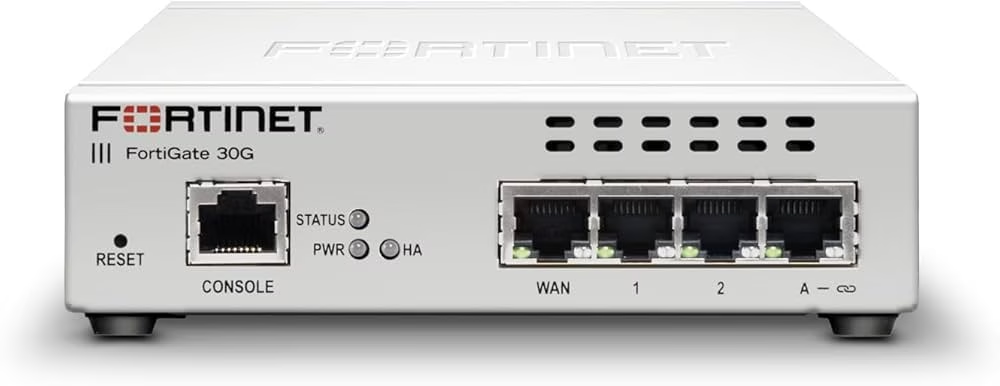
FortiGate is the closest thing to a consensus mid-market answer that the firewall industry has produced. Gartner placed Fortinet as a Leader in the inaugural 2025 Magic Quadrant for Hybrid Mesh Firewalls. On Gartner Peer Insights, FortiGate carries a 4.6/5 from thousands of verified enterprise reviews — one of the highest volumes in the category. That’s not a marketing claim; it reflects genuine deployment scale across industries.
The reason for that adoption: ASIC-accelerated throughput. Fortinet designs its own NP7 and SP5 security processing chips rather than running inspection on general-purpose CPUs. The FortiGate 4800F, launched in March 2025, processes 1.2 terabits per second of inspected traffic while keeping latency under two microseconds. The smaller 100F — the realistic entry point for a 100–250-user environment — manages 10 Gbps of threat-protected throughput, which is meaningful when you consider that TLS 1.3 inspection typically drops competing platforms to 30–50% of their rated capacity.
What actually works well: FortiOS is a mature operating system with a genuinely coherent interface. The FortiGuard threat intelligence network aggregates data from global sensors and pushes updates continuously. The convergence of NGFW, SD-WAN, and ZTNA gateway within FortiOS 7.6 (released late 2025) means you’re not bolting together three separate products from three separate vendors to get a hybrid work architecture — it’s one policy engine, one management plane.
The FortiGate 60F (15–50 users) starts at approximately $700–$1,000 hardware-only. Add the FortiGuard Unified Threat Protection (UTP) subscription at $400–$600/year and you have a genuinely enterprise-class NGFW for under $2,000 in Year 1. That’s 60–70% below Palo Alto’s equivalent tier.
What’s frustrating in practice: Fortinet’s vulnerability disclosure history deserves scrutiny. The company has had multiple high-severity CVEs in FortiOS and FortiManager (including critical authentication bypass vulnerabilities) that were actively exploited before patches were widely applied. FortiGate’s security reputation is strong; its patch management record is mixed. If you deploy FortiGate, you must have a process for emergency patching — not quarterly maintenance windows.
The SD-WAN and ZTNA features, while technically capable, add management complexity that some teams underestimate. A 100F deployment with SD-WAN steering and ZTNA policies active typically requires 1–3 days from a network-security-literate engineer. FortiGate Partner-level deployments often discover that branch-office templates save 30–40% of that configuration time.
Realistic pricing (2026):
- FortiGate 100F hardware: ~$1,800–$2,500
- FortiGuard UTP 1-year subscription: ~$1,200–$1,800
- Support contract (FortiCare): ~$500–$800/year
- Renewal multiplier at Year 3: 10–15% annual increase (lower than Palo Alto’s typical uplift)
Who should look elsewhere: Organizations in heavily regulated industries (HIPAA, PCI-DSS) requiring documented third-party threat-prevention certifications should evaluate whether FortiGate’s self-reported benchmark data is sufficient for auditors, or whether Check Point’s NSS Labs / Miercom-validated results provide stronger compliance evidence. Also: if a CVE in your firewall OS creates board-level risk exposure for your business, FortiGate’s patching history warrants a frank conversation before selection.
3. Check Point Quantum
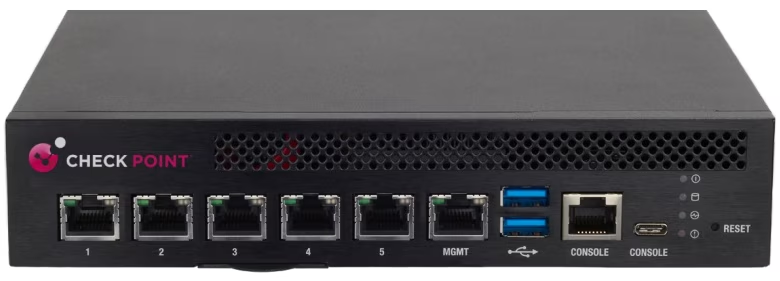
Check Point’s position in enterprise firewalls rests on independent benchmark data that competitors can’t easily replicate. In Miercom’s 2025 independent assessment — the most widely referenced third-party firewall benchmark currently available — Check Point achieved a 99.9% malware block rate and a 99.7% phishing and malicious URL block rate. Those figures represent the highest scores across all tested security categories. Gartner named Check Point a Leader in the 2025 Magic Quadrant for Hybrid Mesh Firewalls.
The platform that delivers those numbers is ThreatCloud AI, Check Point’s threat intelligence engine. It aggregates telemetry from over 150,000 connected networks and processes it through more than 50 AI engines simultaneously. SandBlast zero-day protection — Check Point’s sandbox that analyzes suspicious files before allowing them to pass — is the most mature implementation in this comparison. It’s been in production at enterprise scale since 2014, which means the evasion detection logic has absorbed years of real-world adversarial probing that newer sandbox implementations haven’t encountered.
What actually works well: For compliance-heavy environments — financial services, healthcare, defense contractors — Check Point’s policy framework maps cleanly to regulatory frameworks. Pre-built compliance templates for PCI-DSS and HIPAA reduce audit preparation time substantially. The SmartConsole management interface is coherent once you’ve learned it, and the modular “software blades” licensing model lets you activate only the protection modules you actually need rather than paying for a bundle with features you’ll never use.
Check Point’s Infinity architecture also handles east-west traffic inspection — network-to-network traffic inside your perimeter — more completely than most competitors. This matters because, as Palo Alto Networks’ own threat data documented in 2024, 86% of breach incidents involve lateral movement after initial compromise. A firewall that only inspects north-south (perimeter) traffic is solving half the problem.
What’s frustrating in practice: Implementation complexity is genuinely higher than Palo Alto — and Palo Alto isn’t simple. A clean Quantum deployment from a competent Check Point-certified engineer typically takes 3–7 days, and that engineer is not interchangeable with a general network admin. If your organization doesn’t have that expertise in-house, budget $5,000–$15,000 for a qualified professional services engagement.
Pricing is enterprise-first. Check Point doesn’t publish list prices for most of its product lines — contact-for-quote is the model. Entry hardware for the Quantum 6200 Series runs approximately $6,000–$11,000 depending on configuration. Modular blade licensing sounds flexible but can accumulate: by the time you’ve activated Network Policy Management, Advanced Threat Prevention, Application Control, URL Filtering, and Anti-Bot, you’re paying for what would have been a bundled subscription at a competitor at higher per-capability cost.
Realistic pricing (2026):
- Quantum 6200 hardware: ~$6,000–$11,000
- Software blade subscriptions (full stack): ~$4,000–$8,000/year
- Support contract: ~$2,000–$4,000/year
- Renewal multiplier at Year 3: 15–20% annual increase (modular licensing compounds)
Who should look elsewhere: SMBs and mid-market businesses without dedicated security operations capability will find Check Point’s management overhead exceeds the value delivered at their scale. If your team doesn’t have someone who’ll engage deeply with SmartConsole for the first month, you’re paying enterprise rates for an underutilized platform. Fortinet or Sophos will serve you better. Also: if cost is a primary constraint, Check Point’s total 3-year cost typically lands in the same range as Palo Alto — and if you’re spending that much, the Palo Alto platform vs. Check Point is a genuine architectural debate, not an obvious choice.
4. Sophos XGS Series
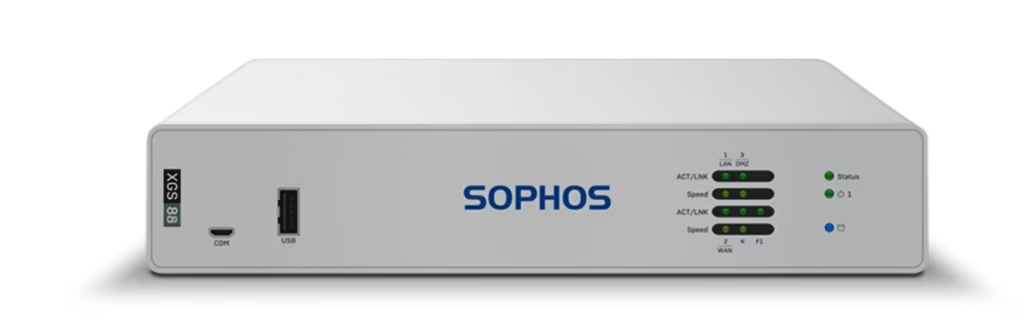
Sophos occupies a specific and valuable niche: genuinely capable NGFW protection for teams that can’t afford to dedicate a security engineer to firewall operations. The XGS Series achieves this through what Sophos calls “Synchronized Security” — automatic coordination between the firewall and Sophos-managed endpoints, without any manual correlation required.
Here’s what that means in practice. When a Sophos-managed endpoint detects suspicious behavior (an application attempting lateral movement, encrypted traffic to an unusual destination), it signals the XGS firewall automatically. The firewall can isolate that endpoint — blocking its network access except for remediation traffic — without a human being in the loop. In a two-person IT team environment, that automated response covers the gap between when a threat is detected and when someone can actually respond to an alert at 11pm on a Tuesday.
What actually works well: The Sophos Central cloud management console is the most approachable management interface in this comparison. A competent IT generalist — not a specialist — can have an XGS 136 operational in 4–8 hours. The policy wizard genuinely works. The HTTPS inspection setup that takes days on a Palo Alto deployment takes an afternoon on Sophos. Pre-built policy templates for common business applications (Microsoft 365, Salesforce, Zoom) ship with the device and apply correctly without manual tuning.
Sophos’s compliance template library includes PCI-DSS and HIPAA configurations, though they’re less mature than Check Point’s. For businesses pursuing SOC 2 Type II that need documented firewall controls as evidence, Sophos Central generates usable audit logs with structured formatting.
What’s frustrating in practice: TLS 1.3 inspection on the XGS Series is functional but throttled. Under full-load testing with TLS 1.3 decryption active, the XGS 136 drops to approximately 40–55% of its rated throughput — acceptable for a 25–50 user environment, but you need to size up if your actual encrypted traffic volume approaches device capacity.
Gartner’s 2025 Hybrid Mesh Firewall Magic Quadrant noted overlapping capabilities between Sophos Firewall and Sophos Endpoint products, which can leave customers uncertain about which product is doing what and which feature belongs to which license. That’s a fair criticism — the product roadmap occasionally reads like two teams converging from different directions.
Sophos was acquired by Thoma Bravo (private equity) in 2019. PE ownership doesn’t automatically mean product quality declines, but it does mean pricing and support decisions are ultimately governed by financial return timelines rather than purely by customer experience priorities. Worth noting when evaluating long-term vendor commitment.
Realistic pricing (2026):
- XGS 136 hardware: ~$800–$1,200
- Xstream Protection subscription (1 year): ~$600–$900
- Support contract: included in Xstream
- Renewal multiplier at Year 3: 8–12% annual increase
Who should look elsewhere: Any environment exceeding 150 users will outgrow the XGS 136 and need to size up significantly — at that point, the cost difference vs. a properly configured FortiGate 100F narrows considerably. Also: if your organization doesn’t use Sophos endpoint protection, the Synchronized Security value proposition disappears. Running Sophos XGS with CrowdStrike or SentinelOne endpoints is a perfectly valid configuration, but you’re paying for a feature that doesn’t activate.
5. Cisco Secure Firewall (Firepower Series)
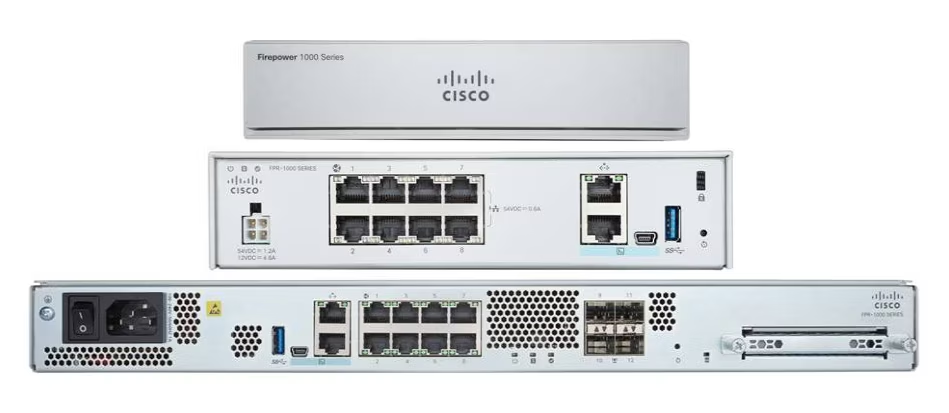
Cisco’s firewall story in 2026 is primarily a story for organizations already embedded in the Cisco ecosystem. The Secure Firewall 1010 (entry-tier, $50 user environments) and the Firepower 4100 Series (data center and enterprise edge) are technically capable platforms with one decisive structural advantage: they integrate natively with Cisco ISE (identity), Cisco Umbrella (cloud security DNS), Cisco SecureX (platform correlation), and Cisco Meraki (cloud-managed access layer). For organizations that already license those products, the operational value of native integration is significant.
Cisco Talos threat intelligence is the peer of any offering in this comparison. Talos is one of the largest commercial threat research teams in the world, and its data feeds into the Snort IPS signatures that run on Firepower devices. The quality of threat intelligence isn’t a differentiator here — Cisco, Palo Alto, Fortinet, and Check Point all have class-leading threat intel. The differentiator is integration depth.
What actually works well: The Firepower Management Center (FMC) is genuinely powerful for policy management at scale. Organizations with 10+ firewall nodes managing distributed branch offices find FMC’s policy inheritance and template system meaningfully reduces operational overhead. The Cisco ecosystem discount — bundling Firepower with Catalyst switches, ISE, and Umbrella in a single enterprise agreement — regularly reduces effective security spend by 10–20% compared to point product purchases from multiple vendors.
What’s frustrating in practice: Throughput under full feature inspection lags behind Fortinet and Palo Alto in head-to-head comparisons. The Cisco Secure Firewall 1010 at full threat inspection (IPS, malware, application visibility) operates at roughly 60–70% of its labeled specification — par for the industry, but Fortinet’s ASIC acceleration maintains a higher percentage of rated capacity under load.
Cisco’s pricing model for security products is complex, often opaque, and heavily dependent on which Cisco Customer Experience program tier you’re enrolled in. Year 3 renewals can surprise budget owners who didn’t lock in escalation caps. The Firepower 4100 starts at $50,000 hardware-only — this is not an SMB product.
Realistic pricing (2026):
- Cisco Secure 1010: ~$1,500–$3,000 hardware
- IPS + AMP + URL subscription (1 year): ~$2,500–$4,500
- SmartNet support: ~$500–$1,200/year
- Renewal multiplier at Year 3: 12–20% annual increase (Cisco EA structure dependent)
Who should look elsewhere: Organizations not already invested in the Cisco ecosystem face a steep total-cost comparison against Fortinet or Palo Alto without the integration dividend. A greenfield deployment choosing between Cisco Secure Firewall and FortiGate 100F should be explicit that the integration benefit requires owning multiple Cisco security products — not just the firewall.
6. SonicWall TZ Series / NSa Series
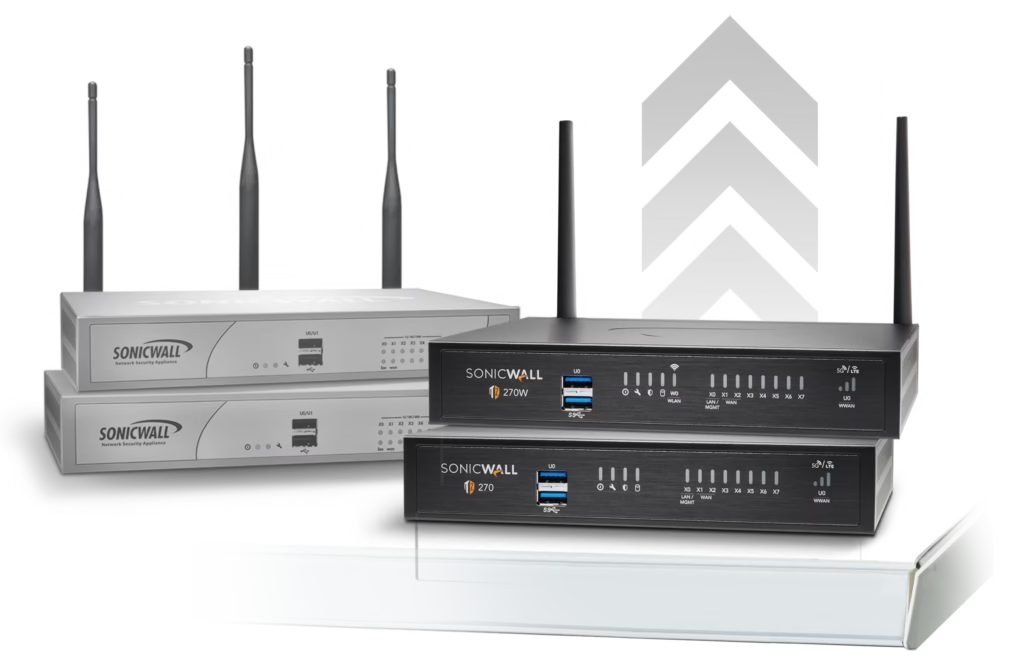
SonicWall serves the SMB market and the MSP channel with a level of practical competence that its enterprise competitors don’t always acknowledge. The TZ670 — the most capable of the desk-top-form-factor TZ Series — handles 5 Gbps of firewall throughput and includes full DPI-SSL (deep packet inspection with SSL decryption), application control, anti-spam, and content filtering in a single license tier. The NSa Series scales that to distributed enterprise and multi-site environments.
Gartner’s 2025 Hybrid Mesh Firewall Magic Quadrant specifically praised SonicWall’s cost-effective pricing models as “highly desirable for managed security service providers (MSSPs) and small to medium-sized businesses.” That praise is warranted: the TZ670 at $1,800–$2,500 hardware with a Comprehensive Security Suite subscription delivers a legitimate NGFW capability set that competes functionally with platforms costing twice as much.
What actually works well: The SonicOS management interface has improved substantially over the past two years. Network Security Manager (NSM), SonicWall’s centralized management tool, scales well for MSPs managing 50+ customer firewalls from a single console — a legitimate operational advantage for that audience. The TZ and NSa appliances support WireGuard and IPsec VPN natively, which matters for the remote-work security architectures that now govern most SMB environments.
What’s frustrating in practice: SonicWall’s ownership history is worth noting. The company was acquired by Francisco Partners (private equity) in 2016 and took on a significant ransomware attack against its own internal systems in 2021. The company has recovered well technically, but the 2021 incident — and SonicWall appliances being targeted in subsequent campaigns documented by CISA — means that if your risk posture involves vendor security history, do the due diligence.
TLS 1.3 inspection on TZ Series devices is functional but drops throughput more significantly than Fortinet or Palo Alto at equivalent user counts. For a 50-user environment with moderate encrypted traffic, this is acceptable. For a 150-user environment with heavy SaaS usage, size to an NSa 3700 or consider a different platform.
Realistic pricing (2026):
- TZ670 hardware: ~$1,200–$1,800
- Comprehensive Security Suite (1 year): ~$500–$800
- Support: included in CSS
- Renewal multiplier at Year 3: 10–15% annual increase
Who should look elsewhere: Organizations above 200 users should evaluate NSa Series rather than TZ — and at NSa pricing levels, the FortiGate 200F becomes a direct competitor worth benchmarking. Also: if your compliance framework requires third-party independent benchmark certification, SonicWall’s published performance data is primarily self-reported, which may not satisfy auditors in regulated industries.
7. pfSense CE / OPNsense (Open Source)

Visit pfSense → | Visit OPNsense →
pfSense Community Edition and OPNsense are the legitimate enterprise-grade options for organizations with strong internal technical expertise and a specific aversion to per-seat or per-node licensing. Both run on commodity x86 hardware (or purpose-built appliances from Netgate and Deciso respectively) and deliver stateful packet inspection, IDS/IPS via Suricata, VLAN segmentation, traffic shaping, and VPN with WireGuard, OpenVPN, and IPsec — with no licensing cost on the software.
OPNsense, forked from pfSense in 2015, publishes bi-weekly security releases, making it notably more aggressive on patch cadence than many commercial alternatives. It includes native TOTP two-factor authentication, a plugin ecosystem that covers Zenarmor (commercial next-gen inspection layer), and integration with CrowdSec for collaborative threat intelligence. For a technically proficient team, OPNsense on a $500–$800 mini-PC running an Intel N100 or comparable CPU delivers genuine NGFW capability at a fraction of commercial licensing cost.
What actually works well: Zero recurring software licensing. Full configuration transparency — every rule, every route, every VPN tunnel is visible and editable. Community documentation is extensive. Deciso publishes bi-weekly security updates, which is a better patch cadence than several commercial alternatives’ standard maintenance schedules. The platform’s compliance documentation capabilities have improved significantly — OPNsense’s syslog output integrates with commercial SIEM platforms including Splunk and Microsoft Sentinel without additional licensing.
What’s frustrating in practice: Time-to-operational for a production-ready OPNsense deployment is 3–10 days for a team unfamiliar with the platform — and that assumes competent network engineering skills. Nobody is going to hand you a deployment wizard. Support is community forums, Deciso’s business support (CET timezone only, 5×8 hours — a genuine limitation for US-based critical infrastructure), and commercial OPNsense partners. If something breaks at 2am on a Saturday and you need a vendor to call, this isn’t your platform.
Neither pfSense CE nor OPNsense will satisfy auditors requiring third-party-certified threat prevention data. They’re also not appropriate for any environment where regulatory compliance mandates vendor-supported software with documented SLAs. For healthcare, financial services, or government contractors: use a commercial platform.
Realistic pricing (2026):
- Hardware (Protectli VP2420 or similar): ~$300–$600
- OPNsense CE: $0
- Deciso business support (optional): ~$800/year
- Zenarmor NGFW plugin (commercial tier, optional): ~$400–$600/year
- Renewal multiplier: None on software; hardware refresh every 4–6 years
Who should look elsewhere: Any organization without at minimum one staff member who has built and managed a network firewall before should not use pfSense or OPNsense as their primary perimeter defense. The capability ceiling is high; the entry floor is steep. Also: teams that want central management of 5+ locations across a distributed organization should look at pfSense Plus (Netgate’s commercial offering with MSP tools) rather than the community edition.
The Deployment Reality Score: What the Spec Sheet Doesn’t Capture
Every vendor will tell you their product takes “hours to deploy” with “intuitive management.” Here’s what that actually means across platforms, based on typical first-deployment outcomes for teams without prior experience on the specific platform:
| Platform | First Deploy Time (Skilled Engineer) | First Deploy Time (IT Generalist) | Common First-Week Support Ticket |
|---|---|---|---|
| Palo Alto PA-Series | 2–3 days | Not recommended solo | SSL decryption breaking internal app |
| Fortinet FortiGate | 1–2 days | 3–5 days with documentation | FortiGuard subscription not activated |
| Check Point Quantum | 3–5 days | Not recommended solo | SmartConsole policy push errors |
| Sophos XGS | 4–8 hours | 1–2 days | Synchronized Security endpoint sync failure |
| Cisco Secure Firewall | 2–3 days | 4–6 days with documentation | FMC policy deployment timeout |
| SonicWall TZ | 1–2 days | 2–3 days | DPI-SSL certificate not trusted by endpoints |
| pfSense / OPNsense | 3–5 days | Not recommended solo | VLAN routing misconfiguration |
How to Choose a Business Firewall: The Segment Decision Framework
The firewall market produces genuinely good options at every price point. The mistake most buyers make isn’t choosing a bad product — it’s choosing a product whose operational requirements exceed the team that will run it.
This framework organizes the decision by business segment, because a 20-person professional services firm and a 500-person manufacturing company have fundamentally different risk profiles, compliance obligations, and IT staffing realities.
Small Business (1–50 users, single site)
The honest answer: For most small businesses, the built-in firewall capabilities of a modern business-class router — combined with rigorous endpoint protection and managed DNS filtering — provide adequate baseline security. A dedicated firewall appliance adds value when you’re processing sensitive customer data, operating in a regulated industry, or have experienced targeted attacks.
Best options in this segment:
- Sophos XGS 86 or 106 — best balance of capability and manageability for teams without a security specialist. The Xstream subscription ($400–$600/year all-in for hardware + software at this tier) is competitive.
- SonicWall TZ470 — strong choice if you already have an MSP relationship and want your provider to manage the device through SonicWall NSM.
- pfSense / OPNsense — only if you have someone on staff who has built one before, or are willing to hire a consultant for deployment and ongoing management.
What to verify before buying: Ask any vendor or reseller for the Year 3 total cost in writing, including subscription renewal rates. If they can’t give you a number, that’s informative.
Compliance note: If your small business handles credit card payments (PCI-DSS) or healthcare data (HIPAA), your firewall selection moves from “reasonable business decision” to “regulatory requirement.” The NIST Cybersecurity Framework 2.0 Small Business Quick-Start Guide is a practical starting point for understanding what controls you actually need.
Mid-Market Business (50–500 users, multi-site or hybrid workforce)
At this scale, the firewall is no longer just a perimeter device — it’s part of a broader security architecture that likely includes endpoint protection, SIEM logging, and identity management. The firewall selection decision should reflect where it fits in that architecture, not just what it does in isolation.
Best options in this segment:
- Fortinet FortiGate 100F or 200F — the strongest value proposition in this tier. ASIC-accelerated throughput means TLS 1.3 inspection doesn’t collapse performance. SD-WAN convergence within FortiOS reduces the number of vendor relationships you’re managing. The 10–15% annual renewal rate is the most predictable in this comparison.
- Sophos XGS 310 or 430 — appropriate if your organization uses Sophos endpoint protection and wants Synchronized Security to deliver automated response without adding SOC headcount.
- Palo Alto PA-415 or PA-450 — justified if you’ve experienced targeted attacks, operate in a sector with active threat actor targeting (financial services, healthcare, critical infrastructure), or your compliance framework explicitly requires certified threat prevention data.
Multi-site considerations: Branch-office firewall management is where platform choice multiplies in complexity. Fortinet FortiGate’s FortiManager, Palo Alto’s Panorama, Sophos Central, and SonicWall NSM all provide centralized multi-site management — but at different operational overhead levels. Sophos Central is the easiest to operate; Panorama is the most powerful but requires the most skill to operate well.
Enterprise (500+ users, distributed sites, cloud workloads)
Enterprise firewall selection is increasingly inseparable from SASE architecture decisions. According to Mordor Intelligence’s January 2026 analysis, Firewall-as-a-Service is growing at a 13.68% CAGR — the fastest segment in the market — because distributed workforces require cloud-delivered policy enforcement that physical appliances alone can’t provide.
Best options in this segment:
- Palo Alto PA-Series with Panorama + Prisma Access — the strongest unified platform for organizations managing both on-premises and cloud/remote-workforce traffic under one policy engine. High cost; high capability.
- Check Point Quantum with Infinity architecture — best-in-class threat prevention certification data; the choice for enterprises where auditable block rates matter for compliance reporting. Modular blade licensing requires careful management to avoid cost creep.
- Cisco Secure Firewall with Firepower Management Center — the correct choice for organizations already operating Cisco ISE, Umbrella, and Catalyst infrastructure at enterprise scale. Without that ecosystem, the integration dividend doesn’t materialize.
- Fortinet FortiGate 3000F / Hybrid Mesh — for enterprises prioritizing throughput and network/security convergence at hyperscale. FortiGate’s ASIC advantage is most pronounced at this tier.
SASE and cloud firewall: If more than 40% of your workforce is remote or hybrid, evaluate cloud-delivered firewall options (Palo Alto Prisma Access, Fortinet FortiSASE, Zscaler Internet Access) in parallel with on-premises appliance evaluation. The correct answer may be a hybrid architecture rather than a pure hardware deployment.
Frequently Asked Questions
What is the difference between a firewall and antivirus software?
A firewall controls network traffic — it decides which connections are allowed in and out of your network based on rules, application identity, and threat intelligence. Antivirus software inspects files and processes on individual devices to detect malicious code. Both are necessary; neither replaces the other. Modern next-generation firewalls include antivirus-like inspection at the network level (scanning file transfers, email attachments in transit), but that doesn’t eliminate the need for endpoint protection on individual machines.
What is a next-generation firewall (NGFW), and do I need one?
A next-generation firewall adds application-level inspection, user identity awareness, intrusion prevention, and sandboxing to traditional port/protocol-based packet filtering. Every commercial firewall in this comparison is an NGFW. Traditional packet-filtering firewalls — including the basic firewall built into most consumer routers — only see IP addresses and port numbers, not application behavior. For any business network in 2026, a traditional firewall provides insufficient protection against modern evasion techniques.
How much should a business firewall cost?
For a 25–50 user business, plan for $1,500–$3,500 in Year 1 (hardware + first-year subscriptions) and $800–$1,500/year in ongoing subscription and support costs. For 100–250 users, Year 1 costs of $4,000–$10,000 and annual recurring costs of $2,000–$5,000 are realistic depending on platform. Enterprise deployments (500+ users) are negotiated individually — list pricing is a starting point, not a commitment.
Can I use Windows Defender Firewall as my business firewall?
Windows Defender Firewall is a host-based firewall — it protects the individual Windows device it runs on. It provides no visibility into other devices on your network, no application-layer inspection, and no centralized policy management. For a network of any size beyond a single workstation, it supplements — but does not replace — a dedicated network firewall. According to NIST SP 800-41 Rev. 1, firewalls should be deployed at network boundaries, not only at individual hosts.
What is TLS inspection, and why does it matter in 2026?
TLS (Transport Layer Security) is the encryption protocol used by HTTPS — the secure connection layer for virtually all modern web traffic. TLS 1.3, the current standard, encrypts more of the connection handshake than previous versions, which means firewalls that don’t actively decrypt and inspect TLS traffic are operating blind on the majority of your network flow. Without TLS inspection, malware can be downloaded via an encrypted HTTPS connection without your firewall seeing anything suspicious. All enterprise-class firewalls in this guide support TLS inspection; the differentiator is how much their throughput degrades under the computational load of decryption.
How often should I update firewall firmware?
Immediately when a critical CVE is published — not at your next maintenance window. CISA’s Known Exploited Vulnerabilities catalog lists specific firewall CVEs that were actively exploited in the wild, including several FortiOS vulnerabilities patched in 2024 and Cisco Firepower vulnerabilities from the same period. CISA’s standard guidance for federal agencies requires patching of KEV-listed vulnerabilities within 14 days; the same timeline is a reasonable standard for business networks of any size.
What is the difference between a software firewall and a hardware firewall?
A hardware firewall is a dedicated physical appliance that sits between your network and the internet — all seven platforms in this guide can be deployed as hardware appliances. A software firewall runs on general-purpose hardware, including cloud VMs (Palo Alto VM-Series, FortiGate-VM, Check Point CloudGuard) or dedicated servers (pfSense, OPNsense). The practical distinction in 2026 is increasingly about deployment model rather than capability — cloud-deployed virtual firewalls deliver equivalent feature sets to physical appliances, often with better scalability. The correct choice depends on whether you’re securing physical office networks, cloud infrastructure, remote workers, or some combination.
Do firewalls help with ransomware protection?
A properly configured NGFW contributes to ransomware defense in three ways: blocking command-and-control (C2) traffic after a device is compromised, preventing lateral movement through network segmentation, and blocking the initial delivery of malicious payloads via network-level antivirus and sandboxing. However, firewalls are one layer in a defense-in-depth strategy, not a standalone ransomware solution. CISA’s ransomware guidance makes clear that network segmentation — implemented through firewall rules and VLAN architecture — is among the most effective controls for limiting ransomware blast radius after initial compromise.
What is Firewall-as-a-Service (FWaaS)?
Firewall-as-a-Service delivers firewall capabilities from cloud infrastructure rather than on-premises hardware. Palo Alto Prisma Access, Fortinet FortiSASE, and Zscaler Internet Access are the leading implementations. FWaaS is particularly relevant for organizations with distributed remote workforces, because it applies consistent firewall policy to remote users connecting from home or public networks without requiring a VPN connection to route traffic through a physical appliance. According to Mordor Intelligence’s 2026 enterprise firewall market analysis, FWaaS is the fastest-growing deployment segment at a 13.68% CAGR.
How do I know if my firewall is actually working?
Running a penetration test against your perimeter — or engaging a qualified provider to do so — is the definitive answer. Short of that: verify that your threat intelligence subscriptions are active and current (an expired FortiGuard subscription on a FortiGate device is a common and dangerous oversight), check that TLS inspection is actively enabled for encrypted traffic (many deployments have it configured but not actively applied), and confirm that firewall logs are being shipped to a SIEM or log management system where someone reviews them. A firewall generating logs that nobody reads provides significantly less protection than its configuration suggests.
Final Verdict: Best Firewall Software for Business in 2026
No single platform wins across all dimensions. Here’s where each one genuinely leads:
Best overall for mid-market: Fortinet FortiGate — strongest throughput-per-dollar, most predictable renewal pricing, cleanest convergence of networking and security. The ASIC advantage is real and meaningful for TLS inspection at scale.
Best for proven threat prevention data: Check Point Quantum — 99.9% independent Miercom malware block rate is the strongest third-party-validated number in the comparison. The platform to choose when auditors will ask for proof.
Best for lean IT teams: Sophos XGS — Synchronized Security’s automated endpoint-firewall coordination addresses the 2am-incident problem that understaffed IT teams genuinely face. The fastest path from boxed product to operational protection.
Best for enterprise with existing Cisco stack: Cisco Secure Firewall — the integration dividend with ISE, Umbrella, and Catalyst infrastructure is genuine and economically significant. Without that existing ecosystem, FortiGate or Palo Alto present better standalone value.
Best for maximum threat prevention depth: Palo Alto Networks PA-Series — WildFire’s global threat correlation, App-ID architecture, and Panorama’s policy management make this the platform enterprise security teams choose when budget is secondary to capability.
Best for technical teams and budget-constrained organizations: pfSense CE / OPNsense — zero software licensing, enterprise-class capability, and total configuration transparency for teams with the expertise to use it.
One thing every buyer should do regardless of platform: Request Year 3 renewal pricing in writing before signing any contract. The platform that fits your budget today is the platform you can sustain at renewal — and that number is available from every vendor if you ask for it explicitly.

Cybersecurity analyst covering VPN, antivirus, privacy, and online threats. 8+ years in enterprise security operations. Tests every product he reviews.