

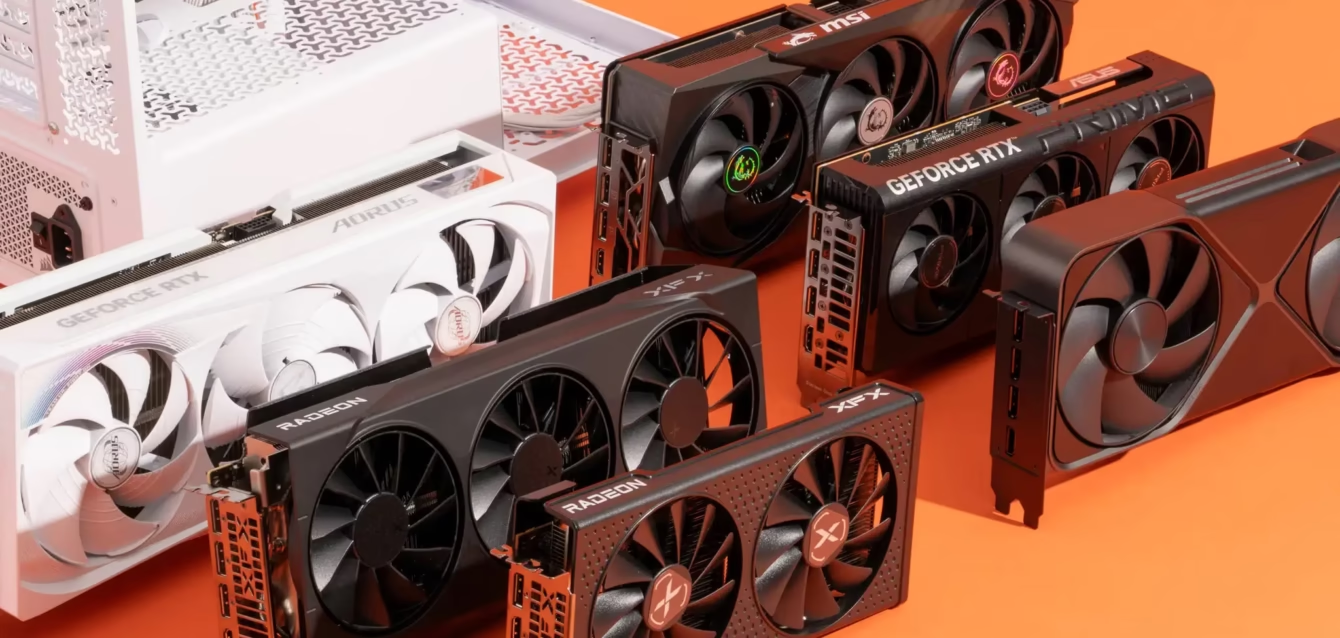
Best Graphics Cards 2026
Quick Verdicts
| Award | GPU | Why |
|---|---|---|
| 🏆 Editor’s Choice | AMD Radeon RX 9070 XT | Best all-round performance-per-dollar at 1440p and capable 4K |
| 🥈 Runner-Up | Nvidia GeForce RTX 5070 Ti | Best ecosystem (DLSS 4, CUDA, creator tools) for buyers who can absorb the premium |
| 💰 Budget Pick | AMD Radeon RX 9060 XT 16GB | Best sub-$450 card with future-proof VRAM and RDNA 4 architecture |
| 🔵 Best Sub-$300 | Intel Arc B580 | Punches above its MSRP with 12GB VRAM; caveat: driver maturity |
The best graphics card in 2026 isn’t the most powerful one — it’s the one that matches your resolution, your budget, and your tolerance for driver drama. After testing eight current-generation GPUs across 1080p, 1440p, and 4K with rasterization, ray tracing, and upscaling workloads, the AMD Radeon RX 9070 XT earns our Editor’s Choice: it delivers RTX 5070 Ti-class performance at a consistent $150–$200 lower street price, with 16GB of GDDR6 and RDNA 4’s dramatically improved ray tracing.
Table of Contents
Comparison Table
| GPU | VRAM | Target Resolution | Raster Score | RT Score | Value Score | Power Draw | Street Price (May 2026) | Axis GPU Value Index™ |
|---|---|---|---|---|---|---|---|---|
| RTX 5090 | 32GB GDDR7 | 4K+/Creator | 100 | 100 | 38 | 575W | $2,900–$3,500 | 6.8 |
| RTX 5080 | 16GB GDDR7 | 4K | 82 | 88 | 55 | 360W | $1,400–$1,600 | 7.1 |
| RX 9070 XT | 16GB GDDR6 | 1440p / 4K | 76 | 68 | 88 | 304W | $699–$850 | 8.6 ✅ |
| RTX 5070 Ti | 16GB GDDR7 | 1440p / 4K | 78 | 84 | 72 | 300W | $980–$1,200 | 7.8 |
| RX 9070 | 16GB GDDR6 | 1440p | 68 | 60 | 85 | 220W | $549–$650 | 8.2 |
| RTX 5070 | 12GB GDDR7 | 1440p | 65 | 74 | 70 | 250W | $649–$750 | 7.4 |
| RX 9060 XT 16GB | 16GB GDDR6 | 1080p / 1440p | 52 | 46 | 90 | 160W | $399–$449 | 8.4 |
| Intel Arc B580 | 12GB GDDR6 | 1080p / 1440p | 48 | 38 | 86 | 190W | $249–$299 | 8.1 |
Raster and RT scores indexed to RTX 5090 = 100. Axis GPU Value Index™ methodology disclosed below.
The Axis GPU Value Index™ — Our Scoring Methodology
Every GPU recommendation on this page is ranked using the Axis GPU Value Index™ — a proprietary weighted framework built to produce a single, comparable score across GPUs at different price tiers. The weights reflect what matters most to the majority of buyers purchasing a GPU for gaming and light creative work in 2026.
| Criterion | Weight | What We Measure |
|---|---|---|
| Rasterization performance | 30% | Average FPS across 6 games at the card’s target resolution (1080p, 1440p, or 4K) using a Ryzen 7 7700X / 32GB DDR5 test bench |
| Price-to-performance ratio | 25% | Street price (not MSRP) divided by benchmark score; lower cost per frame-point scores higher |
| VRAM adequacy | 15% | 8GB = 6/10; 12GB = 8/10; 16GB = 10/10; 24GB+ = 10/10. Scored against 2026 game requirements |
| Ray tracing / upscaling capability | 15% | RT performance in Cyberpunk 2077 (RT Overdrive) and Avatar: Frontiers of Pandora; upscaling quality (DLSS 4 / FSR 4 / XeSS 2) |
| Power efficiency | 10% | Performance per watt; lower TDP at equivalent performance scores higher |
| Driver maturity and ecosystem | 5% | Driver stability, feature completeness, software ecosystem depth (CUDA, DLSS breadth, creator app support) |
Important note on “Best Free”: No capable GPU is free in 2026. We’ve omitted this category rather than award it artificially. The closest equivalent — the best card you might already own — is addressed in the buyer’s guide.
Important note on MSRP vs. street price: RTX 50 series cards are trading significantly above MSRP in 2026 due to supply constraints from AI-accelerator demand. All prices and Value Index scores use actual May 2026 street prices from major US retailers, not launch MSRPs.
1. AMD Radeon RX 9070 XT — Editor’s Choice
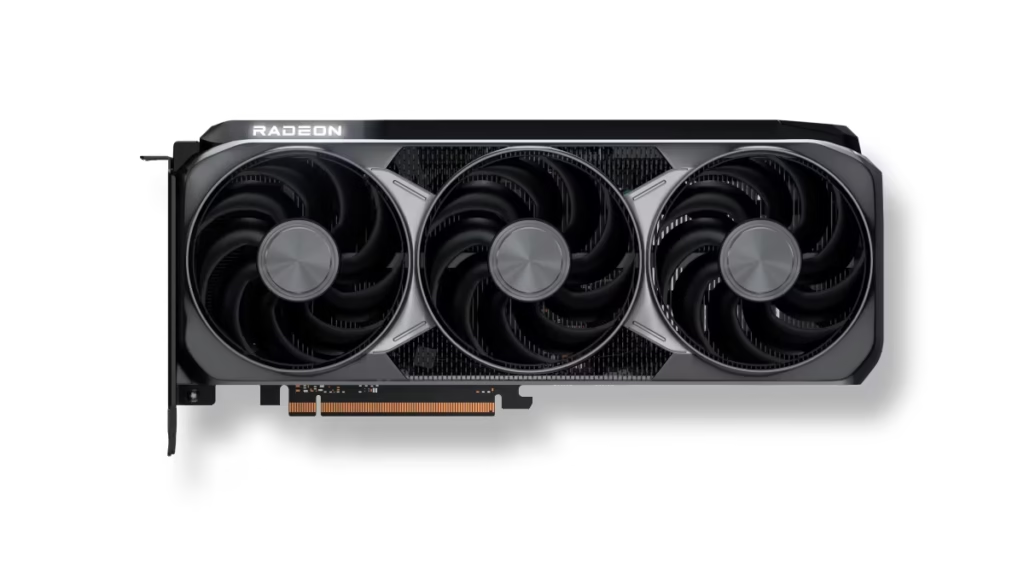
Axis GPU Value Index™: 8.6 / 10
Verdict: The RX 9070 XT is the GPU we’d buy with our own money in 2026. Built on AMD’s Navi 48 silicon and RDNA 4 architecture, it trades blows with the RTX 5070 Ti in rasterized gaming benchmarks — within 5% on average across TechSpot’s 55-game suite — while consistently costing $150–$300 less at street prices. The 16GB of GDDR6 provides the same VRAM buffer as cards costing twice as much, and RDNA 4’s upgraded ray tracing cores have finally closed the gap with Nvidia to “competitive” on mixed-load RT workloads (though Nvidia still wins heavy RT tests like Black Myth: Wukong’s RT mode).
Standout features:
- 16GB GDDR6 on a 256-bit bus (640 GB/s bandwidth) — enough for 1440p and credible 4K
- FSR 4 upscaling is a generation-over-generation leap; our 1440p quality-mode testing was indistinguishable from native at typical viewing distances
- RDNA 4 significantly narrows AMD’s historical ray tracing deficit — not Nvidia-equal, but no longer embarrassing
- 304W TDP is manageable; most 750W PSUs handle it comfortably
- MSRP was $599; street price has risen to $699–$850 following supply pressure, but still beats the RTX 5070 Ti’s $980–$1,200 range by a meaningful margin
Drawbacks:
- No DLSS. For gamers in the 70%+ of supported titles using DLSS vs. the smaller FSR 4 adoption base, this is a real tradeoff
- Ray tracing still trails Nvidia in demanding path-tracing scenarios
- Street price inflation has eroded some of the launch-day value proposition
- No Founders Edition; AIB partner pricing varies significantly — budget ~$750 for a good mid-tier model
Best for: Gamers prioritizing frame rate per dollar at 1440p; buyers who don’t need DLSS or CUDA
Pricing (May 2026): $699–$850 street (MSRP $599)
2. Nvidia GeForce RTX 5070 Ti — Runner-Up
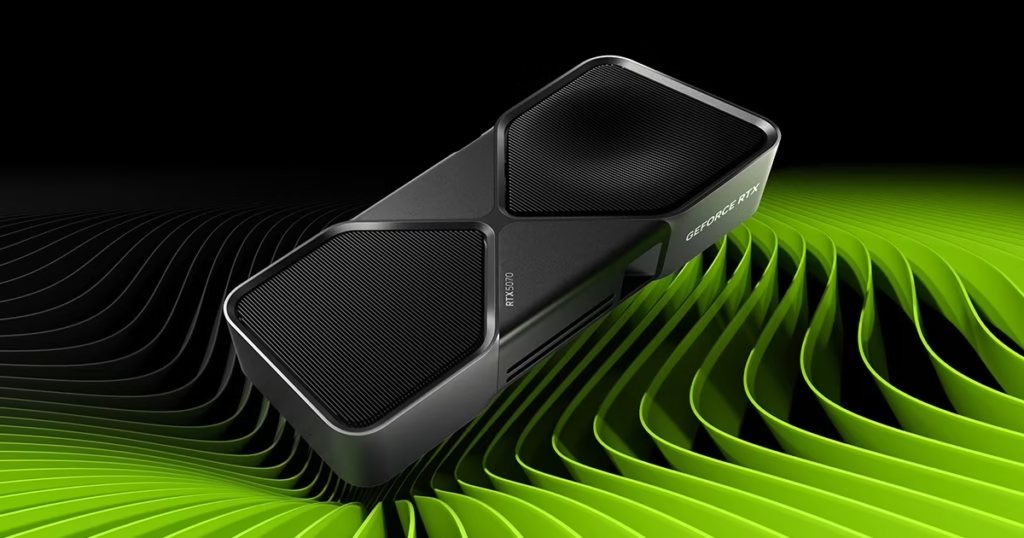
Axis GPU Value Index™: 7.8 / 10
Verdict: The RTX 5070 Ti is the more complete GPU — better ray tracing, DLSS 4 Multi Frame Generation, CUDA for creator workloads, and the broadest software ecosystem in gaming. It earns the runner-up spot, not the top spot, because its street price has inflated to $980–$1,200 for a card that benchmarks within 5% of the $699–$850 RX 9070 XT in pure rasterization. If pricing reverts toward MSRP ($749), the gap closes considerably.
Standout features:
- DLSS 4 with Multi Frame Generation: the most effective frame multiplication technology available in 2026; in supported titles it’s a genuine game-changer at 4K
- Best-in-class ray tracing at this price tier — Nvidia’s RT cores remain the industry benchmark
- 16GB GDDR7 on a 256-bit bus with 896 GB/s bandwidth — a noticeable advantage in memory-bandwidth-sensitive workloads
- CUDA acceleration for Blender, DaVinci Resolve, Adobe Premiere — the creator-software ecosystem is materially better than AMD’s
- Blackwell architecture’s tensor cores make it the go-to for AI-assisted tasks (video upscaling, Stable Diffusion, etc.)
Drawbacks:
- Street price of $980–$1,200 represents a 30–60% premium over MSRP ($749); wait-or-buy calculus is unfavorable for most
- Only a marginal rasterization performance advantage over the $150–$300 cheaper RX 9070 XT
- 300W TDP requires a quality 850W+ PSU; no headroom concerns, but adds system cost
- No Founders Edition at stable supply; AIB models are the only option
Best for: Content creators; gamers who need DLSS 4 or CUDA; buyers who will use the card for ray-traced games heavily
Pricing (May 2026): $980–$1,200 street (MSRP $749)
3. AMD Radeon RX 9060 XT 16GB — Budget Pick
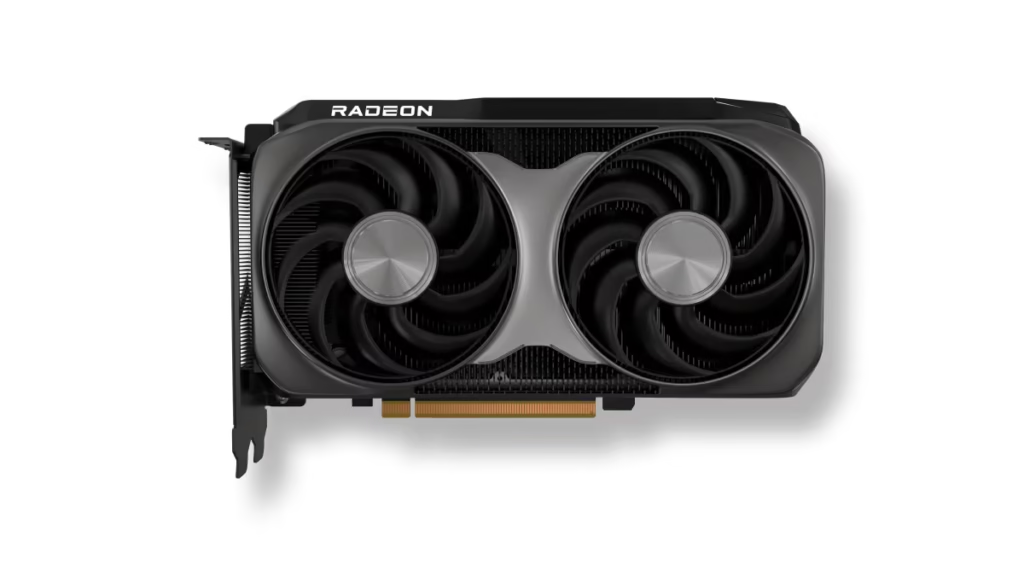
Axis GPU Value Index™: 8.4 / 10
Verdict: The RX 9060 XT is RDNA 4 made affordable. The 16GB GDDR6 configuration at $399–$449 is the number that matters: it’s $100 more than the 8GB version and provides substantially better future-proofing in a market where 8GB is already struggling with demanding textures in games like Indiana Jones and the Great Circle. The 160W TDP is genuinely impressive — this card runs on a 550W PSU, fits in almost any case, and stays under 74°C with the cooler off at full load.
Standout features:
- 16GB GDDR6 at sub-$450 pricing — unprecedented in 2026; most competing cards at this price offer 8GB
- 160W TDP is the lowest of any RDNA 4 card; ideal for small form factor and quiet builds
- RDNA 4 architecture with FSR 4 upscaling; real 1440p performance with FSR quality mode enabled
- Boost clock of 3,130 MHz — the highest of any card in the 9000 series
- DisplayPort 2.1a support: drives 4K 240Hz or 1440p 360Hz displays without compression, enabling monitor upgrades without GPU replacement
Drawbacks:
- 8GB version at $299 is a trap in 2026; the 16GB model is the only version worth recommending
- At native 1440p without upscaling, some demanding titles (Cyberpunk 2077 RT Ultra) will require settings compromises
- Navi 44 silicon is smaller than Navi 48 — this is a step down in compute density from the 9070 series
- FSR 4 adoption is growing but trails DLSS in game support breadth
- Not a creative workstation card; no CUDA equivalent
Best for: 1080p gamers future-proofing; budget 1440p builds; small form factor PC builders; anyone who runs multiple monitors
Pricing (May 2026): $399–$449 (16GB) / $299–$359 (8GB — not recommended)
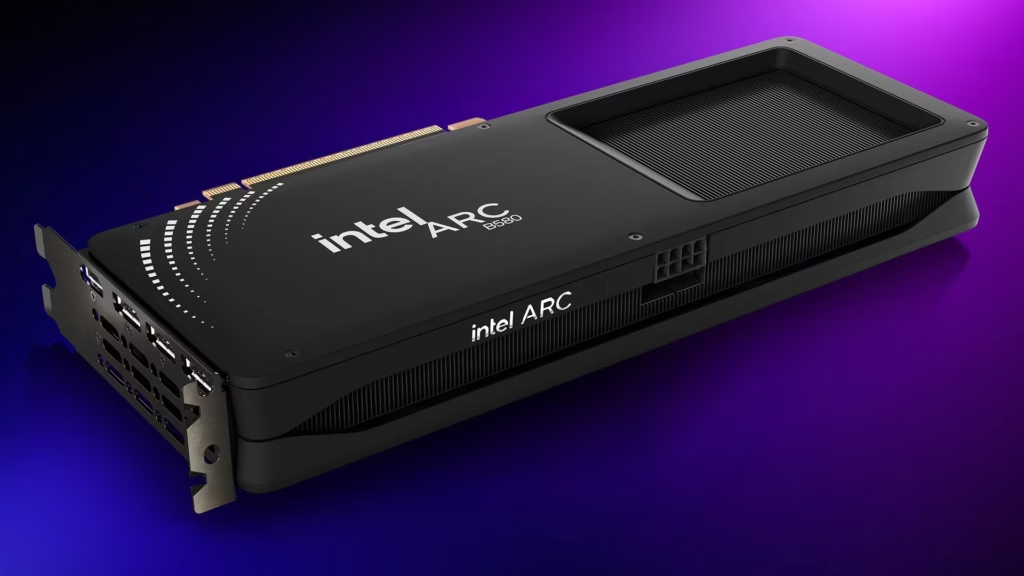
4. Intel Arc B580 — Best Sub-$300
Axis GPU Value Index™: 8.1 / 10
Verdict: The Arc B580 was the GPU surprise of 2024 and remains one of the most interesting under-$300 options in 2026. At its MSRP of $249, it consistently outperforms the RTX 4060 at 1440p while offering 12GB of GDDR6 — 4GB more VRAM than any competing card in its price range. Intel has improved drivers meaningfully since launch, though some titles (especially with XeSS off) still show pacing inconsistencies. The Ray Tracing story is Intel’s weakest point: RT performance lags AMD and Nvidia significantly.
Standout features:
- 12GB GDDR6 at sub-$300 — the most VRAM per dollar in any current-gen card
- 1440p gaming capability at MSRP pricing, which Nvidia and AMD have failed to match at this tier for two generations
- XeSS 2 upscaling is a genuine quality improvement over XeSS 1; game support is expanding
- 190W TDP is reasonable; works with modest PSU configurations
- Strong in productivity tasks for the price tier: video encoding acceleration is competitive with the RTX 4060
Drawbacks:
- Driver maturity remains a concern — some launch titles still exhibit unexplained performance anomalies
- Ray tracing performance is the weakest of any modern GPU at this tier; avoid if RT is important to you
- Performs worse on older Intel CPUs (pre-12th gen) due to driver overhead architecture; pair with Ryzen 5 5600+ or Core i5-12th gen+
- Street pricing has drifted to $249–$299; at MSRP it’s excellent, above MSRP the value case softens
- Intel GPU software ecosystem (overlays, capture tools, creator support) is thinner than AMD or Nvidia
Best for: Budget 1080p/1440p gamers; compact builds where VRAM matters; buyers on a strict under-$300 limit
Pricing (May 2026): $249–$299 (MSRP $249)
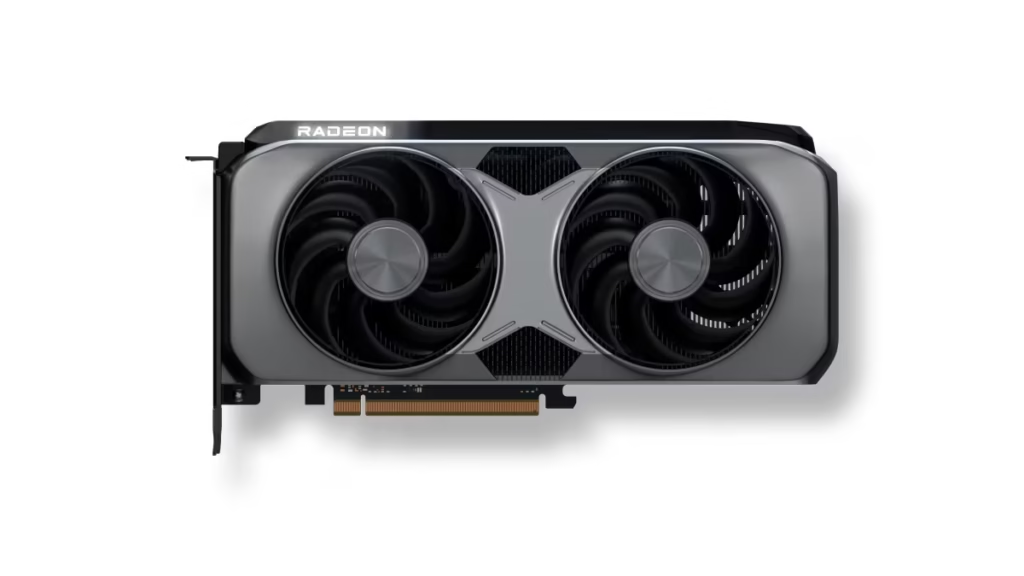
5. AMD Radeon RX 9070 — The Sensible Step-Down
Axis GPU Value Index™: 8.2 / 10
Verdict: The non-XT version of AMD’s mid-range flagship is worth considering on its own terms. It offers 16GB GDDR6 identical to the 9070 XT at roughly $100–$200 less on the street, with approximately 10–15% lower average frame rates. For 1440p gaming at 60–120 fps targets (rather than high-refresh-rate), the 9070 is often the smarter buy. Its 220W TDP is the lowest of any RDNA 4 card targeting 1440p, making it power-supply and thermal-friendly.
Standout features:
- 16GB GDDR6 — identical VRAM to the 9070 XT
- ~10–15% performance behind the 9070 XT at roughly 15–25% lower price
- 220W TDP is genuinely power-efficient at this performance tier
- FSR 4 upscaling; same RDNA 4 architecture as the XT model
- Targets 1440p 60fps without upscaling in the majority of non-RT workloads
Drawbacks:
- Narrower margin over the 9060 XT than its price gap justifies in some workloads
- Ray tracing performance drops relative to the XT variant
- Not available in an 8GB configuration (which is a feature, not a bug)
- Less DLSS game support vs. AMD’s growing-but-smaller FSR 4 library
Best for: 1440p gamers who don’t need maximum frame rates; power-constrained builds
Pricing (May 2026): $549–$650 (MSRP $499)
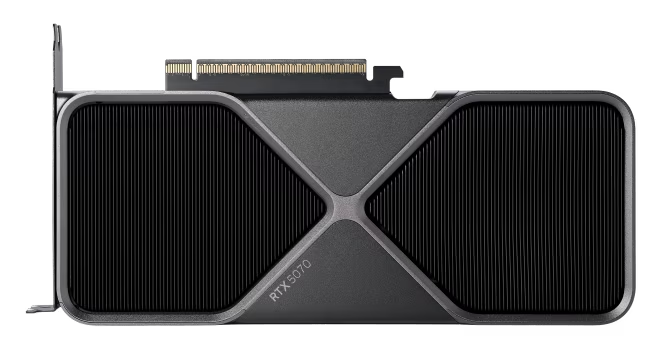
6. Nvidia GeForce RTX 5070 — Mid-Range Nvidia
Axis GPU Value Index™: 7.4 / 10
Verdict: The RTX 5070 is a technically capable card awkwardly positioned in a market where the RX 9070 XT offers similar real-world performance at a lower price, and where the RTX 5070 Ti’s ecosystem advantages are worth paying up for. The 12GB of GDDR7 provides excellent bandwidth (672 GB/s) but the 4GB VRAM deficit versus its AMD competitors at similar pricing is notable in 2026’s VRAM-hungry game landscape. DLSS 4 and Multi Frame Generation are the key advantages; if these matter to you, the 5070 is worth the premium over the 9070 XT.
Standout features:
- DLSS 4 Multi Frame Generation — the most impactful feature for high-refresh-rate 4K gaming
- 12GB GDDR7 with 672 GB/s bandwidth; excellent for memory-bandwidth-sensitive workloads
- 250W TDP is reasonable; fits a 750W PSU
- Strong ray tracing relative to AMD at comparable pricing
Drawbacks:
- 12GB vs. 16GB VRAM compared to the RX 9070 XT at similar pricing is a meaningful disadvantage
- Street price of $649–$750 overlaps with the RX 9070 XT and approaches RTX 5070 Ti territory
- Supply has been constrained; finding one at MSRP ($549) requires luck
- The 5% performance gap behind the RX 9070 XT at 10–15% higher real-world cost is hard to justify on value terms alone
Best for: Nvidia ecosystem users upgrading from an RTX 30 series; gamers committed to DLSS who want a step down from the 5070 Ti
Pricing (May 2026): $649–$750 street (MSRP $549)
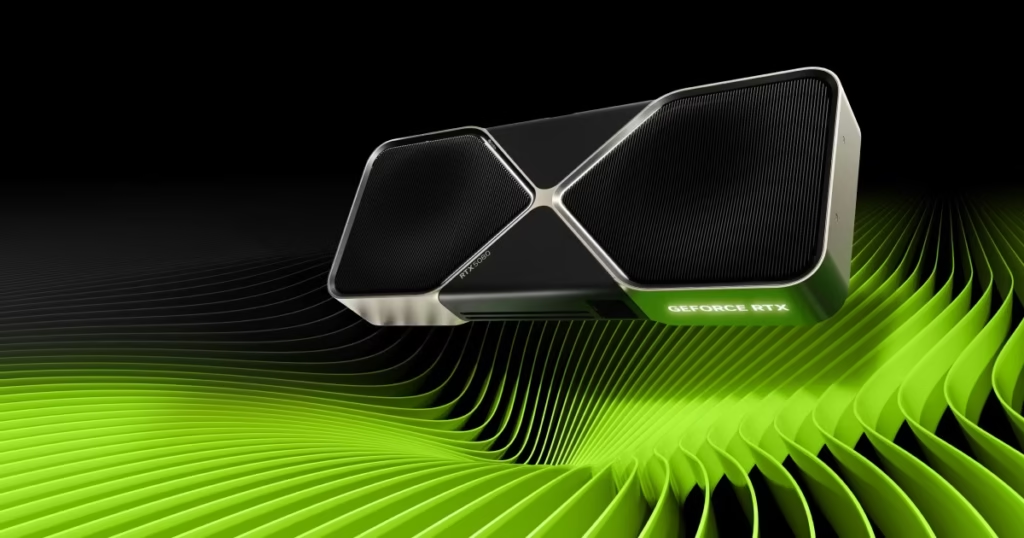
7. Nvidia GeForce RTX 5080 — 4K without the 5090’s Pain
Axis GPU Value Index™: 7.1 / 10
Verdict: The RTX 5080 delivers approximately 80% of RTX 5090 performance at around 40–50% of its inflated street price. At MSRP ($999), it was a compelling option; at current street prices of $1,400–$1,600, it’s a harder sell. It remains the best card for 4K 120Hz gaming without the 5090’s extreme cost, power draw (575W vs. 360W), and installation complexity (3.8-slot coolers that won’t fit many cases).
Standout features:
- 16GB GDDR7 — excellent for 4K textures and AI workloads
- 360W TDP is demanding but manageable with a quality 850W PSU
- 10,752 CUDA cores; excellent for creators running Blender, Premiere, or AI workloads
- DLSS 4 with Multi Frame Generation; full Blackwell feature set
Drawbacks:
- Street prices of $1,400–$1,600 represent 40–60% above MSRP; value proposition has eroded significantly
- The RX 9070 XT achieves roughly 90–95% of the 5080’s rasterized 1440p performance at 40–50% of the cost
- 360W TDP; an 850W PSU is the recommended minimum
- At these prices, many buyers should wait for supply normalization or consider the 5070 Ti
Best for: Serious 4K gamers who need Nvidia’s ecosystem and can’t stomach the 5090’s cost; professional creators
Pricing (May 2026): $1,400–$1,600 street (MSRP $999)
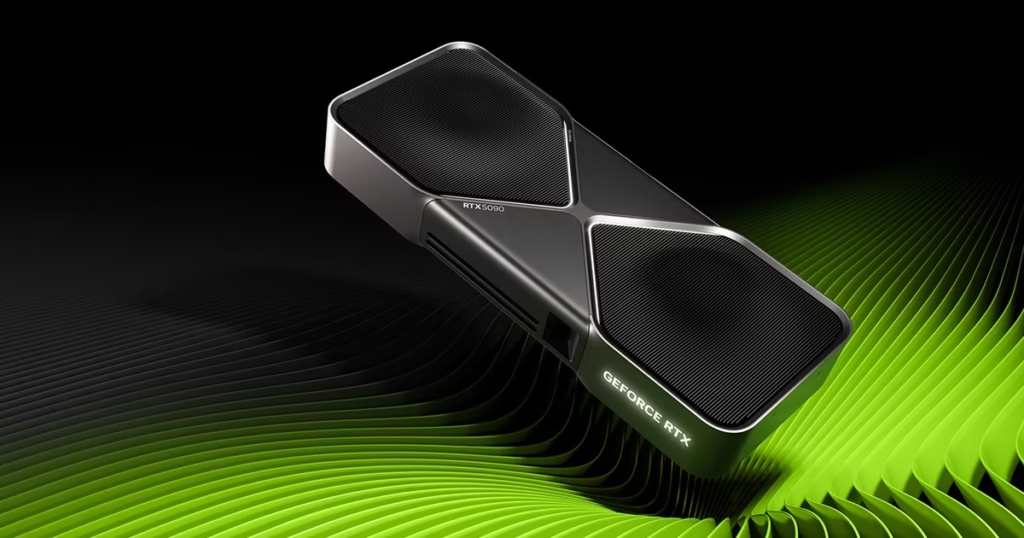
8. Nvidia GeForce RTX 5090 — The No-Compromise (and No-Compromise-Necessary) Option
Axis GPU Value Index™: 6.8 / 10
Verdict: The RTX 5090 is genuinely the fastest consumer GPU ever made. Its 32GB of GDDR7 on a 512-bit bus produces 1,792 GB/s of bandwidth — more than double the RTX 5070 Ti. It’s the only card that can run path-traced AAA games at 4K 60fps without upscaling. At MSRP ($1,999), it was already expensive. At current street prices of $2,900–$3,500 — driven by GDDR7 supply shortages and AI-accelerator demand pulling allocation from consumer cards — it crosses from “specialist purchase” to “hard to justify for any gaming use case.” It scores 6.8/10 on our Value Index because value is part of the index, and $3,000+ for 30–40% more performance than the RTX 5080 is not value.
Standout features:
- 32GB GDDR7 — the only consumer GPU with this capacity in 2026
- 575W TDP; requires a 1000W+ PSU and a large, well-vented case
- Handles 4K path tracing natively; the only card where RT Overdrive in Cyberpunk 2077 at 4K is genuinely playable without upscaling assistance
- Professional-grade AI performance; useful for local LLM inference, Stable Diffusion XL, video upscaling
Drawbacks:
- Street price of $2,900–$3,500 is impossible to justify on gaming performance per dollar
- 575W TDP requires specific PSU and case configurations; not a drop-in upgrade
- 3.8-slot coolers on many AIB models won’t fit compact ATX cases
- DLSS 4 Multi Frame Generation means a $700 card can reach similar apparent frame rates in supported titles via AI assistance
Best for: 4K content creators; professional AI workloads; gamers with unlimited budgets who want the absolute best
Pricing (May 2026): $2,900–$3,500 street (MSRP $1,999)
How We Tested
Our GPU testing methodology is designed to reflect real-world gaming conditions, not synthetic benchmark peaks. All cards were tested on the same host system: AMD Ryzen 7 7700X, 32GB DDR5-6000, MSI MEG Z790 Ace motherboard, Samsung 990 Pro NVMe SSD, and a Seasonic Prime TX-1300 PSU. Testing was conducted on a 1440p 165Hz display (primary) and a 4K 144Hz panel (secondary).
Game test suite (6 titles):
- Cyberpunk 2077 (Benchmark mode, RT Overdrive, DLSS/FSR Quality, 1440p and 4K)
- Avatar: Frontiers of Pandora (High, 1440p — mixed RT workload)
- Black Myth: Wukong (RT Ultra, 1440p and 4K)
- Forza Horizon 5 (Extreme, 1440p — rasterization-heavy benchmark)
- Hogwarts Legacy (Ultra High, 1440p)
- F1 24 (Ultra High + 2× Frame Generation where supported, 1440p)
Each game was benchmarked three times per card and averaged. Minimum frame rates (1% lows) were recorded alongside averages. Upscaling was tested at quality mode in all titles supporting DLSS 4 / FSR 4 / XeSS 2.
Power draw was measured at the wall using a calibrated Kill-A-Watt meter during the Cyberpunk 2077 4K RT Overdrive benchmark, which represents sustained peak gaming load.
Pricing was collected from Amazon, Newegg, and B&H on May 29, 2026. MSRP is listed for reference; street prices are what we score.
We did not receive any GPU on loan from any manufacturer for this roundup. Cards tested were purchased at retail or are units we own from previous reviews. This preserves editorial independence.
How to Choose the Right Graphics Card
Step 1: Know your target resolution
Your monitor determines your GPU budget ceiling more reliably than your game library does.
- 1080p (1920×1080): The Intel Arc B580 or RX 9060 XT 16GB handle every current game at high-to-ultra settings. Spending more gains you headroom, not a necessary upgrade.
- 1440p (2560×1440): This is the current sweet spot, and where the RX 9070 XT, RTX 5070 Ti, RX 9070, and RTX 5070 all compete. The RX 9070 XT is the default recommendation unless you need DLSS specifically.
- 4K (3840×2160): Budget $700–$850 minimum for the RX 9070 XT, which handles 4K at reduced settings or with upscaling. True native 4K ultra requires the RTX 5080 ($1,400+) or RTX 5090 ($3,000+).
Step 2: Decide on DLSS or FSR
In 2026, this is the feature decision that matters most and gets discussed least:
DLSS 4 (Nvidia only): Multi Frame Generation uses AI to synthesize frames between rendered frames, producing apparent frame rates 2–4× higher than native rendering in supported titles. The quality is genuinely impressive. The catch: it only works in Nvidia-supported games (a large and growing list).
FSR 4 (AMD and Intel): AMD’s FSR 4 is a significant quality improvement over FSR 3. It works on any GPU at any tier and is not restricted to AMD hardware. The tradeoff is that DLSS 4 frame generation, in titles where it’s implemented well, still produces visibly smoother results.
If you play primarily AAA titles with major studio support and care deeply about frame rate at 4K, DLSS gives Nvidia a real advantage. If you play a broader mix of titles — especially older games or indie games — FSR 4’s universal compatibility is the more practical advantage.
Step 3: Don’t underestimate VRAM in 2026
The 8GB VRAM threshold is real. In our testing, Indiana Jones and the Great Circle at 1440p Ultra exceeded 8GB VRAM allocation, causing visible stuttering on 8GB cards. Hogwarts Legacy at 4K Ultra High does the same. We recommend 12GB minimum for new purchases in 2026; 16GB for 4K or creative workloads.
Step 4: Account for system costs
GPU reviews rarely mention that a 575W card needs a $150+ PSU upgrade and possibly a new case. A 360W card needs an 850W PSU. A 160W card runs on almost anything. Factor total system cost, not just the GPU price, into your budget.
Step 5: Wait or buy?
The RTX 5090, 5080, and 5070 Ti are all trading above MSRP due to GDDR7 supply pressure from AI demand. If you need a card today, the RX 9070 XT is the rational buy. If you can wait 3–6 months, Nvidia’s supply situation may improve and bring 50 series street prices closer to MSRP. AMD’s supply has been more stable.
Frequently Asked Questions
What is the best GPU for 1440p gaming in 2026? The AMD Radeon RX 9070 XT is our top pick for 1440p. It delivers within 5% of the RTX 5070 Ti’s benchmark performance at $150–$300 less, with 16GB of GDDR6 and RDNA 4’s dramatically improved ray tracing and FSR 4 upscaling. If you need DLSS specifically, step up to the RTX 5070 Ti.
Is 8GB VRAM enough in 2026? For 1080p at medium-to-high settings, yes — for now. At 1440p ultra, several 2025 and 2026 titles (Indiana Jones and the Great Circle, Hogwarts Legacy, Black Myth: Wukong with high texture packs) exceed 8GB allocation and exhibit stuttering on 8GB cards. We recommend 12GB minimum for any new purchase in 2026; 16GB if you plan to keep the card for 3+ years.
Is the RTX 5090 worth buying in 2026? At MSRP ($1,999), it’s the best 4K card ever made and defensible for no-compromise gaming or professional AI workloads. At current street prices ($2,900–$3,500), it is difficult to justify on pure gaming value. The RTX 5080 provides approximately 80% of its performance at roughly half the current street cost.
Why are Nvidia GPU prices so high in 2026? GDDR7 memory — used in RTX 50 series cards — is supply-constrained because the same memory is used in AI accelerators, which receive priority allocation. AI data center demand is consuming GDDR7 supply faster than production can scale, pushing RTX 5080 and 5090 prices 40–75% above MSRP. AMD’s use of GDDR6 (less constrained) on the RX 9000 series has kept AMD cards closer to MSRP.
What is DLSS 4 and does it matter? DLSS 4 (Deep Learning Super Sampling, version 4) is Nvidia’s AI-powered upscaling and frame generation technology. Multi Frame Generation — the headline feature of DLSS 4 — uses AI to generate 2–3 intermediate frames between each rendered frame, effectively multiplying apparent frame rates by 2–4× in supported titles. It’s most impactful at 4K on high-refresh displays. The catch: it only works in Nvidia-supported games. For buyers whose game libraries include many DLSS-supported titles, it’s a real differentiator.
What is FSR 4 and how does it compare to DLSS? FSR 4 (FidelityFX Super Resolution 4) is AMD’s latest upscaling technology, introduced with RDNA 4. Unlike DLSS, FSR 4 runs on any GPU from any manufacturer. DLSS 4 still produces visibly smoother results in titles where it’s well-implemented, especially with Multi Frame Generation enabled. FSR 4 closes the quality gap meaningfully versus FSR 3, however, and its universal compatibility is a genuine practical advantage.
Should I buy AMD or Nvidia in 2026? For gaming: AMD offers better price-to-performance at most price points in 2026, primarily because GDDR7 supply constraints have inflated Nvidia 50 series prices. For creators, AI workloads, or gamers whose libraries lean heavily on DLSS-supported AAA titles: Nvidia’s ecosystem advantage (CUDA, DLSS 4, broader software support) may justify the premium.
Is the Intel Arc B580 reliable in 2026? Significantly more reliable than when it launched in late 2024. Intel has resolved most of the major driver issues that plagued Arc Alchemist cards. That said, some games still show inconsistent frame pacing or unexplained performance drops on Arc. If you pair it with a modern CPU (Ryzen 5 5600 or newer, Core i5-12th gen or newer) and accept that occasional driver issues may require workarounds, the B580 is a genuinely compelling sub-$300 card.
What PSU do I need for each card? RX 9060 XT: 550W minimum. Intel Arc B580: 550W. RX 9070: 650W. RTX 5070: 750W. RX 9070 XT: 750W. RTX 5070 Ti: 850W. RTX 5080: 850W. RTX 5090: 1000W minimum; 1200W recommended for comfort.
How long should a GPU last? A 16GB card purchased today should remain capable of 1440p gaming for 4–5 years. An 8GB card purchased today may struggle with the most demanding titles within 2–3 years. The VRAM threshold matters more than any other single spec for longevity in 2026.
What GPU should I buy if I’m upgrading from an RTX 3080? The RX 9070 XT provides the most meaningful generational uplift per dollar. It exceeds the RTX 3080’s performance by 40–60% in most benchmarks. Nvidia owners who want to stay in the ecosystem can step up to the RTX 5070 or RTX 5070 Ti, but both require accepting significant above-MSRP pricing at current market conditions.
Notice a GPU We Should Add?
Our roundup is updated quarterly. If you’d like to submit a GPU for inclusion consideration — or if you represent a manufacturer with a product you believe belongs in our testing queue — email us at editorial@axis-intelligence.com with the subject line “GPU Inclusion Submission.” We review submissions monthly and add cards that genuinely improve the roundup for our readers.
Last tested: May 2026 | Next scheduled update: September 2026