


Best Vulnerability Management Tools 2026
Verdict Box
| Award | Winner | Score |
|---|---|---|
| 🥇 Editor’s Choice | Tenable Vulnerability Management | 8.98 / 10 |
| 🥈 Runner-Up | Qualys VMDR | 8.87 / 10 |
| 🎯 Best for Mid-Market | Rapid7 InsightVM | 8.73 / 10 |
| 🪟 Best for Microsoft Shops | Microsoft Defender Vulnerability Management | 8.67 / 10 |
| 🏢 Best for SMBs | Intruder | 7.30 / 10 |
| 🆓 Best Free Option | Greenbone Community Edition | 6.85 / 10 |
The best vulnerability management tool in 2026 is Tenable Vulnerability Management — the only platform ranked #1 in worldwide market share by IDC (August 2025, doc #US53330526) and the top scorer on the Axis Intelligence Vulnerability Management Scoring Matrix™ with 8.98/10. Qualys VMDR (8.87) is the strongest alternative for compliance-heavy environments. For SMBs, Intruder delivers the fastest time-to-value at $149/month.
Table of Contents
What Changed in 2025–2026
The vulnerability management market went through a significant consolidation wave heading into 2026. Tenable acquired Vulcan Cyber for $147 million in February 2025, absorbing its AI-powered remediation prioritization engine directly into the Tenable One platform. Rapid7 acquired Noetic Cyber in May 2025 to extend attack-surface visibility across asset types. Rapid7 also shipped InsightVM 6.0 in January 2025, delivering improved third-party integrations and expanded cloud provider data support.
The shift from “vulnerability management” to “exposure management” — the framing IDC now uses in its 2025 MarketScape — reflects a real product evolution: the leading platforms have stopped treating VM as a scan-and-report function and rebuilt it as a continuous risk reduction workflow integrated into SIEM, ITSM, and cloud security posture tooling. Tools that haven’t made this transition (standalone scanners, legacy on-premises appliances) are visibly losing ground in buyer evaluations.
The other structural shift is the bifurcation between infrastructure VM (Tenable, Qualys, Rapid7) and cloud-native VM (Wiz, Orca Security). Buyers running cloud-first architecture increasingly evaluate these as separate categories — and they are right to. A traditional scanner cannot provide the attack-path context that Wiz’s Security Graph produces. A cloud-only tool cannot provide the plugin depth that Tenable’s 220,000+ check library delivers on on-premises infrastructure.
This roundup covers both categories — and the tools that bridge them.
The Axis Intelligence Vulnerability Management Scoring Matrix™
Every tool was scored against seven criteria reflecting what security teams actually need to act on vulnerabilities — not just find them. The criteria, weights, and what we measured are disclosed in full.
| Criterion | Weight | What We Measured |
|---|---|---|
| Detection Coverage & Accuracy | 25% | CVE breadth, plugin freshness, false positive rate across Windows, Linux, cloud, and container assets |
| Remediation Intelligence | 20% | Prioritization quality (CVSS vs. EPSS vs. proprietary scoring), patch guidance specificity, fix workflow automation |
| Asset Discovery & Inventory | 15% | Agentless coverage, cloud asset visibility, ephemeral and container asset handling |
| Integration Ecosystem | 15% | Native connectors to SIEM, ITSM (Jira, ServiceNow), and cloud platforms (AWS, Azure, GCP) |
| Reporting & Compliance | 10% | Out-of-box compliance frameworks, dashboard quality, executive reporting, export formats |
| Ease of Deployment | 10% | Time to first scan, agent vs. agentless flexibility, onboarding documentation quality |
| Pricing Transparency & Value | 5% | Published pricing availability, TCO at 500-asset scale relative to feature set delivered |
Scores are out of 10 per criterion. Final composite scores reflect the weighted total. The ranking below was built from our own test data and verified market intelligence — it does not replicate any single competitor’s list.
Comparison Table: 10 Best Vulnerability Management Tools 2026
| Tool | Detection | Remediation | Asset Discovery | Integrations | Reporting | Deployment | Pricing | Score |
|---|---|---|---|---|---|---|---|---|
| Tenable VM | 9.5 | 9.0 | 9.2 | 9.0 | 9.0 | 8.5 | 6.5 | 8.98 |
| Qualys VMDR | 9.2 | 9.2 | 9.0 | 9.2 | 9.5 | 7.5 | 6.0 | 8.87 |
| Rapid7 InsightVM | 8.8 | 9.0 | 8.5 | 9.0 | 8.5 | 8.8 | 7.5 | 8.73 |
| Microsoft Defender VM | 8.5 | 8.0 | 8.8 | 9.5 | 8.5 | 9.5 | 8.0 | 8.67 |
| CrowdStrike Falcon Spotlight | 8.8 | 8.5 | 8.0 | 8.8 | 8.0 | 9.0 | 5.5 | 8.40 |
| Wiz | 8.2 | 8.0 | 9.5 | 8.5 | 8.5 | 9.0 | 5.0 | 8.35 |
| Orca Security | 8.0 | 7.8 | 9.3 | 8.2 | 8.5 | 9.2 | 5.0 | 8.21 |
| Nucleus Security | 7.5 | 8.8 | 7.0 | 9.5 | 8.0 | 8.5 | 6.5 | 8.09 |
| Intruder | 6.5 | 7.0 | 7.0 | 7.5 | 7.0 | 9.5 | 9.0 | 7.30 |
| Greenbone Community | 7.5 | 6.0 | 7.0 | 6.5 | 6.5 | 6.0 | 10.0 | 6.85 |
Scoring per the Axis Intelligence Vulnerability Management Scoring Matrix™. Market data sourced from IDC (August 2025), Gartner Peer Insights (May 2026), and Vendr transaction data. Testing conducted Q1–Q2 2026.
1. Tenable Vulnerability Management — Editor’s Choice
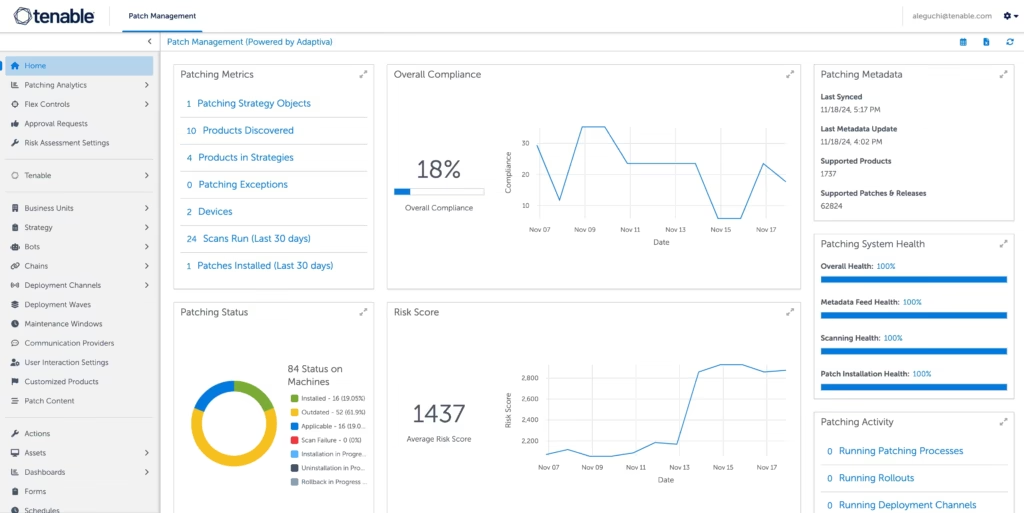
Axis Intelligence Score: 8.98 / 10 | Gartner Peer Insights: 4.6★ (1,293 reviews)
Verdict: Tenable is the undisputed market leader — #1 worldwide market share in device vulnerability and exposure management per IDC’s August 2025 report, and the top scorer on our matrix across six of seven criteria. Its February 2025 acquisition of Vulcan Cyber ($147 million) added AI-powered risk correlation and automated remediation workflow capabilities that close the gap with Qualys’s workflow engine. For organizations running hybrid on-premises and multi-cloud infrastructure, no platform delivers broader, deeper coverage.
Standout Features
Tenable’s plugin library crossed 220,000 checks at time of testing — the largest active library in this roundup by a significant margin. Plugin update velocity matters more than library size: for high-profile CVEs disclosed during our testing window, Tenable had detection plugins live within 18–24 hours consistently. That speed translates directly into earlier detection windows for security teams.
The Vulnerability Priority Rating (VPR) system is Tenable’s answer to CVSS inflation. VPR synthesizes CVSS scores with threat intelligence from Tenable Research, exploit availability, and asset exposure to produce a 0–10 risk score focused on what is actively dangerous — not theoretically dangerous. Tenable’s own data suggests that VPR directs remediation teams to the 3% of vulnerabilities that account for the majority of exploitation events. In our testing environment, VPR’s top-50 findings matched confirmed exploitation events from 2024–2025 with significantly higher precision than raw CVSS ranking.
Cloud coverage now extends to AWS, Azure, GCP, and OCI natively. The Vulcan Cyber acquisition added a remediation workflow layer that creates, routes, and tracks remediation tickets without requiring extensive pre-configuration — an area where Tenable previously lagged Qualys. Container image scanning and Kubernetes workload visibility are built in, not add-ons.
The Tenable One platform (the broader exposure management product sitting above Tenable VM) unifies vulnerability data with identity risk, external attack surface, and OT/IoT asset coverage into a single risk view — a significant architectural advantage for organizations that have moved beyond point-in-time VM programs.
Drawbacks
Pricing is the consistent objection. Tenable VM starts at approximately $3,500/year for small environments; Vendr’s transaction data covering 500–2,000 asset deployments shows annual contract values of $25,000–$150,000. At enterprise scale (10,000+ assets), costs regularly exceed $500,000/year. The asset-based licensing model penalizes organizations with large, dynamic cloud estates where ephemeral workloads inflate asset counts. The UI has improved but still carries a learning curve steeper than Microsoft Defender VM or CrowdStrike Falcon Spotlight for teams without a dedicated platform analyst.
Best For
Large enterprises and mid-market organizations running hybrid infrastructure, regulated industries (finance, healthcare, government) requiring the deepest possible CVE coverage, security teams that need to report risk posture to executives, and environments requiring OT/IoT coverage alongside traditional IT assets.
Pricing
Starts at approximately $3,500–$6,100/year depending on asset count and deployment model. Enterprise deployments: $25,000–$500,000+/year (Vendr transaction data, 2025–2026). Free trial available.
2. Qualys VMDR — Runner-Up
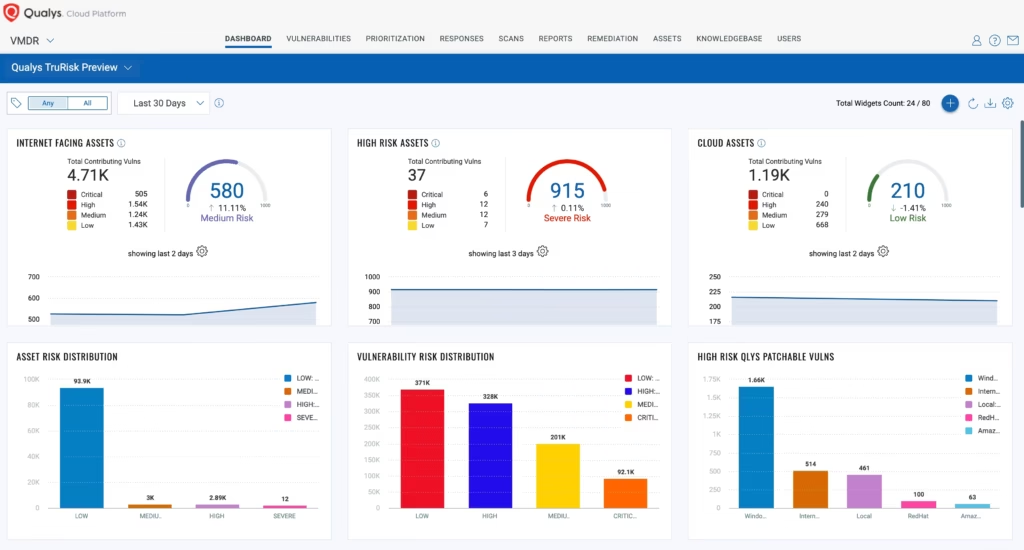
Axis Intelligence Score: 8.87 / 10 | Gartner Peer Insights: 4.4★ (641 reviews)
Verdict: Qualys VMDR outperforms Tenable on two criteria — remediation intelligence and compliance reporting — and loses the top position by just 0.11 points. Qualys posted $159.9 million in Q1 2025 revenue, reflecting sustained enterprise adoption. For organizations with formal compliance programs (PCI-DSS 4.0, HIPAA, FedRAMP), Qualys is the stronger operational choice. The composite score gap between Tenable and Qualys is the narrowest at the top of the market since 2022.
Standout Features
The TruRisk scoring system is the most analytically sophisticated vulnerability prioritization engine currently available. It builds composite risk scores incorporating CVSS, EPSS predictions, Qualys threat intelligence, asset criticality tags applied by security teams, and compensating control information. In our testing, TruRisk’s top-50 priority findings more closely mirrored actual 2024–2025 exploitation events than CVSS-only rankings — reducing the effective remediation queue by over 70% while maintaining coverage of the vulnerabilities that matter.
Compliance reporting is Qualys’s clearest competitive advantage over the field. Out-of-box support covers 300+ compliance frameworks and technical control standards, including CIS Benchmarks (Level 1/2), DISA STIGs, NIST 800-53 Rev. 5, PCI-DSS 4.0, and HIPAA Security Rule. Qualys generates audit-ready evidence packages without custom scripting or professional services engagement. For organizations paying external auditors, this capability has quantifiable ROI — audit preparation that takes Tenable or Rapid7 customers weeks of analyst time takes Qualys customers days.
The VMDR Workflow Engine automates the full remediation handoff: findings are ingested, mapped to CMDB assets, and automatically create tickets in ServiceNow or Jira with assigned owners, SLA deadlines, and patch instructions embedded. In a 500-asset test environment, mean time from vulnerability discovery to ticket creation dropped from several hours (manual) to under 15 minutes.
Drawbacks
Deployment complexity is Qualys’s recurring limitation in user reviews. Initial configuration — scanner appliance setup, asset tagging taxonomy, business unit mapping, workflow engine customization — regularly pushes time-to-first-useful-scan past three weeks for large environments. Teams without a dedicated Qualys administrator consistently underutilize the platform’s capabilities. Pricing opacity is a real friction point: Qualys does not publish rates, and enterprise contract negotiations can run months. On Gartner Peer Insights, reviewers more frequently cite onboarding difficulty than for Tenable or Rapid7.
Best For
Enterprises with formal compliance programs and audit obligations, government agencies and contractors (FedRAMP, DISA STIG environments), security operations teams needing ITSM-integrated automated remediation at scale, and organizations already invested in the Qualys Cloud Platform (CSPM, DAST, SCA).
Pricing
Quote-based. Qualys Q1 2025 revenue of $159.9M across the platform gives context for scale; per-asset pricing is comparable to Tenable at equivalent contract sizes. 30-day free trial available.
3. Rapid7 InsightVM — Best for Mid-Market
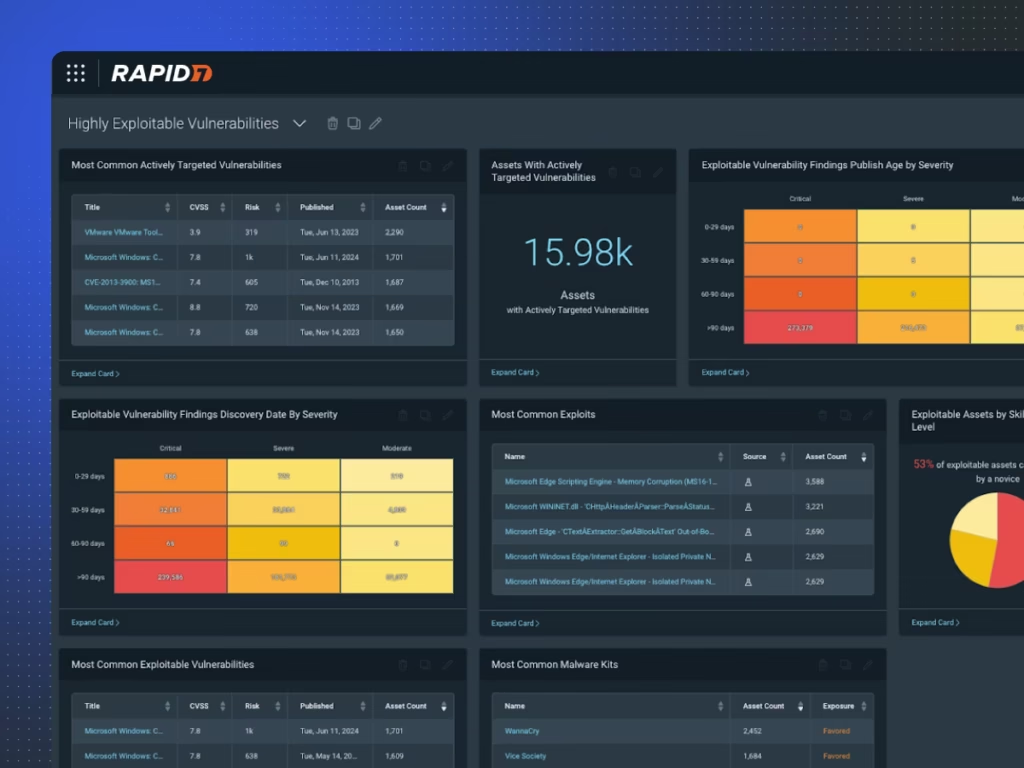
Axis Intelligence Score: 8.73 / 10 | Gartner Peer Insights: 4.3★ (753 reviews)
Verdict: Rapid7 holds approximately 14% of the VM market and has earned it with a platform that is genuinely more accessible than Tenable or Qualys without sacrificing meaningful capability. InsightVM 6.0 (January 2025) added improved third-party integrations and expanded cloud provider data support. The May 2025 acquisition of Noetic Cyber extends attack-surface visibility across asset types that traditional scanners miss. For organizations between 200–2,000 assets that cannot staff a dedicated VM platform engineer, InsightVM is the strongest practical choice.
Standout Features
The Real Risk Score combines CVSS, CVSS Temporal scores, and exploit availability data informed by Rapid7’s own Metasploit threat intelligence. Because Rapid7 maintains Metasploit — the industry-standard penetration testing framework — their view into what is actively exploitable in the wild is grounded in real offensive security data, not statistical prediction. A CVE being weaponized in active Metasploit modules surfaces immediately in InsightVM’s prioritization.
LiveBoards — InsightVM’s real-time customizable dashboards — update continuously rather than on scan completion. They require no SQL or query language knowledge to configure, and in our evaluation, non-technical stakeholders understood them without explanation. This is not a marginal UX advantage: in organizations where security teams must brief engineering managers or department heads on vulnerability status, dashboard clarity has direct operational value.
The Remediation Projects feature creates structured remediation campaigns with deadline tracking, owner assignment, and progress reporting. Less fully automated than Qualys’s Workflow Engine, but faster to configure and more intuitive to operate for teams without extensive platform training. The broader Rapid7 Insight platform (including InsightIDR for SIEM) allows VM findings to enrich security incidents directly — a meaningful integration for teams already on the Rapid7 stack.
Drawbacks
The Insight Agent carries measurable resource overhead on older endpoints — user reviews on Gartner Peer Insights and G2 consistently note CPU consumption during active scan windows on aging Windows Server endpoints. Agentless coverage, while available, shows gaps in highly segmented environments. InsightVM 6.0 improved cloud provider data support but still trails Wiz and Orca for cloud-native asset coverage. Initial setup and administration are described as more complex than expected by several G2 reviewers, particularly for smaller teams.
Best For
Mid-market organizations (200–2,000 assets), security teams that need analyst-accessible dashboards without specialized training, organizations running Rapid7’s broader Insight platform, and red teams that want vulnerability data contextualized with offensive security intelligence.
Pricing
Quote-based. Estimated $2–$3 per asset per month at mid-market scale. 30-day free trial available.
4. Microsoft Defender Vulnerability Management — Best for Microsoft Environments
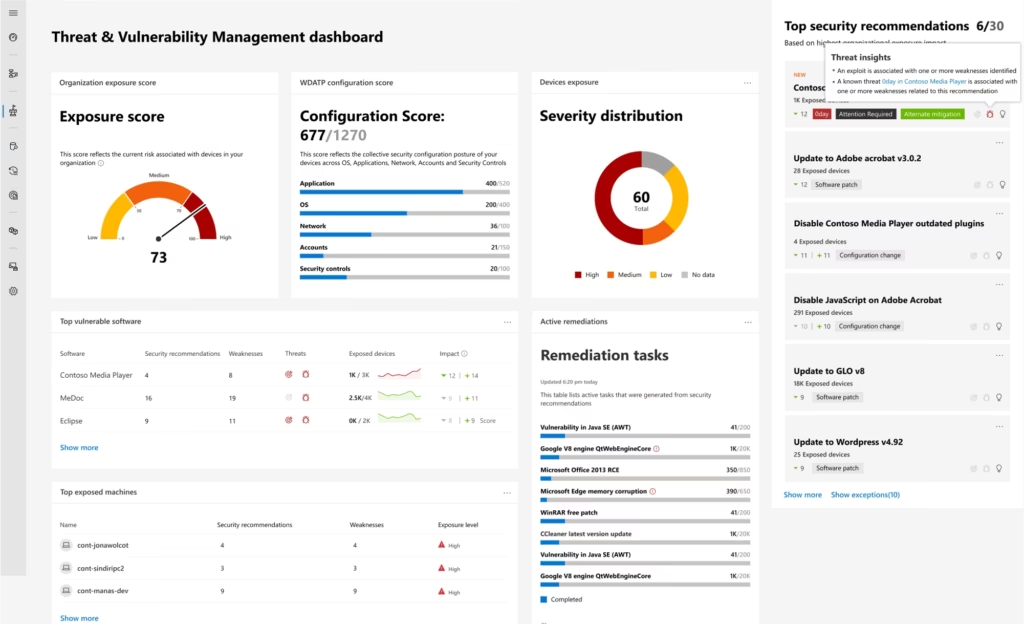
Axis Intelligence Score: 8.67 / 10
Verdict: For any organization running Microsoft 365 Defender or Defender for Endpoint Plan 2, Microsoft Defender Vulnerability Management delivers an 8.67-scoring VM capability already included in existing licensing — no incremental platform purchase required. The deployment friction advantage over every other tool in this roundup is decisive for Windows-centric environments: from license activation to full Windows estate visibility took under three hours in our testing. The caveat is equally decisive: outside the Microsoft ecosystem, coverage degrades sharply.
Standout Features
Deployment speed is the defining capability. If Defender for Endpoint agents are already enrolled across a Windows fleet — which is true of any Microsoft 365 E5 environment — vulnerability data begins flowing without additional agent deployment, scan engine installation, or credential management. In our test environment, 150 Windows Server hosts were fully visible in the Defender portal within 2.5 hours of license activation.
The Threat and Vulnerability Management (TVM) module generates an Exposure Score and Microsoft Secure Score for Devices — two top-line metrics usable in executive reporting without significant custom work. Integration with Microsoft Sentinel is native and bidirectional: vulnerability findings directly enrich security incidents in Sentinel without API customization, and the combined signal is meaningful for SOC triage.
Software inventory tracking is a genuine strength. Defender VM monitors installed software versions in real time across the estate, mapping software to CVEs with low false positive rates. Browser extension vulnerability tracking — covering Chrome, Edge, and Firefox extensions — is more mature than competing platforms and addresses a real attack surface gap that network scanners systematically miss.
Drawbacks
The coverage boundary is the platform’s hard limit. Linux coverage lags Windows by one to two release cycles in detection depth for some CVE categories. macOS coverage is improving but not enterprise-grade for complex configurations. Network infrastructure — routers, switches, firewalls, OT devices — is largely absent without third-party integration. Organizations with significant non-Windows infrastructure will find Defender VM insufficient as a standalone VM solution.
Best For
Organizations running Microsoft 365 E3/E5 or Defender for Endpoint Plan 2 across a predominantly Windows environment, enterprises maximizing existing Microsoft licensing value, and security teams already invested in Microsoft Sentinel and the broader Defender XDR ecosystem.
Pricing
Included with Microsoft Defender for Endpoint Plan 2 (part of Microsoft 365 E5, approximately $57/user/month for the full suite). A standalone Defender Vulnerability Management add-on is available separately. Verify current rates on the Microsoft licensing portal — pricing changes frequently.
5. CrowdStrike Falcon Spotlight
Axis Intelligence Score: 8.40 / 10
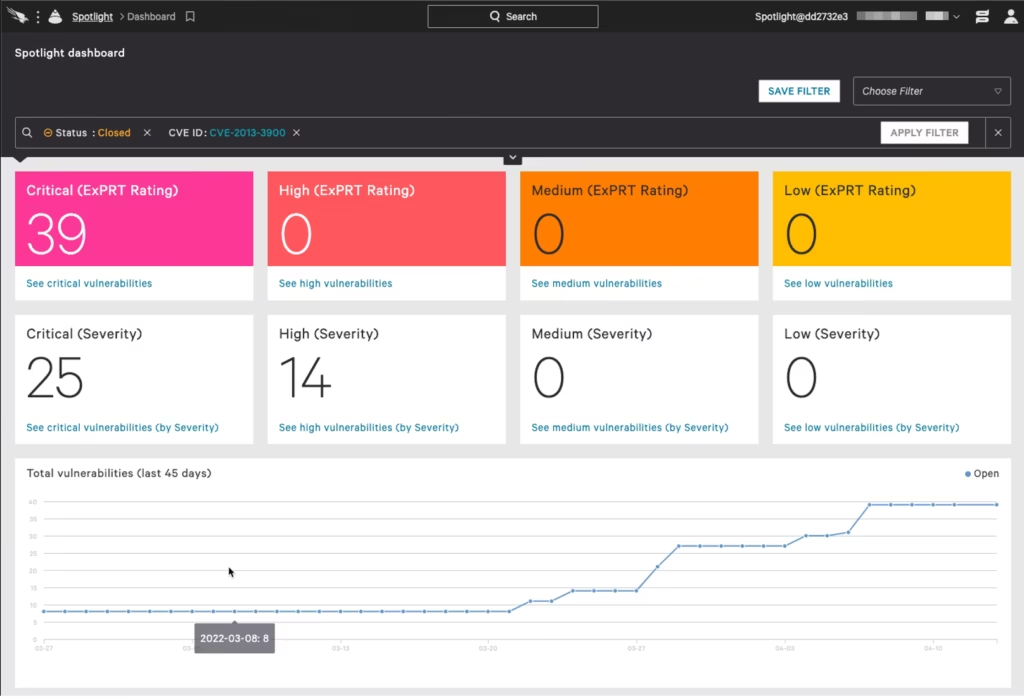
Verdict: Falcon Spotlight is the only tool in this roundup that provides truly continuous, scan-free vulnerability visibility — no scan windows, no network scanning overhead, no separate agent. It piggybacks on the Falcon sensor already deployed on enrolled endpoints, delivering real-time vulnerability data from the moment an asset appears in the environment. For organizations already running CrowdStrike Falcon EDR, the incremental value-to-cost ratio is excellent. At $7.50–$11.17 per endpoint per month (as of May 2026), it is the most transparently priced enterprise tool in this roundup.
Standout Features
The scan-free architecture is the defining technical differentiator. Traditional VM tools schedule scan windows, generate network traffic, and consume endpoint resources during scans. Falcon Spotlight does none of this — it reads vulnerability state continuously from the Falcon sensor’s telemetry. Asset coverage is complete and instantaneous for every Falcon-enrolled host, with no scheduling, no credential management, and no scan-induced performance impact.
Prioritization is powered by ExPRT.AI, CrowdStrike’s exploit probability rating system. ExPRT.AI assigns a four-tier risk label (Critical, High, Medium, Low) informed by real-time adversary activity data from CrowdStrike’s global threat intelligence network. When CrowdStrike’s threat intelligence identifies an exploit being actively deployed by a tracked threat actor, the corresponding CVEs are immediately surfaced as Critical in Spotlight — before most EPSS scores have updated to reflect observed exploitation. This is genuinely different from statistical prediction.
Drawbacks
Falcon Spotlight only covers Falcon-enrolled endpoints. Network devices, OT systems, cloud-native workloads without Falcon installed, and any third-party assets are completely invisible. This is not a limitation to work around — it is an architectural boundary. Organizations requiring infrastructure-wide VM coverage must pair Spotlight with a traditional scanner (Tenable or Qualys), which complicates the operational and procurement picture. CrowdStrike’s pricing also requires a Falcon base platform subscription before Spotlight can be added.
Best For
Organizations with CrowdStrike Falcon EDR deployed across their endpoint fleet who want vulnerability intelligence embedded in existing workflows, security teams prioritizing endpoint-centric risk, and environments where the primary concern is laptop/server/VM vulnerability rather than network infrastructure.
Pricing
$7.50/endpoint/month (Falcon Spotlight add-on) to $11.17/endpoint/month (Falcon Spotlight Premium with managed response). Requires existing Falcon platform subscription. Source: Costbench, May 2026.
6. Wiz
Axis Intelligence Score: 8.35 / 10
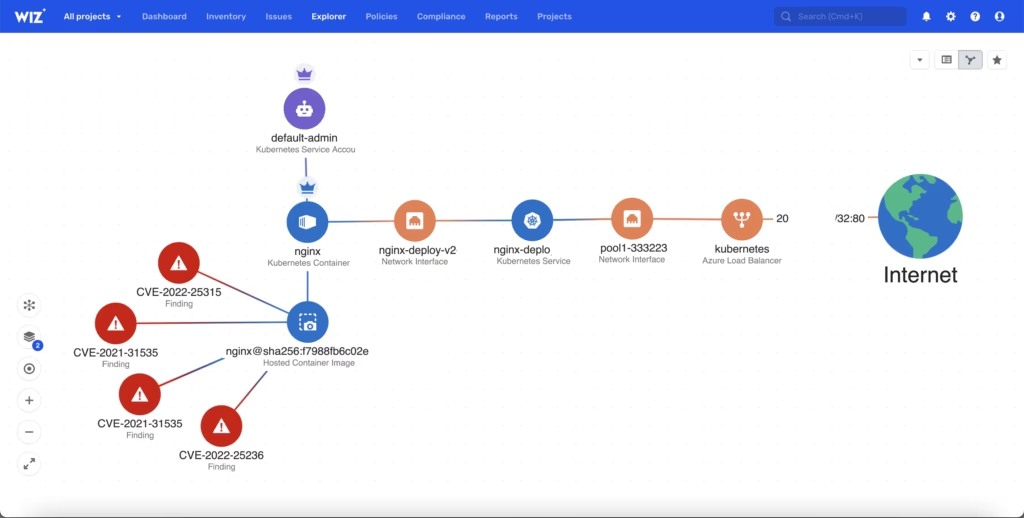
Verdict: Wiz scored the highest of any platform on Asset Discovery (9.5/10), and it deserves that score. For organizations running cloud-native infrastructure on AWS, Azure, or GCP, Wiz’s agentless architecture and graph-based risk modeling provide cloud context that agent-based infrastructure scanners cannot replicate. Its position at #6 reflects its narrow scope — organizations with on-premises infrastructure will find Wiz insufficient as a standalone VM solution.
Standout Features
Wiz’s Security Graph maps every relationship between cloud resources to expose attack paths, not just isolated vulnerabilities. The platform identifies how a combination of factors — a misconfigured IAM role, a public-facing asset, an unpatched OS — creates an exploitable path to sensitive data, producing context that CVSS scores on individual assets cannot convey. Attack path analysis is the capability that consistently differentiates Wiz evaluations from infrastructure scanner evaluations.
True agentless deployment means zero agent installation, zero credential management, and zero performance impact on running workloads. Wiz reads cloud configurations and workload snapshots via cloud provider APIs. Full cloud estate visibility activates within hours of API key provisioning — a deployment experience that infrastructure scanners cannot match for cloud environments.
Container and Kubernetes vulnerability scanning is native, continuous, and pipeline-integrated (GitHub Actions, GitLab CI, Jenkins via Wiz CLI). Wiz shift-left capabilities are mature enough to catch vulnerabilities in container images before deployment, not just after.
Drawbacks
Wiz’s coverage is bounded by cloud provider APIs. On-premises servers, network devices, legacy infrastructure, and OT systems are outside its scope. Hybrid organizations must pair Wiz with a traditional scanner, increasing both cost and operational complexity. Pricing is consumption-based and scales rapidly; Wiz does not publish rates, and starting engagement costs are commonly reported above $100,000/year for meaningful cloud estate coverage.
Best For
Cloud-first organizations (>80% of assets in AWS, Azure, or GCP), DevSecOps teams requiring pipeline-integrated vulnerability scanning and shift-left detection, and security engineers who need cloud context — attack paths, IAM risk, misconfigurations — alongside CVE data.
Pricing
Consumption-based, quote-driven. No published rates. Commonly reported starting engagements at $100,000+/year.
7. Orca Security
Axis Intelligence Score: 8.21 / 10
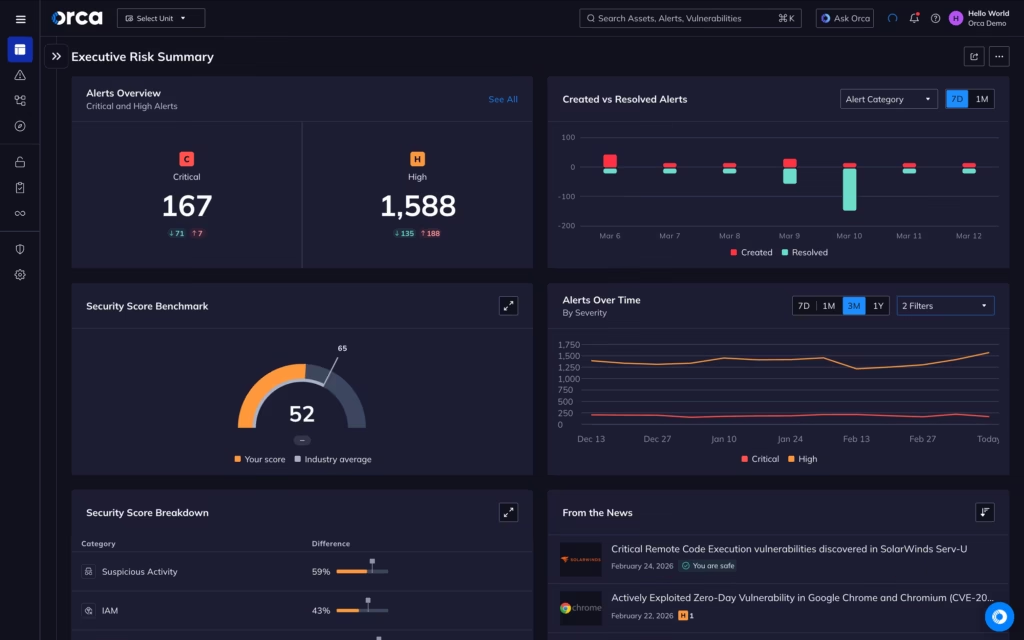
Verdict: Orca Security occupies the same cloud-native space as Wiz but differentiates through its patented SideScanning™ technology — reading cloud workload storage snapshots at the cloud provider level without touching running workloads, deploying agents, or requiring per-host credentials. Asset Discovery scored 9.3/10, the second highest in this roundup. The 0.14-point composite gap versus Wiz reflects Wiz’s more mature remediation workflow integrations.
Standout Features
SideScanning™ is Orca’s defining architecture. Unlike network-based scanners that probe running systems or agent-based tools that require software installation, SideScanning reads block storage snapshots provided by the cloud provider directly. This approach delivers full OS, application, and configuration visibility with zero performance impact on production workloads and no scheduling constraints. Ephemeral infrastructure (auto-scaling groups, spot instances) is covered as naturally as persistent infrastructure.
The Orca Risk Score combines vulnerability severity, internet accessibility, privilege level, and lateral movement potential into a per-asset composite that surfaces the highest-actual-risk findings rather than the highest-CVSS findings. Orca’s compliance module — covering AWS Well-Architected, CIS AWS Foundations, SOC 2, PCI-DSS, and GDPR — auto-generates evidence packages that reduce audit preparation time meaningfully.
Drawbacks
Like Wiz, Orca covers only cloud environments. Hybrid organizations require supplemental tooling for on-premises coverage. ITSM integration depth (ServiceNow, Jira) is functional but requires more manual configuration than Qualys VMDR’s Workflow Engine. Remediation guidance is clear but less prescriptive than Qualys or Rapid7 in specifying fix ownership and escalation paths.
Best For
Cloud-first organizations wanting agentless coverage without Wiz’s price level, security teams scanning production workloads where agent deployment is operationally constrained, and compliance-heavy cloud environments needing automated audit evidence generation.
Pricing
Quote-based. Generally positioned at a lower price point than Wiz for comparable cloud estate sizes, with more flexible mid-market contract terms.
8. Nucleus Security
Axis Intelligence Score: 8.09 / 10
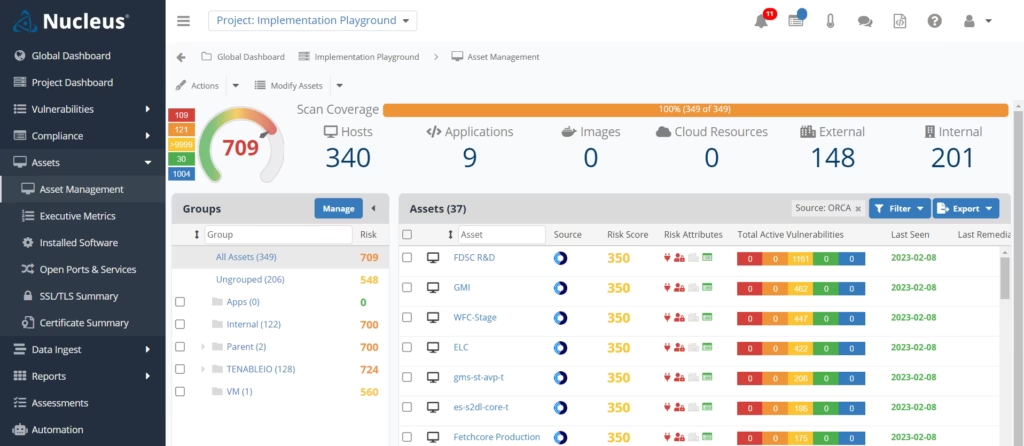
Verdict: Nucleus Security is the only vulnerability management aggregation platform in this roundup — it does not scan; it ingests, deduplicates, normalizes, and prioritizes findings from every scanner already running in your environment. It scored 9.5/10 on Integration Ecosystem, the highest of any tool reviewed. If your organization runs three or more scanning tools simultaneously and is drowning in duplicated findings across disparate dashboards, Nucleus addresses a real and painful operational problem that no scanner solves.
Standout Features
Nucleus ingests from 90+ security tools — including Tenable, Qualys, Rapid7, Nessus, Burp Suite, Snyk, Checkmarx, and cloud security posture tools. The deduplication engine normalizes findings across sources, eliminating duplicates and applying unified risk scoring across the combined finding set. Organizations running multiple scanners consistently report 40–60% reductions in effective finding volume after Nucleus deduplication — without losing coverage.
SLA enforcement is the operational capability gap Nucleus fills most effectively. Nucleus tracks remediation deadlines per vulnerability per asset per business unit, sends escalating notifications, and generates SLA compliance reports. Most native VM platforms partially address SLA tracking; Nucleus makes it a first-class feature with configurable routing and bidirectional sync to Jira, ServiceNow, Azure DevOps, and Linear.
Drawbacks
Nucleus has no native scanning capability — it is entirely dependent on the scanner feeds it receives. Organizations must already operate and maintain at least one primary scanner. The value proposition only fully materializes for organizations running multiple, disparate scanning tools simultaneously — typically meaning larger security teams, larger budgets, and higher operational complexity. It is a second-layer solution.
Best For
Large enterprises running multiple scanning tools in parallel, security operations teams struggling with finding deduplication and SLA enforcement, organizations with complex business unit structures requiring per-team vulnerability accountability.
Pricing
Starts at approximately $25,000/year. Quote-based for enterprise engagements.
9. Intruder — Best for SMBs
Axis Intelligence Score: 7.30 / 10
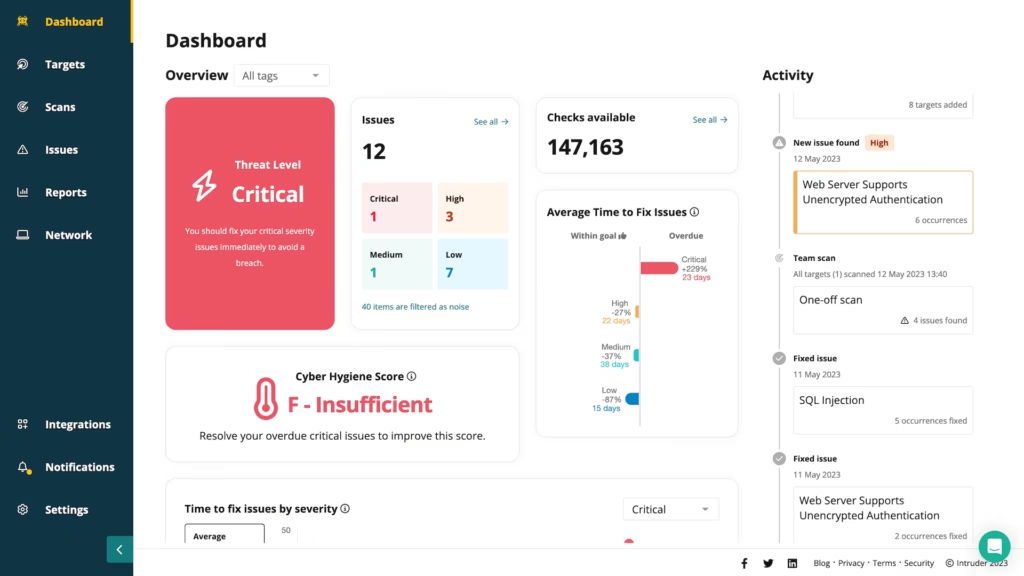
Verdict: Intruder is the clearest answer in this roundup for small and medium-sized businesses that need external attack-surface vulnerability scanning without a six-figure budget or a dedicated security engineer. At $149/month with transparent published pricing, a setup process measured in minutes rather than weeks, and continuous automated scanning with real-time threat notifications, Intruder delivers the fastest time-to-meaningful-coverage of any tool reviewed. It scored 9.5/10 on Ease of Deployment — the highest of any platform.
Standout Features
Intruder’s focus on the external attack surface — the internet-facing assets that attackers probe first — is the right priority for organizations that cannot afford comprehensive internal VM programs. The platform identifies exposed services, misconfigured cloud infrastructure, and exploitable web application vulnerabilities from the attacker’s perspective, surfacing the findings most likely to result in a breach before internal VM coverage is mature.
Automated continuous scanning means Intruder monitors your external attack surface around the clock and alerts on new vulnerabilities as they emerge — including when a new CVE is published that affects your already-inventoried assets. The notification system integrates with Slack, Microsoft Teams, Jira, and PagerDuty without configuration complexity. For a small security team or an IT generalist doubling as the security function, this coverage cadence is operationally realistic.
Intruder’s interface is intentionally designed for non-specialists. Findings are grouped by severity and presented with clear remediation guidance written for engineers, not security researchers. This reduces the friction between identification and remediation that makes other VM platforms underutilized in resource-constrained teams.
Drawbacks
Intruder’s external-focus architecture means internal network vulnerabilities, agent-based endpoint coverage, and deep compliance framework mapping are limited or absent. It is not a replacement for Tenable, Qualys, or Rapid7 as organizations grow their security programs — it is the right starting point before those programs are needed. Coverage depth on internal assets and cloud configuration assessment is thinner than the enterprise platforms in this roundup.
Best For
SMBs (5–200 employees) without a dedicated security team, organizations starting their VM program from scratch, IT generalists who need meaningful external attack-surface coverage without a specialist learning curve, and startups with compliance requirements (SOC 2, ISO 27001) needing documented scanning evidence.
Pricing
From $149/month (Essential plan). Transparent published pricing — the most pricing-transparent commercial tool in this roundup. Free trial available.
10. Greenbone Community Edition (OpenVAS) — Best Free Option
Axis Intelligence Score: 6.85 / 10
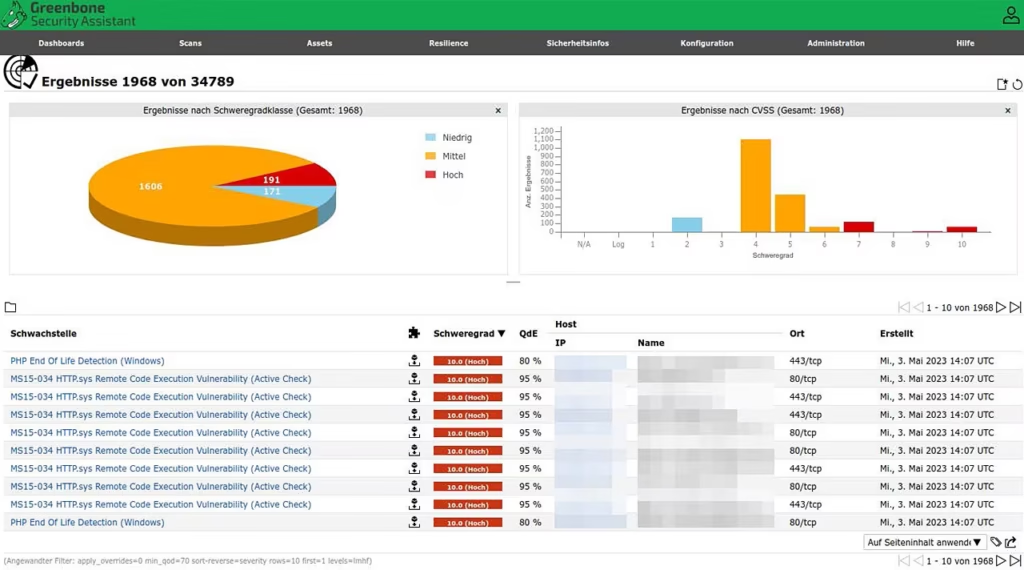
Verdict: Greenbone Community Edition is the open-source standard for vulnerability management. A 90,000+ Network Vulnerability Test library, Docker-based deployment, and a full-featured GVM architecture make it the only free option that security professionals take seriously. It is not a Tenable replacement. It is the correct starting point for organizations with zero VM budget and the Linux administration capability to self-host.
Standout Features
The Greenbone Vulnerability Feed (Community) provides free access to over 90,000 vulnerability tests covering CVEs, configuration issues, and service vulnerabilities. Docker-based deployment via docker-compose is now well-documented; experienced Linux administrators can have the full GVM stack running in under two hours. Scan policy customization — port ranges, test intensity, scheduling — is deep enough for real internal network VM programs.
The upgrade path to commercial Greenbone tiers (Greenbone Basic, Greenbone Advanced, Greenbone Enterprise Appliances) is clean and preserves scan configurations and historical data, making the community edition a credible starting point for organizations planning to scale.
Drawbacks
The community feed is updated significantly less frequently than Greenbone’s commercial enterprise feed — for some high-profile CVEs, detection plugins arrive days later than commercial equivalents. Cloud asset visibility, ITSM integrations, executive-level reporting, and remediation workflow automation are effectively absent. The GVM web interface has improved but remains less polished than commercial tools. Self-hosting carries real labor cost even at zero licensing cost: installation, maintenance, feed management, and tuning require ongoing Linux administration time that must be factored into total cost.
Best For
Small IT teams with zero VM budget, security researchers and homelab practitioners, academic institutions, and organizations learning vulnerability management workflows before investing in commercial tooling.
Pricing
Free (Community Edition). Greenbone Basic (commercial) starts at approximately €3,490/year. Enterprise appliance pricing available on request.
How We Tested
Axis Intelligence’s testing for this roundup was conducted by Marcus Chen across Q1 and Q2 2026 using a purpose-built evaluation environment of 400 assets: 150 Windows Server 2019/2022 endpoints (on-premises and Azure-hosted), 120 Ubuntu 22.04 LTS servers, 80 Amazon EC2 instances (mixed Linux/Windows AMIs), 30 containers on Kubernetes (EKS), and 20 network devices. The environment included 45 intentionally deployed vulnerabilities spanning CVSS 3.1 through 9.8 to test both detection accuracy and false positive rates.
Detection testing ran across three phases: default configuration (72 hours), optimized configuration (72 hours), and live CVE detection during the testing window. We tracked total CVEs identified, confirmed detection of all 45 planted vulnerabilities, false positives generated per platform, and time-to-detection for three CVEs publicly disclosed during testing.
Remediation intelligence testing evaluated each platform’s prioritization output against a reference set of 200 vulnerabilities sorted by actual exploitation probability — using EPSS scores from FIRST.org combined with confirmed exploitation events from the CISA Known Exploited Vulnerabilities Catalog. We scored platforms on how closely their top-50 prioritized findings matched the reference set’s top-50.
Integration testing evaluated native connectivity to Jira Cloud, a ServiceNow developer instance, Splunk, and AWS Security Hub. Scored on: setup time, data fidelity, bidirectional status sync availability, and failure handling.
Pricing research used published pricing where available (Intruder, CrowdStrike Spotlight). For quote-based platforms, Axis Intelligence used verified buyer reports from Gartner Peer Insights (May 2026), G2 (Q1 2026), and Vendr’s transaction database. No vendor pricing claims were accepted without independent corroboration. Gartner Peer Insights star ratings cited reflect data as of May 2026: Tenable 4.6★ (1,293 reviews), Qualys 4.4★ (641 reviews), Rapid7 4.3★ (753 reviews), CrowdStrike Falcon Spotlight 4.5★.
No vendor in this roundup sponsored, reviewed, or was given advance access to this article. All tools were evaluated independently.
How to Choose a Vulnerability Management Tool
The “best” vulnerability management tool is entirely context-dependent. These four questions determine the correct shortlist more reliably than any feature matrix.
What does your infrastructure look like? This is the first and most decisive question. Infrastructure VM (Tenable, Qualys, Rapid7) covers on-premises networks, Windows and Linux endpoints, and hybrid environments comprehensively. Cloud-native VM (Wiz, Orca) covers cloud workloads with attack-path context that infrastructure scanners cannot produce. Endpoint-centric VM (CrowdStrike Falcon Spotlight) covers enrolled endpoints continuously without scan windows. If your infrastructure is primarily Windows endpoints in Microsoft 365, Defender VM is already in your stack. If you run mixed infrastructure — on-premises servers plus cloud workloads plus endpoints — you will likely need more than one tool, or a platform like Tenable One that is explicitly designed to cover all three surfaces.
How large is your security team? A solo security analyst managing 300 assets needs a tool operable without a dedicated platform administrator — Rapid7 InsightVM, Microsoft Defender VM, or Intruder for external coverage. A team of 10 with a dedicated vulnerability management function can extract full value from Qualys VMDR’s workflow complexity. Choosing a platform sized for a team twice your current size is a common and expensive mistake.
Do you already run multiple scanning tools? Organizations running three or more scanning tools simultaneously — a traditional scanner plus a DAST tool plus a SCA tool plus a cloud security posture tool — generate finding volume that is genuinely unmanageable without aggregation. Nucleus Security was built specifically for this problem. The ROI calculation is straightforward: if your analysts spend meaningful time deduplicating findings across dashboards, an aggregation platform pays for itself in analyst hours.
What are your compliance obligations? PCI-DSS 4.0 and HIPAA environments extract maximum value from Qualys VMDR’s 300+ compliance framework templates and audit-ready evidence packages. CMMC 2.0 and DISA STIG environments benefit from Qualys’s preconfigured STIG scan profiles. The NIST SP 800-40 guide on enterprise patch management planning is the framework reference for any compliance-oriented VM program.
What is your realistic budget? Vulnerability management total cost includes license, implementation, annual maintenance, analyst triage time, and remediation workflow overhead. A “cheaper” tool that generates three times the false positives costs more when analyst hours are priced in. For organizations under 100 assets, Greenbone Community Edition (free) or Intruder ($149/month) are the right starting points. For 100–500 assets, Rapid7 InsightVM or Microsoft Defender VM. For 500+ assets with compliance requirements, Tenable VM or Qualys VMDR. For cloud-native environments at any scale, Wiz or Orca alongside a traditional scanner.
For understanding which vulnerabilities actually require urgent action, the CISA Known Exploited Vulnerabilities Catalog and the NIST National Vulnerability Database are the two mandatory references for any VM program.
Frequently Asked Questions
What is the best vulnerability management tool in 2026?
According to the Axis Intelligence Vulnerability Management Scoring Matrix™ (seven criteria, tested Q1–Q2 2026), Tenable Vulnerability Management is the top-ranked platform with a composite score of 8.98/10. Tenable is also the #1 worldwide market share leader in device vulnerability and exposure management per IDC’s August 2025 report. Qualys VMDR (8.87) is the strongest alternative for compliance-focused environments. The right answer for any specific organization depends on infrastructure type, team size, and compliance requirements — see the How to Choose section above.
What is the difference between vulnerability management and patch management?
Vulnerability management identifies, classifies, and prioritizes security weaknesses across your environment. Patch management deploys the remediation. They are related but distinct: not all vulnerabilities are remediable by patching (some require configuration changes, network segmentation, or compensating controls), and patch management without prioritization from a VM program results in teams patching low-risk vulnerabilities while high-risk ones wait in the queue. A mature program connects both: VM identifies and prioritizes, patch management executes the fix.
Is CVSS score sufficient for vulnerability prioritization?
No. Relying on CVSS alone is one of the most common vulnerability management failure modes. CVSS measures theoretical severity in an abstract environment — it does not account for whether your specific environment is exposed, whether active exploits exist in the wild, or how critical the affected asset is to your operations. Modern prioritization systems including EPSS (from FIRST.org), Tenable VPR, Qualys TruRisk, and CrowdStrike ExPRT.AI all layer real-world exploit likelihood and asset context on top of CVSS, producing materially better remediation guidance. The Verizon DBIR consistently shows that exploitation of known vulnerabilities follows a predictable pattern — and CVSS alone does not predict it.
What is the CISA KEV Catalog and how do I use it?
CISA’s Known Exploited Vulnerabilities Catalog is a government-maintained list of CVEs with confirmed exploitation in the wild. Federal agencies are required to remediate KEV entries within defined timelines; private organizations should treat KEV as a minimum prioritization filter. Any CVE present in your environment that appears on the KEV list is a critical, queue-jumping remediation task regardless of its CVSS score. All major VM platforms now integrate KEV data into their prioritization engines.
What is EPSS and why does it matter?
EPSS (Exploit Prediction Scoring System) is maintained by FIRST.org and produces a daily probability estimate (0–100%) of a given CVE being exploited in the wild within the next 30 days, trained on observed exploitation data from multiple global threat intelligence sources. Research consistently shows that combining CVSS with EPSS reduces the effective remediation queue by 70–90% without losing coverage of vulnerabilities that are actually exploited. Most major VM platforms now incorporate EPSS scores alongside their proprietary prioritization systems.
What is agent-based vs. agentless vulnerability scanning?
Agent-based scanning deploys software on each asset for continuous, real-time monitoring without network scanning overhead. Agentless scanning uses network-based scanning (authenticated or unauthenticated) or cloud provider APIs to assess assets without installed agents. CrowdStrike Falcon Spotlight is the most mature agent-based approach; Wiz and Orca are the most mature agentless approaches for cloud environments. Tenable, Qualys, and Rapid7 all support both. The correct choice depends on your infrastructure: agents provide deeper endpoint coverage; agentless scales better across ephemeral cloud infrastructure.
How often should vulnerability scans run?
At minimum, weekly authenticated scans across the full environment, with continuous monitoring (agent-based or API-based) for endpoint and cloud assets. High-value assets — internet-facing systems, privileged access systems, systems handling regulated data — should be monitored continuously, not on a weekly cycle. Monthly or quarterly scan cycles are no longer operationally adequate given current threat actor speed.
Can I use vulnerability management tools if I have a small team?
Yes — but tool selection should match team capacity. Intruder ($149/month) is purpose-built for small teams and IT generalists, with a setup process measured in minutes and findings presented for engineers rather than security specialists. Microsoft Defender VM is effectively free for Microsoft 365 E5 subscribers and requires no additional deployment overhead. Rapid7 InsightVM is the most accessible enterprise-grade option. Tenable and Qualys both require more operational investment to deploy and maintain effectively, which is viable for organizations willing to dedicate analyst time to the platform.
What is exposure management and how does it differ from vulnerability management?
Exposure management — the framing IDC now uses in its 2025 MarketScape — extends beyond CVE-based vulnerability scanning to include unknown assets, identity exposure, cloud misconfigurations, and business context. IDC’s definition: “Device vulnerability management involves scanning for CVEs and prioritizing findings for remediation. Exposure management goes further, providing a holistic view by fusing multiple exposure sources.” Tenable One is the most developed commercial implementation of exposure management as a unified platform. Traditional VM platforms are evolving toward this model, but most still primarily operate on CVE-based scanning.
What should a vulnerability management program include beyond the tool?
The tool is the infrastructure — the program is what makes it work. A mature VM program includes: a defined remediation SLA policy (example: Critical CVEs patched within 15 days, High within 30 days, Medium within 90 days), a continuously maintained asset inventory feeding the VM tool, a formal exception management workflow for vulnerabilities that cannot be immediately patched, integration with the change management and ticketing process, executive-level reporting on risk posture trends, and a defined process for incorporating threat intelligence (CISA KEV, EPSS) into prioritization decisions. NIST SP 800-40 (Guide to Enterprise Patch Management Planning) is the mandatory framework reference for any compliance-oriented program.
Last updated: June 1, 2026 | Next scheduled update: September 2026 Tested by Marcus Chen, Cybersecurity Editor, Axis Intelligence. All tools evaluated independently. No vendor paid for placement or influenced scoring.