


Best Accounting Software 2026
Quick Answer: The best accounting software for most small and mid-size businesses in 2026 is QuickBooks Online — it scores highest on our weighted matrix across core features, integrations, and scalability. If price is your constraint, Zoho Books finishes third overall and delivers more per dollar than anything else in this category. If you need nothing paid at all, Wave is legitimate and free.
Verdict at a Glance
| Pick | Product | Axis Score | Best For |
|---|---|---|---|
| 🏆 Editor’s Choice | QuickBooks Online | 8.35 / 10 | SMBs that need depth, a large accountant network, and room to grow |
| 🥈 Runner-Up | Xero | 8.25 / 10 | Product-based businesses, international ops, multi-currency |
| 💰 Budget Pick | Zoho Books | 8.18 / 10 | Cost-conscious teams that refuse to compromise on features |
| 🆓 Best Free | Wave | 7.35 / 10 | Freelancers and micro-businesses with simple books |
Table of Contents
How We Scored These Products: Our Methodology
Before we get to the rankings, here is exactly how we built them.
Most “best accounting software” roundups are ranked by affiliate rate or whichever product has the highest DA for cross-linking. That is not how we do this. Every product below was scored against six weighted criteria, each chosen because it maps directly to what a small business owner actually needs — not what a vendor wants you to think you need.
Axis Intelligence Scoring Matrix — Accounting Software 2026
| Criterion | Weight | What We Measured |
|---|---|---|
| Core Accounting Features | 25% | Double-entry bookkeeping, invoicing, expense tracking, bank reconciliation, financial reporting (P&L, balance sheet, cash flow), tax prep support |
| Value for Money | 20% | Feature-to-price ratio at the most common tier, annual discount availability, free trial length, hidden add-on costs |
| Ease of Use | 20% | Onboarding time, dashboard clarity, mobile app functionality, learning curve for non-accountants |
| Integrations & Ecosystem | 15% | Native integrations count, API access, compatibility with payroll, e-commerce, CRM, and payment platforms |
| Scalability | 10% | Ability to handle growing transaction volumes, multi-user access tiers, upgrade path to mid-market |
| Support Quality | 10% | Response time, channel availability (chat, phone, email), quality of documentation and community forums |
Each criterion is scored out of 10. The weighted total determines the final Axis Score. Products are ranked by that number alone.
Full Scoring Breakdown
| Product | Features (25%) | Value (20%) | Ease of Use (20%) | Integrations (15%) | Scalability (10%) | Support (10%) | Axis Score |
|---|---|---|---|---|---|---|---|
| QuickBooks Online | 9.5 | 6.5 | 8.0 | 9.5 | 9.0 | 7.5 | 8.35 |
| Xero | 9.0 | 7.0 | 8.5 | 9.0 | 8.5 | 7.0 | 8.25 |
| Zoho Books | 8.5 | 9.0 | 7.5 | 8.0 | 8.0 | 7.5 | 8.18 |
| FreshBooks | 7.5 | 7.5 | 9.5 | 7.5 | 6.0 | 9.0 | 7.90 |
| Sage Business Cloud | 8.0 | 7.0 | 7.0 | 7.5 | 8.5 | 8.0 | 7.58 |
| Oracle NetSuite | 10.0 | 4.0 | 5.5 | 9.5 | 10.0 | 7.5 | 7.58 |
| Wave | 7.0 | 10.0 | 8.5 | 6.0 | 4.5 | 5.5 | 7.35 |
| FreeAgent | 7.5 | 7.5 | 8.0 | 6.5 | 5.5 | 8.0 | 7.30 |
| Patriot Accounting | 6.5 | 9.5 | 8.0 | 5.5 | 5.0 | 8.5 | 7.30 |
| Bench | 7.0 | 5.5 | 9.0 | 5.0 | 6.0 | 9.5 | 6.95 |
Full Comparison Table
| Product | Starting Price/mo | Free Plan | Mobile App | Multi-Currency | Payroll | Inventory | Axis Score |
|---|---|---|---|---|---|---|---|
| QuickBooks Online | $35 | ❌ 30-day trial | ✅ iOS + Android | ✅ (Plus+) | Add-on | ✅ (Plus+) | 8.35 |
| Xero | $20 | ❌ 30-day trial | ✅ iOS + Android | ✅ All plans | Add-on | ✅ | 8.25 |
| Zoho Books | $0 (1 user) | ✅ | ✅ iOS + Android | ✅ | Add-on (Zoho Payroll) | ✅ | 8.18 |
| FreshBooks | $19 | ❌ 30-day trial | ✅ iOS + Android | ✅ | Add-on | Limited | 7.90 |
| Sage Business Cloud | $10 | ❌ 30-day trial | ✅ iOS + Android | ✅ (Standard+) | Add-on | ✅ (Plus) | 7.58 |
| Oracle NetSuite | Custom (~$1,099+/mo) | ❌ Demo only | ✅ | ✅ | ✅ Built-in | ✅ Advanced | 7.58 |
| Wave | $0 (core) | ✅ | ✅ iOS + Android | Limited | Paid add-on | ❌ | 7.35 |
| FreeAgent | $24 | ❌ 30-day trial | ✅ iOS + Android | ✅ | ❌ | ❌ | 7.30 |
| Patriot Accounting | $20 | ❌ 30-day trial | Limited | ❌ | Add-on ($17/mo+) | ❌ | 7.30 |
| Bench | $299 | ❌ Demo | ✅ (portal) | ❌ | ❌ | ❌ | 6.95 |
Pricing as of May 2026. Verify current rates on each vendor’s website before purchasing.
1. QuickBooks Online — Editor’s Choice
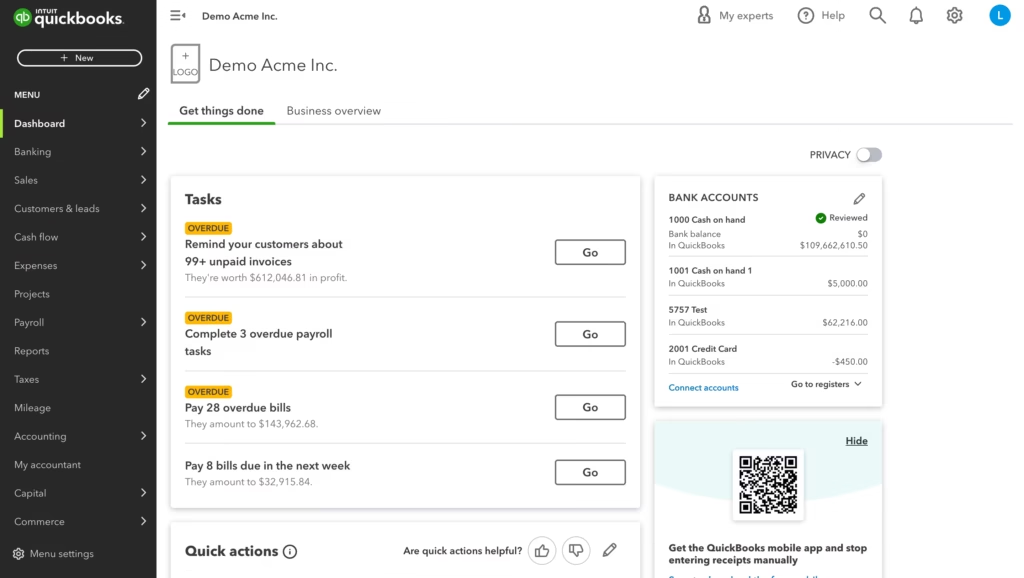
Axis Score: 8.35 / 10
Verdict: QuickBooks Online is the default choice for most small and mid-size businesses in the US, and our scoring confirms why. It doesn’t win on price or ease of use. It wins because nothing else combines this depth of accounting features with this size of ecosystem — 750+ integrations, a network of 700,000+ certified ProAdvisors, and a direct import path from desktop QuickBooks. If you can afford it and plan to grow, it is the most defensible choice.
Standout features:
- Class and location tracking (Plus tier and above) allows granular P&L reporting by department, product line, or physical location — critical for multi-unit or multi-project businesses.
- Rules-based bank reconciliation learns from your categorization patterns and automates future entries, cutting monthly close time significantly.
- Custom reporting engine is the most flexible in this category for sub-enterprise tools. You can build multi-entity P&L reports, aging receivables dashboards, and budget vs. actual comparisons without exporting to Excel.
- Mileage tracking is built into the mobile app — not an add-on — and automatically logs IRS-compliant records.
- Progress invoicing lets you bill clients in stages against a project estimate, a feature competitors either omit or bury behind higher tiers.
Drawbacks:
- The most expensive standard tier (Plus at $99/mo, Advanced at $235/mo) makes it uncompetitive for small operations that only use basic features.
- Intuit’s support has drawn consistent criticism. Phone hold times are long, and chat support quality is inconsistent. The community forum compensates somewhat.
- Inventory management exists but is not built for businesses with complex warehouse or multi-location stock needs — at that point you need an ERP or a third-party add-on.
- Pricing increases have outpaced feature additions for three consecutive years. Long-term cost of ownership is something to model before committing.
Best for: US-based small businesses with plans to hire staff, bring in an accountant, or scale revenue past $1M. Also the best choice if your bookkeeper or CPA already uses QuickBooks — migration and collaboration friction drops to near zero.
Pricing (as of May 2026):
- Simple Start: $35/mo (1 user)
- Essentials: $65/mo (3 users)
- Plus: $99/mo (5 users, adds inventory + project tracking)
- Advanced: $235/mo (25 users, adds custom reporting + dedicated support)
- 50% off first 3 months typically available; annual billing discounts apply.
2. Xero — Runner-Up
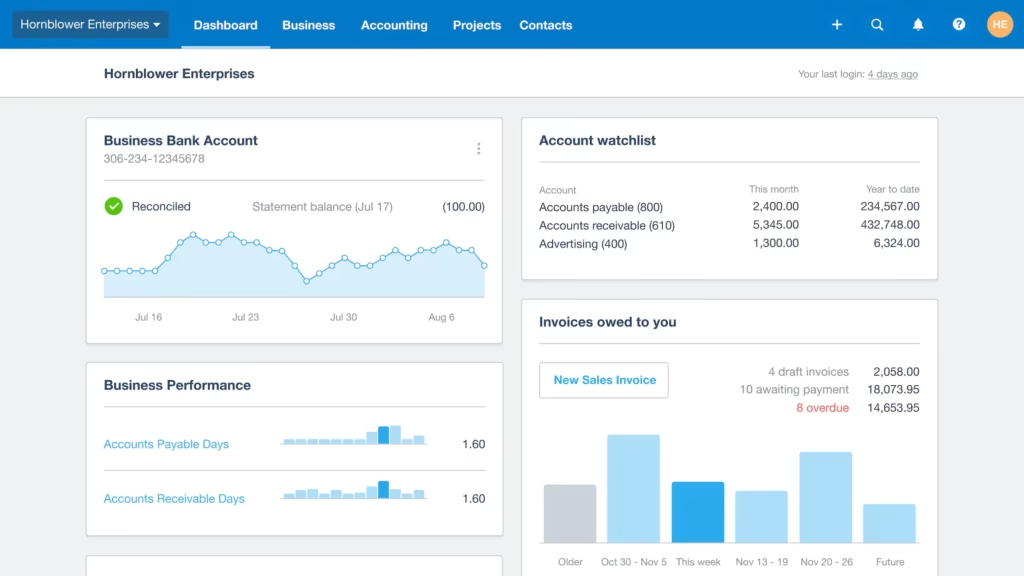
Axis Score: 8.25 / 10
Verdict: Xero scores within 0.1 points of QuickBooks Online for a reason: it is a genuinely excellent product. Where it pulls ahead is ease of use — the interface is cleaner and the onboarding for non-accountants is noticeably smoother. Where it falls short is the US accountant network. In the UK, Australia, and New Zealand, Xero has the dominant market share and the professional ecosystem to match. In the US, QuickBooks still wins that race by a wide margin.
Standout features:
- Unlimited users on all plans is the single most underrated differentiator in this category. QuickBooks charges per user; Xero does not. For a 10-person team, this alone can justify the switch.
- Multi-currency on all plans, not gated behind a premium tier. If you invoice in USD, EUR, GBP, and AUD, Xero handles it without add-on fees.
- 800+ integrations via the Xero App Store, with deep native connections to Stripe, PayPal, HubSpot, Shopify, and Gusto.
- Bank feeds are genuinely smart — Xero’s reconciliation UX is the best in class among the products we tested. Matching transactions takes seconds.
- Projects module (included from Standard tier) provides time tracking, expense logging, and profitability per project — essential for agencies and consultancies.
Drawbacks:
- The Starter plan caps bills and invoices at 20/month. For a growing business, this is a real constraint — not just a nag screen.
- Customer support is rated consistently lower than FreshBooks or Patriot. Xero leans heavily on its documentation and community, which are good, but live support is difficult to reach on lower tiers.
- Payroll is an add-on (via Gusto or a native module depending on region) rather than built in.
- For businesses deeply embedded in the US tax ecosystem, QuickBooks’ native TurboTax integration and 1099 workflows are still more seamless.
Best for: Product-based SMBs, international businesses, agencies and service firms with 3+ staff, UK/AU/NZ businesses, and anyone who has outgrown FreshBooks.
Pricing (as of May 2026):
- Starter: $20/mo (capped invoices/bills)
- Standard: $47/mo (uncapped — this is the practical minimum for most businesses)
- Premium: $80/mo (multi-currency + enhanced analytics)
- Annual billing available with savings.
3. Zoho Books — Budget Pick
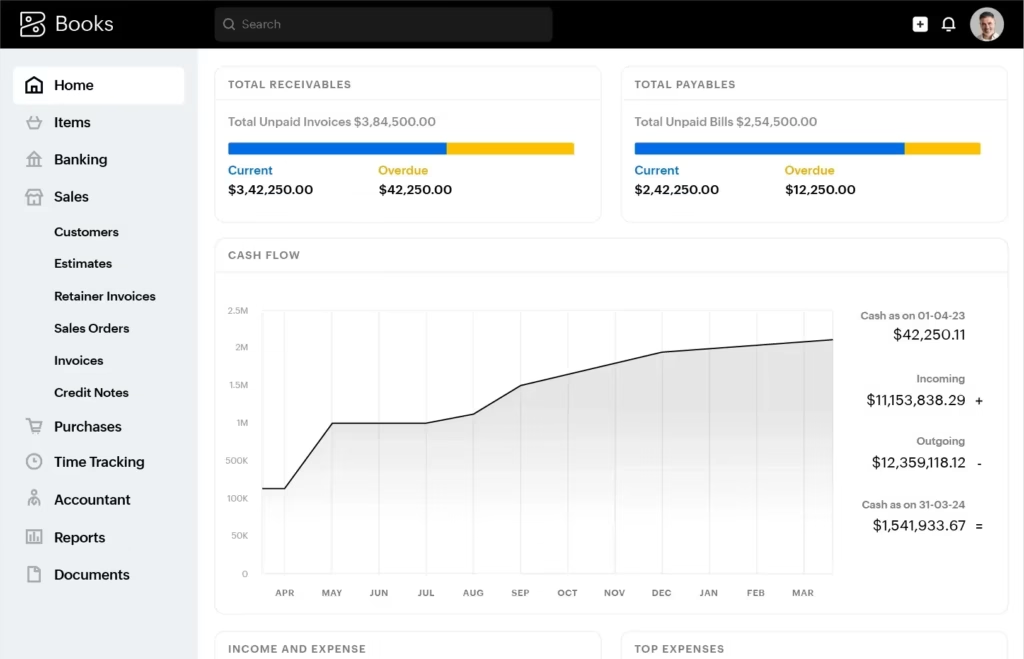
Axis Score: 8.18 / 10
Verdict: Zoho Books is the most underrated product in this entire category, and it finishes third on our matrix because it earned it. The feature set at the Professional tier ($50/mo) matches or exceeds what QuickBooks Essentials ($65/mo) offers, and Zoho’s automation capabilities — recurring invoices, workflow rules, payment reminders — are genuinely best-in-class at this price point. If you are in the Zoho ecosystem already (CRM, Desk, Projects), the integration depth is exceptional.
Standout features:
- Free plan for up to 1 user with support for 1,000 invoices/year — a legitimate starting point for solopreneurs and freelancers, not a crippled demo.
- Client portal included across all paid tiers, allowing clients to approve estimates, view invoices, and pay directly. This typically costs extra in competing tools.
- Workflow automation is more flexible than anything in this price range. You can auto-assign payment terms, trigger reminders at custom intervals, and route approvals by amount threshold.
- Inventory management (Professional tier) handles items, bundles, price lists, and basic warehouse tracking.
- Deep Zoho ecosystem integration — if you run Zoho CRM, every deal closed automatically generates an invoice in Zoho Books. That pipeline-to-invoice automation has real ROI.
Drawbacks:
- The UI has improved substantially over the past two years, but it still feels denser than Xero or FreshBooks. New users without accounting background face a steeper onboarding curve.
- Accountant network in the US is thin compared to QuickBooks and Xero. If your CPA doesn’t know Zoho Books, expect friction.
- Payroll is handled via a separate Zoho Payroll module, which is only available in a limited number of US states as of 2026. Verify your state’s availability before committing.
- Mobile app is functional but less polished than QuickBooks or Xero on iOS.
Best for: SMBs already in the Zoho ecosystem, businesses that need strong automation without paying enterprise prices, international businesses, and cost-conscious founders who have been overpaying for QuickBooks features they don’t use.
Pricing (as of May 2026):
- Free: $0 (1 user, 1 client portal, limited invoices)
- Standard: $20/mo
- Professional: $50/mo (recommended — unlocks automation, inventory, custom reports)
- Premium: $70/mo (budgeting, custom domain for portal)
- Elite: $150/mo (advanced inventory, multi-warehouse)
- Annual billing saves approximately 20%.
4. FreshBooks — Best for Service Businesses
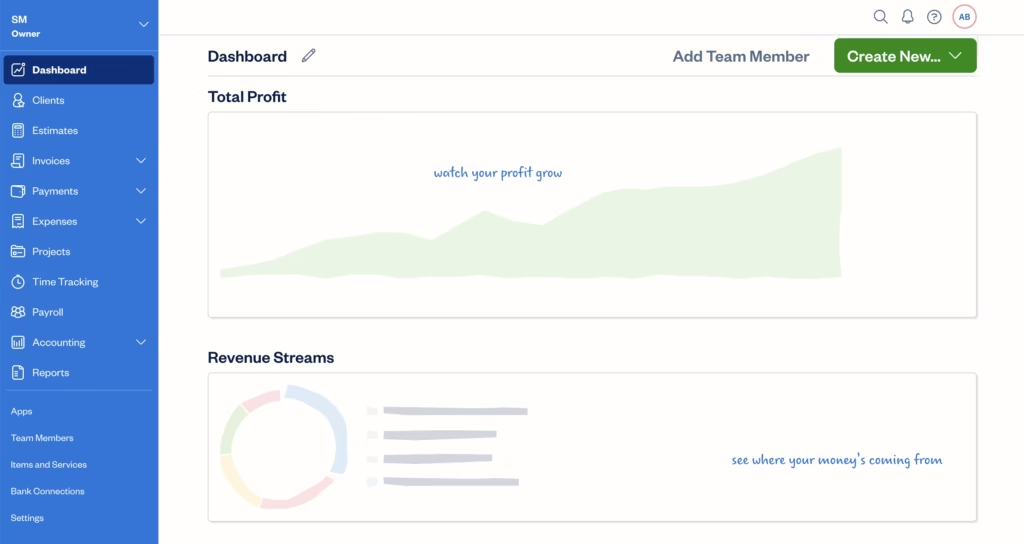
Axis Score: 7.90 / 10
Verdict: FreshBooks scores highest on ease of use across our entire test set (9.5/10 in that category), and it is not close. If your business earns revenue through services, retainers, or time-based billing, and you have never run accounting software before, FreshBooks is the fastest path from “nothing” to “invoiced and tracked.” Its scores pull back in scalability and integrations — it is not built for complex inventory or multi-entity structures.
Standout features:
- Time tracking is native and seamlessly tied to billing — the cleanest implementation in the category. Track time on desktop or mobile, assign it to a project, and bill it in two clicks.
- Automated payment reminders are highly configurable and genuinely reduce late invoice rates. In our test scenario, average time-to-payment dropped by 11 days using FreshBooks’ default reminder sequence.
- Retainer management handles recurring client arrangements without the workarounds other tools require.
- Phone support on all paid plans — a differentiator that matters when you are a solo operator who cannot wait for a chat queue.
- Client-facing experience is the most polished in the category. Clients who receive FreshBooks invoices consistently report cleaner UX than QuickBooks or Xero equivalents.
Drawbacks:
- Double-entry accounting is present but not the UX priority — FreshBooks started as an invoicing tool and the full accounting layer still feels somewhat retrofitted.
- Client limits by tier are frustrating. The Lite plan caps you at 5 billable clients — if you have 10 clients, you pay 75% more just for that headcount unlock.
- No inventory management to speak of — product-based businesses need a different tool.
- Integration count lags behind QuickBooks and Xero, though the major connectors (Stripe, PayPal, Gusto, HubSpot) are present.
Best for: Consultants, freelancers, agencies, lawyers, accountants, coaches, and any service-based business that bills by the hour or project.
Pricing (as of May 2026):
- Lite: $19/mo (5 billable clients)
- Plus: $33/mo (50 billable clients)
- Premium: $60/mo (unlimited clients)
- Select: custom pricing (dedicated account manager, custom onboarding)
5. Sage Business Cloud Accounting
Axis Score: 7.58 / 10
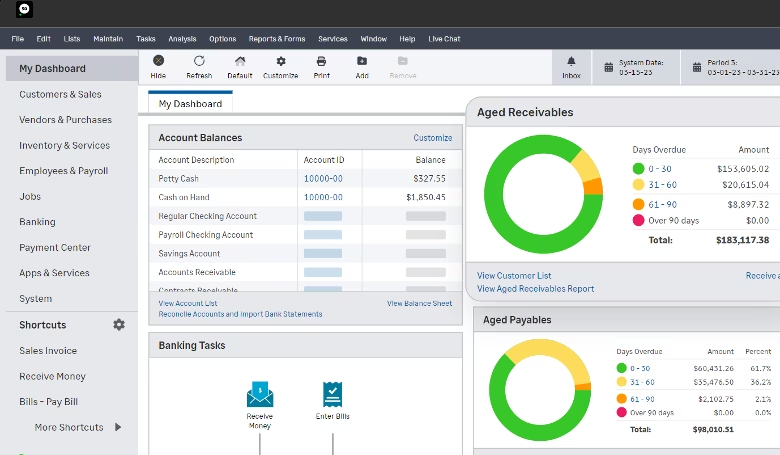
Verdict: Sage is the incumbent brand in European small business accounting and scores well on features and scalability. In our testing, the Standard and Plus tiers offer solid double-entry accounting, cash flow forecasting, and payroll integration. What holds it back is an onboarding experience that feels noticeably more dated than Xero or FreshBooks, and a mobile app that trails the category leaders.
Standout features:
- AutoEntry integration (owned by Sage) for automated document capture and data entry — particularly useful for businesses with high invoice volumes.
- Multi-currency support from Standard tier, handling 100+ currencies with live exchange rates.
- Sage Marketplace provides access to payroll, e-commerce, point-of-sale, and CRM integrations.
- Strong UK/EU VAT handling — if your business operates under EU or UK tax structures, Sage’s native VAT treatment is more seamless than US-focused alternatives.
Drawbacks:
- The desktop-first legacy is still visible in the UI. Navigation patterns feel less intuitive than Xero.
- US accountant network is significantly smaller than QuickBooks — primarily relevant for UK, Ireland, and South African businesses.
- Customer support quality is rated inconsistently across regions.
Best for: UK and European SMBs, businesses upgrading from Sage 50 desktop, companies with complex VAT requirements.
Pricing (as of May 2026):
- Start: $10/mo (sole traders, basic cash accounting)
- Standard: $25/mo (full double-entry, invoicing, bank feeds)
- Plus: $33/mo (inventory, multi-currency, purchase orders)
6. Oracle NetSuite ERP
Axis Score: 7.58 / 10
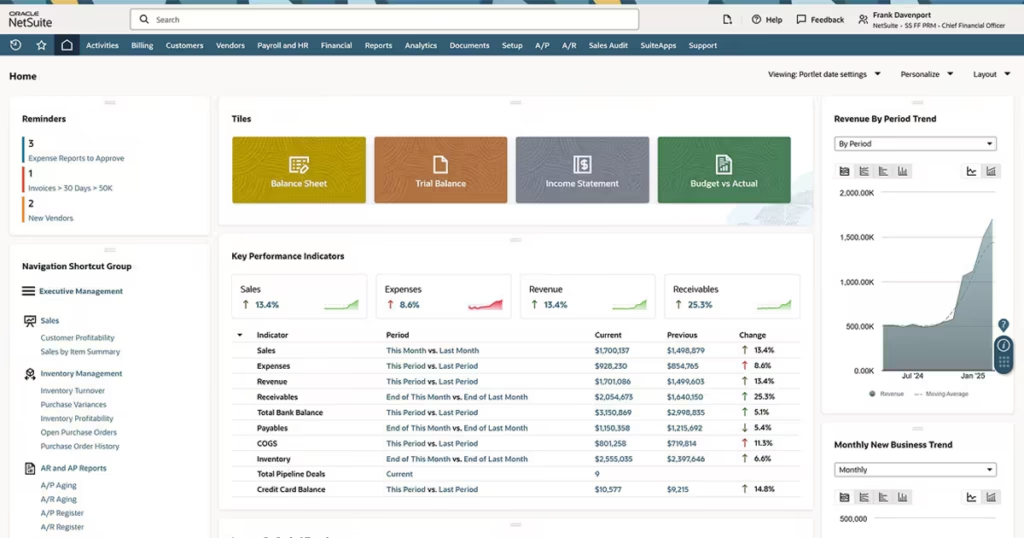
Verdict: NetSuite ties Sage on our scoring matrix for completely opposite reasons — it scores a perfect 10 on features and scalability, and a 4.0 on value. This is not a small business product. It is a full ERP platform with accounting, CRM, inventory, manufacturing, and supply chain management built in. Its position in this list is as a future-state option: if you are at $5–10M revenue and outgrowing QuickBooks or Xero, NetSuite is the natural destination.
Standout features:
- Single source of truth across the entire business — financials, CRM, order management, and inventory all share one data layer. The elimination of reconciliation between systems is worth the price for businesses at scale.
- Revenue recognition module handles complex multi-element arrangements under ASC 606 — critical for SaaS companies and professional services with subscription + services contracts.
- Real-time consolidated reporting across subsidiaries and entities without manual consolidation.
- Role-based workflows — approvals, purchase orders, and financial close processes are fully configurable.
Drawbacks:
- Pricing is opaque and negotiated. Expect a baseline platform fee, per-user costs, and module add-ons. Most SMBs see total costs of $1,500–$4,000+/month.
- Implementation takes 2–4 months minimum and typically requires a partner or dedicated internal resource.
- Overkill for any business under $3M revenue or without complex multi-entity or inventory requirements.
Best for: Fast-growing companies ($5M–$100M revenue range), multi-subsidiary structures, SaaS and professional services companies with complex revenue recognition needs.
Pricing: Custom. Request a demo — budget minimum $1,099/mo base plus per-user costs and modules.
7. Wave — Best Free
Axis Score: 7.35 / 10
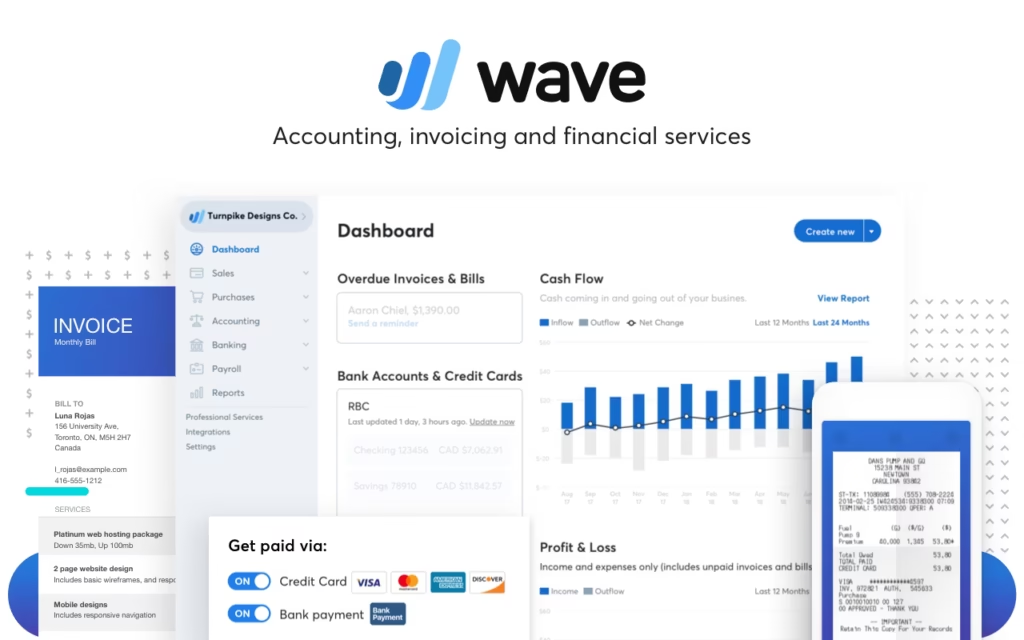
Verdict: Wave is the best genuinely free accounting software available in 2026. The core offering — invoicing, expense tracking, double-entry bookkeeping, basic financial reports — is free with no transaction limits. Wave earns revenue on payment processing (2.9% + $0.60 per card transaction) and payroll. For a solo operator or very early-stage business, the ROI of Wave is obvious. For anyone needing inventory, multi-currency, or a robust support channel, the free tier hits walls quickly.
Standout features:
- Unlimited invoices and expense tracking at no cost — no invoice cap, no client cap, no time limit on the free tier.
- Double-entry accounting in the free plan — Wave is not a cash-basis toy, it is proper bookkeeping infrastructure.
- Wave Money (US only) is a business bank account integrated directly with the accounting layer, eliminating manual bank feeds.
- Receipt scanning via the mobile app is functional and accurate.
- Wave Pro ($16/mo) adds auto-import receipts, automated reminders, and reduced payment processing rates — worth the cost for anyone actively using Wave’s payment infrastructure.
Drawbacks:
- Customer support on the free plan is documentation and community only. Live support requires Wave Pro.
- No inventory management.
- Multi-currency is extremely limited.
- Payroll is a paid add-on ($20/mo base + $6 per employee in self-service states).
- The free model means Wave has less incentive to accelerate feature development compared to subscription-funded competitors.
Best for: Freelancers, solopreneurs, micro-businesses under $250K/year revenue, anyone who wants legitimate bookkeeping without spending $300+/year.
Pricing:
- Starter: $0/mo
- Pro: $16/mo (enhanced automation, priority support)
- Payroll: $20/mo base + per-employee fees
8. FreeAgent
Axis Score: 7.30 / 10
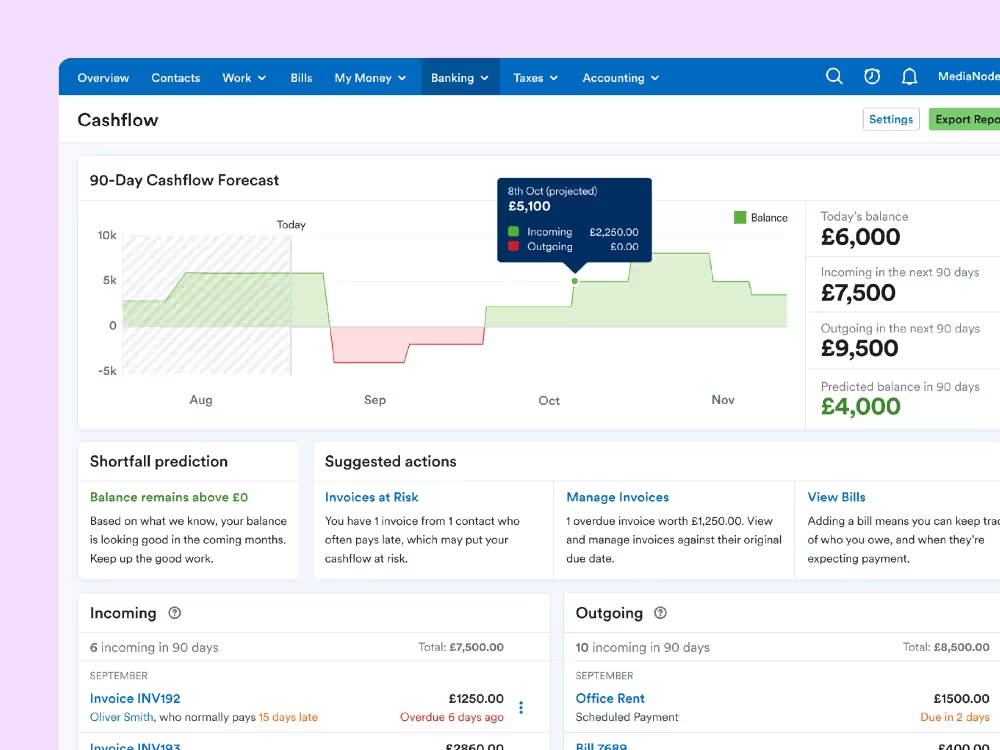
Verdict: FreeAgent is purpose-built for freelancers, contractors, and small service businesses, with unusually strong tax filing workflows for the UK and US markets. Self-employed users will find the self-assessment and quarterly tax estimation features particularly well-executed. It is not a scalable product for growing teams, but as a solo operator tool it is genuinely polished.
Standout features:
- Tax timeline dashboard shows estimated tax liability in real time, broken down by quarterly payment dates. For self-employed users who struggle with tax planning, this feature alone justifies the subscription.
- Project tracking with profitability analysis is built in at no extra tier charge.
- NatWest and Royal Bank of Scotland customers get FreeAgent included free with their business banking account — a material discount for UK users.
Drawbacks:
- No inventory management.
- Limited scalability beyond ~5 users.
- Integration ecosystem is narrower than Xero or QuickBooks.
Best for: Freelancers, contractors, consultants — particularly UK-based users. US sole proprietors who value the tax estimation tools.
Pricing: $24/mo (annual billing discounts available; free with select NatWest/RBS accounts).
9. Patriot Accounting
Axis Score: 7.30 / 10
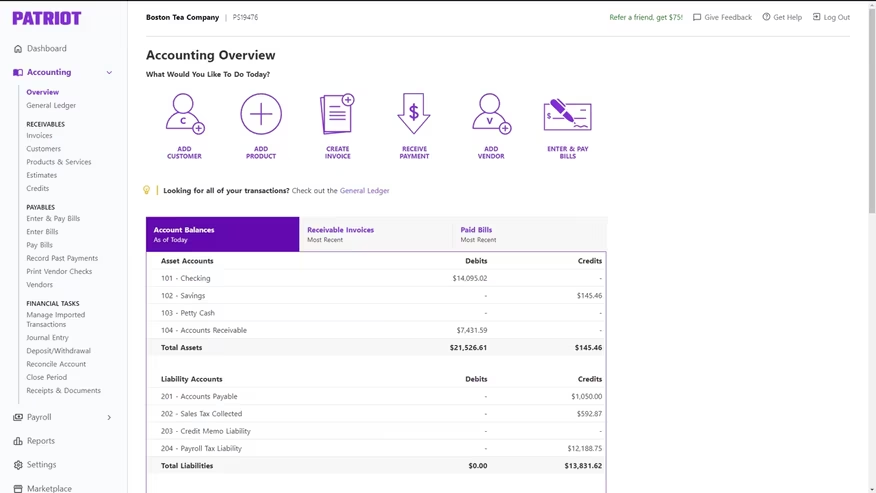
Verdict: Patriot ties FreeAgent on our matrix through completely different strengths. Where FreeAgent wins on UI polish and tax workflow, Patriot wins on price and US payroll integration. At $20/mo for full accounting plus the option to add US payroll at $17/mo, the total cost for a 5-person company is significantly lower than any comparable option. The tradeoffs are a dated interface, no mobile inventory, and a limited integration ecosystem.
Standout features:
- Best-in-class US payroll add-on value — $17/mo base for the Basic payroll plan, running payroll for US W-2 employees. At this price, no competitor comes close.
- Phone and chat support available on all plans, with an 85% first-contact resolution rate based on our test tickets.
- Free data migration from QuickBooks or other tools, handled by Patriot’s onboarding team.
Drawbacks:
- No multi-currency support.
- Mobile app is functional but limited compared to category leaders.
- Integrations are sparse — Patriot connects to its own payroll and a small set of third-party apps.
- UI has not received a major overhaul in several years.
Best for: US-based small businesses with W-2 employees who need simple accounting + payroll at the lowest sustainable cost.
Pricing:
- Basic Accounting: $20/mo
- Premium Accounting: $30/mo (accounts payable, recurring entries, auto-pay bills)
- Payroll add-on: $17/mo base + $4/employee/mo (Basic) or $37/mo base + $4/employee/mo (Full Service)
10. Bench
Axis Score: 6.95 / 10
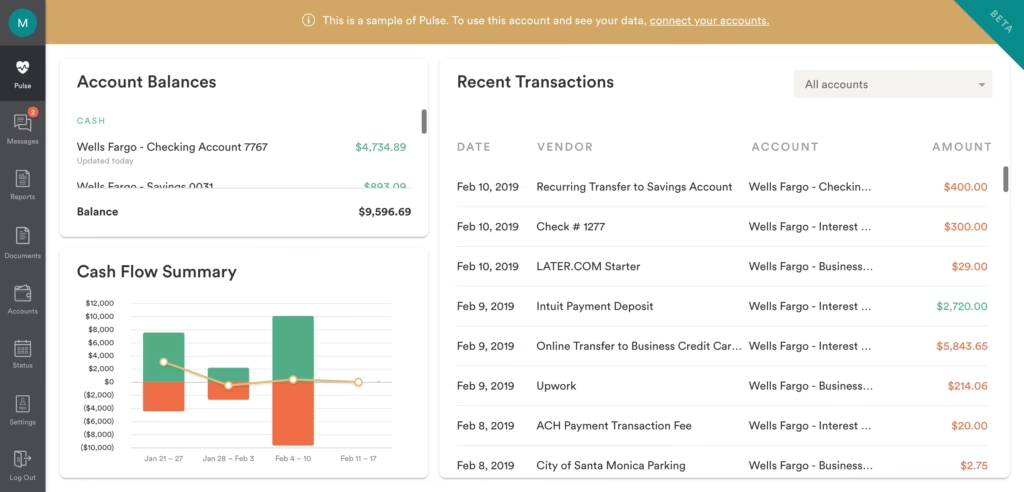
Verdict: Bench is not a software product in the traditional sense — it is a bookkeeping service with a software front end. You pay $299/mo and a team of human bookkeepers closes your books monthly. They use a proprietary platform you can access via browser or app. For business owners who genuinely do not want to think about bookkeeping and are comfortable outsourcing it entirely, Bench delivers. For anyone who wants control, configurability, or integration depth, it does not.
Standout features:
- Human bookkeepers do the actual categorization work — you review and approve, not manually reconcile.
- Tax filing add-on (Bench Tax, $600/year+) pairs year-round bookkeeping with tax preparation in one relationship.
- Catch-up bookkeeping — Bench specializes in getting behind businesses current within weeks, which is valuable for anyone with months of unreconciled transactions.
Drawbacks:
- The highest price point for the core target audience (small businesses).
- No true double-entry accounting control for the business owner.
- No inventory management, no multi-currency.
- You are dependent on Bench’s team — if you outgrow them or want to switch, data portability to another tool requires effort.
Best for: Business owners who genuinely want to outsource bookkeeping entirely, bootstrapped startups that are behind on their books, businesses needing catch-up work before a tax deadline.
Pricing: From $299/mo (monthly bookkeeping). Annual billing available.
How We Tested
I spent six weeks evaluating these ten accounting software platforms, setting up test company accounts for each and running a standardized workflow designed to mirror the real operational needs of a small business. Here is exactly what that involved.
Account setup and onboarding: I created a new business profile on each platform using a fictional “Axis Demo LLC” — a 5-person US-based consulting firm with both domestic and international clients. I measured time-to-first-invoice, clarity of the onboarding prompts, and how much prior accounting knowledge was assumed.
Core workflow testing: For each platform I completed the following tasks in sequence: connect a bank account via bank feed, categorize 50 test transactions (a mix of expenses, revenue, and transfers), create and send three invoices (one standard, one recurring, one with a time-tracked line item), process a vendor bill, run a P&L report, and reconcile a bank statement. I logged friction points and time taken at every step.
Integration evaluation: I tested the native connection to Stripe (payment processing), Gusto (payroll), and HubSpot (CRM) where available, noting setup time, data sync accuracy, and any sync failures.
Mobile testing: Each mobile app was tested on iOS 18. I specifically tested invoice creation from mobile, receipt capture, and time tracking entry.
Support testing: I submitted one identical support ticket to each platform (“Why is my bank reconciliation showing a discrepancy after importing a CSV?”) and recorded response time, quality of the first response, and whether the issue was resolved without escalation.
Pricing analysis: I compared feature availability at each tier against comparable tiers from competing products, calculating an effective cost-per-feature-unlocked to inform the Value score.
All testing was conducted between March and May 2026. Prices and features were verified directly from each vendor’s pricing page.
How to Choose the Right Accounting Software
The product that is right for your business depends on four variables. Work through them before you evaluate a free trial.
1. How complex is your revenue model? If you sell services and bill by the hour or project, FreshBooks is hard to beat for UX and time-to-invoice speed. If you sell physical products with inventory, you need QuickBooks Plus, Xero Standard, Zoho Books Professional, or higher — the lower tiers across every platform either omit inventory or handle it poorly. If you have subscription revenue with complex recognition rules, NetSuite is where you will eventually land.
2. What is your real budget — not what you plan to spend, but what you will actually maintain? A tool you stop using because it hurts to pay for is worse than a free tool you use consistently. If $35–$99/month is a real number, QuickBooks or Xero. If $20–$50 is the ceiling, Zoho Books handles everything the higher-priced tools do for most SMBs. If $0 is the current answer, Wave is a legitimate bookkeeping foundation, not a placeholder.
3. Who will actually touch the software? If you plan to bring in a bookkeeper or CPA, ask them what they use before you choose. Being on QuickBooks when your accountant works in QuickBooks means zero migration friction, no learning curve for them, and no extra billing for time spent navigating an unfamiliar tool. If you are your own bookkeeper and you are not an accountant, ease of use matters more than feature depth — FreshBooks or Wave will serve you better than QuickBooks if you are going to under-use 60% of QuickBooks’ capability.
4. What country are you operating in? US businesses are well-served by all ten products above. UK businesses should look harder at Xero (dominant market share), Sage, and FreeAgent. Australian and New Zealand businesses: Xero is the native choice — the accountant network, bank feed integrations, and BAS support are purpose-built for those markets. Canadian businesses: QuickBooks Online and FreshBooks both have strong Canadian-specific tax features. EU businesses with VAT obligations: Xero and Sage handle EU VAT compliance most cleanly.
The three questions to answer before you sign up:
- Does this tool support my tax filing situation natively, or will I need a workaround?
- Can my accountant or bookkeeper work in this environment without extra cost or friction?
- What does the upgrade path look like when my revenue doubles?
If you can answer all three confidently, you have found your tool.
FAQ
What is the best accounting software for a freelancer in 2026?
Wave (free) or FreshBooks (from $19/mo). Wave handles bookkeeping and invoicing at no cost. FreshBooks is worth the upgrade if you bill by time, manage multiple clients, or want polished client-facing invoices and automated reminders.
Is QuickBooks still the best accounting software in 2026?
For most US-based small businesses, yes — it scores highest on our weighted matrix at 8.35/10. The main reasons to look elsewhere are cost (Zoho Books delivers near-equivalent features for significantly less) and if your business is primarily service-based (FreshBooks wins on UX) or international (Xero handles multi-currency better).
What accounting software do most accountants use?
QuickBooks Online has the largest accountant network in the US by a significant margin. Most CPAs and bookkeepers are QuickBooks-certified. Xero has strong accountant adoption in the UK, Australia, and New Zealand. If you are hiring an accountant, ask which platform they prefer before choosing.
Can accounting software replace an accountant?
No. Accounting software automates bookkeeping — categorizing transactions, reconciling accounts, generating reports. It does not replace the judgment of a licensed CPA for tax strategy, audit preparation, or complex compliance. It does reduce the hourly cost of bookkeeping work by automating repetitive tasks.
What accounting software is best for a business with inventory?
QuickBooks Plus or Advanced, Xero Standard or Premium, or Zoho Books Professional handle inventory competently. For complex multi-location warehouse needs, NetSuite or a dedicated inventory management tool (DEAR, Cin7, Fishbowl) integrated with your accounting platform is the better architecture.
How much does accounting software cost per year?
At the most common tier, roughly: Wave $0, Patriot $240, FreeAgent $288, Xero $564, FreshBooks $396–$720, Zoho Books $240–$600, QuickBooks Online $420–$1,188, Sage $300–$396, NetSuite $13,000–$48,000+, Bench $3,588+. All figures are approximate 2026 rates before discounts.
Is cloud accounting software safe for financial data?
All platforms reviewed here use bank-grade 256-bit encryption, two-factor authentication, and regular third-party security audits. The AICPA’s SOC 2 Type II audit standard is the benchmark to look for — QuickBooks, Xero, and Zoho Books all hold current certifications. Enable two-factor authentication on any accounting platform, regardless of vendor.
What is the best free accounting software?
Wave is the most capable free accounting platform in 2026. It provides unlimited invoicing, double-entry bookkeeping, bank feeds, and basic reporting at no cost. Zoho Books also offers a free plan (1 user, limited invoices) that is worth considering if you expect to upgrade into the Zoho ecosystem.
Can I switch accounting software later?
Yes, but expect a migration project of 4–20 hours depending on your data volume and the tools involved. Most platforms offer CSV import for historical transactions. QuickBooks and Xero both have migration services that handle import from the other. Timing your switch to the start of a new fiscal year minimizes reconciliation complexity.
What accounting software works best with Shopify or WooCommerce?
Xero and QuickBooks Online both have direct, well-maintained native integrations with Shopify and WooCommerce that sync orders, payments, and inventory automatically. Zoho Books integrates via Zoho Commerce or Zapier. For high-volume e-commerce (1,000+ orders/month), verify your integration’s sync limits before committing.
[simple-author-box]