

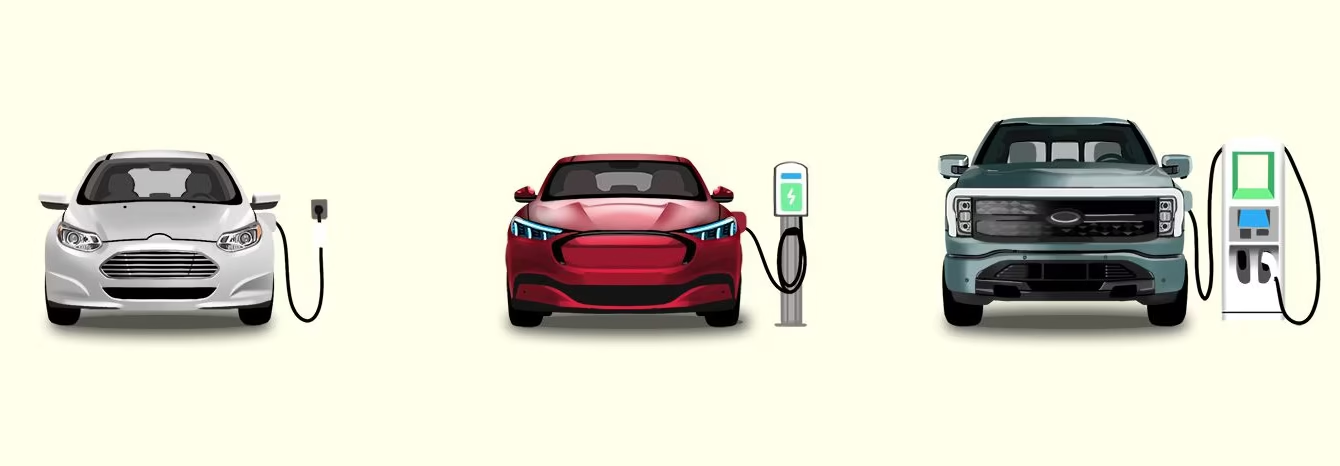
Level 1 vs. Level 2 vs. Level 3 EV Charging
Last updated: June 2026
Level 1 charging uses a standard 120V household outlet and adds 3–5 miles of range per hour — slow, but free to set up. Level 2 runs on 240V and delivers 20–44 miles per hour, making it the right choice for most home and workplace installations. Level 3 (DC fast charging) bypasses your car’s onboard converter and pushes 50–500 kW directly into the battery, adding 100–250 miles in 20–40 minutes. Which one you need depends on your daily mileage, vehicle platform, and whether your car’s battery can actually accept the power a Level 3 station offers.
Table of Contents
Level 1 vs. Level 2 vs. Level 3: At a Glance
| Level 1 | Level 2 | Level 3 (DCFC) | |
|---|---|---|---|
| Voltage | 120V AC | 240V AC | 400V or 800V DC |
| Typical power output | 1.2–1.9 kW | 6.2–19.2 kW | 50–500 kW |
| Miles of range per hour | 3–5 | 20–44 | 300–1,200 (varies by vehicle) |
| 0–80% charge time | 20–40 hours | 3–8 hours | 15–45 minutes |
| Installation required? | No | Yes (dedicated 240V circuit) | No (public only) |
| Home installation possible? | Yes | Yes | No |
| Average cost per session | ~$0 (home electricity) | $0.18–0.25/kWh | $0.40–0.55/kWh |
| Connector standard (US) | J1772 or NACS | J1772 or NACS | CCS1, NACS (J3400), CHAdeMO (legacy) |
| Battery degradation risk | Minimal | Minimal | Elevated if used as primary charger |
What the Level Numbers Actually Mean
The SAE J1772 standard defines EV charging levels by voltage and current type — not speed, not brand, and not how fast the session feels. Understanding this distinction prevents expensive mistakes, especially when buying a home charger or planning a road trip.
Level 1 delivers alternating current (AC) from a standard 120V outlet. Every EV sold in North America includes the cable for this from the factory. The car’s onboard charger — a small inverter inside the vehicle — converts that AC power to the DC that the battery actually stores. Most onboard chargers cap this conversion at 1.2–1.9 kW on a standard 15-amp circuit.
Level 2 also delivers AC, but at 240V — the same voltage as a home clothes dryer or oven. The car’s onboard charger still handles the AC-to-DC conversion, but now it’s fed a much larger energy stream. A 48-amp Level 2 station running into an EV with a 11.5 kW onboard charger adds roughly 44 miles per hour of charging. The onboard charger is the limiting factor: a 7.2 kW Chevrolet Equinox EV won’t charge faster at a 19.2 kW station than it does at a 7.2 kW station.
Level 3 — commonly called DC fast charging (DCFC) or “DC rapid charging” — skips the onboard charger entirely. The station itself converts grid AC to high-voltage DC and pushes it directly into the battery pack at rates the onboard charger could never achieve. This is why DC fast charging is fast: you’re removing the bottleneck.
Level 1 Charging: The Slow Default
Who Level 1 Actually Works For
Level 1 gets dismissed as a stopgap, and for most EV owners it is. But the math works cleanly for a specific driver profile: someone who travels under 30–40 miles per day, has a garage or outdoor outlet, and plugs in every night.
At 3–5 miles of range added per hour over an 8–10 hour overnight window, Level 1 delivers 24–50 miles of fresh range by morning. For a commuter whose round trip is 25 miles, that’s sufficient — indefinitely.
The U.S. Department of Energy’s National Renewable Energy Laboratory (NREL) projects that Level 1 and Level 2 combined will handle 80% of all EV charging sessions by 2030, with 64% of that total taking place at single-family homes. The perception that public fast charging is the backbone of the EV experience doesn’t match where most electrons actually go.
Level 1 Specs and Costs
- Outlet: Standard NEMA 5-15 (3-prong household outlet)
- Circuit requirement: 15–20 amp circuit (already present in most homes)
- Hardware cost: $0 — the cable ships with the vehicle
- Installation cost: $0
- Electricity cost: National average roughly $0.18/kWh in 2026, meaning a 60 kWh pack costs about $10.80 to fill from empty
Level 1 Limitations to Know
The 15-amp draw Level 1 uses runs close to the continuous safe limit for a standard circuit. Most EVs automatically cap Level 1 draw at 12 amps to protect the outlet and wiring. On a GFCI-protected outdoor outlet, some older installations may trip at sustained draws — worth checking before committing to Level 1 as your permanent setup.
One practical caution: never run Level 1 through an extension cord. The added resistance creates heat, and sustained 12-amp loads through a residential extension cord are a fire risk. Use the EVSE cable direct to the outlet.
Level 2 Charging: The Right Answer for Most Drivers
Why Level 2 Is the Practical Standard
For any EV driver who covers more than 40 miles per day, drives a larger-battery vehicle (70+ kWh), or simply doesn’t want to think about whether they have enough range tomorrow, a dedicated Level 2 home charger is the upgrade that changes EV ownership from inconvenient to invisible.
A 48-amp Level 2 station can fully replenish a 75 kWh battery pack from 20% to 100% in roughly 5–6 hours. Plug in when you get home at 7pm, wake up fully charged at midnight, and the charger has been idle for seven hours before you leave.
Workplaces, hotels, retail parking, apartment complexes, and municipal garages have all accelerated Level 2 deployment. As of Q1 2026, over 73,000 public DC fast-charging ports exist in the U.S., but public Level 2 ports — found in parking structures, malls, and workplace lots — outnumber them by a wide margin. The majority of public charging infrastructure is Level 2.
Level 2 Specs and Costs
- Voltage: 240V AC (same circuit type as clothes dryer or electric range)
- Amperage: Typically 16–48A (hardwired) or 16–32A (plug-in NEMA 14-50)
- Power output: 3.8–11.5 kW (residential) up to 19.2 kW (commercial-grade residential)
- Hardware cost: $300–$900 for quality units (ChargePoint Home Flex, Tesla Wall Connector, Wallbox Pulsar Plus)
- Installation cost: $800–$3,000 depending on panel capacity, wiring distance, and local permitting
- Fully installed cost (typical): $1,200–$2,500 before incentives
The federal 30C tax credit — which covers 30% of Level 2 installation costs up to $1,000 for residential installations — expires June 30, 2026 for most locations. Homeowners in eligible census tracts (low-income or non-urban) may qualify for a 40% credit. State utility rebates frequently stack on top.
Understanding Your Car’s Onboard Charger Limit
This is the number most buyers skip, and it determines whether a $900 48-amp charger gives you more than a $400 32-amp charger.
Check your vehicle’s specification sheet for “maximum AC charging rate” in kW:
- Hyundai Ioniq 6: 11 kW (standard), up to 22 kW on the higher-trim long-range variant
- Tesla Model 3 Long Range: 11.5 kW
- Chevrolet Equinox EV: 11.5 kW
- Ford F-150 Lightning: 19.2 kW (the highest-capacity onboard charger in a current mainstream EV)
- Nissan Leaf (40 kWh): 6.6 kW — a 48-amp charger adds nothing over a 32-amp unit for this vehicle
Matching charger output to your vehicle’s onboard charger limit avoids overpaying for capability your car can’t use.
Level 2 Connectors in 2026
The North American connector landscape is mid-transition:
- J1772: Universal AC charging connector, backward-compatible with all non-Tesla EVs. Every Level 2 charger at a public station is J1772.
- NACS (SAE J3400): The Tesla connector, now adopted by Ford, GM, Rivian, Honda, Nissan, and most other major manufacturers for 2024–2026 model years. Home Wall Connectors sold by Tesla are NACS-native.
- The practical reality: New non-Tesla EVs with NACS ports ship with a J1772 adapter. Older CCS/J1772 EVs can use NACS chargers with an adapter. The transition is real but the adapters work.
Level 3 (DC Fast Charging): The Road Trip Enabler
What DC Fast Charging Actually Does
Level 3 charging is categorically different from Level 1 and Level 2. Where the other two deliver AC power that the vehicle’s onboard charger then converts to DC, a Level 3 station handles that conversion externally — pushing high-voltage DC directly into the battery pack at rates that would overwhelm any onboard charger.
The result is charging that compresses a 5-hour Level 2 session into 20–45 minutes, depending on the vehicle, the station’s power output, and the battery’s current state of charge.
The 800V vs. 400V Platform Difference
This is the number the generic competitor guides almost never explain, and it’s the most important variable in your real-world Level 3 experience.
Most EVs run a 400V battery architecture — the same platform used in most Teslas (pre-Cybertruck), Chevrolet’s Ultium-based vehicles, and many others. These vehicles can typically accept 50–150 kW of DC fast charging, with peak rates around 100–150 kW.
800V platforms — including the Hyundai Ioniq 6, Ioniq 5, Kia EV6 and EV9, Porsche Taycan, Lucid Air, Rivian R1T/R1S, and the 2026 Polestar 3 — can accept up to 250–350 kW from compatible stations. The Polestar 3’s 2026 upgrade to an 800V system, for example, takes its 10-to-80% charge time to 22 minutes at a 350 kW station. That same session at a 150 kW station would take roughly 35–40 minutes regardless of the station’s advertised peak.
The practical math: If your car is a 400V platform and you plug into a 350 kW Electrify America station, the car will draw what it can handle — often 100–150 kW — not 350 kW. You’re not wasting anything by using the faster station, but you’re also not unlocking its full speed.
Level 3 Infrastructure in 2026
As of Q1 2026, the U.S. has 73,394 public DC fast-charging ports across approximately 13,700 locations, according to Paren’s industry tracking. The expansion has been aggressive: the U.S. started 2025 with roughly 51,000 stalls and closed Q1 2026 at 73,000 — a 44% gain in 15 months.
Network composition:
- Tesla Supercharger: largest network, ~53% of all DC fast-charging ports as of early 2026, now open to all NACS-compatible vehicles natively and to CCS vehicles via adapter
- Electrify America: second-largest non-Tesla network, recently deploying 350 kW stalls as standard
- EVgo, Blink, ChargePoint, Ionna (the GM/EVgo/Pilot Flying J joint venture), and Walmart’s expanding network round out the field
250+ kW stations: In Q1 2026, high-power chargers (250 kW and above) represented 55% of new non-Tesla DCFC deployments, up from 62% of the overall installed base. Tesla is simultaneously deploying V4 Superchargers capable of 500 kW. The infrastructure is maturing at both the network level and the power level.
NEVI context: The federal NEVI program’s $5 billion allocation (FY2022–2026) restarted in late 2025 after a funding pause, with streamlined new guidance removing several prior spacing requirements. States like Oregon, Colorado, and New York are actively deploying NEVI-funded stations in 2026. The average NEVI project cost runs approximately $915,000 per site — reflecting commercial-grade electrical infrastructure, canopies, and multi-port deployments, not a single charging post.
Level 3 Cost Per kWh
DC fast charging costs significantly more than home charging:
- Home Level 1/2: ~$0.18/kWh (national average electricity rate)
- Public Level 2: ~$0.25/kWh (Stable.Auto national average, July 2024–July 2025)
- Public Level 3 (DCFC): ~$0.47/kWh (national average, same period)
A 75 kWh battery charged from 10% to 80% at a public fast charger costs roughly $25–$28 at the national average rate. The same session at home costs $9–$10. The premium is real, and it’s the reason the home-and-highway-only model — Level 2 at home, Level 3 only on road trips — dominates the economics of EV ownership.
Some networks charge by the minute rather than per kWh, which benefits faster-charging 800V vehicles and disadvantages slower-charging 400V platforms at the same station. Know which pricing model a network uses before calculating road trip costs.
The Battery Degradation Question
DC fast charging’s effect on battery longevity is measurable but frequently overstated for typical use patterns. Geotab’s landmark January 2026 study of 22,700+ real-world EVs found:
- Average annual degradation: 2.3% across all vehicles
- Vehicles primarily using Level 1/2 AC charging: ~1.5% annual degradation
- Vehicles using DC fast charging above 100 kW for more than 12% of sessions: up to 3.0% annual degradation — roughly double the AC-primary rate
The critical qualifier: occasional fast charging during road trips is not meaningfully harmful. The elevated degradation applies to drivers who rely on DC fast charging as their primary charging method — apartment dwellers without Level 2 access, commercial drivers, fleet operators. For the driver who charges at home 95% of the time and fast-charges on quarterly road trips, the battery impact is negligible.
800V platforms are better positioned against this concern. By halving the current required to deliver the same power (compared to a 400V system), 800V architectures reduce the thermal and electrochemical stress that drives DCFC-associated degradation.
Head-to-Head: Which Charging Level Do You Need?
Speed Comparison (Concrete Example: 75 kWh Battery, 10% → 80%)
| Charging Level | Time to 10–80% | Range added per hour |
|---|---|---|
| Level 1 (1.4 kW, 12A) | ~37 hours | ~4 miles |
| Level 2 — 7.2 kW (32A, modest onboard charger) | ~7.3 hours | ~23 miles |
| Level 2 — 11.5 kW (48A, modern EV) | ~4.6 hours | ~37 miles |
| Level 3 — 50 kW (entry DCFC, 400V vehicle) | ~63 minutes | ~160 miles |
| Level 3 — 150 kW (standard DCFC, 400V vehicle peak) | ~21 minutes | ~480 miles |
| Level 3 — 350 kW (high-power, 800V vehicle peak) | ~9 minutes | ~1,000+ miles |
Note: Level 3 times apply to the 10–80% window. Charging slows significantly above 80% as the battery management system protects cell chemistry.
Cost Comparison (Same 75 kWh Battery, 10% → 80%)
| Charging Method | Energy delivered | Cost at current rates |
|---|---|---|
| Level 1 at home | ~52.5 kWh | ~$9.45 |
| Level 2 at home | ~52.5 kWh | ~$9.45 |
| Level 2 public | ~52.5 kWh | ~$13.13 |
| Level 3 public (DCFC) | ~52.5 kWh | ~$24.68 |
The electricity delivered is identical; the cost varies by where and how it gets into the battery.
Choose Level 1 If:
- You drive fewer than 35–40 miles per day
- You have a plug-in hybrid with a small battery (under 20 kWh)
- You’re testing EV ownership before committing to a home charger installation
- Your primary vehicle is something else and the EV is occasional-use
Choose Level 2 If:
- You drive more than 40 miles per day
- You have a battery-electric vehicle with a 50+ kWh pack
- You want to wake up every morning at full charge without planning
- You want to minimize public charging costs by doing most charging at home
- You want to future-proof your home for additional EVs
Choose Level 3 (DCFC) When:
- You’re on a road trip and need 100+ miles of range added in under 30 minutes
- You don’t have home charging access and need a capable stop-gap (understanding the degradation tradeoff)
- Your fleet operates on commercial schedules that Level 2 turnaround times can’t accommodate
Level 3 is not an “instead of Level 2” decision for home users — it’s not available for residential installation. It’s complementary infrastructure for scenarios where time-to-range matters more than cost.
Connector Standards: The Practical Guide for 2026
The charging level only matters if you can physically plug in. The connector landscape has clarified substantially since 2023, but some legacy complexity remains.
For Level 1 and Level 2 (AC charging):
- J1772 is the universal North American AC connector. Every public Level 2 station is J1772-compatible.
- NACS (SAE J3400) is now standard on Tesla, Ford, GM, Rivian, Honda, Nissan, Toyota, and most other manufacturers’ 2024+ model-year EVs.
- NACS vehicles use a J1772 adapter for public Level 2 stations. J1772 vehicles can use NACS home chargers with an adapter.
For Level 3 (DC fast charging):
- CCS1 (Combined Charging System): Adds two large DC pins below the J1772 AC connector. Standard on non-Tesla EVs through 2023–2024 model years.
- NACS (SAE J3400): Tesla Superchargers use this connector. Now natively installed on most 2025+ EVs. Non-NACS vehicles use CCS-to-NACS adapters at Supercharger stations.
- CHAdeMO: Japanese standard, used on legacy Nissan Leaf models and the Mitsubishi Outlander PHEV. Being phased out in North America — few new chargers being deployed, but existing stations operational.
The practical 2026 takeaway: If you’re buying a new EV in 2026, it almost certainly has a NACS port. If you have a 2023 or older non-Tesla EV with CCS, you can use the Supercharger network with Tesla’s official CCS adapter. The CHAdeMO situation requires more research if you own a legacy Leaf.
The 800V Revolution and What It Means for Charging Speeds
Most discussions of charging levels treat all Level 3 sessions as equivalent. They’re not.
400V platforms — including most Tesla models (Model 3, Model S, Model X, Model Y), most GM Ultium-based vehicles, and many others — draw current at higher amperage to achieve the same power. A 150 kW charge on a 400V platform draws roughly 375 amps. Physical and thermal limits cap these vehicles at roughly 150–250 kW peak, with real-world sustained rates often lower.
800V platforms deliver the same power at double the voltage and half the current. A 350 kW charge on an 800V platform draws roughly 438 amps — but the thermal stress is dramatically lower because current, not voltage, is the primary driver of heat. This allows 800V vehicles to sustain higher charge rates for longer before the BMS tapers back.
Current 800V production vehicles in North America:
- Hyundai Ioniq 5, Ioniq 6, Ioniq 9 (up to 350 kW)
- Kia EV6 and EV9 (up to 350 kW)
- Porsche Taycan and Macan Electric (up to 270 kW)
- Lucid Air (up to 250 kW)
- Rivian R1T and R1S (up to 220 kW)
- 2026 Polestar 3 (up to 350 kW, new for 2026 model year)
- Genesis GV60 and GV70 Electrified (up to 350 kW)
If you’re choosing between an 800V and 400V platform and fast-charging infrastructure access is a priority, the 800V vehicle’s advantage at a 350 kW station is not marginal — it can mean 22 minutes vs. 45 minutes for a similar energy delivery.
FAQs
Can I install a Level 3 charger at home?
No. DC fast chargers require commercial-grade electrical infrastructure — three-phase power supply, high-amperage utility service, and installation costs that average $915,000 per NEVI-funded commercial site. Home electrical panels can’t accommodate this. Level 2 at 48 amps (11.5 kW) is the fastest practical home charging option.
Does fast charging damage my EV battery?
Occasional fast charging during road trips causes negligible degradation. Geotab’s 2026 study of 22,700+ real EVs found that drivers who use DC fast charging above 100 kW for more than 12% of their total sessions degrade at about 3.0% per year versus 1.5% for AC-primary users. Road-trip-only DCFC use falls far below the 12% threshold.
Why does my car charge slower at a fast charger than the station’s rated speed?
Two reasons: (1) your car’s maximum DC input rate may be lower than the station’s output — a 150 kW car on a 350 kW charger draws 150 kW maximum; (2) above 80% state of charge, the battery management system throttles input to protect cell chemistry. Always compare your vehicle’s “maximum DC charging rate” to the station’s output.
Is Level 2 worth installing if I already have Level 1?
For daily drivers covering more than 40 miles, yes — the math is straightforward. Level 2 adds 20–44 miles per hour versus 3–5 for Level 1. A driver covering 50 miles per day would need 10–17 hours of Level 1 charging to replenish, but 1.5–2.5 hours of Level 2. The practical implication is waking up fully charged vs. managing partial charges.
What is CHAdeMO and do I need to worry about it?
CHAdeMO is a Japanese DC fast-charging standard used on legacy Nissan Leaf models through the 2023 model year and the Mitsubishi Outlander PHEV. It’s being phased out in North America — no major new charger deployments are planned, but existing public CHAdeMO stations remain operational. If you own one of these vehicles, check your regional station density before assuming infrastructure access.
How do I know if my apartment or rental property can support Level 2?
Most modern apartment buildings have 208V or 240V service in garages or parking structures — the same voltage class Level 2 requires. The constraint is more often circuit availability and landlord authorization than physical electrical capacity. Several states have “right to charge” laws that limit a landlord’s ability to prohibit EV charger installation. Check your state’s right-to-charge statute before assuming installation is off the table.
What’s the difference between a 32-amp and 48-amp Level 2 charger?
A 32-amp charger delivers up to 7.7 kW (at 240V) and a 48-amp unit delivers up to 11.5 kW. If your vehicle’s onboard charger is rated at 7.2 kW or less (Chevrolet Equinox EV, Nissan Ariya, older Bolts), the 48-amp charger offers no speed benefit — save the money and buy the 32-amp unit. For vehicles with 11.5 kW+ onboard chargers (most 2025+ EVs), the 48-amp charger adds roughly 3–4 hours of range per hour of charging time.
Is the NACS connector the same as the Tesla connector?
Yes. NACS (North American Charging Standard, now formally SAE J3400) originated as Tesla’s proprietary connector, was opened to industry in 2022, and was formalized by SAE International in 2024. It’s now the emerging industry standard in North America, with adoption across Ford, GM, Rivian, Honda, Nissan, Toyota, Volkswagen Group, and most other manufacturers for 2025+ model years.