

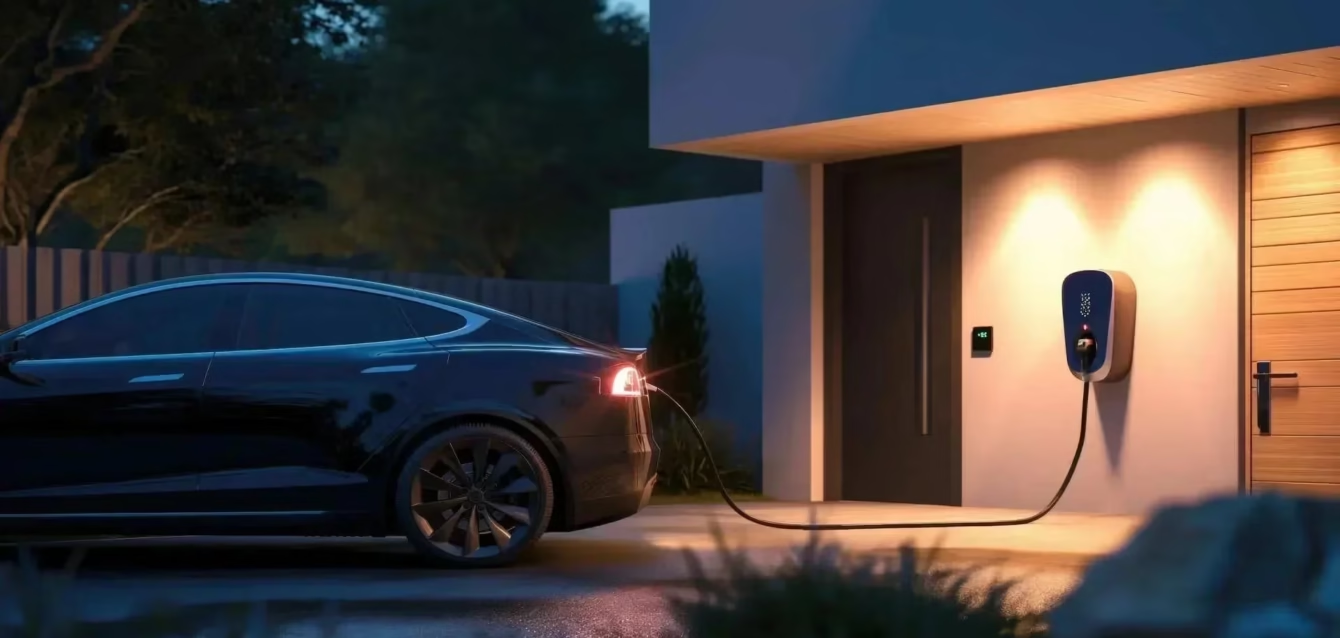
Home EV Charger Installation Cost 2026
Home EV Charger Cost Estimator 2026
Adjust your home situation below to calculate your total installation cost and 30C federal tax credit savings.
Your home situation
Every 10 ft adds ~$100–$140 in wire, conduit, and labor.
Federal 30C tax credit eligibility
Connector standard
Buy a NACS (J3400) home charger
Works natively with your Tesla or 2025+ Hyundai/Kia/Ford/GM/Rivian. Tesla Wall Connector Gen 3 or Emporia NACS are strong choices. No adapter needed at home.Your estimated cost breakdown
Estimates based on 2026 US market data. Actual costs vary by region, contractor, and site conditions. This tool does not constitute tax advice — consult a qualified tax professional for 30C credit eligibility. Source: Axis Intelligence analysis of contractor quote data, IRS Section 30C guidance, and DOE AFDC incentive database.
Quick Answer: Installing a home EV charger in 2026 costs $900–$2,500 for a standard Level 2 setup in a ready home — charger hardware plus professional installation. Complex jobs that require an electrical panel upgrade push costs to $3,000–$6,000+. The federal 30C tax credit covers 30% of eligible costs (up to $1,000) but expires June 30, 2026. Most homeowners with a 200-amp panel, an attached garage, and a short cable run land between $1,200 and $1,800 all-in. This guide walks you through every cost driver, step by step.
Last updated: May 30, 2026 | Author: Aidan Jad | Next scheduled update: September 2026
Table of Contents
Before You Start: What You Need to Know
Installing a home EV charger is an electrical project, not a plug-and-play upgrade. The 2026 National Electrical Code (Section 625.4) now formally requires that permanently installed (hardwired) EV charging equipment be installed by a licensed electrician in most jurisdictions — a change from previous years when DIY installs were legally possible in many states.
Before calling a single electrician, get clear on these five things. They determine your final cost more than any other factor.
Prerequisites
Check every item before requesting quotes:
- Your electrical panel amperage — open the breaker panel and look for a label. Most modern homes have 200A service. Homes built before 1980 often have 100A.
- Available breaker slots — a Level 2 EV charger needs a dedicated 240V double-pole breaker (typically 40A–60A). Count your free slots.
- Distance from panel to parking spot — measure the likely cable path (not straight-line distance). Every 10 feet adds cost.
- Your EV’s onboard charger capacity — check the spec sheet. Most mainstream EVs (Ioniq 5, Model 3, Bolt) max out at 32A–48A AC. Buying a bigger charger is money wasted.
- Your EV’s connector standard — J1772 (most non-Tesla vehicles before 2025) or NACS/J3400 (Tesla, and most 2025+ vehicles from Hyundai, Kia, Ford, GM, Rivian). This determines which charger you buy, not the installation cost.
Estimated time for the full project: 1–3 weeks from first call to driving on a charge. The electrical work itself takes a licensed electrician 3–6 hours for a standard install, or 1–2 days if a panel upgrade is needed. Permit approval adds 3–10 business days depending on your municipality.
Step 1: Assess Your Electrical Panel
Time for this step: 30 minutes
This is where most homeowners discover whether their install is cheap or expensive.
What to do:
- Locate your main electrical panel — typically in the garage, basement, or utility room.
- Look for the main breaker label: 100A, 150A, or 200A.
- Count available double-pole breaker slots (these are the double-width breakers). You need at least one free.
- Note the age of the panel — federal Pacific Electric and Zinsco panels are flagged as fire hazards and will need replacement regardless.
Screenshot description for editorial team: Photo of a 200-amp panel with main breaker labeled, a callout arrow pointing to two empty double-pole slots, and a second photo showing a full panel with zero open slots. Caption: “Left: A 200A panel with room for a 50A EV breaker. Right: A full panel — your electrician will need to consolidate circuits or upgrade service.”
What this tells you about cost:
| Panel situation | Likely additional cost |
|---|---|
| 200A panel with open slots | $0 panel cost — straight to install |
| 200A panel, full — consolidation possible | $200–$400 to consolidate or tandem breakers |
| 100A panel in good condition | $1,500–$3,000 panel upgrade |
| 100A panel that’s outdated (FPE, Zinsco) | $2,500–$5,000 full panel replacement |
2026 note for editorial team: Older guides on competitor sites tell homeowners to “just call an electrician if you need an upgrade.” What they don’t explain: a panel upgrade often requires the utility company to temporarily disconnect your service — a separate scheduling step that can add a week to the project. Ask your electrician upfront whether the upgrade requires utility coordination in your area.
Step 2: Choose Your Charger (Hardware Cost Breakdown)
Time for this step: 1–2 days of research
The charger itself is the smaller of the two cost variables. In 2026, mainstream 32A–48A Level 2 units from reputable brands run $250–$700 before incentives.
Level 1 vs Level 2: The real-world math
| Charger type | Voltage | Miles added per hour | Full charge time (60 kWh battery) | Hardware cost |
|---|---|---|---|---|
| Level 1 (standard outlet) | 120V | 3–5 miles/hr | 40–50+ hours | $0 (use existing outlet) |
| Level 2 (dedicated 240V) | 240V | 20–35 miles/hr | 6–10 hours | $250–$700 |
| DC Fast Charge | 480V+ | 150–200+ miles/hr | Not for home use | N/A |
For anyone driving more than 30 miles per day, Level 1 charging is a daily anxiety spiral. Level 2 is the practical choice for the overwhelming majority of EV owners. If you’re still deciding which EV to buy, see our best EVs 2026 guide for Aidan Jad’s tested recommendations before locking in your charger choice.
Connector standard: J1772 vs NACS (the 2026-specific issue most guides get wrong)
Most older how-to guides instruct buyers to get a “J1772 charger” without acknowledging the industry transition now in full swing. In 2026, the split matters:
- Tesla owners: Your car has a NACS port. Buy a NACS home charger (Tesla Wall Connector or third-party NACS unit) — no adapter needed at home. The J1772 adapter Tesla includes handles public AC charging.
- 2025+ Hyundai, Kia, Ford, GM, Rivian owners: Most 2025+ models now ship with native NACS ports. A NACS home charger works natively.
- Older non-Tesla EVs (pre-2025 J1772): A standard J1772 home charger is the right call. No adapter needed.
- Mixed-EV households: A NACS charger with a J1772 adapter covers both a Tesla and a J1772 vehicle — the cleanest future-proof solution.
Representative 2026 hardware prices (before tax credits):
| Charger | Type | Amps | Price range |
|---|---|---|---|
| Tesla Wall Connector (Gen 3) | NACS | 48A | $400–$430 |
| ChargePoint Home Flex | J1772 | 50A | $550–$600 |
| Emporia Level 2 (NACS) | NACS | 48A | $350–$400 |
| JuiceBox 40 | J1772 | 40A | $450–$520 |
| Grizzl-E Classic | J1772 | 40A | $250–$290 |
One critical decision — plug-in vs. hardwired:
A plug-in charger uses a NEMA 14-50 outlet and can be unplugged and moved. A hardwired unit is wired directly into your electrical system. The 2026 NEC’s qualified installer requirement applies to both — the outlet installation is still permitted electrical work. Hardwired units are generally cleaner, slightly safer for continuous high-current loads, and preferred by most licensed electricians.
Step 3: Get Quotes from Licensed Electricians
Time for this step: 1–3 days
Under NEC 2026 Section 625.4, hardwired EV charger installation requires a “qualified person” — interpreted as a licensed electrician in virtually all adopting jurisdictions. California explicitly requires a C-10 electrical contractor. Florida, Texas, Illinois, Massachusetts, New York, and Washington have similar requirements already on the books. For a full picture of current green tech regulations and EV policy, Axis Intelligence’s EV and clean transportation coverage tracks the latest legislative changes.
How to get accurate quotes:
- Contact three electricians who specifically mention EV charger experience on their websites or profiles. General electricians may quote higher because EV installs are unfamiliar work.
- Before they visit, tell them: your panel amperage, your parking situation (attached garage / detached / outdoor), and the approximate panel-to-charger distance.
- Ask each quote to be itemized: labor, materials (wire, conduit, breaker), permit fee, and any contingency for panel work.
Screenshot description for editorial team: Screenshot of Angi or Thumbtack search for “EV charger installation” with location filter active, showing 4–5 contractor profiles with star ratings and EV-specific experience indicators. Caption: “Search specifically for EV charger experience — general electricians may quote higher or underestimate complexity.”
Red flags in a quote:
- No mention of permit (a legal install requires one in almost every jurisdiction)
- Total quote under $400 for a full new circuit (this is below the cost of materials alone)
- No mention of load calculation or panel assessment
Step 4: Pull the Permit and Schedule Inspection
Time for this step: 3–10 business days
In most jurisdictions, the electrician pulls the permit on your behalf — it’s typically a condition of their license. But you should understand what’s happening and why.
The permit process, step by step:
- Your electrician submits an application to the local building department, including: the charger make and model, proposed circuit specs (breaker size, wire gauge), and a load calculation confirming your panel can support the new circuit.
- The building department reviews and approves — this takes 3–10 business days in most cities. Some jurisdictions (Austin, Seattle, San Francisco) have online portal submissions that can return same-day approval for straightforward installs.
- Your electrician does the work.
- A building inspector visits to verify the installation meets code.
Screenshot description for editorial team: Screenshot of a municipal building permit portal (e.g., Austin’s DevelopmentATX or the generic “Online Permit” portal with fields for “Electrical — EV Charging Equipment”). Caption: “Most municipalities now accept online permit applications for EV charger installations. Your electrician handles this, but confirm it’s happening before work begins.”
Permit cost: $50–$300 depending on jurisdiction. This is almost always included in your electrician’s quote, but verify.
2026 note: Guides from 2023 and earlier frequently omit the inspection step or treat it as optional. It isn’t — failed inspections can require rework and re-inspection, adding days and cost. More importantly, an uninspected installation may void your homeowner’s insurance coverage for any EV-charging-related claim.
Step 5: The Electrical Installation
Time for this step: 3–6 hours (standard) or 1–2 days (with panel upgrade)
This is the electrician’s work. Your job is to be available for the initial walk-through and available by phone. Here is what a standard install looks like in sequence:
- Load calculation — the electrician runs NEC 220.82 math to confirm available panel capacity. For most 200A gas-heated homes, 30–80 amps of available capacity is typical.
- Circuit run — the electrician runs appropriate gauge wire from the panel to the charger location. For a 40A circuit, that’s typically 8 AWG copper in conduit. For 50A, it’s 6 AWG.
- Conduit installation — in garages, wire is run in conduit along the wall or ceiling. In finished spaces, it may be routed through walls (more labor-intensive).
- Breaker installation — a dedicated double-pole breaker is installed in the main panel.
- Charger mounting and wiring — the charger is mounted at the chosen height (typically 48 inches from floor) and wired in.
- Final test — the electrician powers on the circuit, the charger is tested with your vehicle or a load tester.
Screenshot description for editorial team: Three-image sequence: (1) electrician routing conduit along garage wall with clamps, wire not yet pulled; (2) inside main panel with new double-pole breaker installed and labeled “EV CHARGER”; (3) finished wall-mounted Level 2 charger with cable holstered and LED status light on. Caption: “A standard garage install: conduit run, breaker installed and labeled, charger mounted. The work is clean and permanent.”
Common error #1 — wrong wire gauge: Some electricians unfamiliar with EV installs use 10 AWG wire for a 40A circuit. NEC requires 8 AWG minimum for a 40A continuous-load circuit (EV chargers are classified as continuous load, meaning the wire must be rated for 125% of the breaker). If your electrician specifies 10 AWG for a 40A circuit, correct them before work begins.
Common error #2 — no dedicated circuit: Some homeowners try to share a 240V circuit with another appliance using a load-sharing device. These are not permitted in all jurisdictions and can cause nuisance tripping. A dedicated circuit is the right answer.
Common error #3 — charger mounted too close to the floor: At 18 inches from the floor, a charger is vulnerable to vehicle contact. The standard mounting height is 48 inches, which keeps the cable above bumper height.
Step 6: Apply for Tax Credits and Utility Rebates
Time for this step: 1–2 hours at tax time
This is the step most homeowners either rush or skip entirely — and it can mean $500–$1,500 back in your pocket.
Federal 30C Tax Credit — Act Before June 30, 2026
The Alternative Fuel Vehicle Refueling Property Credit (IRC Section 30C) covers 30% of EV charger hardware and installation costs, up to $1,000 for residential properties. As of May 2026, this credit expires June 30, 2026 under the One Big Beautiful Bill Act signed July 4, 2025.
Key eligibility rules:
- The charger must be placed in service (operational) by June 30, 2026
- Your property must be in a qualifying census tract: rural (non-urban) or low-income community
- Claimed on IRS Form 8911 with your federal tax return for the year of installation
- This is a non-refundable credit — it reduces your tax liability, not your installation invoice
Check eligibility using the DOE’s Alternative Fuels Station Locator census tract tool at the Alternative Fuels Data Center (afdc.energy.gov).
Example math:
| Total install cost | 30C credit (30%) | Your net cost |
|---|---|---|
| $1,200 | $360 | $840 |
| $1,800 | $540 | $1,260 |
| $2,500 | $750 | $1,750 |
| $3,500+ | $1,000 (cap) | $2,500+ |
State and utility rebates (stackable with 30C):
Many states and utilities offer separate rebates that can be combined with the federal credit. Examples current as of May 2026:
- Colorado: State rebate + Xcel Energy rebate for qualifying chargers
- California: Some utilities (PG&E, SCE) offer $250–$500 charger rebates
- New York: NYSERDA EV Make-Ready program offers significant incentives for eligible customers
- Most US utilities: Many offer off-peak Time-of-Use (TOU) rate discounts that reduce your per-mile charging cost regardless of installation rebates
Check your utility’s website and the DOE’s AFDC incentive database at afdc.energy.gov for your state.
Full Cost Summary: What You’ll Actually Pay
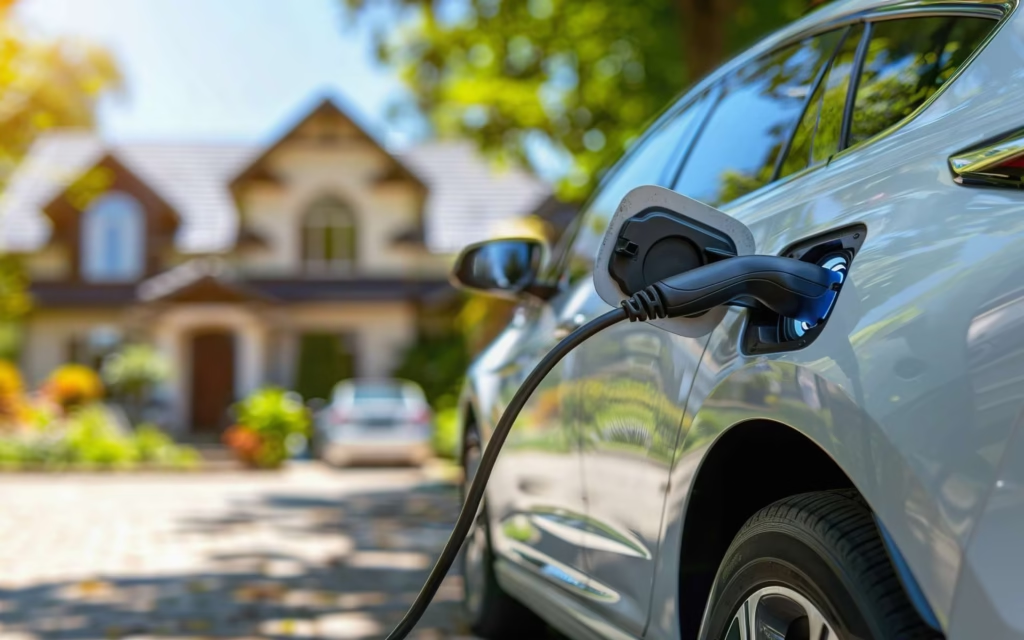
Axis Intelligence’s analysis of 2026 installation cost data across scenarios:
Scenario 1 — Simple install (short run, panel ready)
- Charger hardware: $300–$550
- Labor and materials: $400–$700
- Permit: $75–$150
- Total before incentives: $775–$1,400
- After 30C credit (if eligible): $543–$980
Scenario 2 — Standard install (moderate cable run, 200A panel)
- Charger hardware: $400–$650
- Labor and materials: $700–$1,200
- Permit: $100–$200
- Total before incentives: $1,200–$2,050
- After 30C credit (if eligible): $840–$1,435
Scenario 3 — Complex install (panel upgrade required)
- Charger hardware: $400–$700
- Panel upgrade: $1,500–$3,500
- Labor (charger install): $500–$900
- Permit: $150–$300
- Total before incentives: $2,550–$5,400
- After 30C credit (if eligible): $1,550–$4,400 (credit caps at $1,000)
Common Errors and Fixes
These are the failure points Axis Intelligence found most frequently documented in installer forums, homeowner reviews, and electrician case notes — and the ones most competitor guides leave unaddressed.
Error: Charger won’t connect to Wi-Fi after installation Fix: Most smart chargers (ChargePoint, JuiceBox, Emporia) require 2.4GHz Wi-Fi, not 5GHz. If your router broadcasts both on the same SSID, temporarily separate them or connect from the 2.4GHz band during setup. Once configured, the charger will reconnect automatically.
Error: Circuit breaker trips repeatedly when charging Fix: This typically means the charger is set above the circuit’s 80% continuous-load limit. A 40A breaker’s maximum continuous draw is 32A. In the charger’s app or on the unit itself, set the output to match: 32A max on a 40A breaker, 40A max on a 50A breaker. If tripping continues, the breaker may be weak — a licensed electrician can swap it in under an hour.
Error: Permit failed inspection Fix: The most common inspection failure in 2026 is using non-listed receptacles on a 240V EV circuit. NEC 2026 now requires EVSE-listed receptacles — standard NEMA 14-50 receptacles intended for appliances are no longer compliant on new EV circuits in adopting jurisdictions. Your electrician should use specifically listed EV receptacles. If this was your failure reason, the fix is a receptacle swap — usually a 1-hour return visit.
Error: Charger shows “Ground Fault” error after install Fix: This is almost always a wiring issue — a reversed hot/neutral or a loose ground connection at the charger or at the panel. Power down the circuit at the breaker and call your electrician back before re-energizing. Do not attempt to diagnose inside a hardwired unit.
Error: Installation quote suddenly higher after the panel is opened Fix: This is legitimate — electricians often can’t see the full panel condition until they open it. Ask upfront for a “not to exceed” figure for standard work, and a clear protocol for what happens if additional work is needed. Get the contingency in writing before work begins.
Error: App says “charging” but car shows no power added (Tesla specific) Fix: On NACS chargers used with a Tesla, ensure the charge port is fully latched. The NACS connector requires a firm press until you hear a click. If the car shows “No connection,” try a cable power cycle: unplug, wait 10 seconds, re-plug.
When This Won’t Work
Installing a home Level 2 EV charger is not the right solution in every situation.
You rent your home. Federal law does not guarantee your right to install a charger in a rental property. Several states (California, New York, Florida, and others) have “right-to-charge” protections for renters, but they typically require landlord approval and reasonable conditions. Check your state’s right-to-charge law before approaching your landlord. Public charging or a portable Level 1 solution may be a better near-term answer.
You live in a condo or HOA community. HOA approval is typically required, and the process can take months. Many states have laws prohibiting HOAs from unreasonably blocking EV charger installation, but “unreasonably” is often litigated.
Your parking is on the street or in a shared garage. A home Level 2 charger requires private, controlled access to a 240V outlet near your parking spot. If that doesn’t exist and can’t be created, workplace charging, public charging networks, or DC fast charging may be your primary solution.
Your electrical service is 60A or less. Rare in newer homes but common in very old homes or accessory dwelling units. A 60A panel upgrade to 200A is typically a $2,000–$4,000 project on its own — evaluate whether your total EV ownership economics still make sense before proceeding.
You drive under 30 miles per day and have overnight parking near an outlet. Level 1 charging (standard 120V outlet) adds 3–5 miles of range per hour. For a low-mileage driver, that’s 30–50 miles of range from an 8-hour overnight charge — enough for most daily driving. If the numbers work for you, a Level 1 solution costs nothing beyond the EVSE cord that comes with most vehicles.
What to Do Next
Once your charger is installed and you’ve filed for your tax credit, two questions typically come up:
Should you install solar to offset charging costs? A 5–7 kW solar system can cover the average EV’s annual energy needs in most US climates. Aidan Jad’s analysis of the full EV ownership cost picture — including charging, maintenance, and depreciation.
What’s the best Level 2 home charger to buy? Hardware choice depends on your EV’s connector standard, whether you want smart app features, and your circuit sizing. Our tested guide to the best home EV chargers 2026 covers 8 units with real charging data.
Need to understand the broader EV charging landscape? Our EV charging statistics 2026 tracks adoption rates, public charger availability, and charging speed benchmarks by network.
FAQ
How much does it cost to install a Level 2 home EV charger in 2026?
Most homeowners pay $900–$2,500 for a complete Level 2 setup in a panel-ready home, including the charger hardware and professional installation. Jobs requiring a panel upgrade can reach $3,000–$6,000+. The federal 30C tax credit covers up to $1,000 (30%) for eligible homeowners, but expires June 30, 2026.
Can I install a home EV charger myself in 2026?
In most jurisdictions, no — not legally for a hardwired installation. NEC 2026 Section 625.4 requires permanently installed EV charging equipment to be installed by a “qualified person,” which most jurisdictions interpret as a licensed electrician. California, Florida, Texas, New York, Illinois, and Massachusetts had similar requirements in place before NEC 2026. Plug-in chargers into an existing outlet are different — the charger itself just plugs in — but installing that 240V outlet is still permit-required electrical work in most areas.
Do I need to upgrade my electrical panel for an EV charger?
Not usually, if your home has a 200-amp panel. A standard NEC 220.82 load calculation typically shows 30–80 amps of available capacity in a gas-heated 200A home — more than enough for a Level 2 EV charger. Homes with 100-amp service, electric heat, or older panels may need an upgrade, which adds $1,500–$3,500 to the project cost.
How long does it take to install a home EV charger?
The physical electrical work takes a licensed electrician 3–6 hours for a standard garage install. If a panel upgrade is required, the job typically takes 1–2 days. Permit approval adds 3–10 business days in most municipalities. From first electrician call to driving on a home charge: budget 1–3 weeks total.
What’s the difference between J1772 and NACS chargers for home use?
J1772 is the traditional AC charging connector used by most non-Tesla vehicles before 2025. NACS (the Tesla connector, now the SAE J3400 standard) is being adopted by most automakers for 2025 and newer models. If you drive a Tesla or a 2025+ vehicle from Hyundai, Kia, Ford, GM, or Rivian, a NACS home charger works natively. Older J1772 vehicles need a J1772 charger or an adapter. Adapters exist in both directions for AC charging.
Does the federal EV charger tax credit still exist in 2026?
Yes, but it expires June 30, 2026. The 30C credit covers 30% of charger hardware and installation costs, up to $1,000, for homes in qualifying census tracts (rural or low-income communities). It’s claimed on IRS Form 8911 and is non-refundable. Act before the deadline — there is currently no replacement credit proposed for residential chargers after June 30, 2026.
Can I get a home EV charger rebate from my utility company?
Many utility companies offer $100–$500 rebates on Level 2 home chargers, particularly smart chargers that can be scheduled for off-peak charging. These rebates are separate from and stackable with the federal 30C tax credit. Check your utility’s website directly or search the DOE Alternative Fuels Data Center incentive database at afdc.energy.gov.
How much does it cost to charge an EV at home per mile?
At the US average electricity rate of approximately $0.16/kWh (as of early 2026), and assuming an EV efficiency of 3.5 miles/kWh, the cost is roughly $0.046 per mile — about $4.60 per 100 miles, compared to $13–$15 per 100 miles for a typical 30 MPG gas vehicle at $4/gallon. Your actual cost depends on your local electricity rate and whether you charge during off-peak hours.
This article does not constitute tax or legal advice. Consult a licensed electrician for installation work and a qualified tax professional for credit eligibility.
Editorial independence: Axis Intelligence does not accept payment for product placement. Charger brands mentioned are illustrative examples based on market availability and do not represent endorsements.