

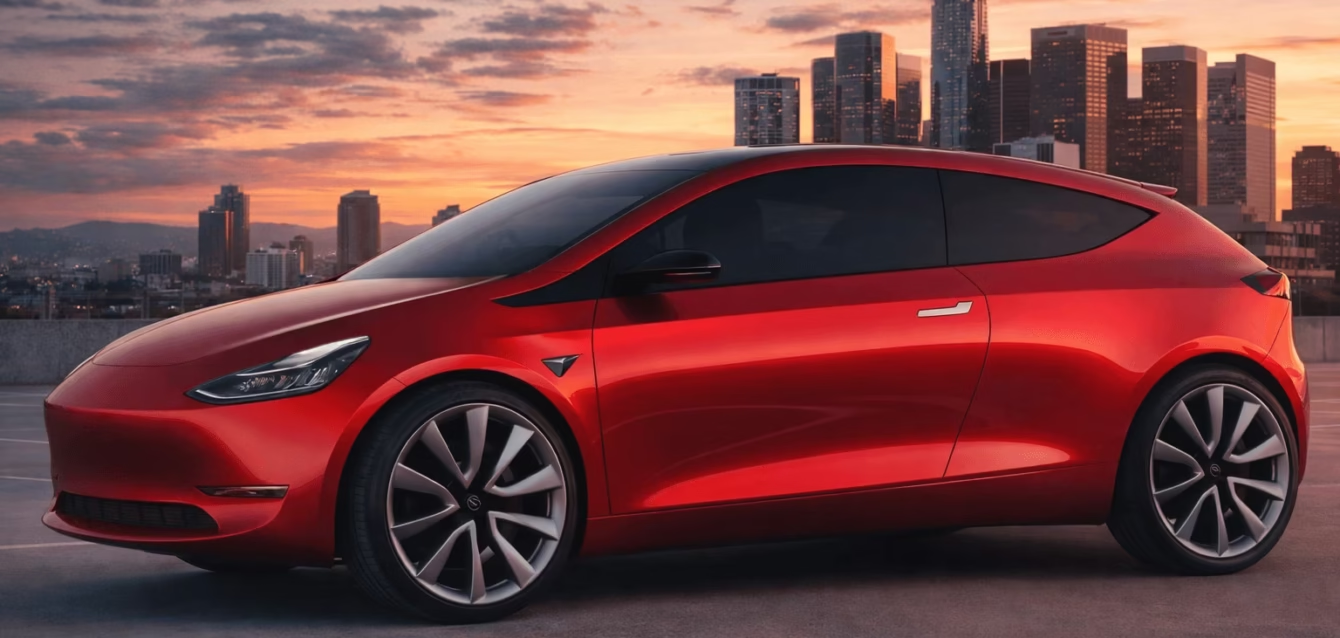
Tesla Model 2 in 2026
Tesla’s Q1 2026 10-Q (filed April 22, 2026) confirms Cybercab pilot production has begun at Giga Texas on the next-generation platform — the same Unboxed manufacturing process that will eventually underpin the rumored $25,000 affordable EV. But the filing lists no timeline, no production status, and no confirmation of consumer deliveries for what media is calling the “Model 2” in 2026.
Published: May 28, 2026 | Author: Aidan Jad, EV Editor | Updated: May 28, 2026
What Happened
Tesla’s Q1 2026 Form 10-Q, filed with the SEC on April 22, 2026, confirms the company began pilot production of Cybercab in Q1 and states its next phase of production growth will include “new products built on our next generation vehicle platform.” The company’s official manufacturing capacity table — the most authoritative snapshot of what is actually in production — lists the Cybercab as “Pilot Production” at Giga Texas. The affordable consumer EV that media has labelled “Model 2” or “Model Q” does not appear as a separate line item. Tesla’s own language across all 2026 filings remains “next-generation vehicle platform.” The name “Model 2” has never appeared in any Tesla document.
Why It Matters
Here is the critical distinction that almost every 2026 Model 2 article is glossing over: the Cybercab and Tesla’s affordable consumer EV are not the same vehicle, and they are not on the same timeline.
Tesla’s Q4 2025 shareholder update explicitly lists preparations for “production ramps of Tesla Semi and Cybercab, both commencing 1H26, and production of the next-generation Roadster” — no affordable consumer EV in that same sentence. The Cybercab is a purpose-built robotaxi with no steering wheel or pedals. The affordable consumer vehicle is a separate product, likely a compact hatchback or crossover, targeting a ~$25,000 price point for human drivers.
Tesla’s Unboxed Process manufacturing system, designed specifically to cut production costs by roughly 50% compared to the Model 3 platform, is being validated through Cybercab production at Giga Texas. This matters enormously: the Cybercab is the real-world proof-of-concept for the manufacturing architecture that the affordable EV will depend on. If the Unboxed Process works at volume for the Cybercab, the $25,000 consumer EV becomes structurally feasible. If it doesn’t, the consumer product is at risk.
The Axis Intelligence reading of the SEC filing produces a finding no major EV outlet has stated directly: the “Model 2 is going into production” narrative circulating in 2026 is based on a conflation of the Cybercab production ramp with the consumer EV program. They share a platform. They do not share a launch calendar. Investors and reservation-holders are operating on different timelines.
Tesla has also never confirmed the $25,000 target price point in a 2026 filing — the figure originates from Elon Musk’s 2023 Investor Day presentation and has not been formally updated or confirmed in any SEC document since.
What Comes Next
The manufacturing read-through is the correct lens here. The Cybercab’s Q1 2026 pilot production milestone is genuinely important — not because it announces the affordable EV, but because it de-risks the production methodology the affordable EV requires.
Tesla has stated it expects volume production of Cybercab this year (2026). If Cybercab reaches 10,000+ units per quarter by Q4 2026 — the threshold that would validate the Unboxed Process at scale — the engineering and manufacturing evidence for a 2027 affordable consumer EV launch becomes substantially stronger. If Cybercab output stalls, that timeline gets pushed.
The next data point to watch: Tesla’s Q2 2026 delivery report (expected early July 2026) and whether the “Other models” category — which captured 16,130 deliveries in Q1 2026 per the 8-K — shows a meaningful increase attributable to Cybercab commercial scaling. That number, not a press release, will be the real signal on whether the Unboxed Process is tracking toward mass-market affordability.
For prospective buyers, the honest advice based on primary SEC sources: plan your purchase timeline around 2027 for the affordable consumer EV, and treat any 2026 delivery as a favorable surprise rather than a baseline expectation.
The Axis Intelligence Verdict: What Tesla’s $25K EV Timeline Actually Is
Based on a direct reading of Tesla’s Q1 2026 10-Q and Q4 2025 shareholder update — not analyst estimates, not community speculation — here is where the affordable EV program actually stands:
| Signal | Status | Primary Source |
|---|---|---|
| Official product name | None confirmed — “next-generation vehicle platform” only | Tesla 10-Q Q1 2026 |
| Manufacturing process validation | ✅ Cybercab pilot production underway | Tesla 10-Q Q1 2026 |
| $25,000 target price confirmed in 2026 filing | ❌ Not confirmed | All 2026 SEC filings reviewed |
| Consumer delivery timeline confirmed | ❌ No 2026 filing specifies a date | All 2026 SEC filings reviewed |
| Giga Texas production capacity listed | ❌ Not in Q1 2026 capacity table | Tesla 8-K Q1 2026 |
| Platform technology in production | ✅ Unboxed Process running on Cybercab | Tesla 10-Q Q1 2026 |
The platform is real. The production methodology is being validated. The consumer vehicle is not confirmed for 2026 deliveries in any official Tesla document. That is the complete picture as of May 28, 2026.
Axis Intelligence covers EV market developments with primary source discipline. All claims in this article are sourced directly from SEC filings or official Tesla documents — no analyst projections or community speculation has been presented as confirmed fact. See our EV statistics guide, Tesla Cybercab explained, and best electric cars 2026 for broader context on the EV market transition.
Aidan Jad covers electric vehicles and clean energy for Axis Intelligence. He drives a Hyundai Ioniq 6 and has followed Tesla’s manufacturing programs since the Model 3 ramp.