

How to Charge EV at Home in 2026
Last updated: June 7, 2026
Setting up home EV charging involves four sequential decisions: choosing your charging level (Level 1 vs Level 2), confirming your home’s electrical capacity, selecting the right charger hardware for your specific vehicle, and scheduling licensed installation with a permit. For most daily drivers with a garage or dedicated parking, a Level 2 charger on a 40A or 50A circuit delivers a full charge overnight at roughly $0.03–0.05/mile — cheaper than gas and available every morning without a trip to a charging station. Total installed cost for a straightforward setup runs $800–$2,000 before any federal or state incentives.
Table of Contents
What You Need Before You Start
About your vehicle:
- Your EV’s make, model, and year (determines connector type and maximum AC charging rate)
- Your vehicle’s onboard charger capacity in kilowatts — found in the owner’s manual under “charging specifications.” This is the ceiling your car will accept from any Level 2 charger, regardless of how powerful the charger is.
About your home’s electrical system:
- Main electrical panel amperage (100A, 150A, or 200A — labeled on the main breaker)
- Available breaker slots in your panel (a 40A circuit requires one double-pole breaker slot; 50A requires one double-pole slot at a higher rating)
- Distance from the panel to your intended charger location — longer runs cost more and may affect wire gauge
For permits and incentives:
- Address handy to check Section 30C tax credit eligibility at the IRS guidance page and the DOE’s eligibility locator (credit expires June 30, 2026; requires your property to be in a qualifying census tract)
- Your utility’s website or phone number — many offer rebates of $200–$500 that stack with federal credits
Tools/access needed:
- Access to your electrical panel with panel cover removed (by your electrician — do not do this yourself)
- Clear path from panel to charger mounting location, either through conduit or in-wall routing
Estimated Time
| Task | Time |
|---|---|
| Choosing charging level and hardware | 30–60 minutes |
| Getting 3 electrician quotes | 2–5 business days |
| Permit application (electrician handles) | 1–5 business days |
| Installation day (straightforward) | 2–4 hours |
| Inspection (if required by jurisdiction) | Same day or next business day |
| Total elapsed time from decision to charging | 1–2 weeks typical |
Step 1 — Decide Between Level 1 and Level 2
This is the most important decision in the guide. Most competitors tell everyone to get Level 2. That’s not always right.
| Charging level | Voltage | Speed | Setup cost | Who it’s for |
|---|---|---|---|---|
| Level 1 | 120V (standard outlet) | 3–5 miles of range per hour | $0 — uses existing outlet | Plug-in hybrids; EVs driven <30 miles/day; people with access to workplace Level 2 |
| Level 2 | 240V (dedicated circuit) | 25–40 miles of range per hour | $800–$2,000 installed | Daily drivers of full-battery EVs; anyone driving 40+ miles/day or wanting overnight full charge |
| DC Fast (Level 3) | 400V+ | 150–300+ miles in 30 min | Not available for home installation | Commercial stations only |
Decision guide:
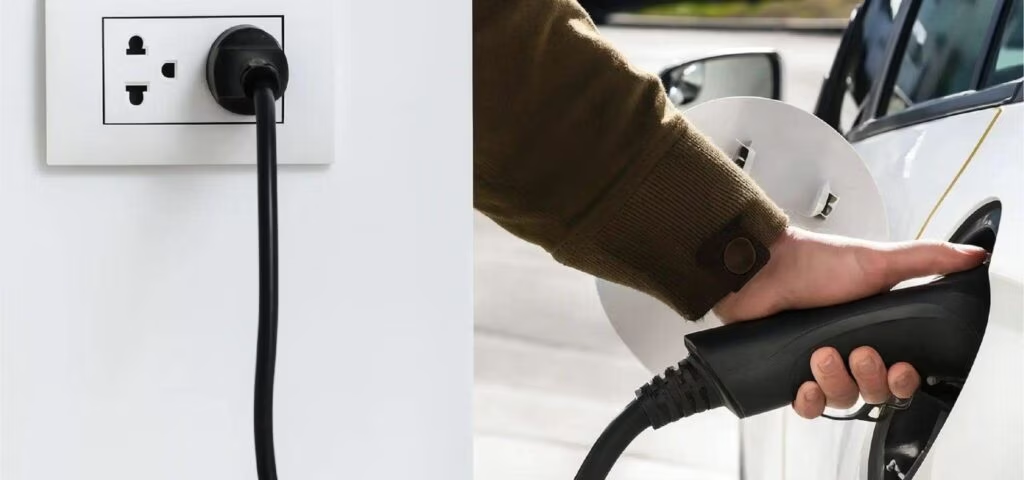
- Drive a plug-in hybrid or an EV for fewer than 30 miles daily? Level 1 is sufficient — plug in every night with the cable that came with your car, wake up fully charged. No installation cost.
- Drive a full-battery EV more than 30–40 miles daily? You need Level 2. The rest of this guide covers the Level 2 setup process.
2026 note for older guides: Articles from 2021–2023 often skip the Level 1 recommendation entirely. With the 30% federal tax credit for EV charger installation expiring June 30, 2026, and the new 2026 NEC GFCI requirements taking effect September 1, 2026, the cost-benefit calculation for Level 2 has changed for low-mileage drivers.
Step 2 — Identify Your Connector Type (NACS vs J1772)
This step is where the 2026 landscape differs significantly from most guides written before 2024.
The connector your car uses determines which charger hardware to buy. Getting this wrong means buying an incompatible charger.
| Your vehicle | Connector type | What to buy |
|---|---|---|
| Any Tesla (all years) | NACS | NACS charger, or J1772 charger with included adapter |
| Ford, Hyundai, Kia, BMW, Rivian — 2025 or newer model year | NACS (native) | NACS charger |
| Ford, Hyundai, Kia, BMW, Rivian — 2024 or older model year | J1772 (with manufacturer NACS adapter supplied) | J1772 charger |
| GM EVs — most 2025+ models | NACS | NACS charger |
| Nissan, VW, Stellantis, most others | J1772 | J1772 charger |
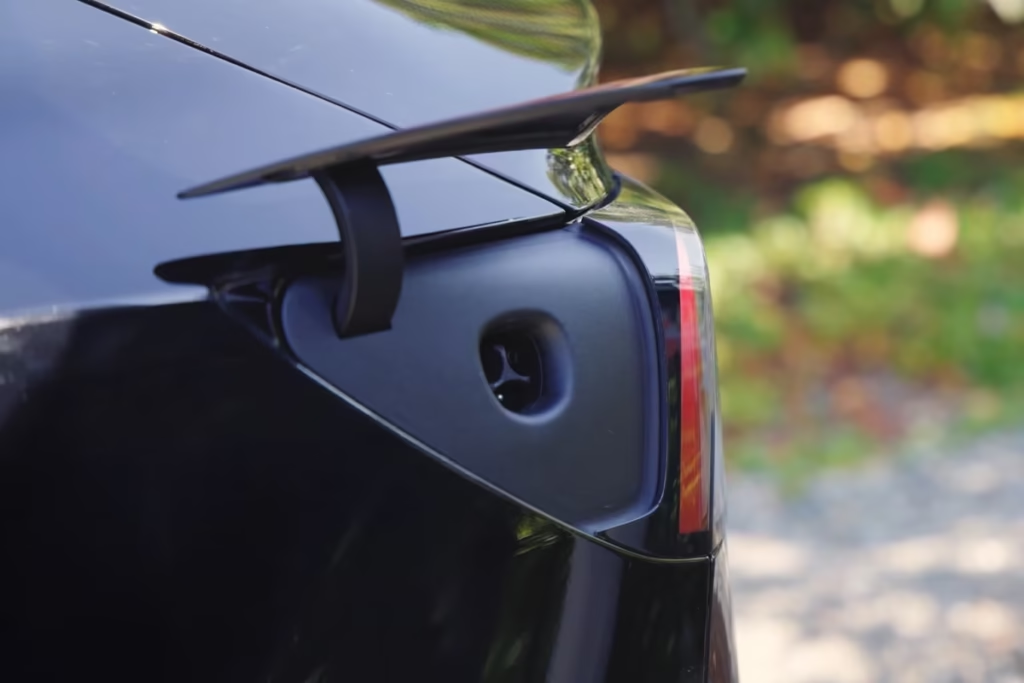
How to check your car’s port: Open the charging door on your vehicle. NACS ports are narrower and squarer; J1772 ports are rounder with a larger opening. If unsure, check your owner’s manual under “charging” or search “[your car make/model/year] connector type.”
Practical guidance for 2026 buyers: If you’re buying a new charger for a new vehicle, NACS is the forward-looking choice — it will be compatible with virtually every new EV entering the US market from 2025 onward. For households with a mix of older J1772 and newer NACS vehicles, a dual-connector charger or a NACS unit with a J1772 adapter covers both.
Step 3 — Check Your Electrical Panel Capacity
Do not skip this step. It determines whether you need a panel upgrade — which can add $1,500–$4,000 to your project cost.
How to read your panel
Step 3a — Open your electrical panel cover (the gray or gray-black box, usually in your garage, basement, or utility closet). Do not touch any wiring. You are only reading labels.
Step 3b — Find the main breaker at the top. It will be labeled 100A, 150A, or 200A. Write this down.
Step 3c — Count the remaining open slots (blank spaces without breakers). A Level 2 charger on a 40A circuit needs one double-pole breaker slot (takes up two rows). A 50A circuit needs one double-pole slot rated for 50A.
Screenshot description: Photo of a residential electrical panel with labels: Arrow pointing to main breaker labeled “200A Main Breaker.” Arrow pointing to two blank slots labeled “Available for 40A double-pole breaker.” Several existing breakers labeled with circuit names.
Panel capacity quick-reference:
| Panel amperage | EV charger compatibility | Notes |
|---|---|---|
| 200A (2-slot available) | ✅ 40A or 50A circuit — no upgrade needed | Ideal situation for most 2000s+ homes |
| 150A (2-slot available) | ✅ 40A circuit usually fine | Have electrician verify with load calculation |
| 100A (2-slot available) | ⚠️ May need upgrade | High risk if home has electric heat, HVAC, or multiple large appliances |
| Any amperage (no slots available) | ❌ Panel upgrade required | $500–$3,000+ depending on service size and utility |
If your panel is at 100A or has no available slots: Get an electrician to perform a load calculation (NEC 220.82) before assuming you need a full panel upgrade. Many homes have theoretical capacity that load calculations confirm is sufficient. An electrician can tell you in under 30 minutes on a site visit. Some companies now offer online panel assessments for $15–$25 using panel photos.
Step 4 — Choose Your Charger Hardware
Amperage: The number that matters most
Buy a charger rated for the circuit you’re installing, not the highest amperage available. NEC requires charging equipment to run at no more than 80% of circuit capacity:
| Circuit breaker | Maximum continuous draw | Recommended charger |
|---|---|---|
| 30A breaker | 24A continuous | 24A charger |
| 40A breaker | 32A continuous | 32A charger ← most common |
| 50A breaker | 40A continuous | 40A charger |
| 60A breaker | 48A continuous | 48A charger ← maximum for most EVs |
Critical: Your car’s onboard charger is the actual ceiling. A 48A (11.5 kW) home charger delivers no value if your car’s onboard charger accepts only 32A (7.7 kW). Check your vehicle spec before buying:
| Vehicle | Max AC charge rate | Charger to buy |
|---|---|---|
| Tesla Model 3/Y | 48A (11.5 kW) | 48A on 60A circuit |
| Tesla Model S/X | 48A (11.5 kW) | 48A on 60A circuit |
| Chevy Equinox EV | 32A (7.7 kW) | 32A on 40A circuit — 48A charger adds no benefit |
| Ford F-150 Lightning | 48A (11.5 kW) | 48A on 60A circuit |
| Hyundai IONIQ 6 | 48A (11.5 kW) | 48A on 60A circuit |
| Nissan Leaf (standard) | 16A (3.7 kW) | 16A or 24A — higher is wasted |
2026 note: Many guides recommend buying the “highest amperage you can get.” This is wrong for cars with low onboard charger limits. A Nissan Leaf owner buying a 48A charger on a 60A circuit pays $200–$400 more for hardware and $300–$600 more for a larger circuit — and charges at exactly the same speed as a 16A charger.
Plug-in vs hardwired
| Type | Pros | Cons | Best for |
|---|---|---|---|
| Plug-in (NEMA 14-50 outlet) | Can take charger when moving; easier to replace charger | Requires GFCI breaker (nuisance trip risk — see Common Errors); outlet adds cost | Renters; people who may move |
| Hardwired | More stable; no GFCI double-trip issue; cleaner install | Permanent; replacing requires electrician | Homeowners planning to stay |
Recommended chargers as of June 2026
- ChargePoint Home Flex — 16–50A adjustable, WiFi, app monitoring, J1772 or NACS versions. $699 retail. The most-installed residential charger in the US.
- Emporia Pro — 48A, NACS or J1772, load-balancing built in, app-controlled. $449 retail. Best value for smart charging.
- Tesla Universal Wall Connector — NACS native, dual-car charging option, integrates with Tesla app. $475 retail. Best for Tesla owners or mixed-brand households.
- Grizzl-E Classic — 32A or 40A, no WiFi, extremely durable, outdoor-rated. $299 retail. Best for owners who want reliability without smart features.
Step 5 — Get Quotes and Hire a Licensed Electrician
Do not attempt Level 2 charger installation yourself. Beyond the safety risk (240V can cause fatal electrocution), unpermitted electrical work voids homeowner’s insurance, complicates home sales, and will fail inspection in jurisdictions that adopt NEC 2026’s qualified-person requirement (effective September 1, 2026 nationally, though state adoption varies).
How to get accurate quotes
Step 5a — Get three quotes. Include at least one from an EV-specialized installer. Prices for identical jobs vary $400–$800 between electricians in most markets; the lowest bid is not always the best.
Step 5b — Provide identical information to each electrician: panel amperage, distance from panel to charger location, indoor vs outdoor installation, which charger unit you’ve already purchased (or ask them to supply). Comparing quotes requires identical scope.
Step 5c — Ask each electrician explicitly:
- “Will you pull the permit?” (Yes is the correct answer. Walk away from electricians who suggest skipping permits.)
- “Do you have experience with EV charger installations specifically?”
- “Will you include a load calculation to confirm panel capacity?” (Should be included at no extra charge for a site visit.)
Where to find EV-specialized electricians:
- Your charger manufacturer’s installer network (ChargePoint, Tesla, and Emporia all maintain installer directories)
- Qmerit — national EV installation network with upfront pricing in many markets
- Your utility company — many offer pre-vetted installer referrals as part of their EV rebate programs
2026 note: The 30C federal tax credit requires your project to be “placed in service” (fully installed and operational) by June 30, 2026 to qualify. That deadline is 23 days from the publication date of this article. If you want to capture this credit, contact electricians immediately — availability before June 30 is constrained in most markets.
Step 6 — Installation Day
Installation of a straightforward Level 2 charger (panel has capacity, charger location is in or adjacent to garage) takes 2–4 hours.
What happens during installation:
Step 6a — Electrician turns off main power. All circuits go dead during this portion of the install. Plan for 30–60 minutes without power.
Step 6b — Circuit is run from panel to charger location. Wire gauge depends on circuit amperage: 10 AWG for 30A, 8 AWG for 40–50A, 6 AWG for 60A. Conduit is used for exposed runs (exterior walls, garages); in-wall runs use NM-B cable where permitted by local code.
Step 6c — Charger is mounted and connected. Hardwired units connect directly to the circuit wire at a junction box behind the unit. Plug-in units connect to the outlet installed on the dedicated circuit.
Step 6d — Breaker is installed and panel labeled. The new double-pole breaker is added to the panel. The electrician labels the circuit (e.g., “EV Charger — 40A”).
Step 6e — Power is restored and charger is commissioned. The electrician tests that the charger energizes correctly and that the circuit operates at the expected amperage.
Step 7 — Claim Your Tax Credits and Rebates
Federal Section 30C tax credit (expires June 30, 2026)
- Amount: 30% of equipment + installation cost, up to $1,000 for residential
- Eligibility requirement: Your home must be in an eligible census tract (low-income community or non-urban area). Check at Argonne National Laboratory’s eligibility map.
- How to claim: File IRS Form 8911 with your federal tax return for the year the charger was placed in service. If installed in 2026 before June 30, claim on your 2026 tax return (filed in 2027).
- Keep: Receipts for charger hardware AND electrician invoice. Both are eligible costs.
2026-specific warning most guides miss: The 30C credit is not universal. Roughly one-third of Americans live in census tracts that do not qualify — primarily urban areas. Check the eligibility map at your exact address before planning your project budget around this credit. If you’re in a non-qualifying tract, the credit does not apply regardless of when you install.
State and utility rebates
These stack with the federal 30C credit. Examples as of June 2026:
| State/Utility | Rebate amount | Source |
|---|---|---|
| California (SMUD) | Up to $599 | Utility rebate |
| New York (NYSERDA) | Up to $1,000 | State program |
| Colorado | Up to $500 | State income tax credit |
| National Grid (MA/RI/NY) | $100–$250 | Utility rebate |
| Pacific Power (OR/WA) | $200 | Utility rebate |
Check your utility’s website and your state energy office for current programs. Many expire or change annually.
Common Errors and Fixes
Error 1: Charger cuts off overnight mid-charge (GFCI nuisance trip)
Symptom: You plug in, charger starts, but you wake up in the morning to a partially charged car and a tripped GFCI breaker.
Why it happens: Plug-in Level 2 chargers require a GFCI-protected NEMA 14-50 outlet under NEC 210.8(A) and 625.54. Most hardwired chargers have built-in CCID-20 ground fault protection. When both systems are present on the same circuit, minor normal electrical leakage during charging can trigger both protection systems simultaneously — the GFCI trips before the charger’s internal protection does, cutting the charge.
Fix:
- Switch to a hardwired installation. Hardwired chargers typically do not require an external GFCI breaker (check with your electrician and AHJ). No external GFCI = no double-trip conflict.
- If you must use a plug-in setup, ask your electrician to install a CCID-20 GFCI rather than a standard 5mA Class A GFCI. The 20mA threshold is more tolerant of the normal leakage levels produced by EV chargers. Note: NEC 2026 (effective September 1, 2026) mandates 5mA Class A GFCI for all EV charging circuits in adopting jurisdictions — if your jurisdiction adopts NEC 2026, the CCID-20 option may no longer be code-compliant.
- Try relocating the charger farther from grounded plumbing or HVAC equipment — nearby grounds can increase leakage current that triggers the GFCI.
⚠️ NEC 2026 update: NEC 2026 Article 625 (effective September 1, 2026 nationally, subject to state adoption) mandates 5mA Class A GFCI for all EV charging circuits — the same sensitive threshold that causes nuisance tripping. If your jurisdiction adopts NEC 2026, the CCID-20 workaround in point 2 above may no longer be code-compliant. Hardwired installation becomes the cleaner path.
Error 2: Bought a charger your car can’t use at full speed
Symptom: You paid for a 48A hardwired charger on a 60A circuit, but your Chevrolet Equinox EV still charges at the same speed it always did.
Why it happens: Your car’s onboard charger is limited to 32A (7.7 kW). A 48A charger delivers no additional current — it’s capped at the vehicle level.
Fix: You cannot fix this retroactively without selling the charger and buying a lower-amperage unit. For future buyers: look up your vehicle’s maximum AC charging rate before purchasing charger hardware. This information is in the owner’s manual under “charging specifications” or searchable as “[year] [make] [model] onboard charger kW.”
Error 3: J1772 charger for a NACS vehicle (or vice versa)
Symptom: Charger connector doesn’t fit your car’s port.
Why it happens: Most guides written before 2024 assume J1772. Increasingly, 2025+ model year vehicles ship with native NACS ports and no J1772 port. If you bought a J1772 charger for a 2025 Kia EV6, it doesn’t fit.
Fix: Purchase the manufacturer-supplied NACS-to-J1772 adapter (typically $25–$50) that came with your vehicle, or that is available from the automaker. This adapter allows your NACS vehicle to use J1772 chargers. Going forward, buy a NACS charger for any NACS-native vehicle.
Error 4: Section 30C credit claimed for a non-qualifying address
Symptom: IRS rejects or adjusts your 8911 filing.
Why it happens: Many online guides describe the 30C credit as broadly available. It is not — it requires the charger installation address to be in a qualifying census tract. Urban homeowners frequently discover they don’t qualify only after installation.
Fix — before installation: Check your address at the Argonne National Laboratory AFDC locator. If you’re in a non-qualifying tract, remove the federal credit from your project budget calculation and focus on state and utility incentives, which have different eligibility criteria and often cover urban areas.
Error 5: Panel upgrade quote given without a load calculation
Symptom: Electrician quotes a $3,000+ full panel upgrade without performing a load calculation.
Why it happens: Some electricians (and some installer networks) default to recommending panel upgrades because they’re profitable. Many homes with 100A or 150A service can support a Level 2 charger with a proper load calculation.
Fix: Ask for a written NEC 220.82 load calculation before authorizing any panel upgrade. This calculation accounts for all existing loads (HVAC, water heater, appliances, etc.) against your panel’s rated capacity. If the calculation shows headroom, you don’t need an upgrade. If it shows you’re at or over capacity, the upgrade is genuinely needed. Many online services now offer this calculation for $15–$25 using photos of your panel and a questionnaire — useful for validating an in-person quote.
When This Won’t Work
You rent your home. Level 2 charger installation requires landlord permission and typically involves structural work (conduit, panel modifications). Before proceeding, get written permission from your landlord. If permission is denied, Level 1 charging and public Level 2 networks are your alternatives. Some states (California, Colorado, New York) have “right to charge” laws that limit a landlord’s ability to refuse.
You live in an apartment or condo with no dedicated parking. Home Level 2 charging is not feasible without a dedicated parking spot and electrical access. Alternatives: workplace charging, public Level 2 networks (over 200,000 ports in the US as of Q1 2026), and overnight DC fast charging where available.
Your home has only 60A service (older homes, some rural properties). A 60A main service cannot support a Level 2 EV charger without a service upgrade — upgrading from 60A to 200A typically costs $3,000–$6,000 including utility coordination. In this scenario, run the numbers: the upgrade may still pay back over time through lower fueling costs, but it materially changes the project economics.
Your home has federal Pacific knob-and-tube or aluminum branch circuit wiring. If your home was wired with aluminum branch circuits or has significant knob-and-tube wiring (common in homes built before 1970), a licensed electrician must assess whether these systems can safely support a new 240V circuit. Do not proceed with EV charger installation before this evaluation.
The Section 30C credit window has passed. If you’re reading this after June 30, 2026, the federal Section 30C EV charger installation credit has expired. Check your state’s energy office and utility for active rebate programs, which may partially compensate.
What to Do Next
If your project qualifies for the 30C credit (deadline June 30, 2026): Contact at least two electricians for quotes this week. Installation backlogs are real in June 2026 as the deadline approaches. Verify your address eligibility first at the DOE AFDC map.
If you need a panel upgrade: Get the load calculation first. Then get panel upgrade quotes from at least two licensed electricians. Some utilities offer rebate programs specifically for panel upgrades in conjunction with EV charger or heat pump installation — check your utility’s website.
To understand your total EV home charging cost in detail: See our full breakdown: Home EV Charger Installation Cost 2026 — covers cost breakdowns by scenario, panel upgrade pricing, and long-term cost comparison vs public charging.
To compare specific charger hardware: See our Best Home EV Chargers 2026 ranking — scored on safety certifications, connector flexibility, smart features, and value for the price.
For EV charging statistics and adoption data: See our EV Charging Statistics 2026 — SEIA, DOE, and Edison Electric Institute data on US charging infrastructure, home vs public charging split, and cost trends.
Frequently Asked Questions
How much does it cost to charge an EV at home?
At the US average electricity rate of $0.163/kWh, charging a 75 kWh battery (typical mid-size EV) from empty costs approximately $12.25. Most owners don’t charge from empty — a typical top-up of 30–40 kWh costs $5–$7. That’s equivalent to about $0.03–0.05 per mile for most EVs, compared to $0.12–0.18 per mile for a 30 MPG gasoline vehicle at $3.50/gallon. Many utilities offer off-peak EV rates that drop below $0.10/kWh for overnight charging.
Do I need a permit to install a home EV charger?
Yes, in virtually all US jurisdictions. A Level 2 EV charger requires a dedicated 240V circuit, which is a permitted electrical installation in every jurisdiction that follows the National Electrical Code (NEC). Your electrician should pull the permit and schedule the inspection. Never skip the permit — unpermitted electrical work voids homeowner’s insurance for fire damage originating from that circuit and creates problems during home sales.
Can I install a Level 2 EV charger myself?
Not safely in most cases, and not legally in jurisdictions adopting NEC 2026’s qualified-person requirement. A 240V circuit carries enough current to cause fatal electrocution. Even experienced DIYers who are comfortable with 120V work often underestimate the risks of 240V work. Beyond safety, most jurisdictions require electrical work to be performed by a licensed electrician for permits to be issued. Hire a licensed electrician.
How long does it take to charge an EV at home on Level 2?
A 32A Level 2 charger delivers approximately 25–30 miles of range per hour. An 80-mile daily drive requires about 3 hours of charging. Most EVs with a 60–100 kWh battery fully charge from empty in 4–8 hours on Level 2 — comfortably completing overnight. Larger packs (Ford F-150 Lightning, 131 kWh) may need 8–10 hours for a full charge.
Will a home EV charger increase my electricity bill significantly?
Yes — expect your monthly electricity bill to increase by $30–$80/month for an average commuter driving 1,000–1,200 miles per month, depending on local electricity rates. This is offset by eliminating gasoline costs. Most EV owners find the net monthly cost of electricity is $60–$120 less than the gasoline they were previously buying. Using time-of-use or EV-specific rates available from most utilities can cut the electricity cost further.
Is a smart charger worth the extra cost?
For most homeowners, yes. Smart chargers ($400–$700) add WiFi connectivity and scheduling — you set charging to start at midnight when off-peak electricity rates apply, and the charger handles the rest automatically. The electricity cost savings from consistent off-peak scheduling typically pay back the cost difference within 1–2 years depending on your utility’s rate structure. Smart chargers also track energy usage by session, which is useful for identifying charging patterns and for tax record-keeping.
What happens to my EV charger during a power outage?
A Level 2 home charger is grid-connected — it stops functioning during a power outage, just like all other appliances. Your EV does not provide power back to your home through a standard Level 2 charger (vehicle-to-home, or V2H, charging requires special bidirectional chargers and compatible vehicles — Ford F-150 Lightning and select others support this with dedicated equipment). During a multi-day outage, use any remaining range in your EV for essential trips and charge at public stations when available.