

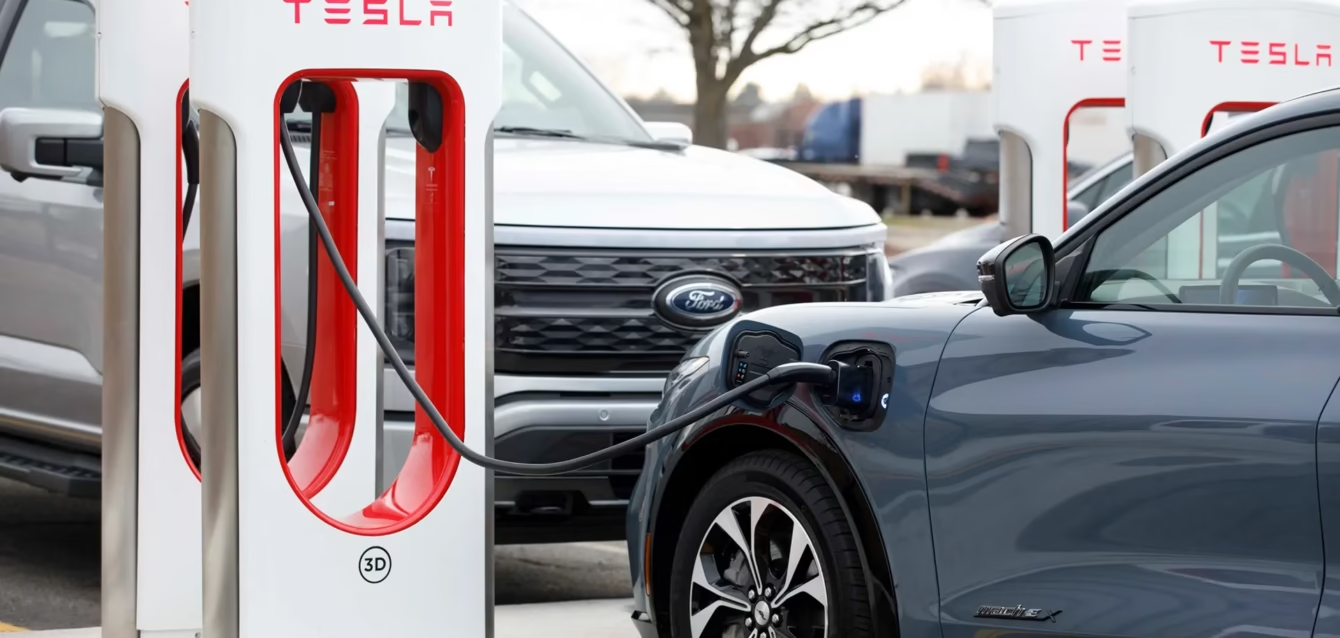
NACS Adapter 2026
Last Updated: May 2026
The right NACS adapter depends on three variables that most guides ignore: your vehicle’s port architecture, the infrastructure voltage at the charger, and the communication protocol your vehicle and charger share. Get those three aligned and you charge at full speed. Get them wrong and you either can’t connect at all or lose significant power — sometimes more than 60% of your vehicle’s rated peak.
This guide covers the technical reality of NACS (SAE J3400) adapter compatibility in 2026: what the connector physically is, which protocol makes bridging possible or impossible, the complete adapter decision matrix, and the one situation — 800V vehicles on 400V infrastructure — where the adapter is the least of your concerns.
Table of Contents
At a Glance: The NACS Adapter Decision Matrix 2026
According to Axis Intelligence’s technical analysis of SAE J3400, UL 2252 certification data, and infrastructure deployment data, every NACS adapter scenario in 2026 falls into one of seven categories defined by port type, charger type, and protocol compatibility.
| Vehicle Port | Charger Type | Adapter Required | Protocol Compatible | Peak Power Accessible | UL 2252 Certified Option |
|---|---|---|---|---|---|
| NACS / SAE J3400 | NACS Supercharger V3/V4 | None | ✓ Native | Up to 500 kW (V4) | N/A |
| NACS / SAE J3400 | CCS1 DCFC (EA, EVgo) | CCS-to-NACS adapter | ✓ ISO 15118 | Up to 350 kW (charger) | Lectron, A2Z EV |
| NACS / SAE J3400 | J1772 Level 2 | J1772-to-NACS adapter (included) | ✓ IEC 61851 | Up to 19.2 kW | Lectron |
| CCS1 | NACS Supercharger V3/V4 | NACS-to-CCS1 adapter (OEM or certified 3P) | ✓ ISO 15118 | Up to 500 kW (V4) | Lectron Vortex Plus, Amphenol |
| CCS1 | J1772 Level 2 | J1772 adapter (included with vehicle) | ✓ IEC 61851 | Up to 19.2 kW | N/A |
| CHAdeMO | NACS Supercharger | No commercially viable adapter exists | ✗ CAN bus ≠ ISO 15118 | N/A | None |
| CHAdeMO | CCS1 DCFC | No reliable adapter (protocol mismatch) | ✗ Partial | Unreliable | None certified |
Source: Axis Intelligence technical analysis of SAE J3400, SAE J3400/2, UL 2252 certification registry, and charger network deployment data. May 2026. For vehicle-specific charging curves and battery architecture data, see our EV Research Hub.
What NACS (SAE J3400) Actually Is — The Engineering Layer
NACS is not simply a plug shape. It is a connector specification, a communication protocol, and a power delivery architecture packaged into a single physical interface. Understanding all three layers is what separates an adapter that works from one that fails at speed.
Physical Layer
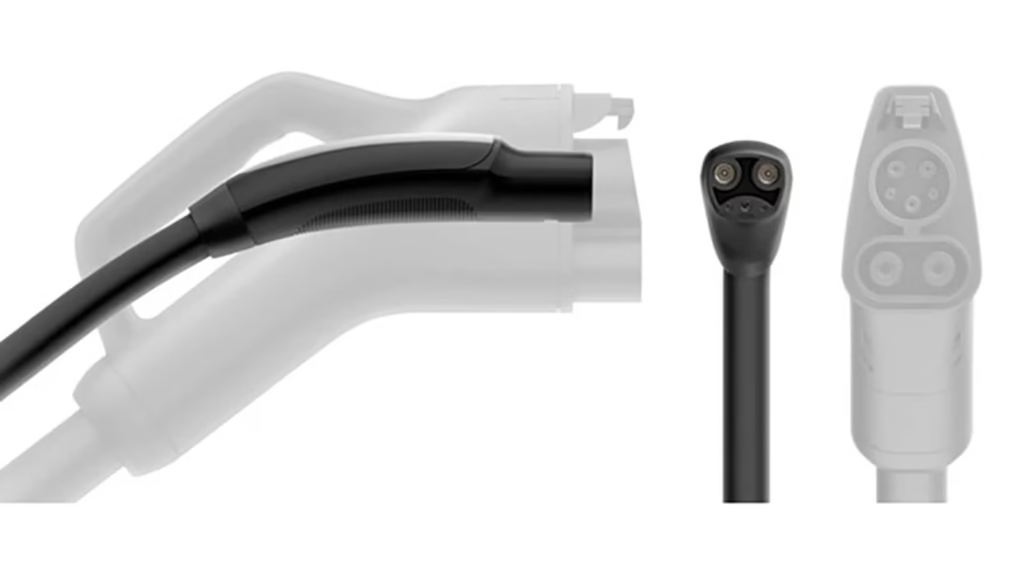
The SAE J3400 connector uses five contacts: two power pins (positive and negative), a ground pin, a Control Pilot (CP) pin for charge state signaling, and a Proximity Pilot (PP) pin that detects connection status and triggers the latch release mechanism via a UHF signal when the button is pressed. The full connector specification is maintained by SAE International as an open standard. The absence of moving latch parts — compared to the spring-loaded mechanism on CCS1 — is why J3400 has a lower mechanical failure rate in the field.
The connector is physically identical across the original NACS specification and the newer SAE J3400/2 standard published in May 2025. J3400/2 extends the voltage ceiling from the original 500V design limit to 1,000V through increased isolation between positive and negative terminals while maintaining the same external form factor. This backward compatibility means a J3400/2-rated connector physically fits all existing NACS inlets — the upgrade is in the electrical specification, not the geometry.
The AC pin layout of J3400 is deliberately identical to the SAE J1772 connector, which is why simple pass-through J1772-to-NACS adapters for Level 2 charging work without any active electronics. No protocol translation is required at AC voltages.
Communication Protocol Layer
This is where the fundamental divide between compatible and incompatible adapter scenarios originates.
NACS uses ISO 15118 for DC fast charging communication — specifically, High-Level Communication (HLC) transmitted over Power Line Communication (PLC) on the Control Pilot pin. CCS1 uses the same protocol: ISO 15118 over PLC on its own CP pin. This shared protocol foundation is the technical reason a properly built CCS1-to-NACS adapter can bridge the two standards. The adapter hardware passes control signals between physically different connector geometries while letting the vehicle and charger negotiate directly using the same digital language.
CHAdeMO uses an entirely different protocol: CAN bus (Controller Area Network) over its own dedicated data pins. There is no translation path between CAN bus and ISO 15118 that can be implemented in passive adapter hardware. A CHAdeMO-to-NACS adapter would require active computing, real-time protocol translation, and vehicle-side software support — none of which exist in any commercially certified product. This is not a regulatory gap or a market gap. It is a fundamental protocol incompatibility that makes CHAdeMO bridging to NACS or CCS technically impractical at DC fast charging speeds.
Power Delivery Layer
The connector supports both AC (single-phase, up to 19.2 kW) and DC (scalable up to 500V × ~900A theoretical, or 1,000V × lower current under J3400/2) through shared pins, unlike CCS1 which uses additional large DC power pins separately from the AC interface. This single-port architecture is why NACS vehicles do not need separate AC and DC charging ports. Two exceptions exist in 2026: the redesigned Nissan Leaf and the Mercedes-Benz CLA, both of which use a NACS port for DC only while retaining a separate J1772 inlet for AC Level 2. Both configurations are SAE J3400-compliant; the dual-port approach is a manufacturer packaging decision, not a standard deviation.
The Four Connector Types You Encounter at North American Chargers
Understanding what exists in the field prevents the most common adapter selection mistakes.
SAE J3400 / NACS is the dominant DC fast charging connector in North America as of 2026. All Tesla Supercharger stalls use it. Electrify America, EVgo, ChargePoint, and Blink are actively adding NACS cables alongside CCS1 at dual-standard sites. All Tesla vehicles have always used this port natively. Starting in model year 2025, Ford, GM, Hyundai, Kia, Genesis, Rivian, Lucid (Gravity), Volvo, Polestar, BMW Group, Toyota/Lexus, Subaru, and Volkswagen Group began shipping vehicles with NACS ports factory-installed, with remaining brands completing the transition in 2026.
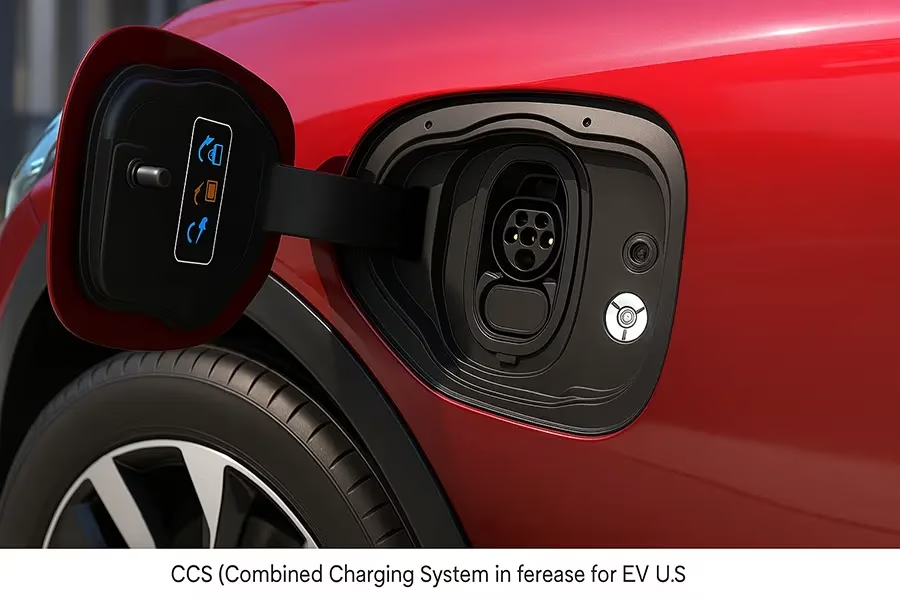
SAE J1772 / CCS1 combines the J1772 AC interface with two additional DC power pins using a Combined Charging System design. CCS1 was the dominant non-Tesla DC fast charging standard in North America through model year 2024. Most 2024 and earlier non-Tesla EVs use CCS1 for DC charging — for a full breakdown of which specific models this affects, see our Best Electric Cars 2026 guide. CCS1 DC fast chargers from Electrify America, EVgo, ChargePoint, and others remain fully operational. These vehicles need an adapter for Supercharger access and will continue needing one until the vehicle is replaced.
CHAdeMO is a Japanese DC fast charging standard used exclusively on the Nissan Leaf (pre-2026) in the North American market. It peaked with approximately 3,000 US stations, but no major network is installing new CHAdeMO hardware. According to the Alternative Fuels Data Center (AFDC), the public charging network in the United States now exceeds 277,000 ports — the vast majority of new DCFC installations deploy NACS and CCS1 exclusively. CHAdeMO is a declining infrastructure standard with no path to NACS compatibility through adapters.
SAE J1772 (AC only) remains the universal Level 2 AC connector at public stations and most home equipment. Every EV — NACS or CCS — handles J1772 Level 2, either natively (CCS1 vehicles, which include the J1772 AC portion of their port) or through a simple pass-through adapter (NACS vehicles, which include a J1772-to-NACS adapter in the glovebox from the factory).
Case A: CCS1 Vehicle Accessing NACS Chargers
This is the most consequential adapter scenario in 2026. Tens of millions of CCS1-equipped EVs need this path to access the largest DC fast charging network on the continent.
The Hardware Requirement
A CCS1 vehicle accessing a NACS Supercharger needs a NACS-to-CCS1 adapter — not a cable, not a converter. The adapter is a passive mechanical bridge with pass-through signal conductors. It translates the physical geometry of the NACS socket at the charger to the CCS1 connector geometry accepted by the vehicle. The ISO 15118 protocol passes through unchanged; the vehicle and charger negotiate the session directly.
This is the direction that matters for most non-Tesla EV owners: the adapter sits at the charger end, plugged into the Supercharger’s NACS cable, with the CCS1 connector going into the vehicle.
OEM Adapters vs. Certified Third-Party Options
Two sources of hardware exist: OEM adapters from the vehicle manufacturer, and third-party adapters certified under UL 2252.
OEM adapters are manufacturer-authorized and in most cases carry no warranty risk to the vehicle’s charging system. Several manufacturers distributed them for free, others charge $185–$250.
UL 2252 is the first safety standard specifically for EV DC charging adapters, published on March 19, 2025 by Underwriters Laboratories. It defines baseline requirements for electrical safety, thermal performance under continuous high-power cycling, mechanical durability, and weather resistance. UL 2252 certification is the minimum standard Axis Intelligence recommends when evaluating any third-party adapter.
Three manufacturers have achieved UL 2252 certification for NACS/CCS adapters as of May 2026: Amphenol (the first to certify, rated to 380A / 1,000V), Lectron (Vortex Plus: 500A / 1,000V), and A2Z EV. Lectron’s Vortex Plus was the first widely commercially available certified DC adapter and is approved by multiple automakers as part of their Supercharger access programs.
According to Axis Intelligence’s analysis of the UL 2252 framework, the critical technical specifications to verify before purchasing any adapter are: (1) continuous current rating in amps — must meet or exceed your vehicle’s peak DC charge current; (2) voltage rating — minimum 500V, with 1,000V preferred for J3400/2 forward compatibility; (3) IP rating — IP67 minimum for water and dust resistance; and (4) operating temperature range — thermal management under repeated high-power cycles determines long-term reliability.
The Supercharger Generation Constraint
Not all Supercharger hardware is equally accessible to CCS1 vehicles with adapters.
V2 Superchargers (up to 150 kW, 120–145 kW per car in pairs) are not accessible to non-Tesla vehicles. Tesla’s Supercharger access program for non-Tesla EVs operates on V3 and V4 hardware only.
V3 Superchargers deliver up to 250 kW per stall on 400V-class infrastructure. They support ISO 15118 HLC — the protocol shared between NACS and CCS1 — and are the primary access point for CCS1 vehicles using adapters. As of early 2025, 92 V3 Supercharger locations had Tesla’s built-in Magic Dock adapter, which eliminates the need for a personal adapter at those specific stalls.
V4 Superchargers deliver up to 500 kW per stall for passenger EVs (1.2 MW for commercial vehicles), support higher voltage ranges, and are the hardware that resolves the 800V performance penalty described in the next section. 44 V4 locations supported Magic Dock as of early 2025, with expansion continuing.
The Software Activation Requirement
The adapter is necessary but not sufficient. CCS1 vehicles must have manufacturer-approved Supercharger access activated through the automaker’s app. Tesla maintains the current list of approved brands on its official NACS program page. This involves account linking and in most cases a vehicle firmware update that enables the ISO 15118 handshake negotiation between the vehicle’s charging system and the Tesla network. A physically correct adapter connected to a vehicle without software approval will not initiate a charging session. These manufacturer apps also process location data and session history — practices worth reviewing in our EV data privacy guide.
Case B: NACS Vehicle Accessing CCS Chargers
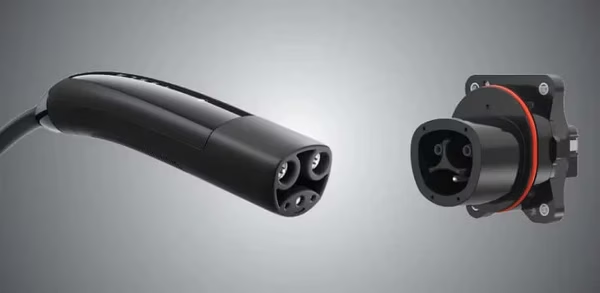
Tesla owners and 2025+ NACS-native EV drivers accessing Electrify America, EVgo (CCS side), or other CCS1-only DC fast chargers need the reverse adapter direction: CCS1-to-NACS, connecting the CCS1 charger cable to the NACS vehicle port.
Tesla sells its own CCS1 adapter at $230, rated for up to 250 kW. It is compatible with Model 3, Model Y, 2021+ Model S/X, and Cybertruck. Pre-2021 Model S and Model X require an ECU retrofit to support the ISO 15118 protocol required for CCS communication — the original firmware used CAN bus, which the older vehicles shipped with before Tesla’s 2021 software transition. This ECU constraint is the direct mirror of the CHAdeMO problem: protocol incompatibility, hardware-rooted.
For 2025+ NACS-native non-Tesla EVs, the Lectron CCS-to-NACS adapter (UL 2252 certified, 500A / 1,000V, IP67) covers the same scenario: accessing CCS1 DCFC stations on a NACS vehicle.
The practical need for this adapter is decreasing as dual-cable (NACS + CCS1) charger deployments become standard at EA, EVgo, and ChargePoint sites. By 2027, the majority of new DC fast charger installations in North America are expected to include NACS cables natively, reducing CCS-to-NACS adapter dependence for NACS vehicle owners to a transitional period problem.
Case C: The AC Level 2 Adapter Scenarios
Level 2 AC charging uses J1772, and the adapter scenarios here are simpler than DC because no protocol translation is required — the AC pin layout of J3400 is dimensionally identical to J1772, making pass-through adapters mechanically and electrically straightforward.
CCS1 vehicle at J1772 charger: No adapter needed. The CCS1 port natively accepts J1772 plugs via the top half of the combo connector. Every CCS1 EV can charge at any public J1772 Level 2 station without any adapter.
NACS vehicle at J1772 charger: Requires a J1772-to-NACS adapter. This is the small adapter included in the glovebox of every NACS-equipped vehicle — Tesla has included it since the Model S, and all 2025+ NACS-native non-Tesla EVs ship with one. It supports single-phase AC up to 19.2 kW (limited by the vehicle’s onboard charger, typically 11.5 kW or 19.2 kW depending on model).
NACS vehicle at Tesla Destination charger (NACS Level 2): No adapter. NACS vehicles plug directly. CCS1 vehicles cannot access Tesla Destination chargers through an adapter — Destination chargers are AC-only NACS hardware, and there is no CCS1-to-NACS adapter designed for AC Level 2 in the standard adapter ecosystem.
The Ford 2024 AC adapter misconception: Ford shipped a NACS AC adapter with 2024 F-150 Lightning and Mustang Mach-E vehicles. This adapter was designed specifically for Tesla Destination chargers — AC Level 2 only. It does not work at Tesla Superchargers, which are DC. This distinction was widely misreported. 2024 Ford owners with only the AC adapter who attempt to use it at a Supercharger will not initiate a session. Supercharger access for 2024 Ford CCS1 models requires the DC NACS-to-CCS1 adapter and software activation through FordPass.
The 800V Penalty: What Happens to High-Voltage Vehicles at 400V Supercharger Infrastructure
This is the most technically consequential adapter scenario in 2026, and the one most guides describe inaccurately.
Several current EVs use 800V battery architectures for faster peak charging rates on native infrastructure: the Hyundai Ioniq 5 and Ioniq 6, the Kia EV6 and EV9, the Genesis GV60, GV70E, and G80E, the Lucid Air (900V), the Porsche Taycan and Macan EV, and the Audi e-tron GT. These vehicles charge at their rated peak speeds only at 800V-compatible DC fast chargers.
V3 Superchargers deliver power at approximately 400–480V DC. This creates a voltage mismatch with 800V vehicle architectures that directly limits charging power — and the adapter is irrelevant to this limit. It is an infrastructure voltage problem.
The Power Mathematics
Electric power = Voltage × Current (P = V × I). A CCS1 800V vehicle like the Ioniq 5 peaks at 233 kW on native 800V infrastructure, achieved by drawing approximately 291 amps at 800 volts. At a 400V Supercharger, the vehicle must either draw double the current (up to 582A, exceeding most charger limits) or operate at half the power. In practice, 800V vehicles use an internal DC-DC converter to step up from 400V to 800V, a process that caps throughput to roughly what the converter can handle — typically 120–170 kW depending on the vehicle and thermal state.
The Lucid Air (900V architecture) presents an extreme case. Consumer Reports testing recorded a charge rate of approximately 49 kW on an older Supercharger session — reflecting the severe throttling that occurs when converter overhead compounds with a relatively small gap between charger voltage ceiling and vehicle architecture. Under optimal conditions, Lucid Air owners report higher rates at V3 Superchargers, but the ceiling is substantially below the 250 kW the Lucid Air achieves on high-power 800V CCS infrastructure.
The V4 Resolution
V4 Superchargers support higher per-stall power output (up to 500 kW for passenger vehicles) and operate at voltages better suited to 800V vehicle architectures, substantially reducing the penalty. For Hyundai E-GMP vehicles (Ioniq 5, Ioniq 6, EV6, EV9), V4 access approaches or reaches native 800V charge rates. According to Axis Intelligence’s cross-reference of network deployment data and manufacturer specifications, V4 Supercharger expansion is the primary infrastructure variable that determines the real-world utility of NACS access for 800V EV owners.
For 800V EV owners planning high-speed charging sessions: V3-only Supercharger stops are viable for top-ups but not for rapid replenishment. V4 Supercharger stops deliver performance approaching native-network rates. This distinction matters for route planning. For vehicle-specific peak charge rates and battery architecture data across 2025–2026 models, consult our EV Research Hub.
According to Axis Intelligence: The 800V Penalty Summary Table
| Vehicle Architecture | Native Peak DC | V3 Supercharger (~400V) | V4 Supercharger (500 kW capable) | Penalty at V3 |
|---|---|---|---|---|
| 400V standard (e.g., Mach-E, Blazer EV) | 150–250 kW | Up to 250 kW (V3 limit) | Up to 500 kW (V4) | Minimal |
| 800V E-GMP (Ioniq 5/6, EV6/9) | 220–240 kW | ~120–170 kW | Near-native rate | 30–50% reduction |
| 900V (Lucid Air) | ~300 kW | ~49–100 kW | Significant improvement | 65–85% reduction |
| Tesla (native NACS, 400V base) | 250–500 kW | Up to 250 kW (V3) | Up to 500 kW (V4) | None (native) |
Source: Axis Intelligence technical synthesis from Consumer Reports EV testing, manufacturer spec sheets, and Supercharger network generation data. May 2026. Individual results vary by state of charge, ambient temperature, and thermal state.
The adapter does not cause this penalty. The 800V architecture and 400V infrastructure create it. Any NACS-to-CCS1 adapter rated for the vehicle’s peak current and certified to UL 2252 performs identically to the OEM adapter at V3 hardware — the infrastructure voltage ceiling is the binding constraint.
The Complete Brand-by-Brand Adapter Status: Master Reference Table 2026
According to Axis Intelligence’s synthesis of manufacturer announcements, Tesla Supercharger program data, and CarGurus/Consumer Reports tracking as of May 2026. For buying recommendations and range comparisons across these models, see our Best Electric Cars 2026 guide and EV Research Hub.
| Brand | CCS1 Models Needing Adapter | Native NACS Model Year | OEM Adapter Cost | Adapter Source | Software Activation |
|---|---|---|---|---|---|
| Tesla | Pre-2021 Model S/X (CCS adapter unavailable; ECU retrofit required) | All Tesla (native always) | $230 (Tesla CCS1 adapter, reverse direction) | Tesla.com | Tesla app |
| Ford | Mach-E (≤2024), F-150 Lightning (≤2024), E-Transit (≤2024) | 2025+ (most models) | Free (free period ended June 2025; now paid) | FordPass / Ford dealers | FordPass app |
| GM (Chevy/GMC/Cadillac) | Bolt EV/EUV (≤2026 CCS), Blazer EV (≤2024 CCS), Equinox EV (some), Lyriq, Hummer EV, Silverado EV (CCS models) | 2025+ for most models | ~$225 | myChevrolet / GM dealers | myChevrolet app |
| Hyundai | Ioniq 5 (≤2024), Ioniq 6 (≤2024) | 2025 Ioniq 5, 2026 Ioniq 9 | Free (all existing owners) | MyHyundai with Bluelink app | MyHyundai app |
| Kia | EV6 (≤2024), EV9 (≤2024), Niro EV | 2025 EV6, 2026 EV9 | Free (EV6/EV9 cutoff date applies); $249 for Niro EV | Kia Connect app / dealers | Kia Connect app |
| Genesis | GV60, GV70E, G80E (≤2024 CCS) | 2026 GV60, Electrified GV70 | Free (owners before Jan 31, 2025); paid after | MyGenesis app | MyGenesis app |
| Rivian | R1T, R1S (2022–2025 CCS) | 2026 R1T, R1S (native NACS) | Free | Rivian app | Rivian app |
| Lucid | Lucid Air (≤2025) | 2025+ Lucid Gravity (native) | $220 | Lucid app / lucidmotors.com | Lucid app |
| BMW Group | i4, i5, i7, iX, MINI EVs, Rolls-Royce Spectre | 2025+ (transitioning) | ~$230 | BMW dealers | BMW app |
| Mercedes-Benz | EQE, EQS, EQB, EQA (CCS models) | 2026 CLA (native NACS DC; dual-port) | $185 | Mercedes dealers / Mercedes me Charge | Mercedes me Charge app |
| Audi | Q4 e-tron, Q8 e-tron (most) | 2025+ (selected models) | OEM adapter (Lectron-supplied); selective model coverage | Audi dealers | myAudi app |
| Porsche | Taycan (≤2025), Macan EV (≤2025) | 2026 Taycan, Macan EV (native) | Free (2025); $185 (≤2024 Taycan) | My Porsche app / Porsche dealers | My Porsche app |
| Volkswagen | ID.4, ID.Buzz (≤2024) | 2025+ (transitioning) | To be confirmed | VW app | VW app |
| Polestar | Polestar 2, 3, 4 (CCS) | 2026 Polestar 5 (expected native) | $230 | Polestar Service Points | Polestar app |
| Volvo | XC40/C40 Recharge, EX30, EX90 (CCS models) | 2025+ (transitioning) | ~$230 | Volvo dealers | Volvo Cars app |
| Nissan | Ariya (CCS), all pre-2026 Leaf (CHAdeMO) | 2026 Leaf (NACS DC only, dual-port) | $235 (Ariya); None for CHAdeMO Leaf | Nissan dealers | NissanConnect app |
| Honda/Acura | Prologue, ZDX (CCS via GM platform) | 2026+ (announced for future models) | $225 | Honda/Acura dealers | Honda/Acura app |
| Toyota/Lexus | bZ4X (≤2024), RZ (≤2024) | 2026 bZ4X, 2026 Lexus RZ, 2026 ES | Available (check dealers for cost) | Toyota/Lexus dealers | Toyota app |
| Subaru | Solterra (≤2024, Toyota platform) | 2026 Solterra (native NACS) | Available (check dealers) | Subaru dealers | Subaru app |
| Jaguar Land Rover | I-Pace (Jaguar) | Announced; JLR new EVs 2025+ | Adapter program active | JLR dealers | InControl app |
| Stellantis (Jeep, Ram, Dodge) | Current CCS models | 2026+ model year target | To be confirmed | Stellantis dealers | Brand-specific apps |
Source: Axis Intelligence synthesis from Tesla Supercharger program, manufacturer press releases, CarGurus tracking, and Consumer Reports documentation. May 2026. Verify current status directly with your manufacturer — adapter programs and free periods change.
The CHAdeMO Dead End: Why No Adapter Exists and None Is Coming
The Nissan Leaf prior to the 2026 redesign uses CHAdeMO, a DC fast charging standard developed by a consortium led by Nissan, Mitsubishi, Toyota, and Tokyo Electric Power. It was never adopted by other major North American light-duty EV manufacturers and is now effectively discontinued in North America as a new-installation standard.
The fundamental barrier to a CHAdeMO-to-NACS adapter is the communication protocol:
- CHAdeMO uses CAN bus (Controller Area Network) over two dedicated data pins (D+ and D−). The vehicle and charger negotiate the session parameters — current, voltage, start/stop — through CAN frames.
- NACS / CCS1 uses ISO 15118 over Power Line Communication (PLC) on the Control Pilot pin. HLC (High-Level Communication) is required for DC fast charging sessions and handles session initialization, payment authorization, and thermal management.
These are incompatible protocols at the data layer. An adapter capable of bridging them would need to function as an active real-time protocol translator — receiving CAN frames from one side and generating ISO 15118 PLC signals on the other — while simultaneously managing power delivery safety. No such device has achieved UL 2252 certification, and no automaker has sponsored one. Third-party CAN-to-ISO 15118 bridge adapters exist in hobbyist form but are unreliable, uncertified, and not supported by any charger network.
The 2026 Nissan Leaf resolves this for new buyers: it ships with a NACS DC port (for fast charging) alongside a separate J1772 inlet (for Level 2 AC), bypassing CHAdeMO entirely. This dual-port architecture is unique in the market and reflects a manufacturer-level acknowledgment that the CHAdeMO standard could not be adapted — the port had to be replaced. Like all modern EV apps, the NissanConnect platform processes session and location data at each charge event.
Owners of pre-2026 Nissan Leaf vehicles with CHAdeMO ports have two practical options: plan routes around operational CHAdeMO stations (declining in number), or accept that the CHAdeMO fast charging ecosystem will continue contracting until those stations reach end-of-life.
SAE J3400/2: What the 1,000V Standard Means for Adapters
In May 2025, SAE International published SAE J3400/2 — Connectors and Inlets for the North American Charging System (NACS) for Electric Vehicles. This expansion to the J3400 standard defines the physical architecture for NACS connectors capable of operating at up to 1,000V, compared to the 500V ceiling of the original specification.
The physical geometry of J3400/2 connectors is intentionally identical to J3400 connectors. A 1,000V-capable J3400/2 plug fits all existing NACS inlets. This backward compatibility is the specification’s most important practical feature: vehicles and chargers built to the original 500V specification can use J3400/2 hardware without modification, and future 1,000V-capable vehicles and chargers will accept existing hardware.
What this means for adapters: The Lectron Vortex Plus and Lectron CCS-to-NACS adapter — both rated to 500A / 1,000V and certified under UL 2252 — are technically aligned with the J3400/2 specification’s voltage ceiling. Adapters rated only to 500V are not aligned with J3400/2 and may become limiting hardware as future vehicle architectures move toward 1,000V charging. According to Axis Intelligence, EV owners purchasing new NACS-compatible adapters in 2026 should verify the voltage rating explicitly — 1,000V-rated adapters offer a longer forward compatibility horizon.
No production passenger EV currently charges at voltages above 900V in North America. The J3400/2 standard is forward-looking infrastructure, anticipating vehicle architectures under development. The Megawatt Charging System (MCS) is a separate standard for heavy-duty commercial vehicles and is not part of the J3400 family.
UL 2252: What Certification Actually Means — and What It Doesn’t
UL 2252 is the first North American safety standard specifically for EV DC fast charging adapters. Published March 19, 2025 by Underwriters Laboratories, it establishes minimum requirements across five performance dimensions:
Electrical safety: Insulation resistance, dielectric withstand, leakage current limits under normal and fault conditions.
Thermal performance: Temperature rise under continuous rated-current operation, thermal cycling across operating range (–22°F to 122°F / –30°C to 50°C), and thermal management under repeated high-power charge events.
Mechanical durability: Insertion and extraction cycle life (minimum number of connect/disconnect cycles before degradation), tensile strength, impact and crush resistance.
Environmental resistance: IP (Ingress Protection) rating for water and dust — the standard requires IP67 minimum, meaning the adapter must survive 30 minutes submerged at 1 meter depth and complete dust exclusion.
Interoperability: The adapter must not degrade the communication handshake between the vehicle and charger under test conditions.
What UL 2252 does not guarantee: It does not confirm that a specific adapter works with every vehicle model or every charger network. Network compatibility (Supercharger access, EA access) depends on the adapter being on the OEM’s approved list — a commercial relationship separate from the safety certification. An adapter can be UL 2252 certified and still not work at Tesla Superchargers if the manufacturer has not added it to the approved adapter list. The accounts required for network access are also worth securing properly — see our cybersecurity tools guide for password managers and identity protection applicable to connected vehicle accounts.
According to Axis Intelligence’s analysis of the certification landscape, the UL 2252 standard significantly raises the minimum bar for third-party adapter hardware compared to the uncertified products that dominated the market before 2025. The distinction between UL 2252-certified adapters and uncertified options is material — uncertified adapters carry unknown thermal, electrical, and mechanical failure risk at 250–500 kW charge rates.
Network Compatibility by Adapter Type
| Charging Network | NACS Cable Available | CCS1 Cable Available | Notes |
|---|---|---|---|
| Tesla Supercharger V3 | ✓ (all stalls) | ✓ (Magic Dock at ~92 locations) | Non-Tesla vehicles need OEM adapter + software activation |
| Tesla Supercharger V4 | ✓ (all stalls) | ✓ (Magic Dock at ~44 locations) | Higher power, 800V-friendly infrastructure |
| Electrify America | ✓ (dual-cable rollout ongoing) | ✓ (all stalls) | Up to 350 kW CCS; NACS cable deployment accelerating |
| EVgo | ✓ (many stalls) | ✓ (all stalls) | Dual-cable standard on new builds |
| ChargePoint (DCFC) | ✓ (Omni Port at selected stations) | ✓ | Omni Port includes built-in CCS1-to-NACS adapter hardware |
| Blink DCFC | Partial (deployment ongoing) | ✓ | NACS rollout underway |
| Tesla Destination (Level 2) | ✓ (NACS only) | ✗ | AC Level 2; CCS1 vehicles cannot access via adapter |
Source: Axis Intelligence analysis of network deployment announcements and confirmed station data. May 2026. Network configurations change; verify before routing. Note: session billing through manufacturer apps transmits vehicle, location, and payment data over the network — using a reputable VPN on the mobile device running your EV app adds a layer of transport-layer protection.
Who Does Not Need Any Adapter in 2026
According to Axis Intelligence, the following scenarios require no adapter hardware at all — a point that a large fraction of new EV buyers are asking about unnecessarily:
2025+ NACS-native vehicle at a Supercharger V3/V4: Plug directly into the NACS cable. No adapter. Session started via Tesla app or manufacturer app. This covers all 2025+ Ford, GM, Hyundai, Kia, Genesis, Rivian, Lucid Gravity, BMW Group, Toyota, Lexus, Subaru, and Volkswagen Group EVs built with native NACS ports.
2025+ NACS-native vehicle at a dual-cable DC fast charger (EA, EVgo, ChargePoint Omni Port): Use the NACS cable side. No adapter.
2025+ NACS-native vehicle at any J1772 Level 2 charger: Use the included J1772-to-NACS adapter (in the glovebox). This adapter ships with every NACS vehicle.
CCS1 vehicle at any CCS1 DC fast charger or J1772 Level 2 charger: No adapter needed. Your vehicle’s port handles both natively.
The scenarios where an adapter is necessary are precisely: a CCS1 vehicle at a NACS Supercharger (NACS-to-CCS1 adapter required), a NACS vehicle at a CCS1-only DC fast charger without dual cables (CCS1-to-NACS adapter required), or a NACS vehicle at a J1772 Level 2 station (J1772-to-NACS adapter included).
Frequently Asked Questions
What is a NACS adapter?
A NACS adapter is a passive hardware bridge that allows a vehicle with one DC charging port standard to connect to a charger built for a different standard. In the North American context, the two relevant DC adapter directions are: NACS-to-CCS1 (enabling a CCS1-equipped EV to plug into a NACS Supercharger) and CCS1-to-NACS (enabling a NACS-equipped EV to plug into a CCS1 DC fast charger). The adapters work because NACS (SAE J3400) and CCS1 share the same underlying communication protocol, ISO 15118. No active electronics are required; the adapter passes control signals through unchanged while translating physical connector geometry.
Which vehicles need a NACS adapter to charge at Superchargers?
Any EV with a CCS1 port — typically model years 2024 and earlier from most non-Tesla brands — needs a NACS-to-CCS1 adapter to access Tesla Superchargers. The adapter must be OEM-approved or UL 2252-certified, and the vehicle must have Supercharger access activated through the manufacturer’s app. Tesla vehicles and 2025+ NACS-native EVs from any brand plug directly into Superchargers without an adapter.
Can any non-Tesla EV charge at a Supercharger?
Any non-Tesla EV whose manufacturer has established a Supercharger access agreement with Tesla can charge there, using either a NACS-to-CCS1 adapter (for CCS1 vehicles) or a native NACS port (for 2025+ models). As of May 2026, approved brands include Ford, Rivian, GM, Volvo, Polestar, Nissan, Lucid, Mercedes-Benz, Hyundai, Genesis, Kia, Honda, Acura, JLR, Audi, Porsche, Toyota, Volkswagen, Subaru, BMW, and Stellantis. Physical adapter access is necessary but not sufficient — software authorization through the manufacturer’s app is also required. The Nissan Leaf’s pre-2026 CHAdeMO models cannot access Superchargers at all due to protocol incompatibility.
Why can’t CHAdeMO vehicles use NACS adapters?
CHAdeMO uses CAN bus communication, while NACS and CCS1 use ISO 15118 over PLC on the Control Pilot pin. These protocols are incompatible at the data layer. A functional bridge adapter would need real-time active protocol translation — not passive pass-through — which no commercially certified product achieves. This is a protocol-level technical incompatibility, not a regulatory or business decision. The 2026 Nissan Leaf resolved this by switching to a NACS port for DC fast charging, abandoning CHAdeMO entirely.
Does an adapter reduce charging speed?
A properly rated adapter does not itself reduce charging speed. The adapter passes the ISO 15118 communication protocol and power delivery path unchanged. Speed limitations come from: (1) the Supercharger generation (V3 caps at 250 kW; V4 supports up to 500 kW); (2) the vehicle’s own peak charge rate; and (3) the 800V architecture penalty on 400V V3 infrastructure. According to Axis Intelligence, the 800V penalty — not the adapter — is the primary source of speed reduction for high-voltage vehicles like the Ioniq 5, EV6, or Lucid Air at V3 Superchargers.
What is UL 2252 and why does it matter for adapters?
UL 2252, published March 19, 2025, is the first dedicated North American safety standard for EV DC fast charging adapters. It establishes minimum requirements for electrical safety, thermal performance under high-power cycling, mechanical durability, and environmental resistance (IP67 minimum). Third-party adapters certified under UL 2252 have been independently tested by a Nationally Recognized Testing Laboratory (NRTL) to meet these benchmarks. As of May 2026, UL 2252 certification has been granted to adapters from Amphenol, Lectron, and A2Z EV. Axis Intelligence recommends UL 2252 certification as the minimum standard for any third-party DC charging adapter purchase.
What is the difference between a NACS adapter and Magic Dock?
A NACS-to-CCS1 adapter is a personal device that the EV owner carries and attaches to the Supercharger’s NACS cable. Magic Dock is Tesla’s built-in station-side adapter system: a CCS1 connector permanently attached at select Supercharger stalls, allowing CCS1 vehicles to charge without carrying their own adapter. As of early 2025, approximately 92 V3 and 44 V4 Supercharger locations had Magic Dock hardware. Magic Dock eliminates the personal adapter requirement at those specific stalls but does not eliminate the software activation requirement.
Do I still need an adapter if my EV has a NACS port?
For DC fast charging at Superchargers and NACS-equipped DCFC stations: no adapter is needed. Your vehicle plugs directly. For J1772 Level 2 AC charging: a J1772-to-NACS adapter is required — this small adapter ships with every NACS vehicle in the glovebox. For CCS1-only DC fast chargers without dual cables: a CCS1-to-NACS adapter is required. This scenario is becoming less common as dual-cable DCFC deployments expand, but it remains relevant at older CCS-only stations.
What is SAE J3400/2 and how does it differ from J3400?
SAE J3400 (September 2024) is the primary standard defining NACS connector requirements up to 500V. SAE J3400/2 (May 2025) is an expansion that defines the physical architecture for connectors rated to 1,000V, achieved through increased isolation between positive and negative terminals. The physical geometry is identical — J3400/2 connectors and inlets are backward compatible with all existing J3400 hardware. For adapter buyers, J3400/2 alignment means choosing adapters rated to 1,000V rather than 500V for better forward compatibility with future high-voltage vehicle architectures.
Is the Nissan Leaf compatible with NACS chargers in 2026?
It depends on model year. Pre-2026 Nissan Leaf models use CHAdeMO for DC fast charging and are not compatible with NACS Superchargers via any commercially certified adapter. The 2026 Nissan Leaf introduced a unique dual-port architecture: a J1772 port for Level 2 AC charging and a NACS port for DC fast charging. The 2026 Leaf can access Superchargers and all NACS DC fast chargers natively through its NACS port, and J1772 Level 2 stations through its J1772 port, with no adapters required for either scenario. Nissan’s Ariya (CCS1) can access Superchargers with an OEM-approved adapter for $235.
Can I use a third-party NACS adapter, or must I use the OEM adapter?
Third-party adapters certified under UL 2252 are technically suitable for DC fast charging sessions. Whether a specific third-party adapter will work at Tesla Superchargers also depends on whether the adapter is on Tesla’s and your automaker’s approved list — UL 2252 certification addresses safety, not network authorization. Some automakers explicitly approve specific third-party adapters (Lectron supplies adapters under Porsche and Audi programs). Others require OEM adapters for Supercharger authorization. Check your manufacturer’s adapter program documentation before purchasing a third-party adapter if Supercharger access is your primary use case.
Aidan Jad covers electric vehicle technology, battery systems, and charging infrastructure at Axis Intelligence. His work focuses on the engineering and economic realities behind EV adoption.
Aidan Jad covers electric vehicles, battery economics, and clean energy data for Axis Intelligence. He holds a degree in mechanical engineering with a powertrain concentration and spent 7 years building fleet electrification cost models before joining Axis Intelligence. He drives a 2024 Hyundai Ioniq 6 and charges primarily at home overnight in Montreal. Aidan brings engineering rigor to every review and analysis — he calculates real-world cost-per-mile, not manufacturer estimates.
Voice: Data-driven, engineering-minded. Combines technical depth with practical buyer advice. Uses real math (TCO calculations, $/kWh breakdowns, charge curve analysis) to cut through marketing claims.