

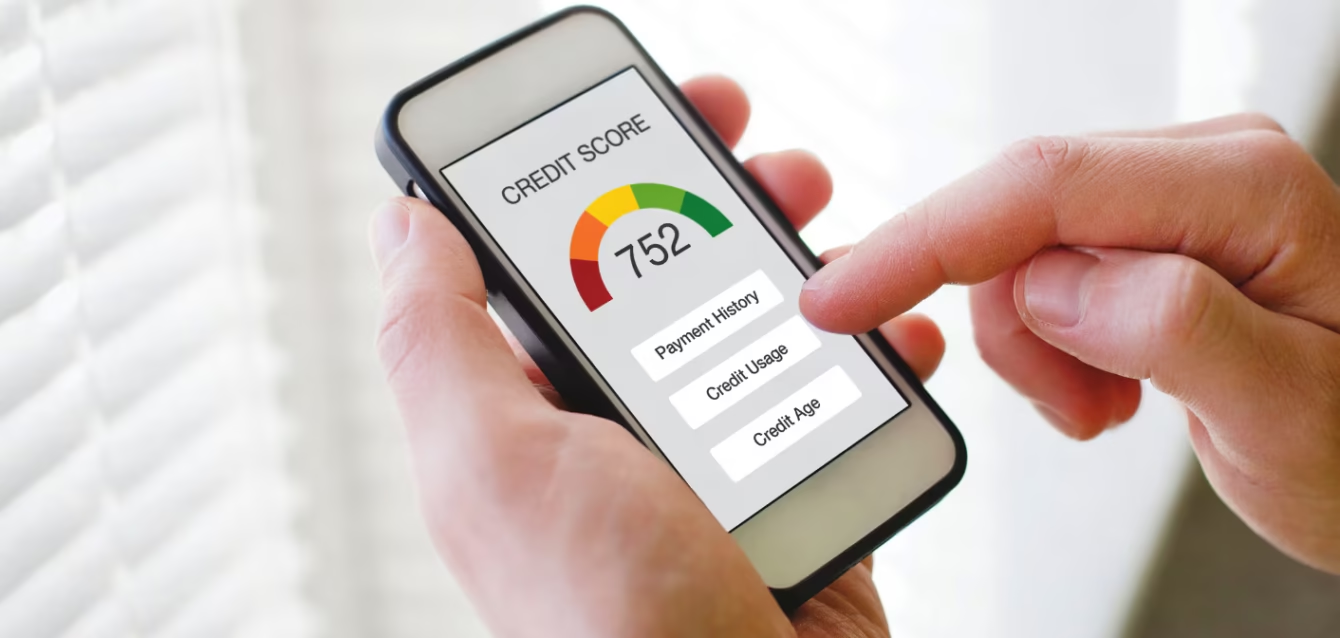
How to Check Your Credit Score Free in 2026
Last updated: June 7, 2026
You have four legitimate ways to see your credit score for free in 2026 without triggering a hard inquiry: through AnnualCreditReport.com for your full credit reports (no score included), through Experian or Discover for a free FICO score, or through Credit Karma or your bank/credit card app for a free VantageScore. The fastest method — under three minutes — is checking your bank or credit card app, which likely already shows your score on the dashboard. This guide walks through each method in the exact order you should try them, with the specific UI steps current as of June 2026.
Table of Contents
What You Need Before You Start
- Social Security Number (SSN): Required for identity verification on AnnualCreditReport.com, Experian, and Discover. Your last 4 digits are sufficient for some services; others require the full number.
- A device you own and trust: Do not do this on a public computer, shared device, or public Wi-Fi network.
- Your current home address (and prior address if you moved in the last 2 years): Used for identity verification.
- Date of birth: Standard identity verification field on all services.
- An email address you can access immediately: Required for account creation on Credit Karma, Experian, and most bank-based services.
Optional but helpful:
- A credit card or bank account number handy — some identity verification systems use recent account activity to confirm your identity.
- A screenshot tool or PDF printer — your reports are only available on-screen during the session on some services.
Estimated Time
| Method | Setup time | Time to see score |
|---|---|---|
| Bank/credit card app | 0 (already have account) | 30 seconds |
| Credit Karma | 3–5 min to create account | Immediate after signup |
| Discover Free FICO (non-customer) | 2–3 min | Immediate |
| Experian free account | 3–5 min | Immediate |
| AnnualCreditReport.com (report only) | 5–10 min | Immediate (reports, not score) |
Important: Credit Report vs. Credit Score
Before you follow any step below, understand this distinction — it is where most guides leave readers confused.
- Your credit report is a detailed record: every account, every payment, every inquiry, every public record. Three bureaus maintain separate reports (Equifax, Experian, TransUnion). You are legally entitled to these for free.
- Your credit score is a 3-digit number calculated from your report data. It is not the same document. AnnualCreditReport.com — despite being the government-authorized free report service — does not give you a score.
The free methods below are organized by what they actually provide:
| Method | Gives credit score? | Gives credit report? | Free? |
|---|---|---|---|
| AnnualCreditReport.com | ❌ (not included) | ✅ All 3 bureaus | ✅ Legally required |
| Credit Karma | ✅ VantageScore 3.0 | ✅ Equifax + TransUnion | ✅ Always free |
| Experian (free account) | ✅ FICO Score 8 | ✅ Experian only | ✅ Free tier |
| Discover (no account needed) | ✅ FICO Score 8 | ❌ Score only | ✅ No card required |
| Bank/credit card app | ✅ FICO or VantageScore | ❌ Usually score only | ✅ If you’re a customer |
Method 1 (Fastest): Check Your Bank or Credit Card App
Time: 30 seconds. Best first step — you may already have access.
Most major US banks and credit card issuers now show your credit score for free in their apps or online banking portal. This is the fastest method and the one most people don’t know they already have.
Banks and issuers that include free credit scores as of June 2026:
| Issuer | Score type | Bureau | Who gets it |
|---|---|---|---|
| Discover | FICO Score 8 | TransUnion | All cardholders (and non-customers at discover.com) |
| Capital One | VantageScore 3.0 | TransUnion | All customers |
| American Express | FICO Score 8 | Experian | Primary cardholders with monthly statement |
| Chase | VantageScore 3.0 | Experian | All customers via Credit Journey |
| Bank of America | FICO Score 8 | TransUnion | Eligible accountholders |
| Wells Fargo | FICO Score 9 | Experian | Enrolled online banking customers |
| Citi | FICO Score 8 | Equifax | All cardholders |
Steps
Step 1 — Open your banking app and log in. Navigate to the account dashboard for your credit card or primary bank account.
Step 2 — Look for a “Credit Score,” “FICO Score,” or “VantageScore” tile. On most mobile apps it appears directly on the account summary screen or under a “More,” “Account Services,” or “Benefits” menu item. On Chase, it’s labeled “Credit Journey” and accessible from the account menu.
Step 3 — Tap the score tile. Your score loads immediately. No additional verification required — you’re already authenticated via your banking login.
Step 4 — Review the score and the factors listed below it. Every issuer’s credit score feature shows the key factors affecting your score (payment history, utilization, etc.). These are worth reading — they tell you what to work on.
⚠ 2026 note for guides written before 2024: Older competitor articles suggest checking statements by mail for credit scores. This is outdated — all major issuers now show scores in-app, updated monthly.
Method 2: Credit Karma (Free VantageScore from Equifax + TransUnion)
Time: 3–5 minutes to create account, then immediate access. Score updates daily.
Credit Karma shows your VantageScore 3.0 from both Equifax and TransUnion for free. It also shows your credit report data from both bureaus. The score is not a FICO score — it may read 10–40 points different from the FICO score your lender pulls. But it is accurate to the underlying data and tracks your credit health reliably over time.
Steps
Step 1 — Go to creditkarma.com on a private browser tab.
Step 2 — Click “Check Your Free Credit Scores.” On the registration form, enter: first and last name, email address, and a password. No credit card is required. Click “Continue.”
Step 3 — Verify your email. Credit Karma sends a verification email immediately. Open it and click “Confirm Email.” Return to the browser.
Step 4 — Complete identity verification. On the next screen, enter: date of birth, home address, and last 4 digits of your SSN. This is a soft inquiry — it does not affect your score.
Step 5 — Your dashboard loads. Your TransUnion and Equifax VantageScore 3.0 scores appear on the main screen as two circular gauges, one per bureau. The scores may differ — that is normal. Below each score, Credit Karma shows the five factors affecting it, current account summaries, and recent changes.
Step 6 — Optional: Enable credit monitoring alerts. In Settings > Notifications, turn on “Score changes” and “New accounts.” This is free and alerts you to identity theft within 24 hours of a new account appearing on your report.
Method 3: Discover Free FICO Score (No Account Required)
Time: 2–3 minutes. Gives you a real FICO Score 8 even if you’re not a Discover customer.
Discover is the only major credit card issuer that provides a genuine FICO Score 8 (not VantageScore) to people who don’t have a Discover card. This is the closest thing to what your lender will actually see.
Steps
Step 1 — Go to discover.com/free-credit-score. Do not search for “Discover credit score” — lookalike sites exist. Type the URL directly.
Step 2 — Click “Get Your Free Score.” The form asks for: full name, address, date of birth, email, and full SSN (9 digits). This is a soft inquiry; it does not affect your score.
Step 3 — Submit the form. Your FICO Score 8 from TransUnion loads within seconds on the confirmation screen.
Step 4 — Review your score and key factors. The Scorecard shows: your 3-digit FICO Score 8, score range context (300–850 scale), five factors with their current status, and a 12-month score history graph.
⚠ 2026 note for older guides: Some articles published before 2024 say Discover’s free FICO score is “only for cardholders.” This is wrong. Non-customers can access it with no credit card and no paid subscription.
Method 4: Experian Free Account (FICO Score 8)
Time: 3–5 minutes. Free FICO Score 8 + full Experian credit report.
Experian’s free account tier provides your FICO Score 8 based on your Experian credit file, updated once per month. It also gives you your full Experian credit report. Unlike Credit Karma, which uses VantageScore, this is a genuine FICO score from the bureau itself.
Steps
Step 1 — Go to experian.com and click “Get Your Free Credit Report.”
Step 2 — Click “Start for Free.” Enter: email address and create a password. No credit card required for the free tier.
Step 3 — Complete identity verification. Experian asks for: full name, address, date of birth, last 4 digits of SSN, and optionally your phone number for 2-factor authentication. Enter your phone number — it makes future logins significantly faster.
Step 4 — Experian may send a one-time code to your phone. Enter it on the next screen.
Step 5 — Your dashboard loads. Your FICO Score 8 appears as a circular gauge. Below it: a summary of your Experian credit report, score factors, and an “Experian Boost” prompt (optional — see note below).
⚠ Experian Boost prompt: Experian will prompt you to connect your bank account to add on-time utility and streaming payments to your credit history via “Experian Boost.” This is optional and genuinely can raise your score. It is not required to see your free score. If you want the score without Boost, click “Skip” or “Maybe Later.”
Method 5: AnnualCreditReport.com (Free Credit Reports — Not Scores)
Time: 5–10 minutes. Mandatory annual step — even if you check your score elsewhere.
This is not a score check — it is a full report pull. You should do this at least once per year in addition to monitoring your score elsewhere, because it is the only way to verify every account, payment, and inquiry that appears in your files at all three bureaus.
2026 key fact most guides miss: You can now pull your reports weekly from all three bureaus at no cost. Equifax has additionally extended its settlement-related offer of 6 free Equifax reports per year through December 31, 2026 (on top of the standard weekly access).
Steps
Step 1 — Go to annualcreditreport.com directly. Do not click links from emails claiming to be from AnnualCreditReport.com. Type the URL. The FTC confirms this is the only government-authorized free report service.
Step 2 — Click “Request your free credit reports.” On the form, enter: first and last name, date of birth, SSN, and current address. If you’ve moved in the last two years, have your previous address ready.
Step 3 — Select which bureaus to pull from. You can request reports from Equifax, Experian, TransUnion, or all three simultaneously. For a full annual audit, select all three. For a quick quarterly check, you can rotate — pull Equifax now, Experian in 3 months, TransUnion 3 months after that.
Step 4 — Complete identity verification for each bureau. After submitting your information, each bureau runs a knowledge-based authentication (KBA) quiz — typically 4–5 multiple choice questions based on your credit history. Examples: “Which of these banks have you had a loan with?” or “Which of these addresses have you lived at?” Answer based on your actual history.
Step 5 — Download and save each report immediately. Once identity is verified, your report appears on-screen as a detailed list of accounts. Click “Download” or print to PDF immediately — this session view does not persist after you close the browser. Save each bureau’s report as a separate PDF named with the date (e.g., “Equifax-Report-June2026.pdf”).
Step 6 — Review each report for errors. Scan for: accounts you don’t recognize, incorrect personal information, late payments you know you made on time, accounts reported as open that you closed, and hard inquiries you didn’t authorize. Any error can be disputed directly on the bureau’s website for free.
Common Errors and Fixes
These are the points where readers get stuck. Competitors rarely document them.
Error 1: “We are unable to verify your identity” on AnnualCreditReport.com
Why it happens:
- Your credit file has too little recent activity to generate KBA questions (common for people who rarely use credit, recently moved, or have thin credit files)
- A security freeze is active on your credit file
- You answered a KBA question incorrectly
- Your name or address on file differs from what you entered (e.g., you used a middle initial the bureau doesn’t have)
Fix:
- Try a different browser first — Chrome handles the session better than Firefox or Safari on this site.
- If you have a security freeze active (you’ll know if you placed one), temporarily lift it at each bureau before requesting the report. Experian: experian.com/freeze · Equifax: equifax.com/personal/credit-report-services · TransUnion: transunion.com/credit-freeze. Lifts take effect in under 1 hour online; allow up to 3 business days for phone requests.
- If identity verification still fails online, call 1-877-322-8228 — phone verification uses different questions. Your report will be mailed within 15 days.
- You can also mail the Annual Credit Report Request Form to: Annual Credit Report Request Service, PO Box 105281, Atlanta, GA 30348-5281.
Error 2: “Your score is not available” on bank app or Credit Karma
Why it happens:
- Your credit file doesn’t yet have 6 months of history (FICO requires this; VantageScore can score with less)
- No account has been reported to that specific bureau recently
- Your SSN is entered incorrectly during setup
Fix:
- For FICO: if your file is under 6 months old, try VantageScore services (Credit Karma, Credit Sesame) which can generate a score with less history.
- Try a different bureau’s service — if your issuer uses TransUnion and you have no TransUnion accounts, try Experian or Equifax instead.
- For bank apps: log out, force-close the app, and log back in. Score display glitches are the most common reason for a blank score tile.
Error 3: Your Credit Karma score looks much higher (or lower) than your bank’s score
Why it happens: Credit Karma shows VantageScore 3.0. Most banks show FICO Score 8. These are different scoring algorithms and can legitimately differ by 10–40 points on the same underlying credit data. Neither is “wrong.”
Fix: This is not an error — it is by design. For general credit health monitoring, either score works. If you’re preparing for a mortgage application, what matters most is your FICO Score 2 (Experian), FICO Score 5 (Equifax), and FICO Score 4 (TransUnion) — the legacy models most mortgage lenders use. These can only be purchased at myFICO.com (~$20 each) or through a mortgage pre-qualification inquiry. See “When This Won’t Work” below.
Error 4: Experian Boost dramatically raised your score but a lender sees something different
Why it happens: Experian Boost adds utility and streaming payment history to your Experian credit file only. It affects FICO scores calculated from Experian data — not Equifax or TransUnion. If your lender pulls a different bureau or a model version that doesn’t incorporate Boost data, your score will appear lower than what Experian shows.
Fix: Boost is legitimate and beneficial for Experian-specific score checks. Before a major loan application, ask your lender which bureau and which FICO model version they pull. Don’t rely solely on Boost-enhanced scores for pre-application planning.
Error 5: You see a “freecreditreport.com” offer while searching for AnnualCreditReport.com
Why it happens: Freecreditreport.com, FreeCreditScore.com, and similar domains are private commercial services. Some offer free trials that auto-enroll in paid subscriptions if not cancelled. They are not the government-authorized free report service.
Fix: Use only annualcreditreport.com. The FTC and CFPB both list this as the sole authorized site. When in doubt, reach it through consumer.ftc.gov which links directly to the official site.
When This Won’t Work
Some situations require steps beyond what the free services above provide:
You need mortgage-specific FICO scores. Mortgage lenders use FICO Score 2 (Experian), FICO Score 4 (TransUnion), and FICO Score 5 (Equifax) — “classic” FICO models not shown on free services. The score you see on Experian’s free tier (FICO Score 8) or Credit Karma (VantageScore) can differ from your mortgage scores by 20–50 points. Purchase the relevant scores at myFICO.com before applying.
You are credit invisible. If you’ve never had a credit account, you may not have a score at all — roughly 26 million Americans are “credit invisible” according to the CFPB. Free services will show you an error rather than a score. To build a starting credit file, consider a secured credit card or a credit-builder loan.
Your file has a fraud alert or security freeze blocking verification. This is actually a good sign — it means your freeze is working. Lift it temporarily, pull the report, then re-freeze. Instructions for freezing and unfreezing at all three bureaus: consumer.ftc.gov/articles/what-know-about-credit-freezes-fraud-alerts.
You want to see all 50+ FICO score versions. Different lenders use different FICO model versions for different purposes (auto loans, credit cards, mortgages). The free services show you FICO Score 8 or VantageScore 3.0. If you need a specific version, purchase it at myFICO.com or check if your lender will disclose which version they use before you apply.
What to Do Next
Once you’ve seen your score:
If your score is below 670 (Fair or lower): Read our guide to understanding the five factors that affect your score and what moves the needle fastest. Payment history (35% of FICO) is the highest-impact lever — even one 30-day late payment can drop a good score by 50–100 points. Credit utilization (30% of FICO) is the fastest to fix: paying down balances moves your score within 30 days.
If you found errors on your credit report: You can dispute errors for free directly with each bureau. Equifax: equifax.com/personal/disputes · Experian: experian.com/disputes · TransUnion: transunion.com/credit-dispute. Under the FCRA, bureaus must investigate and respond within 30 days. For identity theft-related errors, file a report at IdentityTheft.gov first.
If your score is good but you’re concerned about data exposure: Place a free security freeze at all three bureaus. This is the most effective single step you can take against identity theft — it prevents any new lender from accessing your credit file, blocking new fraudulent accounts from being opened. It is free, does not affect your score, and can be lifted instantly online when you need to apply for credit.
Check your score regularly: Set a reminder to check your score monthly via your bank app or Credit Karma, and pull all three full reports once per year (or quarterly by rotating bureaus). A sudden unexplained drop of 20+ points is the most common early signal of fraudulent activity on your account.
Frequently Asked Questions
Does checking your credit score hurt your credit?
No. Checking your own credit score through any of the methods in this guide is a soft inquiry, which has no impact on your credit. Hard inquiries — which can temporarily lower your score by a few points — only occur when you apply for new credit and a lender pulls your file. You can check your score as many times as you want through soft inquiry services.
Is my Credit Karma score the same as my real credit score?
Credit Karma shows your VantageScore 3.0 from Equifax and TransUnion. This is a real, valid credit score calculated from your actual credit data — but it may differ by 10–40 points from the FICO Score 8 that most banks use, and potentially more from the mortgage-specific FICO models lenders use. Neither is more “real” than the other — they’re different algorithms on the same underlying data. For everyday monitoring, Credit Karma is accurate enough. For mortgage planning, get your FICO scores.
What’s the difference between a credit score and a credit report?
Your credit report is a detailed record of your credit history — every account, balance, payment, and inquiry. Your credit score is a 3-digit number (300–850) calculated from that data. AnnualCreditReport.com gives you the reports for free; it does not include a score. You need a separate service (Credit Karma, Experian, Discover, your bank app) to see the score.
How often should I check my credit score?
Monthly is ideal for score monitoring — most free services update monthly, and your bank app shows the current figure at any time. For full credit reports (all three bureaus), once per year minimum, or quarterly by rotating bureaus (one per quarter). If you’ve been a victim of identity theft or recently applied for a lot of new credit, check more frequently.
Can I get my credit score for free without giving out my Social Security number?
Not meaningfully. SSN (or last 4 digits) is required for identity verification at every legitimate credit monitoring service because your credit file is tied to your SSN. Services that offer a score without an SSN are either providing a generic estimate or are not accessing actual bureau data. If you’re concerned about data security, review the privacy policies of the service you use — Experian and the major bureaus are regulated by the FCRA and have obligations regarding how your data is handled.
Why does my score differ between Experian, Equifax, and TransUnion?
Two reasons: the bureaus have different data, and the scoring models calculate differently. Not every lender reports to all three bureaus — your car loan might be on Experian and TransUnion but not Equifax. Additionally, FICO Score 8 has three bureau-specific versions, and the weights and calculations differ slightly. A 10–30 point difference between bureaus is normal. A difference of 50+ points warrants checking each report for missing or erroneous data.
Is Experian safe to give my SSN to?
Experian is a major consumer reporting agency regulated under the Fair Credit Reporting Act and is one of the three federally authorized credit bureaus. They do require your SSN to match you to your credit file. However, no online service is risk-free — Experian suffered a data breach in 2020 that exposed 24 million South African records. Use Experian on a private device, over a secure connection, and enable 2-factor authentication (available via SMS or authenticator app).