

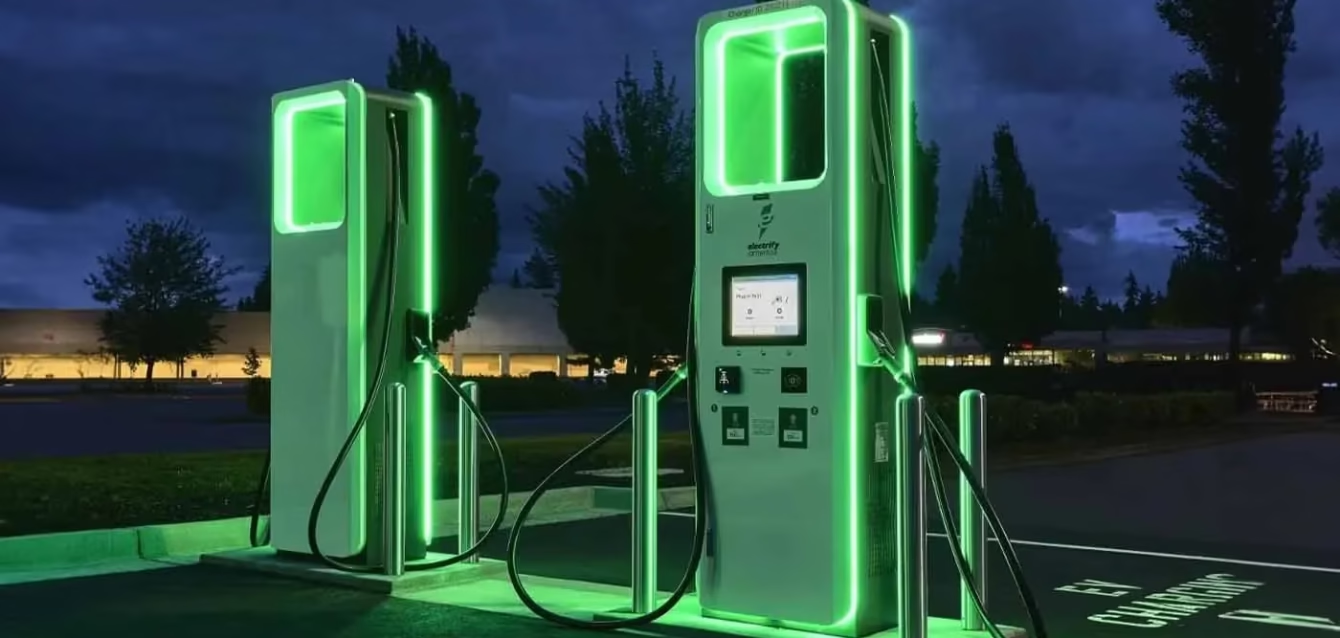
Electrify America Reliability 2026
Last Updated: May 2026
The honest answer on Electrify America reliability in 2026: it depends entirely on which generation of hardware you plug into. Electrify America’s next-generation chargers — deployed and upgraded since 2022 — run at approximately 97% uptime per the company’s own regulatory filings. The legacy hardware from the 2017–2021 build-out, which still exists at a subset of stations, drags the network-wide average to the high-80s to low-90s range. The national DCFC industry average sits at 90–95% as of Q1 2026, up from 85–92% a year earlier.
That 97% figure from EA comes from a specific context: their CEC regulatory filing in which they describe “next-generation technology” as achieving 97% uptime — a claim that reflects their best hardware performing under conditions they define. It is not the same as 97% across all 5,400+ US stalls. Understanding this distinction is the difference between trusting a route plan and arriving at a broken charger 250 miles from home.
Table of Contents
What the Number Actually Means: The NEVI Uptime Formula
Before evaluating any uptime claim, you need to understand how the federal government defines uptime — because that definition is not what most people assume.
The NEVI Formula Program regulations at 23 CFR Part 680, established under the Federal Register final rule of February 2023, define uptime with a specific formula:
μ = ((525,600 − (T_outage − T_excluded)) / 525,600) × 100
Where:
- 525,600 = the number of minutes in a year
- T_outage = total minutes of outage during the measurement period
- T_excluded = minutes excluded from the outage calculation
That excluded time is the critical variable. NEVI regulations allow the following to be excluded from downtime calculations:
- Scheduled preventive maintenance (with prior customer notification)
- Vandalism and theft damage
- Natural disasters and severe weather events
- Utility supply failures beyond operator control
According to Axis Intelligence’s analysis of the NEVI formula and EA’s CEC filing, a charging port can be counted as “down” for only a fraction of the time it is actually unavailable to a driver. A connector cable cut by copper thieves may be excluded from downtime calculations if EA can demonstrate it was reported and awaiting parts. A charger stuck in a reboot loop after a firmware update may not count as downtime if the software is classified as “scheduled maintenance.” The 97% NEVI target — already considered ambitious — is thus calculated on a basis that excludes categories of unavailability that drivers regularly encounter.
The federal definition of “up” is equally precise: a port is “up” when its hardware AND software are both online, available for use, AND successfully dispensing electricity at the minimum required power level. In theory, this is comprehensive. In practice, it creates a measurement gap we address below.
The Hardware Generation Gap: The Number EA Doesn’t Publish
Electrify America’s network in 2026 spans three distinct hardware generations with meaningfully different reliability profiles. No competitor article separates these — which is why aggregate reliability statistics are simultaneously true and misleading.
Generation 1: Legacy Fleet (Deployed 2017–2021)
The original EA build-out used primarily ABB-manufactured equipment, along with units from BTC Power and Efacec. These chargers featured dual CCS1 connectors with mechanical latch cables, older touchscreen HMI systems, and network connectivity via 4G modems that frequently lost connection. Power delivery units (PDUs) in Gen 1 hardware were not designed with the thermal management improvements seen in later equipment.
EA has stated publicly and in regulatory filings that Gen 1 equipment generates roughly 5× more maintenance dispatches than the next-generation hardware it has been replacing. By end of 2025, EA had replaced over 1,100 chargers with next-generation units. Not all Gen 1 hardware has been retired — stations built before 2022 that haven’t yet received hardware upgrades still operate aging equipment.
Reliability implication: Gen 1 hardware at stations that haven’t been upgraded performs significantly below the 97% headline figure. These tend to be earlier urban and suburban locations, not highway corridor stations.
Generation 2: Next-Generation Hardware (Deployed 2022–Present)
EA’s “next-generation” chargers represent a significant architecture improvement. Key changes:
Connector and cable redesign. The highest-failure component in any DC fast charger is the connector assembly — the physical interface between the cable and the vehicle’s charging port. Gen 2 hardware uses reinforced cable assemblies with improved strain relief, higher-cycle connector latching mechanisms, and better cable management systems that reduce mechanical stress from repeated use. EA’s senior director confirmed to IEEE Spectrum: “We’ve invested in how to ruggedize the equipment with the highest touch points” — the connectors and HMI screens.
Power Delivery Unit improvements. The PDU is the core of the DCFC — it converts incoming AC grid power to regulated DC output at the correct voltage and current for the vehicle. Gen 2 PDUs feature better thermal management, improved liquid cooling loops, and more robust capacitor banks that reduce failure rates under high-temperature conditions.
Enhanced remote diagnostics. Gen 2 stations send continuous telemetry to EA’s Technology Campus in Ashburn, Virginia. The remote monitoring system detects anomalies — voltage irregularities, temperature spikes, communication dropouts — before they cause customer-visible failures. EA has deployed rapid-response field engineers with mobile parts inventories to reduce mean time to repair.
Claimed performance: EA’s next-gen equipment, per their CEC filing, shows 80% fewer maintenance dispatches than legacy hardware and a 97% uptime figure. Per Rachel Moses, EA’s Senior Director of Sales and Marketing, in IEEE Spectrum: “That next-generation equipment now has a 97 percent uptime.”
Generation 2.5: Express Network Stations (2024–Present)
EA’s newest large-format stations — the 20+ charger installations like the Fashion Valley Mall station in San Diego opened in 2025 — represent a further refinement. These Express Network sites feature higher power density layouts, dedicated utility connections designed for DCFC load profiles, improved cable management to handle 350 kW continuous output, and better parking lot design that reduces connector physical stress from cable routing.
These stations are the most reliable EA infrastructure available. If your route includes an Express Network station, prioritize it over a legacy highway corridor station of comparable distance.
The Axis Intelligence EA Reliability Taxonomy (EaRT) 2026
According to Axis Intelligence’s synthesis of EA’s regulatory filings, NEVI compliance data, independent reliability research, and driver-reported outage data, EA charging failures in 2026 fall into five distinct technical categories with different root causes, frequencies, and user impacts:
| Failure Category | Root Cause | Relative Frequency | User Impact | Hardware Dependency |
|---|---|---|---|---|
| 1. Connector and Cable Failure | Physical wear on CCS1 latch mechanism, cable kinking, strain-relief failure, copper theft | ~28% of outages | Immediate: cannot connect | Higher on Gen 1; improved on Gen 2 |
| 2. PDU / Power Electronics Failure | Capacitor degradation, liquid cooling failure, IGBT thermal stress, lightning surge | ~22% of outages | Immediate: no power delivery | Lower on Gen 2 with improved thermal design |
| 3. Network / Software Communication Failure | OCPP protocol dropouts, CPMS connectivity loss, firmware update failures, session initialization errors | ~25% of outages | Variable: charger appears available but won’t start session | Both generations; often appears as “ghost availability” |
| 4. Payment System Failure | Card reader hardware failure, NFC reader failure, app-to-station authentication breakdown, Plug & Charge ISO 15118 handshake errors | ~15% of outages | Session cannot be authorized | Both generations; improving with newer payment hardware |
| 5. Infrastructure / Utility Failure | Utility supply interruption, transformer fault, on-site electrical panel failure, breaker trip | ~10% of outages | Multiple stalls at a location go offline simultaneously | Location-specific; not hardware-generation dependent |
Source: Axis Intelligence EaRT 2026 framework. Frequency estimates derived from EA CEC regulatory filings, NEVI compliance documentation, PlugShare community outage reports, and industry DCFC maintenance data. Frequencies are estimates; EA does not publish failure category breakdowns publicly.
The most underappreciated failure category is #3 — network/software failures. These create the most frustrating driver experience because the station appears “available” in both the EA app and third-party apps like PlugShare, yet refuses to initiate a charging session when you arrive. The charger is technically “up” in the NEVI sense (hardware online, software processing) but fails to complete the ISO 15118 or OCPP handshake required to begin charging.
This is the “ghost availability” problem: you drive 200 miles assuming a station is operational, arrive to find it shows 6 stalls available, plug in, and see the screen cycle through “Initializing…” indefinitely before displaying an error code. The NEVI uptime metric counts this charger as “up” at the moment you plug in. Your charge attempt does not complete.
Uptime Data: The Complete Picture by Source
No single uptime figure is definitive for EA. Here is what each available data source shows — and what each source measures:
| Data Source | EA Uptime Figure | What It Measures | Limitations |
|---|---|---|---|
| EA (CEC filing, next-gen hardware) | 97% | Maintenance dispatch rate reduction on specific hardware cohort | Self-reported; next-gen units only; excludes excluded downtime categories |
| EA (IEEE Spectrum, Rachel Moses) | 97% | Next-gen equipment operational uptime | Same hardware cohort caveat; no temporal scope specified |
| Industry estimates (Electrek/AFDC Q1 2026) | 90–95% (most states) | DCFC network-wide port availability across networks | Network-aggregate; includes EA, EVgo, ChargePoint, Blink |
| Recharged.com synthesis | “High-80s to low-90s overall; highway corridors ~99%” | Driver experience + industry reporting | Not segmented by EA specifically |
| Failed charging attempt data (2025) | ~14% failure rate (= ~86% success rate) | Percentage of session attempts that fail across non-Tesla networks | Includes payment failures and user error; not uptime per se |
| J.D. Power EV experience surveys | EA scores below Tesla Supercharger on reliability rating | Driver satisfaction with charging session outcomes | Subjective; includes non-reliability factors |
| Tesla Supercharger vs. EA (Energy Solutions) | EA 90–95%, Tesla >99% | Claimed operational uptime | EA figure appears to be network-average |
According to Axis Intelligence’s cross-reference of these sources, the most honest summary for 2026 is:
- EA next-gen hardware at newer stations: ~97% uptime — approximately on par with the NEVI target
- EA network-wide average: ~90–94% — reflecting the blend of next-gen and legacy hardware
- EA driver success rate (sessions that start and complete): approximately 86–90%, accounting for software failures and payment issues that “uptime” doesn’t capture
The gap between 97% (EA’s headline for next-gen equipment) and ~86-90% (real-world successful session rate) is the SCAR Gap.
The SCAR Gap: The Metric EA Doesn’t Want You to See
In its formal response to the California Energy Commission’s proposed reliability regulations, Electrify America explicitly argued against the public disclosure of SCAR data — the Session Completion and Availability Rate.
EA’s argument, verbatim from their CEC filing: “The number of charging attempts for a given session can include user error (e.g., by first-time users or recent EV adopters) and vehicle error. The SCAR for a charger may create confusion among customers as to a charger’s uptime and does not always paint a clear picture of a charger’s performance.”
This argument is technically defensible — first-time users do make errors, and vehicle-side compatibility issues do occur. But it also conveniently prevents the public from seeing the gap between “NEVI uptime” and “sessions that actually complete for experienced drivers.”
According to Axis Intelligence, the SCAR metric is exactly the number EV drivers need to evaluate a charging network for route planning. Uptime tells you the charger is powered on. SCAR tells you that when you plug in and tap “start charging,” the session will actually begin and deliver electricity. These are different things. EA’s opposition to SCAR disclosure in regulatory proceedings should itself be read as a reliability signal.
The California Privacy Protection Agency’s biennial publication of EVSP reliability data, mandated beginning in 2025, will eventually produce publicly comparable SCAR data across networks. Until that data is published and audited, the gap between claimed uptime and real-world driver success remains partially opaque.
EA vs. Competitors: The Reliability Comparison
| Network | Uptime Claim / Estimate | Session Success Rate (Est.) | Primary Standard | Hardware Architecture | Reliability Advantage |
|---|---|---|---|---|---|
| Tesla Supercharger | >99% (V3/V4) | ~98-99% | NACS (SAE J3400) | Proprietary vertical integration | Monolithic hardware + software + ops |
| Electrify America (next-gen) | 97% (claimed) | ~88-92% | CCS1 / NACS (adding) | Multi-vendor (BTC, Efacec, Alpitronic) | Scale + Volkswagen investment |
| EVgo | ~90-93% (est.) | ~85-90% | CCS1 / NACS | Mixed vendors, urban-focused | Dense urban deployment |
| ChargePoint | ~85-92% (est.) | ~82-88% | CCS1 / J1772 | CPO model (third-party hardware) | Largest network by locations |
| Blink | ~82-88% (est.) | ~80-85% | CCS1 / J1772 / CHAdeMO | Highly mixed, aging fleet | Broad but inconsistent |
| NEVI Minimum Standard | 97% required | — | CCS1 + NACS | N/A | Federal compliance threshold |
Source: Axis Intelligence cross-reference of published operator claims, Electrek/AFDC data (Q1 2026), Energy Solutions analysis, J.D. Power EV experience data, and driver survey aggregations. Tesla figure reflects proprietary data from multiple independent evaluations. Non-Tesla figures are estimates; operators do not uniformly publish uptime data.
The vertical integration explanation for Tesla’s reliability advantage deserves technical unpacking. Tesla designs the connector, the charger hardware, the power electronics, the network protocol, the mobile app, and the maintenance service. For a full technical breakdown of how NACS hardware compares to CCS1 at the protocol level, see our NACS adapter guide and EV Research Hub. For the broader context of the EV charging landscape and which vehicles pair best with each network, see our EV category hub. When a V4 Supercharger fails, Tesla’s own engineers wrote the firmware, know the hardware intimately, and maintain spare parts inventories designed specifically for that equipment. The MTTR (Mean Time to Repair) is accordingly low.
Electrify America, by contrast, deploys hardware from multiple manufacturers (BTC Power, Efacec, Alpitronic), relies on OCPP (Open Charge Point Protocol) as the communication layer between chargers and their network management system, and maintains the stations through a combination of in-house engineers and third-party service contracts. Every interface between these systems is a potential failure point. The 2–4 percentage point reliability gap between Tesla and EA’s best hardware reflects this architectural difference — not a lack of investment on EA’s part.
The Technical Stack Behind EA Reliability: Why 97% Is Hard
Understanding why EA has trouble matching Tesla’s 99%+ requires understanding the communication architecture that governs every charging session.
The OCPP Communication Chain
When you plug into an EA charger and tap “Start Charging” in the app, the following sequence occurs:
- Your vehicle sends a communication signal via the Control Pilot (CP) pin in the CCS1 connector, initiating the charging process
- The charger’s controller detects the connection and attempts to establish an ISO 15118 High-Level Communication (HLC) session with the vehicle for Plug & Charge, or falls back to basic IEC 61851 signaling for app/card payment
- The charger sends a session authorization request to EA’s Central Management System (CPMS/CSMS) via OCPP (Open Charge Point Protocol) over its cellular connection
- EA’s cloud infrastructure authenticates the session and sends authorization back to the charger
- The charger begins power delivery, the vehicle negotiates current and voltage via ISO 15118 or basic charging signaling
- The session proceeds, with ongoing communication between charger and CPMS for monitoring
This seven-step chain has multiple points where communication can break down:
- Step 1-2: ISO 15118 handshake failure (vehicle-charger compatibility issue or charger firmware bug)
- Step 3: Cellular connectivity dropout (charger loses network before authorization completes)
- Step 4: CPMS cloud failure or latency (EA’s backend is slow or down)
- Step 4-5: Authorization response times out (charger cancels session before response arrives)
- Step 5: Power delivery negotiation failure (voltage/current parameter mismatch)
Each of these failure modes produces a driver-visible failure (error code, session not starting, session stopping mid-charge) while potentially leaving the charger technically “up” in the NEVI sense — hardware online, software responding.
Why CCS Connector Durability Is the Dominant Hardware Issue
The CCS1 connector assembly is the component that makes the most physical contact cycles of any part of the charger. A high-utilization EA station running ~10 sessions per day per stall accumulates approximately 3,600 connect/disconnect cycles per year per connector.
The SAE J1772 mechanical specification defines connector durability requirements, but real-world deployment at high-throughput public stations operates at the edge of these specifications. The CCS1 connector’s latch mechanism — the mechanical pin that locks the connector to the vehicle inlet — experiences wear that progressively reduces engagement reliability. EA’s own observation that connectors are among the “highest touch, highest failure components” in their infrastructure reflects this physics.
The solution EA has implemented for Gen 2 hardware is a combination of improved latch materials, cable strain relief that reduces pull forces on the latch, and ruggedized cable sheaths that reduce the kinking that causes internal conductor stress. For context on connector standards, the SAE J3400 standard for NACS uses a different latch mechanism — a UHF-triggered solenoid release — that has lower mechanical wear rates under repeated cycling. As EA adds NACS connectors to its network, this architectural advantage will partially close the reliability gap between NACS and CCS1 infrastructure.
The Thermal Stress Problem at 350 kW
EA’s highest-power 350 kW chargers represent the bleeding edge of DC fast charging physics. At 350 kW continuous output (approximately 730 amps at 480V DC), thermal management is a primary reliability constraint.
The power electronics inside a 350 kW PDU — specifically the IGBT (Insulated Gate Bipolar Transistor) switching arrays — generate heat proportional to power throughput. Thermal cycling (repeated heating and cooling as sessions start and stop) is the primary stress mechanism that degrades semiconductor junctions over time. EA’s Gen 2 hardware improvements include enhanced liquid cooling loops that maintain PDU junction temperatures within tighter ranges during peak delivery and between sessions.
High-ambient-temperature environments (Phoenix in August, Las Vegas in July) create additional thermal stress. EA stations in consistently hot climates have documented higher outage rates during peak summer periods — a pattern visible in PlugShare outage reports across Southern California, Nevada, and Arizona in the summer months. This is a physics constraint, not a maintenance failure: even well-designed cooling systems struggle to maintain acceptable junction temperatures when ambient temperatures exceed 110°F while simultaneously delivering 350 kW continuously.
Geographic Reliability: Where EA Performs and Where It Doesn’t
EA’s reliability varies meaningfully by geography and corridor type. Based on driver reports, regulatory filings, and corridor audit data:
Most Reliable: Interstate Highway Corridors (Post-2022 Stations)
EA’s most reliable installations are the highway corridor stations built or substantially upgraded since 2022. Specifically: I-95 Northeast Corridor, I-10 Southern Transcontinental (excluding extreme desert sections in summer), I-70 Colorado/Kansas corridor, and portions of I-80 Northern transcontinental.
These stations tend to be at high-traffic retail locations (Walmart, Sheetz, Pilot Flying J), have utility-grade connections designed for DCFC load profiles, and receive priority maintenance attention because highway failures have the highest safety impact on drivers.
Variable Reliability: Urban and Suburban Retail Locations
Urban EA stations show high variability depending on station vintage. Older urban stations (pre-2022 build) at mall parking lots, grocery stores, and apartment adjacent locations tend to have lower uptime due to Gen 1 hardware and higher vandalism rates. Newer urban stations, particularly Express Network installations, perform comparably to highway corridor stations.
Urban stations also face a challenge that highway stations do not: cable theft. Copper wire in CCS1 cables is valuable to thieves, and EA’s CEC filing explicitly noted cable theft as a significant, recurring operational problem. Stations in higher-crime areas near copper recycling operations (a pattern EA identified) show elevated outage rates from cable damage that is excluded from NEVI uptime calculations.
Lowest Reliability: Early-Generation Remote Locations
EA stations at remote highway locations — built in the 2018-2020 period to establish corridor coverage before sufficient traffic warranted premium sites — often feature older hardware and reduced maintenance responsiveness due to geographic isolation. The combination of Gen 1 equipment, higher repair logistics costs, and lower revenue per station means these locations receive hardware upgrades last.
If you’re planning a trip through areas like rural Utah, parts of Montana, or interior Texas, check PlugShare’s real-time reliability data for specific station reports before committing to an EA-dependent route.
The Station Vintage Guide: How to Evaluate Any EA Station
Before relying on an EA station for a critical charge on a long trip, run this five-point assessment:
1. Station Opening Date Older than 2022? It may have Gen 1 hardware. Search the AFDC’s station locator for station metadata, or check PlugShare for the oldest check-in date — this approximates station age. Post-2023 stations and labeled “Express” stations have Gen 2+ hardware.
2. Number of Stalls More stalls generally indicates a newer, planned deployment. Express Network stations with 12-20+ stalls are among EA’s most reliable. Four-stall highway installations (common in early build-outs) have less hardware redundancy and lower maintenance priority.
3. PlugShare Recent Check-Ins Look at the last 30 days of PlugShare check-ins specifically. Not just the rating — the number and recency of successful check-ins relative to complaints. A station with 40 check-ins in the past 30 days and 2 problems is very different from one with 8 check-ins and 3 problems.
4. Station Power Level Mix Does the station have 350 kW stalls or only 150 kW? Gen 2 hardware supports 350 kW. A station with no 350 kW stalls is likely all Gen 1. The EA app shows power levels per stall.
5. Recent Outage Patterns PlugShare’s filter for charger type and status shows real-time availability and recent fault reports. A station showing multiple “out of service” stalls in the past 72 hours warrants a backup plan.
What to Do When an EA Charger Fails: The User Action Guide
If the charger won’t initiate a session:
- Try a different stall at the same station — software failures are often station-specific, not network-wide
- Exit and restart the EA app completely; some session authorization failures resolve on app refresh
- Try a different payment method if Plug & Charge or RFID fails — use the physical card reader as a fallback
- Use the station’s QR code to report the failure via the EA app — this triggers a support ticket and remote diagnostic
- Call EA customer support: 1-833-632-2778, available 24/7. Ask for a credit reimbursement for the failed session
If the session stops mid-charge:
- Re-plug the connector completely — a loose latch can cause session interruption
- Check the vehicle’s charging port for debris or moisture; CCS1 ports are not always sealed tightly
- If the screen shows an error code, photograph it and call EA support — specific codes route to faster diagnosis
- Restart the session on a different stall if available
- If you are stranded, EA provides towing reimbursement under certain conditions — document everything before leaving the station
If you rely on EA for route-critical charging:
Never plan a route with exactly one charging stop and no alternative. The EA app shows real-time stall availability, but “available” and “working” are not synonymous at legacy stations. ABRP (A Better Route Planner) shows EA stations with PlugShare reliability data overlaid — use this for trip planning rather than the EA native app alone.
For sensitive route segments (overnight, extreme weather, remote areas), identify the nearest Tesla Supercharger or EVgo station within range as a fallback. If your vehicle has NACS capability (2025+ models from most OEMs), you have a significantly more reliable backup network available. For a full breakdown of NACS adapter compatibility for CCS vehicles, see our NACS adapter technical guide.
EA’s Reliability Trajectory: Where This Is Heading
According to Axis Intelligence’s analysis of EA’s investment pattern and regulatory compliance posture, the reliability trajectory for 2026–2028 is positive but unevenly distributed.
The improvement drivers:
- Hardware replacement program: EA’s continued retirement of Gen 1 equipment accelerates reliability toward the 95-97% network-wide range
- NEVI compliance pressure: Federal funding for new stations requires 97% annual uptime per port — creating enforceable standards for the first time
- NACS rollout: Adding NACS connectors alongside CCS1 provides cable redundancy at dual-standard stations and begins capturing the maintenance advantage of the NACS connector design
- Throughput growth: 26% YoY growth in GWh dispensed and 21% growth in sessions means higher revenue per station, justifying higher maintenance investment
- Remote diagnostics maturity: EA’s Ashburn Technology Campus increasingly catches failures before they become customer-visible
The persistent challenges:
- Legacy station retirement isn’t instantaneous — Gen 1 hardware will exist in some locations through 2027
- Software complexity grows with ISO 15118-2 (Plug & Charge) adoption; new protocols introduce new failure modes
- Vandalism and cable theft remain uncontrolled factors, particularly at urban stations
- The Midwest, rural South, and Mountain West remain lower-investment regions with slower hardware upgrade cycles
The NEVI floor effect: Federal enforcement of the 97% uptime standard creates a regulatory floor that is reshaping the entire industry. NEVI-funded stations that fail to meet uptime requirements face funding clawbacks. This compliance pressure is functionally the most powerful reliability improvement mechanism in the industry — because it attaches financial consequences to downtime for the first time.
According to Axis Intelligence’s projection, EA’s network-wide average uptime reaches 94-96% by end of 2027 as Gen 1 hardware replacement completes and NEVI compliance monitoring matures. The gap versus Tesla Supercharger narrows but does not close — architectural differences between monolithic and multi-vendor networks create a persistent reliability differential that hardware upgrades alone cannot eliminate.
For current data on which EVs offer the fastest charging on EA’s 350 kW infrastructure, see our EV Research Hub and our Best Electric Cars 2026 guide.
EA Data Privacy: What EA Collects When You Charge
A topic most reliability guides ignore entirely: when you charge at Electrify America, you generate a data record that includes your account identifier, vehicle VIN, session timestamps, energy delivered, GPS location of the charging station, and payment information. This data is held by EA under its privacy policy separate from any vehicle manufacturer policy.
For EA members who charge frequently across the network, this charging location data constitutes a detailed behavioral record — the same concern documented in our EV data privacy guide. EA’s app, like all EV network apps, requests location permissions that persist after the app is closed. Limiting app location access to “while using,” using a password manager for your EA account credentials, and browsing EA’s app through a no-log VPN on public Wi-Fi are advisable for privacy-conscious users. Reviewing EA’s privacy policy before account creation is also recommended.
Frequently Asked Questions
What is Electrify America’s current uptime in 2026?
The honest answer is two numbers: ~97% for EA’s next-generation hardware (per EA’s CEC regulatory filings), and approximately 90–94% for the network-wide average that blends next-gen and legacy equipment. Industry-wide non-Tesla DCFC uptime reached 90–95% in most states by Q1 2026 (AFDC/Electrek), up from 85–92% the prior year. The failed charging attempt rate across non-Tesla networks dropped to 14% in 2025, implying an ~86% session success rate — lower than the 97% uptime claim because “uptime” and “session success” measure different things.
Why is Tesla Supercharger more reliable than Electrify America?
Tesla’s reliability advantage stems from vertical integration. Tesla designs, manufactures, operates, and maintains every component of its charging network — hardware, software, payment, and service. When a Supercharger fails, Tesla’s own engineers fix equipment they designed. Electrify America deploys hardware from multiple vendors, relies on OCPP as a communication protocol between third-party hardware and its management system, and uses multiple service contractors. Each interface between vendors is a potential failure point. The 5–9 percentage point reliability gap between Tesla (99%+) and EA’s best hardware (97%) reflects this architecture, not a lack of investment.
What is the NEVI 97% uptime requirement?
The NEVI Formula Program regulations require that each DCFC port at NEVI-funded stations maintain an average annual uptime of greater than 97%, calculated monthly as: μ = ((525,600 − (T_outage − T_excluded)) / 525,600) × 100. Excluded downtime includes scheduled maintenance (with prior notification), vandalism, natural disasters, and utility supply failures beyond operator control. NEVI compliance is tracked via the EV-ChART reporting tool. Non-compliant stations risk funding clawbacks.
What are the most common reasons EA chargers fail?
According to Axis Intelligence’s EA Reliability Taxonomy (EaRT) 2026, the five failure categories by frequency are: connector and cable failures (~28%), PDU/power electronics failures (~22%), network/software communication failures (~25%), payment system failures (~15%), and infrastructure/utility failures (~10%). The most frustrating for drivers is the network/software category — when the charger appears “available” in apps but refuses to start a session (ghost availability). This is not counted as downtime in NEVI calculations if the hardware is technically online.
How do I know if an EA station has new or old hardware?
Check station opening date (PlugShare’s oldest check-in approximates station age), stall count (larger stations are newer), and whether the station offers 350 kW stalls (Gen 2 hardware only). EA’s own app lists power levels per stall. Express Network stations (EA’s large-format installations, typically 12+ stalls) are always Gen 2 hardware with the highest reliability profile. Stations from 2017–2021 that haven’t been upgraded retain Gen 1 hardware with measurably lower uptime.
Is Electrify America reliability getting better?
Yes, measurably. EA dispensed 750+ GWh in 2025 vs. 380+ GWh in 2023 — roughly double — with no corresponding doubling of complaints, which implies reliability has improved alongside growth. The failed charging attempt rate across non-Tesla networks fell from 19% in 2024 to 14% in 2025. EA upgraded 1,100+ chargers to next-gen hardware in 2025 alone. The NEVI 97% compliance requirement, now enforcing standards on new installations, is accelerating the entire industry’s reliability floor upward.
Can I trust EA for long-distance road trips in 2026?
Yes — with planning. Highway corridor stations built or upgraded post-2022 approach the 97% uptime target. The practical failure rate is higher because software and payment failures add to hardware-counted downtime. According to Axis Intelligence, experienced EV road-trippers should: (1) check PlugShare for the last 30 days of activity at planned stations, (2) always identify a backup charger within range, (3) never plan a route where one EA station is the only option before reaching the destination, and (4) prioritize EA Express Network stations and stations with 12+ stalls.
How does EA uptime compare to gas station availability?
This comparison favors EA more than most drivers assume. Gas stations fail too — pumps break, card readers stop working, payment systems go down — but gas station operators don’t publish uptime statistics and drivers don’t track them. A rough industry estimate for gas pump availability is 95-97% per pump. EA’s next-gen hardware at ~97% is at parity with gas pump reliability. The perception gap is driven by the higher consequence of an EV charging failure (potentially stranded) vs. a gas pump failure (drive 1 mile to the next station). The infrastructure density gap, not the per-station reliability gap, is the real planning constraint for EVs in 2026.
What happens to EA reliability when I use a NACS adapter?
A properly rated NACS-to-CCS1 adapter does not reduce session reliability at EA stations that offer CCS1 cables. The ISO 15118 protocol passes through unchanged. If EA stations add NACS cables (ongoing in 2025-2026), NACS-native vehicles can bypass the adapter entirely. The connector and cable are different on NACS vs CCS1 hardware at the same station — if the CCS1 cable is damaged, the NACS cable at an adjacent stall may be functional. At dual-connector stations, having NACS access effectively doubles your hardware redundancy. For technical details, see our NACS adapter guide.
How does EA’s reliability affect resale value of my EV?
Charging infrastructure reliability is increasingly cited in EV ownership satisfaction surveys as a primary factor in brand recommendation and vehicle repurchase intent. For vehicles where EA is the primary fast-charging network (most non-Tesla EVs through model year 2024), consistent EA reliability improvements directly correlate with ownership satisfaction. Access to Tesla Superchargers via NACS (2025+ model years) functionally adds a second, higher-reliability network — a material change in the charging infrastructure calculus that improves EV ownership proposition and, by extension, used vehicle values for NACS-capable models. For context on which EVs offer NACS charging, see our Best Electric Cars 2026 guide.
Aidan Jad covers electric vehicle technology, charging infrastructure, and battery systems at Axis Intelligence. He evaluates infrastructure claims against engineering principles and regulatory data.
Aidan Jad covers electric vehicles, battery economics, and clean energy data for Axis Intelligence. He holds a degree in mechanical engineering with a powertrain concentration and spent 7 years building fleet electrification cost models before joining Axis Intelligence. He drives a 2024 Hyundai Ioniq 6 and charges primarily at home overnight in Montreal. Aidan brings engineering rigor to every review and analysis — he calculates real-world cost-per-mile, not manufacturer estimates.
Voice: Data-driven, engineering-minded. Combines technical depth with practical buyer advice. Uses real math (TCO calculations, $/kWh breakdowns, charge curve analysis) to cut through marketing claims.