

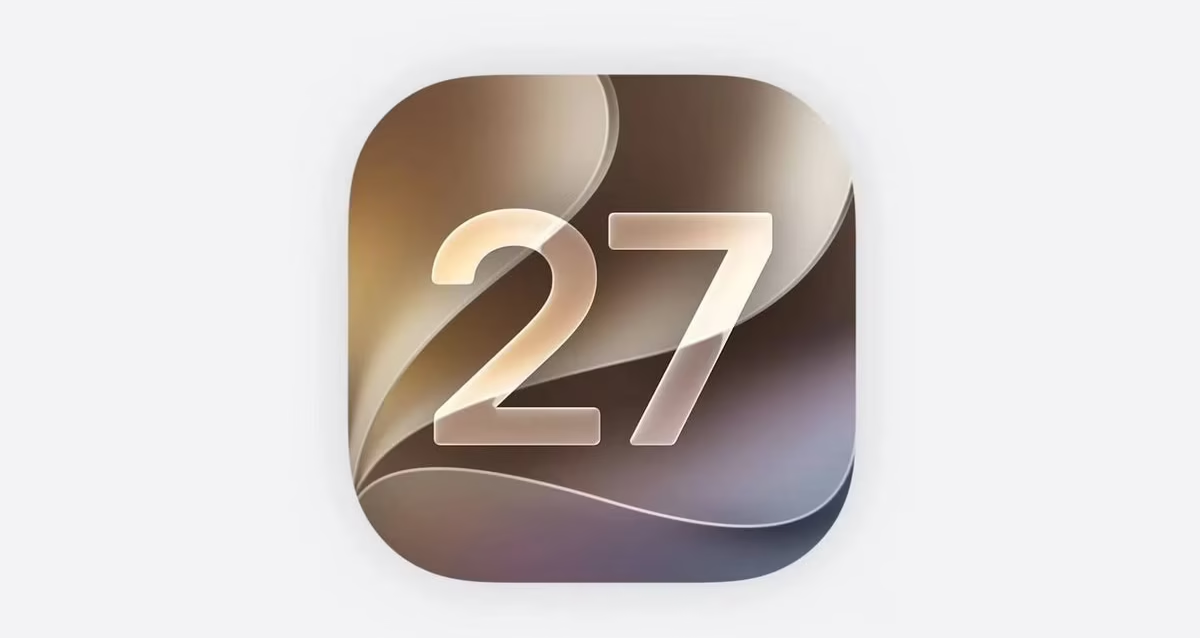
iOS 27 Features
Alex Rivera + Sarah Mitchell
Last updated: June 8, 2026
Apple announced iOS 27 at WWDC 2026 on June 8, revealing a completely rebuilt Siri powered by a custom Google Gemini model, system-wide performance upgrades including 30% faster app launches and 80% faster AirDrop transfers, Liquid Glass design refinements, and an overhauled Search engine — all arriving as a developer beta today, with public release expected in September 2026.
What Happened
Apple unveiled iOS 27 during the WWDC 2026 keynote at Apple Park on June 8, 2026. The centerpiece is a rebuilt Siri — now officially branded Siri AI — running on a custom Google Gemini model for cloud-based queries, while simpler tasks are handled on-device. Performance is the second headline: Apple claims apps launch up to 30% faster, AirDrop transfers are up to 80% faster, and Photos appear in the library up to 70% faster after capture. A redesigned CPU scheduler targets responsiveness on older hardware. Search has been rebuilt from the ground up, indexing device context on update. The Liquid Glass visual design from iOS 26 gains a transparency slider for user control. Developer beta is available today; public beta is expected July 2026; general release targets September 2026 alongside the iPhone 18 lineup.
Primary source: Apple Newsroom — Apple Introduces Siri AI
Why It Matters
iOS 27 lands at an unusual intersection: it is simultaneously Apple’s most consequential AI announcement in years and its most honest admission that Siri has been broken.
The Gemini partnership is the story. Apple spent nearly two decades building Siri in-house, running the privacy-as-a-product argument as a commercial differentiator. Handing Siri’s cloud intelligence to Google — a company whose core business is the opposite of Apple’s stated privacy philosophy — is not a quiet architectural choice. It is a concession that Apple’s own foundation models were not competitive, and that the company was willing to pay an estimated $1 billion per year (per Bloomberg reporting, unconfirmed by Apple) to fix it before the iPhone 18 cycle.
For iPhone users, this matters practically. The rebuilt Siri AI offers on-screen awareness, personal context drawn from Messages, Photos, and Notes, and the ability to carry out multi-step actions across apps — capabilities Apple first promised at the iOS 18 launch in 2024 and then failed to ship. If the Gemini-backed version actually delivers at launch, it closes a two-year gap with Google Assistant and Samsung’s Galaxy AI.
The performance story is arguably just as important for the installed base. A 30% improvement in app launch speed and an 80% faster AirDrop — driven by a new CPU scheduler and preloading techniques — will be felt on every supported device, not just the latest hardware. Apple explicitly framed this as its “quality and stability” release, echoing the Mac OS X Snow Leopard strategy from 2009: slow down the feature cadence, fix the foundations, and let the platform breathe before the next hardware supercycle.
Axis Intelligence original analysis: Most coverage is leading with Gemini. The sharper story, overlooked so far, is what iOS 27 signals for the iPhone upgrade cycle. If Apple ships a genuinely functional Siri AI in September — one that eliminates the ChatGPT hand-off and handles complex personal-context queries natively — it removes the single biggest software objection to upgrading from an iPhone 15 or 16. That is a deliberate setup for iPhone 18 Pro demand, and it is worth watching whether Apple gates Siri AI’s most advanced features behind the A19 chip in the same way it gated Apple Intelligence behind the A17 Pro.
What Comes Next
Developer beta 1 is available today at developer.apple.com across iOS 27, iPadOS 27, macOS 27, watchOS 27, tvOS 27, and visionOS 27. Public beta is expected in July 2026. Final public release tracks to September 2026, coinciding with the iPhone 18 Pro and — for the first time — the iPhone Fold launch.
Siri AI will debut in English as a beta later this year, with language expansion to follow. Apple Intelligence features remain unavailable in China pending regulatory approval. The full Gemini integration details — which devices support cloud routing, whether there is a waitlist for advanced features, and the precise chip requirements — will emerge through the beta cycle.
Three milestones to track: whether Siri AI ships without a waitlist at the September launch (Apple used a staged rollout for Apple Intelligence in 2024); whether iPhone 11 remains on the compatibility list through final release (conflicting reports as of keynote day — see Notes); and whether Apple announces third-party AI model support at the general release, which was previewed at WWDC but not formally committed to for launch day.