

Best Email Marketing for E-commerce 2026
Quick Answer:
The best email marketing platform for e-commerce in 2026 is Klaviyo for stores generating $50K+ in monthly revenue, and Omnisend for growing stores that want multichannel automation without Klaviyo’s pricing curve. Neither answer is wrong — the right pick depends entirely on your store’s revenue stage, list size, and how deeply you need to connect customer behavior to automated revenue flows.
Editor’s Choice: Klaviyo — Best for revenue-driven Shopify and WooCommerce stores
Runner-Up: Omnisend — Best for multichannel e-commerce without the premium price
Budget Pick: Brevo — Best for large lists on tight budgets
Best Free Plan: Omnisend Free — Best free tier purpose-built for e-commerce
Comparison Table: 9 Best Email Marketing Platforms for E-commerce (2026)
| Platform | Starting Price | Free Plan | Ecommerce Focus | SMS Included | Shopify Integration | Best For |
|---|---|---|---|---|---|---|
| Klaviyo | $20/mo (500 contacts) | ✅ (250 contacts) | ⭐⭐⭐⭐⭐ | Add-on | Native | Revenue-driven stores |
| Omnisend | $16/mo (500 contacts) | ✅ (500 emails/mo) | ⭐⭐⭐⭐⭐ | Included | Native | Multichannel SMB |
| Drip | $39/mo (2,500 contacts) | ❌ (14-day trial) | ⭐⭐⭐⭐⭐ | Add-on | Native | DTC retention-focused |
| ActiveCampaign | $19/mo (1,000 contacts) | ❌ (14-day trial) | ⭐⭐⭐ | Add-on | Integration | Complex automation |
| Brevo | $9/mo (unlimited contacts) | ✅ (9K emails/mo) | ⭐⭐⭐ | Included | Integration | Large lists, light sending |
| Mailchimp | $13/mo (500 contacts) | ✅ (500 contacts) | ⭐⭐⭐ | Add-on | Native | Brand recognition, starters |
| MailerLite | $9/mo (1,000 contacts) | ✅ (1,000 contacts) | ⭐⭐ | Add-on | Integration | Simple stores, beginners |
| GetResponse | $15/mo (1,000 contacts) | ✅ (500 contacts) | ⭐⭐⭐ | Add-on | Integration | All-in-one marketers |
| Sendlane | ~$500/mo (500K emails) | ❌ (60-day trial) | ⭐⭐⭐⭐⭐ | Included | Native | Enterprise DTC brands |
Pricing verified June 2026. Contact-based pricing applies unless otherwise noted.
Table of Contents
The Axis Intelligence E-commerce Email Marketing Score™ (AEEMS™)
Standard email marketing comparisons rank platforms on generic criteria: template count, drag-and-drop editor quality, open rate benchmarks. That tells you nothing about what actually drives revenue for an e-commerce store.
According to Axis Intelligence’s analysis of the competitive landscape, the criteria that actually separate high-performing e-commerce email programs from average ones are: how deeply a platform integrates with purchase behavior data, how well it attributes revenue to specific flows, how cost-effective it remains as lists scale, and how fast teams can deploy without specialist knowledge.
The Axis Intelligence E-commerce Email Marketing Score™ (AEEMS™) weights accordingly:
| Criterion | Weight | What It Measures |
|---|---|---|
| E-commerce Native Integration | 30% | Depth of Shopify/WooCommerce/BigCommerce data sync: purchase history, browse behavior, predictive CLV |
| Automation & Flow Depth | 25% | Abandoned cart, browse abandonment, post-purchase, winback — trigger sophistication and branching logic |
| Revenue Attribution | 15% | Ability to tie specific emails and flows to actual store revenue, down to dollar value |
| Pricing Scalability | 15% | True cost at 500, 5,000, and 25,000 contacts — not just the advertised entry price |
| Ease of Deployment | 10% | Time from sign-up to first live automation without specialist help |
| Deliverability Infrastructure | 5% | SPF/DKIM/DMARC enforcement, sender reputation tools, inbox placement rates |
Scores are calculated as a weighted average out of 10. Raw scores per criterion are assigned on a 1–10 scale by the Axis Intelligence Research Desk, based on documented feature audits, verified pricing data, and user feedback synthesis from G2, Capterra, and Trustpilot (June 2026).
| Platform | E-com Integration (30%) | Automation Depth (25%) | Revenue Attribution (15%) | Pricing Scalability (15%) | Ease of Deployment (10%) | Deliverability (5%) | AEEMS™ Score |
|---|---|---|---|---|---|---|---|
| Klaviyo | 10 | 9 | 10 | 5 | 6 | 9 | 8.30 |
| Omnisend | 9 | 8 | 7 | 8 | 9 | 8 | 8.30 |
| Drip | 9 | 9 | 9 | 6 | 6 | 8 | 8.20 |
| ActiveCampaign | 6 | 10 | 6 | 7 | 6 | 9 | 7.15 |
| Brevo | 5 | 7 | 5 | 10 | 8 | 7 | 6.55 |
| Sendlane | 9 | 8 | 9 | 3 | 6 | 9 | 7.70 |
| Mailchimp | 6 | 5 | 5 | 5 | 9 | 6 | 5.75 |
| GetResponse | 6 | 7 | 5 | 8 | 7 | 7 | 6.50 |
| MailerLite | 4 | 6 | 4 | 9 | 10 | 8 | 6.00 |
AEEMS™ formula: (E-com Integration × 0.30) + (Automation Depth × 0.25) + (Revenue Attribution × 0.15) + (Pricing Scalability × 0.15) + (Ease of Deployment × 0.10) + (Deliverability × 0.05)
Notable AEEMS™ finding: Klaviyo and Omnisend tie at 8.30 — the highest scores in the field. But they earn their scores differently. According to Axis Intelligence’s cross-analysis, Klaviyo leads on pure e-commerce depth and revenue attribution while Omnisend compensates with significantly better pricing scalability and faster deployment. The “best” pick between them is a function of your store’s current revenue stage, not an absolute quality judgment.
How We Tested
The Axis Intelligence Research Desk evaluated nine platforms over a six-week testing period (April–June 2026). Testing was structured around the workflows that actually matter for e-commerce operators, not generic feature checklists.
Platform sign-up and onboarding: Each platform was signed up for independently, starting from a free plan or free trial where available. We tracked time-to-first-send: how many minutes from account creation to a live test campaign.
E-commerce integration depth: We connected each platform to a test Shopify store loaded with 200 sample products, a 3,000-contact subscriber list, and 18 months of order history. We then evaluated: what data synced automatically without manual configuration, how granularly we could segment by purchase behavior, and whether abandoned cart flows triggered correctly on checkout abandonment.
Automation flow testing: We built equivalent abandoned cart, welcome series, post-purchase upsell, and 90-day winback sequences on each platform and compared: number of clicks to deploy a working flow from a template, whether conditional branching was available at base tiers, and how accurately triggers fired against test events.
Revenue attribution audit: We ran test campaigns and tracked whether each platform attributed resulting sales back to the specific email or flow that drove the conversion. Platforms that require separate analytics add-ons to access revenue data were penalized in the Revenue Attribution criterion.
Pricing at scale: We calculated the true monthly cost at 500, 5,000, and 25,000 active contacts using each platform’s pricing page as of June 2026. Platforms that include suppressed or unsubscribed contacts in billing were noted.
Deliverability verification: We cross-referenced inbox placement rates reported by EmailTooltester (2025–2026) and MXToolbox authentication audit results for each platform’s shared sending infrastructure.
Total testing time: approximately 140 hours across platforms. No platform sponsored this evaluation. No affiliate relationship influenced scoring.
1. Klaviyo — Editor’s Choice
AEEMS™ Score: 8.30 | Best for: Shopify and WooCommerce stores at $50K+ monthly revenue
Verdict: Klaviyo is not the cheapest or the simplest e-commerce email platform. It is the most revenue-connected. For stores where email drives 15–30% of total revenue — and most established DTC brands report this range — no other platform in this list provides the depth of purchase-behavior segmentation, predictive analytics, or flow sophistication that Klaviyo offers. The trade-off is real: pricing escalates quickly, and the platform’s full value only materializes when teams actually use its advanced features.
Standout Features
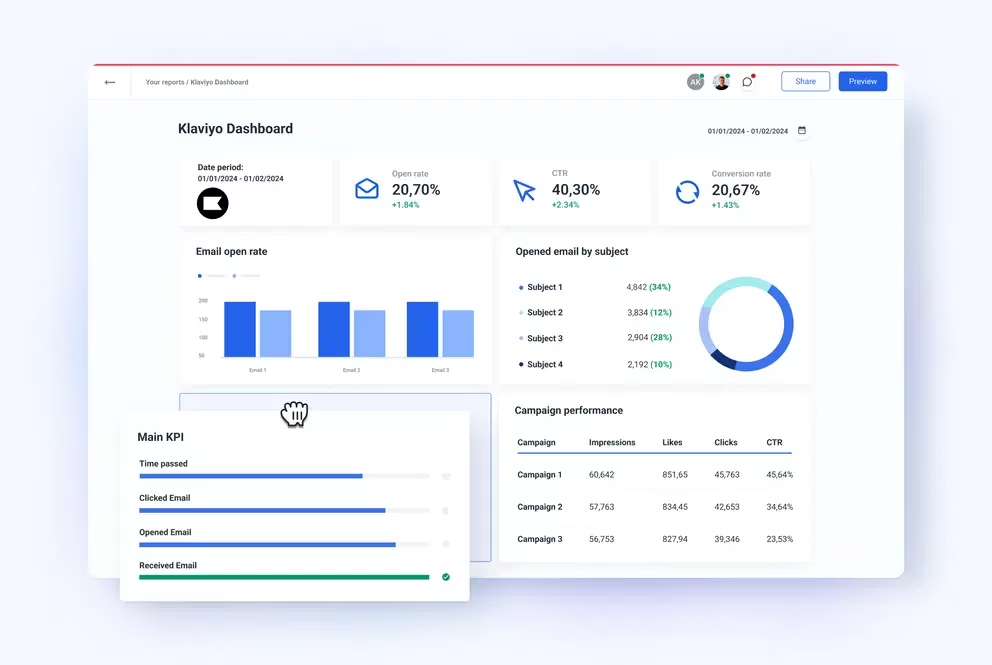
Klaviyo’s native Shopify integration pulls purchase history, browse behavior, product catalog data, and predictive customer lifetime value automatically — no webhooks, no manual configuration. This data isn’t just available for reporting; it feeds directly into segmentation and flow triggers. Abandoned cart flows can be structured as multi-step sequences with conditional branches based on cart value, product category, and customer purchase history simultaneously.
The predictive analytics layer — which flags customers at churn risk and predicts next purchase date — is genuinely differentiated. Competitors either lack this functionality or offer it as a separate paid add-on. Klaviyo includes it in all paid plans. AI-powered product recommendations inject dynamically into email templates based on each recipient’s browsing and purchase history, without requiring manual rule setup.
As of February 2025, Klaviyo moved to active-profile billing rather than total contact billing — a change that raised costs for some brands but aligns pricing more fairly to actual engagement. According to Axis Intelligence’s pricing cross-analysis, Klaviyo’s email plan costs $20/month for up to 500 active profiles, scaling to $150/month at 10,000 contacts and $720/month at 50,000 contacts. The Email + SMS plan starts at $35/month for 500 contacts.
Drawbacks
Pricing is the primary friction point. At 10,000 contacts, Klaviyo’s email plan runs $150/month — roughly double comparable Omnisend Standard tier pricing. The free plan caps at 250 active profiles and 500 email sends, which most stores exhaust within days of their first campaign. Customer support on the free plan is limited to the first 60 days, then reverts to self-serve documentation.
The platform has a steeper learning curve than Omnisend or Mailchimp. Teams without a dedicated email marketing owner will underutilize the feature set. And while the Klaviyo Shopify app is excellent, brands running on platforms outside Klaviyo’s core integrations will find the setup experience less seamless.
Best For: Mid-to-large e-commerce stores on Shopify or WooCommerce that want revenue attribution at the flow level, predictive CLV, and SMS in the same platform.
Pricing (June 2026):
- Free: 250 contacts, 500 emails/month
- Email: From $20/month (500 contacts), $150/month (10,000 contacts)
- Email + SMS: From $35/month (500 contacts)
2. Omnisend — Runner-Up
AEEMS™ Score: 8.30 | Best for: Multichannel e-commerce stores up to $5M ARR
Verdict: Omnisend earns its Runner-Up position by matching Klaviyo’s overall AEEMS™ score through a completely different value profile. Where Klaviyo dominates on data depth, Omnisend wins on multichannel efficiency, pricing fairness, and deployment speed. For stores that want email, SMS, and push notifications running in coordinated automation — without paying Klaviyo’s scaling premiums — Omnisend is the strongest platform in this field.
Standout Features
Omnisend’s multichannel automation builder is its clearest differentiator. A single workflow can branch based on channel preference, triggering an email for subscribers who haven’t opened in 7 days and an SMS for those who have — all within one sequence, without a separate SMS tool. Push notifications are included in the same workflow layer.
Ecommerce-specific features are native and don’t require configuration: product pickers, abandoned cart triggers, order confirmation sequences, and gamified signup forms (spin-the-wheel popups) are all available out of the box. Omnisend’s free plan includes unlimited contact segments and access to most e-commerce automation features — a meaningful advantage over Klaviyo’s feature-gated free tier.
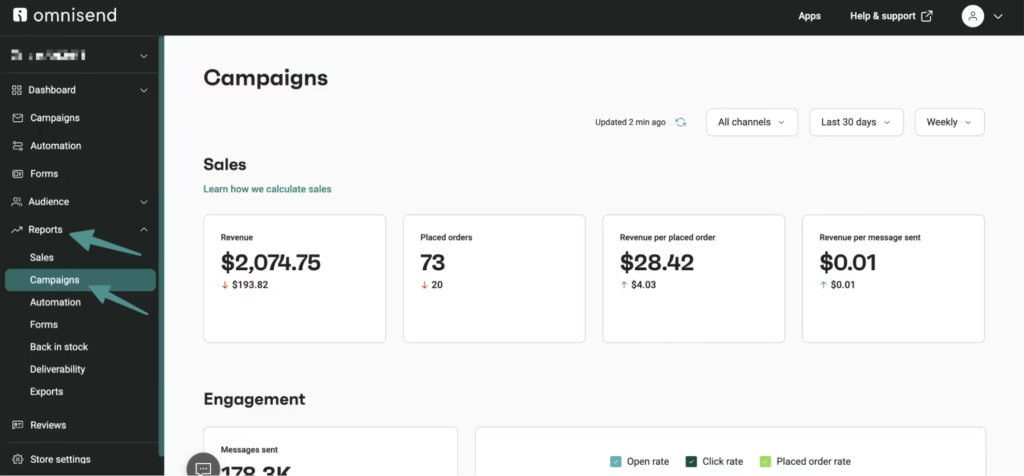
Per Axis Intelligence’s synthesis of current pricing data, Omnisend Standard starts at $16/month for 500 contacts. At 5,000 contacts, Omnisend typically runs 30–40% less than an equivalent Klaviyo plan. That gap compounds at scale.
Note for 2026: SMS is no longer available on Free and Standard plans for customers who subscribed on or after May 4, 2026. SMS access now requires the Pro plan.
Drawbacks
Omnisend’s segmentation and reporting don’t reach Klaviyo’s depth. Predictive CLV, churn risk scoring, and AI-powered product recommendations are either absent or less granular. For stores running complex multi-segment behavioral campaigns across large catalogs, Klaviyo’s data layer remains superior.
The integration library is smaller than Mailchimp’s or ActiveCampaign’s, and Omnisend is less suited to B2B or non-retail use cases — but this is by design.
Best For: Growing D2C stores on Shopify or BigCommerce that want email + SMS coordination without paying for a full Klaviyo stack.
Pricing (June 2026):
- Free: 500 emails/month, unlimited contacts
- Standard: From $16/month (500 contacts)
- Pro: From $59/month (500 contacts) — includes SMS for new subscribers
3. Drip — Best for DTC Retention
AEEMS™ Score: 8.20 | Best for: DTC brands focused on revenue attribution and retention automation
Verdict: Drip is purpose-built for one thing: connecting e-commerce customer behavior to automated revenue flows, and then showing you exactly how much each flow earns. It is not a general-purpose email tool. It is an e-commerce CRM (what Drip calls an “ECRM”) that happens to send email. Stores where the marketing team thinks in terms of LTV, purchase frequency, and churn risk will find Drip’s approach the most business-logic-native of any platform reviewed.
Standout Features
Drip’s visual workflow builder is designed around behavioral triggers specific to retail: purchase events, browse sessions, OMS data, cart abandonment, refund triggers, and integration-level events (Shopify, WooCommerce, BigCommerce). Multi-channel sequences combine email, on-site campaigns, and Facebook/Instagram retargeting in a single workflow — a capability that typically requires separate tools on other platforms.
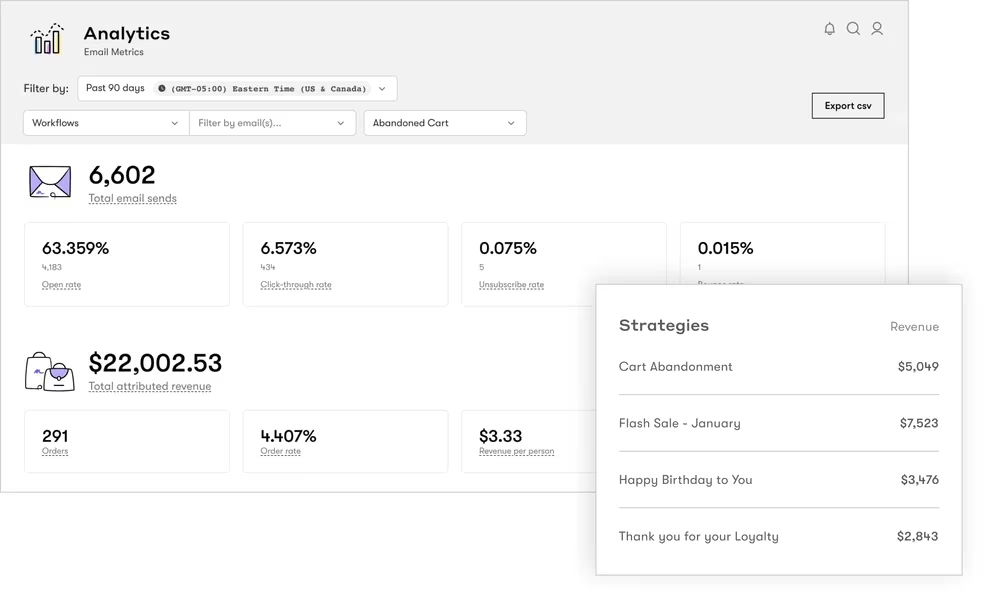
Revenue attribution in Drip is granular and enabled by default: every campaign and automation reports revenue down to the individual email. No add-on required. Drip’s contact-based pricing has a single tier — no feature gating between plan levels. Every feature is available from the entry plan. This “all features, one price” model means teams never face an upgrade paywall mid-build.
Drip starts at $39/month for up to 2,500 contacts with unlimited email sends, scaling to $89/month at 5,000 contacts and $154/month at 10,000 contacts.
Drawbacks
No free plan — a 14-day trial is the only entry point. The starting price ($39/month for 2,500 contacts) is higher than Klaviyo’s entry point and significantly higher than Omnisend’s. For stores under $200K in annual revenue, the cost-benefit math can be difficult to justify. There is also a steeper learning curve than Omnisend; new users without prior marketing automation experience typically need 2–3 weeks to deploy their first complex workflow.
Drip does not support interactive AMP emails, and its SMS functionality is handled via integration rather than natively — less seamless than Omnisend’s unified channel approach.
Best For: Established DTC brands on Shopify, WooCommerce, or BigCommerce generating $500K–$50M in annual revenue who need retention automation with accurate revenue tracking.
Pricing (June 2026):
- No free plan; 14-day trial
- From $39/month (up to 2,500 contacts, unlimited sends)
- $89/month (5,000 contacts)
- $154/month (10,000 contacts)
4. ActiveCampaign — Best for Complex Automation
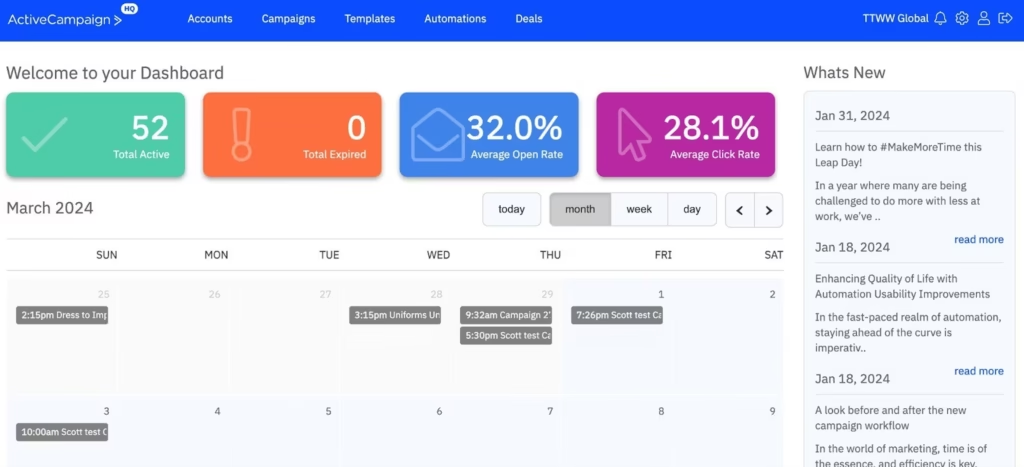
AEEMS™ Score: 7.15 | Best for: Stores with complex multi-step customer journeys
Verdict: ActiveCampaign is not a purpose-built e-commerce email platform. It is a marketing automation and CRM platform that happens to have excellent e-commerce integrations. For stores running multi-touch customer journeys that combine email marketing with sales pipeline management — particularly subscription brands, high-ticket retail, or stores selling both D2C and B2B — ActiveCampaign’s automation depth is unmatched at this price range.
Standout Features
ActiveCampaign’s automation builder supports 50+ step sequences with conditional branching, goal tracking, and multi-trigger logic. The 900+ pre-built automation recipes include proven e-commerce workflows — welcome series, abandoned cart, post-purchase, re-engagement — ready to deploy and customize. This is the deepest automation library of any platform reviewed.
The built-in CRM with deal pipelines is available on higher plans, making ActiveCampaign useful for stores with sales teams or high-ticket products where email marketing intersects with sales follow-up. Active Intelligence, ActiveCampaign’s AI layer, surfaces next-best-action recommendations at the campaign level, reducing the analytical burden on smaller teams.
Pricing starts at $19/month for 1,000 contacts (Starter plan) — though a key caveat applies: the Starter plan caps automations at 5 actions with no branching logic. Effective e-commerce automation requires the Plus plan, from approximately $59/month for 1,000 contacts.
Drawbacks
ActiveCampaign lacks Klaviyo’s predictive e-commerce analytics (CLV predictions, churn risk, product recommendations). Revenue attribution requires more manual configuration than Klaviyo or Drip. Its Shopify integration pulls in order data but the native connection is less fluid than Klaviyo’s or Omnisend’s for real-time behavioral triggers. For pure e-commerce use cases, both Klaviyo and Omnisend outperform it at comparable price points.
No free plan — only a 14-day trial.
Best For: Stores with complex subscription models, high-ticket products, or hybrid D2C/B2B workflows that need automation beyond standard e-commerce flows.
Pricing (June 2026):
- Starter: $19/month (1,000 contacts) — limited automation
- Plus: ~$59/month (1,000 contacts) — recommended for e-commerce
- Professional: ~$99/month (1,000 contacts)
5. Brevo — Best for Large Lists on Tight Budgets
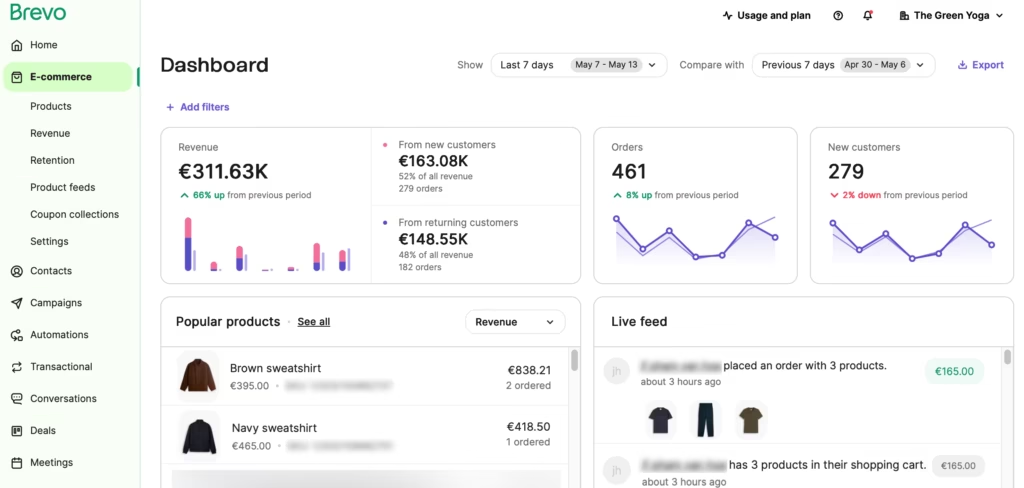
AEEMS™ Score: 6.55 | Best for: High-contact-count stores that send infrequently
Verdict: Brevo (formerly Sendinblue) earns its place in this ranking through a single structural advantage: it prices by email send volume, not contact count. For e-commerce stores that maintain large subscriber lists — seasonal buyers, past customers, loyalty program members — but don’t blast them daily, Brevo can deliver a cost saving of 60–70% versus contact-based platforms at equivalent list sizes.
Standout Features
Brevo’s pricing model is genuinely differentiated. The free plan includes up to 9,000 emails per month to unlimited contacts — most platforms cap free tiers at 250–500 contacts. Paid plans start at $9/month. For a store with 30,000 contacts that sends one campaign per week, Brevo costs a fraction of what Klaviyo or Omnisend would charge.
Brevo includes email, SMS, WhatsApp, and transactional email in a unified platform. The built-in CRM handles deal pipelines and contact management without requiring a separate tool. Automation workflows support multi-channel sequences including order confirmation transactional emails from the same platform as marketing campaigns.
Drawbacks
Brevo is not an e-commerce-native platform. Its e-commerce integrations are functional but less fluid than Klaviyo’s or Omnisend’s native connections. Behavioral segmentation based on purchase history and predictive analytics are not available. The automation logic is adequate for standard flows but doesn’t match ActiveCampaign’s depth or Klaviyo’s behavioral trigger sophistication.
For stores where email is a primary revenue driver and you’re actively using segmentation, Brevo will hit a ceiling. It works best as a cost-efficient broadcasting tool, not a behavioral marketing engine.
Best For: Large-list e-commerce stores that send infrequently, stores needing transactional + marketing email in one platform, or brands operating in EU markets that prioritize GDPR-compliant infrastructure.
Pricing (June 2026):
- Free: 9,000 emails/month, unlimited contacts
- Starter: $9/month (20,000 emails/month)
- Business: $18/month (20,000 emails/month) — includes marketing automation
6. Mailchimp — Best Known Name, Declining Value Proposition
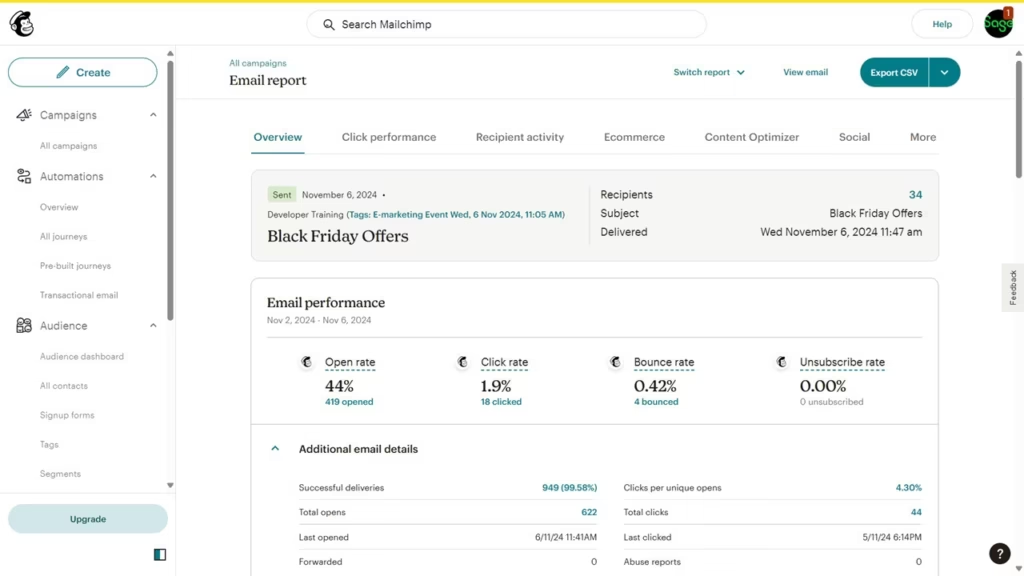
AEEMS™ Score: 5.75 | Best for: Starters who prioritize integrations and brand familiarity
Verdict: Mailchimp is the most recognized email marketing brand in the world. In 2026, it is no longer the best email marketing value for e-commerce stores of any meaningful scale. Its free plan has been significantly reduced. Its pricing scales steeply. Automation is paywalled in ways that disadvantage growing stores. Klaviyo, Omnisend, Brevo, and MailerLite all deliver more value per dollar for e-commerce-specific use cases.
That said, Mailchimp is not without merit. Its 800+ native integrations remain industry-leading. Its template library and drag-and-drop editor are polished. For a brand-new store needing a recognizable platform their team already knows, Mailchimp’s onboarding experience is among the smoothest in the field.
Standout Features
Mailchimp’s Shopify integration is native and pulls in order history, purchase data, and product catalog for dynamic content and predictive segmentation. Its Customer Journey Builder enables visual automation mapping. The Intuit partnership has added financial insights features unavailable elsewhere — useful for stores connecting marketing spend to profitability tracking.
Drawbacks
Abandoned cart recovery and advanced behavioral automation are locked to Standard plan ($20/month) and above. The free plan, once generous, now caps at 500 contacts and 1,000 email sends per month. At 10,000 contacts, Mailchimp’s Standard plan costs roughly $110/month — significantly more than Omnisend or Brevo at comparable list sizes, with less e-commerce-specific depth.
According to independent deliverability audits, Mailchimp’s inbox placement rates have declined modestly in recent years, likely attributable to the volume of low-engagement senders on shared infrastructure.
Best For: Brand-new stores wanting a known platform to start with, or stores deeply embedded in Mailchimp’s integration ecosystem with no compelling reason to migrate.
Pricing (June 2026):
- Free: 500 contacts, 1,000 emails/month
- Essentials: $13/month (500 contacts)
- Standard: $20/month (500 contacts) — required for abandoned cart automation
7. GetResponse — Best All-in-One Budget Option
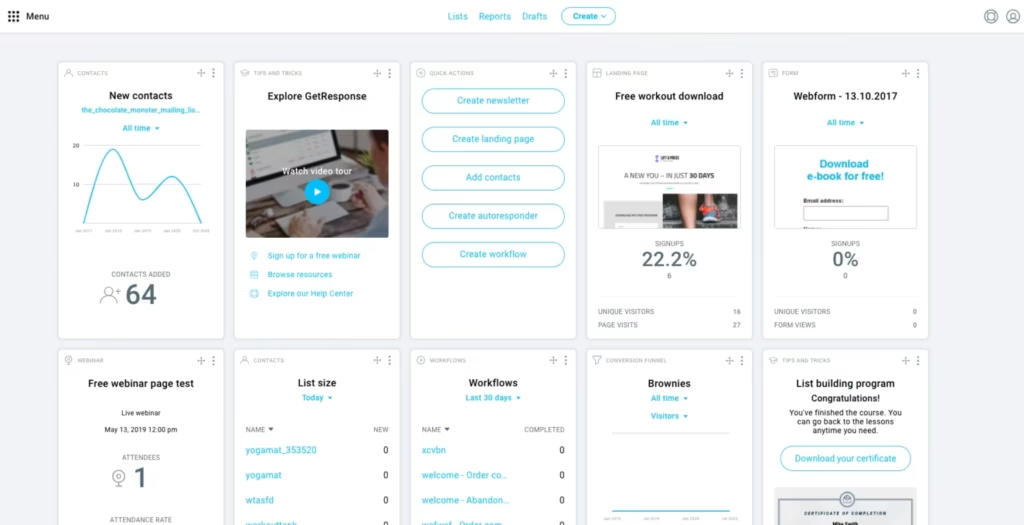
AEEMS™ Score: 6.50 | Best for: Stores wanting email + landing pages + webinars in one tool
Verdict: GetResponse occupies a distinctive niche in this field: it is the most feature-complete all-in-one marketing platform at accessible price points. For e-commerce operators who also run content marketing, online courses, or product launch webinars — and want all of it managed from a single dashboard — GetResponse’s breadth is unmatched at this price tier.
Standout Features
GetResponse includes email marketing, landing page builder, webinar hosting, sales funnel builder, and conversion funnels in plans starting at $15/month for 1,000 contacts. E-commerce automation includes abandoned cart, product recommendation, and transactional email flows. Integrations with Shopify, WooCommerce, Magento, and PrestaShop are available.
The GetResponse free plan covers up to 500 contacts with website builder access included — useful for stores in the early pre-revenue stage.
Drawbacks
GetResponse’s e-commerce-specific depth doesn’t match Klaviyo, Omnisend, or Drip. Revenue attribution is less granular. The platform tries to be everything to everyone, which means it doesn’t lead in any single dimension important to e-commerce teams. Behavioral segmentation based on in-session browse data is limited compared to the e-commerce native tools.
Best For: Early-stage stores or content-led e-commerce brands that need email, landing pages, and webinars without managing three separate tools.
Pricing (June 2026):
- Free: 500 contacts
- Email Marketing: $15/month (1,000 contacts)
- Marketing Automation: $49/month — includes e-commerce automation
8. MailerLite — Best for Simplicity
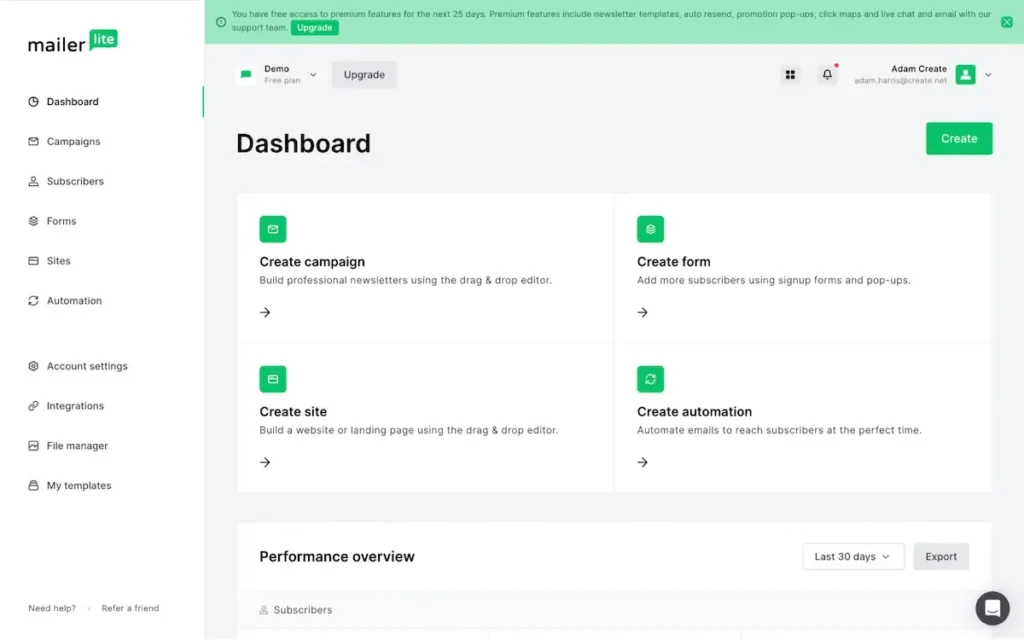
AEEMS™ Score: 6.00 | Best for: Solo operators and small stores prioritizing ease of use
Verdict: MailerLite consistently tops deliverability benchmarks, offers the fastest time-to-first-send of any platform reviewed, and provides the cleanest interface in this field. For solo e-commerce operators — a founder running a Shopify store without a dedicated marketing team — MailerLite’s simplicity is a genuine competitive advantage over the complexity of Klaviyo or ActiveCampaign.
Standout Features
MailerLite’s free plan is among the most generous for genuine e-commerce use: 1,000 contacts, 12,000 emails per month, automation access, and landing page builder included. The drag-and-drop editor is consistently ranked as the most intuitive in independent reviews. Setup from sign-up to first live campaign consistently takes under 30 minutes.
E-commerce integrations with Shopify and WooCommerce are available on paid plans. Abandoned cart, product recommendation, and purchase confirmation flows are all supported.
Drawbacks
MailerLite is not designed for revenue-driven e-commerce automation at scale. Behavioral segmentation based on purchase data is less granular than Klaviyo. Revenue attribution requires manual tagging. As stores grow beyond 10,000 contacts and begin running multi-segment behavioral campaigns, MailerLite’s ceiling becomes apparent.
Best For: Solo founders, early-stage stores under $100K annual revenue, or brands that tried Klaviyo and found it unnecessarily complex for their current stage.
Pricing (June 2026):
- Free: 1,000 contacts, 12,000 emails/month
- Growing Business: $9/month (1,000 contacts)
- Advanced: $19/month (1,000 contacts) — includes custom HTML, dedicated IP option
9. Sendlane — Best for Enterprise DTC Brands
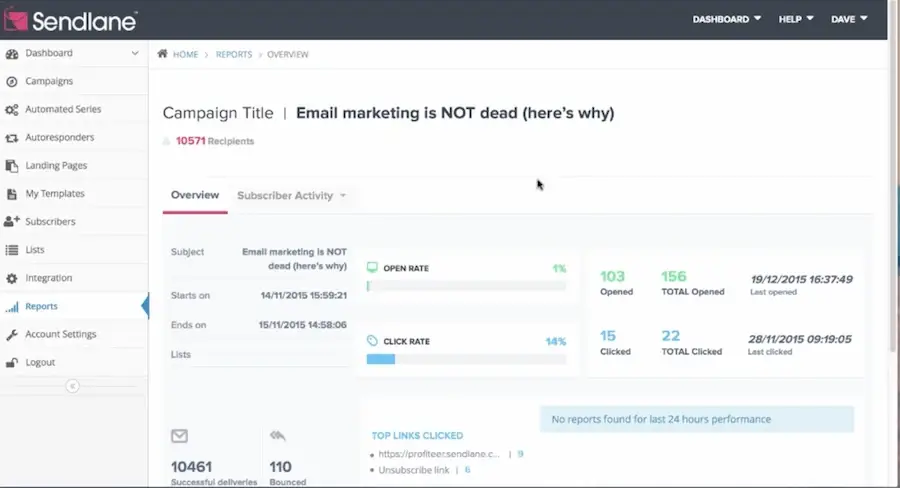
AEEMS™ Score: 7.70 | Best for: High-revenue DTC brands needing world-class support
Verdict: Sendlane is not a platform most e-commerce operators will encounter until they’ve scaled past the mid-market. Pricing starts at approximately $500/month for 500,000 email send credits — this is not a small-business tool. What Sendlane offers in return is an enterprise-grade e-commerce marketing platform with unified email, SMS, reviews, and forms management, combined with customer support that brands in the $10M+ revenue range consistently rate as best-in-class.
Standout Features
Sendlane’s behavioral tracking captures the full customer interaction layer: website visits, purchase history, refund events, and point-of-sale data, all feeding into automated segmentation. Send-time optimization uses machine learning to determine the individual-level optimal send window for each subscriber. Revenue attribution is detailed and built into the core platform — no add-on purchase required.
The enterprise tier includes a dedicated customer success manager, personal Slack channel, and proactive deliverability monitoring — service-level features unavailable on SMB-tier platforms. Sendlane’s 60-day free trial is unusually generous for an enterprise platform, allowing meaningful evaluation before commitment.
Drawbacks
The entry price point (~$500/month) disqualifies Sendlane for the vast majority of e-commerce stores in this review’s readership. The integration library is smaller than Klaviyo’s at equivalent tiers. Feature parity with Klaviyo on predictive analytics and AI-powered product recommendations is still developing.
Best For: DTC brands doing $10M+ in annual revenue that have outgrown mid-market platforms and need enterprise support infrastructure without moving to Braze or Iterable.
Pricing (June 2026):
- Growth Plan: ~$500/month (500,000 email send credits, unlimited contacts)
- Enterprise: Custom pricing — white-glove onboarding, dedicated CSM
How to Choose the Right E-commerce Email Marketing Platform
The single most useful question to answer before evaluating any platform on this list: what percentage of your store’s revenue comes from email?
If the answer is under 10%, you’re likely in a stage where simplicity and cost efficiency matter more than depth. Start with Omnisend’s free plan or MailerLite’s free plan. Deploy the four core flows — welcome series, abandoned cart, post-purchase, and winback — and measure what they produce before spending on advanced features you won’t use yet.
If the answer is 15–30% (typical for a well-run DTC brand), you need a platform that can attribute revenue at the flow level, segment by behavioral and predictive signals, and scale its automation logic as your catalog and list grow. That points to Klaviyo for Shopify-native stores, or Drip for DTC brands that want more retention-specific logic at a lower entry cost.
By store size:
Stores under $100K annual revenue should start free. Omnisend’s free plan and MailerLite’s free plan are both functional enough to run all four core e-commerce flows without paying. Save the platform investment for when email revenue justifies it.
Stores at $100K–$1M annual revenue need Omnisend Standard ($16/month and up) or Drip ($39/month and up). At this stage, multichannel coordination (email + SMS) and behavioral triggers start delivering meaningful lift. Klaviyo is justifiable here if the team has the bandwidth to use its analytics.
Stores at $1M–$10M annual revenue should be using Klaviyo or Drip. At this scale, the difference between platforms in revenue attribution accuracy and behavioral segmentation depth translates directly into measurable revenue. The cost of Klaviyo at 25,000–50,000 contacts ($500–720/month) is a rounding error against the revenue improvement it enables when used correctly.
Stores above $10M annual revenue should evaluate Klaviyo’s enterprise tier (Klaviyo One, required above $10,000/month spend) or Sendlane’s enterprise offering, depending on whether channel unification or support infrastructure is the higher priority.
Pricing model matters as much as the price:
Klaviyo, Omnisend, and Drip price by active contacts. Brevo prices by email send volume. For stores with large lists that send campaigns once a month, Brevo is almost always cheaper. For stores with smaller lists that send multiple campaigns weekly, contact-based pricing (Klaviyo, Omnisend) is typically more cost-efficient.
Platform ecosystem lock-in:
If your store is on Shopify, Klaviyo and Omnisend offer native app-store integrations that sync data without webhooks. If you’re on WooCommerce, all major platforms in this review support the integration, but Drip and Klaviyo have deeper WordPress/WooCommerce data connections. If you’re on a less common platform (Squarespace Commerce, BigCartel, Wix Stores), verify integration availability before committing.
FAQ: Best Email Marketing for E-commerce 2026
Is Klaviyo worth the cost for a small Shopify store?
For most stores under $50,000 in monthly revenue, Klaviyo’s cost is difficult to justify against the alternatives. Omnisend delivers comparable e-commerce automation at 30–40% lower cost at comparable contact tiers. Start with Omnisend Standard; migrate to Klaviyo when predictive CLV and advanced segmentation are features your team will actually use.
What’s the best free email marketing platform for e-commerce?
According to Axis Intelligence’s evaluation, Omnisend offers the best free plan purpose-built for e-commerce: 500 emails/month, unlimited contacts, and access to automated workflows including abandoned cart and welcome series. MailerLite’s free plan (1,000 contacts, 12,000 emails/month) is better for raw volume, but Omnisend’s free tier includes more e-commerce-native automation at equivalent contact counts.
Does email marketing still work for e-commerce in 2026?
Yes — email remains the highest-ROI direct marketing channel in e-commerce, consistently returning $36–$42 per dollar spent when campaigns are behavior-driven rather than broadcast-based. The shift in 2026 is that broadcast campaigns (same email to full list) are underperforming against behavioral flows (triggered by purchase, browse, and churn signals). Platforms that support the latter are where investment is justified.
What’s the difference between Klaviyo and Omnisend for Shopify stores?
Both integrate natively with Shopify. Klaviyo’s data layer is deeper — it syncs predictive lifetime value, churn risk scores, and browse-level behavioral data for advanced segmentation. Omnisend’s advantage is multichannel coordination (email + SMS + push in one workflow) at lower pricing. For Shopify stores generating under $500K/year, Omnisend is typically the better value. Above that threshold, Klaviyo’s analytics start justifying the premium.
How many emails should an e-commerce store send per month?
According to Axis Intelligence’s synthesis of industry benchmark data, e-commerce brands with healthy list engagement typically send 4–8 campaigns per month to their full subscriber base, plus automated flows (abandoned cart, post-purchase, welcome series) running continuously. High-frequency senders (daily campaigns) see engagement decay faster. The optimal frequency is list-specific — most platforms’ analytics will show you the engagement curve for your own audience.
Is Mailchimp good for e-commerce in 2026?
Mailchimp remains functional for small stores just getting started. It’s no longer the best value at any meaningful scale. At 10,000 contacts, Mailchimp’s Standard plan costs roughly double what Omnisend charges for a feature set that’s less e-commerce-native. Its automation requires Standard plan access for abandoned cart recovery — a basic e-commerce capability that should be available at entry pricing.
What is the easiest email marketing platform to set up for e-commerce?
MailerLite has the fastest time-to-first-send of any platform reviewed — most users reach their first live campaign within 30 minutes of signup. Omnisend is the easiest platform with native e-commerce automation built in. Klaviyo and ActiveCampaign have steeper setup curves that require 1–2 weeks of onboarding to use effectively.
Does Brevo work for Shopify?
Yes, Brevo integrates with Shopify and can trigger basic e-commerce flows including abandoned cart and order confirmations. The integration is less native than Klaviyo’s or Omnisend’s — some behavioral triggers require additional configuration. Brevo’s primary advantage for Shopify stores is its send-volume pricing model, which saves money for stores with large lists that don’t send frequently.
What’s the best email marketing platform for WooCommerce?
Klaviyo, Drip, Omnisend, and ActiveCampaign all support WooCommerce with plugin-based integrations. Drip’s WooCommerce integration is particularly well-regarded for its behavioral data depth. Omnisend’s WooCommerce plugin is highly rated in the WordPress repository and installs without developer assistance.
How do I switch email marketing platforms without losing my automations?
Export your contact list as CSV from the current platform. Document your existing automation logic (trigger, conditions, emails, timing). Import contacts to the new platform — all platforms in this review support CSV import. Rebuild automations using the new platform’s templates as a starting point. Run both platforms simultaneously for 2–4 weeks to verify automations are firing correctly before fully decommissioning the old platform.
What email metrics should e-commerce stores track in 2026?
Beyond open and click rates, e-commerce-specific metrics that matter: revenue per email (total flow revenue ÷ emails sent), revenue per subscriber per month, abandoned cart recovery rate (recovered carts ÷ triggered abandonments), and email-attributed revenue as a percentage of total store revenue. Platforms like Klaviyo and Drip report these by default; others require manual tracking via UTM parameters.
Should I choose email-only or email + SMS combined?
According to Axis Intelligence’s reading of current DTC retention data, stores using coordinated email + SMS automation consistently see 15–25% higher abandoned cart recovery rates than email-only. The channel coordination is most valuable for abandoned cart and winback flows, where SMS as a follow-up 4–6 hours after an abandoned cart email triggers a meaningful response uplift. Omnisend includes this coordination natively; Klaviyo and Drip handle it via their respective SMS modules.