

Stablecoin Card Statistics 2026
By Axis Intelligence Research
Co-author: Sarah Davis, Digital Finance & Fintech | Last updated: September 20, 2026 | License: CC BY 4.0
More than 160 stablecoin-linked card programs were live on Visa’s network in its fiscal second quarter of 2026, with payment volume up nearly 200% year over year. Axis Intelligence Research finds that all of that activity still amounts to 5.7 basis points of Visa’s payments volume — the number that puts the growth rate in proportion.
Quick Answer
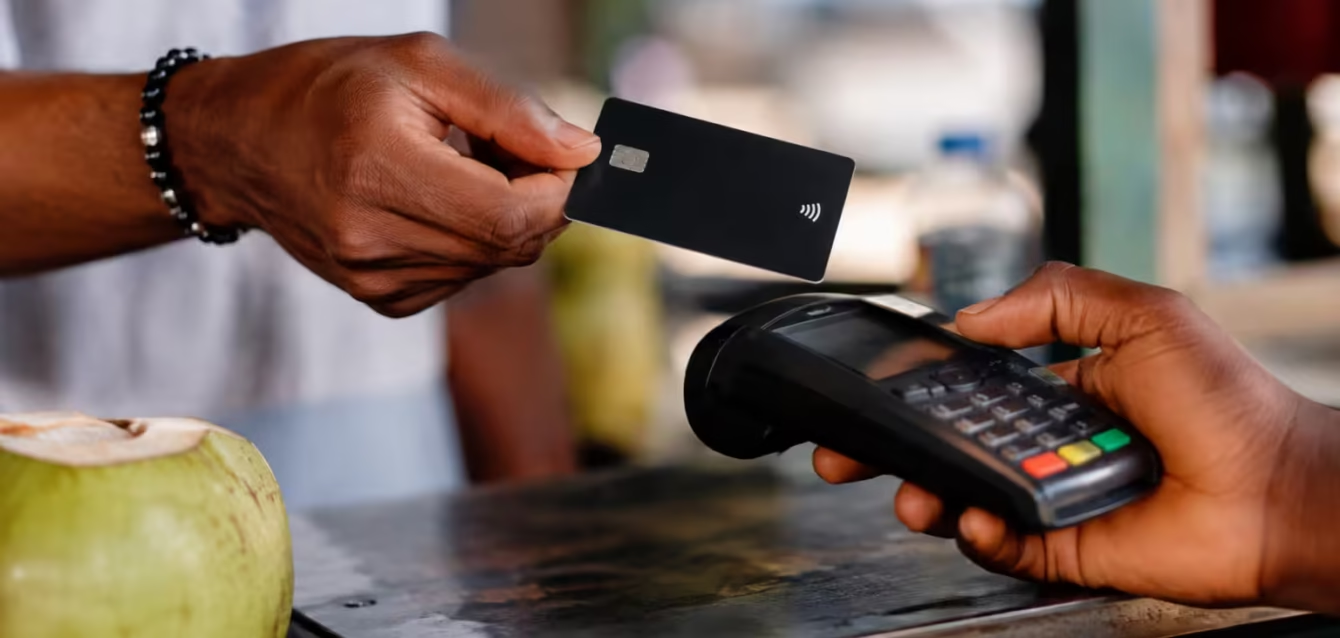
Stablecoin cards let a cardholder spend a dollar-pegged token at any merchant on an existing card network; the balance is converted at authorization and the merchant is paid in local currency. As of September 2026, Visa reports more than 160 live stablecoin-linked card programs and a $20 billion annualized stablecoin settlement run rate, up more than 15x year over year. Tracked consumer card spend funded by stablecoins ran at $759 million in July 2026 across nearly 9 million purchases, later revised to $1.04 billion. Axis Intelligence Research’s Stablecoin Card Penetration Ratio (SCPR) reads 5.68 basis points of Visa payments volume — 7.79 bp on the revised data.
Key Findings
- According to Visa, more than 160 stablecoin-linked card programs were live globally in its fiscal second quarter of 2026, with payment volume on those programs up nearly 200% year over year.
- Visa’s stablecoin settlement volume surpassed a $20 billion annualized run rate as of September 8, 2026, up more than 15x year over year and up from $7 billion in April 2026.
- Axis Intelligence Research finds that stablecoin-funded card spend equals 5.68 basis points of Visa’s annualized payments volume, measured against $16.02 trillion for the quarter ended June 30, 2026.
- Dollar-pegged tokens funded 84% of tracked crypto card spend in July 2026 — USDC 58%, USDT 26% — against 88% for the euro-backed EURe in early 2024.
- Axis Intelligence Research finds three programs accounted for 77.1% of tracked stablecoin card volume in July 2026, making the category’s headline totals a function of three issuers’ reporting.
How Big Is the Stablecoin Card Market in 2026?
Three different numbers get quoted as “the stablecoin card market,” and they measure three different things. Getting them confused is how a $759 million market becomes a $33 trillion one in a headline.
Cardholder spend is what people actually buy: $759 million in July 2026 across the programs tracked by Paymentscan, per a16z crypto’s August 7, 2026 analysis. Network settlement is what issuers and acquirers move to and from the network to clear those transactions: Visa’s $20 billion annualized run rate. On-chain stablecoin transfer volume is everything the tokens do, most of it trading and treasury movement, and it has nothing to do with cards.
| Measure | Value | As of | Source |
|---|---|---|---|
| Tracked stablecoin-funded card spend, monthly | $759M | July 2026 | a16z crypto / Paymentscan |
| Same reading, revised | $1.04B | July 2026 | Paymentscan, reported August 23, 2026 |
| Visa stablecoin settlement, annualized run rate | $20B | September 8, 2026 | Visa |
| Visa payments volume, quarter ended June 30, 2026 | $4,006B | Q3 FY2026 | Visa |
| Live stablecoin-linked card programs, Visa | 160+ | Q2 FY2026 | Visa |
Note the direction of the gap. Visa’s settlement run rate is 2.2x annualized tracked card spend. That is not a contradiction: settlement covers every program on the network, including corporate and business cards that no consumer tracker sees, while Paymentscan observes a defined set of programs on-chain. The two series are not substitutes, and anyone adding them together is double-counting.
Sarah Davis: The spread between those two numbers is the most useful thing on this page. When a category’s settlement flow runs at twice its observable consumer spend, the volume is sitting in business cards — advertising buys, supplier payments, contractor payouts — not in coffee purchases. Visa said as much on its April call: businesses using stablecoin-linked cards to buy digital advertising and supplies. The consumer story is the one that gets written; the commercial spend is the one that pays the interchange.
Source: Axis Intelligence Research — CC BY 4.0
The Stablecoin Card Penetration Ratio (SCPR)
SCPR — Stablecoin Card Penetration Ratio. Annualized stablecoin-funded card spend divided by annualized network payments volume, expressed in basis points.
Formula: SCPR = (monthly tracked card spend × 12) ÷ (quarterly network payments volume × 4) × 10,000
Inputs and computation, September 2026 baseline:
- Numerator: $759,000,000 × 12 = $9.108 billion
- Denominator: $4,006,000,000,000 × 4 = $16.024 trillion
- SCPR = 9.108 ÷ 16,024 × 10,000 = 5.68 basis points
- On the revised $1.04 billion monthly reading: 12.48 ÷ 16,024 × 10,000 = 7.79 basis points
Both numerator and denominator are run rates, which is deliberate — a run-rate numerator divided by a trailing annual denominator would flatter the ratio during a growth phase. The same construction applied to Visa’s own settlement figure gives a settlement penetration of 12.48 bp.
| SCPR component | Reading | Basis |
|---|---|---|
| SCPR, conservative | 5.68 bp | $759M monthly spend, August 7, 2026 data |
| SCPR, revised | 7.79 bp | $1.04B monthly spend, August 23, 2026 data |
| Settlement penetration | 12.48 bp | Visa $20B annualized run rate |
| Settlement-to-spend multiple | 2.20x | $20B ÷ $9.108B |
Why basis points rather than percentages: because at this scale percentages round to zero and stop being useful. A category growing 200% a year from 5.68 bp reaches roughly 17 bp in twelve months and 51 bp in twenty-four. It crosses one percent of Visa’s volume somewhere past 2029 on that trajectory. That is a real business and a poor candidate for the word disruption.
Who Issues Stablecoin Cards? The Three-Layer Stack
A stablecoin card has more parties behind it than a bank debit card, and the money splits differently at each layer.
Networks
Visa and Mastercard carry essentially all of it. a16z’s tracked programs settle “almost entirely through Visa.” Mastercard took a different route to the same place: it completed its acquisition of stablecoin infrastructure provider BVNK on August 3, 2026, for up to $1.8 billion including $300 million in contingent payments. Visa rented the plumbing through partnerships; Mastercard bought it.
Issuer platforms and BIN sponsors
This is where the programs actually live. Rain, a Visa Principal Member, powers card programs globally and sponsors BINs for programs including Karta, Moto and Xplace. Bridge, a Stripe company, issues through a partnership with Lead Bank. Reap operates as a Visa principal issuer across Asia and the Middle East. StraitsX supplies card infrastructure to other crypto firms and reported a 40-fold increase in transaction volume on that infrastructure between the fourth quarters of 2024 and 2025.
Consumer and business programs
RedotPay, ether.fi Cash, KAST, Gnosis Pay, Oobit, the Binance Card, Kraken’s Krak Card, Coinbase One Card, Phantom and MetaMask. This is the layer users recognize and the layer with the least pricing power.
| Program | July 2026 monthly volume | Share of tracked total | Source basis |
|---|---|---|---|
| RedotPay | $395.1M | 52.1% | Self-reported by issuer |
| ether.fi | $100.3M | 13.2% | Purchase volume, excludes ~$30M fiat transfers |
| KAST | $89.6M | 11.8% | Observed |
| All other tracked programs | $173.9M | 22.9% | Observed |
| Tracked total | $759.0M | 100% | Paymentscan |
Axis Intelligence Research finds the top three programs account for 77.1% of tracked volume. One of those three reports its own numbers. That single fact should govern how anyone reads a market-size claim in this category — including this one.
Sarah Davis: Follow the money and it lands in the middle layer. The issuer platform earns interchange, takes the conversion spread on every authorization, and — where it custodies balances — earns the float. The consumer program gets whatever it can negotiate and pays for acquisition. That is why the venture capital went to Rain and Bridge rather than to the apps with the logos on the cards. The card is the front door; the BIN is the building.
Which Countries Have Stablecoin Cards, and Where Are They Actually Used?
Issuance footprint and spending footprint are not the same map, and the gap between them is the most under-reported thing in this category.
Issuance. Bridge-enabled stablecoin-linked Visa cards were live in 18 countries as of March 3, 2026, with planned expansion to over 100 countries across Europe, Asia Pacific, Africa and the Middle East by year-end.
Acceptance. Once issued, the card works at Visa’s 175 million-plus merchant locations. A card issued in one of 18 countries spends in more than 200.
That asymmetry is the entire product. The constraint is licensing and BIN sponsorship on the issuing side, not merchant acceptance on the spending side — the opposite of every “merchants must accept crypto” framing the category inherited.
Regional demand: the growth is inversely correlated with GDP
| Market segment | Growth measure | Period | Source |
|---|---|---|---|
| Lower-GDP markets | +600% gross transaction value | Mar 2025 – Feb 2026 | StraitsX |
| Higher-GDP markets | +150% gross transaction value | Mar 2025 – Feb 2026 | StraitsX |
| Brazil (Binance Card) | Users +53%, average volume +80% | Launch quarter – Q2 2026 | Binance |
| Argentina (Oobit) | 72% of payments funded in USDT | August 2026 | Oobit |
The category composition data is blunt. In Brazil, Oobit reports active users spending about $400 a month across roughly 20 transactions, with grocery stores accounting for 35% of regional activity. In Argentina, food represents 41% of transactions. Kraken reports weekly payments per user of 8.3, more than double a year earlier, with retail and store purchases at 59.3% of spend.
Twenty transactions a month at a grocery store is not an off-ramp. It is a current account.
Visa’s own regional payments volume gives the denominator that regional card growth has to be measured against:
| Region | Visa payments volume, quarter ended June 30, 2026 | Source |
|---|---|---|
| United States | $1,940B | Visa |
| Europe | $871B | Visa |
| Asia Pacific | $532B | Visa |
| Latin America & Caribbean | $292B | Visa |
| CEMEA | $253B | Visa |
| Canada | $118B | Visa |
| Total | $4,006B | Visa |
Latin America and CEMEA together are $545 billion a quarter — 13.6% of Visa’s volume. They are also where the stablecoin card growth rates are four times the rest of the world. A category can grow 600% in a market that represents a seventh of the network and still barely move the global ratio. Both things are true at once, and most coverage picks one.
What Funds a Stablecoin Card? USDC, USDT and the Euro That Disappeared
The funding-asset mix flipped completely in two years.
| Funding asset | Early 2024 share | July 2026 share | Change |
|---|---|---|---|
| EURe (euro-backed) | ~88% | ~2% | −86 pts |
| USDC | ~48% (July 2025) | ~58% | +10 pts YoY |
| USDT | ~7% (July 2025) | ~26% | +19 pts YoY |
Source for all rows: a16z crypto / Paymentscan, July 2026 reading.
Early card spend was a Gnosis Pay phenomenon settling in euros on one chain. Dollar tokens took the category as soon as it left Europe. USDT’s move from 7% to 26% in a year is the sharper signal: USDT is the emerging-market funding asset, and its share is a proxy for how much of the growth came from Latin America, Africa and Asia rather than from European early adopters.
Settlement chains fragmented the same way:
| Chain | Share of card settlement volume, July 2026 |
|---|---|
| Optimism | ~29% |
| Solana | ~19% |
| Base | ~19% |
| Gnosis | ~2% |
| Other | ~31% |
Source: a16z crypto / Paymentscan.
Gnosis went from carrying effectively the whole tracked market in early 2024 to 2%. No chain holds a third. For an issuer platform, that means multi-chain treasury operations are not optional, and reconciliation cost scales with the number of chains a program supports.
Why Do Stablecoin Card Programs Need Working Capital?
This is the part of the business that nobody markets and everybody underwrites, and in 2026 it became the actual constraint on how many programs can exist.
A card program pays the network daily before it collects from cardholders. Visa put the problem plainly: many stablecoin-linked programs settle every day including weekends and holidays, and often need capital “well below the size at which warehouse economics typically work” — a first-year program might need a few million dollars, drawn and repaid daily, secured against receivables it only recently started generating.
The structure that emerged uses the settlement receivable itself as collateral. Credit Coop’s facility routes settlement proceeds through a smart contract before they reach the borrower’s operating account, functioning as a programmatic lockbox. Visa disclosed the performance record on September 8, 2026:
| Metric | Value | Scope |
|---|---|---|
| Cumulative financed settlement volume | $2.5B+ | Credit Coop platform since 2023 |
| Defaults | Zero | As of August 19, 2026 |
| On-chain borrow events | 3,000+ | Platform total |
| On-chain repayment events | 9,000+ | Platform total |
| Rain cumulative volume financed | ~$2B | Since August 2023 |
| Rain interest paid to date | $1.58M+ | Since August 2023 |
| Borrowing cost reduction | Up to 30% | Participating programs |
Source: Visa, September 8, 2026.
Axis Intelligence Research notes that roughly $2 billion of the $2.5 billion — 80% — is attributable to a single borrower, Rain. A zero-default record across one large, three-year relationship is a different credit signal from a zero-default record across a diversified book, and the two should not be quoted interchangeably. Visa’s own footnotes flag that the on-chain counts are as of August 19, 2026 and that the figures are supplied by Credit Coop.
Karta is the proof-of-concept Visa points to: a US premium travel card operating under Rain’s BIN that launched on a small Credit Coop facility and, on the strength of 10x growth in 2025, raised $140 million in June 2026 — a $15 million Series A led by Galaxy Ventures plus a $125 million institutional facility from Community Investment Management.
Sarah Davis: $1.58 million of interest against $2 billion of financed volume works out to about 8 basis points of cumulative volume, on capital that turns over daily. That is not a lending business in the usual sense; it is a plumbing fee. The margin is thin because the exposure window is hours. Which is exactly why it works at facility sizes where a documented warehouse line does not — and why the interesting question is not the default rate but what happens to it the first time a program’s cardholder collections slip by a day.
How Does Regulation Shape Stablecoin Card Economics?
The GENIUS Act prohibits permitted payment stablecoin issuers from paying interest or yield to holders. That single clause reshapes the card stack, because it pushes the economics of an idle balance out of the issuer layer and into the program layer.
The practical consequence: a program cannot legally be sold on “your stablecoin earns while it sits.” What it can be sold on is interchange-funded rewards, and that is a materially thinner proposition. It also explains why cards became the distribution strategy for stablecoin businesses in 2026 rather than savings products — spending is the use case the regulation leaves open.
Mastercard’s framing in its March 2026 acquisition release sizes the addressable pool differently: digital currency payment use cases reached at least $350 billion in volume in 2025. Cards are a small slice of that, and the largest slices — cross-border B2B, payouts, treasury — are where both networks are pointing their infrastructure. The card is the consumer-visible edge of a settlement business.
For adjacent context, our stablecoin issuer and reserve analysis covers the supply-side concentration behind these tokens, and our bank-issued deposit token tracking covers the institutional alternative that banks are building instead.
Why Do Stablecoin Card Statistics Disagree So Much?
Because the tracker revises, and most publishers quote whichever reading they saw first.
The same July 2026 figure from the same dataset was published at $759 million on August 7, 2026 and reported at $1.04 billion on August 23, 2026 — a 37.0% upward revision in sixteen days. The composition data published alongside it did not move with it: the three named program volumes ($395.1M, $100.3M, $89.6M) sum to 77.1% of $759 million, not of $1.04 billion.
Axis Intelligence Research uses the $759 million figure for all composition and ratio work on this page because it is internally consistent with the program-level and asset-mix breakdowns, and reports the $1.04 billion reading as the revised headline. Anyone building on this dataset should date every figure they take from it.
Two further reasons the numbers diverge:
- Self-reporting. The largest program’s volume is supplied by the issuer, not observed on-chain. It is 52% of the tracked total.
- Definitional scope. “Crypto card spend” sometimes includes non-stablecoin funding and fiat transfers. ether.fi’s $100.3 million is purchase volume excluding roughly $30 million of fiat transfers; Coinbase reports about 16% of its combined card volume involving USDC, with the rest funded by other assets and bank transfers.
That last figure is worth sitting with. Coinbase holds $20 billion of USDC across its products, up 44% year over year, while USDC funds 16% of its card volume and active Coinbase One cardholders spend roughly $3,000 a month. Holding and spending are still two different behaviors on the same balance.
Methodology
Collection. Every figure on this page was retrieved from a source document opened during production on September 18, 2026. Network figures come from Visa’s September 8, 2026 publication on stablecoin card settlement financing, Visa’s fiscal third quarter 2026 earnings release and operational performance data (quarter ended June 30, 2026), the March 3, 2026 Visa–Bridge announcement, and Mastercard’s March 17 and August 3, 2026 releases. Card spend, funding-asset mix and settlement-chain composition come from a16z crypto’s published analysis of Paymentscan data. Program-level and operator figures are attributed in the CSV with an is_primary flag; company-reported operator figures are marked as such.
SCPR construction. SCPR = (monthly tracked stablecoin-funded card spend × 12) ÷ (quarterly network payments volume × 4) × 10,000. Denominator is the sum of Visa’s six disclosed regional payments volumes for the quarter ended June 30, 2026: 1,940 + 871 + 532 + 292 + 253 + 118 = $4,006 billion. Both sides are run rates, so the ratio is scale-consistent during a growth phase. Readings carry the date of the underlying spend observation, not the publication date.
What SCPR measures. It measures observable stablecoin-funded card spend against the acceptance network that clears it. It excludes stablecoin card programs outside the tracked set, business and commercial card programs not visible to on-chain trackers, and Mastercard-routed volume, which is not separately disclosed. It is therefore a floor, not a ceiling — which is why the settlement penetration ratio of 12.48 bp is published alongside it.
Cross-check. Program-level volumes were verified to sum to the stated concentration share against the $759 million total rather than the revised total. Regional payments volumes were verified to sum to the stated quarterly figure. All Axis-calculated rows in the CSV carry their formula in method_note.
About This Dataset
stablecoin-card-statistics.csv contains every figure cited on this page, one row per observation, with source organization, source document, URL, retrieval date, primary-source flag and — for Axis-calculated rows — the formula used. Released under CC BY 4.0.
Citation: Axis Intelligence Research, Stablecoin Card Statistics 2026: Programs, Spend, Issuers and Country Coverage, 2026.
APA: Axis Intelligence Research. (2026). Stablecoin card statistics 2026: Programs, spend, issuers and country coverage. https://axis-intelligence.com/stablecoin-card-statistics/
MLA: Axis Intelligence Research. “Stablecoin Card Statistics 2026: Programs, Spend, Issuers and Country Coverage.” Axis Intelligence, 2026, axis-intelligence.com/stablecoin-card-statistics/.
Chicago: Axis Intelligence Research. “Stablecoin Card Statistics 2026: Programs, Spend, Issuers and Country Coverage.” Axis Intelligence. 2026. https://axis-intelligence.com/stablecoin-card-statistics/.
Frequently Asked Questions
Does a merchant have to accept crypto for a stablecoin card to work?
No, and this is the design point. The conversion happens at authorization inside the issuer stack. The merchant receives local currency through the same acquiring relationship it already has and sees an ordinary card transaction. Merchant acceptance was never the constraint; issuing licences are.
Who is the issuer of record on a stablecoin card, and why does it matter?
Usually a sponsor bank or a network Principal Member, not the app whose logo is on the card. Bridge issues through Lead Bank; Karta, Moto and Xplace all run under Rain’s BIN. It matters because the issuer of record holds the network licence, the compliance obligation and the settlement liability. If the consumer-facing program fails, the BIN sponsor’s arrangements determine what happens to cardholder balances.
Why does a program need a credit facility if cardholders prefund their balances?
Because network settlement and cardholder collection do not happen at the same time. The program owes Visa daily — weekends and holidays included — before the corresponding funds are available to it. That gap is a working capital requirement regardless of whether the underlying balance is prefunded, and Visa identified it as a binding constraint on early-stage programs in September 2026.
Does the GENIUS Act ban on issuer yield stop stablecoin cards from paying rewards?
The prohibition applies to permitted payment stablecoin issuers paying interest or yield to holders for holding the token. Rewards funded from interchange on card spend are a different revenue source and a different legal question. The practical effect is that programs compete on spend-based rewards rather than on balance yield.
Which blockchain settles the most stablecoin card spend?
Optimism, at roughly 29% of tracked card settlement volume in July 2026, followed by Solana and Base at about 19% each. No chain holds a third. Gnosis, which carried effectively the entire tracked market in early 2024, is now around 2%.
Why is USDT gaining share on cards while USDC still leads?
USDC holds about 58% of tracked card spend and USDT about 26%, up from roughly 7% a year earlier. USDT’s gain tracks where the growth is coming from: Oobit reports 72% of its Argentine payments funded in USDT. Funding-asset share on cards is substantially a geography question, not a product-preference question.
Are stablecoin card balances protected the way bank deposits are?
Card network protections apply at the point of sale in the usual way. The stablecoin balance behind the card is a separate question that depends on the custody model — deposited with the issuer, or held in a self-custodial wallet — and on the licences the program operates under. Deposit insurance does not attach to a stablecoin balance by default.
Why do published stablecoin card market sizes differ by 40%?
Because the main tracker revises. The July 2026 reading was published at $759 million on August 7 and reported at $1.04 billion on August 23 — a 37% revision to the same month. Composition data published alongside the earlier figure was not restated. Any figure quoted from this category needs its observation date attached.
How does stablecoin card spend compare with instant payment rails?
Different rails, different scale. Our instant payments data covers FedNow and RTP volumes, and our agentic payments analysis covers the AI-initiated transaction rails now being built alongside both. Stablecoin cards sit on existing card infrastructure; instant payment rails replace it.
Is Mastercard behind Visa in stablecoin cards?
Visa discloses program counts and a settlement run rate; Mastercard does not disclose equivalent card-level metrics, so a direct comparison is not available from primary sources. Mastercard’s disclosed move is structural — it bought BVNK outright on August 3, 2026 rather than partnering for the infrastructure. Related reading: our institutional tokenization coverage, tokenized Treasury fund data, CBDC programme tracking and Stripe payment volume analysis.