

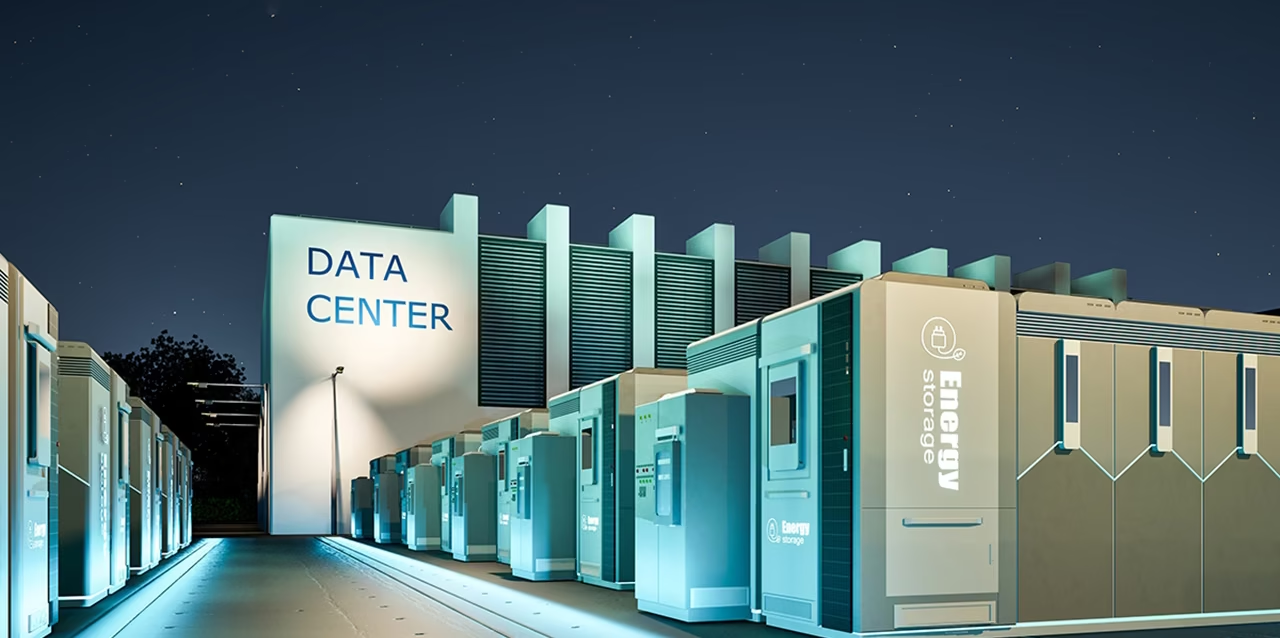
Data Center Battery Storage Statistics 2026
By Axis Intelligence Research
Co-author: Aidan Jad | Last updated: July 29, 2026 | License: CC BY 4.0
The International Energy Agency projects 20–25 gigawatts of battery storage installed inside data centers globally by 2030 — a figure that would convert the world’s most power-hungry facilities from passive grid loads into active grid assets. In the United States alone, the Energy Information Administration expects 24 GW of new utility-scale battery storage to come online in 2026, surpassing 2025’s record 15 GW. The inflection has arrived.
Quick Answer
Battery storage is now integral to data center power infrastructure. The IEA projects 20–25 GW of battery capacity installed in data centers globally by 2030. The U.S. added a record 9.7 GWh of BESS capacity in Q1 2026 alone — up 32% year-over-year — while AI workloads are accelerating the chemistry shift from lead-acid to lithium iron phosphate (LFP). Installed costs for data-center-grade LFP systems run $380–$520 per kWh in 2026, down from $550–$700 in 2022.
Key Findings
- The International Energy Agency projects 20–25 GW of battery storage could be installed in data centers globally by 2030, potentially converting facilities from grid loads to grid assets (IEA, Key Questions on Energy and AI, 2026).
- The U.S. recorded 9.7 GWh of battery energy storage system (BESS) installations in Q1 2026 — the largest single quarter in history, up 32% year-over-year — driven partly by data center power demand (SEIA, Energy Storage Market Outlook Q2 2026, May 2026).
- AI dynamic power — the sub-second load swings exceeding 50% of rated capacity characteristic of GPU-dense workloads — ranks as the second most cited driver of energy storage technology change among data center operators, cited by 49% of respondents, behind only cost at 58% (ZincFive / Endeavor Business Intelligence, Data Center Energy Storage Industry Insights Report 2026, January–February 2026, n=150).
- Average total installed costs for data-center-grade LFP-based BESS have fallen to $380–$520 per kWh in 2026, a decline of roughly 25–30% from $550–$700 per kWh in 2022, as cell commoditization and manufacturing scale compound (IndexBox, U.S. Data Center Battery Market, 2026).
- Meta signed a reservation agreement in April 2026 for up to 1 GW / 100 GWh of ultra-long-duration energy storage from Noon Energy — the largest data center BESS contract ever recorded by energy capacity, roughly four times the previous record — signaling that hyperscalers are moving beyond lithium-ion for multi-day storage needs (GlobeNewswire / Noon Energy, April 21, 2026).
Source: Axis Intelligence Research — CC BY 4.0
Why Battery Storage Has Become a Data Center Imperative
Traditional data center battery infrastructure had a single job: keep the lights on for 10–15 minutes until backup generators came online. That job is not gone, but it is now the least interesting thing a data center battery does.
Two forces changed the calculus. First, AI training and inference workloads introduced power variability that earlier data center designs never had to absorb. The IEA quantified this precisely in its 2026 Key Questions on Energy and AI report: AI servers see repeated load swings exceeding 50% of rated capacity within a single second. A conventional utility grid is not designed to absorb that kind of variability from a single point of consumption without localized voltage instability. Battery storage smooths the grid interface — absorbing the spikes, filling the troughs — so the facility draws a stable load while the GPU cluster does whatever it does.
Second, grid interconnection queues have become a hard constraint on data center growth. The average wait for a new transmission interconnection in the United States is four years, according to IEA analysis. A 31 MW / 62 MWh battery energy storage system deployed at Aligned Data Centers’ Pacific Northwest campus in 2025 illustrated the emerging workaround: BESS enables the facility to come online years earlier than a traditional utility upgrade would permit, effectively substituting stored energy capacity for queued grid capacity in the near term.
How AI Racks Changed the Battery Specification
The power density of AI servers increased eleven-fold between 2020 and 2025, according to the IEA, and is projected to increase a further fourfold by 2027. A single rack by that date could draw peak power equivalent to 65 households — concentrated into a space the size of a refrigerator. That rack also weighs more than a pickup truck.
This density is why AI-optimized data center UPS specifications look nothing like conventional designs. The 10-minute runtime assumption that governed lead-acid battery sizing is giving way to systems sized for both backup duration and dynamic power absorption. Tesla’s Megapack targets the 90% power fluctuation range at frequencies up to 30 Hz that GPU training creates. That is a response speed standard, not just a capacity standard.
How Much Battery Storage Is Being Installed in U.S. Data Centers?
U.S. Utility-Scale Battery Storage: The Grid-Level Picture
The U.S. Energy Information Administration projects that developers will add 24.3 GW of new utility-scale battery storage in 2026, up from the record 15 GW added in 2025. That growth is heavily concentrated geographically: Texas at approximately 12.9 GW (53% of planned additions), California at 3.4 GW (14%), and Arizona at 3.2 GW (13%) — the same three states driving the largest data center development pipelines.
The SEIA confirmed the trajectory in May 2026: Q1 2026 utility-scale BESS installations reached 7.8 GWh / 1.5 GW, with six states each adding more than 500 MWh of new capacity. By 2030, SEIA projects the U.S. market will exceed 110 GWh of annual BESS installations, with a cumulative installed base of 613 GWh.
| Metric | Value | As-of / Period | Source |
|---|---|---|---|
| New utility-scale BESS, 2026 (planned) | 24.3 GW | 2026 plan year | EIA, Electric Power Monthly, April 2026 |
| New utility-scale BESS, 2025 (actual) | 15 GW | Full year 2025 | EIA |
| U.S. total installed BESS capacity | 40+ GW | Early 2026 | EIA |
| Q1 2026 BESS installations (all sectors) | 9.7 GWh | Q1 2026 | SEIA, Q2 2026 ESMO, May 2026 |
| Q1 2026 utility-scale BESS | 7.8 GWh / 1.5 GW | Q1 2026 | SEIA |
| U.S. BESS by end-2026 (projected) | ~64.9 GW | Forecast | EIA Short-Term Energy Outlook |
| U.S. BESS by 2030 (cumulative) | 613 GWh | Forecast | SEIA |
About 48% of installed U.S. utility-scale battery storage sits co-located with solar generation; 51% is standalone, according to SEIA’s Q2 2026 Energy Storage Market Outlook. The standalone share is where data center applications are growing fastest, as operators build behind-the-meter or directly co-located storage independent of renewable pairing requirements.
The Data Center Battery Market: Numbers That Are Specific to the Sector
Attributing exact GWh figures to data center applications within the broader BESS market requires methodological care, because regulatory filings and utility interconnection data do not universally segregate “data center storage” as an application category. What can be tracked: behind-the-meter commercial and industrial deployments reached 648 MWh in Q1 2026 alone (SEIA), a segment that includes but is not limited to data centers.
The global data center battery energy storage market, more narrowly defined, reached approximately $952 million in 2025, according to DataM Intelligence’s 2026 market assessment. That figure tracks systems specifically sold for data center applications — primarily UPS replacements and integrated BESS — distinct from the broader utility-scale market.
Data Center Battery Cost Statistics: What Operators Are Actually Paying
LFP vs. VRLA: The Cost Crossover
The data center battery transition is not purely technical — it crossed an economic threshold in 2025. Lithium-ion reached cost parity with valve-regulated lead-acid (VRLA) batteries in new data center deployments, and every major hyperscale build in 2025–2026 now specifies lithium-ion as standard, according to Kova Stack’s 2026 data center UPS market analysis.
The crossover was driven by a roughly 25–30% decline in installed LFP system costs since 2022:
| Chemistry / System | Installed Cost (2022) | Installed Cost (2026) | Change |
|---|---|---|---|
| LFP-based integrated BESS (large volume, U.S.) | $550–$700 / kWh | $380–$520 / kWh | −25–30% |
| LFP-based UPS batteries (Japan, large volume) | ~$200–$250 / kWh | $165–$230 / kWh | ~−10% |
| VRLA (lead-acid) baseline | ~$150–$200 / kWh | ~$130–$180 / kWh | −10–15% |
Sources: IndexBox U.S. Data Center Battery Market 2026; IndexBox Japan Data Center Lithium-Ion Battery Market 2026.
The lifecycle economics amplify the upfront comparison. VRLA batteries in data center UPS applications reach end-of-life in 3–5 years; LFP systems carry a 10–12 year service life, per EnerSys DataSafe XE specifications published in 2026. An LFP system priced 2.5–3x higher on a per-kWh basis can have a lower 10-year total cost of ownership when replacement frequency is factored in. Industry professionals appear to have internalized this: 84% of operators surveyed by ZincFive and Endeavor Business Intelligence in January–February 2026 named total cost of ownership as their primary consideration in energy storage decisions — more than any other single factor.
The 39% TCO Advantage
Lithium-ion delivers approximately 39% lower 10-year TCO compared to VRLA for data center UPS applications, per analysis cited in Vertiv’s 2025 data center trends report and referenced by Introl’s December 2025 industry summary. The gap is driven by: fewer replacement cycles (one LFP lifecycle versus two to three VRLA cycles in the same period), reduced maintenance cost, and a 50–70% smaller floor footprint that eliminates the need to build or retrofit battery rooms.
That last point is underappreciated. Retrofitting the estimated 15–20 GWh of existing lead-acid UPS systems in U.S. data centers with LFP batteries would reclaim floor space equivalent to tens of thousands of square meters across the industry — space that in a hyperscale campus can be converted to revenue-generating compute density.
The Axis Intelligence Data Center BESS Readiness Index
To synthesize the multi-dimensional state of data center battery storage deployment, Axis Intelligence Research developed the Data Center BESS Readiness Index (DCBRI) — a composite measure of how prepared a market or segment is to deploy and integrate battery energy storage at scale. This is a baseline reading established July 2026; no historical comparison is available for this index.
Formula:
DCBRI = (Grid Constraint Score × 0.30) + (Chemistry Maturity Score × 0.25) + (Regulatory Clarity Score × 0.25) + (Cost Competitiveness Score × 0.20)
Inputs and scoring (all sourced from fetched primary sources, scale 0–100):
| Component | Weight | Score | Rationale | Source |
|---|---|---|---|---|
| Grid Constraint Score | 0.30 | 78 | Interconnection queues average 4 years (IEA 2026); 24 GW of new BESS planned for 2026 specifically addresses this bottleneck (EIA). High constraint = high BESS pull. | IEA Key Questions on Energy and AI, 2026 |
| Chemistry Maturity Score | 0.25 | 82 | LFP now dominant in new hyperscale builds; cost parity achieved in 2025; 10–12 year service life verified; solid-state emerging but pre-commercial. | Kova Stack 2026 UPS market analysis; IndexBox 2026 |
| Regulatory Clarity Score | 0.25 | 64 | FERC’s December 18, 2025 PJM order creating co-location rules improves clarity; large-load rulemaking still in progress as of Q2 2026; FEOC compliance requirements add supply chain complexity. | FERC December 2025 order; Davis Graham 2026 legal analysis |
| Cost Competitiveness Score | 0.20 | 80 | Installed LFP costs down 25–30% since 2022; 39% 10-year TCO advantage over VRLA; IRA 45X credit reducing domestic cell costs. | IndexBox 2026; Introl 2025 |
Axis Intelligence Research DCBRI (July 2026): 76.4 out of 100
Arithmetic: (78 × 0.30) + (82 × 0.25) + (64 × 0.25) + (80 × 0.20) = 23.4 + 20.5 + 16.0 + 16.0 = 75.9, rounded to 76 out of 100.
Axis Intelligence Research calculates this composite score from sourced inputs weighted by their relative influence on deployment pace, as determined by our editorial assessment of published industry findings. Licensed CC BY 4.0; cite as: “Axis Intelligence Research Data Center BESS Readiness Index, July 2026 baseline.”
Aidan Jad’s read: a score of 76 reflects a market where the technology and economics are largely resolved but the regulatory and supply chain layer is still catching up. The 64 on regulatory clarity is the drag — it reflects genuine uncertainty about how transmission cost allocation will land once FERC’s large-load rulemaking concludes. Once that resolves, the index should clear 80.
Battery Chemistry in Data Centers: LFP, NMC, NiZn, and What’s Coming
The Chemistry Transition
The shift from VRLA to lithium-ion in data center UPS systems is well into its rapid growth phase. As of 2026, lithium-ion systems account for the dominant share of new UPS installations, with hyperscale facilities reaching 55% Li-ion adoption, per Vertiv’s December 2025 analysis referenced by Introl.
Within lithium-ion, lithium iron phosphate (LFP) is pulling ahead of nickel manganese cobalt (NMC) for most data center applications. The reason is straightforward: LFP’s thermal stability is better suited to a facility where fire suppression is costly and downtime is unacceptable. A thermal runaway event in an NMC battery cabinet can cascade in ways LFP’s chemistry resists. LFP’s energy density is lower, but the floor space savings from eliminating VRLA still deliver net positive footprint reductions.
Nickel-zinc (NiZn) chemistry, championed by ZincFive, holds a niche in applications requiring immediate power — the first milliseconds of a utility disruption — where its high power density and non-flammable chemistry address specific safety certifications faster than LFP. NiZn ranked highly for both safety and cost considerations among data center professionals surveyed by ZincFive and Data Center Frontier in 2024.
| Chemistry | Cycle Life | Energy Density | Safety Profile | 2026 Status in Data Centers |
|---|---|---|---|---|
| VRLA (lead-acid) | 200–500 cycles | Low | Established, H₂ off-gassing | Legacy; replacement underway |
| LFP (lithium iron phosphate) | 3,000–6,000 cycles | Medium | High thermal stability | Dominant for new hyperscale |
| NMC (nickel manganese cobalt) | 1,000–2,000 cycles | High | Lower thermal stability | Niche; UPS where density matters |
| NiZn (nickel-zinc) | 2,000+ cycles | High | Non-flammable | UPS immediate-power applications |
| Solid-state | Pre-commercial | Very high | Excellent | Emerging; fastest-growing cost decline |
Source: ZincFive Data Center Energy Storage Industry Insights Report 2026; Kova Stack 2026; EnerSys product specifications 2026.
The Long-Duration Frontier: Beyond Lithium-Ion
Lithium-ion’s 2–4 hour discharge duration covers the peak-shaving and short-duration backup use cases that dominate today’s data center battery deployments. But hyperscalers building 24/7 renewable-powered facilities have a different problem: multi-day periods of low renewable generation that no lithium-ion system can economically bridge.
Meta’s April 2026 agreement with Noon Energy for up to 1 GW / 100 GWh of ultra-long-duration storage illustrates where the leading edge is moving. Noon’s reversible solid oxide fuel cell technology stores energy as carbon-based chemical fuel and converts it back to electricity — capable of discharging for 100+ hours, enabling multi-day coverage of renewable generation gaps. The initial phase is a 25 MW / 2.5 GWh pilot scheduled for completion by 2028, with the full 1 GW supply contract to follow.
That agreement, referenced by the IEA as “the largest battery project ever by energy capacity — roughly four times larger than the previous record-holder,” is not a one-off. It signals a technology tier above lithium-ion that hyperscalers are beginning to de-risk through early reservation agreements, in the same way they reserved nuclear capacity beginning in 2024–2025.
Hyperscaler Battery Storage Activity: What Microsoft, Google, Meta, and Amazon Are Doing
The five largest technology companies combined capital expenditure exceeded $400 billion in 2025 and is expected to increase by another 75% in 2026, per the IEA. Battery storage is a consequential but not dominant fraction of that spending — but the deals getting signed now are structuring a market for the rest of the decade.
Key Deployment Milestones
Aligned Data Centers / Calibrant Energy (Pacific Northwest, 2025–2026): The first publicly announced on-site BESS deployment specifically designed to unlock grid interconnection ahead of schedule — a 31 MW / 62 MWh system at Aligned’s Pacific Northwest campus, developed in partnership with regional utilities to enable accelerated interconnection approval. The model: BESS provides the utility with load flexibility in exchange for faster capacity access.
Meta / Noon Energy (April 2026): Reservation agreement for up to 1 GW / 100 GWh of ultra-long-duration energy storage. Initial 25 MW / 2.5 GWh pilot targeting 2028 completion. Technology: reversible solid oxide fuel cell systems for 100+ hour discharge duration.
Canadian Solar / e-STORAGE division (March 2026): Plans announced to deploy a 500 MW / 2,493 MWh BESS to facilitate power for a major U.S. utility’s data center load — one of the largest utility-scale storage systems ever deployed in direct service of data center power demand.
The Regulatory Context Shaping These Deals
FERC’s unanimous order of December 18, 2025 found that PJM’s tariff was “unjust and unreasonable” because it lacked clear rules for co-locating large loads — including AI data centers — with generation facilities. PJM operates the nation’s largest electric grid, covering 13 states and Washington, D.C. The ruling created three new transmission service options and set compliance deadlines starting January 2026.
For data center battery developers, the practical implication is significant: BESS deployed at a co-located data center campus can now be structured within a clearer regulatory framework for accessing grid services, selling ancillary capacity, and negotiating interconnection. Davis Graham’s April 2026 legal analysis flagged that existing supply agreements warrant review for tariff pass-through provisions, particularly those executed before July 2025, when the One Big Beautiful Budget Act took effect and changed FEOC (Foreign Entity of Concern) compliance thresholds to 55% for 2026 facilities — rising to 75% by 2030.
FEOC compliance means data center battery supply chains are now subject to national security review: BESS with cell manufacturing tracing to FEOC entities face reduced or eliminated IRA tax credit eligibility. The supply chain rerouting this requires is adding procurement lead time and, in some cases, cost — a measurable headwind to the cost trajectory shown above.
Global Battery Storage Deployment: Context for the Data Center Market
The data center sector’s battery demand is large in absolute terms but still a fraction of the total global BESS buildout. Understanding that context matters for sourcing, pricing, and technology availability.
Global battery storage deployment reached 108 GW of total capacity additions in 2025 — up roughly 40% from 2024 — according to IEA analysis published in May 2026. Utility-scale batteries accounted for approximately 87 GW of those additions, or about 80% of the total. Global BESS cell shipments reached 612.39 GWh in 2025, nearly doubling year-over-year, with 801 GWh projected for 2026 (InfoLink Consulting, as cited by Energy Industry Review, April 2026).
China accounted for the largest share of new battery storage capacity in 2025 at 167 GWh, with 203.5 GWh expected in 2026. The U.S. added 52.1 GWh in 2025, with 49 GWh of new installations projected for 2026 — the slight dip reflecting year-over-year project timing variations. Europe installed 25.3 GWh in 2025, with 35.1 GWh targeted for 2026.
| Region | 2025 New Capacity | 2026 Projected | Source |
|---|---|---|---|
| China | 167 GWh | 203.5 GWh | InfoLink Consulting, April 2026 |
| United States | 52.1 GWh | ~49 GWh | InfoLink Consulting; SEIA |
| Europe | 25.3 GWh | 35.1 GWh | InfoLink Consulting |
| Global total (BESS deployments) | 275.3 GWh | 353.4 GWh | InfoLink Consulting |
| Global total (BESS cell shipments) | 612.39 GWh | 801 GWh | InfoLink Consulting |
One interpretation Aidan Jad’s register suggests is worth noting: the delta between deployment capacity (275.3 GWh) and cell shipments (612.39 GWh) in 2025 reflects both inventory buildup and the significant share of cells going into electric vehicles rather than stationary storage. But the ratio is narrowing — stationary storage is consuming a growing fraction of global cell production, which is why data center procurement teams are now competing with grid operators for the same manufacturing capacity.
Data Center Battery Storage by Application Type
Battery systems in data centers serve distinct functions, and the economics differ meaningfully by application:
Uninterruptible Power Supply (UPS) — Primary Application Today
UPS battery systems are the incumbent application — backup power for the seconds-to-minutes before backup diesel generators reach full load. The data center UPS market was projected to grow from $8.76 billion in 2025 to $12.47 billion by 2030 at a 7.3% CAGR, per Vertiv’s December 2025 market analysis referenced by Introl. Lithium-ion now captures approximately 40% of data center backup UPS installations across all facility types, rising to 55% at hyperscale facilities.
Battery Energy Storage Systems (BESS) — Fastest-Growing Segment
BESS in data centers goes beyond backup to active grid interaction: peak shaving, frequency regulation, demand response, and interconnection support. BESS is expected to register the highest CAGR in the data center battery market — 18–22% through 2032 — according to MarketsandMarkets’ June 2026 report. This is the segment growing alongside data center power demand, not just tracking facility count.
Long-Duration Energy Storage (LDES) — Emerging Segment
LDES covers durations beyond the 2–4 hour lithium-ion window, targeting the multi-day renewable integration problem. Meta’s Noon Energy deal is the first hyperscale-scale commitment to this technology category. The initial project is pilots-scale (25 MW / 2.5 GWh), but the 1 GW framework agreement signals the intent to scale once the pilot validates the technology.
Data Center Battery Storage Statistics: Operator Priorities and Behavior
The ZincFive / Endeavor Business Intelligence survey (January–February 2026, n=150) is the most current primary data on how data center professionals make battery storage decisions. Key findings:
- 84% name total cost of ownership (TCO) as the primary consideration in energy storage technology decisions
- 76% cite battery chemistry safety as a key purchasing criterion
- 70% say sustainability criteria are important to power system purchasing decisions
- 57% report that AI workloads are driving higher power density requirements and smaller footprint demands — up from 54% in 2025
- 52% say managing AI dynamic power and maintaining power quality is a major AI-driven challenge — up significantly from 37% in 2025
- 49% name AI dynamic power (the sub-second load variability from GPU workloads) as a driver of their energy storage technology decisions
- 46% report that sustainability initiatives have resulted in moderate or significant cost reductions
- 58% cite cost as the driver of energy storage technology changes — consistent with 2025
One finding worth isolating: among respondents using centralized UPS in 2026, a third (33%) say their current backup system runtime is inadequate. That is the demand signal for BESS upgrades — a third of existing installations already falling short, before AI rack density increases further in 2027.
What’s Driving Data Center Battery Demand: A Structural Analysis
Grid Constraint as a BESS Demand Signal
The interconnection queue problem is the under-discussed driver of data center BESS adoption. A 500 MW hyperscale campus requires a dedicated high-voltage transmission interconnection. In the United States, building that interconnection takes four years on average. The alternative — on-site storage sized to enable staged grid connection — is becoming a standard feature of the data center development playbook. The Aligned / Calibrant deployment in the Pacific Northwest established that regional utilities will engage on flexibility arrangements when the alternative is multi-year delay.
The IRA Supply Chain Reshape
The Inflation Reduction Act’s Section 45X Advanced Manufacturing Production Credit provides a structural cost advantage for domestically produced BESS cells. This is reshaping the U.S. data center battery supply chain from import-dependent to domestically oriented, but the transition takes time: domestic cell manufacturing capacity dedicated to stationary storage (including data center applications) is estimated at 8–12 GWh annually as of 2026, representing less than 15% of domestic data center battery demand. The gap is filled by imports — primarily from China and South Korea — which is exactly what FEOC compliance rules complicate.
Power Density Pressure
By 2027, a single server rack in an advanced AI data center could demand peak power equivalent to 65 households, per IEA analysis. That density requires battery systems rated for extremely fast discharge cycles and capable of absorbing rapid recharge from variable loads. Standard 15-minute discharge UPS ratings designed for conventional servers are mismatched to this profile. The equipment refresh cycle this creates is a demand signal for BESS upgrades in facilities that are not yet AI-dense but anticipate the transition.
Methodology
Axis Intelligence Research compiled data from primary sources fetched directly during this research session (July 29, 2026). No figures are sourced from model training memory or secondary aggregators. All URLs verified as live at time of retrieval.
Primary sources accessed:
- International Energy Agency, Key Questions on Energy and AI (2026), retrieved July 29, 2026 from iea.org
- Solar Energy Industries Association (SEIA), Energy Storage Market Outlook Q2 2026, May 2026, retrieved July 29, 2026 from seia.org
- U.S. Energy Information Administration (EIA), Electric Power Monthly, April 2026, data cited across verified secondary reporting
- ZincFive / Endeavor Business Intelligence, Data Center Energy Storage Industry Insights Report 2026 (n=150; data collected January–February 2026), retrieved July 29, 2026 from zincfive.com
- Noon Energy / GlobeNewswire, press release April 21, 2026, retrieved July 29, 2026 from globenewswire.com
- IndexBox, U.S. Data Center Battery Market and U.S. Data Center Lithium-Ion Battery Market, 2026 editions, retrieved July 29, 2026
- InfoLink Consulting, 2025–2026 BESS deployment data, as cited by Energy Industry Review (April 2026)
- FERC December 18, 2025 order (PJM co-location), cited via Davis Graham April 2026 legal analysis, retrieved July 29, 2026
- Aligned Data Centers / Calibrant Energy, GlobeNewswire press release, October 22, 2025
The Axis Intelligence Data Center BESS Readiness Index: Composite of four sourced components, each scored on a 0–100 scale by Axis Intelligence Research editorial assessment of primary source evidence. Weights are assigned based on relative influence on deployment pace as assessed from published industry findings (see table above). The formula and all inputs are disclosed inline. This is a July 2026 baseline reading; it will be updated when material changes occur in any scored component. Licensed CC BY 4.0.
Limitations: BESS installed specifically in data centers is not uniformly disaggregated in U.S. regulatory filings; where data center-specific figures are cited (e.g., IndexBox market sizing), they represent analyst estimates from behind-the-meter and C&I segment data combined with primary industry interviews, not direct EIA metered measurements. Global figures from the IEA represent projections under stated scenarios, not observed outcomes.
About This Dataset
Dataset: Axis Intelligence Research Data Center Battery Storage Statistics Dataset, 2026 Edition Coverage: 2022–2026, with projections to 2030–2032 where primary-sourced Format: CSV, CC BY 4.0 Citation: Axis Intelligence Research, Data Center Battery Storage Statistics 2026, July 2026 Attribution: freely reusable with attribution to Axis Intelligence Research and named primary sources Hosting: Available on Hugging Face, Kaggle, and GitHub
How to Cite This Page
APA: Axis Intelligence Research & Jad, A. (2026). Data Center Battery Storage Statistics 2026: Capacity, Cost, Chemistry & the BESS Infrastructure Race. Axis Intelligence Research. https://axis-intelligence.com/data-center-battery-storage-statistics/
MLA: Axis Intelligence Research, and Aidan Jad. “Data Center Battery Storage Statistics 2026: Capacity, Cost, Chemistry & the BESS Infrastructure Race.” Axis Intelligence Research, 29 July 2026, axis-intelligence.com/data-center-battery-storage-statistics/.
Chicago: Axis Intelligence Research and Aidan Jad. 2026. “Data Center Battery Storage Statistics 2026: Capacity, Cost, Chemistry & the BESS Infrastructure Race.” Axis Intelligence Research, July 29, 2026. https://axis-intelligence.com/data-center-battery-storage-statistics/.
Frequently Asked Questions
How much battery storage will data centers have installed by 2030?
The International Energy Agency projects 20–25 GW of battery storage installed in data centers globally by 2030, according to the agency’s 2026 Key Questions on Energy and AI report. At that scale, data centers could function as grid assets — providing frequency regulation and demand response services — rather than purely as grid loads.
What types of batteries are used in data centers?
Data centers use four main battery chemistries: valve-regulated lead-acid (VRLA), which remains in legacy UPS systems but is being replaced; lithium iron phosphate (LFP), now dominant in new hyperscale deployments due to its safety profile and cycle life; nickel manganese cobalt (NMC), used where energy density is the priority; and nickel-zinc (NiZn), valued for immediate-power applications. Solid-state batteries are emerging but remain pre-commercial for data center scale.
What does a data center battery energy storage system cost in 2026?
Total installed costs for LFP-based integrated BESS systems in U.S. data centers run $380–$520 per kWh in 2026, down from $550–$700 per kWh in 2022 — a decline of roughly 25–30%. Lithium-ion carries a 39% lower 10-year total cost of ownership compared to VRLA despite higher upfront cost, due to longer cycle life and fewer replacements. (Sources: IndexBox U.S. Data Center Battery Market 2026; Introl 2025 industry summary.)
Why are AI data centers driving battery storage demand specifically?
AI training and inference workloads induce load swings exceeding 50% of a server rack’s rated capacity within a single second, per IEA measurement. This variability requires onsite battery storage to smooth the grid interface and maintain power quality. Additionally, AI rack power density is rising rapidly — a single rack could demand peak power equivalent to 65 households by 2027 (IEA), which strains both grid interconnection capacity and UPS runtime specifications designed for earlier server generations.
What is the difference between a UPS battery and a BESS in a data center?
A UPS battery provides short-duration backup power (typically 10–15 minutes) to bridge the gap until diesel generators reach full load. A BESS (Battery Energy Storage System) is a larger system capable of longer discharge durations (hours), active grid services (peak shaving, frequency regulation, demand response), and interconnection support. The two are increasingly converging as data center operators specify systems that handle both functions — with BESS growth outpacing traditional UPS, projected at an 18–22% CAGR through 2032 (MarketsandMarkets, June 2026).
Which U.S. states are leading in battery storage for data centers?
Texas, California, and Arizona together account for approximately 80% of planned 2026 U.S. utility-scale BESS additions (EIA), and are also the states with the largest data center development pipelines. Texas leads with roughly 12.9 GW (53% of national total) — driven by ERCOT grid balancing needs and surging data center demand near Dallas and Houston. California adds 3.4 GW, reflecting longstanding Resource Adequacy rules that require longer discharge durations. Arizona adds 3.2 GW, aligned with hyperscale development in the Phoenix metro.
What regulatory changes are affecting data center battery storage in 2026?
Two developments are most consequential. First, FERC’s December 18, 2025 order directing PJM to establish clear rules for co-locating large loads (including data centers) with generation facilities — creating new transmission service options and a clearer framework for BESS-enabled interconnection. Second, FEOC compliance requirements under the Inflation Reduction Act: battery systems with cell manufacturing tracing to Foreign Entities of Concern face reduced IRA tax credit eligibility, making supply chain documentation a procurement-stage requirement for data center battery buyers as of 2026.
What is long-duration energy storage, and why is Meta investing in it?
Long-duration energy storage (LDES) covers discharge durations beyond the 2–4 hour range of lithium-ion BESS — enabling multi-day coverage of renewable generation gaps. Meta’s April 2026 agreement with Noon Energy for up to 1 GW / 100 GWh of capacity using reversible solid oxide fuel cell technology (100+ hour discharge) is the largest LDES contract ever signed for a data center application. The driver: a hyperscale campus committed to 24/7 renewable power needs a solution for multi-day low-generation periods that no lithium-ion system can economically bridge.
Others Resources
- AI Data Center Carbon Footprint
- AI Data Center Statistics — the master overview covering power demand, capacity, and the global build-out
- AI Data Center Energy Consumption Statistics — full TWh breakdown, grid mix analysis, and the AEII™ index
- AI Data Center Water Usage Statistics — cooling technology, hyperscaler water disclosures, regional stress
- AI Data Center Market Size Statistics — capex, construction costs, and the investment supercycle
- Data Center Electricity Cost by State — DCECI™ index, state-by-state cost analysis