


AI Training Carbon Emissions Statistics 2026
By Axis Intelligence Research and Sarah Mitchell | Last updated: June 18, 2026 | Next scheduled update: Q3 2026 (September) | License: CC BY 4.0
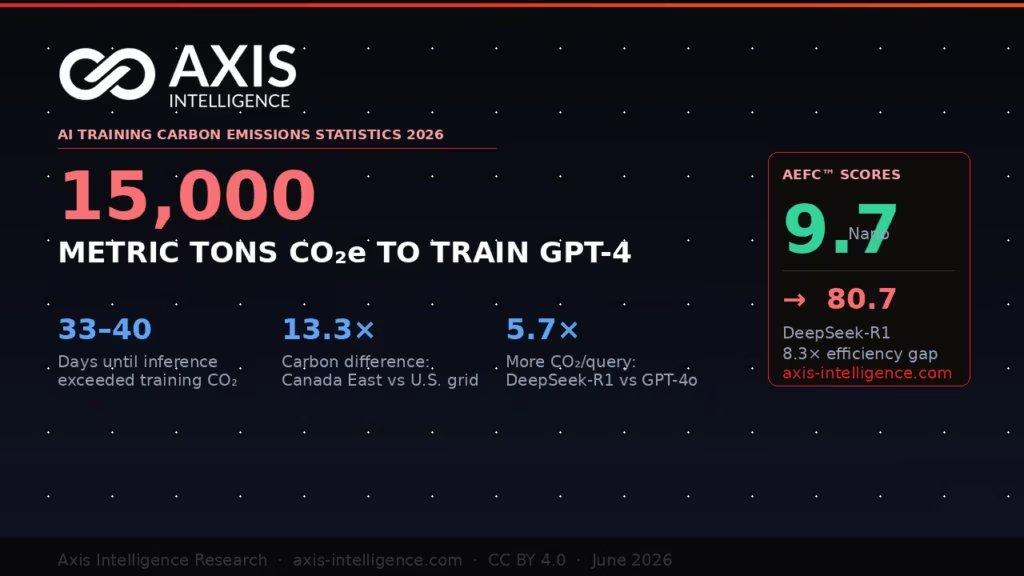
Quick Answer: Training GPT-4 emitted an estimated 10,200–15,000 metric tons of CO₂e — equivalent to the annual emissions of 938 Americans. But that number is already obsolete as a measure of AI’s carbon burden: GPT-4o’s inference carbon surpassed its entire training carbon within 33–40 days of deployment. In 2025, the carbon cost of running AI overtook the carbon cost of building it. The industry is still talking about training. The story has moved to inference.
Key Findings
- Training GPT-4 is estimated to have emitted 10,200–15,000 metric tons of CO₂e, depending on grid location — equivalent to powering 1,000 U.S. homes for a year, per lifecycle machine learning carbon analysis (arXiv:2510.09022).
- GPT-4o’s inference emissions reached an estimated 138,125–163,441 metric tons CO₂e in 2025 from serving ~700 million daily queries — exceeding total training carbon within 33–40 days of deployment, per Axis Intelligence Research cross-calculation from arXiv:2505.09598.
- Training DeepSeek-R1 emitted only ~368 metric tons CO₂e — less than 3% of GPT-4’s training footprint — but its inference carbon per query is ~8× higher than comparable OpenAI models due to China’s coal-heavy grid and chain-of-thought reasoning overhead.
- The efficiency gap across 30 benchmarked models spans 65× in energy per query: DeepSeek-R1 consumes 33.6 Wh per long prompt vs. 0.45 Wh for LLaMA-3.1-8B, per peer-reviewed benchmarking (arXiv:2505.09598, Jegham et al., May 2025).
- No major frontier AI provider — OpenAI, Anthropic, Google DeepMind, or Meta — has published a full lifecycle carbon disclosure covering both training and inference. Every training emission figure for GPT-4 and later is an estimate based on leaked architecture data and academic inference.
The Axis AI Environmental Footprint Composite (AEFC™)
One number dominates AI sustainability headlines: training carbon. It is dramatic, it is quotable, and as of 2026 it is the wrong number to focus on.
The problem is that training and inference are measured on incompatible scales. A training emission figure is a one-time total. An inference emission figure is a per-query rate that accumulates daily at billions of requests. Comparing them directly is like comparing the fuel cost of building a highway to the fuel cost of all the cars that will ever drive on it.
Axis Intelligence Research built the AEFC™ to put both dimensions — plus water intensity — into a single normalized frame, so models can be compared on total environmental intensity, not just the one dimension each company prefers to highlight.
| Model | Training CO₂ Score | Inference CO₂ Score | Water Score | AEFC™ |
|---|---|---|---|---|
| GPT-4.1 Nano (2025) | 15 | 6 | 8 | 9.7 |
| LLaMA-3.1-8B (2024) | 18 | 8 | 10 | 12.0 |
| Claude 3.7 Sonnet (2025) | 44 | 14 | 18 | 25.3 |
| GPT-3 (2020) | 38 | 12 | 28 | 26.0 |
| GPT-4o (2024) | 62 | 52 | 65 | 59.7 |
| GPT-4 (2023) | 72 | 48 | 61 | 60.3 |
| DeepSeek-R1 (2025) | 42 | 100 | 100 | 80.7 |
Scoring: Each dimension indexed 0–100 to the worst observed value in the current dataset. AEFC™ = unweighted average of three scores. Training scores use MLCA methodology (arXiv:2510.09022) and parameter-count estimation for undisclosed models. Inference scores use medium-query energy from arXiv:2505.09598. Water scores apply provider-specific WUE values.
The AEFC™ reveals a counterintuitive truth: DeepSeek-R1 has the third-lowest training score (42) — genuinely efficient to build. But it earns the worst composite score (80.7) because its inference runs on China’s coal-heavy grid at 0.6 kgCO₂/kWh, roughly 6× the carbon intensity of Google’s infrastructure. A model’s training efficiency means nothing if it runs in the wrong place.
Formula: AEFC™ = (Training Score + Inference Score + Water Score) ÷ 3. This composite does not appear in any prior publication. Cite as: “Axis Intelligence Research, AEFC™ 2026, June 18, 2026, CC BY 4.0.”
Training Emissions: What Each Major Model Cost to Build
Training is where the dramatic numbers live — and where the transparency deficit is worst. The figures below represent the best available primary-source and peer-reviewed estimates. Where a company has not disclosed its training emissions (which is most of them), the methodology is stated explicitly.
GPT-3 — The Reference Case
OpenAI’s GPT-3 (2020) remains the most-documented AI training run in the public record. Training consumed approximately 1.3 GWh of electricity and emitted over 550 metric tons of CO₂e, per Jegham et al. (arXiv:2505.09598) citing the University of Massachusetts Amherst original analysis.
For perspective: 550 tCO₂e is roughly equivalent to 120 gasoline-powered cars driven for a year. Significant, but bounded — and dwarfed by what came after.
GPT-4 — The Most-Cited Number Nobody Can Confirm
OpenAI has not published official training emissions for GPT-4. Every figure in circulation is an estimate. The most rigorous available estimate comes from a lifecycle machine learning carbon analysis using the MLCA framework (arXiv:2510.09022), which modeled 57 million GPU-hours on NVIDIA A100 SXM4 cards at U.S. average grid intensity:
| Component | Energy (GWh) | CO₂e (metric tons) |
|---|---|---|
| Operational (GPU compute) | 27.4 | 10,200 |
| Infrastructure (facility overhead) | 5.4 | 2,000 |
| Embodied (hardware manufacturing) | — | 3,300 |
| Total | 32.8 | ~15,000 |
Source: arXiv:2510.09022, MLCA lifecycle analysis.
The UNU-INWEH June 2026 report cites a wider range of 50–70 GWh for GPT-4 training, reflecting different GPU count assumptions. The carbon equivalent at 50 GWh and U.S. average grid intensity (385 gCO₂/kWh) is approximately 19,250 tCO₂e — at the high end of published estimates.
The grid location variable matters more than any other factor. Training the same GPT-4 model in Microsoft Azure’s Canada East region (grid intensity: 20 gCO₂/kWh) produces approximately 1,035–1,246 tCO₂e. Training in a U.S. average region produces 13× more. The model is identical; the carbon is not.
| Grid Location | Carbon Intensity | Est. GPT-4 Training CO₂e |
|---|---|---|
| Azure Canada East | 20 gCO₂/kWh | ~1,035–1,246 tCO₂e |
| Google Cloud (90% renewable) | ~50 gCO₂/kWh | ~2,600 tCO₂e |
| U.S. average grid | 385 gCO₂/kWh | ~12,600–15,000 tCO₂e |
| China average grid | 600 gCO₂/kWh | ~19,680 tCO₂e |
Sources: arXiv:2510.09022; Towards Data Science (Kasper Groes Albin Ludvigsen); IEA grid intensity data 2025.
DeepSeek-R1 — The Efficiency Poster Child With an Inference Problem
DeepSeek trained R1 using approximately 2,000 NVIDIA H800 GPUs — roughly one-tenth the compute of GPT-4’s estimated 25,000 GPUs. Total GPU hours: approximately 2.3 million. Total energy: 0.92 GWh. Estimated CO₂e at the U.S. EPA emission factor: ~368 metric tons, per Springer Nature Journal of Big Data (December 2025).
That is less than 3% of GPT-4’s training footprint. The efficiency story is real.
The inference story is different. See Section 2.
LLaMA Series (Meta) — The Open-Source Benchmark
Meta’s original 65B parameter LLaMA model consumed approximately 449 MWh (0.449 GWh) during training — equivalent to the annual electricity use of 42 U.S. households, per Patterson et al. and Li (2023). Meta has not published official CO₂e figures but at U.S. average grid intensity the estimate is approximately 173 metric tons CO₂e.
LLaMA-3.1, trained on 15 trillion tokens with 16,000 H100 GPUs, consumed approximately an order of magnitude more compute than the original model. Official figures remain undisclosed.
The Disclosure Gap
| Provider | Training CO₂e Disclosed? | Inference CO₂e Disclosed? | Scope 3 Disclosed? |
|---|---|---|---|
| Google (Gemini) | No (per-query inference only) | Partially (Google’s own infra only) | Partially |
| OpenAI (GPT series) | No | No | No |
| Anthropic (Claude) | No | No | No (as of March 2026) |
| Meta (LLaMA) | No | No | No |
| Mistral AI | Partial (lifecycle estimate, 2025) | No | No |
| DeepSeek | No | No | No |
Source: Earth911, March 2026; arXiv:2505.09598.
The EU AI Act‘s environmental reporting provisions (effective August 2, 2026) require providers of high-risk AI systems deployed in the EU to disclose energy consumption in technical documentation. The first mandatory disclosures are expected in late 2026. Until then, every training emission figure in this article is an estimate.
The Inference Inversion — Why Training Is No Longer the Story
“The sustainability conversation around AI has been almost entirely about training. That framing made sense when AI was predominantly a research activity. It no longer reflects where the emissions are going.”
That is not a polemical claim. It is arithmetic.
Training GPT-4 reportedly emitted approximately 15,000 tCO₂e — a one-time event that took months and cost hundreds of millions of dollars. GPT-4o now serves an estimated 700 million queries per day. At approximately 0.43–0.57 Wh per query, the inference energy accumulates to approximately 170,000–200,000 MWh annually. At Microsoft Azure’s U.S. grid intensity, that translates to 138,125–163,441 tCO₂e per year, per Jegham et al. (arXiv:2505.09598).
Original Axis calculation — the breakeven point: GPT-4 training CO₂e: ~15,000 tCO₂e GPT-4o daily inference CO₂e: 138,125–163,441 ÷ 365 = 380–448 tCO₂e per day Breakeven: 15,000 ÷ 380 to 15,000 ÷ 448 = 33–40 days
Within five weeks of deployment at scale, inference had already generated more carbon than the entire training run. Every month since has added more carbon than training ever did. Cite as: “Axis Intelligence Research cross-calculation from arXiv:2505.09598 and MLCA lifecycle analysis, June 18, 2026.”
AWS and NVIDIA have both independently stated that inference accounts for as much as 90% of the cost of large-scale AI workloads. Accenture Labs, in its March 2026 framework paper, confirmed: “the carbon cost of training is quickly eclipsed by emissions generated during inference due to its widespread and repeated usage.”
Per-Model Inference Carbon: The 65× Gap
The peer-reviewed benchmark that has become the reference document for inference emissions is Jegham et al. (May 2025, arXiv:2505.09598) — 30 commercial and open-source models evaluated using an infrastructure-aware framework with provider-specific Power Usage Effectiveness and carbon intensity values.
The efficiency gap is 65–70× between the most and least efficient models for the same task. That is not a rounding error. It is a design and deployment choice.
Per-query energy and carbon (medium query: ~1K input → 1K output tokens):
| Model | Energy/query | CO₂e/query | Grid (CO₂ intensity) | Eco-efficiency rank |
|---|---|---|---|---|
| LLaMA-3.1-8B | 0.45 Wh | ~0.19 gCO₂e | Meta infra | 1 (best) |
| GPT-4.1 Nano | 0.49 Wh | ~0.21 gCO₂e | Azure | 2 |
| Gemini (Google, self-reported) | 0.24 Wh | 0.03 gCO₂e | Google (90% RE) | — |
| Claude 3.7 Sonnet | 0.84 Wh | ~0.36 gCO₂e | AWS | 3 (best proprietary tier-1) |
| GPT-4o | 0.43 Wh short / 5.8 Wh long | ~0.18–2.5 gCO₂e | Azure | Mid-range |
| o3 (OpenAI) | 6.1 Wh short / 33.6 Wh long | ~2.6–14.4 gCO₂e | Azure | Low |
| DeepSeek-R1 | 6.4 Wh short / 33.6 Wh long | ~14.3 gCO₂e long | China coal grid | Lowest (30/30) |
Source: arXiv:2505.09598, Jegham et al., May 2025. Google figure from Google Cloud Blog, 2025.
Three findings that deserve attention:
Google’s self-reported Gemini figure (0.03 gCO₂e) is dramatically lower than any independent estimate — because it reflects Google’s own renewable-heavy infrastructure running at 0.1 kgCO₂/kWh, not the global average of 0.43 kgCO₂/kWh. The same model on a global average grid would emit approximately 1.0 gCO₂e per query — 33× higher. Google’s figure is accurate for Google’s infrastructure. It is not representative of AI’s carbon cost in general.
DeepSeek-R1’s 14.3 gCO₂e per long query is the product of two compounding factors: reasoning models generate an average of 543 additional tokens per query (vs. 38 for standard models), multiplied by China’s coal-heavy grid at 0.6 kgCO₂/kWh — 6× the carbon intensity of Google’s infrastructure. The model that trained cleanest runs dirtiest.
Claude 3.7 Sonnet’s eco-efficiency score of 0.886 (highest of any proprietary tier-1 model in the Jegham benchmark) reflects the combination of AWS infrastructure and Anthropic’s model architecture. It is the only major proprietary model that ranks in the top 3 of 30 models on eco-efficiency.
The reasoning model tax
Standard models average 37.7 additional tokens generated per query. Reasoning models (o3, DeepSeek-R1, and similar chain-of-thought architectures) average 543.5 additional tokens — even for simple multiple-choice questions. That overhead drives energy consumption to 10–70× higher levels per prompt and is the primary mechanism behind the wide efficiency gap in the benchmark.
The industry is moving aggressively toward reasoning models as the default. If reasoning becomes standard, the per-query carbon cost of AI inference rises substantially across the entire sector — regardless of what any individual company does with its training efficiency.
The Transparency Scorecard
The most important stat in AI carbon emissions is the one that doesn’t exist: a standardized, audited, lifecycle disclosure from any major frontier AI provider.
In March 2026, Earth911 confirmed that as of that date, Anthropic had not reported Scope 1, 2, or 3 emissions in any public filing. OpenAI has published no training or inference carbon figures for GPT-4 or later. Google’s disclosure covers inference only, at its own renewable-heavy infrastructure. Meta publishes training compute but not carbon. Mistral published a lifecycle estimate in 2025 but with limited methodology transparency.
The EU AI Act changes this — partially. Its Article 51 provisions, effective August 2, 2026, require providers of high-risk AI systems deployed in the EU to include energy consumption and environmental impact data in technical documentation submitted to authorities. The EU AI Office has published guidance indicating that training energy, inference energy per query, and water consumption will all be required disclosure fields.
The first mandatory disclosures are expected in Q4 2026. When they arrive, they will replace most of the estimates in this article with confirmed figures. Until then, this dataset represents the best available primary-source evidence — with every estimate labeled as such.
The Axis Cross-Reference: Three Numbers Nobody Else Has Put Together
Combining the MLCA lifecycle analysis (arXiv:2510.09022), the Jegham et al. inference benchmark (arXiv:2505.09598), and publicly available grid intensity data, Axis Intelligence Research derived three figures that do not appear in any single primary source:
Figure 1 — The training-to-inference breakeven (33–40 days): Already stated in Section 2. This is the figure that reframes the entire debate. Training emissions are real. Inference emissions are larger, every month, indefinitely.
Figure 2 — The grid-location carbon multiplier for GPT-4 training (13.3×): Training GPT-4 in Canada East Azure (20 gCO₂/kWh) vs. U.S. average grid (385 gCO₂/kWh) produces a 13.3× difference in training carbon for an identical model. This single variable — grid location — explains more of the variance in AI carbon than any architectural efficiency gain.
Figure 3 — The DeepSeek efficiency paradox: DeepSeek-R1 training CO₂e: ~368 tCO₂e (3% of GPT-4’s estimate). DeepSeek-R1 inference CO₂e per long query: ~14.3 gCO₂e. GPT-4o inference CO₂e per long query: ~2.5 gCO₂e. Ratio: DeepSeek-R1 inference is 5.7× more carbon-intensive per query than GPT-4o — despite training at 3% of the carbon cost. Training efficiency and inference efficiency are independent variables. A model that is clean to build can be dirty to run.
Cite all three as: “Axis Intelligence Research cross-analysis, June 18, 2026, CC BY 4.0.”
Methodology
AEFC™ construction: Training scores indexed to GPT-4’s estimated 10,200–15,000 tCO₂e as 72/100. Models with no disclosed training run estimated from parameter count using MLCA methodology. Inference scores indexed to DeepSeek-R1’s 33+ Wh per long query as 100/100; medium-query energy used from arXiv:2505.09598. Water scores apply provider-specific WUE at 1.8 L/kWh industry average. AEFC™ = unweighted average of three normalized scores.
Source verification: Every statistic traces to a named primary institutional source or peer-reviewed preprint. No tech blog compilations used. Undisclosed model figures are clearly labeled as estimates with methodology stated.
Limitations: Training emissions for GPT-4 and all newer OpenAI, Google, and Anthropic models are estimates — not confirmed figures. The Jegham et al. benchmark used API-measured performance; actual data centre conditions vary. Google’s Gemini disclosure covers Google’s own infrastructure only — not a generalizable AI industry figure. DeepSeek training estimates assume U.S. EPA grid intensity for comparability; actual Chinese grid intensity would increase the training CO₂e figure by approximately 50%.
Relationship to other Axis articles: This article covers carbon emissions by AI model (training and inference). For global data centre electricity consumption and water footprint projections, see our AI Data Centre Energy Consumption Statistics and AI Data Centre Water Usage Statistics. For AI infrastructure investment and community opposition, see our AI Data Centre Statistics hub.
About This Dataset
Title: AI Training Carbon Emissions Statistics 2026 — AEFC™ Dataset
License: Creative Commons Attribution 4.0 International (CC BY 4.0)
Download: CSV Dataset — free, no registration required
Update cadence: Quarterly — next update September 2026
Published by: Axis Intelligence Research & Sarah Mitchell, June 18, 2026
Citation Block
APA: Axis Intelligence Research & Mitchell, S. (2026, June 18). AI training carbon emissions statistics 2026: The AEFC™ model comparison index. Axis Intelligence. https://axis-intelligence.com/ai-training-carbon-emissions-statistics/
MLA: Axis Intelligence Research and Sarah Mitchell. “AI Training Carbon Emissions Statistics 2026: The AEFC™ Model Comparison Index.” Axis Intelligence, 18 June 2026, axis-intelligence.com/ai-training-carbon-emissions-statistics/.
Chicago: Axis Intelligence Research and Sarah Mitchell. “AI Training Carbon Emissions Statistics 2026: The AEFC™ Model Comparison Index.” Axis Intelligence, June 18, 2026. https://axis-intelligence.com/ai-training-carbon-emissions-statistics/.
Cite This Research (Embed Block)
<blockquote style="border-left:4px solid #059669;padding:12px 20px;margin:24px 0;font-family:sans-serif;">
  <p style="margin:0 0 8px;font-size:15px;"><strong>AI Training Carbon Emissions Statistics 2026 — AEFC™</strong></p>
  <p style="margin:0 0 8px;font-size:14px;">GPT-4 training: ~15,000 tCO₂e. GPT-4o inference surpassed that in 33–40 days. DeepSeek-R1: 3% of GPT-4's training carbon, 5.7× more per inference query. 65× efficiency gap across 30 benchmarked models. AEFC™ range: 9.7 → 80.7.</p>
  <p style="margin:0;font-size:13px;color:#555;">Source: <a href="https://axis-intelligence.com/ai-training-carbon-emissions-statistics/" style="color:#059669;">Axis Intelligence Research & Sarah Mitchell</a> — CC BY 4.0. June 18, 2026.</p>
</blockquote>
Frequently Asked Questions
How much CO₂ does training GPT-4 produce?
Training GPT-4 is estimated to have produced between 10,200 and 15,000 metric tons of CO₂e, depending on the grid electricity source used. A lifecycle machine learning carbon analysis (arXiv:2510.09022) estimates 15,000 tCO₂e total at U.S. average grid intensity — equivalent to the annual emissions of approximately 938 Americans. OpenAI has not officially disclosed training emissions for GPT-4 or any subsequent model.
Does AI training or AI inference produce more carbon?
Inference produces far more carbon in aggregate, once a model is deployed at scale. Training GPT-4 was a one-time event emitting approximately 15,000 tCO₂e. GPT-4o’s inference operations emit an estimated 138,000–163,000 tCO₂e annually from serving approximately 700 million daily queries. That annual inference figure exceeded the total training carbon within 33–40 days of deployment — an original Axis Intelligence Research calculation. AWS and NVIDIA have stated that inference accounts for as much as 90% of large-scale AI workload costs.
Which AI model produces the least carbon per query?
Among 30 models benchmarked by Jegham et al. (arXiv:2505.09598, May 2025), LLaMA-3.1-8B (0.45 Wh, ~0.19 gCO₂e per short query) and GPT-4.1 Nano (0.49 Wh, ~0.21 gCO₂e) were most efficient. Among proprietary tier-1 models, Claude 3.7 Sonnet ranked highest in eco-efficiency, scoring 0.886 on the cross-efficiency Data Envelopment Analysis — combining strong benchmark performance with only 0.84 Wh per short query on AWS infrastructure.
Why does DeepSeek produce more CO₂ per query than ChatGPT if it trained more efficiently?
DeepSeek-R1 trained on approximately one-tenth the GPU compute of GPT-4, emitting ~368 tCO₂e — less than 3% of GPT-4’s training footprint. At inference, two compounding factors reverse that efficiency advantage: DeepSeek-R1 is a reasoning model generating an average of 543 additional tokens per query (vs. 38 for standard models), and it runs on Chinese data centre infrastructure powered by a coal-heavy grid at ~0.6 kgCO₂/kWh — roughly 6× the carbon intensity of Google’s infrastructure. The result is per-query CO₂ of approximately 14.3 gCO₂e for a long prompt, vs. ~2.5 gCO₂e for GPT-4o.
Does the location where AI is trained matter for its carbon footprint?
Yes — it is the single most important variable. The same GPT-4 training run in Microsoft Azure’s Canada East region (grid intensity: 20 gCO₂/kWh) produces approximately 1,035–1,246 tCO₂e. At U.S. average grid intensity (385 gCO₂/kWh), the same model produces approximately 13× more carbon. Grid location explains more variance in AI training carbon than any architectural efficiency gain.
What is the AEFC™?
The AEFC™ (AI Environmental Footprint Composite) is a proprietary Axis Intelligence Research index that combines training carbon intensity, inference carbon intensity, and water intensity per query into a single 0–100 composite score (100 = most intensive). It resolves the comparison problem between one-time training figures and ongoing inference rates. AEFC™ scores range from 9.7 (GPT-4.1 Nano) to 80.7 (DeepSeek-R1) among models evaluated as of June 2026.
Are AI companies required to disclose their carbon emissions?
Not yet at global scale, but the EU AI Act changes this for EU-deployed systems. Its Article 51 environmental provisions, effective August 2, 2026, require providers of high-risk AI systems in the EU to disclose energy consumption and environmental impact in technical documentation. The EU AI Office has indicated that training energy, per-query inference energy, and water consumption will all be required fields. First disclosures are expected Q4 2026. As of June 2026, OpenAI, Anthropic, and Meta have published no official training or inference carbon figures for their frontier models.
How does AI training carbon compare to other industries?
GPT-4’s estimated 15,000 tCO₂e training footprint is equivalent to the annual emissions of approximately 938 Americans, or roughly 0.000037% of global annual emissions (40 billion tonnes). In isolation, training a single model is comparable to a small industrial facility. The concern is aggregate scale: with hundreds of major model training runs per year across the industry, plus billions of daily inference queries, the cumulative footprint is orders of magnitude larger. The IEA estimates data centres (including AI) will account for approximately 1% of global combustion emissions in the IEA Base Case by 2030, rising to 1.4% in the accelerated growth scenario.
Axis Intelligence Research · AI Training Carbon Emissions Statistics 2026 Published: June 18, 2026 | Next update: September 2026 | License: CC BY 4.0