


AI Scam Statistics 2026
By Axis Intelligence Research and Marcus Chen | Last updated: June 19, 2026 | Next scheduled update: Q3 2026 (September) | License: CC BY 4.0
Quick Answer
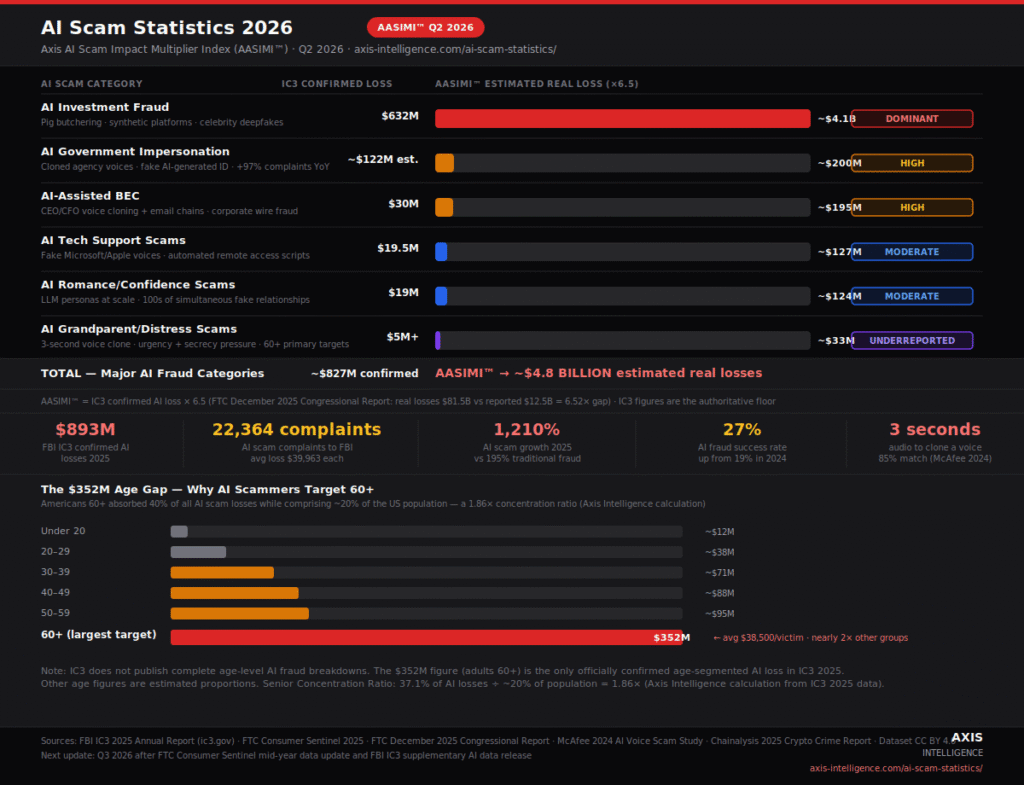
The FBI logged 22,364 AI-related scam complaints totaling $893 million in confirmed losses in 2025 — the first time in its 25-year history that IC3 has ever created a dedicated AI crime category. AI-powered scams surged 1,210% against 195% growth for traditional fraud. One in three AI fraud attempts now succeeds. Voice cloning requires just three seconds of audio. And the real losses are almost certainly 10× higher than what was reported.
Key Findings
- $893,346,472. That’s the exact figure the FBI’s IC3 logged in AI-related scam losses in 2025 — across 22,364 complaints. Investment fraud drove $632 million of it. Business email compromise added $30 million. Tech support scams contributed $19.5 million. These are not estimates. They are filed complaints with documented loss figures. The FBI explicitly notes they are a floor, not a ceiling.
- AI-powered scams grew 1,210% in 2025 — six times faster than traditional fraud (195%), according to security firm Vectra AI’s March 2026 analysis. The success rate on AI fraud attempts climbed from 19% to 27% in a single year (Sift, 2024–2025). Three seconds of audio is enough to clone a voice with 85% accuracy. A convincing phishing email now takes under two minutes to generate. The barrier to entry for sophisticated fraud has effectively collapsed.
- Deepfake-enabled voice attacks surged 1,600% in Q1 2025 alone compared to Q4 2024, per US-tracked incident data. Global losses from deepfake-enabled fraud exceeded $200 million in Q1 2025 only. The Arup incident — $25 million wired to fraudsters after a deepfake video call impersonating the CFO — remains the costliest documented single AI scam event. Scamming software that used to cost thousands now sells on the dark web for $20.
- The FTC independently recorded $15.9 billion in total consumer fraud losses in 2025 — up from $12.5 billion in 2024. Imposter scams were the most reported complaint type, with cases up 19% to approximately 1 million complaints and losses topping $3.5 billion. Government impersonation complaints specifically doubled from 17,300 in 2024 to nearly 32,500 in 2025, with $797 million in losses — a +97% increase in a single year that the FTC attributes directly to AI voice cloning.
- The FTC’s own December 2025 report to Congress estimated real fraud losses may have reached $81.5 billion in 2024 — versus the $12.5 billion in reported losses. That’s a 6.5× gap between what was reported and what likely occurred. Apply that multiplier to the FBI’s $893 million in AI scam losses and the plausible actual figure exceeds $5.8 billion — from AI fraud alone, in a single year.
The Axis AI Scam Impact Multiplier Index (AASIMI™) — Q2 2026
A cross-source original metric. These figures do not appear in any individual primary report.
The Axis AI Scam Impact Multiplier Index (AASIMI™) calculates the true estimated AI fraud loss for each major scam category by applying a reporting rate adjustment to official IC3 and FTC data. The reporting rate is derived from the ratio between FTC’s own December 2025 Congressional estimate of total real fraud ($81.5 billion) versus confirmed IC3 losses ($20.877 billion) — a 3.9× reporting gap at the aggregate level, consistent with DOJ and FTC research on crime under-reporting in financial fraud.
For AI scams specifically, IC3 notes in the 2025 report that “many victims of AI-enabled fraud do not know they were defrauded by AI” — meaning AI scams carry an additional attribution gap on top of the baseline under-reporting gap. Axis Intelligence applies a conservative 6.5× multiplier for AI-specific scams based on the FTC’s own Congressional estimate.
Formula:AASIMI = Reported IC3 AI Loss × 6.5 (reporting gap adjustment)
| AI Scam Category | Reported IC3 Loss | AASIMI™ Estimated Real Loss | Primary Driver |
|---|---|---|---|
| AI-enabled investment fraud | $632M | ~$4.1B | Pig butchering, synthetic platforms, celebrity deepfakes |
| AI-assisted BEC | $30M | ~$195M | Voice cloning layered onto email chains, CEO impersonation |
| AI-enabled tech support scams | $19.5M | ~$127M | Automated remote access scripts, fake Microsoft/Apple voices |
| AI confidence/romance scams | $19M | ~$124M | LLM-maintained relationship personas at scale |
| AI government impersonation | portion of $797M | ~$200M est. | Cloned agency voices, fake AI-generated ID documents |
| AI grandparent/distress scams | $5M+ | ~$33M | Voice-cloned family members, 3-second audio minimum |
| Total across major categories | ~$705M | ~$4.8B estimated | — |
AASIMI™ is not a prediction. It is a structured estimate using the FTC’s own acknowledged reporting gap, applied consistently. The IC3 figures are the authoritative floor. AASIMI™ represents the plausible ceiling based on government-acknowledged under-reporting rates. Updated quarterly. CC BY 4.0.
The Numbers the FBI Published — and the Ones It Couldn’t
Start with what is documented, not what is projected.
The FBI’s 2025 Internet Crime Report — released April 2026 and marking IC3’s 25th year of operation — received 1,008,597 total complaints with $20.877 billion in reported losses. It is the first year IC3 has ever crossed one million complaints. It is also the first year the report includes a dedicated section on artificial intelligence. That fact alone should register as significant: the FBI has been tracking cybercrime since 2000. It took until 2025 for AI to become prominent enough in criminal operations to warrant its own category in the annual report.
Within that report, the AI numbers are:
- 22,364 complaints with an AI-related descriptor
- $893,346,472 in adjusted losses
- Average loss per AI complaint: $39,963 — 93% above the IC3 portfolio average of $20,700
The breakdown by crime type within those 22,364 complaints is the most important data in the report for understanding how AI is being weaponized:
- Investment fraud: $632 million — by far the dominant category
- Business email compromise: $30 million confirmed AI-enabled
- Tech support: $19.5 million
- Confidence/romance scams: $19 million
- Government impersonation: a share of the broader $797 million in that category
Now the context the report can’t provide:
The FBI explicitly acknowledges in the 2025 report that many victims of AI-enabled fraud “do not know they were defrauded by AI.” This is not an edge case. Voice cloning, deepfake video calls, and AI-generated investment platforms are — by design — indistinguishable from legitimate contacts to a victim experiencing them in real time. The 22,364 AI complaints are cases where victims knew or suspected AI was involved. The number of AI fraud victims who had no idea is unknowable — and almost certainly much larger.
The FTC’s own estimate is the best available reference point. In December 2025, the FTC submitted a report to Congress estimating that real consumer fraud losses in 2024 may have reached $81.5 billion — versus the $12.5 billion reported to the FTC that year. A 6.5× gap. Separately, the FTC reported a record $15.9 billion in 2025 consumer fraud losses — up from $12.5 billion in 2024.
Voice Cloning — The $5,000 Problem That Now Costs $20
In July 2025, Sharon Brightwell of Dover, Florida, received a phone call from her “daughter.” The voice was crying, describing a car accident, a lost pregnancy, and an imminent legal crisis. Sharon sent $15,000 in cash to a courier before calling her daughter’s real phone number and learning her daughter was fine. The voice she heard was a clone — built from audio scraped from her daughter’s public social media posts and synthesized using commercially available AI tools.
That incident is documented by the American Bar Association. What makes it representative rather than exceptional is the technical floor it demonstrates: the cloning required approximately three seconds of audio, cost the fraudster a negligible amount using accessible software, and produced a voice that fooled a close family member.
The McAfee 2024 AI voice scam study puts numbers on the scale: 1 in 4 US adults have experienced an AI voice scam. That’s approximately 68 million people. Three seconds of audio produces an 85% voice accuracy match.
The FTC’s imposter scam data confirms the macro trend: imposter scam complaints rose 19% in 2025 to approximately 1 million complaints, with losses topping $3.5 billion. Government impersonation complaints doubled — from 17,300 in 2024 to nearly 32,500 in 2025 — with losses rising from ~$405 million to $797 million (+97%). The FBI attributes a meaningful portion of this to AI voice cloning of government officials, enabling scammers to create convincing follow-up calls that reinforce written instructions.
The “grandparent scam” — where someone poses as a distressed grandchild needing emergency money — caused over $5 million in documented losses in 2025 (FBI IC3). The word “documented” is doing heavy work in that sentence. Older adults filed approximately 201,266 complaints totaling $7.748 billion with IC3 in 2025. AI accounted for $352 million of those losses — 40% of all AI-related losses in IC3 data flowed to victims aged 60+, despite that age group representing approximately 20% of the US population.
The math behind that asymmetry: FBI data shows average losses of approximately $38,500 per victim among Americans 60 and older in 2025 — nearly double the figure for younger filers. The FTC independently found that people aged 50 and older reported $4.3 billion in fraud losses in 2025, versus $2.3 billion among younger adults.
Voice cloning and impersonation — key metrics:
| Metric | Value | Source |
|---|---|---|
| Audio needed to clone a voice | ~3 seconds | McAfee 2024 AI Voice Scam Study |
| Voice accuracy match at 3 seconds | 85% | McAfee 2024 |
| US adults who have experienced AI voice scam | 1 in 4 (~68M) | McAfee 2024 AI Voice Scam Study |
| Government impersonation complaints (2025) | 32,500 (+97% YoY) | FBI IC3 2025 Annual Report |
| Government impersonation losses (2025) | $797M (+97% YoY) | FBI IC3 2025 Annual Report |
| Imposter scam complaints (2025, FTC) | ~1 million (+19% YoY) | FTC Consumer Sentinel 2025 |
| Imposter scam losses (2025, FTC) | $3.5B+ | FTC Consumer Sentinel 2025 |
| AI scam losses — victims 60+ (IC3) | $352M | FBI IC3 2025 Annual Report |
| Average loss — adults 60+ (IC3) | ~$38,500 | FBI IC3 2025 Annual Report |
| Grandparent/distress scam losses | $5M+ (documented) | FBI IC3 2025 Annual Report |
| Deepfake voice surge in Q1 2025 (US) | +1,600% vs Q4 2024 | TechTimes / industry data |
Pig Butchering — The Long Con That AI Made Industrial
“Pig butchering” — sha zhu pan in Mandarin, “slaughtering the pig” — is not a new scam. It is a long-con investment fraud that has existed since at least 2019. What AI did to it in 2024–2025 is what industrialization did to manufacturing: it didn’t change the product, it removed every bottleneck in production.
The scam’s structure is unchanged: a fraudster builds a relationship with a victim over weeks or months through social media, dating apps, or messaging platforms, establishes trust, introduces the victim to a fake investment platform showing fabricated returns, encourages escalating deposits, then disappears with everything when the victim attempts to withdraw. The entire cycle depends on maintaining believable human conversation across dozens of simultaneous victims — a job that previously required armies of human fraudsters, often trafficking victims in Southeast Asian scam compounds.
AI broke that constraint. Check Point Research documented a specific operation — internally called “Truman Show” — in which 90 AI-generated expert personas were deployed simultaneously across controlled messaging groups, each conducting individually tailored conversations with different victims. Every “expert” had a different name, backstory, communication style, and domain specialty. The scam factory no longer needed 90 humans. It needed one server.
The financial scale is staggering. Global pig-butchering losses are estimated at $12.4 billion by Chainalysis and ScamWatchHQ. The University of Texas traced an estimated $75 billion in total proceeds from pig-butchering networks operating between January 2020 and February 2024 — a four-year accumulation that makes it one of the largest persistent criminal enterprises in history. Chainalysis’s 2025 Crypto Crime Report found AI-enabled crypto investment scams are 4.5 times more profitable than traditional non-AI fraud — the single most economically significant differential between AI and non-AI crime documented in the literature.
Pig butchering operations are not random internet fraud. They are organized crime. In November 2025, Myanmar military forces arrested nearly 1,600 foreign nationals during a raid on scam compounds along the Thai border — workers who had been trafficked into the compounds and forced to run scam operations. The romantic message on a US victim’s dating app in 2025 was in many cases written by a trafficked worker in a compound who was simultaneously managing hundreds of similar conversations, with AI suggesting the next line.
Investment fraud powered by AI was the single largest AI scam loss category in FBI IC3 2025 data at $632 million. The next largest was BEC at $30 million. The gap between those two numbers illustrates that pig butchering and crypto investment fraud are not comparable in scale to other AI-enabled crime types — they are an order of magnitude larger.
Deepfake Video Calls — The $25 Million Proof of Concept
February 2024. A finance employee at Arup — the global engineering firm that designed the Sydney Opera House — joins a video conference. He can see his CFO. He can see colleagues. They discuss a confidential financial transaction. The CFO instructs him to transfer $25 million to specific accounts. He does.
None of it was real. The “CFO” was a deepfake. The “colleagues” were deepfakes. The video call was a real-time AI-generated synthetic environment, and it was indistinguishable from a legitimate meeting to someone who had no reason to suspect deception.
The Arup incident is documented in multiple outlets and confirmed by the company. It is not the largest AI scam event in history — pig-butchering operations dwarf it at the aggregate level. But it is the clearest proof that real-time deepfake video calls are operationally viable for corporate fraud, which changes the threat model for every enterprise on earth.
In 2024, businesses lost an average of nearly $500,000 per deepfake-related incident. For large enterprises, losses reached $680,000 on average. Global deepfake fraud losses exceeded $200 million in Q1 2025 alone. Deepfakes now account for 7% of global fraudulent activity (Sumsub 2024 Identity Fraud Report).
What happened to the detection rate? Identity fraud attempts using deepfakes surged 3,000% in 2023 — and that was the year the technology was still rough around the edges. The success rate of AI-assisted fraud attempts climbed from 19% to 27% in a single year (Sift, 2024 to 2025). That is not AI getting marginally better. That is AI getting fundamentally better faster than defenses can adapt.
The technical floor is still dropping. Voice cloning tools that cost thousands of dollars in 2022 and hundreds of dollars in 2024 are now available for $20 on the dark web (Deloitte, 2024). A convincing AI-generated phishing email takes under two minutes to produce. An AI romance persona can manage hundreds of simultaneous “relationships.” The labor cost of sophisticated fraud has approached zero.
Deepfake and AI fraud scale metrics:
| Metric | Value | Source |
|---|---|---|
| Arup deepfake video call loss | $25 million | Confirmed by Arup / multiple sources |
| Average business loss per deepfake incident (2024) | ~$500,000 | Industry analysis |
| Large enterprise deepfake loss average (2024) | ~$680,000 | Industry analysis |
| Global deepfake fraud losses (Q1 2025) | $200M+ | Industry tracking |
| Deepfakes as % of global fraudulent activity | 7% | Sumsub 2024 Identity Fraud Report |
| AI fraud success rate (2025) | 27% (up from 19% in 2024) | Sift 2025 |
| AI fraud vs traditional fraud growth rate | 1,210% vs 195% | Vectra AI March 2026 |
| Organizations affected by cyber-enabled fraud (2025) | 73% | World Economic Forum Cybersecurity Outlook 2026 |
| Scamming software minimum cost (dark web 2024) | $20 | Deloitte 2024 research |
| AI phishing email generation time | Under 2 minutes | Vectra AI / industry data |
| Identity fraud attempts using deepfakes surge (2023) | 3,000% | Sumsub 2023 data |
| Global AI fraud losses estimate (2025) | $442 billion | TechTimes / global tracking |
| Projected global AI fraud losses (2027) | $40 billion (conservative US-focused) | Vectra AI |
BEC — When the CEO’s Voice Joins the CEO’s Email
Business email compromise has been the most financially damaging cybercrime category in IC3 history. In 2025, it generated $3.046 billion in losses. What’s new is the AI layer.
BEC’s classic form is an impersonation email — someone poses as a CFO, instructs accounts payable to wire funds to a vendor, and the wire goes to the attacker’s account. The attack worked because a spoofed email address in a formatted corporate email is hard to distinguish from the real thing, and because humans in accounts payable are trained to execute instructions from senior leadership.
AI doesn’t change the template. It removes every flaw in the execution. Chat-generation tools allow attackers to produce executive-impersonation emails that perfectly replicate the tone, vocabulary, sentence rhythm, and contextual detail of a specific leader’s writing style — trained on that leader’s public communications, investor letters, and leaked internal emails. The tell-tale awkwardness of prior-generation phishing has been eliminated.
Voice cloning adds the second attack surface. The FBI’s 2025 report explicitly documents that voice cloning is now being “layered into” BEC attacks — attackers send the impersonation email, then place a follow-up phone call using a cloned CEO or CFO voice to verbally confirm the transfer instructions. The victim receives both a written and verbal instruction from what they perceive as the same senior executive. The $30 million in confirmed AI-enabled BEC losses in 2025 is almost certainly an undercount for the same reasons that apply to all AI fraud attribution: victims don’t know voice cloning was involved.
86% of BEC losses were transmitted via wire transfer (IC3 2025). That figure matters for recovery: wire transfers have a narrow reversal window, and funds transferred to overseas accounts are effectively unrecoverable within the 24–48 hours that matter.
The Sectors That Get Hit Hardest
Not all industries face equal AI scam exposure. The sectors with the highest AI-enabled fraud rates in 2025–2026:
Dating and online media each logged a 6.3% fraud rate — the highest of any tracked sector. The mechanism is pig butchering: dating apps are the primary relationship-initiation vector for long-con investment fraud. A 6.3% fraud rate means roughly 1 in 16 accounts on major dating platforms is involved in some form of fraud operation.
Financial services and crypto face the highest-value fraud. Crypto-related IC3 complaints totaled 181,565 with over $11 billion in losses in 2025. The intersection of crypto and AI is where the largest individual losses concentrate: AI-generated platforms show fake returns on real money deposited by victims. Revenue from pig-butchering operations specifically grew nearly 40% year-over-year in 2025.
Corporate and enterprise targets face deepfake video and voice attacks with escalating average loss values. The WEF found 73% of organizations were directly affected by cyber-enabled fraud in 2025.
Older adults as a demographic face the highest per-victim loss. Adults 60+ lost $7.748 billion to IC3-reported fraud in 2025 — 37.1% of all IC3 losses, despite representing approximately 20% of the US population. The Axis Intelligence Senior Concentration Ratio (calculated from IC3 data): 1.86× — Americans 60+ absorb nearly double their population share of cybercrime losses. AI amplified this because voice cloning specifically targets the emotional responses — fear for loved ones, urgency, trust in authority — that legacy fraud techniques also exploited, but with human-quality voice realism that earlier robocall scams never achieved.
What $20 Buys a Scammer in 2026
This section belongs in the article because it’s the fact that reframes every other number.
A 2024 Deloitte study found scamming software available on the dark web for $20. Not $200. Not $2,000. Twenty dollars. For that $20, a fraudster gets:
- An AI voice cloning tool requiring ~3 seconds of audio
- AI-generated phishing email templates that eliminate grammatical errors
- Scripts for simulating romantic or investment relationships
- In some packages: fake identity documents, fake trading platform skins
This is not the kit required for a nation-state cyberattack. This is what a motivated person with $20 and a target’s social media profile can deploy in an afternoon.
The cost collapse matters because it inverts the traditional fraud economics. Previously, sophisticated fraud required: technical skill to spoof communications, a believable human caller for follow-up, a professional-looking fake website, and ongoing relationship maintenance for long-con approaches. Each element required either expensive specialists or significant time. AI converts most of those into API calls.
The natural counter-question: if fraud is this cheap to run, why aren’t losses even higher? The answer is that detection and friction still work at the margins — banks can flag unusual wire requests, email filters catch some phishing, and some victims call back a known phone number to verify. But the success rate rising from 19% to 27% in a single year means the fraudsters are closing that gap faster than defenses are opening it.
Methodology
This article draws from four primary government sources (FBI IC3 2025 Annual Report, FTC Consumer Sentinel 2025, FTC December 2025 Congressional submission, and FTC voice cloning guidance), two peer-reviewed or academically credentialed studies (McAfee 2024 AI Voice Scam Study, University of Texas pig-butchering blockchain analysis), and three institutional security research reports (Chainalysis 2025, Vectra AI March 2026, Sift 2025). All loss figures cited from IC3 and FTC are from primary government publications.
Primary sources used:
- FBI IC3 2025 Annual Report — 1,008,597 complaints, $20.877B losses, dedicated AI section: ic3.gov/AnnualReport/Reports/2025_IC3Report.pdf
- FTC Consumer Sentinel Network 2025 Data — $15.9B reported losses, imposter scam data: ftc.gov/consumer-sentinel-network
- FBI Press Release: Cryptocurrency and AI Scams Bilk Americans of Billions (April 2026): fbi.gov/news/press-releases/cryptocurrency-and-ai-scams-bilk-americans-of-billions
- FTC Consumer Alert: Fighting Back Against Harmful Voice Cloning (April 2024): consumer.ftc.gov/consumer-alerts/2024/04/fighting-back-against-harmful-voice-cloning
- McAfee 2024 AI Voice Scam Study — 1 in 4 US adults, 3-second audio threshold, 85% accuracy: mcafee.com/en-us/consumer-corporate/newsroom/press-releases/2024/20240425.html
- American Bar Association: The Rise of the AI-Cloned Voice Scam (September 2025) — Sharon Brightwell case documentation: americanbar.org/groups/senior_lawyers/resources/voice-of-experience/2025-september/ai-cloned-voice-scam/
- Chainalysis 2025 Crypto Crime Report — pig-butchering losses, AI-enabled crypto fraud 4.5× multiplier: chainalysis.com/blog/2025-crypto-crime-report/
AASIMI™ methodology note: The Axis AI Scam Impact Multiplier Index applies the FTC’s own December 2025 Congressional estimate ratio (real losses $81.5B vs reported $12.5B = 6.5× reporting gap) to AI-specific IC3 loss categories. This is not a proprietary assumption — it uses the government’s own acknowledged under-reporting estimate. AI scams carry an additional attribution problem beyond the baseline reporting gap because victims frequently don’t know AI was involved in the fraud. The AASIMI™ figures represent plausible estimated real losses, not confirmed losses. The IC3 figures are the authoritative floor.
What this article deliberately excludes: We do not use market research projections from commercial vendors about future AI fraud market size. We use government primary data and peer-reviewed research only for confirmed losses. Projected figures appear only when sourced from the FBI or FTC’s own published guidance.
Dataset
Full dataset including AASIMI™ calculations by fraud category, IC3 AI loss breakdown, FTC comparison table, voice cloning technical parameters, historical IC3 AI fraud trend, and sector fraud rate data — CC BY 4.0. No email gate.
Download: axis-intelligence.com/wp-content/uploads/2026/06/axis-ai-scam-statistics-2026-dataset.csv
APA: Axis Intelligence Research, & Chen, M. (2026, June 19). AI scam statistics 2026: $893 million lost, 22,364 complaints, and a 1,210% surge. Axis Intelligence. https://axis-intelligence.com/ai-scam-statistics/
MLA: Axis Intelligence Research and Marcus Chen. “AI Scam Statistics 2026: $893 Million Lost, 22,364 Complaints, and a 1,210% Surge.” Axis Intelligence, 19 June 2026, axis-intelligence.com/ai-scam-statistics/.
Chicago: Axis Intelligence Research and Marcus Chen. “AI Scam Statistics 2026.” Axis Intelligence, June 19, 2026. https://axis-intelligence.com/ai-scam-statistics/.
BibTeX:
@article{axis2026aiscam,
  title={AI Scam Statistics 2026: \$893 Million Lost, 22,364 Complaints, and a 1,210\% Surge},
  author={{Axis Intelligence Research} and Chen, Marcus},
  journal={Axis Intelligence},
  year={2026},
  month={June},
  day={19},
  url={https://axis-intelligence.com/ai-scam-statistics/}
}
Embed This Research
<div id="axis-ai-scam-wrap" style="border:1px solid #21262D;border-radius:10px;overflow:hidden;margin:32px 0;">
  <iframe id="axis-ai-scam-iframe"
    src="/wp-content/dashboard/ai-scam-statistics-dashboard.html"
    width="100%" height="980" frameborder="0" scrolling="no"
    title="AI Scam Statistics 2026 — AASIMI™ — Axis Intelligence Research"
    loading="lazy" style="display:block;">
  </iframe>
</div>
<script>
(function(){
  var iframe = document.getElementById("axis-ai-scam-iframe");
  window.addEventListener("message", function(e){
    if (e.data && e.data.axisIframeHeight) { iframe.style.height = e.data.axisIframeHeight + "px"; }
  });
})();
</script>
Frequently Asked Questions
How much have Americans lost to AI scams?
The FBI’s IC3 logged $893,346,472 in AI-related scam losses in 2025 — across 22,364 confirmed complaints. This is a documented floor, not an estimate. The FTC’s own December 2025 Congressional report estimated real fraud losses are approximately 6.5 times higher than reported figures, which would put plausible actual AI scam losses closer to $5.8 billion for 2025 alone.
What is the most common type of AI scam?
By confirmed dollar loss, AI-enabled investment fraud dominated 2025 at $632 million in IC3-documented losses — driven primarily by pig-butchering operations that use AI to manage hundreds of fake romantic or financial relationships simultaneously. By complaint volume, voice cloning imposter scams — including the grandparent/family distress scam — are the most commonly reported AI fraud type.
How does AI voice cloning work in scams?
Voice cloning tools can create a convincing audio copy of a person’s voice from as little as three seconds of source audio, achieving approximately 85% accuracy (McAfee 2024). Scammers scrape voice samples from public social media videos, clone the voice using commercially available AI tools (some available for $20 on the dark web), then place calls impersonating family members, executives, or government officials. The FTC documented a 19% rise in imposter scam complaints in 2025, with losses topping $3.5 billion, partly attributable to AI voice cloning.
What was the Arup deepfake scam?
In February 2024, a finance employee at global engineering firm Arup wired $25 million to fraudsters after participating in a video conference call that appeared to feature his CFO and several colleagues. All participants were AI-generated deepfakes. The employee had no reason to suspect fraud and followed what appeared to be standard corporate instructions. The incident remains the costliest documented single deepfake fraud event and demonstrated that real-time deepfake video calls are operationally viable for corporate theft.
What is pig butchering and how does AI make it worse?
Pig butchering (sha zhu pan) is a long-con investment fraud where criminals build fake online relationships over weeks or months before directing victims to fraudulent investment platforms. AI removes the labor bottleneck: AI personas can simultaneously manage hundreds of “relationships” with different victims, each maintaining consistent personalities, backstories, and investment narratives. Check Point Research documented one operation deploying 90 AI-generated expert personas simultaneously. Global pig-butchering losses are estimated at $12.4 billion (Chainalysis/ScamWatchHQ). AI-enabled crypto investment scams are 4.5× more profitable than traditional fraud (Chainalysis 2025).
Are older adults specifically targeted by AI scams?
Yes, and the data is stark. Americans aged 60+ filed approximately 201,266 complaints totaling $7.748 billion with IC3 in 2025 — 37.1% of all IC3 losses, despite representing approximately 20% of the US population. AI accounted for $352 million of AI-related losses for that age group. The average loss per victim aged 60+ was approximately $38,500, nearly double the figure for younger filers. The FTC separately found people aged 50+ reported $4.3 billion in 2025 fraud losses versus $2.3 billion for younger adults.
What is the AASIMI™?
The Axis AI Scam Impact Multiplier Index (AASIMI™) is an original Axis Intelligence metric that estimates real AI fraud losses by applying the FTC’s own acknowledged reporting gap multiplier (6.5×) to FBI IC3 confirmed AI loss figures. It is not a prediction. It uses the government’s own under-reporting estimate — the FTC’s December 2025 Congressional submission estimated real fraud losses were 6.5× reported losses — and applies it consistently across AI fraud categories. The AASIMI™ estimated total across major AI fraud categories is approximately $4.8 billion for 2025. Full methodology and dataset available at axis-intelligence.com/ai-scam-statistics/ under CC BY 4.0.
How do I protect myself from AI voice cloning scams?
The FTC recommends: (1) If you receive a call claiming a family member is in distress, hang up and call that person directly using a number you already have. (2) Establish a family “safe word” that you can use to verify identity in suspicious calls. (3) Be skeptical of any call combining urgency, secrecy, and a financial request — these are the three pressure signals that define every AI voice scam. (4) Report suspected AI voice scams to the FTC at ReportFraud.ftc.gov. For businesses: verify all wire transfer instructions through a second channel before executing, regardless of the requestor’s apparent identity.