


Shadow AI Trends 2027
By Axis Intelligence Research
Co-author: Marcus Chen | Last updated: November 25, 2026 | License: CC BY 4.0
Short answer
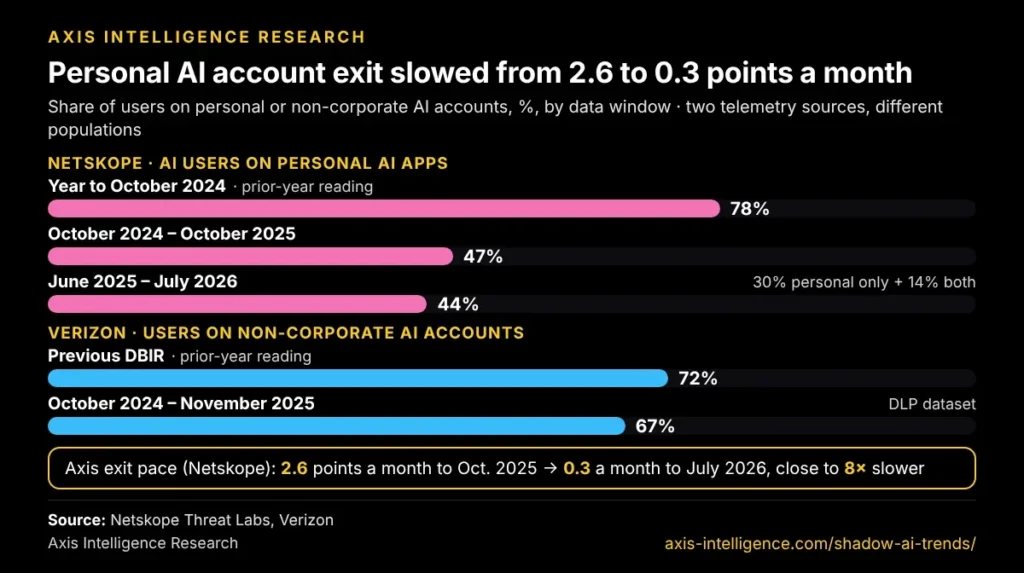
The move off personal AI accounts has nearly stopped. In Netskope’s telemetry, 44% of enterprise AI users still used personal AI apps in data through July 2026 (30% personal-only, 14% mixed), against 47% in the year to October 2025 and 78% the year before (Netskope AI Report 2026, published July 27, 2026). Axis Intelligence Research calculates that the exit slowed from about 2.6 percentage points a month to about 0.3, close to eightfold. Meanwhile the risk is moving from the chat box to the connection: in ten weeks, remote MCP server users rose 250% and MCP transactions 375%, and cases of AI services returning data to people or agents without clearance more than doubled, from 12 to 31 a week per organization. Of the nine shifts scored below, the best-evidenced is in breach data: shadow AI was involved in incidents at 43% of the organizations in IBM’s 2026 breach study, up from 20%.
Key stats for 2027 planning
- Organizations using AI coding apps doubled from 42% to 84% in Netskope’s June 2025–July 2026 data, and Claude Code alone reached 75% of organizations.
- 61% of senior cybersecurity professionals surveyed by Gartner have seen AI agent automation turn up inside enterprise software they had already approved (September 2026).
- 38% of organizations have what ISACA calls a “formal, comprehensive” AI policy, up from 28% in 2025, while 90% of ISACA’s 3,400+ respondents say employees use AI: a 52-point gap (Axis calculation, ISACA 2026 AI Pulse Poll).
- In a September 2026 survey of 510 large French companies, 85% said an AI incident had reached their board or executive committee in the past year; only 44% changed their AI governance afterward (IBM).
- Stand-alone high-risk AI rules under Annex III of the EU AI Act, which cover uses such as employment and education, now apply from December 2, 2027 (Regulation (EU) 2026/1744).
What are the biggest shadow AI trends for 2027?
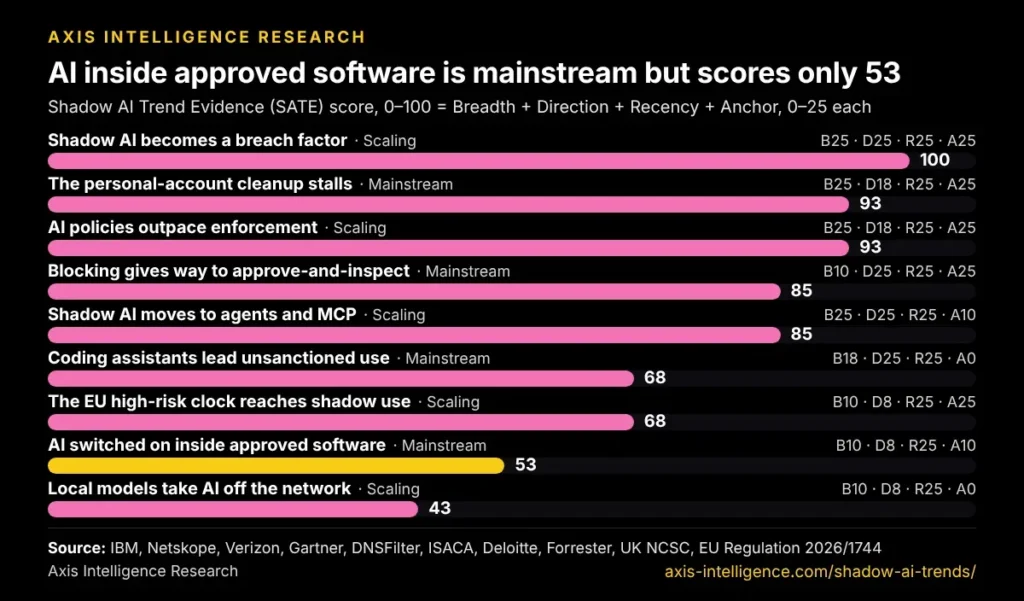
Nine shifts have enough primary evidence to plan around. The best-measured is the jump of shadow AI in breach data (SATE 100), and the move to agents and MCP now scores 85, level with the shift from blocking to approval. Among the widespread ones, AI switched on inside software IT already approved is the least measured (SATE 53). Axis Intelligence Research scores each trend with the Shadow AI Trend Evidence (SATE) score, a 0–100 rating of how well the trend is documented. It measures evidence, not how big the trend is.
| # | Trend | Dated evidence | Stage | Who it hits first | Signal to watch | SATE |
|---|---|---|---|---|---|---|
| 1 | Shadow AI is now a breach factor, not a hypothesis | 43% of breached organizations had shadow AI incidents, from 20% (IBM, March 2025–February 2026 breaches) | Scaling | CISOs, incident responders, cyber insurers | IBM’s next Cost of a Data Breach edition | 100 |
| 2 | The personal-account cleanup has stalled | Personal AI app use: 78% → 47% → 44% of AI users; decline stopped around March 2026 (Netskope); non-corporate AI accounts only 72% → 67% (Verizon DBIR) | Mainstream | Identity and SaaS security teams | Netskope’s next annual Cloud and Threat Report | 93 |
| 3 | AI policies are spreading faster than enforcement | Formal AI policy 28% → 38% (ISACA, May 2026); IT approval for AI deployments fell from 45% to 38% of organizations in IBM’s breach study | Scaling | GRC, internal audit, DPOs | ISACA 2027 AI Pulse Poll | 93 |
| 4 | “Block” is giving way to “approve and inspect” | Organization-managed AI accounts 25% → 62% of AI users; 90% of organizations still block at least one genAI app (Netskope); UK NCSC advises reducing shadow AI rather than eliminating it (September 2026) | Mainstream | Security architects, procurement | Share of AI users on managed accounts only | 85 |
| 5 | Shadow AI moves from prompts to agents and MCP | Remote MCP users +250%, transactions +375% in 10 weeks; downstream violations 12 → 31 a week (Netskope); 50% of organizations report employee access to public agent platforms (Gartner); 46.1% had an employee connect an unapproved AI tool to Google Workspace, Microsoft 365 or SSO (DNSFilter, June 2026) | Scaling | AppSec, IAM, platform engineering | Count of unregistered MCP servers and OAuth grants | 85 |
| 6 | Coding assistants become the biggest unsanctioned category | AI code apps 42% → 84% of organizations (Netskope); 75% of organizations report unauthorized AI coding assistant use (Gartner) | Mainstream | Engineering leaders, AppSec | Source-code share of AI data violations | 68 |
| 7 | The EU high-risk clock starts to cover shadow use | Annex III obligations from December 2, 2027; 41% of EU executives accelerating governance spending ahead of it (IBM, October 2026) | Scaling | HR, credit, education teams in the EU | National market-surveillance guidance | 68 |
| 8 | Shadow AI arrives inside approved software | 61% of senior cybersecurity professionals saw AI agent automation in already-approved enterprise software (Gartner) | Mainstream | SaaS owners, vendor-risk teams | Vendor release notes enabling AI by default | 53 |
| 9 | Local models take shadow AI off the network | 41% of organizations use Ollama to run models locally (Netskope) | Scaling | Endpoint and data-protection teams | Model files and runtimes in endpoint inventory | 43 |
Watch list, not yet a trend: agentic AI browsers and personal AI agents (SATE 35), where Gartner advised CISOs in December 2025 to block AI browsers “for now” and Forrester predicts an employee’s personal AI agent will trigger an incident at a Fortune 500 company; and self-paid AI tools (SATE 33), where 17% of UK GenAI users pay for their own tools, according to the Deloitte GenAI Workforce Survey 2026. Both have forecasts or a single reading, and no second measurement yet.
How the SATE score is built. SATE = B + D + R + A, each from 0 to 25:
- Breadth (B): independent producers with primary measurements of the trend: none 0, one 10, two 18, three or more 25.
- Direction (D): the same producer measured it at least twice on the same definition: a change of 2× or more scores 25, a smaller change 18, one reading 8, forecasts only 0.
- Recency (R): newest evidence published within six months of November 25, 2026: 25; six to twelve months: 15; older: 5.
- Anchor (A): a binding legal date, guidance from a government security agency on that behavior, or a breach-investigation dataset scores 25; an analyst forecast only, 10; none, 0.
Stage follows a separate rule. A trend is mainstream when one primary measure shows a majority of organizations or users, scaling at 20% to 49% or after a 2× change within a year, and emerging otherwise. Every input is a row in the CSV, so any score can be recomputed in a few minutes.
Marcus Chen, cybersecurity and privacy analyst at Axis Intelligence Embedded AI scores 53 while 61% of security teams already see it in their estate, and I’d audit that pairing first in 2027. A vendor flipping on an agent feature inside an approved CRM never crosses a proxy as a new app, so nobody has a second reading to compare against. Coverage is high and measurement is thin. That is exactly where the next incident review will say “we didn’t know it was on.”
Is shadow AI shrinking now that companies buy enterprise AI?
Not anymore. Personal AI account use fell fast in 2025 and then flattened. Netskope reports that the decline “stopped around March 2026, plateaued, and has trended back slightly,” leaving 44% of enterprise AI users on personal apps in data through July 2026.
| Netskope reading | Data window | AI users on personal AI apps | AI users on organization-managed accounts |
|---|---|---|---|
| Prior year, as reported in the 2026 Cloud and Threat Report | Year to October 2024 | 78% | 25% |
| Cloud and Threat Report 2026 (Jan. 5, 2026) | Oct. 1, 2024–Oct. 31, 2025 | 47% | 62% |
| Netskope AI Report 2026 (July 27, 2026) | June 2025–July 2026 | 44% (30% personal only + 14% both) | — |
Netskope also notes that in 2023, nearly all enterprise AI traffic was shadow AI. The cleanup since then is real, but it has run its course. Axis Intelligence Research calculates the pace from the end month of each data window:
- Year to October 2025: (78 − 47) ÷ 12 months = 2.6 percentage points a month
- October 2025 to July 2026: (47 − 44) ÷ 9 months = 0.3 points a month
The exit slowed by a factor of about eight. Verizon’s breach dataset, which draws on separate DLP telemetry, points the same way: 67% of users reach AI services through non-corporate accounts on corporate devices, down only from 72% the previous year (Verizon 2026 DBIR, data October 2024–November 2025). Over the same period, users switching between personal and enterprise accounts more than doubled, from 4% to 9%. These people have a license and still go back to their own account for some tasks.
Marcus Chen, cybersecurity and privacy analyst at Axis Intelligence I read the plateau as a coverage ceiling, and two producers with different sensors now show it. The 2025 drop was the easy part: enterprise seats went to the people already asking for them. The remaining 44% are on a model, a plugin or a workflow that the approved catalog doesn’t offer. Another wave of license purchases will buy a few points at most. In 2027 the levers are a faster approval queue and inspection of the traffic that stays personal.
The 2026 shares by tool, seniority and country are on our shadow AI statistics page.
How many employees use shadow AI going into 2027?
Between roughly a third and two-thirds of AI users, depending on what is counted: unapproved tools, personal accounts, or use the employer doesn’t know about. The six most recent primary measures each count something different.
| What is counted | Value | Population | Period | Producer |
|---|---|---|---|---|
| Used AI at work despite believing it was not permitted | 66% | AI users among 1,250 office workers at companies with $500M+ revenue, US, UK, Australia, Japan | April 9–20, 2026 | PagerDuty / Wakefield Research |
| Use personal GenAI accounts for work | Over 57% | 175 employees surveyed | May–November 2025 | Gartner |
| Use non-corporate accounts to reach AI services on corporate devices | 67%, from 72% | Users in Verizon’s DLP dataset | Oct. 2024–Nov. 2025 | Verizon DBIR 2026 |
| Use personal AI apps (alone or with managed apps) | 44% | Enterprise AI users, Netskope telemetry | June 2025–July 2026 | Netskope |
| Use GenAI without the employer knowing | 31% | GenAI users in a 25,000-worker UK survey | May–June 2026 | Deloitte |
| Regular AI users (access at least once every 15 days), approved or not | 45%, from 15% | Employees on corporate devices | Oct. 2024–Nov. 2025 | Verizon DBIR 2026 |
Deloitte’s 31% answers a different question, whether the employer knows, and it is the one to bring to HR and legal. The last row is the base shadow AI grows from. Verizon counts frequent AI use, sanctioned or not, and it tripled in a single year. Netskope’s telemetry points the same way, with weekly AI users at the median organization rising from 34% to 59%.
Marcus Chen, cybersecurity and privacy analyst at Axis Intelligence The two telemetry counts disagree by 23 points: Netskope’s 44% against Verizon’s 67%. I’d trust Netskope for direction and Verizon for level. Netskope sees traffic at companies mature enough to buy a security service edge and roll out managed AI, which pulls its share down; Verizon’s DLP view catches the browser sessions those programs miss. Both fell only a few points in their latest year, and that agreement matters more than the gap.
How fast sanctioned adoption is moving by company size is tracked in our corporate AI adoption statistics.
Why are AI agents and MCP becoming the new shadow AI?
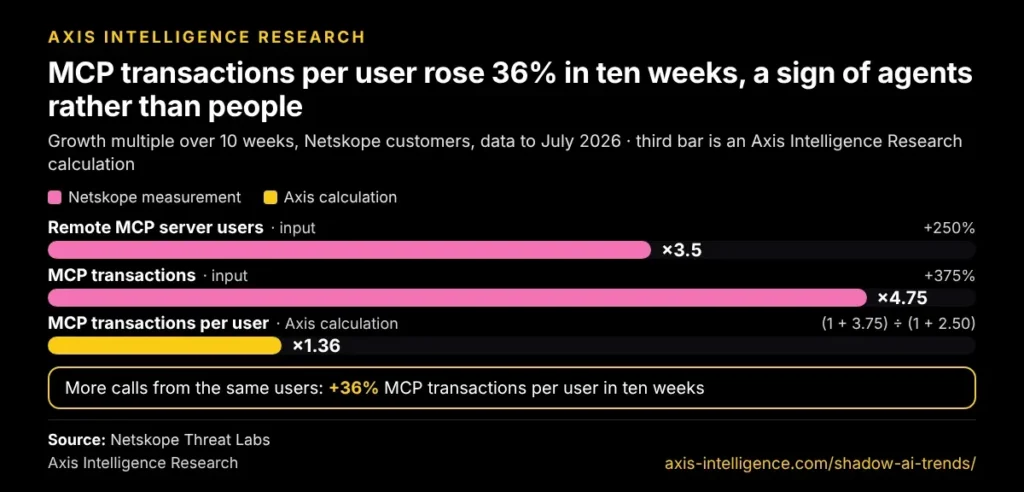
Because the riskiest data flow now runs through the connection, not the prompt. In the Netskope AI Report 2026, remote MCP server users rose 250% and MCP transactions rose 375% over ten weeks. The Model Context Protocol (MCP) is the open standard that links AI models and agents to internal data and tools.
Transactions grew faster than users, and Axis Intelligence Research calculates what that implies for each user: (1 + 3.75) ÷ (1 + 2.50) = 1.36, or 36% more MCP transactions per user in ten weeks. More calls from the same people points to software looping on their behalf.
| Agentic shadow AI signal | Value | Period | Producer |
|---|---|---|---|
| Downstream data policy violations per organization per week | 12 → 31 | June 2025–July 2026 | Netskope |
| Organizations reporting employee access to public SaaS GenAI agent platforms | 50% | Published Sept. 30, 2026 | Gartner |
| Organizations suspecting or holding evidence of unsanctioned employee AI use | 59% | Published Sept. 30, 2026 | Gartner |
| Organizations where an employee connected an unapproved AI tool to Google Workspace, Microsoft 365 or SSO | 46.1% | June 2026, 400 IT leaders, North America | DNSFilter |
| Organizations where IT learns of an AI tool’s OAuth or API access only after it is granted, or never | 43% | June 2026 | DNSFilter |
| Organizations where an unapproved AI connection already caused a security incident | 20.1% | June 2026 | DNSFilter |
| Large French companies with agentic AI in production | 35% | Sept. 14–24, 2026 | IBM |
| Large French companies expecting agents with some decision autonomy by 2027 | 87% | Sept. 14–24, 2026 | IBM |
DNSFilter’s own network data shows how far estimates trail reality: on a standard business day in August 2026, 15.2% of organizations on its North American network connected to more than 10 AI tools, while 0.5% of the IT professionals it surveyed believed their employees used that many.
A downstream violation is Netskope’s term for an AI service returning sensitive data to a user or agent who is not authorized to see it. The data leaves through the agent’s privileges rather than through a paste. Forrester’s 2027 Asia Pacific predictions put a ratio on what comes next: one in three large APAC enterprises will uncover at least ten employee-built shadow AI agents for every sanctioned one (Forrester, October 2026). That is a forecast, not a count.
Marcus Chen, cybersecurity and privacy analyst at Axis Intelligence Transactions outrunning users is the fingerprint of an agent, not a person. A human opens a connector a few times a day, while an agent can loop through it hundreds of times on one OAuth grant. The log shows an employee’s identity, but the actor is software with that employee’s scopes. Most DLP rules still assume someone is typing, and in 2027 they need to inspect what comes back from the model as well as what goes in.
Incident counts for agents, including MCP server CVEs, are in our AI agent security statistics and the AI agent security incident tracker. Sanctioned deployment by sector is in AI agent adoption by industry, and the injection path that turns a connector into an attack vector is in our prompt injection statistics.
Which unsanctioned AI tools will security teams find in 2027?
Coding agents first. Netskope counts AI code apps at 84% of organizations, from 42% a year earlier, and Gartner reports unauthorized AI coding assistant use at 75% of organizations. The other categories differ mainly in which control is blind to them.
| Category | Latest evidence | Why existing controls miss it |
|---|---|---|
| Coding assistants and agents | AI code apps 42% → 84% of organizations; Claude Code at 75%, Codex at 58% (Netskope, June 2025–July 2026); unauthorized use at 75% of organizations (Gartner, Sept. 2026) | They run in the IDE and terminal with repository and shell access, and MCP lets them reach internal tools |
| AI inside approved software | 61% of senior cybersecurity professionals saw agent automation in already-approved software (Gartner) | The vendor is already on the allow-list, so no new app appears in discovery |
| Local models | 41% of organizations use Ollama (Netskope) | Inference never leaves the laptop, so no prompt crosses the proxy |
| AI browsers and extensions | The average company had more than 15% of users with unauthorized AI browser extensions (Verizon DBIR 2026); Gartner’s advisory “Cybersecurity Must Block AI Browsers for Now” (Dec. 1, 2025) | The browser acts on authenticated sessions and can be steered by content on the page |
| Self-paid subscriptions | 17% of UK GenAI users pay for their own tools; UK workers spend an estimated £1 billion a year on them (Deloitte, May–June 2026) | Personal card and personal account: invisible to procurement and to SaaS management |
Coding tools also lead on what leaks. Source code made up 42% of genAI data policy violations in Netskope’s Cloud and Threat Report 2026, and it was the most common data type submitted to external GenAI models “by a large margin” in Verizon’s DLP data. How far AI has spread into the software delivery workflow is measured in our developer AI adoption statistics.
What data is leaking through shadow AI?
Source code leads, at 42% of genAI data policy violations, ahead of regulated data at 32% and intellectual property at 16% (Netskope, October 2024–October 2025). Verizon’s DLP data, from a different sensor, puts source code first as well. The volume doubled: the average organization logged 223 genAI data policy incidents a month. The 2026 change is direction. Data now also flows back out of the model.
| Exposure measure | Value | Period | Producer |
|---|---|---|---|
| GenAI data policy violations, average organization | 223 a month, doubled in a year | Oct. 2024–Oct. 2025 | Netskope |
| Prompts sent to genAI apps, average organization | 3,000 → 18,000 a month | Oct. 2024–Oct. 2025 | Netskope |
| Most common data type sent to external GenAI models | Source code, “by a large margin” (858,440 DLP events) | Oct. 2024–Nov. 2025 | Verizon DBIR 2026 |
| DLP events uploading research and technical documentation to unauthorized AI | 3.2% | Oct. 2024–Nov. 2025 | Verizon DBIR 2026 |
| Employees admitting they entered sensitive information into unapproved tools | 33% | May–Nov. 2025 | Gartner |
| Shared emails or other correspondence with public AI tools | 43% | April 2026 | PagerDuty |
| Shared meeting notes or summaries | 40% | April 2026 | PagerDuty |
| Entered customer data | 34% | April 2026 | PagerDuty |
| Shared financial information or confidential documents and strategies | 31% | April 2026 | PagerDuty |
| Downstream violations (AI returns data the user or agent may not see) | 12 → 31 a week per organization | June 2025–July 2026 | Netskope |
Upstream violations, where a user or agent sends sensitive data to an AI app, are still the largest category by volume in Netskope’s 2026 AI data. Downstream violations rank second and are the fastest-growing.
Marcus Chen, cybersecurity and privacy analyst at Axis Intelligence Upstream leakage is a training and DLP problem. Downstream leakage is an entitlement problem, and it is the one most programs have not scoped. When an agent can query a data store the employee was never meant to browse, the model becomes a search engine over over-permissioned data. The 2027 fix is the same unglamorous access review that IBM ties to AI breaches, now applied to service accounts and MCP servers.
Are shadow AI incidents increasing?
Yes. Shadow AI was involved in security incidents at 43% of organizations in IBM’s 2026 Cost of a Data Breach study, up from 20% a year earlier, and those breaches cost more: USD 5.39 million on average, against USD 4.63 million a year earlier (IBM Cost of a Data Breach Report 2026, pp. 45–46; summary on IBM Think). The study covers 602 organizations breached between March 2025 and February 2026 (IBM newsroom, July 29, 2026).
| Incident measure | Value | Period | Producer |
|---|---|---|---|
| Organizations with shadow AI security incidents | 43%, from 20% | Breaches March 2025–Feb. 2026 vs prior study | IBM / Ponemon Institute |
| Shadow AI incidents leading to data loss or compromise | 49% | Same | IBM |
| Shadow AI incidents leading to operational disruption | 42% | Same | IBM |
| Shadow AI incidents leading to regulatory fines | About one in five (21%) | Same | IBM |
| Average cost of a breach involving shadow AI | USD 5.39 million, from USD 4.63 million (global average USD 4.99 million) | Same | IBM |
| Organizations saying an unapproved AI connection caused a security incident | 20.1% | June 2026, 400 IT leaders, North America | DNSFilter |
| Rank of shadow AI among non-malicious insider actions in DLP data | Third most common, a fourfold increase in share from the previous year | 2025 | Verizon DBIR 2026 |
| Enterprises expected to have shadow AI security or compliance incidents by 2030 | More than 40% (forecast) | Published Nov. 19, 2025 | Gartner |
IBM’s 43% and Gartner’s “more than 40% by 2030” look contradictory but measure different groups. IBM counts organizations that suffered a breach. Gartner forecasts the share of all enterprises. A breached organization is more likely to find shadow AI because forensic investigators go looking for it. Breach costs overall, with their own 2027 outlook, are on our data breach statistics page, and the cost premium of shadow AI breaches is broken out in the shadow AI cost section of our 2026 dataset.
Marcus Chen, cybersecurity and privacy analyst at Axis Intelligence Part of the doubling is better tagging. Once IBM made shadow AI a breach factor, investigators started checking browser and proxy logs for it. So 20% was probably an undercount, and 43% is a floor set by what forensics can rebuild. Agent traffic through MCP leaves less to rebuild, which is why I expect the 2027 reading to rise again while the share attributed with confidence falls.
Are company AI policies catching up with shadow AI?
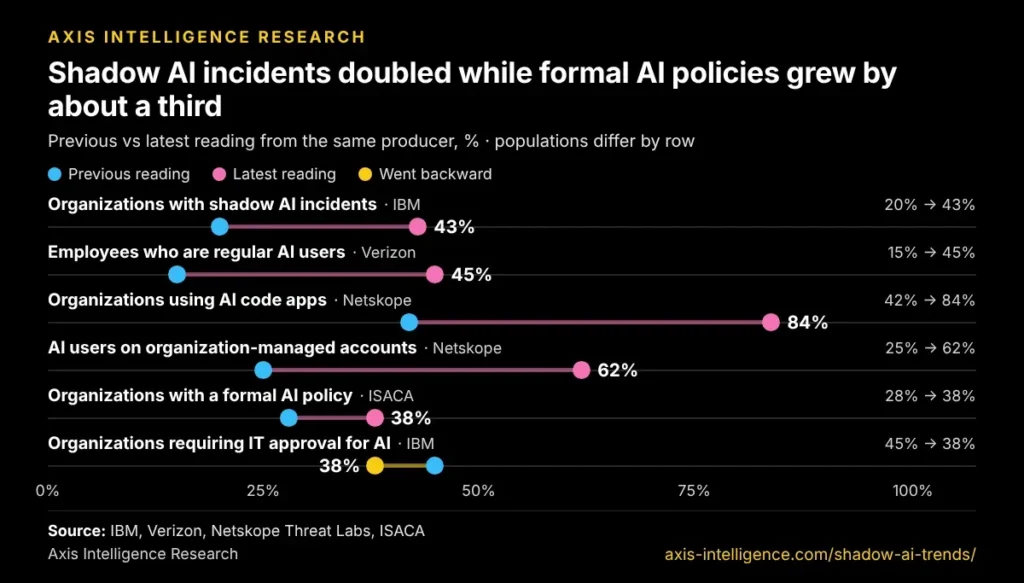
On paper, slowly. In practice, not yet. 38% of organizations have a “formal, comprehensive” AI policy in ISACA’s terms, up from 28% in 2025; 30% have a limited one and 25% none (ISACA 2026 AI Pulse Poll, May 5, 2026).
| Governance measure | Value | Period | Producer |
|---|---|---|---|
| “Formal, comprehensive” AI policy | 38%, from 28% | 2026 vs 2025 | ISACA (3,400+ digital trust professionals) |
| Train all employees on AI | 33%, from 22% | 2026 vs 2025 | ISACA |
| Don’t know how long halting an AI system would take after an incident | 56% | 2026 | ISACA |
| Usage–policy gap (respondents saying employees use AI, minus formal policy) | 52 points | 2026 | Axis calculation: 90% − 38% (ISACA) |
| Breached organizations lacking AI governance policies to manage AI or detect shadow AI | 68%, from 63% | 2026 vs 2025 study | IBM |
| Organizations in IBM’s study requiring IT approval for AI deployments | 38%, from 45% | 2026 vs 2025 study | IBM |
| Breached organizations developing AI governance policies | 33%, from 22% | 2026 vs 2025 study | IBM |
| Organizations in IBM’s breach study using access controls on AI models and data | 40% | 2026 study | IBM |
| Organizations in IBM’s breach study reporting meaningful governance–security coordination | 19% | 2026 study | IBM |
| AI incident reported to the board or executive committee in the past year | 85% | Sept. 2026, 510 large French companies | IBM |
| Changed AI governance policy or framework after it | 44% | Same | IBM |
| Incident-to-policy response gap | 41 points | Same | Axis calculation: 85% − 44% (IBM) |
Measured on their own producers’ repeat readings, incidents and usage grew two to three times in a year, formal AI policy grew by about a third, and one control went backward: the share of organizations in IBM’s study requiring IT approval for AI deployments fell from 45% to 38%.
Marcus Chen, cybersecurity and privacy analyst at Axis Intelligence If a policy doesn’t change after an incident reaches the board, it is a compliance artifact. In 2027, test an AI acceptable-use policy by whether each clause names its enforcement point: the proxy rule, the OAuth app allow-list, the MCP server registry, the endpoint check for local runtimes. ISACA’s 56% who can’t say how long it takes to halt an AI system tells you how many policies would fail that test today.
The paper-versus-proof gap across the wider AI governance field is measured in our AI governance statistics, and control coverage across 15 primary sources is in our AI security statistics.
What deadlines and forecasts shape shadow AI in 2027?
One binding date sets the 2027 calendar: December 2, 2027, when the EU AI Act’s stand-alone high-risk rules (Annex III) start to apply under the Digital Omnibus on AI, Regulation (EU) 2026/1744, in force since July 27, 2026. The rest of the calendar is guidance and forecasts.
| Date | What happens | Why it matters for shadow AI | Type |
|---|---|---|---|
| July 27, 2026 | Digital Omnibus on AI enters into force; Article 4 now requires providers and deployers to “take measures to support the development of AI literacy” of staff, and states that this does not require them to guarantee any specific level for any individual | The literacy duty still covers employees using AI tools at work | Binding law |
| September 7, 2026 | UK NCSC publishes “The hidden risks of shadow AI”: reduce shadow AI risk rather than try to eliminate it, and provide secure approved alternatives | A government security agency endorsing “approve and inspect” over blanket bans | Government guidance |
| 2027 (prediction) | Forrester: one in three large APAC enterprises finds at least 10 employee-built shadow agents per sanctioned agent; an employee’s personal AI agent triggers an incident at a Fortune 500 company | First analyst forecasts framed around shadow agents rather than shadow apps | Forecast |
| December 2, 2027 | Chapter III obligations apply to high-risk systems under Article 6(2) and Annex III (uses including biometrics, employment and education) | Unsanctioned AI used in hiring or similar decisions moves from a policy breach to a regulatory exposure | Binding law |
| August 2, 2028 | High-risk AI embedded in regulated products (Annex I) | Mostly sanctioned product AI; limited shadow relevance | Binding law |
| By 2030 (prediction) | Gartner: more than 40% of enterprises experience shadow AI security or compliance incidents | Baseline forecast to compare annual breach data against | Forecast |
In IBM’s October 2026 survey, 41% of EU executives (33% in France) said they are accelerating governance investment ahead of the December 2027 high-risk deadline. Every milestone’s live status is tracked in our EU AI Act compliance tracker, and binding rules outside the EU are in our AI regulation tracker. The full sector view is on the Cybersecurity & Digital Trust outlook hub.
Shadow AI in 2027: questions CISOs and auditors ask
Should we block AI browsers like ChatGPT Atlas and Comet in 2027?
Gartner’s December 1, 2025 advisory told CISOs to block AI browsers until enterprise-ready versions reach general availability, because their agentic features can act on authenticated sessions. The UK NCSC’s September 2026 shadow AI guidance takes the broader view that bans alone don’t remove shadow AI. In practice, block agentic browsing on managed devices and offer a sanctioned assistant for the same tasks.
Is an MCP server an employee connects to their AI assistant shadow AI?
Yes, if security never reviewed the server or the scopes it was granted. It is often the riskier kind, because the server can return data the employee couldn’t browse directly. Netskope counts these “downstream” violations rising from 12 to 31 a week per organization between June 2025 and July 2026. A registry of approved MCP servers belongs in the same review as OAuth app consent.
Can a proxy or SSE still see shadow AI if employees run models locally?
Not the prompts. Local inference never crosses the network, and Netskope found 41% of organizations using Ollama to run models locally in its July 2026 report. Detection moves to the endpoint: model files, local runtimes and the plugins that connect them to corporate data.
Does the EU AI Act still require AI literacy training after the Digital Omnibus?
Yes, in a softer form. Since July 27, 2026, Article 4 requires providers and deployers to take measures to support the AI literacy of their staff, and it says explicitly that this does not require them to guarantee any specific level for any individual. Training that covers unapproved tools remains the simplest evidence of those measures. This is not legal advice.
What shadow AI number belongs in a 2027 board report?
The share of AI users on organization-managed accounts only, tracked quarterly, because it moves when controls work. In Netskope’s July 2026 data, 56% of enterprise AI users touched no personal AI app (100% minus 30% personal-only and 14% mixed). Pair it with the time needed to halt an AI system, which 56% of ISACA respondents could not state in 2026.
Methodology
Sources. Only producers’ own pages and reports opened on November 25, 2026: IBM (Cost of a Data Breach Report 2026, full report; October 2026 France governance study), Netskope Threat Labs (Cloud and Threat Report 2026; Netskope AI Report 2026), Verizon (2026 DBIR, full report), Gartner (press releases of November 19, 2025 and February 5, 2026; September 30, 2026 article; December 1, 2025 advisory abstract), Forrester (2027 Asia Pacific predictions), ISACA (2026 AI Pulse Poll), PagerDuty (2026 Shadow AI Survey), Deloitte (GenAI Workforce Survey 2026, UK), DNSFilter (AI Cybersecurity Survey 2026 and network data, release of November 3, 2026), UK NCSC and the Official Journal of the EU. Figures from the full IBM Cost of a Data Breach Report 2026, the Verizon 2026 DBIR, the Official Journal text of Regulation (EU) 2026/1744 and DNSFilter’s November 3, 2026 release were checked against the documents themselves. Figures relayed only by third-party sites were excluded.
Comparability. The two Netskope reports draw on aggregated data from subsets of Netskope customers. The exit-pace calculation uses the end month of each data window and treats each reading as the state at that date. Survey shares (PagerDuty, Gartner, Deloitte, ISACA, IBM France) measure different populations and are never added or averaged.
Axis calculations. Exit pace = (earlier share − later share) ÷ months between window ends. MCP transactions per user = (1 + transaction growth) ÷ (1 + user growth). Usage–policy gap = ISACA share saying employees use AI − ISACA share with a formal policy. Incident-to-policy response gap = IBM France share reporting an AI incident to the board − share that changed governance afterward. SATE scoring rules are in the trends section.
Dataset: shadow-ai-trends.csv contains every input, Axis calculation and SATE component on this page (CC BY 4.0 for Axis compilation and calculations).
Cite this page: Axis Intelligence Research, “Shadow AI Trends 2027”, data as of November 25, 2026, https://axis-intelligence.com/shadow-ai-trends/ [copy]