


AI Coding Trends 2027
By Axis Intelligence Research
Co-author: Sarah Mitchell | Last updated: November 25, 2026 | License: CC BY 4.0
Short answer
Going into 2027, the main change in AI coding is who opens the pull request. In September 2026, coding agents started more than 40% of all pull requests on GitHub, up from 17% in March, according to GitHub’s Octoverse 2026 report (published October 28, 2026). The cost has moved from writing code to checking it. Axis Intelligence Research calculates that merged pull requests per GitHub developer rose 1.93× in a year. This is the Review Load Multiple (RLM). Over the same period, 38% of AI-generated code samples still failed Veracode’s security tests in October 2026.
| 2027 trend | Stage | CTES (0–100) |
|---|---|---|
| Agents open the pull request | Mainstream | 100 |
| Review becomes the bottleneck | Scaling | 100 |
| Pricing moves to $100+ tiers and metered credits | Mainstream | 85 |
| Developers run several models and agents at once | Mainstream | 80 |
| AI code security improves at the top, not at the floor | Scaling | 75 |
| Hiring tilts senior and the junior ramp narrows | Mainstream | 75 |
| Company claims of AI-written code keep climbing | Scaling | 60 |
| Teams shrink and solo builders multiply | Emerging | 60 |
CTES = Coding Trend Evidence Score, an Axis Intelligence Research score of how well each trend is documented. It does not measure how big a trend is. The formula is in the section on the biggest trends.
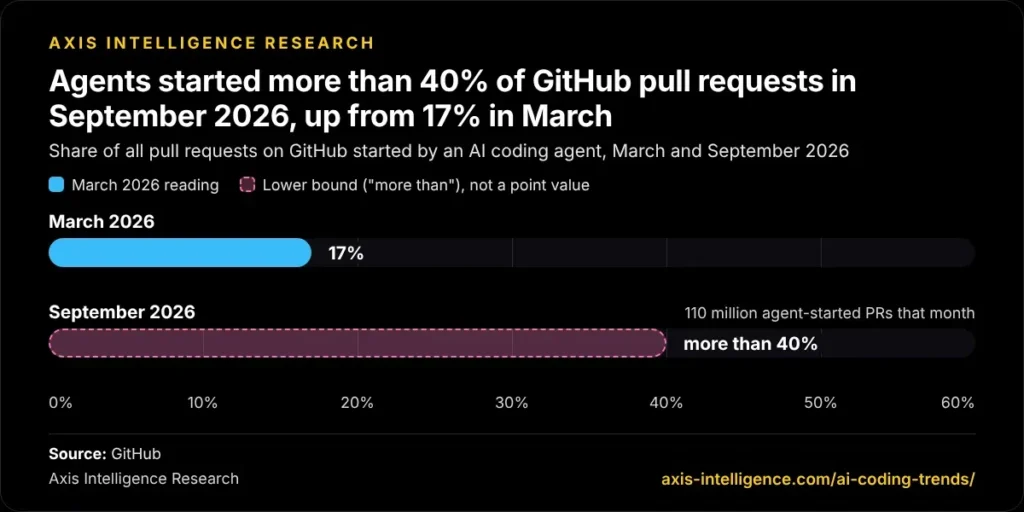
Sarah Mitchell, AI and machine learning analyst at Axis Intelligence An agent-started pull request is a proposed diff, not shipped software. The jump from 17% to over 40% in six months says models crossed the bar for producing a reviewable change on the first pass, which is a lower bar than merging it unattended. For 2027 headcount plans, I would size reviewer hours against the agent PR count and treat seat count as a secondary input.
Key stats for 2027 planning
- 82.8% of Stack Overflow’s 2026 respondents use at least one AI tool for work; 17.2% use none (n = 17,464; Axis calculation from Stack Overflow’s 2026 AI data, published October 6, 2026).
- 90% of professional developers used AI coding agents at work at least weekly in May–July 2026, and 68% used them daily (JetBrains Developer Ecosystem Survey 2026).
- 75% of all new code at Google is AI-generated and approved by engineers, up from 50% in fall 2025 (company-reported, April 22, 2026).
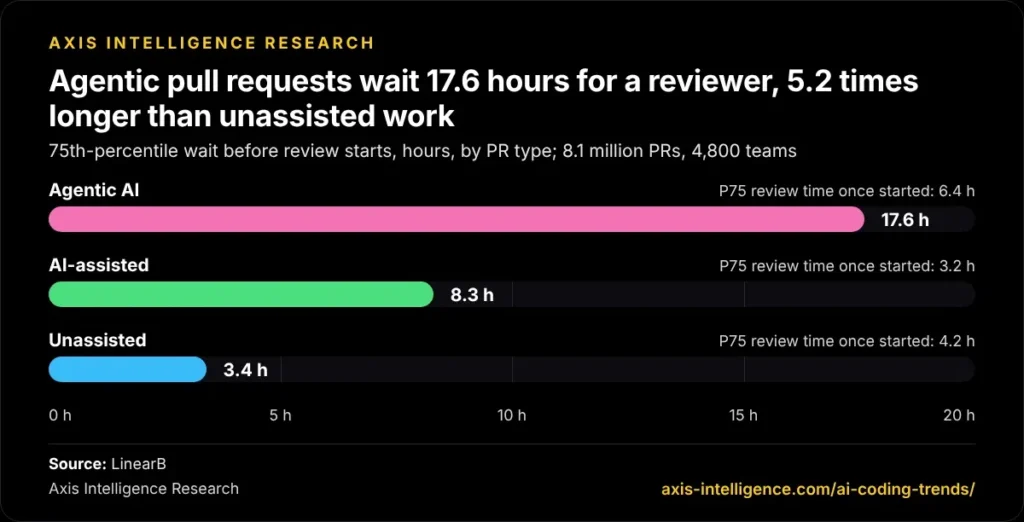
- 17.6 hours: the 75th-percentile wait before a reviewer picks up an agentic AI pull request, against 3.4 hours for unassisted work (LinearB 2026 benchmarks, 8.1 million PRs).
- 5 of 5 major coding-agent vendors now sell a $100-a-month individual tier (Axis Intelligence Research finds, from vendor pricing pages checked November 25, 2026).
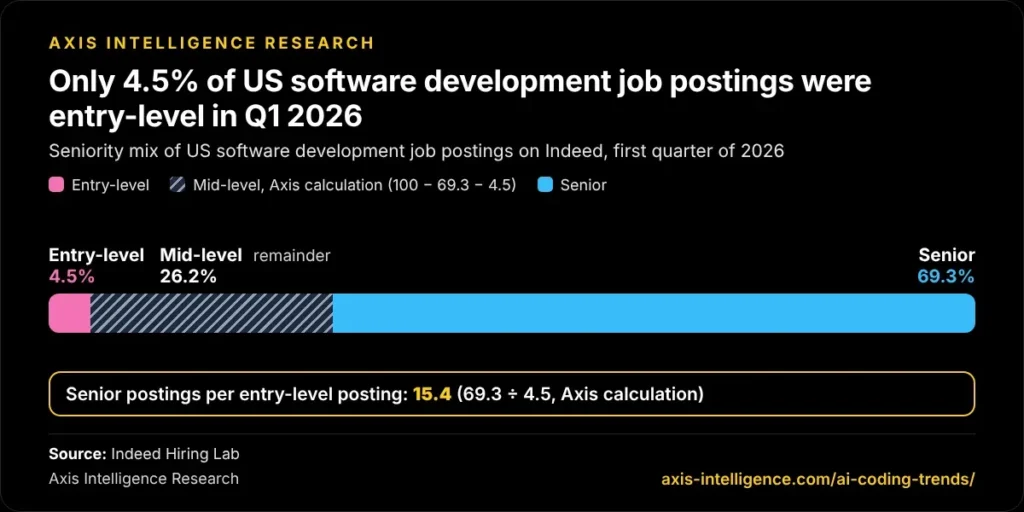
- 4.5% of US software development job postings were entry-level in Q1 2026, against 69.3% senior. That is about 15 senior postings per entry-level posting (Axis calculation from Indeed Hiring Lab).
What are the biggest AI coding trends for 2027?
Eight trends meet the evidence bar. They are ranked by the Coding Trend Evidence Score (CTES), which rates how well each trend is measured going into 2027. The columns below show the strongest dated evidence and the signal that would confirm or break each trend next year.
| Trend | Strongest dated evidence | Stage | CTES | Who it affects | Signal to watch in 2027 |
|---|---|---|---|---|---|
| Agents open the pull request | Agent-started PRs: 17% (Mar 2026) → over 40% (Sep 2026), GitHub | Mainstream | 100 | Engineering managers, platform teams | Agent share in Octoverse 2027 |
| Review becomes the bottleneck | Merged PRs 538M → 1.3B in a year, GitHub; RLM 1.93 | Scaling | 100 | Reviewers, tech leads, SRE | Pickup time on agent PRs in LinearB’s next benchmarks |
| $100+ tiers and metered credits | $100 individual tier at 5 of 5 vendors; Copilot priced in AI credits (Nov 2026); 51% of tech managers track token usage, JetBrains | Mainstream | 85 | Finance, engineering ops | Gartner’s 2028 cost-versus-salary forecast |
| Several models and agents at once | 61% of developers who pick their own Copilot model used more than one (Sep 2026), GitHub | Mainstream | 80 | Tool buyers, procurement | Whether any model passes 25% of Copilot requests |
| Security improves at the top, not at the floor | Average pass rate 56% → 62%; floor stuck at 44–50%, Veracode (Oct 2026) | Scaling | 75 | AppSec, CISOs | Log-injection (CWE-117) pass rate, flat at 13% |
| Hiring tilts senior | 69.3% of software postings senior, 4.5% entry-level (Q1 2026), Indeed; 18% of developers see a favorable local job market, JetBrains | Mainstream | 75 | New graduates, hiring managers | Stanford’s monthly gap for ages 22–25 (19% in June 2026) |
| AI-written code claims climb | Google 50% (fall 2025) → 75% (Apr 2026), company-reported | Scaling | 60 | Executives, investors | A third-party audit of any company’s figure |
| Smaller teams, more solo builders | Organizations of one: 4% → 10% of respondents, Stack Overflow 2026 | Emerging | 60 | Founders, agencies | Gartner’s 15% (2026) small-team baseline |
How CTES works. CTES = T + S + C + F, on a 0–100 scale:
- T, telemetry (0–30): 30 if the trend is measured in platform telemetry, payroll or job-posting data, controlled tests, or pricing pages Axis checked itself. 10 if it rests on company statements alone.
- S, surveys (0–20): 20 if two or more independent 2026 developer surveys corroborate it, 10 for one survey.
- C, change (0–30): 30 if the same producer measured it twice on the same definition within 12 months and the move was at least 2× or 10 percentage points. 15 for a smaller move, 5 for a single reading.
- F, forecast (0–20): 20 if a dated Gartner or Forrester forecast for 2027–2029 points the same way.
Stage is assigned separately. A trend is “mainstream” when a primary measure shows a majority of developers, organizations, PRs or vendors. It is “scaling” when the measure is 20% to 49%, or has doubled within a year. Otherwise it is “emerging.” Every component is a row in the CSV.
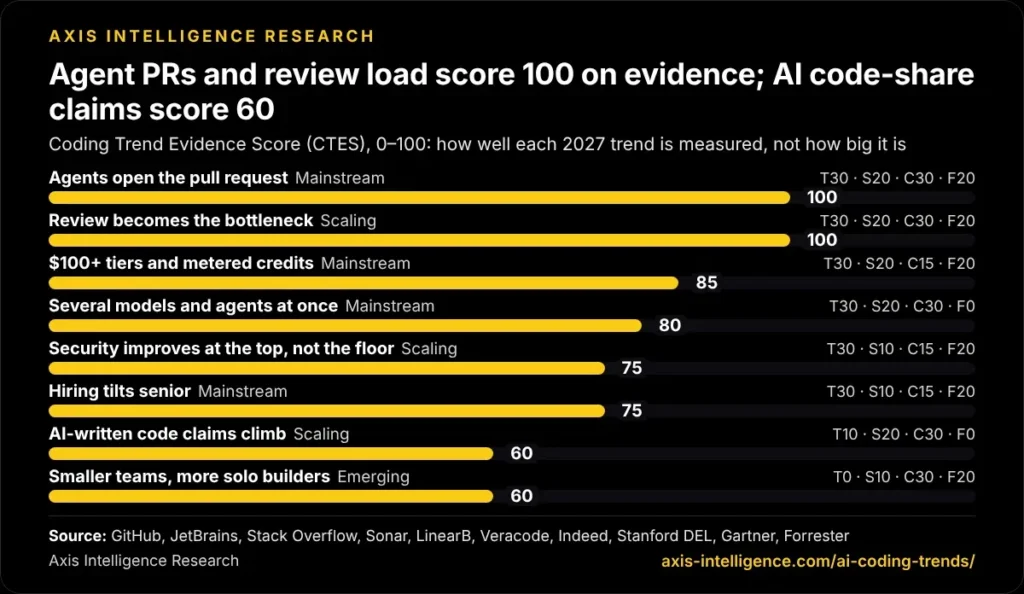
Sarah Mitchell, AI and machine learning analyst at Axis Intelligence The ranking is the reverse of the news cycle. “75% of code is AI-written” is the most-repeated number in this field and one of the least independently measured: one company, its own definition, no outside telemetry. That is why it scores 60, while the PR-share trend GitHub counts directly scores 100. If a 2027 board deck can carry one AI coding number, make it a counted one.
How many developers use AI coding agents going into 2027?
Use is close to universal among working developers, and agents are now the default form of it. JetBrains surveyed more than 15,000 professional developers in May–July 2026. It found 90% using AI coding agents at work at least weekly and 68% daily, as reported in its 2026 agent adoption analysis. Stack Overflow’s broader 2026 sample includes students and hobbyists. There, 65.9% use AI coding assistants or agents, and 17.2% use no AI tools at all.
| Measure | Value | Population | Period | Producer |
|---|---|---|---|---|
| Use AI coding agents at work at least weekly | 90% | Professional developers, 15,000+ | May–Jul 2026 | JetBrains |
| Use AI coding agents at work daily | 68% | Professional developers | May–Jul 2026 | JetBrains |
| Use AI coding assistants or coding agents | 65.9% | All respondents, n = 17,464 | 2026 survey | Stack Overflow |
| Use AI agents or automated workflows (beyond coding) | 26.2% | All respondents, n = 17,464 | 2026 survey | Stack Overflow |
| Use no AI tools | 17.2% | All respondents, n = 17,464 | 2026 survey | Stack Overflow |
| Copilot monthly active users using agentic features | 55%, up from 35% a year earlier | Copilot MAU (company-reported) | Year to Sep 30, 2026 | GitHub |
Governance has not caught up with use. Among Stack Overflow respondents describing their employer (n = 13,167), 29.7% say AI use is mostly optional and left to individuals. Only 24.0% say they get approved tools and guidance. A further 10.2% say AI use is now measured or evaluated in performance reviews. That last figure is an early sign that AI use is becoming a job expectation rather than an option. The gap between personal use and sanctioned tools is the subject of our shadow AI trends for 2027. The workflow-stage breakdown sits in our developer AI adoption statistics. Usage counts by tool and vendor revenue are in our AI coding assistant statistics.
Which coding agents are winning, and why do the surveys disagree?
Claude Code leads both major 2026 developer surveys. Stack Overflow and JetBrains still put GitHub Copilot at very different levels. In JetBrains’ May–July 2026 wave, 39% of professional developers used Claude Code at work, up from 18% in January. Copilot fell to 21% from 29% a year earlier. In Stack Overflow’s 2026 survey, Claude Code reached 65.5% and Copilot 58.7% among the 12,255 respondents who answered the coding-agent question.
| Tool | JetBrains: used at work, May–Jul 2026 | JetBrains: earlier reading | Stack Overflow 2026: used in past year (n = 12,255) |
|---|---|---|---|
| Claude Code | 39% | 18% (Jan 2026) | 65.5% |
| GitHub Copilot | 21% | 29% (a year earlier) | 58.7% |
| OpenAI Codex | 16% | 3% (Jan 2026) | 29.5% |
| Cursor | 12% | 18% (Jan 2026) | 25.5% |
| Google Antigravity | 6% | stable | 16.0% |
| JetBrains AI (IDE and/or Junie) | about 9% | — | 12.8% |
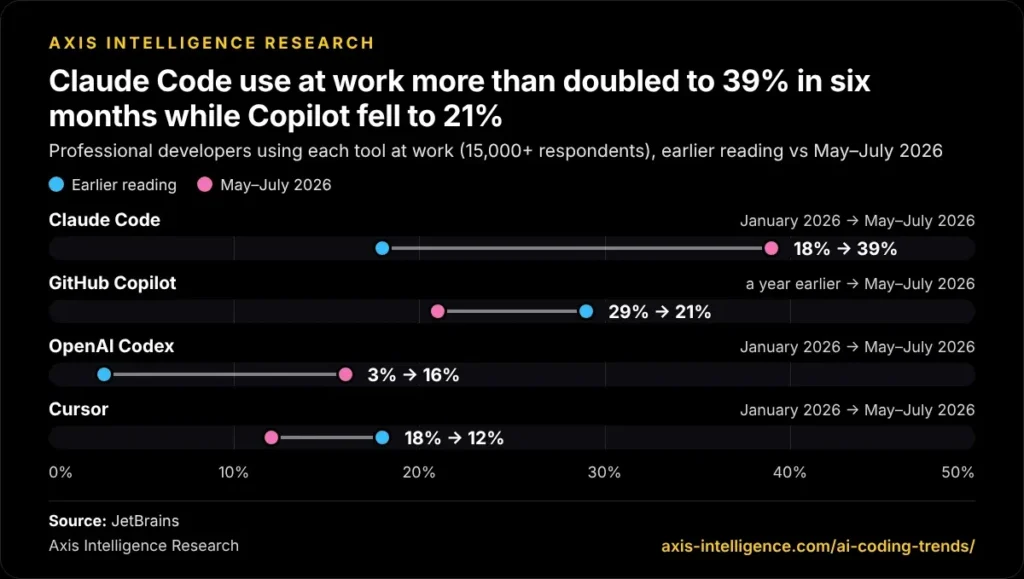
The two surveys overlap heavily on the same people. Stack Overflow’s two leading tools add up to 124.2% of one base. So at least 24.2% of those respondents used both Claude Code and Copilot in the past year (Axis Intelligence Research calculation: 65.5% + 58.7% − 100%). GitHub’s platform data shows the same habit at the model level: in September 2026, 61% of Copilot users who picked a model themselves used more than one, and no single model took more than 25% of requests. Vendor-level detail is in our GitHub Copilot statistics and Claude usage and revenue data.
The market also consolidated. Cursor confirmed on August 14, 2026 that SpaceX had completed its acquisition, which began as a model-training partnership in April. Cursor’s own work-use share fell from 18% to 12% between JetBrains’ January and May–July readings. In China it fell from 28% to 16%. The Cursor statistics page tracks the company’s disclosed figures.
Sarah Mitchell, AI and machine learning analyst at Axis Intelligence Copilot at 58.7% in one survey and 21% in the other is the same market seen through two windows. Stack Overflow asks AI users what they touched in the past year, so trials count. JetBrains asks all professional developers what they use at work in a three-month window, so only habits count. For a 2027 enterprise standard, the JetBrains number is the one to plan against. That is also where Claude Code’s doubling in six months shows up.
How much code is AI writing in 2027?
It depends on who is counting. Companies report the highest shares and developer surveys report lower ones. Google says 75% of all new code at the company is now AI-generated and approved by engineers, up from 50% last fall, in Sundar Pichai’s Cloud Next post of April 22, 2026. Developers surveyed by JetBrains in May–July 2026 put the average share of their code fully generated by agents at about 47%, according to JetBrains’ code-share analysis.
| Producer | Figure | What is counted | Date | Type |
|---|---|---|---|---|
| 75% of all new code | AI-generated and approved by engineers, company-wide | Apr 22, 2026 | Company-reported | |
| 50% of all new code | Same wording, earlier reading | Fall 2025 | Company-reported | |
| JetBrains | ~47% average | Share of last month’s work code fully generated by agents | May–Jul 2026 | Developer survey, 15,000+ |
| JetBrains | ~22% of developers | Generate over 80% of their code with agents | May–Jul 2026 | Developer survey |
| Sonar | 42% | Share of all committed code that is AI-generated | Published Jan 8, 2026 | Developer survey, 1,100+ |
| Sonar | 65% by 2027 | What developers expect the share to reach | Published Jan 8, 2026 | Expectation, not a measurement |
| GitHub | Over 40% | Pull requests started by an agent (not lines of code) | Sep 2026 | Platform telemetry |
| Robinhood | +50% | Commits per engineer since the start of 2025, a new high in Q1 2026 (output, not AI share) | Apr 28, 2026 | Company-reported |
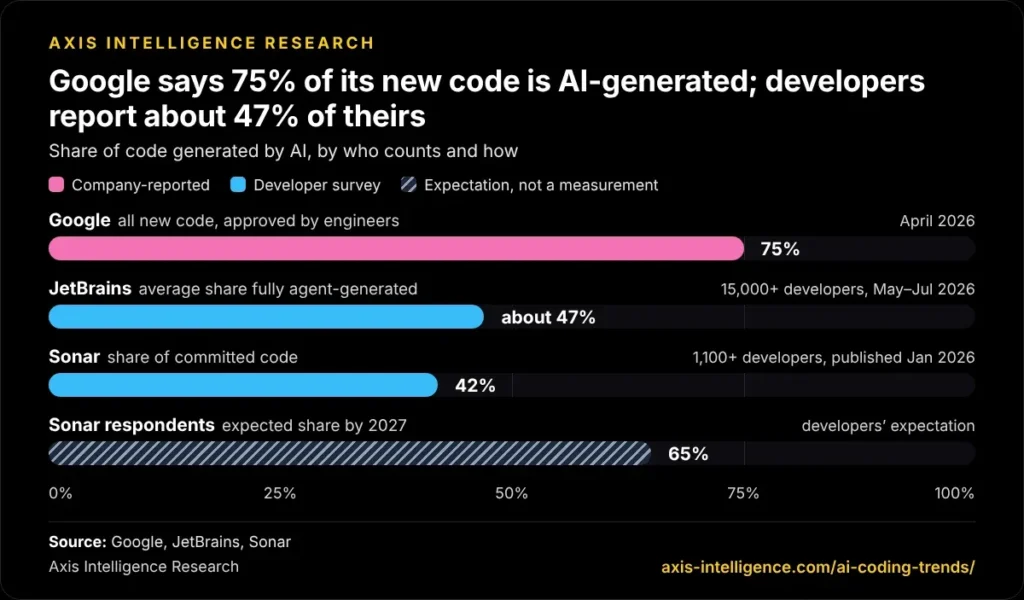
The gap is mostly about definitions. Google’s figure covers one company with its own tooling and counts code an engineer approved. JetBrains asks individuals to estimate a share of last month’s output. GitHub counts PRs rather than lines, and PR size varies widely: agentic PRs run to 293 lines at the 75th percentile in LinearB’s benchmarks. The figures differ by language as well. In JetBrains’ data, Go, JavaScript and TypeScript developers average 54%–55% agent-generated code, while C and C++ developers still write 38% of theirs by hand. Some companies now report output rather than share. On its Q1 2026 earnings call (April 28, 2026), Robinhood said more than 90% of its employees use AI tooling. It also said commits per engineer, which it defines as code successfully deployed to production, were up 50% since the start of 2025, and that it is still hiring engineers. Our AI-generated code statistics track each company disclosure with its exact wording.
Sarah Mitchell, AI and machine learning analyst at Axis Intelligence None of these is a market rate, and averaging them would be wrong. Google’s 75% describes a company that builds its own models and review tooling; JetBrains’ 47% is the closer proxy for a typical team. What all four producers agree on is direction. Sonar’s respondents expect 65% by 2027, which leaves the median team 18 points short of where it stood in mid-2026. Closing that in a year would take Google-style tooling that most teams do not run.
Can code review keep up with coding agents?
Not at 2026 staffing levels. GitHub reports that merged pull requests rose from 538 million to 1.3 billion in the 12 months to September 30, 2026. Over a similar span, the developer base grew from “180 million-plus” in Octoverse 2025 to more than 225 million. Axis Intelligence Research combines the two growth rates into the Review Load Multiple (RLM): merged PRs per developer rose 1.93× in a year.
| Review Load Multiple (RLM) input | 2025 | 2026 | Growth |
|---|---|---|---|
| Merged pull requests on GitHub (12 months to Sep 30) | 538 million | 1.3 billion | ×2.42 |
| Developers on GitHub | 180 million-plus | More than 225 million | ×1.25 |
| RLM = merged-PR growth ÷ developer growth | 1.93 |
RLM formula: (1.3 billion ÷ 538 million) ÷ (225 million ÷ 180 million) = 2.416 ÷ 1.25 = 1.93. Both developer counts are lower bounds (“plus”, “more than”), so RLM is an approximate upper reading. The 2025 PR count is GitHub’s recalculated figure published in Octoverse 2026. The 2025 developer count covers September 2024–August 2025.
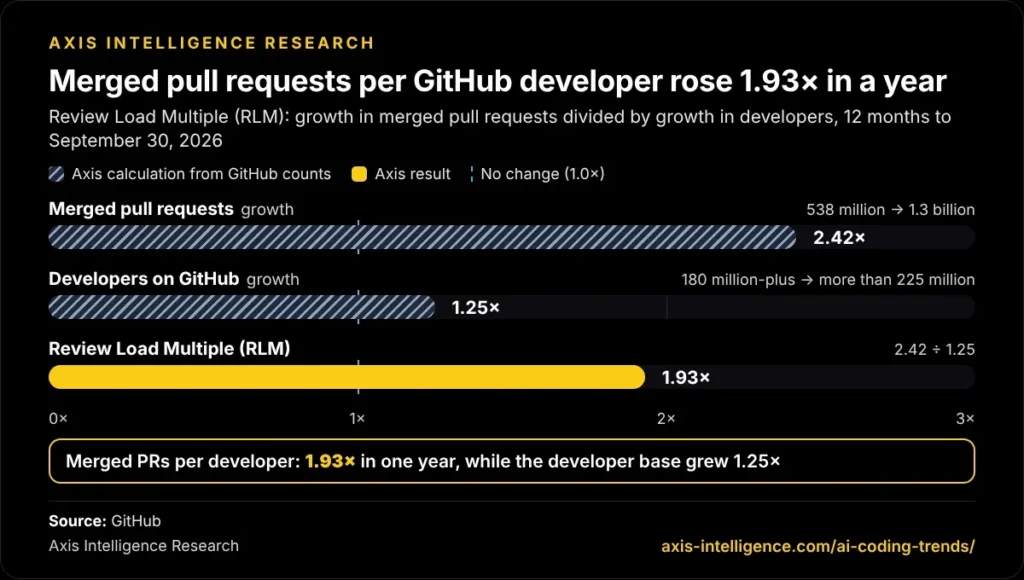
Sarah Mitchell, AI and machine learning analyst at Axis Intelligence RLM is a per-head figure, and that is the point. On most enterprise branches every merge still needs a human approval. That means approvals per developer roughly doubled while the headcount doing them grew a quarter. A team that staffed review for 2025 volumes is now running a queue.
The queue shows up in team-level telemetry. LinearB’s 2026 benchmarks cover 8.1 million PRs from 4,800 teams in 42 countries. At the 75th percentile, an agentic AI pull request waits 17.6 hours before anyone picks it up, about 5.2 times the 3.4 hours for unassisted work (Axis calculation). Only 32.7% of AI pull requests merge within 30 days, against 84.4% of manual ones.
| Pull request type | Median size (lines) | P75 size (lines) | P75 pickup time (hours) | P75 review time (hours) |
|---|---|---|---|---|
| Agentic AI | 89 | 293 | 17.6 | 6.4 |
| AI-assisted | 96 | 408 | 8.3 | 3.2 |
| Unassisted | 26 | 157 | 3.4 | 4.2 |
GitHub’s own data points the other way. Agent-authored PRs merged within two weeks rose from 83% in February 2026 to 90% in September, against about 86% for PRs with no detected agent.
Sarah Mitchell, AI and machine learning analyst at Axis Intelligence GitHub’s 90% and LinearB’s 32.7% describe different repositories. GitHub’s base includes millions of personal and small projects where a developer merges their own agent’s work. LinearB’s 4,800 teams run required reviewers and branch protection. For any company with an approval policy, I would plan with LinearB’s numbers and read GitHub’s as the ceiling of what review-free merging looks like.
Developers say the same in surveys. In Sonar’s State of Code survey (January 8, 2026), 96% of developers do not fully trust AI-generated code to be functionally correct, and only 48% always check it before committing. 38% find reviewing it harder than reviewing a colleague’s code. In JetBrains’ 2026 Developer Ecosystem report (28,945 respondents), 46% say their sense of code ownership has decreased over the past year because of AI. Managers are mostly not measuring the effect. Among managers who know their company’s productivity practices, 38% say the company does not track AI impact and 31% are not sure. The share of code shipped without a check is measured in our vibe coding statistics. Gartner named the “agent coding harness” one of its top strategic technology trends for 2027 on October 20, 2026. It describes the harness as a closed-loop control system for autonomous developer behavior across the lifecycle.
Is AI-generated code getting more secure?
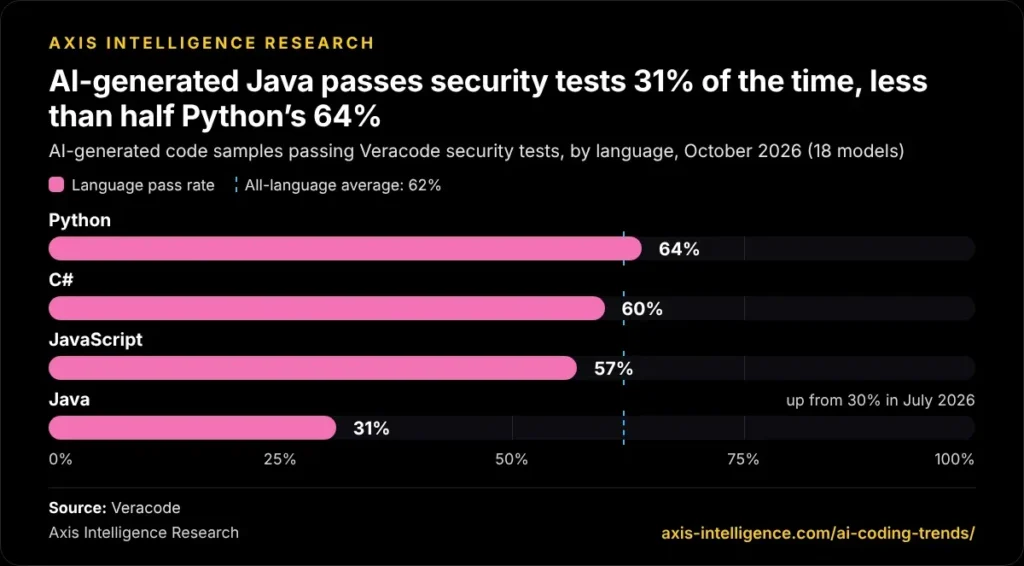
At the top end, yes. Veracode’s October 2026 edition found the average security pass rate across 18 models rose from 56% to 62%, the first meaningful gain since the series began in July 2025, according to its October 29, 2026 release. That still leaves 38% of generated code containing a vulnerability. Two models, Claude Opus 5.5 and GPT-6-Sol, tied at a record 73%. The weakest models stayed at 44%–50%.
| Veracode measure, October 2026 edition | Value | Previous |
|---|---|---|
| Average security pass rate | 62% | 56% |
| Share of generated code with vulnerabilities | 38% | 44% |
| Best models (Claude Opus 5.5, GPT-6-Sol) | 73% | 68% (GPT-5.5, July 2026) |
| Models at or above 60% | 10 | 4 |
| Floor of the range | 44%–50% | unchanged |
| Python / C# / JavaScript / Java | 64% / 60% / 57% / 31% | Java 30% in July |
| Cross-site scripting (CWE-80) pass rate | 18% | main driver of the gain |
| Log injection (CWE-117) pass rate | 13% | flat |
| SQL injection (CWE-89) / weak crypto (CWE-327) | 84% / 87% | held |
Veracode also found that models built specifically for coding scored no better: 51% on average, against 54% for general-purpose models. On the platform side, GitHub’s push protection ran 5.8 billion scans in the Octoverse 2026 year, nearly four times 2025’s pace, and more than 30 million Dependabot pull requests were merged. Agent-specific flaws are logged in our Claude Code vulnerability tracker, and incident rates for agents in production are in our AI agent security statistics.
Sarah Mitchell, AI and machine learning analyst at Axis Intelligence Six points of average gain, carried mostly by cross-site scripting, is a pattern-matching improvement. Log injection stayed at 13% because catching it means following data across functions, and today’s models still miss that. Java at 31%, 33 points behind Python, is the figure I would put in front of any team planning to hand a legacy Java estate to an agent in 2027.
How much do AI coding tools cost in 2027?
Every major vendor now sells a $100-a-month tier, and usage, not seats, sets the real bill. Axis Intelligence Research checked five vendor pricing pages on November 25, 2026. Each one lists an individual plan at $100 a month. GitHub now meters Copilot in “AI credits” at $0.01 each.
| Vendor (agent) | Entry paid individual | $100 tier | Top individual tier | Team / business seat |
|---|---|---|---|---|
| GitHub Copilot | Pro $10 | Max $100 | Max $100 | Business $19, Enterprise $39 per seat; overage $0.01 per AI credit |
| Cursor | Plus $8 (Grok models only) | Super $100 | Ultra $200 | Teams from $30 per user |
| Claude / Claude Code | Pro $20 monthly ($17 billed annually) | Max $100 | Ultra $200 | Team standard $25 monthly; premium $125 monthly; Enterprise $20 per seat plus usage at API rates |
| ChatGPT / Codex | Go $8, Plus $20 | Pro from $100 | Pro $500 | Business $25 monthly ($20 billed annually) |
| Google AI / Antigravity | — | AI Ultra $100 (new, May 19, 2026) | AI Ultra $200 (cut from $250) | Via Google Cloud from $30 per seat |
The sticker price is small next to pay. A $200 plan equals 1.8% of the median US software developer’s monthly wage. The Bureau of Labor Statistics puts that median at $135,980 a year in May 2025, about $11,332 a month (Axis calculation). Gartner expects the gap to close. In a June 24, 2026 forecast, it predicted AI coding costs will overtake the average developer’s salary by 2028 as token consumption and consumption-based licensing grow. Organizations are already metering. 38% of Stack Overflow’s 2026 respondents say their employer sets AI usage limits, and 28% say it reviews spending data. In JetBrains’ 2026 report, 51% of tech managers say their company tracks token usage, but only 30% rate it among the most insightful metrics. Net time gain is rated insightful by 39%, yet only 28% say their organization tracks it.
Sarah Mitchell, AI and machine learning analyst at Axis Intelligence The seat price has stopped being the cost. An agent that runs for hours burns credits no seat price shows, which is why Gartner can forecast salary-level spending by 2028 while a top plan is still under 2% of median pay. Before a 2027 renewal, I would ask each vendor for the credit cost of one agent-hour on your own repository, measured on a real task.
Are AI coding agents shrinking junior developer jobs?
The data points to a narrower entry ramp rather than fewer developer jobs. Employment of workers aged 22–25 in highly AI-exposed occupations is about 19% below comparable less-exposed peers as of June 2026, up from a 15% gap a year earlier. That finding comes from Stanford Digital Economy Lab’s August 12, 2026 revision of its ADP payroll study, which found the adjustment works mainly through reduced hiring rather than layoffs. Over the same period, Indeed Hiring Lab data show US software development postings up almost 15% since late February 2025, while overall postings fell 7%.
| Measure | Value | Period | Producer |
|---|---|---|---|
| Employment gap, ages 22–25, highly AI-exposed vs less-exposed occupations | −19% | Jun 2026 data | Stanford Digital Economy Lab (ADP payroll) |
| Same gap, previous vintage | −15% | Jul 2025 data | Stanford Digital Economy Lab |
| US software development postings since Feb 24, 2025 | almost +15% | to mid-2026 | Indeed Hiring Lab |
| US overall job postings, same period | −7% | to mid-2026 | Indeed Hiring Lab |
| Software development postings vs pre-pandemic level | about −27.5% | Jun 2026 | Indeed Hiring Lab |
| Share of the May 2025–May 2026 posting increase from senior roles | 71% | May 2025–May 2026 | Indeed Hiring Lab |
| Share of the increase from jobs with AI in the title | 37% | May 2025–May 2026 | Indeed Hiring Lab |
| Entry-level share of software development postings | 4.5% | Q1 2026 | Indeed Hiring Lab |
| Senior share of software development postings | 69.3% | Q1 2026 | Indeed Hiring Lab |
| Senior postings per entry-level posting | 15.4 | Q1 2026 | Axis calculation (69.3 ÷ 4.5) |
| Projected US employment growth, software developers, QA and testers | +10% (185,400 jobs) | 2025–2035 | BLS |
Developers feel the squeeze too. In JetBrains’ 2026 report, just 18% of developers say job-market conditions in their area are favorable, yet three in four would choose the profession again. The same report shows why the entry rung is under the most pressure. Among agent users with 1–2 years of experience, 60% say AI-generated solutions are somewhat or much better than their own, against 47% of those with 16+ years.
Indeed’s seniority analysis of July 23, 2026 shows software development has the most senior-skewed postings of any sector it tracks. Projections still point up. The BLS expects 10% growth for software developers, QA analysts and testers from 2025 to 2035. It projects a 7% decline for the separate “computer programmers” category. Gartner issued its warning on July 7, 2026: by 2028, organizations that rely on AI to cut junior roles will hollow out their own engineering talent pipeline. Live hiring and wage data are in our AI job market tracker. Cuts are counted in our 2026 tech layoffs statistics, and pay by country in our software engineer salary guide.
Sarah Mitchell, AI and machine learning analyst at Axis Intelligence The most counterintuitive pairing on this page is a 15% rebound in US software postings next to a 19% employment gap for 22-to-25-year-olds in exposed jobs. Both hold because the rebound is 71% senior. The starter work juniors learned on (tests, small fixes, boilerplate migrations) is the same work agents now open PRs for. A team that stops hiring juniors in 2027 will be short of mid-level reviewers in the years after, and those are exactly the people RLM says are already scarce.
What do Gartner and Forrester predict for AI coding in 2027 and 2028?
The analyst forecasts for 2027 are mostly about control: who verifies agent output, where testing happens, and what fails when nobody checks. None of them forecasts fewer developers in 2027. Gartner predicts that by 2027 over 65% of engineering teams using agentic coding will treat IDEs as optional. Forrester’s Predictions 2027 expect at least one large organization to suffer a serious failure from AI-written code reaching production without enough checking.
| Prediction | Horizon | Producer | Published | Where the 2026 evidence stands |
|---|---|---|---|---|
| Over 65% of engineering teams using agentic coding will treat IDEs as optional | 2027 | Gartner | May 20, 2026 | Copilot cloud agent usage grew 230% year over year (GitHub) |
| At least one big organization will “go up in flames” from unchecked AI code | 2027 | Forrester | Oct 30, 2026 | 48% of developers always check AI code before committing (Sonar) |
| 15% of developers will be looking for new roles | 2027 | Forrester | Oct 30, 2026 | 4.5% of software postings are entry-level (Indeed, Q1 2026) |
| 35% of organizations will add automated testing earlier in the pipeline | 2027 | Forrester | Oct 30, 2026 | 32.7% of AI PRs merge within 30 days (LinearB) |
| AI share of committed code reaches 65% | 2027 | Sonar respondents | Jan 8, 2026 | Developer expectation; JetBrains’ May–July 2026 average is ~47% |
| AI coding costs overtake the average developer’s salary | 2028 | Gartner | Jun 24, 2026 | $200 top tiers equal 1.8% of median monthly pay (Axis calculation) |
| Organizations with coding-harness infrastructure see 60% fewer post-deployment defects | 2028 | Gartner | Nov 18, 2026 | Veracode average pass rate 62% |
| 70% of software engineering teams adopt eval-driven development, up from under 20% in 2026 | 2028 | Gartner | Nov 18, 2026 | — |
| Organizations cutting junior roles with AI hollow out their talent pipeline | 2028 | Gartner | Jul 7, 2026 | Ages 22–25 employment gap 19% (Stanford) |
| 60% of organizations adopt smaller software teams at scale, up from 15% in 2026 | 2029 | Gartner | Jul 7, 2026 | Organizations of one: 10% of Stack Overflow respondents, from 4% |
Gartner’s November 18, 2026 software engineering trends add harness engineering, agent sandboxing and eval-driven development to the list. For the wider agent market and its 2027 spending base case, see our AI agents trends. For the model layer underneath, see our AI trends for 2027. Two measurements will test these forecasts first. GitHub published the last two Octoverse reports on October 28, so the next agent PR share should arrive in fall 2027. Stanford updates its 22–25 employment gap every month.
AI coding in 2027: questions engineering leaders ask
Should coding agents be allowed to merge their own pull requests in 2027?
Not on branches that ship to customers. LinearB’s 2026 benchmarks show only 32.7% of AI pull requests merge within 30 days in team settings, against 84.4% of manual ones. Veracode’s October 2026 tests still found vulnerabilities in 38% of AI-generated code. Gartner’s 2027 “agent coding harness” trend describes the alternative: automated verification gates that review agent output before a human does.
What should replace “percent of code written by AI” in a 2027 board report?
Use a counted flow metric, such as the share of pull requests opened by agents and how long they wait for review. GitHub counted agent-started PRs at more than 40% in September 2026. LinearB measured a 17.6-hour 75th-percentile pickup time for agentic PRs. Line-share claims such as Google’s 75% (April 2026) are company-reported and use definitions that cannot be compared across companies.
Does a $100-a-month coding agent plan cost more than it saves?
The seat rarely decides it; usage does. As of November 25, 2026, all five major vendors sell a $100 individual tier, and a $200 plan equals about 1.8% of the median US software developer’s monthly pay (BLS, May 2025). Gartner forecasts that total AI coding costs, driven by tokens, will overtake the average developer’s salary by 2028. Credit burn per agent-hour is therefore the number to negotiate.
Which languages are riskiest to hand to a coding agent?
Java, on security. Veracode’s October 2026 edition measured a 31% security pass rate for AI-generated Java, against 64% for Python, 60% for C# and 57% for JavaScript. Developers also trust agents least in C and C++: JetBrains found they still write 38% of that code by hand, the highest manual share of any language group in its 2026 survey.
Is learning to code still worth it going into 2027?
Yes, but the entry path is narrower. The BLS projects 10% employment growth for US software developers, QA analysts and testers from 2025 to 2035. In JetBrains’ 2026 survey, three in four developers would choose the profession again. However, only 18% see a favorable local job market, and entry-level roles were 4.5% of US software postings in Q1 2026 (Indeed). New coders who can review and test agent output fit the roles that are growing.
Will AI replace programmers by 2040?
No producer publishes a credible 2040 forecast. The longest official projection, the BLS 2025–2035 outlook, still shows 10% growth for software developers. It shows a 7% decline only for the separate, smaller “computer programmers” category (110,800 jobs in 2025). Gartner’s furthest coding forecast is 2029: 60% of organizations running smaller software teams, from 15% in 2026. That describes smaller teams, not the disappearance of the job.
Should companies pause junior developer hiring because of agents?
The 2026 data argues against it. Entry-level roles were 4.5% of US software development postings on Indeed in Q1 2026, and Stanford measured a 19% employment gap for 22-to-25-year-olds in AI-exposed jobs as of June 2026. Gartner warned on July 7, 2026 that organizations cutting junior roles with AI will hollow out their engineering pipeline by 2028. Agent output also needs more reviewers, not fewer.
Methodology
Every figure comes from a producer’s own page or document, opened on November 25, 2026. The producers are GitHub, JetBrains (2026 blog analyses and the 2026 Developer Ecosystem report), Stack Overflow, Sonar, LinearB, Veracode, Google, Robinhood (Q1 2026 call transcript), Cursor, Anthropic, OpenAI, Indeed Hiring Lab, the Stanford Digital Economy Lab, the U.S. Bureau of Labor Statistics, Gartner and Forrester. Survey bases differ. JetBrains samples professional developers and reweights the sample by region, employment and language. Stack Overflow’s sample also includes students and hobbyists, and its questions are multi-select. Company code-share figures are company-reported and unaudited. A reported Snap figure on AI-generated code was left out because it does not appear in Snap’s own April 15, 2026 memo.
Axis calculations. The Review Load Multiple (RLM) divides growth in merged GitHub pull requests (12 months to September 30, 2026 vs the recalculated prior year) by growth in GitHub’s reported developer base (Octoverse 2026 vs Octoverse 2025). Both developer counts are lower bounds. The Coding Trend Evidence Score (CTES) is scored as described in the trends section, with each component published in the dataset. Other calculations on this page:
- the minimum overlap of Claude Code and Copilot users (Stack Overflow, same base);
- LinearB’s pickup-time ratio, from P75 values;
- Indeed’s senior-to-entry ratio and mid-level remainder;
- plan prices as a share of the BLS median monthly wage;
- the AI-user share (100% minus Stack Overflow’s “I don’t use AI tools”).
Dataset. ai-coding-trends.csv holds every figure, input, calculation and CTES component on this page, with its observed period, publication date, source URL and retrieval date. Axis compilation and calculations are licensed CC BY 4.0. Third-party data remains its producers’.
Cite this page: Axis Intelligence Research, “AI Coding Trends 2027: Agents Now Open 40% of Pull Requests, and Review Is the New Bottleneck”, data as of November 25, 2026, https://axis-intelligence.com/ai-coding-trends/ [Copy]