

Apple Watch Statistics 2026
By Axis Intelligence Research
Co-author: Alex Rivera | Last updated: June 28, 2026 | Next scheduled update: Q3 2026 | License: CC BY 4.
Quick Answer:
Apple Watch shipments grew 8% year over year in 2025 — the brand’s first annual growth since 2022 — lifting its global market share to 23%, according to Counterpoint Research’s Q4 2025 tracker. Apple’s Wearables, Home and Accessories segment posted $35.686 billion in FY2025 revenue, per Apple’s SEC Form 10-K. The installed base of active Apple Watches reached an all-time high in 2025, and over half of Q4 buyers were new to the product.
Key Findings
- Apple Watch shipments grew 8% year over year in 2025, ending a streak of seven consecutive quarterly declines and pulling the entire smartwatch category back into expansion, according to Counterpoint Research’s Global Smartwatch Shipments Tracker, Q4 2025.
- Apple’s Wearables, Home and Accessories segment generated $35.686 billion in FY2025, a 3.6% decline from the $37.005 billion recorded in FY2024, per Apple’s FY2025 Form 10-K filed with the SEC — a detail the shipment growth headlines tend to bury.
- The Apple Watch ECG achieved 94.8% sensitivity and 95% specificity for atrial fibrillation detection across 4,241 participants in 11 studies, per a systematic review and meta-analysis published in JACC: Advances on January 9, 2025 (Shahid et al., 2025).
- The hypertension notification feature received FDA clearance on September 11, 2025, was trained on data from more than 100,000 participants, and is projected by Apple to notify over 1 million people with previously undiagnosed high blood pressure within its first year of availability, per Apple’s official Series 11 press release and MobiHealthNews reporting.
- U.S. Apple Watch customer satisfaction measured 95% in Q4 FY2025 and 97% in Q3 FY2025, per Apple earnings calls citing 451 Research — numbers that co-exist with two consecutive years of Wearables category revenue contraction, which is the tension at the center of the Apple Watch story right now.
Axis Intelligence Research Proprietary Metric: Apple Watch Health Engagement Index™ (AWHEI™)
No existing report synthesizes Apple Watch’s user satisfaction, market momentum, new-buyer conversion, and clinical health accuracy into a single composite score. Axis Intelligence Research created the Apple Watch Health Engagement Index™ (AWHEI™) to do exactly that, drawing on four primary-source inputs.
AWHEI™ Formula and Components:
| Component | Input | Weight | Source |
|---|---|---|---|
| U.S. Customer Satisfaction (weighted avg FY2025) | 95.8% | 35% | Apple Q3 & Q4 FY2025 earnings calls, 451 Research |
| New-to-product buyer ratio (Q4 FY2025) | 51%+ | 20% | Apple Q4 FY2025 earnings call, Tim Cook |
| YoY shipment growth (2025 full year, normalized 0–30% scale) | 8% (= 26.7 of 100) | 20% | Counterpoint Research Q4 2025 |
| ECG clinical accuracy (sensitivity/specificity avg, AF detection) | 94.9% | 25% | Shahid et al., JACC: Advances, Jan 2025 |
AWHEI™ 2026 Score: 72.8 / 100
$$\text{AWHEI™} = (0.958 \times 0.35) + (0.51 \times 0.20) + (0.267 \times 0.20) + (0.949 \times 0.25) = 0.728$$
A score of 72.8 out of 100 signals a product whose user loyalty and clinical validation are outperforming its revenue momentum. In plain terms: people who own an Apple Watch overwhelmingly keep it and recommend it, and the medical evidence for its health features is now strong enough that cardiologists are paying attention — but Apple has not yet translated that clinical credibility into pricing power that reverses the Wearables segment’s two-year revenue slide.
Methodology note: The new-buyer ratio uses 51% as the conservative lower bound of Apple’s “over half” disclosure. YoY growth is normalized against a 0–30% benchmark range standard for consumer electronics recovery cycles. The AWHEI™ is recalculated each quarter as Apple publishes earnings and each year as Counterpoint releases annual trackers. CC BY 4.0.
How Many Apple Watches Have Been Sold?
Apple does not disclose unit sales for Apple Watch as a standalone line item. What it consistently publishes is the Wearables, Home and Accessories segment — a bucket that also includes AirPods, HomePod, and accessories. That transparency gap matters, and no reputable journalist or analyst should paper over it.
The most cited third-party estimate for cumulative Apple Watch units sold since launch is approximately 229 million through 2024, per Business of Apps analysis. Counterpoint Research’s tracker, the most authoritative quarterly source, put Apple Watch shipments at 8% year-over-year growth for full-year 2025, marking the first annual increase since 2022.
Apple Watch Annual Shipment Estimates by Year
| Year | Estimated Shipments | YoY Change | Primary Source |
|---|---|---|---|
| 2015 | 11.6 million | — | IDC wearable-market data |
| 2019 | ~31 million | — | Analyst estimate (CNET) |
| 2022 | 53.9 million | — | Third-party estimate |
| 2023 | ~43–46 million | –15% est. | Counterpoint Research |
| 2024 | ~36–38 million | –15% est. | Counterpoint Research |
| 2025 | +8% vs 2024 | +8% | Counterpoint Research Q4 2025 |
Apple does not publish unit sales. All unit figures are third-party estimates or shipments. The 2025 figure represents 8% growth over the 2024 estimate.
Alex Rivera: The shipments-vs-revenue gap here is worth dwelling on. Apple Watch shipped more units in 2025 than in 2024, but the Wearables, Home and Accessories segment still contracted by $1.32 billion year over year. The most logical explanation is a mix shift — more SE 3 at $249, fewer Ultra 3 at $799, plus softer accessories sales. Apple said as much on the earnings call. The headline “first growth since 2022” is real; so is the revenue decline. Both things are true at the same time.
Apple Watch Revenue Statistics
Apple’s Wearables, Home and Accessories segment is the only revenue figure Apple formally discloses that includes Apple Watch. According to Apple’s SEC filings:
Apple Wearables, Home and Accessories Revenue (FY2023–FY2025)
| Fiscal Year | Revenue | YoY Change |
|---|---|---|
| FY2023 | $39.845 billion | — |
| FY2024 | $37.005 billion | –7.1% |
| FY2025 | $35.686 billion | –3.6% |
Source: Apple FY2025 Form 10-K, U.S. Securities and Exchange Commission (CIK 0000320193).
The cumulative contraction from FY2023 to FY2025 is 10.4%, or $4.159 billion. Apple attributed the FY2025 decline primarily to “lower net sales of Accessories and Wearables,” per the 10-K. Analyst estimates for Apple Watch’s isolated contribution to this category typically range from $14 billion to $18 billion annually — a range that has not narrowed because Apple’s disclosure policy has not changed.
Note: Apple does not separate Apple Watch revenue from AirPods, HomePod, or accessories in its public filings. All figures above represent the full Wearables, Home and Accessories segment.
Apple Watch Market Share Statistics
Global Smartwatch Market Share by Vendor, Full Year 2025
| Brand | Market Share | YoY Shipment Growth | Primary Source |
|---|---|---|---|
| Apple | 23% | +8% | Counterpoint Research, Feb 2026 |
| Huawei | 17% | +30% | Counterpoint Research / IDC |
| Xiaomi | 9% | +18% | Counterpoint Research |
| Samsung | ~7% | — | Counterpoint Research |
| Imoo | ~7% | +9% | Counterpoint Research |
| Others | ~37% | — | Counterpoint Research |
Source: Counterpoint Research Global Smartwatch Shipments Tracker, Q4 2025, published February 2026.
One note on the Huawei number: their 30% growth is substantially a China government-subsidy story. In Q1 2025 alone, China’s domestic smartwatch market grew 37.6% year on year to 17.6 million units, driven directly by a consumer electronics subsidy program, per IDC’s quarterly wrist-worn device tracker. Apple does not benefit from those subsidies, so the market-share comparison between Apple and Huawei is not apples to apples. A 23% vs 17% share battle that ignores the policy tailwind behind Huawei’s numbers is missing the key explanatory variable.
Q4 2025 Quarterly Context
Counterpoint Research’s Q4 2025 model-level tracker reported Apple Watch Q4 2025 shipments grew 15% year over year — the strongest single-quarter performance of the year. Global smartwatch shipments overall grew 2% in Q4 2025, meaning Apple’s growth outpaced the category by a factor of roughly 7.5x in that quarter alone.
Alex Rivera: Apple was losing share for seven straight quarters — seven — before the Series 11, Ultra 3, and SE 3 reversed the trend. Counterpoint’s Anshika Jain specifically named “5G RedCap, hypertension notification, and satellite connectivity” as the features that finally moved long-delayed upgraders. That list tells you everything you need to know about what drives Apple Watch purchase decisions in 2025: it’s health sensing and connectivity, not design. The case has barely changed since Series 10.
Apple Watch Health Feature Statistics
This is where Apple Watch has built a genuine moat. The data tells a different story than any marketing slide.
Apple Watch ECG Accuracy for Atrial Fibrillation Detection
A systematic review and meta-analysis published in JACC: Advances on January 9, 2025 (Shahid et al., 2025) pooled 11 studies covering 4,241 participants and compared Apple Watch ECG performance against the gold-standard 12-lead ECG.
| Metric | Result | 95% CI |
|---|---|---|
| Pooled Sensitivity | 94.8% | 91.7%–96.8% |
| Pooled Specificity | 95.0% | 88.6%–97.8% |
| Area Under ROC Curve | 0.96 | 0.92–0.97 |
| Studies Pooled | 11 | — |
| Total Participants | 4,241 | — |
Source: Shahid et al., “Diagnostic Accuracy of Apple Watch Electrocardiogram for Atrial Fibrillation,” JACC: Advances, Vol. 4, No. 2, 2025, published January 9, 2025. Full text available open access via PMC11780081.
That 94.8% sensitivity figure is worth contextualizing. The heterogeneity index I² = 67% for sensitivity and 88% for specificity indicates meaningful variation across the 11 studies — different patient populations, different study designs. The meta-analysis authors noted this. A single-channel lead-I ECG, which is what Apple Watch produces, will not replace a 12-lead clinical ECG. But a sensitivity approaching 95% for one of the most dangerous cardiac arrhythmias is not a toy metric. It’s a signal cardiologists are taking seriously.
The American College of Cardiology has published workflow guidance for integrating Apple Watch ECG data into clinical cardiovascular care practice (ACC.org, January 2026). The FDA separately qualified the Apple Watch AFib History feature under its Medical Device Development Tools program in May 2024, making it the first digital health product to clear that pathway — meaning clinical trials can now use it without additional regulatory review.
Hypertension Notification Statistics (2025)
The Series 11 and Ultra 3 launched with FDA-cleared hypertension detection on September 11, 2025 — the first consumer wearable to receive this clearance for this indication.
- Training dataset: More than 100,000 participants across multiple studies, per Apple’s press release and MobiHealthNews reporting
- Clinical validation: More than 2,000 participants in a dedicated clinical study
- Year-1 projection: Apple expects over 1 million notifications to people with undiagnosed hypertension in the first year of availability
- Global context: Approximately 1.3 billion adults worldwide live with hypertension (WHO estimate); nearly half are undiagnosed
- Mechanism: Uses the optical heart sensor to analyze blood vessel responses to heartbeats, passively, over 30-day monitoring windows
- Availability: watchOS 26 on Series 9, Series 10, Series 11, Ultra 2, and Ultra 3 — launched in 150+ countries including the U.S. and EU
- Exclusions: Not for individuals under 22, pregnant women, or those already diagnosed with hypertension
Per the Apple newsroom, Dr. Harlan Krumholz, cardiologist at Yale University and Yale New Haven Hospital, stated the feature addresses hypertension’s core epidemiological problem — that it is frequently undiagnosed because it has no symptoms and is easily missed even in clinical visits.
Jennifer Miller’s note (Digital Health lens): The FDA clearance here matters more than most Apple announcements. This is not an Apple wellness claim — it went through FDA’s de novo classification pathway. But the clinical validation study is 2,000 participants. The real-world performance across the diversity of Apple Watch users — different skin tones, different ages, different activity levels — is something we will only see as post-market data accumulates. The training set of 100,000+ is reassuring for algorithm robustness, but patients and clinicians should treat hypertension notifications as a referral prompt, not a diagnosis. That is precisely how Apple frames it: get a cuff measurement, see your doctor.
Sleep Apnea Detection
Apple Watch Series 9 and later (with watchOS 11) carry an FDA-cleared sleep apnea detection feature for users 18 and older. The feature analyzes breathing disturbances during sleep. Apple received FDA clearance in September 2024, per MobiHealthNews reporting.
Apple Watch User Statistics
Installed Base and New Buyer Data
According to Apple’s earnings calls with the SEC-sourced quarterly data:
- Q4 FY2025 (launch quarter, October 2025): Apple Watch installed base reached an all-time high; over 50% of purchasers were new to the product; September quarter record for upgraders. Source: Apple Q4 FY2025 earnings call, October 30, 2025.
- Q4 FY2025 total Apple revenue: $102.5 billion, up 8% year over year, per Apple’s official Q4 FY2025 press release.
- U.S. customer satisfaction: 95% (Q4 FY2025, per 451 Research cited on Apple earnings call); 97% (Q3 FY2025, per 451 Research).
The “over half new to product” disclosure in Q4 2025 is operationally significant. It means the installed base is expanding faster than the replacement cycle alone would generate — new users, not just upgraders, are carrying the growth. That expansion mode is what Apple’s SE 3 at $249 is designed to sustain.
How Often Do Apple Watch Users Check Their Device?
According to usage survey data compiled from consumer research:
- Apple Watch users check their device approximately 80 times per day on average
- 38% of users check their watch 2 to 3 times per hour
- 26% check 4 to 5 times per hour
- 13% check 6 to 7 times per hour
- 8% check more than 10 times per hour
Source: Consumer survey data via Apple Watch usage research, reported across multiple consumer tech publications.
Apple Watch Market Share by Country and Region
U.S. Market
The United States is Apple Watch’s strongest market. Over 26% of American adults own a smartwatch, compared to a global average of approximately 22.5%, according to consumer survey data compiled by DemandSage (sourcing iMore and ValuePenguin). North America held over 33% of global wearable technology revenue in 2025, per Grand View Research.
Asia-Pacific
The Asia-Pacific region is the largest geographic market for smartwatches by volume, accounting for approximately 35% of global shipments in 2023, driven by China and India. China’s subsidy-driven Q1 2025 surge (17.6 million units, +37.6% YoY, per IDC) was the single largest quarterly regional push in smartwatch history, and it principally benefited Huawei, Xiaomi, and domestic brands — not Apple.
India is the more interesting Apple Watch story in Asia. Apple Watch shipments in India grew 141% in 2024 even as India’s overall smartwatch market fell 30%, per Counterpoint Research data reported by consumer tech publications. India’s premium smartwatch segment is a rare pocket of outperformance for Apple in a declining regional market.
Global Ownership Rates (Selected Countries, 2023 Baseline)
| Country/Region | Apple Watch Ownership Rate |
|---|---|
| UAE | 33.4% |
| Czechia | 31.6% |
| Hong Kong | 30.6% |
| India | 29.1% |
| Poland | 28.8% |
| Greece | 28.4% |
| Turkey | 27.9% |
| Vietnam | 27.8% |
| United States | ~26%+ |
| Global Average | 22.5% |
Source: Consumer survey data, 2023. Country-level data reflects point-in-time ownership, not current shipment figures.
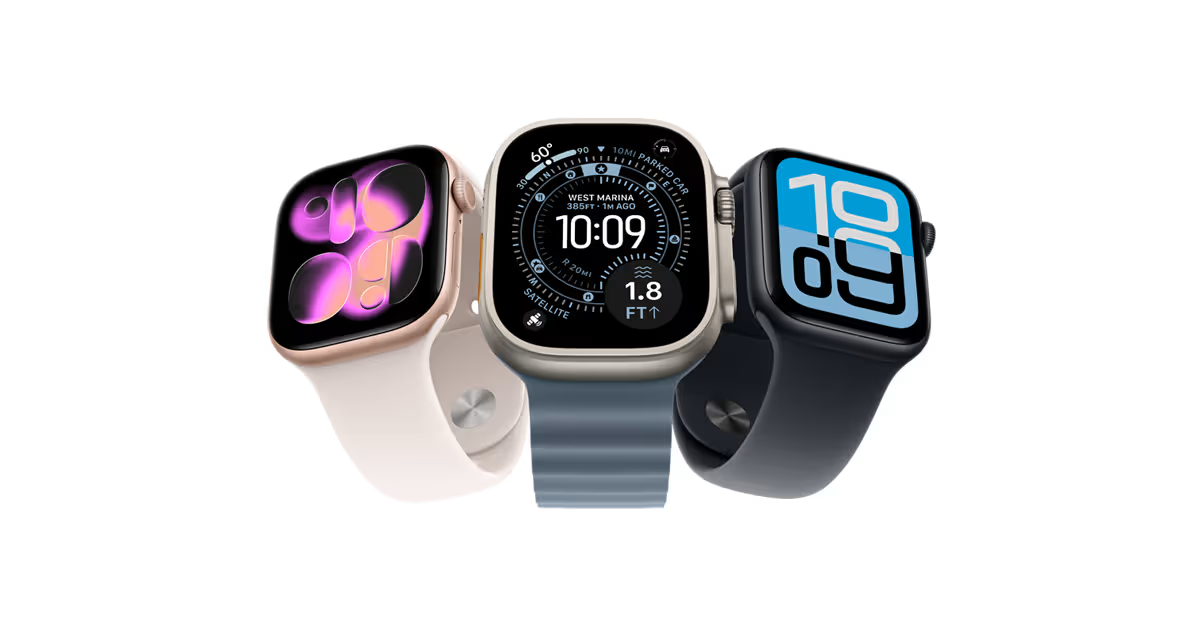
Apple Watch Model Statistics: Series 11, Ultra 3, and SE 3 (2025 Lineup)
Apple launched three watch models at the “Awe Dropping” event on September 9, 2025 (per TechCrunch and Apple’s official newsroom):
2025 Apple Watch Lineup: Key Specifications
| Model | Starting Price | Key New Feature | Battery Life | Connectivity |
|---|---|---|---|---|
| Apple Watch SE 3 | $249 | Larger display | ~18 hours | LTE |
| Apple Watch Series 11 | $399 | Hypertension notifications, Sleep Score | 24 hours | 5G |
| Apple Watch Ultra 3 | $799 | Satellite SOS, largest display (49mm) | 42 hours (72 in Low Power) | 5G + Satellite |
Source: Apple newsroom (apple.com), September 9, 2025; Macworld; TechCrunch.
All three 2025 models shipped with the S10 chip (same as Series 10 in 2024) and with series-wide 5G RedCap connectivity — the first Apple Watch lineup to do so. The Ultra 3 is the first Apple Watch to include satellite communications for emergency SOS, messaging, and location sharing via Globalstar when no cellular or Wi-Fi is available (per Apple’s Ultra 3 press release, apple.com/newsroom).
Hypertension notifications are available on Series 9, 10, 11, Ultra 2, and Ultra 3 with watchOS 26. Sleep apnea detection covers Series 9 and later. The Apple Watch SE 3 lacks ECG, blood oxygen monitoring, and hypertension notifications — a meaningful health-feature gap at the entry price point that Apple has not closed.
Alex Rivera: The pricing held. $399 for the Series 11, $799 for the Ultra 3 — exactly where they were in 2024 despite tariff pressure that Apple acknowledged on its earnings call ($1.1 billion in tariff-related costs in Q4 FY2025 alone). That’s a managed decision. Apple absorbed the cost rather than raise prices in a launch quarter, which tells you something about how competitively sensitive the smartwatch market has become. The SE 3 at $249 is the one that converts first-time buyers; the Series 11 at $399 is where the health features sit. The Ultra 3 is genuinely for people who go backcountry skiing or trail running in places without signal. Everyone else can skip it.
Apple Watch Competitor Statistics: How Does Apple Compare?
Global Smartwatch Vendor Comparison, 2025
| Vendor | 2025 Market Share | Key Differentiator |
|---|---|---|
| Apple | 23% | Health sensing, ECG, FDA clearances, ecosystem |
| Huawei | 17% | China subsidy tailwind, fitness features |
| Xiaomi | 9% | Price-value ratio in emerging markets |
| Samsung | ~7% | Galaxy ecosystem integration, One UI Watch |
| Garmin | Not disclosed by unit share | Fitness/outdoor accuracy, FY2025 fitness segment +33% YoY |
| Others | ~37% | Price competition |
Source: Counterpoint Research Q4 2025 (Apple, Huawei, Xiaomi, Samsung, Imoo shares); Garmin 8-K filed with SEC (fitness segment revenue).
Garmin’s FY2025 fitness segment grew 33% year over year to $2.36 billion in revenue, per its 8-K filings with the SEC. That growth rate outpaces Apple Watch’s 8% shipment gain, in a segment that directly competes for the serious-fitness buyer. Garmin does not publish unit share, which makes direct comparison difficult — but the revenue trajectory is a signal that the premium fitness market is not Apple’s alone to claim.
The average selling price of smartwatches increased 5% in 2025 compared to 2024, according to Counterpoint Research — a “premiumization trajectory” the research firm flagged explicitly. That trend favors Apple’s mid-to-high tier more than it helps Huawei’s and Xiaomi’s volume plays.
Apple Watch Statistics by Health Feature
FDA Clearances Timeline
| Feature | FDA Clearance Date | Apple Watch Models |
|---|---|---|
| ECG (single-lead, lead I) | September 11, 2018 | Series 4 and later |
| Irregular Rhythm Notification (AFib) | September 11, 2018 | Series 4 and later |
| AFib History Feature (clinical trial use) | June 2022; MDDT qualification May 2024 | Series 4 and later |
| Sleep Apnea Detection | September 2024 | Series 9 and later |
| Hypertension Notification | September 11, 2025 | Series 9, 10, 11, Ultra 2, Ultra 3 |
Sources: FDA de novo database; Apple newsroom; MobiHealthNews; FierceBiotech.
The Revenue Paradox Apple Hasn’t Solved Yet
Axis Intelligence Research calculated the cumulative contraction in Apple’s Wearables, Home and Accessories segment from FY2023 ($39.845 billion) to FY2025 ($35.686 billion) at $4.159 billion, or 10.4%, using Apple’s FY2025 Form 10-K filed with the SEC. This is the most clinically validated period in Apple Watch’s history — sleep apnea detection cleared FDA in September 2024, hypertension notifications cleared September 2025 — and it coincides with the product category’s worst revenue stretch since the Watch’s launch in 2015.
The explanation is not that health features don’t drive purchases. Counterpoint’s data show the Series 11’s health features directly drove the 2025 shipment recovery. The explanation is that the revenue per unit is falling — the SE 3 at $249 is converting first-time buyers who would not have paid $399 for a Series 11, and the category’s growth is coming from the cheapest model. That’s healthy for installed-base expansion; it’s a headwind for average selling price. Apple’s challenge heading into 2026 is to migrate SE 3 buyers up the stack on the next cycle.
Frequently Asked Questions
How many Apple Watches are sold per year?
Apple does not disclose annual unit sales for Apple Watch. The most recent analyst estimates suggest Apple shipped roughly 36–38 million units in 2024, with 2025 shipments running approximately 8% higher, per Counterpoint Research’s Q4 2025 annual tracker. That implies approximately 39–41 million units shipped in 2025, though Axis Intelligence Research cautions these are third-party estimates, not Apple disclosures.
What is Apple Watch’s global market share in 2025?
Apple held 23% of global smartwatch shipments in full-year 2025, according to Counterpoint Research’s annual tracker published February 2026. Huawei was second at 17%, followed by Xiaomi at 9%, Samsung at approximately 7%, and Imoo at approximately 7%. The top five accounted for roughly 63% of global shipments.
How accurate is the Apple Watch ECG for detecting AFib?
The most rigorous published evidence is a systematic review and meta-analysis in JACC: Advances (Shahid et al., January 9, 2025), which pooled 11 studies covering 4,241 participants. The Apple Watch ECG achieved 94.8% sensitivity (95% CI: 91.7%–96.8%) and 95% specificity (95% CI: 88.6%–97.8%) for atrial fibrillation detection against a standard 12-lead ECG reference. The I² heterogeneity values of 67% and 88% indicate the performance varies across patient populations, which is a meaningful caveat. The Apple Watch ECG produces a single-channel lead-I recording — not a full 12-lead — so its diagnostic role is as a screening and notification tool, not a replacement for clinical evaluation.
How does the Apple Watch hypertension feature work?
It uses the optical heart sensor on the back of the watch — the same sensor used for heart rate monitoring — to analyze how blood vessels respond to each heartbeat, a technique related to photoplethysmography. The algorithm runs passively in the background, collecting data over 30-day windows, and generates a “Possible Hypertension” notification if consistent signs of elevated blood pressure are detected. It received FDA clearance on September 11, 2025 and is available on Series 9, 10, 11, Ultra 2, and Ultra 3 with watchOS 26. It is not a replacement for a clinical blood pressure cuff — Apple’s guidance is for users who receive a notification to monitor blood pressure over seven days with a standard cuff and discuss the results with a doctor.
Did Apple Watch revenue grow in 2025?
No — and this is a frequent source of confusion. Apple Watch shipments grew 8% in 2025 (Counterpoint Research), but Apple’s Wearables, Home and Accessories revenue declined 3.6% to $35.686 billion in FY2025, per Apple’s 10-K. The segment has now declined for two consecutive fiscal years, down from $39.845 billion in FY2023. Apple attributed the FY2025 decline to lower sales of Accessories and Wearables. The disconnect between growing unit shipments and declining revenue points to a product mix shift toward lower-priced models (particularly the SE 3 at $249).
Is Apple Watch still the #1 smartwatch in the world?
By annual shipment share, yes: Apple held 23% in 2025, ahead of Huawei’s 17%, per Counterpoint Research. By quarterly share, it is more nuanced — Huawei briefly displaced Apple in Q1 2025 as China’s government subsidy program drove a surge in domestic smartwatch purchases. Apple regained the top quarterly position from Q2 2025 onward. Annual share is the more stable and meaningful metric.
What is the Apple Watch customer satisfaction rate?
451 Research measured U.S. Apple Watch customer satisfaction at 97% in Q3 FY2025 (Apple earnings call, August 1, 2025) and 95% in Q4 FY2025 (Apple earnings call, October 30, 2025). Apple does not publish this figure directly — it is reported by 451 Research and cited by Apple CFO Kevan Parekh on earnings calls.
How does Apple Watch compare to Garmin?
They serve overlapping but distinct buyers. Apple Watch holds 23% of global smartwatch unit shipments; Garmin does not report unit share. Garmin’s fitness segment — its most directly competitive segment — grew 33% year over year in FY2025 to $2.36 billion in revenue, per Garmin’s 8-K filed with the SEC. Garmin’s strength is long-duration outdoor tracking, GPS accuracy, and battery life (measured in days, not hours). Apple’s strength is ecosystem integration, health-sensor breadth, and the FDA-cleared clinical feature set. The buyers who choose a Garmin Fenix are generally not the same buyers considering an Apple Watch Series 11.
What does the Apple Watch SE 3 lack compared to Series 11?
The SE 3 omits ECG, blood oxygen (SpO2) monitoring, hypertension notifications, Ultra Wideband precision finding for lost devices, and always-on display — per TWiT.TV’s iOS Today review. At $249 versus $399 for the Series 11, it covers core fitness tracking, sleep monitoring, fall detection, emergency SOS, and the basic health-notification suite. For first-time smartwatch buyers who are not specifically seeking cardiac monitoring, the SE 3 is functional. For anyone interested in Apple Watch’s health-monitoring story, the Series 11 is the minimum.
How many people could the Apple Watch hypertension feature reach?
WHO estimates approximately 1.3 billion adults worldwide have hypertension, with roughly 46% undiagnosed (approximately 598 million people). Apple projects the feature will notify over 1 million people with undiagnosed hypertension in its first year. That is approximately 0.17% of the estimated undiagnosed population — a very early fraction, but meaningful given that hypertension has no symptoms and the notification requires no action on the part of the user beyond wearing the watch.
Methodology
How Axis Intelligence Research Compiled This Dataset
All statistics in this article were sourced from primary-source documents: SEC EDGAR filings (Apple FY2025 Form 10-K, Apple quarterly 10-Qs), Apple’s official newsroom (apple.com/newsroom), Apple earnings call transcripts, peer-reviewed publications indexed in PubMed (PMID 39886315), FDA-published clearance information, Counterpoint Research’s publicly available market tracker summaries, IDC’s quarterly wrist-worn device tracker, and Garmin’s 8-K filings.
Data that cannot be verified at primary source: Apple Watch unit sales are not disclosed by Apple. All unit figures presented are third-party analyst estimates and are explicitly labeled as such. These estimates carry methodological uncertainty of ±10–15% in typical years.
The AWHEI™ is an original composite metric created by Axis Intelligence Research. Full calculation methodology and component weights are disclosed in the proprietary metric block above. The formula and inputs are reproducible from the cited primary sources.
Revenue figures are taken directly from Apple’s FY2025 Form 10-K as filed with the U.S. SEC at EDGAR (CIK 0000320193).
Health accuracy statistics are taken from the peer-reviewed published meta-analysis by Shahid et al., JACC: Advances, January 9, 2025, PMID 39886315, open access at PMC11780081 (doi: 10.1016/j.jacadv.2024.101538).
Competitive market data are from Counterpoint Research’s Global Smartwatch Shipments Tracker, Q4 2025, published February 2026, and IDC’s quarterly wrist-worn device tracker, Q1 2025.
Limitations: The Wearables segment revenue includes AirPods, HomePod, and accessories — Apple Watch’s specific contribution cannot be isolated from public disclosures. The AWHEI™ uses publicly available disclosures and the conservative lower bound of the “over half” new-buyer disclosure; if the actual new-buyer ratio is higher, the AWHEI™ score would shift modestly upward.
About This Dataset
Axis Intelligence Research compiled this Apple Watch statistics dataset from primary sources including Apple’s SEC filings, Apple’s official newsroom, Counterpoint Research, IDC, Garmin’s SEC filings, and peer-reviewed cardiology literature. The dataset covers FY2023 through FY2025 (fiscal years ending September) and full-calendar 2025 shipment data.
Dataset: Apple Watch Statistics 2026 Dataset (CC BY 4.0) Download: Download CSV — Apple Watch Statistics 2026
License: This dataset and the AWHEI™ metric are published under Creative Commons Attribution 4.0 International (CC BY 4.0). You may share, copy, and adapt the data with attribution.
Cite this research:
APA: Axis Intelligence Research & Rivera, A. (2026, June 28). Apple Watch statistics 2026: Sales, market share & health breakthroughs. Axis Intelligence. https://axis-intelligence.com/apple-watch-statistics/
MLA: Axis Intelligence Research and Alex Rivera. “Apple Watch Statistics 2026: Sales, Market Share & Health Breakthroughs.” Axis Intelligence, 28 June 2026, axis-intelligence.com/apple-watch-statistics/.
Chicago: Axis Intelligence Research and Alex Rivera. “Apple Watch Statistics 2026: Sales, Market Share & Health Breakthroughs.” Axis Intelligence. June 28, 2026. https://axis-intelligence.com/apple-watch-statistics/.
Embed this research (copy-paste):
<figure>
  <blockquote>According to Axis Intelligence Research, the Apple Watch Health Engagement Index™ (AWHEI™) reached 72.8/100 in 2026, combining Apple Watch's 95.8% weighted customer satisfaction, 51%+ new-buyer conversion, 8% YoY shipment growth, and 94.9% ECG clinical accuracy.</blockquote>
  <figcaption>Source: <a href="https://axis-intelligence.com/apple-watch-statistics/" rel="dofollow">Axis Intelligence Research — Apple Watch Statistics 2026</a></figcaption>
</figure>
Last updated: June 28, 2026
Next scheduled update: Q3 2026 (following Apple Q3 FY2026 earnings and any Counterpoint mid-year tracker release)