

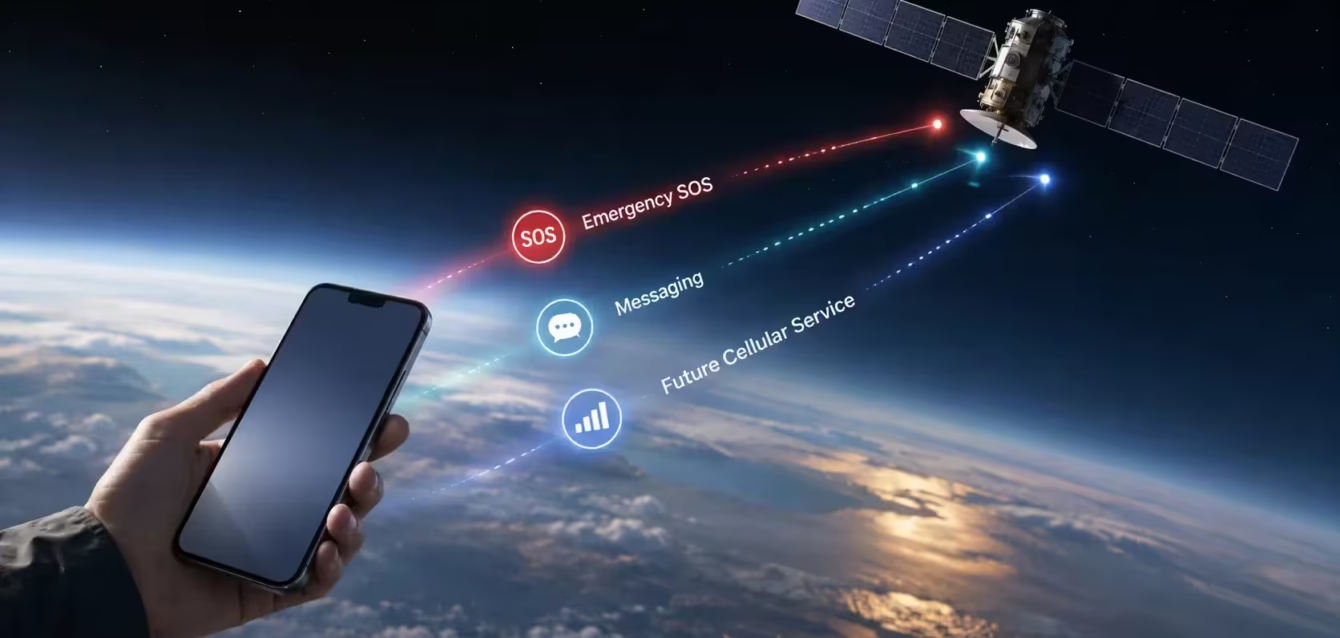
Direct-to-Cell Satellite Statistics 2026
By Axis Intelligence Research
Co-author: Steven Smith | Last updated: September 12, 2026 | License: CC BY 4.0
Five direct-to-cell networks now compete to connect ordinary phones from orbit, and only three of them sell a commercial service today. Axis Intelligence Research scored each on six sourced components and found the global leader wins by 1.3 points — over a Chinese geostationary system most Western coverage leaves out entirely.
Quick Answer
As of September 12, 2026, Starlink Direct to Cell scores 86.3 / 100 on the Axis Direct-to-Cell Service Readiness Index (D2C-SRI), narrowly ahead of China Telecom’s Tiantong at 85.0 and Apple–Globalstar at 78.8. AST SpaceMobile scores 47.5 with 13 spacecraft in orbit against 248 authorized by the FCC. Amazon Leo’s direct-to-device system, scoring 11.3, has no service before 2028.
Key Findings
- Axis Intelligence Research finds that the two highest-scoring direct-to-cell networks worldwide — Starlink Direct to Cell (86.3) and China Telecom’s Tiantong (85.0) — are separated by 1.3 points on a 100-point scale as of September 12, 2026.
- Axis Intelligence Research finds that the two LEO direct-to-cell constellations have collectively deployed 42.3% of their announced or authorized satellite counts: 613 spacecraft in orbit against 1,448 planned.
- AST SpaceMobile has 13 spacecraft in orbit against the 248 satellites authorized by the FCC in its Order and Authorization DA 26-391 of April 21, 2026 — a 5.2% orbital fulfilment ratio.
- T-Mobile reported on January 21, 2026 that T-Satellite with Starlink serves more than 150,000 Americans daily and carries data for 34 optimized apps across roughly 500,000 square miles of United States territory beyond terrestrial tower reach.
- Apple’s Emergency SOS via satellite was available in 20 countries and regions as of Apple’s support documentation dated July 22, 2026, the widest national footprint of any consumer satellite-to-phone service.
What Is the Axis Direct-to-Cell Service Readiness Index (D2C-SRI)?
D2C-SRI stands for Direct-to-Cell Service Readiness Index. It is a 0–100 score built by Axis Intelligence Research measuring how close a satellite network is to delivering commercial cellular service to phones people already own — not how good the technology could eventually be.
Six components, each scored 0–4 against a published rubric, each weighted:
| Component | Weight | What it measures |
|---|---|---|
| Constellation deployment | 0.20 | Spacecraft in orbit against the network’s own stated or authorized target |
| Commercial market footprint | 0.15 | Countries and regions where the service is commercially available |
| Service depth | 0.20 | Emergency-only, messaging, app data, or native voice/broadband — as sold, not as demonstrated |
| Device addressability | 0.15 | What handset a subscriber needs: dedicated terminal, single vendor, flagship subset, or any unmodified LTE/5G phone |
| Spectrum position | 0.15 | Shared MNO spectrum, MSS holdings, or exclusive nationwide assignments |
| Regulatory authorization | 0.15 | Experimental, partial, single-market commercial grant, or multi-market commercial grant |
Score = (Σ component × weight) ÷ 4 × 100. Full rubric thresholds and every input row are in the Methodology section and in the downloadable dataset.
D2C-SRI Readings, September 12, 2026
| Network | Deployment | Markets | Service depth | Devices | Spectrum | Regulatory | D2C-SRI |
|---|---|---|---|---|---|---|---|
| Starlink Direct to Cell (SpaceX) | 3 | 3 | 3 | 4 | 4 | 4 | 86.3 |
| Tiantong (China Telecom) | 4 | 2 | 4 | 3 | 3 | 4 | 85.0 |
| Apple–Globalstar | 4 | 4 | 2 | 2 | 3 | 4 | 78.8 |
| AST SpaceMobile | 2 | 0 | 0 | 4 | 3 | 3 | 47.5 |
| Amazon Leo (D2D) | 0 | 0 | 0 | 0 | 2 | 1 | 11.3 |
Source: Axis Intelligence Research, September 12, 2026. Component inputs sourced individually in the dataset.
Steven Smith: The ranking is uncomfortable for anyone who reads this market through American press releases. Tiantong is three geostationary satellites, launched between 2016 and 2021, moving a maximum of 384 kbps — and it scores within rounding distance of a 600-satellite LEO constellation, because it finished deploying, it sells native voice calls to consumers today, and it holds a licence to do it. Starlink wins on everything that will matter in 2028 and ties on everything that matters in 2026. That is the whole story of this industry compressed into 1.3 points.
How Many Direct-to-Cell Satellites Are in Orbit in 2026?
| Network | Spacecraft in orbit | Orbit type | Announced / authorized target | As of | Source |
|---|---|---|---|---|---|
| Starlink Direct to Cell | 600+ | LEO (~525–560 km) | ~1,200 for contiguous global coverage | May 2026 | SpaceX statement, reported |
| AST SpaceMobile | 13 | LEO (520 / 690 km shells) | 248 (FCC DA 26-391) | Aug 10, 2026 | AST SpaceMobile Q2 2026 business update |
| Tiantong | 3 | GEO | 3 operational + 1 planned | 2026 | China Telecom / Tiantong programme reporting |
| Amazon Leo (D2D payloads) | 0 | LEO | System from 2028 | Apr 2026 | Amazon–Globalstar transaction announcement |
SpaceX’s Starlink updates documented the first Direct to Cell text messages on January 8, 2024, six days after the first payloads reached orbit. By February 2025 the company reported a constellation of over 400 D2C satellites and commercial messaging live in the United States and New Zealand. In May 2026, alongside the EchoStar spectrum acquisition, SpaceX stated the figure had passed 600.
AST SpaceMobile took the opposite path. Its BlueBirds 11, 12 and 13 launched on August 5, 2026 from Cape Canaveral, the second of two missions inside 50 days, bringing the constellation to 13 spacecraft carrying roughly 20,000 square feet of combined aperture. The company’s Q2 2026 business update put BlueBirds 14 through 16 ready to ship and BlueBirds 17 through 46 in production, against full-year revenue guidance of $150.0 million to $200.0 million.
Axis calculation: the orbital fulfilment ratio
Axis Intelligence Research combined the two LEO direct-to-cell fleets against their own stated build-out numbers:
(600 Starlink D2C + 13 AST BlueBird) ÷ (1,200 Starlink target + 248 AST authorized) = 613 ÷ 1,448 = 42.3%
Split by operator, Starlink sits at 50.0% of its stated contiguous-coverage fleet and AST at 5.2% of its FCC-authorized 248. Both denominators come from the operators’ own public statements or their regulatory grants, so the ratio measures delivery against promise rather than against an analyst’s forecast.
Steven Smith: A manifest is not a constellation. AST’s 248-satellite authorization is real and the launch cadence since June is real — six spacecraft in 50 days is a genuine industrial result, not a slide. But 5.2% deployed is where the network is, and the gap between those two numbers is the single most consequential figure in this dataset. Schedule history predicts schedule better than guidance does, and the 2026 beta is the thing to watch: it either converts the authorization into a footprint or it doesn’t.
Which Countries Have Commercial Satellite-to-Phone Service?
Apple–Globalstar has the widest national footprint of any consumer satellite-to-phone service. Per Apple’s Emergency SOS via satellite support documentation, published July 22, 2026, the feature is available in 20 countries and regions:
Andorra · Australia · Austria · Belgium · Canada · France · Germany · Iceland · Ireland · Italy · Japan · Luxembourg · Mexico · Netherlands · New Zealand · Portugal · Spain · Switzerland · United Kingdom · United States.
The same document notes satellite connectivity is not offered on iPhone models purchased in mainland China, Russia, Belarus, Armenia, Kazakhstan or Kyrgyzstan — the clearest single line in any operator document explaining why the direct-to-cell market has split into two non-overlapping hemispheres.
| Network | Commercially live markets | Named next markets | Source |
|---|---|---|---|
| Apple–Globalstar | 20 countries and regions | Expansion “subject to regulation” | Apple support documentation, Jul 22, 2026 |
| Starlink Direct to Cell | United States (T-Mobile), New Zealand (One NZ) confirmed by SpaceX | Australia, Canada, Japan, Switzerland, Chile, Peru, Ukraine named in operator rollout | SpaceX Direct to Cell service document |
| Tiantong | Mainland China, Hong Kong, Laos | Southeast Asia expansion stated | China Telecom launch announcements |
| AST SpaceMobile | None (non-commercial beta planned 2026) | United States, Europe, Japan, Saudi Arabia | AST Q2 2026 business update |
Steven Smith: Count the footprints and the hierarchy inverts again. Apple sells in 20 countries with a network that can only carry a compressed emergency text; SpaceX has the throughput and two confirmed commercial markets. Regulatory approval, not orbital capacity, is the binding constraint in 2026 — and it is granted one national regulator at a time, in a currency no launch cadence can buy.
What Does Direct-to-Cell Actually Deliver to Users?
The most detailed usage disclosure from any operator comes from T-Mobile. In its January 21, 2026 review of T-Satellite’s first six months, the carrier reported more than 150,000 Americans using the service daily, data support for 34 optimized apps, and coverage across roughly 500,000 square miles of U.S. territory beyond tower reach. The October 2025 data expansion added app traffic — including WhatsApp voice and video — barely two months after commercial launch.
Disaster-event performance, United States, 2025
| Event | People connected | Messages exchanged | Emergency alerts delivered |
|---|---|---|---|
| Los Angeles wildfires | 410,000 | 250,000 | 157 |
| Texas floods | 94,000 | 287,000 | 125 |
| Oregon wildfires | 6,800 | 24,000 | 7 |
| Total | 510,800 | 561,000 | 289 |
Source: T-Mobile, January 21, 2026.
Axis Intelligence Research estimates a message yield of 1.10 messages per connected person across these three events (561,000 ÷ 510,800). The ratio is the useful number here: it says the service is functioning as a one-shot lifeline rather than a conversation channel, which matches what a narrowband beam over a disaster footprint can physically support.
The reverse-direction detail from T-Mobile’s beta is the one most operators never publish: the service delivered three times more incoming messages than users sent, because handsets attach to the satellite automatically without the user knowing they left coverage. That asymmetry is the design decision that separates direct-to-cell from every satellite messenger that came before it.
Who Holds the Spectrum?
Spectrum is where the 2026 competitive picture was actually decided.
EchoStar sold SpaceX its AWS-4 and H-block licences — about 50 MHz — in a roughly $17 billion cash-and-stock agreement announced September 8, 2025, then added 15 MHz of unpaired AWS-3 uplink for approximately $2.6 billion on November 6, 2025. The FCC approved the transfer of roughly 65 MHz on May 12, 2026. SpaceX stated the next generation of Direct to Cell satellites would be designed around it, targeting approximately 20× the throughput of a first-generation spacecraft.
AST SpaceMobile’s position is structurally different: shared MNO spectrum. FCC Order DA 26-391 authorizes supplemental coverage from space using 700 MHz and 800 MHz low-band coordinated with AT&T, Verizon and FirstNet, and the company describes a strategy targeting roughly 100 MHz of access in the United States and 60+ MHz globally on a market-by-market basis.
| Network | Spectrum model | U.S. position | Source |
|---|---|---|---|
| Starlink D2C | Exclusive nationwide + MNO-shared | ~65 MHz (AWS-3/AWS-4/H-block) approved May 12, 2026 | EchoStar releases; FCC approval |
| AST SpaceMobile | MNO-shared + controlled MSS | 700/800 MHz via AT&T, Verizon, FirstNet | FCC DA 26-391, Apr 21, 2026 |
| Apple–Globalstar | MSS (L-band / S-band) | Globalstar licensed MSS | Apple support documentation |
| Tiantong | MSS (L-band) | Not applicable | China MIIT licensing framework |
Steven Smith: Exclusive contiguous spectrum is the part of this business that behaves like real estate rather than engineering — it does not scale with manufacturing, and once it is assigned it does not come back. SpaceX spent roughly $19.6 billion across two EchoStar tranches to stop renting from a mobile operator. That is a capital allocation decision, not a technology one, and it is the reason the second-generation constellation is a different competitive proposition from the first.
What Is the Addressable Base Behind Each Network?
AST SpaceMobile reported agreements with roughly 60 mobile network operators representing more than 3 billion subscribers. Vodafone alone, its European anchor, serves 340 million customers across 15 countries plus network partners in 45 more markets, and the two companies’ Luxembourg-headquartered joint venture SatCo selected Germany for a European satellite operations centre in November 2025, filing with the ITU through Germany for a mid-band constellation with a European “command switch.”
Axis Intelligence Research finds that AST SpaceMobile’s addressable base per spacecraft currently stands at approximately 231 million potential subscribers for every satellite in orbit (3,000,000,000 ÷ 13, as of August 10, 2026). Starlink Direct to Cell, on the same arithmetic against 600 spacecraft, would need an addressable base of 138.6 billion to match — which is the point. The ratio is a measure of promise-to-hardware distance, not of capacity, and it is the cleanest way to express why AST’s 2026 beta matters more than any partnership announcement.
China’s figures run on a separate track entirely. China Telecom passed 3 million Tiantong satellite subscribers with satellite revenue up 20.5% year on year in the first half of 2025, on the strength of L-band antennas built into Huawei, Xiaomi, Honor and OPPO flagships. China’s MIIT ended China Telecom’s monopoly by licensing China Unicom and China Mobile for satellite mobile services, and its October 2025 guidance set a target of a satellite communications user base above 10 million by 2030.
Steven Smith: Three million paying subscribers is more consumer direct-to-cell revenue than the rest of the world combined has booked, and it was built on a geostationary architecture Western operators wrote off as obsolete. The lesson is not that GEO wins. It is that a handset with the right antenna and a regulator that moves fast beats a better constellation that cannot sell yet.
What Changes the Picture in 2027 and 2028?
Three dated commitments, each from the parties themselves:
- Amazon–Globalstar. Amazon announced an agreement to acquire Globalstar for $11.57 billion in April 2026, with the transaction expected to close in 2027 and Apple’s iPhone and Apple Watch satellite features transitioning to Amazon Leo. Amazon’s own next-generation direct-to-device system is stated for 2028.
- Starlink second-generation D2C. SpaceX targets Starship-deployed satellites from mid-2027, with a stated goal of roughly 1,200 spacecraft for contiguous global coverage within six months of deployment start.
- SatCo Europe. Vodafone and AST SpaceMobile target commercial European service, with mobile operators across 21 EU member states having expressed interest and EU 2 GHz MSS band licences held by incumbents expiring in May 2027.
| Milestone | Stated date | Party | Status |
|---|---|---|---|
| Amazon–Globalstar close | 2027 | Amazon | Pending regulatory approval |
| Amazon Leo D2D system | 2028 | Amazon | Announced |
| Starlink next-gen D2C deployment | Mid-2027 | SpaceX | Announced |
| EU 2 GHz MSS licence expiry | May 2027 | European Commission | Scheduled |
| AST non-commercial beta | 2026 | AST SpaceMobile | In preparation |
Methodology
Collection. Every figure in this dataset was retrieved between September 9 and September 12, 2026 from the publishing organization’s own documents: operator newsrooms and investor releases (T-Mobile, AST SpaceMobile, Vodafone, EchoStar, SpaceX), vendor support documentation (Apple), and regulatory grants (FCC Order and Authorization DA 26-391, April 21, 2026; FCC approval of the SpaceX–EchoStar spectrum transfer, May 12, 2026). Where a figure exists only in a company statement relayed by a trade publication, the dataset records is_primary = no and names the originating organization.
D2C-SRI construction. Each network receives a 0–4 score on six components against fixed thresholds:
- Constellation deployment: 0 none in orbit · 1 test assets only · 2 under 25% of stated target · 3 25–75% · 4 above 75% or complete for stated service scope.
- Commercial market footprint: 0 none · 1 single market · 2 two to five · 3 six to nineteen · 4 twenty or more.
- Service depth: 0 no commercial service · 1 emergency contact only · 2 two-way messaging · 3 messaging plus app data · 4 native voice or broadband sold commercially. Scored on what is sold, not what has been demonstrated.
- Device addressability: 0 no commercial devices · 1 dedicated satellite terminal · 2 single-vendor device family with built-in satellite radio · 3 multi-vendor flagship subset with built-in satellite radio · 4 any unmodified standard LTE/5G handset.
- Spectrum position: 0 none secured · 1 experimental authorizations only · 2 shared MNO spectrum only · 3 shared MNO plus MSS holdings · 4 exclusive nationwide assignment plus shared MNO access.
- Regulatory authorization: 0 none · 1 experimental · 2 partial or market-by-market · 3 full commercial grant in one major market · 4 full commercial grant plus additional markets.
Score = (Σ component × weight) ÷ 4 × 100, rounded to one decimal. Weights: deployment 0.20, markets 0.15, service depth 0.20, devices 0.15, spectrum 0.15, regulatory 0.15.
Worked example — AST SpaceMobile. (0.20 × 2) + (0.15 × 0) + (0.20 × 0) + (0.15 × 4) + (0.15 × 3) + (0.15 × 3) = 1.90. 1.90 ÷ 4 × 100 = 47.5.
What D2C-SRI measures. Commercial readiness of a service to phones people already own. It does not measure throughput, capacity per beam, spectral efficiency or unit economics — a three-satellite GEO network delivering 384 kbps and a 600-satellite LEO network delivering app data can sit within two points of each other, and the component columns are published precisely so a reader can re-weight them for a different question. A competent outsider working from the sourced input rows should reproduce every reading in this table.
Methodology versioning. Component definitions and weights are fixed at this reading. Any change to components, weights or thresholds will be stated on this page and applied to a re-baselined series rather than retrofitted to past readings.
About This Dataset
Contents. 58 observations covering direct-to-cell and supplemental-coverage-from-space networks: satellites in orbit, authorized constellation sizes, commercial market counts, spectrum holdings, usage and disaster-response figures, subscriber bases, and the six-component D2C-SRI inputs and readings. Geographic coverage: global, with United States, European Union and China detail. Temporal coverage: 2024-01-08 to 2026-09-11.
File. direct-to-cell-satellite-statistics.csv — UTF-8, comma-separated, one observation per row, with source_org, source_document, source_url, retrieved_date, is_primary, axis_calculated and method_note columns on every row.
License. CC BY 4.0. Free to reuse, including commercially, with attribution.
Citation. Axis Intelligence Research, Direct-to-Cell Satellite Statistics 2026, 2026.
Cite This Page
APA — Axis Intelligence Research. (2026). Direct-to-cell satellite statistics 2026: Constellations, coverage, devices and the D2C-SRI readiness ranking. Axis Intelligence.
MLA — Axis Intelligence Research. “Direct-to-Cell Satellite Statistics 2026: Constellations, Coverage, Devices and the D2C-SRI Readiness Ranking.” Axis Intelligence, 2026.
Chicago — Axis Intelligence Research. “Direct-to-Cell Satellite Statistics 2026: Constellations, Coverage, Devices and the D2C-SRI Readiness Ranking.” Axis Intelligence, 2026.
Frequently Asked Questions
Why does my phone show “T-Mobile SpaceX” instead of a normal carrier name?
Because the handset has attached to a Starlink Direct to Cell satellite rather than a terrestrial tower. T-Mobile documents the network identifier appearing as “T-Mobile SpaceX” or “T-Sat+Starlink” when no ground network is reachable. There is no app to open and no activation step for basic messaging — the satellite presents itself to the phone as an LTE cell, which is the entire architectural point of supplemental coverage from space.
Can I text 911 over satellite if I’m not a T-Mobile customer?
T-Mobile has made T-Satellite’s text-to-911 available free, with a signup, to anyone with a satellite-compatible smartphone regardless of carrier. Wireless Emergency Alerts delivered over the service reach all eligible devices in the footprint irrespective of primary carrier — 157 alerts during the 2025 Los Angeles wildfires and 125 during the Texas floods, per T-Mobile.
Will AST SpaceMobile’s satellites work on my existing AT&T or Verizon phone?
The architecture is designed for unmodified 4G and 5G handsets using the carrier’s own low-band spectrum, and FCC Order DA 26-391 authorizes exactly that using 700 MHz and 800 MHz coordinated with AT&T, Verizon and FirstNet. What does not yet exist is a commercial consumer service — AST describes a non-commercial beta with partner operators in 2026, which is why its service-depth component scores zero in this dataset while its device-addressability component scores full marks.
What happens to my iPhone’s satellite features once Amazon owns Globalstar?
Amazon announced an agreement with Apple, alongside its Globalstar acquisition, to continue providing satellite connectivity for current and future iPhone and Apple Watch features, with the transaction expected to close in 2027 and services moving onto Amazon Leo thereafter. Apple’s support documentation continues to name Globalstar and its affiliates or third-party network providers as the network behind the features.
Why is a three-satellite geostationary system scoring near a 600-satellite LEO constellation?
Because D2C-SRI scores delivered commercial service, not capacity. Tiantong is complete for its stated coverage, sells native voice calls to consumers through licensed operators, and reaches flagship handsets from four Chinese manufacturers with L-band antennas built in. It moves a maximum of 384 kbps per satellite and covers the Asia-Pacific region rather than the globe. The index publishes its six component scores separately so a reader weighting throughput above availability can recompute the ranking for that question.
Does direct-to-cell work indoors, in a car, or under tree cover?
No, and none of the operators claim otherwise. The link budget depends on a clear view of sky — T-Mobile’s own service terms condition coverage on outdoor areas where the sky is visible, and warn that service may be delayed, limited or unavailable. Direct-to-cell is a dead-zone layer for open terrain, not an indoor substitute for a tower.
How many phones actually support satellite-to-phone service?
It depends entirely on which network. Starlink Direct to Cell works with standard LTE handsets and T-Mobile describes support across hundreds of smartphones, with satellite data requiring recent software such as Android 16 or iOS 26. Apple’s features require iPhone 14 or later, or Apple Watch Ultra 3. Tiantong requires a handset with an L-band satellite antenna — a subset of Huawei, Xiaomi, Honor and OPPO flagships.
What is the single number that decides who leads this market in 2028?
Deployed spacecraft against authorized spacecraft. Starlink sits at roughly 50% of its stated contiguous-coverage fleet; AST SpaceMobile at 5.2% of its FCC-authorized 248. Spectrum is settled, partnerships are signed, and regulators have granted the framework. What remains unresolved is hardware in orbit, and that is a launch-cadence and production question rather than a strategic one.