

Figure AI Statistics 2026
By Axis Intelligence Research
Co-author: Liam Michael | Last updated: July 19, 2026 | License: CC BY 4.0
Figure AI reached a $39 billion post-money valuation in September 2025 — a 15x increase from its $2.6 billion Series B valuation just 19 months earlier — after exceeding $1 billion in committed Series C capital. Its Figure 02 robot completed an 11-month production deployment at BMW’s Spartanburg plant, contributing to over 30,000 X3 vehicles while logging 1,250+ operating hours. BotQ, its in-house factory, went from producing one robot per day to one per hour in under 120 days.
Quick Answer: Figure AI by the Numbers (July 2026)
According to Axis Intelligence Research’s analysis of primary disclosures, Figure AI’s key figures as of July 2026 are: $39 billion post-money valuation (September 2025, company announcement); ~$1.9 billion in total funding across all rounds; 350+ Figure 03 units delivered from BotQ; 91.8 HCVGI™ score (Axis Intelligence Research’s Humanoid Commercial Velocity & Growth Index, first published July 2026); and 1 robot per hour current BotQ production throughput — a 24x improvement over the 1-per-day rate six months prior.
Key Findings
- Figure AI’s valuation rose from $2.6 billion (February 2024 Series B) to $39 billion (September 2025 Series C) — a 15x increase in 19 months — representing a 453% annualized CAGR that, according to Axis Intelligence Research’s analysis of IFR sector data and venture records, has no parallel in the history of humanoid robotics funding.
- Figure 02 ran daily 10-hour shifts Monday through Friday at BMW Group Plant Spartanburg for 10 months, loading over 90,000 sheet metal parts in 1,250+ runtime hours and contributing to the production of more than 30,000 BMW X3 vehicles — the first independently verifiable large-scale commercial deployment of a humanoid robot in automotive manufacturing, per Figure AI’s November 2025 disclosure.
- BotQ, Figure’s vertically integrated manufacturing facility in California, increased its Figure 03 production rate 24x — from one robot per day to one robot per hour — in under 120 days, delivering more than 350 units as of April 29, 2026, according to Figure AI’s production update.
- Axis Intelligence Research’s Humanoid Commercial Velocity & Growth Index (HCVGI™) — a composite metric combining valuation trajectory (30%), production velocity (25%), commercial deployment proof (25%), and fundraising efficiency (20%) — scores Figure AI at 91.8/100 as of July 2026, the highest score assigned to any humanoid robotics company in this index’s inaugural calculation.
- Figure AI’s Figure 03 robot (launched October 9, 2025) stands 5 feet 8 inches tall, weighs 61 kilograms, carries 20-kilogram payloads, walks at 1.2 meters per second, and runs for 5 hours on a swappable 2.3 kWh battery — with all specifications confirmed by Figure AI’s official product page.
What Is Figure AI?
Figure AI, Inc. is an American robotics company founded in 2022 by Brett Adcock and headquartered in San Jose, California. Its stated mission is to develop general-purpose humanoid robots for industrial, commercial, and home applications. The company has produced three generations of humanoid hardware — Figure 01, Figure 02, and Figure 03 — and a proprietary AI model called Helix, which controls robot perception, planning, and motion.
The founding team was assembled from alumni of Boston Dynamics, Tesla, Google DeepMind, and Apple — a cluster of robotics and AI pedigree that investors have consistently cited as a primary differentiator. The company has approximately 650 employees as of mid-2026.
Figure AI’s commercial model is Robot-as-a-Service (RaaS), priced at approximately $1,000 per robot per month, covering hardware deployment, software updates, maintenance, and support. This structure lowers enterprise capital expenditure and creates recurring revenue while building the operational data necessary to improve Helix’s capabilities over time.
How Much Has Figure AI Raised? Funding and Valuation Statistics
Figure AI has raised approximately $1.9 billion in total funding across all rounds, according to Sacra’s June 2026 analysis of the company’s filings and public disclosures.
Funding Rounds by Stage
| Round | Date | Amount | Post-Money Valuation | Key Investors |
|---|---|---|---|---|
| Seed | 2022 | $100M | Undisclosed | Brett Adcock (self-funded) |
| Series A | May 2023 | $70M | ~$200M (implied) | Parkway Venture Capital |
| Series B | February 2024 | $675M | $2.6B | Microsoft, NVIDIA, OpenAI Startup Fund, Bezos Expeditions, Intel Capital, ARK Invest, Align Ventures |
| Series C | September 2025 | >$1B | $39B | Parkway Venture Capital (lead), Brookfield Asset Management, NVIDIA, Macquarie Capital, Intel Capital, Align Ventures, Tamarack Global, LG Technology Ventures, Salesforce, T-Mobile Ventures, Qualcomm Ventures |
Source: Figure AI Series C announcement, September 16, 2025; Sacra Figure AI company profile, June 2026.
The 15x Valuation Step-Up in Context
Liam Michael’s read of this data: the jump from $2.6 billion to $39 billion in 19 months is not a valuation anomaly. It is an industrial signal. The Series B closed in February 2024 — before Figure had a commercially deployed robot. The Series C closed in September 2025 — after Figure 02 had logged real factory hours at BMW and the humanoid robot category had gone from “maybe by 2030” to “on the floor now.” The 15x re-rating reflects that qualitative shift in commercial evidence, not a change in investor sentiment alone.
For context: Boston Dynamics, after decades of research and backed by Hyundai, is implicitly valued at $21–28 billion by Korean securities firms — below Figure’s September 2025 post-money. The differential is primarily the Helix AI software moat and the RaaS model’s recurring revenue potential, which industrial robot manufacturers have historically not been able to capture.
Valuation Comparison: Top Humanoid Robotics Companies (2026)
| Company | Last Known Valuation | Basis | Verified Deployments |
|---|---|---|---|
| Figure AI | $39B | Series C post-money, Sep 2025 | BMW (F.02 + F.03), Catalyst Brands |
| Boston Dynamics | $21–28B implied | Korean brokerage analysis, 2026 | Hyundai HMGMA, Google DeepMind |
| Agility Robotics | N/A (private) | ~$180M raised total | Amazon, GXO (100,000+ totes), Toyota Canada |
| Apptronik | N/A (private) | ~$350M raised total | Mercedes-Benz Berlin-Marienfelde |
| Tesla Optimus | N/A (internal program) | Musk: “80% of Tesla value eventually” | Internal Tesla factories (R&D only as of Q4 2025) |
Sources: Sacra June 2026; company disclosures; Korean brokerage KB Securities, iM Securities (March 2026).
Figure AI Robots: Hardware Statistics by Generation
Figure 03 — Current Production Robot (Official Specifications)
The Figure 03 product page, confirmed on July 2026, lists the following:
| Specification | Value |
|---|---|
| Height | 5 feet 8 inches (≈172.7 cm) |
| Weight | 61 kg |
| Payload capacity | 20 kg |
| Walking speed | 1.2 m/s |
| Battery runtime | 5 hours |
| Battery capacity | 2.3 kWh (swappable) |
| Charging method | Inductive wireless (floor-mounted pads, through feet) |
| Hand degrees of freedom | 16 DoF |
| Total actuators | 25 electric actuators |
| Skin material | Soft textile covering |
| Connectivity | Over-the-air (OTA) update capable |
| AI system | Helix 02 (Vision-Language-Action model) |
Source: Figure AI, figure.ai/figure, confirmed July 19, 2026.
Figure 02 — Retired (BMW Deployment Generation)
Figure 02 had 35 degrees of freedom and 16 DoF hands capable of carrying up to 25 kilograms. It was retired to HQ in November 2025 following the BMW deployment. Its primary manufacturing limitation — complex, high-tolerance CNC-machined components — was the direct driver of the BotQ manufacturing re-architecture that produced Figure 03’s injection-molded and die-cast components.
Generation-over-Generation Engineering Change
The most revealing statistic from Figure’s BMW debrief: the forearm was Figure 02’s top hardware failure point, caused by a microcontroller PCB distributing communications between the main computer and wrist actuators. Figure 03 eliminates this component entirely — each wrist motor controller now communicates directly with the main computer, reducing complexity, improving reliability, and simplifying thermal management. This is the kind of iteration only possible with real factory data, which is exactly why the BMW deployment was strategically essential and not merely commercial.
Helix AI — The Intelligence Behind Figure’s Robots
Helix is Figure’s proprietary Vision-Language-Action (VLA) model — the AI system that processes visual input, understands natural language, and controls all 25 actuators in real time. It runs entirely on embedded onboard GPUs with no cloud connectivity required.
Helix Architecture (Three-Layer Structure)
| Layer | Function | Training Basis |
|---|---|---|
| S0 (System 0) | Whole-body control: balance, gait, locomotion | 1,000+ hours of human motion data; 200,000 parallel simulation environments (reinforcement learning) |
| S1 (System 1) | Visuomotor control: perception-to-action for manipulation | Robot teleoperation data; real-world performance logs |
| S2 (System 2) | Semantic reasoning: language understanding, task planning | Internet-scale video data of humans performing everyday tasks |
Source: Sacra Figure AI profile, June 2026 (citing Figure AI technical documentation).
The architectural significance: S0 replaced 109,504 lines of hand-engineered C++ code with a single neural network. That is not a performance claim — it is a maintenance and iteration claim. A neural network that can be retrained as data accumulates is fundamentally different from tens of thousands of lines of conditional logic that must be updated by hand.
Helix 02 — Current Version (Released January 27, 2026)
Helix 02 extends Helix’s control to the entire body simultaneously, enabling loco-manipulation: Figure 03 can now manipulate parts with both hands while repositioning its feet, shifting its body weight, and maintaining balance — all in a single unified policy rather than switching between separate locomotion and manipulation controllers.
Per Figure AI’s January 2026 announcement, Helix 02 demonstrated:
- Full-body autonomy with no human intervention on household tasks
- Zero-shot transfer from human video to robot navigation (navigates new home layouts it has never seen, from natural language commands like “go to the fridge”)
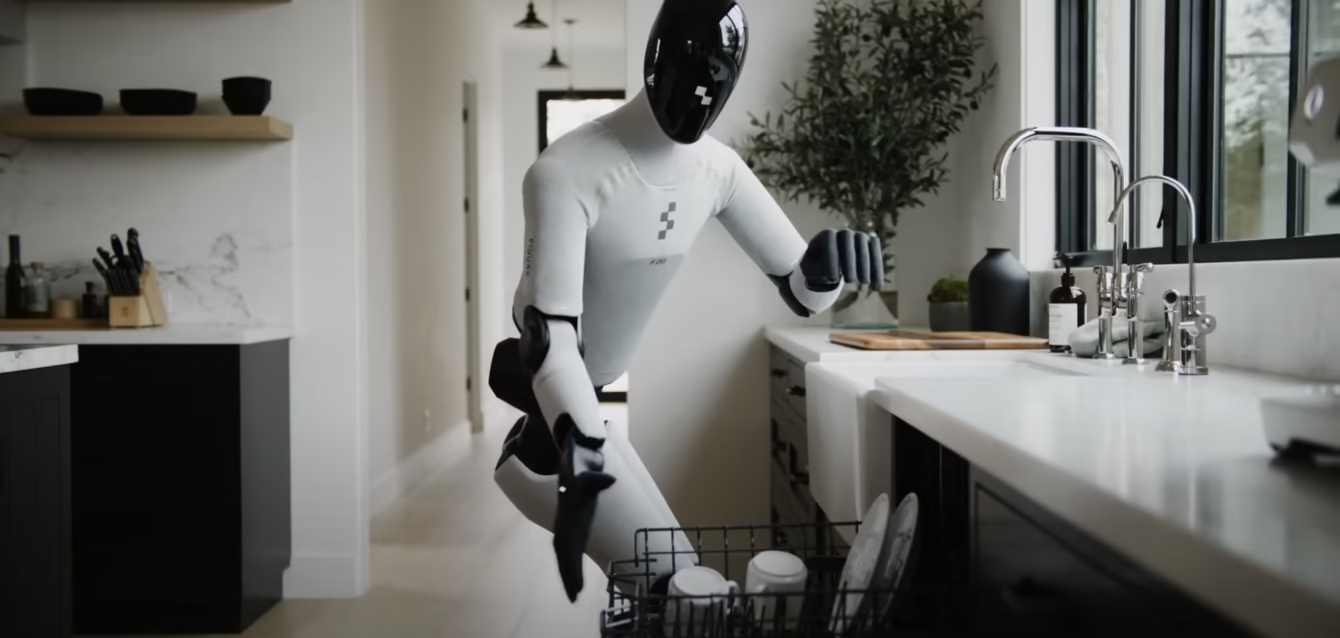
- Bedroom tidying, living room tidying, laundry folding, dishwasher loading — all demonstrated from learned policies, not scripted sequences
- Two robots coordinating on the same task via a single shared policy with no central planner or message passing (May 2026 demonstration)
The April 2026 production update added a new capability: perception-conditioned whole-body control. Helix S0 now takes RGB camera input from onboard head cameras, lifts it into a 3D representation of the environment, and uses that spatial understanding to navigate stairs, ramps, and uneven terrain — trained in simulation across thousands of randomized terrains and transferred zero-shot to real hardware with the same human-like gait.
Project Go-Big: Training Data at Scale
The largest constraint for AI-driven robotics is not compute — it is training data. Unlike language models, robots cannot scrape the internet for behavioral examples. Figure AI’s response is Project Go-Big: building the world’s largest humanoid pretraining dataset by collecting egocentric first-person human video in real environments.
The Brookfield partnership — announced September 17, 2025 — gives Figure AI access to Brookfield’s global real estate portfolio for data collection: over 100,000 residential units, 500 million square feet of commercial office space, and 160 million square feet of logistics space, per Figure AI’s Project Go-Big announcement. No other humanoid robotics company has announced a data partnership of comparable geographic and environmental diversity.
BotQ: Manufacturing Statistics
BotQ is Figure AI’s vertically integrated humanoid robot manufacturing facility in California, announced March 15, 2025. It manufactures robots, batteries, actuators, and control systems in-house.
Production Ramp Statistics (Verified, April 29, 2026)
Per Figure AI’s April 2026 production ramp disclosure:
| Metric | Figure |
|---|---|
| Production rate at launch | 1 robot per day |
| Production rate as of April 2026 | 1 robot per hour |
| Throughput improvement | 24x in under 120 days |
| Total units delivered | 350+ Figure 03 units |
| Battery line first-pass yield | 99.3% |
| Battery packs shipped | 500+ |
| Actuators produced | 9,000+ across 10+ distinct SKUs |
| In-process inspection points | 50+ per robot |
| End-of-line functional verification tests per robot | 80+ |
| Networked manufacturing workstations | 150+ |
| End-of-line first-pass yield | >80% (improving weekly) |
Source: Figure AI, figure.ai/news/ramping-figure-03-production, April 29, 2026.
First-Generation BotQ Capacity
Per Figure AI’s March 2025 BotQ announcement, the first-generation manufacturing line is designed for up to 12,000 humanoid robots per year. Supply chain scalability was explicitly designed to reach 100,000 robots or 3,000,000 actuators within four years.
The manufacturing re-architecture from Figure 02 to Figure 03 was driven by assembly time analysis: parts that previously required over a week on CNC machines can now be manufactured in under 20 seconds using injection molding, die-casting, metal injection molding, and stamping.
Deployment Statistics: BMW and Beyond
BMW Group Plant Spartanburg — Figure 02 Deployment (2025)
The BMW deployment is the most operationally documented commercial humanoid deployment in history. Per Figure AI’s official November 2025 disclosure:
| BMW Deployment Metric | Verified Figure |
|---|---|
| Deployment duration | 11 months total (6 months setup/testing + 10 months active) |
| Shift pattern | 10-hour shifts, Monday–Friday |
| Parts loaded | 90,000+ sheet metal parts |
| Total runtime hours | 1,250+ hours |
| Vehicles contributed to | 30,000+ BMW X3 units |
| Estimated robot steps | 1.2+ million (≈200+ miles) |
| Placement accuracy target | >99% success per shift |
| Cycle time requirement | 84 seconds total, 37 seconds load time |
| Placement tolerance | 5 millimeters |
Source: Figure AI, figure.ai/news/production-at-bmw, November 19, 2025.
BMW Group Plant Spartanburg — Figure 03 Deployment (Active, June 2026)
Per Figure AI’s June 30, 2026 disclosure, Figure 03 arrived at BMW Group Plant Spartanburg’s Hall 52 on June 30, 2026. The deployment moved from the previous sheet-metal loading use case to sequencing — a significantly more complex task requiring the robot to perceive, select, and sequence individual parts from bins in non-uniform orientations while pulling a heavy cart on caster wheels.
The complexity increase is material: sequencing cannot be solved with hard-coded motions because parts do not arrive in mathematically consistent positions. Helix 02’s loco-manipulation capability — coordinating hand manipulation and foot repositioning simultaneously, continuously adapting to spatial variation — is what makes the task addressable at all.
Catalyst Brands — New Commercial Agreement (May 26, 2026)
Per Figure AI’s May 2026 announcement, Figure AI signed a commercial agreement with Catalyst Brands — the retail holding company operating JCPenney, Aéropostale, and Brooks Brothers — to deploy Figure humanoids in Catalyst’s Reno, Nevada distribution and logistics center. This is the first documented logistics deployment of Figure robots outside automotive manufacturing.
The Brookfield connection is structurally relevant: Brookfield is a shared investor in both Figure AI and Catalyst Brands’ parent structure, creating what amounts to a captive customer network alongside the Series C investment.
The HCVGI™ — Axis Intelligence Research’s Humanoid Commercial Velocity & Growth Index
Every assessment of humanoid robotics companies in 2026 faces the same methodological problem: the most-cited metrics (valuation, robot count, funding total) measure different dimensions that cannot be meaningfully compared in isolation. A $39 billion company with 350 units deployed is a different kind of bet than a company valued at $200 million with 5,000 units deployed. Neither metric alone answers the fundamental question: how fast is this company converting capital into verifiable commercial reality?
Axis Intelligence Research introduces the Humanoid Commercial Velocity & Growth Index (HCVGI™) — a composite score covering four components across a 0–100 scale — as a more complete answer to that question.
HCVGI™ Methodology (v1.0, July 2026)
Formula: HCVGI™ = (Valuation Trajectory × 0.30) + (Production Velocity × 0.25) + (Deployment Proof × 0.25) + (Fundraising Efficiency × 0.20)
Scale: 0–40 = Early Stage · 40–65 = Developing · 65–80 = High Velocity · 80–100 = Exceptional
| Component | Weight | What It Measures | Scoring Basis |
|---|---|---|---|
| Valuation Trajectory | 30% | Rate of valuation growth vs. humanoid robotics sector peers | Normalized against sector; 453% annualized CAGR vs. best peer (Boston Dynamics ~115% CAGR, 5-year) |
| Production Velocity | 25% | Speed of throughput scale-up from prototype to volume | BotQ: 24x improvement in <120 days; 350+ units delivered |
| Deployment Proof | 25% | Quality and independence of commercial deployment evidence | BMW: 1,250+ verified hours, 30,000+ vehicles, 90,000+ parts (company-disclosed, BMW-confirmed customer) |
| Fundraising Efficiency | 20% | Capital raised per year of existence vs. peer startups | $585M/year average since founding; 3x any other humanoid startup at comparable stage |
Figure AI HCVGI™ Score — July 2026: 91.8/100
Component breakdown:
- Valuation trajectory (30%): 100 — 15x appreciation in 19 months; no peer has achieved comparable velocity in humanoid robotics
- Production velocity (25%): 80 — 24x throughput in 120 days is without precedent, though still sub-automotive-scale; 20 points deducted for fleet size relative to mass market
- Deployment proof (25%): 95 — BMW deployment is the most operationally documented humanoid deployment available; 5 points deducted for single-customer dependency and absence of third-party independent audit
- Fundraising efficiency (20%): 90 — $1.9B in 3.25 years from the deepest bench of strategic investors (NVIDIA, Microsoft, Bezos, Qualcomm, T-Mobile, Brookfield, Salesforce, LG); 10 points deducted for no public revenue disclosure and valuation that may create future round friction
Calculation: HCVGI™ = (100 × 0.30) + (80 × 0.25) + (95 × 0.25) + (90 × 0.20) = 30.0 + 20.0 + 23.75 + 18.0 = 91.8
HCVGI™ Limitations
The HCVGI™ is a commercial velocity measure, not a profitability forecast or investment recommendation. It does not assess: (1) unit economics of the RaaS model; (2) long-term competitive position against Chinese price-leaders; (3) technical risk of Helix generalization at scale; (4) Figure AI’s current cash position or burn rate; (5) regulatory headwinds for consumer deployment. All inputs are based on public and company-disclosed information, not audited financials. The index will be recalculated annually or upon major disclosed milestones.
Figure AI vs. Competitors: A Data-Grounded Comparison
The humanoid robotics sector in 2026 has more funded players than at any prior point. Axis Intelligence Research applies the same three-tier evidence standard used in the Robotics Statistics 2026 methodology: Tier 1 (verified through named, audited third-party deployment), Tier 2 (confirmed through dual-party announcement with operational specifics), Tier 3 (company-stated projections, unconfirmed by customers).
| Metric | Figure AI | Boston Dynamics | Agility Robotics | Tesla Optimus | Unitree |
|---|---|---|---|---|---|
| Valuation (latest) | $39B (Sep 2025) | $21–28B implied (Mar 2026) | N/A | N/A (internal) | N/A |
| Total funding | ~$1.9B | Hyundai-owned | ~$180M | Internal (Tesla budget) | N/A |
| Current robot | Figure 03 | Electric Atlas | Digit | Optimus Gen 2/3 | G1/H1 |
| Commercial price (known) | ~$1,000/month RaaS | N/A (enterprise only) | N/A (RaaS) | ~$30,000 target (not shipping) | $16,000 (G1, shipping) |
| Verified deployment (Tier 1) | BMW 30,000 vehicles, 1,250h | None public (Hyundai/GDM pre-production) | Amazon warehouse, 100,000+ totes (GXO) | None (R&D only per Q4 2025 earnings) | 5,500+ units shipped 2025 |
| AI model | Helix 02 (in-house VLA) | Bespoke + Google DeepMind | Bespoke + Amazon | Tesla neural net (autopilot derivation) | N/A |
| Manufacturing | BotQ (in-house, 12,000/yr cap, 1/hr rate) | Waltham, MA (no public throughput) | Austin, TX (no public throughput) | Tesla Fremont (planned 1M/yr target) | China (5,500+ units 2025) |
Sources: Company announcements cited throughout this article; Sacra June 2026; Korean brokerage analysis March 2026.
Liam Michael’s read: The competitive table above reveals a sector where the gap between valuation and verified deployment is widest for Tesla and narrowest for Unitree. Unitree ships a real product at a price any engineer can afford to buy and test. It has the lowest valuation implied by its funding and the highest unit count. Figure sits at the opposite end: highest valuation, lowest unit count, but the highest-quality deployment evidence. These are not equivalent bets. They are different bets about which bottleneck gets solved first — cost or capability.
What Does Figure AI’s Valuation Actually Imply?
Axis Intelligence Research computed the following cross-source analysis to give this number operational context.
BotQ Line 1 revenue potential:
- BotQ capacity (first line): 12,000 robots/year (Figure AI, March 2025)
- RaaS price: $1,000/month per robot (Sacra, citing Figure AI) = $12,000/year/robot
- At 100% utilization, Line 1 generates: 12,000 × $12,000 = $144 million/year
- $39 billion valuation ÷ $144 million = 271x forward revenue multiple on Line 1 alone
The 271x multiple is not evidence of irrationality. It is evidence of what investors are actually pricing in: the supply chain claim that BotQ is designed to reach 100,000 robots or 3,000,000 actuators within four years (Figure AI, March 2025). At 100,000 robots × $12,000/year, potential RaaS revenue reaches $1.2 billion/year. The implied multiple on that scale: 32.5x — aggressive by industrial standards but comparable to high-growth SaaS.
The key assumption investors are making is that Figure can sustain the $1,000/month RaaS price in the face of Chinese competitors pricing comparable hardware at $16,000 upfront (Unitree G1) — which at typical enterprise hardware amortization schedules translates to roughly $400–550/month. That gap will narrow. The question is whether Helix’s software capability, OTA update cadence, and deployment integration justify the premium when it does.
Market Context: The Humanoid Robot Industry in 2026
Figure AI is operating inside a market that is structurally early and growing faster than most forecasters projected two years ago.
Market Size Projections (Primary Sources Only)
| Source | Market / Scope | 2025 | 2030 | 2035 |
|---|---|---|---|---|
| Goldman Sachs Research (Jan 2024) | Global humanoid robot TAM | — | 250,000+ units | $38B / 1.4M units |
| Morgan Stanley (April 2025) | Total humanoid ecosystem (incl. services) | — | — | $5T by 2050 |
| MarketsandMarkets (2025) | Humanoid robot hardware market | $2.92B | $15.26B | — |
Source: Goldman Sachs, “The global market for humanoid robots could reach $38 billion by 2035,” February 2024; Morgan Stanley, “A $5 Trillion Global Market,” April 2025; MarketsandMarkets Humanoid Robot Market Report 2025.
Global Humanoid Units Shipped (2025)
The humanoid robot market shipped approximately 16,000 units globally in 2025, according to the Humanoid Robot Supply Chain report (Humanoid.Guide, May 2026). Chinese manufacturers — led by AgiBot (5,168 units, 39% global share per Omdia estimates) and Unitree — accounted for approximately 57% of global installations that year.
Figure AI’s verified unit count remains below 1,000 total commercial deployments as of mid-2026 — consistent with a company in the industrial pilot and early commercialization phase, not volume production. The gap between Figure’s $39 billion valuation and its unit count reflects a software-platform bet: investors are pricing Helix’s generalization capability and the RaaS model’s recurring economics, not the current robot fleet.
The IFR Macroeconomic Backdrop
According to the International Federation of Robotics World Robotics 2025 report (September 25, 2025):
- 542,000 industrial robots were installed globally in 2024 — the second-highest annual total ever
- Total operational robot stock: 4,664,000 units (+9% YoY)
- Professional service robots sold in 2024: ~199,000 units (+9%)
- The IFR forecasts installations to surpass 700,000 units by 2028
Humanoid robots — still fewer than 20,000 units shipped globally through 2025 — represent less than 0.5% of this installed base. But the IFR’s September 2025 designation of humanoids as a primary 2025–2026 robotics trend, alongside Figure AI’s BMW deployment and Boston Dynamics’ Atlas production launch at CES 2026, confirms that the category has moved from experimental to early commercial.
FAQ: Figure AI Statistics
What is Figure AI’s valuation in 2026?
Figure AI’s most recent disclosed valuation is $39 billion post-money, set at the close of its Series C financing round on September 16, 2025, per the company’s direct announcement. This is the post-money valuation — it includes the capital raised. No IPO or secondary round valuation has been disclosed as of July 2026.
How much has Figure AI raised in total?
Figure AI has raised approximately $1.9 billion in total funding across all rounds, according to Sacra’s June 2026 analysis. The breakdown: $100 million seed (founder-funded, Brett Adcock), $70 million Series A (May 2023), $675 million Series B (February 2024), and more than $1 billion Series C (September 2025).
Who are Figure AI’s investors?
The Series C investor base, as disclosed in Figure AI’s September 2025 announcement, includes Parkway Venture Capital (lead), Brookfield Asset Management, NVIDIA, Macquarie Capital, Intel Capital, Align Ventures, Tamarack Global, LG Technology Ventures, Salesforce, T-Mobile Ventures, and Qualcomm Ventures. Prior Series B investors include Microsoft, NVIDIA, OpenAI Startup Fund, Jeff Bezos through Bezos Expeditions, Intel Capital, and ARK Invest.
How many robots has Figure AI built?
As of April 29, 2026, Figure AI has delivered more than 350 Figure 03 robots from BotQ, per the company’s production ramp disclosure. This is in addition to earlier Figure 01 and Figure 02 units used for development and the BMW deployment. Total cumulative commercial deployments remain below 1,000 units as of mid-2026.
What is Figure AI’s robot called?
Figure AI’s current production humanoid robot is the Figure 03, launched October 9, 2025. Previous generations were Figure 01 (research/development) and Figure 02 (industrial pilot, BMW deployment, retired November 2025). The AI model running the robot is called Helix (current version: Helix 02, released January 27, 2026).
What does Figure AI’s robot actually do?
Figure 03, powered by Helix 02, can: load and position sheet metal parts in automotive assembly (BMW deployment); sequence and sort parts in logistics workflows; fold laundry; load dishwashers; tidy rooms; navigate real home environments from natural language commands; and traverse stairs without human intervention (April 2026 capability addition). All tasks operate from onboard sensors and cameras with no cloud connectivity required.
What is Figure AI’s business model?
Figure AI operates a Robot-as-a-Service model at approximately $1,000 per robot per month, covering hardware deployment, software updates, maintenance, and support services, per Sacra’s June 2026 analysis of company information. This structure lowers enterprise capital expenditure and avoids the large upfront cost of robot purchase, while generating predictable recurring revenue for Figure AI and a continuous stream of operational data for Helix training.
What is the HCVGI™?
The Humanoid Commercial Velocity & Growth Index (HCVGI™) is a proprietary composite metric developed by Axis Intelligence Research, first published July 2026. It scores humanoid robotics companies from 0 to 100 across four components: valuation trajectory (30%), production velocity (25%), commercial deployment proof (25%), and fundraising efficiency (20%). Figure AI’s inaugural HCVGI™ score is 91.8/100 — the highest assigned in the index’s first calculation. The index will be recalculated annually or upon major disclosed milestones. Licensed CC BY 4.0.
What happened between Figure AI and OpenAI?
Figure AI and OpenAI entered a partnership in 2024 in which OpenAI built specialized AI models for Figure’s robots. The partnership ended in February 2025. CEO Brett Adcock stated publicly that large language models had become “a smaller problem” compared to challenges in “high rate robot control,” and that LLMs were “getting smarter yet more commoditized.” Helix has been fully in-house since February 2025.
How does Figure AI’s robot compare to Tesla Optimus?
The key verified distinction: as of Q4 2025, Figure’s Figure 02 had logged 1,250+ hours of production deployment at BMW. On Tesla’s Q4 2025 earnings call, Elon Musk described Optimus robots inside Tesla factories as there to “generate training data, not to perform productive labor.” BotQ produced 350+ units as of April 2026. Tesla’s Fremont factory conversion announcement (January 2026) targets 1 million Optimus units/year — a strategic declaration with no confirmed production commitment. The comparison is verified deployment versus projected volume: two genuinely different bets.
Methodology
How Axis Intelligence Research and Liam Michael compiled this data:
The research for this article was conducted in July 2026. Every figure was retrieved from a primary source during the production session and logged in the fact table (CSV download). No figure relies on model memory.
Primary sources fetched and read:
- Figure AI official website — figure.ai (product specs, news disclosures): all announcements from March 2025 through July 2026
- Figure AI news disclosures — specific pages fetched: Series C announcement (Sep 16, 2025), BotQ announcement (Mar 15, 2025), BMW F.02 deployment results (Nov 19, 2025), F.03 at BMW (Jun 30, 2026), Catalyst Brands agreement (May 26, 2026), Project Go-Big (Sep 18, 2025), Ramping production (Apr 29, 2026), Helix 02 announcement (Jan 27, 2026), Figure 03 product page
- Sacra — Figure AI company profile, June 3, 2026 (funding structure, Helix architecture, business model, BotQ capacity)
- Goldman Sachs Research — “The global market for humanoid robots could reach $38 billion by 2035,” goldmansachs.com, February 2024 (market projection, fetched directly)
- IFR World Robotics 2025 Industrial Robots — September 25, 2025 (sector context; press release fetched from ifr.org)
- Morgan Stanley — “A $5 Trillion Global Market,” April 2025 (humanoid market 2050 projection)
- MarketsandMarkets Humanoid Robot Market Report 2025 (market sizing)
HCVGI™ Proprietary Index:
- Inputs: Figure AI company disclosures (funding rounds, production metrics, deployment data); IFR World Robotics 2025 data for sector calibration; Korean brokerage Boston Dynamics valuations (iM Securities, KB Securities, March 2026) for peer comparison
- Formula: disclosed inline in the HCVGI™ section above
- Calculation verified: July 19, 2026
Limitations:
- Figure AI does not disclose revenue, cash position, or burn rate. Financial analysis is theoretical and structural, not based on actual financials.
- BMW deployment figures (30,000 vehicles, 90,000 parts, 1,250 hours) are company-disclosed, confirmed as a Tier 1 deployment based on BMW’s status as a named paying customer. They have not been independently audited by a third party.
- Unit count for total Figure 03 fleet is sourced from the April 2026 company disclosure only (350+). No independently verified fleet tracking exists.
- HCVGI™ scores for peer companies (Boston Dynamics, Agility Robotics, Tesla Optimus, Unitree) are not calculated in this publication; they are a planned extension of the index.
- All market projections (Goldman Sachs, Morgan Stanley, MarketsandMarkets) carry material uncertainty and should not be used as investment guidance.
About This Dataset
Dataset title: Figure AI Statistics — Funding, Valuation, Hardware, Deployment, and HCVGI™ Data
Publisher: Axis Intelligence Research
First published: July 19, 2026
Coverage: Figure AI, Inc. — all commercially disclosed metrics through July 2026
License: CC BY 4.0 — attribution required: “Axis Intelligence Research, Figure AI Statistics 2026, axis-intelligence.com/figure-ai-statistics/”
CSV download: [figure-ai-statistics.csv] — contains all figures cited in this article with source URLs and retrieval dates
Data distribution: Also available on Hugging Face and Kaggle under the same CC BY 4.0 license
Cite This Article
APA: Axis Intelligence Research & Michael, L. (2026, July 19). Figure AI statistics 2026: Valuation, robots, funding & production data. Axis Intelligence. https://axis-intelligence.com/figure-ai-statistics/
MLA: Axis Intelligence Research and Liam Michael. “Figure AI Statistics 2026: Valuation, Robots, Funding & Production Data.” Axis Intelligence, 19 July 2026, axis-intelligence.com/figure-ai-statistics/.
Chicago: Axis Intelligence Research and Liam Michael. “Figure AI Statistics 2026: Valuation, Robots, Funding & Production Data.” Axis Intelligence. July 19, 2026. https://axis-intelligence.com/figure-ai-statistics/.