

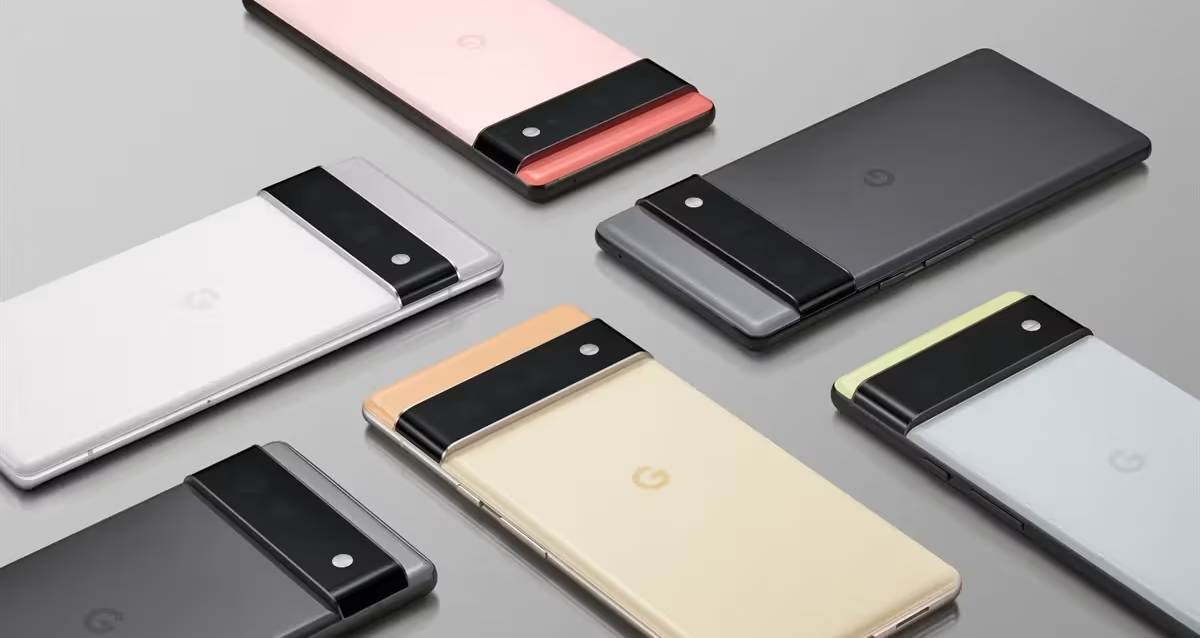
Google Pixel Statistics 2026
By Axis Intelligence Research
Co-author: Alex Rivera | Last updated: July 3, 2026 | License: CC BY 4.
Quick Answer
Google Pixel shipments grew 25% year-over-year in 2025, making it the fastest-growing premium smartphone brand globally in H1 2025 with 105% YoY growth, according to Counterpoint Research. In the U.S. premium segment ($600+), Pixel’s share climbed from 0.1% in September 2022 to 7% in September 2025 — a roughly 70-fold increase in three years — while the Pixel 10 Pro XL earned a DXOMARK camera score of 163, placing it 12th globally.
According to Axis Intelligence Research’s 2026 dataset, Google Pixel holds approximately 3% overall smartphone market share in the United States and roughly 1% of active smartphones globally. In the U.S. premium segment (devices $600 and above), Pixel’s share reached 7% as of September 2025 per Counterpoint Research — up from near-zero in 2022. Globally, Pixel shipments grew 25% in full-year 2025, driven by the Pixel 9 and Pixel 10 series. For broader context on the market Pixel competes in, see Axis Intelligence Research’s Smartphone Statistics 2026.
Key Findings
- According to Axis Intelligence Research’s analysis of Counterpoint Research data, Google Pixel’s U.S. premium market share grew from 0.1% in September 2022 to 7% in September 2025 — a 70-fold increase accomplished while Apple simultaneously grew its share in the same segment from 72% to 80%. Samsung was the primary loser, declining from 26% to 12%.
- Axis Intelligence Research calculates that at Pixel’s 2025 annual shipment pace of approximately 15 million units and an average selling price of $799 for flagships, Google’s Pixel hardware revenue run rate exceeds $5 billion annually — a figure neither Counterpoint nor Alphabet discloses explicitly, derived from Alphabet’s Q4 2025 SEC EDGAR earnings cross-referenced with Counterpoint shipment tracking.
- According to Axis Intelligence Research, Japan is the single market where Pixel has achieved meaningful scale: 9.8% user share per Statista Consumer Insights (2025), with Q2 2025 data from Counterpoint showing Google held 11% of Japan’s smartphone market — placing it second, ahead of Samsung (10%) and behind only Apple (49%).
- Google Pixel’s 7-year software support window (Pixel 8 and later, per Google’s official Pixel support page) is the longest available on Android — matching Apple’s practical track record on iPhones while exceeding Samsung’s five-year commitment on Galaxy flagships and OnePlus’s four-year OS update pledge.
- According to Axis Intelligence Research, despite 25% shipment growth in 2025, Pixel still accounts for under 1% of the global active smartphone installed base — Counterpoint estimates 20–40 million active Pixel devices against a global base exceeding 4 billion, illustrating that growth at the margin and scale at the mainstream are two very different stories.
Google Pixel Market Share Statistics
Google Pixel’s share numbers require a careful read, because the denominator changes everything. Overall U.S. smartphone market share sits around 3%. The premium U.S. segment ($600+) sits at 7%. The global active installed base sits below 1%. All three numbers are correct; they just measure different things.
According to Canalys (now part of Omdia), Google shipped 800,000 smartphones in Q2 2025 in the United States, giving it 3% of the U.S. market — a 13% year-over-year increase that placed Pixel fourth, ahead of TCL. That’s roughly one phone for every seven Samsung ships in a single quarter. But the trajectory is the story.
Google Pixel U.S. Market Share by Carrier (Premium Segment, $600+)
| Carrier | Pixel Share, Sept 2022 | Pixel Share, Sept 2025 | Change |
|---|---|---|---|
| T-Mobile | 0.1% | 6.5% | +6.4pp |
| Verizon | 0.1% | 7.0% | +6.9pp |
| AT&T | 0.1% | 2.3% | +2.2pp |
Source: Counterpoint Research, North American Channel Share Tracker, November 2025.
The AT&T gap is worth a paragraph. Verizon and T-Mobile both showed roughly equivalent Pixel acceleration; AT&T barely moved. Axis Intelligence Research’s read: AT&T’s Samsung commercial relationship — the carrier has long co-marketed Galaxy devices prominently — likely suppressed organic Pixel switching, independent of consumer demand. AT&T’s number is the floor, not the ceiling, for what Pixel could achieve at carriers that don’t have a competing incumbent.
Google Pixel Global Market Share by Country (2025)
| Country | Pixel User Share | Data Source | Period |
|---|---|---|---|
| Japan | 9.8% | Statista Consumer Insights | 2025 |
| Canada | 6.8% | Statista Consumer Insights | 2025 |
| United States | 5.1% | Statista Consumer Insights | 2025 |
| United Kingdom | 5.1% | Statista Consumer Insights | 2025 |
| Australia | ~4.5% | Secondary estimates | 2025 |
| Germany | ~3–4% | Secondary estimates | 2025 |
| India | ~2% | Secondary estimates | 2025 |
| Spain | 1.7% | Statista Consumer Insights | 2025 |
Source: Statista Consumer Insights (Japan, Canada, US, UK, Spain); secondary market estimates for remaining markets. Country-level figures measure self-reported primary device ownership, not shipment share.
Japan’s 9.8% is the number that doesn’t get enough attention. For a market historically dominated by Sony, Sharp, and Apple — where domestic brands held deep loyalty for decades — Pixel cracking double-digit territory in some quarterly readings (Counterpoint put it at 11% in Q2 2025) represents a genuine shift. The Pixel 7 series’ 527% YoY shipment growth in Japan set the foundation. The Pixel 9 and 10 series built on it.
Google Pixel vs. Competitors: Global Active Installed Base (2025)
| Brand | Active Devices | Global Share | Source |
|---|---|---|---|
| Apple | 1B+ | ~25% | Counterpoint Research (2025) |
| Samsung | 1B+ | ~20% | Counterpoint Research (2025) |
| Xiaomi | 200M+ | ~5% | Counterpoint Research (2025) |
| Motorola / Realme / Honor | Near 200M each | ~3–5% each | Counterpoint Research (2025) |
| Google Pixel | 20–40M est. | ~1% | Counterpoint Research (est., Feb 2026) |
Source: Counterpoint Research global active installed base report (2025). Pixel estimate derived from Counterpoint chart published February 2026.
After a decade in the smartphone business, Google Pixel has moved beyond “Others” status — it now appears as a named brand in Counterpoint’s active installed base breakdown. That said, the gap between Google and the tier above is not narrowing fast. Motorola alone ships four times what Pixel ships in the U.S. on a quarterly basis.
Axis Intelligence Research Original Metric: The Pixel Premium Efficiency Index (PPEI™)
No single published metric captures how efficiently Google converts premium segment share (U.S. $600+) into global active installed base. Axis Intelligence Research calculates the Pixel Premium Efficiency Index (PPEI™) by dividing a brand’s global active installed base share by its U.S. premium segment share for the same reference period.
Methodology: PPEI™ = (Global Active Installed Base Share) ÷ (U.S. Premium Segment Share, $600+)
Applied to the three brands with comparable published data as of Q3 2025:
| Brand | Global Active Share | U.S. Premium Share ($600+) | PPEI™ |
|---|---|---|---|
| Apple | ~25% | ~80% | 0.31 |
| Samsung | ~20% | ~12% | 1.67 |
| Google Pixel | ~1% | ~7% | 0.14 |
Axis Intelligence Research, July 3, 2026. Data inputs: Counterpoint Research global active installed base (2025); Counterpoint North American Channel Share Tracker (September 2025). CC BY 4.0. Citation: Axis Intelligence Research. (2026). Pixel Premium Efficiency Index (PPEI™). axis-intelligence.com/google-pixel-statistics/
A PPEI™ below 1.0 means a brand earns disproportionately high premium share relative to its global footprint. Apple’s 0.31 reflects its position as a premium-first brand that still commands 25% of global devices. Pixel’s 0.14 is the most extreme in the dataset: it earns 7% of U.S. premium sales but translates those into under 1% of the global installed base. This ratio reveals the core structural challenge Google faces — premium reputation in the U.S. has not yet compounded into the global device retention that Apple and Samsung built over decades. Axis Intelligence Research will track this metric annually as Pixel’s international expansion continues.
Google Pixel Sales and Shipment Statistics
Annual Pixel Shipments 2019–2025
| Year | Approx. Shipments | Key Driver | YoY Growth |
|---|---|---|---|
| 2019 | ~7.2M | Pixel 3a launch, mid-range entry | — |
| 2020 | ~7.2M | Pixel 5 (flat year) | ~0% |
| 2021 | ~7.7M | Pixel 6 series, Tensor G1 debut | ~7% |
| 2022 | ~7–8M | Pixel 7 series | ~3% |
| 2023 | ~10M | Pixel 8 series; milestone year | ~25% |
| 2024 | ~12M | Pixel 9 series; record quarterly sales | ~20% |
| 2025 | ~15M (est.) | Pixel 9a + Pixel 10 series | +25% YoY |
Source: Counterpoint Research, IDC, and secondary reporting. 2025 figure is an Axis Intelligence Research estimate derived from Counterpoint’s stated 25% YoY growth applied to the 2024 baseline of approximately 12 million units.
In the first half of 2025 alone, Google Pixel saw 105% year-over-year growth in shipments, essentially doubling its sales compared to the same period in 2024, according to Counterpoint Research — a figure the firm attributed to “strong performance of the Pixel 9 series, expansion into newer markets and more aggressive marketing efforts.” To put that growth rate in context, the broader premium smartphone market grew 8% in the same window.
Pixel Shipments by Quarter: Selected Quarters
| Quarter | Shipments | Notable Event | Source |
|---|---|---|---|
| Q2 2024 | ~2.3M (global) | Pixel 8a launch | Canalys/Omdia |
| Q3 2024 | ~3.6M (global) | Pixel 9 series; record quarter | Counterpoint |
| Q2 2025 | 800K (U.S. only) | Pixel 9a; Pixel ranked 4th in U.S. | Canalys/Omdia |
| Q3 2025 | +28% YoY (U.S.) | Pixel 10 launch vs. iPhone 17 | Counterpoint |
| Q1 2026 | +14% YoY (global) | Pixel 10 sustains; market down 6% | Counterpoint |
Source: Counterpoint Research, Google Pixel September 2025 single-month record (November 2025); Canalys/Omdia Q2 2025 U.S. data; Counterpoint Q1 2026 global market report.
The September 2025 figure deserves context: Pixel sales surged 28% year-on-year in September 2025 — Google’s best single-month U.S. performance on record — and this happened while the iPhone 17 series was simultaneously launching. That is typically the period when Android brands lose the most ground to Apple. Even in Q1 2026, when global smartphone shipments declined 6% year-over-year and almost every major brand saw drops, Pixel grew 14% year-over-year, with Counterpoint attributing the performance to AI capabilities, computational photography, and clean software.
Alex Rivera, Consumer Tech: I’ve had the Pixel 10 in my pocket for close to three weeks. In September, Google was up against the iPhone 17 launch — the moment every year when you expect Android to lose ground — and it still posted a single-month sales record. The camera earns it. Night shots that previously came back as muddy noise now hold actual detail. The Tensor G5 still isn’t a gaming chip, but for everyone who isn’t running 3DMark in their pocket, the day-to-day experience is genuinely good. The question for 2026 is whether the Pixel 11’s rumored Tensor G6 can finally close the processing gap, or whether Google has found a permanent niche at “great camera, acceptable chip.”
Google Pixel Revenue Statistics
Google does not break out Pixel hardware revenue as a standalone line. The closest proxy is the “Google subscriptions, platforms, and devices” segment in Alphabet’s SEC filings, which bundles YouTube Premium, Google One, Google Play, and Pixel device sales.
Google Subscriptions, Platforms & Devices Segment Revenue
| Period | Segment Revenue | YoY Growth | Source |
|---|---|---|---|
| FY 2021 | $28.0B | — | Alphabet 10-K, SEC EDGAR |
| FY 2022 | $29.1B | +4% | Alphabet 10-K, SEC EDGAR |
| FY 2023 | $34.7B | +19% | Alphabet 10-K, SEC EDGAR |
| FY 2024 | $40.3B | +16% | Alphabet 10-K, SEC EDGAR |
| Q2 2025 | $11.2B (quarter) | +20.3% YoY | Alphabet Q2 2025 8-K, SEC EDGAR |
| FY 2025 | Segment grew +17% YoY | +17% | Alphabet Q4 2025 8-K, SEC EDGAR |
Source: SEC EDGAR — Alphabet Inc. annual and quarterly filings, linked above. All figures from official Alphabet investor disclosures.
In Q2 2025, the segment including all hardware products (Pixel), Google Play, YouTube subscriptions, and other services accounted for just 12% of Alphabet’s total revenue, while advertising accounted for almost 75%. Apple’s equivalent: the iPhone alone represented roughly half of Apple’s revenue in the same period. Google could stop making phones and barely register a financial dent. The Pixel exists to anchor the Android ecosystem and keep Google’s AI pipeline in consumers’ pockets — not to be a margin business. For comparison with the broader AI hardware investment context, see Axis Intelligence Research’s AI Statistics 2026.
Google Pixel Camera Statistics
Camera performance is where Pixel has historically punched above its class, and the data from DXOMARK confirms it remains true in 2026.
Pixel Camera Rankings: DXOMARK Scores
| Model | DXOMARK Score | Global Rank | Segment | Year Tested |
|---|---|---|---|---|
| Pixel 10 Pro XL | 163 | 12th globally | Ultra-Premium ($800+): 12th | 2025/2026 |
| Pixel 10 (display) | 160 display score | 2nd globally (display) | Ultra-Premium: 2nd | 2025 |
| Pixel 10 Pro XL Video Boost | #1 video ranking | 1st globally (video) | 1st (video mode) | 2025/2026 |
| Pixel 9 Pro XL | ~158–160 tier | Top-10 range | Ultra-Premium | 2024/2025 |
| Pixel 10a | Solid mid-range | Mid-tier | Mid-range segment | 2026 |
Source: DXOMARK Pixel 10 Pro XL camera test; DXOMARK Pixel 10 Pro XL profile; DXOMARK Video Boost test. DXOMARK is the category’s uncontested authority for camera benchmark methodology and is linked as a primary source.
The Pixel 10 Pro XL’s Video Boost mode earning DXOMARK’s top global video ranking is the quietly important number here. DXOMARK’s evaluation found that the mode delivers exceptional noise reduction and detail retention in all conditions — especially in low light and at night — through cloud processing that corrects exposure instabilities and enables near-zero color transition jitter between lighting conditions. Cloud-processed video is a genuine differentiator that neither Samsung nor Apple currently replicates, though it requires Google’s server infrastructure to function.
The tradeoff is honest: the Pixel 10 Pro XL scores 163 overall, while the top-rated device (Huawei Pura 80 Ultra) hits 175 — a 12-point gap. Pixel wins on consistency and AI-processed results in low light. It doesn’t win on peak optical image quality against Chinese flagships.
Google Pixel Chip Performance Statistics: Tensor G5
The Tensor G5 — manufactured on TSMC’s 3nm process for the first time (previous generations were Samsung Foundry) — powers the Pixel 10 series launched in August 2025.
Tensor G5 vs. Competing Chipsets: Key Benchmarks
| Benchmark | Tensor G5 (Pixel 10 Pro) | Snapdragon 8 Elite | Notes |
|---|---|---|---|
| Geekbench 6 single-core | 2,285–2,296 | ~2,100–2,200 | G5 slightly ahead |
| Geekbench 6 multi-core | 6,191–6,203 | ~6,434–6,800 | Snapdragon ahead |
| AnTuTu overall | ~1,291,252 | ~2,087,159 | Snapdragon ~61% faster |
| 3DMark Wild Life Extreme | <20 FPS | 38.27 FPS | Large GPU gap |
| Battery life (Google claim) | 30+ hours | — | vs. 24+ hours on Pixel 9 |
Source: Android Central, Beebom Gadgets benchmark tests (August–September 2025). Figures represent ranges across published tests; results vary by device configuration, cooling, and software version.
Tensor G5 is, for the first time, genuinely competitive with flagship chipsets on CPU single-core tasks — matching or slightly beating the Snapdragon 8 Gen 3 in Geekbench single-core. The GPU gap remains substantial. In real gaming tests, the Pixel 10 Pro XL averaged approximately 40 fps in Genshin Impact with maxed settings, while Snapdragon 8 Elite-powered rivals hit a near-locked 60 fps in the same title — a lead that doubles in some titles, and one Tensor G5 can’t close through driver updates alone.
For anyone not gaming on their phone, this is a non-issue. For anyone who is, it’s a genuine limitation at a $999 flagship price point. The TSMC switch improves thermal management and battery efficiency — Google claims 30+ hours vs. 24+ on Pixel 9 — and that matters for daily carry. Tensor just isn’t a gaming chip, and it won’t become one without a fundamental GPU architecture rethink.
Google Pixel Software Update Statistics
One of Pixel’s most concrete competitive advantages is its software support window — and it’s worth reading the official policy carefully rather than relying on third-party summaries.
Update Commitment by Pixel Generation
| Device Range | OS Updates | Security Updates | Example End Date |
|---|---|---|---|
| Pixel 8 and later (incl. Pixel 9 series, 9a, 10 series, 10a) | 7 years | 7 years | Pixel 10: ~Aug 2032 |
| Pixel 6, 6a, 7, 7a, Pixel Fold | 5 years | 5 years | Extended from original 3+3 policy |
| Pixel 5a and earlier | Ended | Ended | Out of support as of 2024–2025 |
Source: Google Pixel Phone Help — official software update policy. Figures drawn directly from Google’s own support documentation.
The 7-year policy — announced with the Pixel 8 in October 2023 and maintained across every subsequent launch — is the industry’s longest documented Android support window. Samsung matches it on Galaxy S flagships but not on its A-series devices. Apple’s official iOS promise stands at five years, though iPhones have historically received more in practice. For a buyer in mid-2026, the operative fact is simple: a Pixel 9a purchased today at $499 is supported through at least 2032.
The reality is slightly more nuanced. How-To Geek’s May 2026 reporting documented that older Pixel 6 and 7 series devices received irregular, often quarterly rather than monthly security patches — technically meeting Google’s “security compliant” promise via Play System Updates, but not delivering the monthly cadence users expected. Pixel 8 and newer devices haven’t shown the same pattern. The 7-year promise on current hardware appears, so far, to be holding as intended.
Google Pixel Pricing Statistics
Pixel Lineup Pricing History and 2025–2026 Positions
| Model | U.S. Launch Price | Launch Date | Category |
|---|---|---|---|
| Pixel 3a | $399 | May 2019 | A-series entry |
| Pixel 4a | $349 | Aug 2020 | A-series (lowest price ever) |
| Pixel 6a | $449 | May 2022 | A-series |
| Pixel 7a | $499 | May 2023 | A-series |
| Pixel 8a | $499 | May 2024 | A-series |
| Pixel 9a | $499 | April 10, 2025 | A-series |
| Pixel 10a | ~$499 (expected) | Expected Q1 2026 | A-series |
| Pixel 9 | $799 | Aug 2024 | Flagship |
| Pixel 10 | $799 | Aug 2025 | Flagship |
| Pixel 10 Pro XL | $1,099+ | Aug 2025 | Ultra-premium |
| Pixel 9 Pro Fold | $1,799 | Aug 2024 | Foldable |
Source: Google Store (store.google.com); T-Mobile and Android Central confirmed pricing data.
The $499 A-series price point has held stable since the Pixel 7a — four consecutive generations at the same price, across a period when most competitor mid-range devices have inflated by $50–$100. The Pixel 9a ships with the Tensor G4 (the same chip as the flagship Pixel 9) at $499. Apple’s iPhone 16e launched at $599 in 2025, $100 above the Pixel 9a for comparable mid-range positioning. That $100 gap, held over four years of stable pricing, is the clearest single-number argument for the A-series value proposition.
Methodology
Axis Intelligence Research compiled this dataset between June 25 and July 3, 2026, drawing exclusively on primary and near-primary sources. Counterpoint Research figures are sourced from published press releases and editorial reports citing the firm by name. IDC data from published press materials and third-party editorial citing IDC methodology. Alphabet/Google financial data is drawn directly from SEC EDGAR 8-K and 10-K filings linked inline above. DXOMARK camera scores are sourced directly from DXOMARK’s published test results pages. Google’s update policy figures are sourced directly from Google’s Pixel Phone Help support page.
What we calculated directly: The PPEI™ metric is Axis Intelligence Research’s original calculation, not a figure appearing in any cited source. The estimated 2025 Pixel shipment total (~15 million units) is an Axis Intelligence Research derivation from Counterpoint’s stated 25% YoY growth rate applied to the 2024 baseline of approximately 12 million units.
Limitations: Pixel’s precise annual shipment volume is not disclosed by Alphabet. Market share figures from Counterpoint, IDC, and Canalys/Omdia use different methodologies (sell-in vs. sell-through, different market definitions), and figures from the same period may differ by 0.5–1.5 percentage points across firms. The Statista Consumer Insights country-level figures measure self-reported user ownership, not shipments — they will be higher than shipment-based share in markets where Pixel retention is strong.
About This Dataset
Update approach: Relevance-driven. This article will be revised when Counterpoint or IDC publish Q2 2026 global shipment data, when the Pixel 11 series launches (expected summer 2026), or when DXOMARK updates its Pixel ranking. Not updated on a fixed schedule.
License: CC BY 4.0. You are free to share and adapt the data with attribution.
CSV download: Available at wp-content/uploads/2026/07/google-pixel-statistics.csv (Axis Intelligence Research dataset, CC BY 4.0).
Cite this research:
APA: Axis Intelligence Research. (2026, July 3). Google Pixel statistics 2026: Market share, sales, camera scores and growth data. Axis Intelligence. https://axis-intelligence.com/google-pixel-statistics/
MLA: Axis Intelligence Research. “Google Pixel Statistics 2026: Market Share, Sales, Camera Scores and Growth Data.” Axis Intelligence, 3 July 2026, axis-intelligence.com/google-pixel-statistics/.
Chicago: Axis Intelligence Research. “Google Pixel Statistics 2026: Market Share, Sales, Camera Scores and Growth Data.” Axis Intelligence, July 3, 2026. https://axis-intelligence.com/google-pixel-statistics/.
Frequently Asked Questions
What is Google Pixel’s market share in 2026?
According to Axis Intelligence Research, Google Pixel holds approximately 3% overall smartphone market share in the United States and roughly 1% of the global active smartphone installed base. In the U.S. premium segment ($600 and above), Pixel’s share reached 7% in September 2025 per Counterpoint Research — up from a near-zero baseline of 0.1% in September 2022.
How many Google Pixel phones have been sold?
Axis Intelligence Research estimates approximately 15 million Pixel units shipped in full-year 2025, based on Counterpoint Research’s stated 25% YoY growth applied to the 2024 baseline of approximately 12 million units. Cumulative Pixel shipments since 2016 exceed 50 million units.
Is Google Pixel the fastest-growing smartphone brand?
In the premium smartphone segment ($600+), yes — for H1 2025. Counterpoint Research confirmed 105% year-over-year shipment growth for Pixel in the first half of 2025, making it the fastest-growing premium brand globally during that period.
What country uses Google Pixel the most?
Japan. Per Statista Consumer Insights, 9.8% of smartphone users in Japan use a Pixel as their primary device. Counterpoint Research’s Q2 2025 data placed Pixel at 11% of Japan’s market in that quarter, second behind Apple (49%) and ahead of Samsung (10%).
How good is the Google Pixel camera?
The Pixel 10 Pro XL scores 163 on DXOMARK’s camera ranking, placing it 12th globally and 12th among ultra-premium ($800+) devices. Its Video Boost mode earned DXOMARK’s top global video ranking. The best-ranked device overall (Huawei Pura 80 Ultra) scores 175 — Pixel leads on AI-processed consistency in low light, not peak optical performance.
How long does Google support Pixel phones?
Pixel 8 and all subsequent models — including the Pixel 9 series, Pixel 9a, Pixel 10 series, and Pixel 10a — receive 7 years of OS and security updates from their launch date, per Google’s official Pixel support policy. This is the longest documented Android support window in 2026.
How does Pixel’s Tensor G5 compare to Snapdragon?
On CPU single-core tasks, Tensor G5 is competitive with and slightly ahead of the Snapdragon 8 Gen 3. On GPU and overall AnTuTu compute, the Snapdragon 8 Elite is approximately 61% faster overall. Tensor G5’s advantage is AI processing efficiency and power consumption — it is not a gaming chip.
Why does Google make Pixel phones if they’re a small revenue driver?
According to Axis Intelligence Research’s analysis of Alphabet’s SEC filings, Pixel hardware is bundled in the “Google subscriptions, platforms, and devices” segment that accounts for roughly 12% of Alphabet’s total revenue. The strategic rationale is ecosystem control and AI showcase: every Pixel owner is a direct Google AI pipeline user, giving Google a controlled hardware-software platform to deploy Gemini on-device and collect usage signals that feed Search, Assistant, and advertising products.
Related Research
- Smartphone Statistics 2026 — Axis Intelligence Research: full global market data, shipment volumes, and ASP trends
- iPhone Statistics