

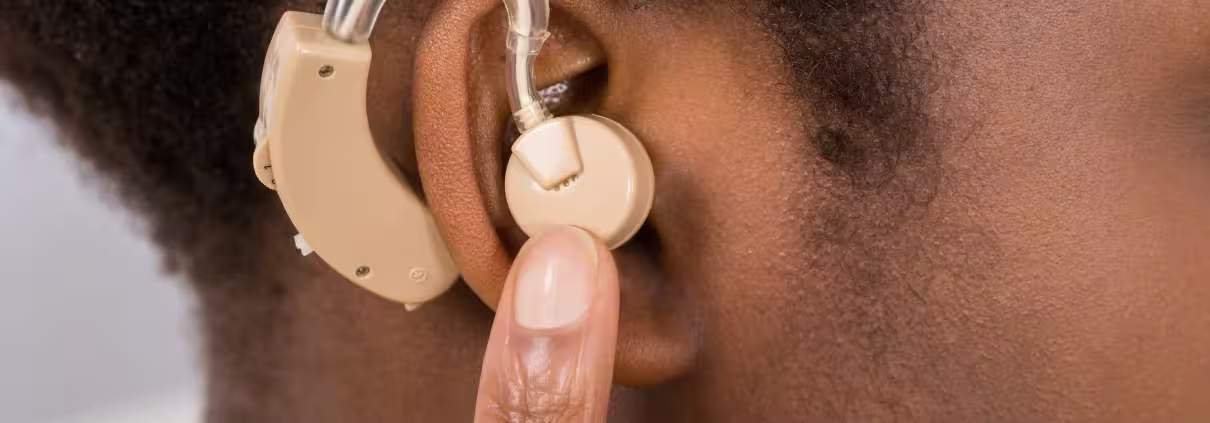
Hearing Aid Statistics 2026
By Axis Intelligence Research
Co-author: Jennifer Miller | Last updated: September 30, 2026 | License: CC BY 4.0
Six in ten Americans with self-reported hearing difficulty still don’t own a hearing aid. Axis Intelligence Research’s Hearing Adoption Gap Index (HAGI) puts the United States at 60.9 points as of September 30, 2026 — wider than the United Kingdom (49.5), Germany (53) and France (45), four years after over-the-counter hearing aids went on sale.
Quick Answer
According to the Hearing Industries Association’s MarkeTrak 2025 survey, 39.1% of Americans with self-reported hearing difficulty own a hearing aid. Axis Intelligence Research calculates that OTC devices account for 14.5% of U.S. hearing aid adopters, and that the U.S. Hearing Adoption Gap Index stands at 60.9, versus 45 in France.
Key Findings
- Axis Intelligence Research finds the U.S. Hearing Adoption Gap Index (HAGI) at 60.9 points as of September 30, 2026, meaning 60.9% of Americans with self-reported hearing difficulty own no hearing aid (MarkeTrak 2025).
- Axis Intelligence Research calculates that OTC devices make up 14.5% of U.S. hearing aid adopters, based on MarkeTrak 2025 adoption rates of 5.7% (OTC) and 33.5% (traditional).
- At the 2015–2025 pace of 0.89 points a year, Axis Intelligence Research estimates the U.S. would need roughly 18 years to reach France’s 2025 adoption rate of 55%.
- The World Health Organization projects that people needing hearing rehabilitation will rise from 430 million to more than 700 million by 2050, an increase Axis Intelligence Research calculates at 62.8%.
- U.S. men aged 45 and older use hearing aids at 1.67 times the rate of women (9.2% versus 5.5%), according to CDC’s National Health Interview Survey 2021.
How Many People Wear Hearing Aids in 2026?
There is no single “hearing aid usage” number, and anyone who quotes one without its denominator is selling something. Three federal and industry datasets measure three different things, and the gap between them is the story.
U.S. Hearing Aid Use: Three Datasets, Three Denominators
| Measure | Value | Denominator | As of | Source |
|---|---|---|---|---|
| Own a hearing aid | 39.1% | Self-reported hearing difficulty | Oct–Nov 2024 fieldwork | HIA, MarkeTrak 2025 |
| Ever used a hearing aid | 30% | Adults 70+ who could benefit (audiometric) | NIDCD, updated Sept 2024 | NIDCD |
| Ever used a hearing aid | ~16% | Adults 20–69 who could benefit | NIDCD, updated Sept 2024 | NIDCD |
| Currently use a hearing aid | 9.2% men / 5.5% women | All adults 45+ | NHIS 2021 | CDC NCHS |
According to the NIDCD, about 28.8 million U.S. adults could benefit from using hearing aids — an estimate built on December 2015 Census data that the institute has not revised since. Among adults 70 and older who could benefit, fewer than one in three (30%) has ever used them; among adults 20–69, roughly 16% have.
The MarkeTrak figure is higher because it starts from people who already say they have trouble hearing. The NIDCD figure starts from an audiogram. Mild loss that a person hasn’t noticed never enters MarkeTrak’s denominator, which is why survey-based adoption always runs ahead of exam-based adoption.
Jennifer Miller’s read: When a headline says “only 16% of people who need hearing aids use them,” check which age band and which definition. The 16% belongs to working-age adults measured by audiometry. The 30% belongs to over-70s. Mixing them produces a number that describes nobody. The honest summary is that between roughly one in six and four in ten people with hearing loss use amplification, depending on age and on whether the person has admitted the loss to themselves yet.
Hearing Aid Use by Age and Sex
Per the CDC’s National Center for Health Statistics, hearing aid use among U.S. adults rises steeply with age and is higher among men in every age band (NHIS 2021).
| Age group | Men | Women | Source |
|---|---|---|---|
| 45–64 | 3.0% | 1.4% | CDC NCHS, NHIS 2021 |
| 65–74 | 12.3% | 5.7% | CDC NCHS, NHIS 2021 |
| 75–84 | 26.7% | 13.7% | CDC NCHS, NHIS 2021 |
| 85+ | 39.5% | 31.5% | CDC NCHS, NHIS 2021 |
| All 45+ | 9.2% | 5.5% | CDC NCHS, NHIS 2021 |
The sex gap tracks prevalence: the NIDCD reports that men aged 20–69 are almost twice as likely as women to have hearing loss. It is widest at 75–84, where men’s use (26.7%) is nearly double women’s (13.7%).
Disabling Hearing Loss by Age in the U.S.
| Age group | Disabling hearing loss prevalence | Source |
|---|---|---|
| 45–54 | ~5% | NIDCD (NHANES 2015–2020) |
| 55–64 | 10% | NIDCD (NHANES 2015–2020) |
| 65–74 | 22% | NIDCD (NHANES 2015–2020) |
| 75+ | 55% | NIDCD (NHANES 2015–2020) |
NIDCD uses the 35 dB better-ear threshold — the level at which adults could generally benefit from hearing aids.
What Is the Hearing Adoption Gap Index (HAGI)?
The Hearing Adoption Gap Index (HAGI) is an Axis Intelligence Research metric that measures the share of people with self-reported hearing loss who do not own a hearing aid, on a 0–100 scale where 0 means every person with hearing loss owns one.
Formula: HAGI = 100 − (hearing aid adoption rate among people with self-reported hearing loss)
HAGI only compares countries measured with the same instrument. MarkeTrak (U.S., Hearing Industries Association) and EuroTrak (Europe, run by Anovum for EHIMA) use the same self-report definition — EHIMA states that the EuroTrak questionnaire is designed to be compatible with MarkeTrak for cross-continent comparison. NIDCD’s audiometric figures are deliberately excluded: mixing an exam-based denominator with a survey-based one would produce a number that means nothing.
HAGI Readings by Country, as of September 30, 2026
| Country | Adoption rate (survey year) | HAGI | Input source |
|---|---|---|---|
| France | 55% (2025) | 45.0 | EuroTrak France 2025 (EHIMA/SNITEM) |
| United Kingdom | 50.5% (2025) | 49.5 | EuroTrak UK 2025 (BIHIMA) |
| Germany | 47% (2025) | 53.0 | EuroTrak Germany 2025 (EHIMA/BVHI) |
| Belgium | 41% (2025) | 59.0 | EuroTrak Belgium 2025 (EHIMA/beMedTech) |
| Italy | 40% (2025) | 60.0 | EuroTrak Italy 2025 (EHIMA) |
| United States | 39.1% (fieldwork late 2024) | 60.9 | MarkeTrak 2025 (HIA) |
All EuroTrak country reports are listed on EHIMA’s survey page.
The United States has the widest gap of the six markets. France and the UK have closed roughly half their gap; the U.S. has closed less than 40%.
Jennifer Miller’s read: The ranking lines up with reimbursement, not with technology. French industry body SNITEM, presenting the EuroTrak France results, said the higher a country’s reimbursement rate for hearing aids, the higher its adoption. Italy is the useful counter-example inside Europe: public coverage there only begins above a 55 dB loss, and its adoption sits at 40%, next to the United States. The hearing aids sold in Milan and Munich come from the same handful of manufacturers. What differs is who pays, and at what threshold.
How Fast Is the U.S. Gap Closing?
| Year | U.S. adoption rate | HAGI | Source |
|---|---|---|---|
| 1989 | 23% | 77 | HIA MarkeTrak, via Jilla & Jorgensen (Semin Hear 2025) |
| 2000 | 22% | 78 | HIA MarkeTrak, via Semin Hear 2025 |
| 2015 | 30.2% | 69.8 | HIA MarkeTrak 9 |
| 2022 | 38.4% | 61.6 | HIA MarkeTrak 2022 |
| 2025 | 39.1% | 60.9 | HIA MarkeTrak 2025 |
Between 2015 and 2025 the U.S. rate rose 8.9 points — 0.89 points a year. Axis Intelligence Research estimates that at this pace, closing the remaining 15.9-point distance to France’s 55% would take about 17.9 years ((55 − 39.1) ÷ 0.89). That is a straight-line extrapolation, not a forecast; a Medicare hearing benefit or a sharp OTC price drop would change the slope.
The more telling number is the last row. From 2022 to 2025 — the three years that straddle the OTC launch — U.S. adoption moved 0.7 points.
Did Over-the-Counter Hearing Aids Increase Adoption?
The FDA’s OTC hearing aid category opened on October 17, 2022, for adults 18 and older with perceived mild-to-moderate hearing loss. MarkeTrak 2025 is the first national survey fielded after the rule, and its answer is: modestly.
OTC vs Prescription Hearing Aids: The Adopter Profile
| Metric | Traditional (prescription) | OTC | Source |
|---|---|---|---|
| Adoption rate (share of people with hearing difficulty) | 33.5% | 5.7% | Jilla & Jorgensen, Semin Hear 2025 |
| Median owner age | 73 | 58 | Jilla & Jorgensen, Semin Hear 2025 |
| First-time buyers | 58% | 70% | HIA MarkeTrak 2025 |
| Average daily wear | 9.4 hours | 6.8 hours | HIA MarkeTrak 2025 |
| Wear daily | 69% | 55% | HIA MarkeTrak 2025 |
| Adoption, White respondents | 35% | 5% | Jilla & Jorgensen, Semin Hear 2025 |
| Adoption, BIPOC respondents | 29% | 8% | Jilla & Jorgensen, Semin Hear 2025 |
Axis Intelligence Research calculates the OTC share of U.S. hearing aid adopters at 14.5%: 5.7 ÷ (33.5 + 5.7). The net effect on the national rate is smaller still. A MarkeTrak 2025 analysis in Seminars in Hearing puts OTC’s incremental contribution to overall adoption at about 4 percentage points — the rest of OTC buyers would likely have bought something anyway.
Jennifer Miller’s read: OTC did exactly one thing the policy promised: it reached a different patient. OTC owners are fifteen years younger at the median, more likely to be first-time buyers, and more likely to be BIPOC — the one segment where OTC adoption (8%) runs above the White rate (5%). What it did not do is move the older, bilateral, moderate-to-severe population that drives prevalence. Those patients were never in the OTC indication to begin with. Judging OTC by the national adoption number is like judging a new clinic by the city’s life expectancy.
Did OTC Hurt Audiology Clinics?
Not measurably, in the one practice-level study published so far. A single-site analysis in the American Journal of Audiology compared 534 days before and after October 17, 2022: hearing aid evaluation visits rose 12.0%, and the authors concluded the ruling had no meaningful impact on visit volume. One academic tertiary clinic is a thin sample — its referral base skews toward complex cases that OTC was never designed to serve.
MarkeTrak 2025 points the same way: 90% of hearing aid owners report satisfaction with their hearing care professional, and physician recommendations to get a hearing aid rose to 22%, from 18% in 2022.
Why Don’t People With Hearing Loss Get Hearing Aids?
Time From Noticing Hearing Loss to Getting a Hearing Aid
According to MarkeTrak 2025, it takes about 4 years from becoming aware of hearing difficulty to getting a hearing aid — unchanged from 2022. The earlier steps (talking to a doctor, getting a professional test, seeing a hearing care professional) each dropped from about four years to three.
Cost, Coverage and Income
MarkeTrak 2025 names cost, inadequate coverage and not feeling ready as the top reasons non-owners with a recommendation don’t buy. The income gradient shows up in the data: traditional hearing aid adoption is 29% among households under $50,000 and 35% at $100,000 or more (Jilla & Jorgensen, 2025). Among non-owners, 15% say they never plan to buy a hearing aid.
Jennifer Miller’s read: The four-year delay is the figure clinicians should anchor on, not the adoption rate. Every step up to the audiologist got faster between 2022 and 2025; the final step — the purchase — did not. That is a pricing and coverage signal, not an awareness one. People are getting diagnosed sooner and then stalling at the checkout.
What Does Untreated Hearing Loss Cost?
Global Burden of Hearing Loss
| Indicator | Value | As of | Source |
|---|---|---|---|
| People needing rehabilitation for disabling hearing loss | 430 million (over 5% of world population) | Mar 2026 | WHO |
| Of whom children | 34 million | Mar 2026 | WHO |
| Projected need for rehabilitation, 2050 | More than 700 million | Mar 2026 | WHO |
| Projected people with any hearing loss, 2050 | Nearly 2.5 billion | Mar 2026 | WHO |
| Annual global cost of unaddressed hearing loss | Almost US$1 trillion | Mar 2026 | WHO |
| Share of disabling hearing loss in low- and middle-income countries | Nearly 80% | Mar 2026 | WHO |
| Adults over 60 with disabling hearing loss | Over 25% | Mar 2026 | WHO |
The WHO’s March 2026 fact sheet also estimates that less than US$1.40 per person per year in additional investment would scale up ear and hearing care globally, returning nearly US$16 for every dollar over ten years. Axis Intelligence Research calculates that the WHO’s own projections imply a 62.8% rise in people needing hearing rehabilitation between today and 2050 (700 ÷ 430 − 1).
Hearing Loss, Depression and Dementia Risk
According to the NIDCD, about 18% of U.S. adults aged 20–69 with moderate or worse hearing loss have depression, compared with about 8% of all adults in that age range (PHQ-9, NHANES).
The 2024 Lancet Commission on dementia estimates that midlife hearing loss accounts for 7% of dementia cases worldwide — tied for the largest single potentially modifiable risk factor, down from 8.2% in the Commission’s 2020 report.
Jennifer Miller’s read: The 7% is a population attributable fraction, and it carries a large assumption: that the association is causal and that removing hearing loss would remove the risk. The Commission says so itself. The evidence that treating hearing loss lowers dementia risk is stronger than it was in 2020, but “hearing aids prevent 7% of dementia” is not what the paper says and should not appear in any marketing copy. What the data does support is simpler: hearing loss is common, treatable, cheap to address at population scale, and associated with outcomes nobody wants.
Hearing Aid Technology in 2026: What Owners Actually Have
| Feature (owners who bought in the past 5 years) | Share | Source |
|---|---|---|
| Volume control | 74% | HIA MarkeTrak 2025 |
| Rechargeable | 69% (up from 52%) | HIA MarkeTrak 2025 |
| Wireless capability | 70% (up from 63%) | HIA MarkeTrak 2025 |
| Downloadable app | 54% | HIA MarkeTrak 2025 |
| Binaural fitting (owners with bilateral loss) | 83% | HIA MarkeTrak 2025 |
MarkeTrak 2025 also finds that 51.3% of Americans with hearing difficulty own some hearing device once cochlear implants and earbuds with hearing-improvement features are counted; with implants but not earbuds, the figure is 43.4%. Worldwide, more than 1 million cochlear implants had been implanted as of July 2022, per the NIDCD.
Frequently Asked Questions
What percentage of people with hearing loss wear hearing aids in 2026?
In the United States, 39.1% of people with self-reported hearing difficulty own a hearing aid, per the Hearing Industries Association’s MarkeTrak 2025. Among audiometrically confirmed candidates, NIDCD reports 30% of adults 70+ and about 16% of adults 20–69 have ever used one.
Which country has the highest hearing aid adoption rate?
Among countries surveyed with the MarkeTrak/EuroTrak method in 2025, France leads at 55%, giving it the lowest Hearing Adoption Gap Index (45) in Axis Intelligence Research’s comparison. The UK follows at 50.5% and Germany at 47%.
Are OTC hearing aids as good as prescription hearing aids?
For mild-to-moderate loss, randomized trials show OTC devices help, but a 2025 JAMA Otolaryngology trial found best-practice audiologist fittings produced better outcomes. OTC owners also wear their devices less — 6.8 hours a day versus 9.4 for prescription users, per MarkeTrak 2025.
Who should not buy an OTC hearing aid?
Under the FDA rule, OTC hearing aids are for adults 18 and older with perceived mild-to-moderate hearing loss. Anyone under 18, or with severe loss — trouble hearing speech in quiet rooms, for example — needs a prescription device and a professional evaluation.
How long do people wait before getting a hearing aid?
About four years on average from first noticing hearing difficulty, according to MarkeTrak 2025. That delay did not shorten between 2022 and 2025, even though the earlier steps — seeing a doctor and getting tested — each fell to about three years.
Does wearing hearing aids reduce dementia risk?
The 2024 Lancet Commission attributes 7% of dementia cases worldwide to midlife hearing loss and reports stronger evidence than in 2020 that treating it lowers risk. That figure assumes causality; it is not proof that hearing aids prevent 7% of cases.
Why are men more likely to wear hearing aids than women?
Men have more hearing loss: NIDCD reports men aged 20–69 are almost twice as likely as women to have it. CDC’s NHIS 2021 shows 9.2% of men 45+ use hearing aids versus 5.5% of women, a 1.67-to-1 ratio calculated by Axis Intelligence Research.
How many people will need hearing care by 2050?
The WHO projects more than 700 million people will need hearing rehabilitation by 2050, up from 430 million today, and nearly 2.5 billion will have some degree of hearing loss.
Methodology
Collection. Axis Intelligence Research retrieved every figure on this page between September 29 and 30, 2026, from the World Health Organization, the NIDCD (NIH), CDC’s National Center for Health Statistics, the FDA, the Hearing Industries Association’s MarkeTrak 2025 (as published by HIA’s executive director in Hearing Review and by academic authors in Seminars in Hearing, 2025), EHIMA/BIHIMA EuroTrak 2025 country reports, the Lancet Commission on dementia (2024), and the American Journal of Audiology (2025). Each value, its as-of date, source document and URL appear in the dataset below.
HAGI. HAGI = 100 − adoption rate, where adoption rate is the share of people with self-reported hearing loss who own at least one hearing aid (prescription or OTC; implants excluded). Only MarkeTrak and EuroTrak inputs are used, because both rely on the same self-report screening design. France’s EuroTrak rate is reported by SNITEM; UK, Germany, Belgium and Italy rates come from the respective EuroTrak 2025 reports.
Other Axis calculations. OTC share of adopters = 5.7 ÷ (33.5 + 5.7). Annual adoption gain = (39.1 − 30.2) ÷ 10. Years to French parity = (55 − 39.1) ÷ 0.89, a linear estimate. Rehabilitation growth to 2050 = 700 ÷ 430 − 1. Male-to-female usage ratio = 9.2 ÷ 5.5.
What the data does not capture. Self-report surveys miss people who haven’t recognized their loss, so HAGI understates the true treatment gap. The NIDCD’s 28.8 million figure rests on 2015 population data. European reports were published at different points in 2025, and EuroTrak does not yet break out OTC purchases, since the category is U.S.-specific.
About This Dataset
Download: hearing-aid-statistics.csv — 105 rows covering hearing aid adoption by country, age, sex, income and device type; global burden figures; and every Axis-calculated HAGI reading with its formula. Also on Hugging Face, Kaggle and GitHub under Axis Intelligence Research.
License: CC BY 4.0. Reuse freely with attribution: Axis Intelligence Research, Hearing Aid Statistics 2026, 2026
Cite This Page
APA: Axis Intelligence Research, & Miller, J. (2026, September 30). Hearing aid statistics 2026: Who wears them, who doesn’t, and why the OTC era barely moved the needle. Axis Intelligence. https://axis-intelligence.com/hearing-aid-statistics/
MLA: Axis Intelligence Research, and Jennifer Miller. “Hearing Aid Statistics 2026: Who Wears Them, Who Doesn’t, and Why the OTC Era Barely Moved the Needle.” Axis Intelligence, 30 Sept. 2026, axis-intelligence.com/hearing-aid-statistics/.
Chicago: Axis Intelligence Research, and Jennifer Miller. “Hearing Aid Statistics 2026: Who Wears Them, Who Doesn’t, and Why the OTC Era Barely Moved the Needle.” Axis Intelligence, September 30, 2026. https://axis-intelligence.com/hearing-aid-statistics/.