

Music Streaming Trends 2027
By Axis Intelligence Research
Co-author: Alex Rivera | Last updated: November 27, 2026 | License: CC BY 4.0
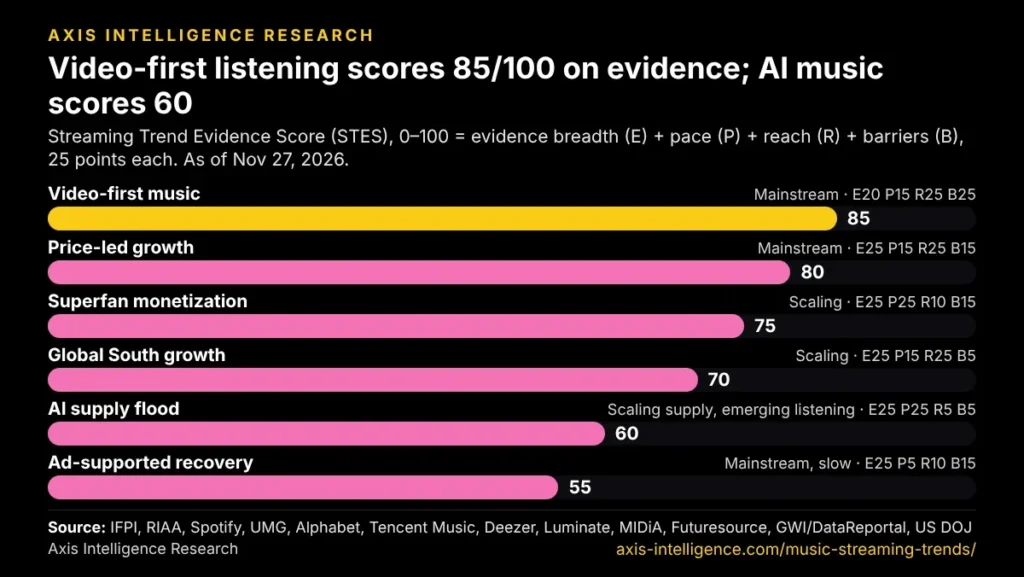
Going into 2027, music streaming grows more from price than from new subscribers. Price increases added 10.6% to Spotify’s average Premium revenue per user in Q3 2026, against 8.9% subscriber growth, according to an Axis Intelligence Research calculation from Spotify’s Q3 2026 Form 6-K (filed October 2026). Our Streaming Trend Evidence Score (STES) ranks six shifts by the strength of their proof. Video-first listening scores highest (85/100). AI music, the most discussed trend, scores 60 because it has flooded the upload pipe without reaching listeners.
| Rank | Trend going into 2027 | Strongest dated evidence | Stage | Who it affects | Signal to watch in 2027 | STES |
|---|---|---|---|---|---|---|
| 1 | Music becomes a video-first habit | 54.5% of internet users aged 16+ watch music videos weekly, Q2 2026, up from 50.9% a year earlier (GWI via DataReportal) | Mainstream | Labels, DSPs, artist marketing teams | Alphabet’s next YouTube Music and Premium milestone | 85 |
| 2 | Price grows faster than volume | Price increases added €0.48 to Spotify’s €4.53 Premium ARPU, Q3 2026 vs Q3 2025 (Spotify 6-K) | Mainstream | Subscribers, DSP finance, rights holders | RIAA full-year 2026 revenue per paid account | 80 |
| 3 | Superfans pay more for extras | Tencent Music’s Super VIP tier passed 20 million members by end-2025, up from 15 million in mid-2025 (TME) | Scaling (China), emerging (West) | Premium product teams, artist managers | Launch date of a Western super-premium tier | 75 |
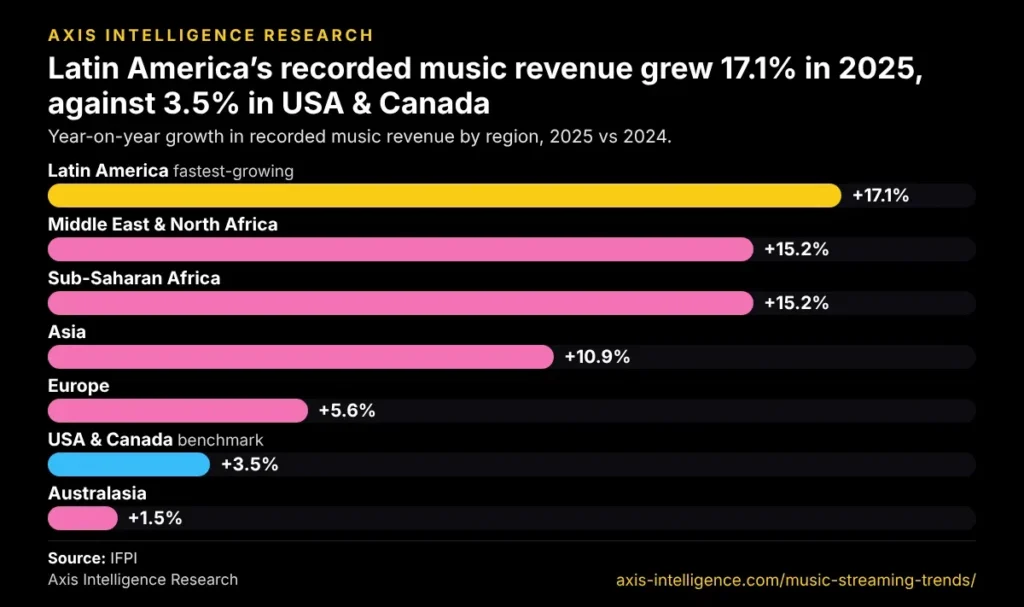
| 4 | Subscriber growth moves to the Global South | Latin America +17.1%, MENA +15.2%, Sub-Saharan Africa +15.2% vs USA & Canada +3.5% (IFPI, 2025 revenue) | Scaling | Labels’ regional teams, DSP pricing | IFPI regional growth for 2026 | 70 |
| 5 | AI floods uploads, not listening | About 90,000 fully AI-generated tracks a day, over 50% of uploads on peak days, June 2026; 1–3% of streams (Deezer) | Scaling supply, emerging listening | Distributors, royalty pools, trust & safety | Deezer’s AI share of uploads and streams | 60 |
| 6 | Free tiers earn a little more, slowly | US free streaming revenue +3.7% in H1 2026 after −2.9% a year earlier (RIAA) | Mainstream, slow | Ad sales, free-to-paid funnels | Spotify ad revenue growth vs ad-supported users | 55 |
Watch list (not scored, evidence is company announcements only): licensed AI remix and creation tools, and a Western super-premium tier.
How does the Streaming Trend Evidence Score rank the 2027 trends?
Axis Intelligence Research scores each trend from 0 to 100 on the Streaming Trend Evidence Score (STES): four components of 25 points each, scored only from documents opened at their producer. Evidence breadth counts independent producers with measured data. Pace is the latest annual change in the trend’s lead indicator. Reach is the share of the relevant base the change already touches. Barriers counts documented constraints. Ties break on Pace.
| Trend | Evidence breadth | Pace | Reach | Barriers | STES |
|---|---|---|---|---|---|
| Video-first music | 20 (Alphabet, GWI, MIDiA) | 15 (YouTube Music + Premium subs ≈ +11.7% a year) | 25 (54.5% watch music videos weekly) | 25 (none documented) | 85 |
| Price-led growth | 25 (Spotify, Apple, RIAA, UMG) | 15 (price effect +10.6% on ARPU) | 25 (price explains ≈62% of Spotify Premium revenue growth) | 15 (price cuts in five emerging markets) | 80 |
| Superfan monetization | 25 (TME, Spotify, Luminate, RIAA) | 25 (SVIP base ≈ +78% annualized) | 10 (SVIP ≥ 15.7% of TME payers) | 15 (no Western super-premium launch) | 75 |
| Global South growth | 25 (IFPI, Luminate, MIDiA, Futuresource) | 15 (Latin America +17.1%) | 25 (>70% of subscriber growth from Latin America, Asia Pacific and Rest of World) | 5 (flat payer share; India price cut) | 70 |
| AI supply flood | 25 (Deezer, Spotify, Luminate, US DOJ) | 25 (AI uploads +275% in a year) | 5 (1–3% of Deezer streams) | 5 (demonetization; filters; prosecution) | 60 |
| Ad-supported recovery | 25 (RIAA, Spotify, UMG, MIDiA) | 5 (US free streaming +3.7%) | 10 (18.4% of US streaming revenue) | 15 (ad revenue per ad user −1.4%) | 55 |
Source: Axis Intelligence Research, STES, as of November 27, 2026. Scoring bands and inputs are in the methodology and the CSV.
Alex Rivera, Consumer Tech, Media & Streaming analyst at Axis Intelligence If you budget for 2027 off the trade-press headlines, you will overspend on AI and underspend on video. AI scores 60 because its 2026 numbers describe uploads, takedowns and a court case, not listeners choosing it. Video scores 85 because three unrelated producers, a survey firm, an analyst house and Alphabet, all see the same shift in daily behavior.
Why are music streaming prices still rising in 2027?
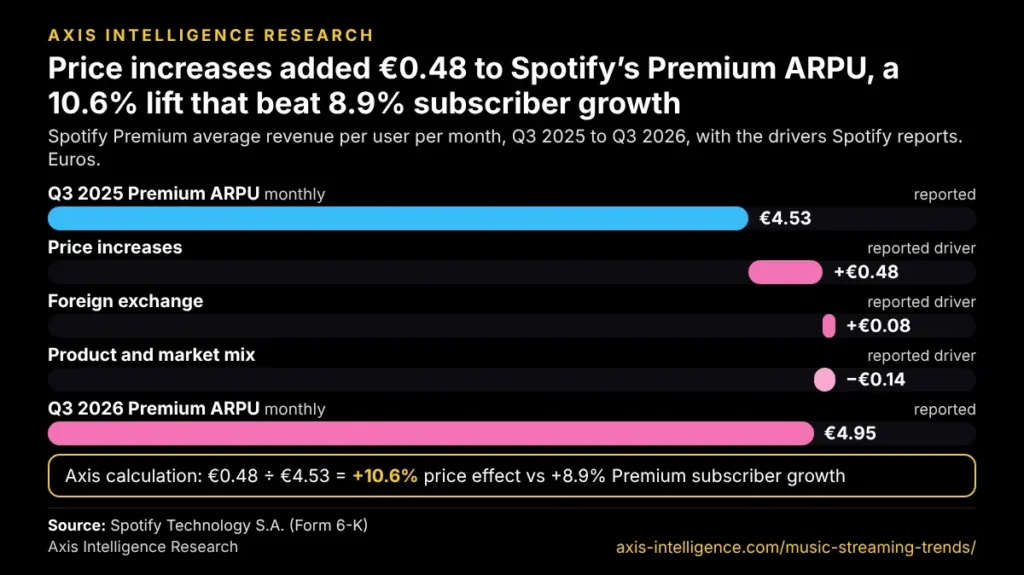
Because price is now the bigger growth lever. Spotify’s average Premium revenue per user (ARPU) rose from €4.53 to €4.95 in Q3 2026, and the company attributes €0.48 of that to price increases, partly offset by product and market mix (−€0.14) and helped by currency (+€0.08), per its Q3 2026 Form 6-K. Axis Intelligence Research calculates that price alone lifted ARPU by 10.6%, more than the 8.9% growth in Premium subscribers (281 million to 306 million).
| Indicator | Earlier period | Latest period | Change | Source |
|---|---|---|---|---|
| Spotify Premium ARPU (monthly) | €4.53 (Q3 2025) | €4.95 (Q3 2026) | +9% | Spotify Form 6-K |
| Price effect on ARPU | — | +€0.48 | +10.6% of Q3 2025 ARPU | Axis calculation from Spotify 6-K |
| Spotify Premium subscribers | 281M | 306M | +8.9% | Spotify Form 6-K |
| Spotify Premium revenue | €3,835M | €4,487M | +17% | Spotify Form 6-K |
| Spotify Premium Individual, US | $11.99 | $12.99 (from Feb. 2026 billing) | +$1.00 | Spotify US Premium page |
| Apple Music Individual, US | $10.99 | $11.99 (July 17, 2026) | +$1.00 | Apple Music page; Apple statement reported by Music Business Worldwide |
| US premium subscription revenue per paid account (half-year) | $27.43 (H1 2025) | $28.02 (H1 2026) | +2.1% | Axis calculation from RIAA |
The price lever is accelerating. Spotify’s ARPU growth went from +1% in Q1 2026 to +7% in Q2 (when price added €0.49, per its Q2 2026 6-K) and +9% in Q3. The list prices are public: Spotify’s US Premium page shows $12.99 Individual, $18.99 Duo and $21.99 Family; Apple Music now lists $11.99 Individual and $19.99 Family. Apple’s July increase was its first since October 2022, and it told Music Business Worldwide the reason was rising licensing costs.
The US wholesale data lags the list prices. In the RIAA’s H1 2026 report, premium paid accounts grew 5.5% to 111.1 million while premium revenue grew 7.8% to $3.11 billion, so volume still outran price in the US through June. Spotify’s February increase was only partly in that window, and Apple’s July one was not in it at all.
Alex Rivera, Consumer Tech, Media & Streaming analyst at Axis Intelligence The decade of the $9.99 plan is over, and churn didn’t punish its end. Spotify added 25 million paying subscribers in the same twelve months that price increases lifted its ARPU by €0.48, and the 8.9% subscriber growth sits less than half a point below the 9.3% ARPU gain. For a household on a $21.99 Family plan, the 2027 question is not whether another dollar is coming but whether the next one comes with something they actually use, like lossless or audiobook hours.
Axis Intelligence Research calculates that price explains about 62% of Spotify’s 17.0% Premium revenue growth in Q3 2026 (10.6 ÷ 17.0). Rights holders see the same shift: Universal Music Group’s Q3 2026 results (October 29, 2026) credit wholesale price increases and healthy subscriber growth for recorded-music subscription revenue up 9.5% at constant currency excluding Downtown, an acceleration in the quarter. The ceiling is visible in emerging markets. In May 2026 Spotify scrapped its Premium Lite tier in India, Indonesia, Saudi Arabia, the UAE and South Africa and cut India’s Standard plan by 30%, from ₹199 to ₹139 a month, Music Business Worldwide reported. Price growth in 2027 is a mature-market story. The Spotify statistics page tracks the plan-by-plan history.
How much of music streaming is AI-generated now?
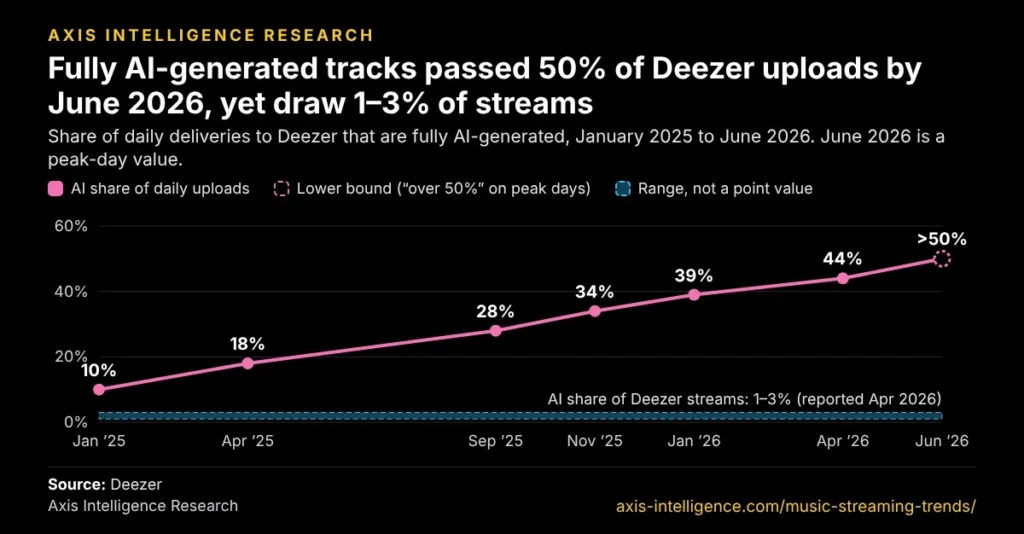
About half of new uploads on Deezer, and almost none of the listening. Deezer reported nearly 90,000 fully AI-generated tracks a day, more than 50% of all daily deliveries at peak in June 2026, in its July 21, 2026 release. Its April 2026 release put AI music at 1% to 3% of total streams and found that up to 85% of streams on fully AI-generated tracks were fraudulent in 2025.
| Date | Fully AI-generated tracks delivered to Deezer per day | Share of daily uploads | Source |
|---|---|---|---|
| January 2025 | ~10,000 | ~10% | Deezer |
| April 2025 | ~20,000 | 18% | Deezer |
| September 2025 | ~30,000 | 28% | Deezer |
| November 2025 | ~50,000 | 34% | Deezer |
| January 2026 | ~60,000 | 39% | Deezer |
| April 2026 | ~75,000 | 44% | Deezer |
| June 2026 (peak) | ~90,000 | >50% on peak days | Deezer |
Axis Intelligence Research calculates that AI uploads grew 275% between April 2025 and April 2026, and that 75,000 AI tracks at 44% implies roughly 170,000 total deliveries a day. At 44% of uploads and at most 3% of streams, AI tracks hold about 15 times more of Deezer’s catalog intake than of its listening.
The other producers point the same way. Spotify said it removed more than 75 million spammy tracks in the twelve months to September 2025 and introduced a spam filter and AI credits through DDEX, the music-metadata standard (Spotify, September 25, 2025). Luminate’s 2026 Midyear Report found the highest-ranked AI-assisted song globally at No. 282, with 210.7 million audio streams over weeks 1–24 of 2026. On October 6, 2026, the US Attorney for the Southern District of New York announced an 18-month sentence for Michael Smith, in what the Justice Department described as its first criminally charged AI-assisted streaming fraud case. Smith used up to 10,000 bot accounts at once to stream hundreds of thousands of AI-generated songs from 2017 to 2024, collecting more than $8 million in royalties; he was ordered to forfeit $8,091,843.64. In April 2023 alone, his bots streamed his tracks 80.9 million times through YouTube Music family plans, against 9.3 million family-plan streams for Taylor Swift’s entire catalog.
Alex Rivera, Consumer Tech, Media & Streaming analyst at Axis Intelligence The 50% headline tells you about content farms, not about what people play on the bus. A track that 85% of the time is streamed by a bot is a fraud tool, which is why the useful number for 2027 is the 1–3% share of streams, not the upload share. If that streaming share moves past 3% while platforms are still filtering, AI music will have found real listeners, and it will deserve a new score.
Licensing is still mostly promises. Universal and Warner settled with Udio in late 2025 and announced licensed platforms for 2026, and Spotify announced a paid Premium add-on for covers and remixes under a Universal licence at its May 2026 Investor Day. None of these has published user numbers, so they sit on the watch list. The court side is logged in our AI copyright lawsuits tracker.
Is video taking over music streaming, and which platforms are gaining?
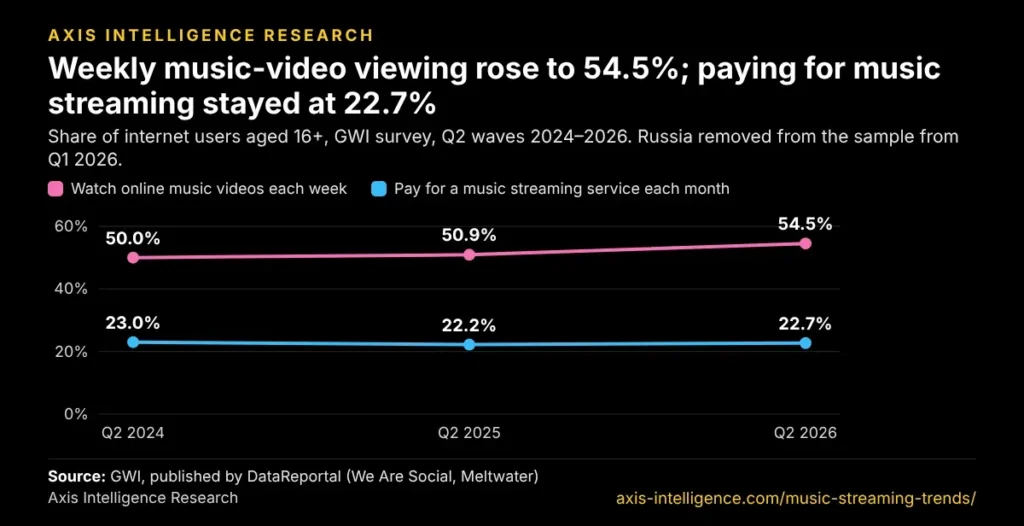
Video is now the default way people meet music online. 54.5% of internet users aged 16+ watch online music videos each week, making them the most-watched video type in GWI’s Q2 2026 survey, ahead of comedy and meme clips at 35.7% (DataReportal, Digital 2027 Global Overview Report, published October 21, 2026). Alphabet passed 150 million YouTube Music and Premium subscribers, trials included, according to Sundar Pichai’s Q3 2026 remarks on October 28, 2026.
| Indicator | Earlier | Latest | Change | Source |
|---|---|---|---|---|
| Internet users 16+ watching music videos weekly | 50.0% (Q2 2024); 50.9% (Q2 2025) | 54.5% (Q2 2026) | +3.6 pts in a year | GWI via DataReportal |
| YouTube Music + Premium subscribers (incl. trials) | 125M (March 2025) | 150M+ (October 2026) | ≈ +11.7% a year (Axis, annualized) | Alphabet |
| Spotify Premium subscribers | 281M (Q3 2025) | 306M (Q3 2026) | +8.9% | Spotify Form 6-K |
| YouTube Music’s global rank by subscriber share | — | 4th; fastest-growing DSP in % terms for the second year; overtook Spotify to lead MENA | — | MIDiA Research, Q4 2025 shares |
Spotify still has roughly twice YouTube’s combined subscriber count, and YouTube’s figure includes trials and video-only Premium buyers. The direction is still clear, and MIDiA Research ranks YouTube Music as the fastest-growing major service. Spotify has moved toward video too: its 6-K says video is included in Premium in certain markets. Platform-level detail is on our YouTube Music statistics and Apple Music statistics pages.
Alex Rivera, Consumer Tech, Media & Streaming analyst at Axis Intelligence A song now gets heard first in a clip and only later saved to a playlist, if at all. For 2027 release plans, the music video is no longer a promotional extra. It is the main product, and the audio-only service is where the most engaged listeners end up.
Where will new music subscribers come from in 2027, and will the total pass 1 billion?
Mostly from outside North America and Europe, and whether the total passes 1 billion in 2027 depends on who is counting. IFPI counted 837 million users of paid subscription accounts at the end of 2025. Latin America was the fastest-growing region (+17.1% revenue), with MENA and Sub-Saharan Africa at +15.2% each, while USA & Canada grew 3.5%. Luminate measured ex-US on-demand audio streams up 11.8% in H1 2026 against 4.8% in the US.
| Count of paid music subscriptions, 2025 | Value | 2025 growth | Needed to reach 1 billion by end-2027 | Reaches 1B at 2025 pace | Source |
|---|---|---|---|---|---|
| IFPI (users of paid subscription accounts) | 837M | +9.6% (from 764M restated) | 9.3% a year | End-2027 (≈1,005M) | IFPI GMR 2026 |
| Futuresource (paid subscriptions) | 865M | +71.5M (≈ +9.0%) | 7.5% a year | During 2027 | Futuresource, July 2026 |
| MIDiA (subscribers, incl. YouTube Premium music access) | 921.6M | +10.1% | 8.5% in 2026 alone | During 2026 | MIDiA, June 2026 |
Required growth and pace projections are Axis Intelligence Research calculations from each producer’s 2025 base. They are arithmetic thresholds, not forecasts.
The three counts differ by 84.6 million, or 10.1% of IFPI’s base, because they define a subscriber differently: IFPI counts users of paid accounts under a methodology agreed with services, Futuresource counts paid subscriptions, and MIDiA includes YouTube Premium buyers who use the music component. Futuresource’s June 2025 outlook forecast more than 1 billion subscriptions by the end of 2027, and its July 2026 update did not restate a 2027 figure. Spotify calls one billion subscribers of its own a long-term ambition, with no year attached.
Alex Rivera, Consumer Tech, Media & Streaming analyst at Axis Intelligence When you see a “billion subscribers” headline in 2027, check whose count it is before you quote it. I’d trust IFPI’s as the one that matters for rights holders, since it is built with the services themselves, and on that basis the billion is a coin toss: the 2025 pace gets there with about 5 million to spare. MIDiA’s count will probably cross first. That is a difference in definitions, not a sign the market grew faster.
The most surprising number of 2026 sits under that growth. GWI’s survey shows the share of internet users aged 16+ who pay for music streaming each month flat at 22.7% in Q2 2026, against 23.0% two years earlier, while 77.4% listen to streaming music weekly (DataReportal, Digital 2027). Axis Intelligence Research calculates that fewer than 3 in 10 weekly listeners pay (22.7 ÷ 77.4 = 29.3%). Spotify’s 6-K adds that Family and Duo plans accounted for a significant portion of gross additions.
Alex Rivera, Consumer Tech, Media & Streaming analyst at Axis Intelligence Subscriptions grew about 10% while the share of people who say they pay barely moved. My reading is that 2025’s growth came largely from extra seats on family plans and from bundles, not from new households deciding to pay. That matters for 2027, because seat growth runs out once the household is full, and in India, Spotify just cut its price by 30% to win the next payer.
Emerging markets will add the people but not much of the money. In India, 178 million people streamed music in 2025 and only about 8% paid, according to an EY–FICCI figure reported by Music Business Worldwide. The full 2025 subscriber series is on our music streaming statistics pillar.
Will superfan tiers finally launch in 2027?
They already exist at scale in China, and in the West they arrive as add-ons rather than a single top tier. Tencent Music’s Super VIP (SVIP) membership passed 20 million by the end of 2025, up from more than 15 million in mid-2025, according to the company’s Q4 2025 results and Q2 2025 results. With 127.4 million paying users at the end of 2025, Axis Intelligence Research calculates SVIP penetration of at least 15.7%.
| Indicator | Value | Date | Source |
|---|---|---|---|
| TME SVIP members | >15M → >20M | Mid-2025 → end-2025 | Tencent Music |
| TME online music paying users | 127.4M (+5.3%) | Q4 2025 | Tencent Music |
| TME monthly ARPPU, online music | RMB 11.9 (+7.2%) | Q4 2025 | Tencent Music |
| TME membership services revenue | RMB 4.99B (+9.2%) | Q3 2026 | Tencent Music |
| US listeners who are superfans | 20% | 2026 | Luminate |
| Spotify Audiobooks+ | On track for $100M annualized recurring revenue | July 2026 | Spotify |
| US CD revenue | $171.1M (+58.6%) | H1 2026 | RIAA |
| US vinyl revenue | $543.8M (+17.7%) | H1 2026 | RIAA |
Spotify’s version is a set of paid extras. At its Investor Day it launched Reserved, which holds two tour tickets for an artist’s most engaged Premium listeners before general sale, with Live Nation as launch partner, and announced the Universal-licensed remix add-on. It also put Audiobooks+ on track for $100 million in annualized recurring revenue. The single higher-priced tier the industry has discussed since 2025 has not yet arrived in Western markets, Music Business Worldwide noted when Reserved launched. In the US, Luminate counts 20% of music listeners as superfans, and fans are paying through physical formats: CD revenue rose 58.6% in the first half of 2026, per the RIAA.
Alex Rivera, Consumer Tech, Media & Streaming analyst at Axis Intelligence China shows the model works when the perks are things fans touch, like better sound, early tickets and digital albums. TME got about one paying member in six into SVIP. Western services are selling the same perks one at a time instead of as a bundle, and I’d bet on that approach in 2027 over a big-bang “Pro” tier. A fan will pay for a ticket window long before they pay a monthly premium for a promise.
TME stopped reporting paying-user counts after its full-year 2025 results, so 2027 tracking depends on membership revenue, which grew 9.2% in Q3 2026 (TME Q3 2026 results).
Is free, ad-supported music streaming growing again?
Yes, but slowly, and less per listener. US free streaming revenue rose 3.7% to $899.6 million in H1 2026, after falling 2.9% in H1 2025, per the RIAA. Spotify’s ad-supported revenue grew 10% to €482 million in Q3 2026 while its ad-supported users grew 12% to 499 million.
| Indicator | Earlier | Latest | Change | Source |
|---|---|---|---|---|
| US free streaming revenue (wholesale) | $867.5M (H1 2025) | $899.6M (H1 2026) | +3.7% | RIAA |
| Free streaming share of US streaming revenue | — | 18.4% (H1 2026) | — | Axis calculation from RIAA |
| Spotify ad-supported revenue | €437M (Q3 2025) | €482M (Q3 2026) | +10% | Spotify Form 6-K |
| Spotify ad-supported MAUs | 446M | 499M | +12% | Spotify Form 6-K |
| Spotify ad revenue per ad-supported MAU (quarter) | €0.98 | €0.97 | −1.4% | Axis calculation from Spotify 6-K |
MIDiA Research’s 2026–2033 forecasts expect ad-supported audio to be the fastest-growing component by compound growth through 2033, after a weak 2025, while premium subscriptions still add more absolute revenue. Universal Music Group’s ad-supported streaming revenue grew 4.7% at constant currency excluding Downtown in Q3 2026, partly on better per-play rates, though its publishing arm flagged softer ad-supported revenue. The free tier’s main job remains feeding the paid tier: Spotify’s paid share of users slipped from 39.4% to 38.8% (Axis calculation). The ad side of audio is covered in our podcast advertising statistics and digital marketing trends 2027.
The wider media picture for the year is on our Consumer Tech, Media & Gaming outlooks hub, and the audience side is in our Gen Z statistics 2027 and podcast statistics.
Music streaming in 2027: questions from the trade
Will Spotify raise its US price again in 2027?
Spotify has not announced one, but its 6-K says it periodically updates pricing. Its US Individual plan has risen three times since July 2023 and reached $12.99 from February 2026 billing. In Q3 2026, price increases added €0.48 to its €4.53 Premium ARPU while subscribers still grew 8.9%, so Spotify has had no sign from churn that it needs to stop.
Do fully AI-generated tracks earn royalties on streaming services?
On Deezer, streams it detects as manipulated are excluded from royalty payments. Its April 2026 data found up to 85% of streams on fully AI-generated tracks were fraudulent in 2025, and those tracks are kept out of algorithmic recommendations and editorial playlists. Spotify’s September 2025 spam filter stops recommending tracks and uploaders it flags.
Is YouTube Music bigger than Spotify?
No. Alphabet reported 150 million YouTube Music and Premium subscribers, trials included, in October 2026, against 306 million Spotify Premium subscribers at the end of September 2026. YouTube grew faster: about 11.7% a year since March 2025 (Axis annualization) against Spotify’s 8.9% year-on-year.
Why do IFPI, Futuresource and MIDiA report different subscriber totals?
They count different things. For 2025, IFPI reports 837 million users of paid subscription accounts, Futuresource 865 million paid subscriptions, and MIDiA 921.6 million subscribers including YouTube Premium buyers who use the music service. The 84.6 million gap is mostly about definitions, so compare growth rates within one source rather than levels across sources.
What is a “super VIP” or super-premium music tier?
It is a plan priced above standard premium that bundles extras such as higher audio quality, early ticket access or digital albums. Tencent Music’s SVIP had more than 20 million members at the end of 2025, at least 15.7% of its 127.4 million paying users (Axis calculation). Spotify’s Premium Platinum, launched in five emerging markets in November 2025, is its nearest equivalent.
Is US music streaming still growing?
Yes, at about half the rest of the world’s rate. Luminate counted 732.7 billion US on-demand audio streams in H1 2026, up 4.8%, against 11.8% growth outside the US. The RIAA reported US streaming revenue up 4.7% to $4.9 billion in the same half, 82% of all US recorded music revenue.
Methodology
Scope. This page tracks changes in music streaming services (subscriptions, pricing, platforms, AI supply, ad-supported tiers) going into 2027. Market-size forecasts are excluded. Every figure was taken from its producer: company filings (Spotify, Tencent Music, Universal Music Group), trade bodies (IFPI, RIAA), measurement firms (Luminate, GWI via DataReportal, Deezer’s own detection data), analyst houses (MIDiA, Futuresource) and the US Justice Department. All were opened between November 26 and 27, 2026. Company figures are company-reported. GWI and Luminate figures are survey or measurement estimates.
Streaming Trend Evidence Score (STES). STES = Evidence breadth + Pace + Reach + Barriers, each 0–25.
- Evidence breadth: independent producers with measured data: 1 = 5, 2 = 12, 3 = 20, 4+ = 25.
- Pace: latest annual or annualized % change in the lead indicator: <0% = 0; 0–4.9% = 5; 5–9.9% = 10; 10–24.9% = 15; 25–49.9% = 20; ≥50% = 25.
- Reach: share of the relevant base already touched: <5% = 5; 5–19.9% = 10; 20–49.9% = 15; ≥50% = 25. For price-led growth, the base is Spotify’s Premium revenue growth, and Reach is the share of that growth explained by price.
- Barriers: documented constraints in producer data: none = 25; one = 15; two or more = 5; blocked = 0.
- Ties break on Pace. Trends supported only by company announcements are listed on the watch list, not scored.
Axis calculations. Price effect = Spotify’s reported price contribution (€0.48) ÷ prior-year ARPU (€4.53). Price share of Premium revenue growth = 10.6% ÷ 17.0%. US revenue per account = RIAA premium revenue ÷ premium paid accounts, per half-year. Billion threshold = (1,000 ÷ 2025 count)^(1/2) − 1. YouTube annualized growth = (150 ÷ 125)^(12 ÷ 19.75) − 1, treating both milestones as point values, although both are stated as “more than”. SVIP penetration = 20M ÷ 127.4M, a lower bound. Implied Deezer deliveries = 75,000 ÷ 0.44.
Limits worth knowing. GWI removed Russia from its survey from Q1 2026, so its global values are not directly comparable with earlier waves. YouTube does not separate YouTube Music from YouTube Premium. Deezer’s AI data covers one service.
Dataset: music-streaming-trends.csv (CC BY 4.0 for Axis compilation and calculations; third-party figures remain their producers’).
Cite this page: Axis Intelligence Research, “Music Streaming Trends 2027,” data as of November 27, 2026, https://axis-intelligence.com/music-streaming-trends/ [copy]